
Market Wiz AI

Market Wiz

With ingenious automation fused with human dedication 24/7, Market Wiz puts the local marketing competition on notice – they’ve created a new standard operating system for dominating every digital front.All-Platform Compatibility: Facebook, Craigslist, Google, you name it. This system plays well with all the big players, ensuring your ads are everywhere they need to be.The Cherry on Top: There's a ton more under the hood, each feature adding more muscle to your marketing efforts.Bottom line: Market Wiz.ai isn’t just another tool; it’s your 24/7 digital marketing powerhouse. In the world of local advertising, it's the smartest move you’ll make.Market Wiz automates your online ads.|

How Facebook Marketplace Creates Warm Buyer Conversations

ChatGPT Image Feb 18 2026 12 18 44 PM
How Facebook Marketplace Creates Warm Buyer Conversations

How Facebook Marketplace Creates Warm Buyer Conversations

How Facebook Marketplace Creates Warm Buyer Conversations is the blueprint for turning browsing intent into high-quality inbound messages—using listing clarity, proof, cadence, speed-to-lead scripts, and follow-up systems that convert.

Marketplace Warm Lead Stack: Intent Listings Proof Cadence Speed Follow-Up

Note: This is general guidance. Keep all listings accurate, avoid misleading claims, rotate content responsibly (no spammy duplicates), and follow platform rules and applicable privacy/consent requirements.

Introduction

How Facebook Marketplace Creates Warm Buyer Conversations comes down to one simple truth: Marketplace captures active buying intent.

When someone is scrolling Marketplace, they’re not “doomscrolling.” They’re browsing to buy. That changes everything.

On most platforms, you pay to interrupt people. On Marketplace, you show up in front of shoppers who are already raising their hand. The result is a different kind of lead:

  • Messages come faster
  • Questions are more specific
  • Buyers are closer to decision
  • Conversations feel warmer

Big idea: Marketplace doesn’t “create” demand from nothing—it collects existing demand and turns it into instant messaging.

Expanded Table of Contents

1) Why Marketplace conversations feel warmer

Marketplace conversations feel warm because the buyer initiates contact from a place of interest, not interruption.

The “warmth” comes from three forces

1) Self-selection

Buyers message because your listing matched their intent.

2) Shopping psychology

They’re comparing options and looking to decide—not “learning” what you do.

3) Tap-to-message frictionless flow

No landing pages. No forms. Just conversation.

4) Local proximity

Marketplace is local by default, which increases urgency and relevance.

Pro move: Treat Marketplace as a conversation engine, not a “post and hope” channel.

2) Buyer intent capture: shopping mode vs scrolling mode

Not all attention is equal. Marketplace attention is different because people arrive with intent.

ContextUser mindsetTypical behaviorLead quality
Social feedEntertainmentScroll, like, skipLower intent
Paid adsInterruptedMaybe click, maybe bounceMixed intent
MarketplaceShoppingBrowse, compare, messageHigher intent
Local searchNeed-drivenCall, direction, websiteVery high intent

Rule: If you want warm conversations, focus on intent-first channels like Marketplace and local search.

3) Low friction = more messages

Marketplace shortens the path from interest to contact. That’s why message volume can grow even without big traffic.

Why low friction matters

  • Buyers don’t want to fill out forms
  • They want quick answers
  • They message multiple options
  • The fastest and clearest wins

Pro move: Your job is to convert “tap-to-message” into “booked next step” quickly.

4) Surface area: how to create more entry points

Surface area is how often you show up for different buyer intents. More surface area means more warm conversations.

Marketplace surface area is built with

  • Multiple titles (different search behavior)
  • Multiple angles (different buyer objections)
  • Multiple first photos (different attention triggers)
  • Multiple offers (different budgets)

Surface area map (examples)

Buyer intentAngleHook example
ValueBest deal“Best value option available this week”
ConvenienceFast + easy“Simple process — quick next step”
UrgencyLimited availability“Slots available today/this week”
PremiumHigher quality“Upgraded option for buyers who want better”
TrustProof-heavy“Real photos + transparent details”

Rule: More warm conversations come from more relevant entry points—not just more posting.

5) Listing structure that triggers tap-to-message

Warm buyer conversations begin with a listing that feels real, clear, and easy to respond to.

Winning listing structure

  1. First photo: clear and trustworthy
  2. Title: specific, buyer-friendly, not hype
  3. First line: what it is + who it’s for
  4. Offer block: price/availability/options
  5. CTA question: city/zip + timeline

Listing skeleton (copy/paste)

✅ Available (today/this week)
✅ Price: $____ (or truthful range)
✅ Options: (pickup/delivery/appointment)

Quick question:
What city/zip are you in, and is this for today or this week?

Avoid: vague titles, “DM for price,” or missing next steps. Confusion kills messages.

6) Proof photos: the trust layer that converts

Proof turns Marketplace from “random listings” into “credible offers.” Proof reduces skepticism and increases message volume.

Proof photo framework

  1. Bright hero image
  2. 2–4 angles for completeness
  3. Close-ups of details/condition/results
  4. Context photo (professional environment)
  5. Optional: simple overlay text (price/availability)

Pro move: Add one “reassurance line” in the description: “Happy to answer questions—tell me your city and timeline.”

7) Offer clarity: price, options, next step

Warm conversations increase when buyers understand the offer instantly.

Offer clarity rules

  • Be transparent about price and terms
  • Be specific about availability
  • Be simple about the next step
  • Ask one question that moves the lead forward

Offer block (copy/paste)

✅ Price: $____
✅ Available: (today/this week)
✅ Next step: (pickup/delivery/appointment)
✅ Reply with your city/zip for fastest options

Rule: The less a buyer has to “figure out,” the more they message.

8) Cadence: the compounding advantage

Marketplace rewards consistency. Cadence increases visibility, keeps listings fresh, and trains your process.

Cadence model

  • Daily: post or refresh a small set of varied listings
  • Weekly: update top performers (new first photo + title)
  • Monthly: retire weak listings and replace with new angles

Important: Don’t spam duplicates. Cadence should be quality + variety, not repetition.

9) Variation strategy: scale without spammy duplicates

Scaling Marketplace lead flow requires variation. Not tiny edits—real variations.

What to vary

  • Title: different buyer intent keywords
  • First photo: different “hook” visuals
  • Angle: value vs premium vs urgency vs convenience
  • Offer: options and next step phrasing
  • CTA question: same intent, different wording

Variation examples (titles)

  • “Available This Week — Simple Next Step”
  • “Best Value Option (Real Photos) — Message for Details”
  • “Premium Option — Fast Scheduling Available”
  • “Quick Turnaround — Tell Me Your Zip Code”

Pro move: Track which angle produces more booked next steps, not just messages.

10) Speed-to-lead scripts: win the inbox

Warm buyer conversations get colder fast if you respond late. Speed-to-lead is the conversion multiplier.

Instant reply (universal)

Yes — it’s available ✅
Quick question so I can help fast:
What city/zip are you in, and is this for today or this week?

Options reply (after they answer)

Perfect ✅
Based on your area, here are the fastest options:
1) Option A (today/this week)
2) Option B (alternate)

Which one do you prefer?

Rule: Always end with a question. Questions create momentum.

11) Follow-up SOP: recover ghosts and close more

The hidden revenue on Marketplace is in follow-up. Most sellers don’t do it consistently.

3-touch follow-up sequence

TimingMessageGoal
20–40 minQuick check-in + questionRe-engage
Same dayAvailability + optionsCreate action
Next dayAlternate optionSave the lead

Follow-up #1

Quick check-in ✅
Did you still want this?

Reply with your city/zip + today/this week and I’ll confirm options.

Follow-up #2

Heads up ✅ We’ve had a few people ask today.
If you want it, reply with your city and I’ll confirm the fastest next step.

Follow-up #3

Still shopping? ✅
If this isn’t perfect, tell me your budget + must-haves and I’ll send the best match.

12) Pipeline + tracking: prevent lead leakage

Once Marketplace starts producing warm conversations, you need a simple pipeline so leads don’t disappear in your inbox.

Pipeline stages

  • New → first message received
  • Qualified → city + timeline captured
  • Options sent → next step offered
  • Booked → appointment/pickup/delivery scheduled
  • Closed → completed
  • Lost → no response after SOP

Weekly tracking checklist

[ ] # of active listings
[ ] inbound messages/week
[ ] median response time
[ ] qualified conversations
[ ] booked next steps
[ ] closed sales
[ ] top 5 angles by bookings

Pro move: “Booked next steps” is the KPI that predicts revenue—not raw messages.

13) KPIs to optimize warm buyer conversations

KPIWhat it measuresTarget direction
Active listingsSurface areaUp (responsibly)
Messages/weekInbound flowUp
Median response timeSpeed-to-leadDown
Qualified rateFit clarityUp
Booked rateConversionUp

Truth: The warmest conversations come from buyers who feel clarity and momentum.

14) 30–60–90 day rollout plan

Days 1–30 (Build the Marketplace foundation)

  1. Create 5–7 listing angles and templates
  2. Build proof photo sets and a consistent offer block
  3. Post 15–30 varied listings (surface area)
  4. Implement instant reply scripts
  5. Deploy 3-touch follow-up SOP

Days 31–60 (Convert more of the same leads)

  1. Identify top performers and replicate variations
  2. Improve first photos and titles for clarity
  3. Optimize qualification questions
  4. Track response time + booked next steps weekly

Days 61–90 (Scale responsibly)

  1. Increase surface area with new angles and proof
  2. Retire weak listings, double down on winners
  3. Add light automation for speed and consistency
  4. Optimize weekly using KPIs

15) 25 Frequently Asked Questions

1) What are warm buyer conversations on Facebook Marketplace?

Inbound chats from shoppers who are already browsing with intent and message you directly from the listing.

2) Why do Marketplace leads feel warmer than cold outreach?

Buyers self-select into the conversation while shopping, with low friction.

3) Does Marketplace work for service businesses?

Yes—when offers are framed clearly and supported with proof.

4) What makes a listing convert into messages?

Clear first photo, clear offer, proof, and a CTA question.

5) How many listings should I have?

Start with 15–30 varied listings and expand as winners emerge.

6) What is surface area?

The number of quality entry points across intents, angles, and titles.

7) What matters most in the first photo?

Clarity and trust.

8) Do proof photos increase messages?

Yes—proof reduces skepticism and increases tap-to-message conversion.

9) Best offer structure?

Price, what they get, availability, next step, one question.

10) How often should I post?

Consistently—daily or several times per week.

11) How do I avoid duplicate issues?

Use real variations and avoid identical duplicates.

12) What is speed-to-lead?

How quickly you respond after a message.

13) Target response time?

Under 5 minutes is good; under 1 minute is best.

14) Best first response script?

Confirm availability, ask city/zip and timeline.

15) Why do buyers ghost?

They’re shopping multiple options; slow response and no follow-up loses them.

16) How many follow-ups?

Three touches is a strong baseline.

17) Best qualification question?

City/zip + today/this week.

18) How do I book appointments from chats?

Confirm fit, present options, ask for a specific next step.

19) What pipeline should I use?

New → Qualified → Options Sent → Booked → Closed → Lost.

20) What KPIs matter most?

Active listings, messages/week, response time, booked next steps, close rate.

21) Can Marketplace replace ads?

It can become a primary channel; ads can amplify later.

22) Which businesses do best?

Clear offers with strong visuals and low-friction next steps.

23) Do I need automation?

Not required, but it improves speed and consistency.

24) How long to see results?

Signals in 1–3 weeks; compounding over 60–90 days.

25) Core reason Marketplace creates warm conversations?

It captures existing intent and converts it into messaging instantly—when paired with proof and speed.

16) 25 Extra Keywords

  1. How Facebook Marketplace Creates Warm Buyer Conversations
  2. Facebook Marketplace warm leads
  3. Marketplace buyer conversations
  4. warm buyer leads
  5. Facebook Marketplace lead generation
  6. inbound buyer messages
  7. Marketplace messaging scripts
  8. Marketplace intent capture
  9. Marketplace surface area strategy
  10. Facebook Marketplace posting cadence
  11. proof photos for Marketplace
  12. offer clarity for Marketplace listings
  13. speed to lead Marketplace
  14. Marketplace follow up SOP
  15. how to reduce Marketplace ghosting
  16. Marketplace qualification question
  17. book appointments from Marketplace
  18. pipeline tracking Marketplace leads
  19. KPI tracking Marketplace marketing
  20. organic lead generation Marketplace
  21. high intent inbound messages
  22. Marketplace lead conversion
  23. how to get more Marketplace messages
  24. Marketplace marketing strategy 2025
  25. Marketplace lead engine 2026

© 2026 Your Brand. All Rights Reserved.
General information only—follow Facebook Marketplace policies, local advertising rules, and applicable privacy/consent requirements. Avoid spam or misleading claims, and respect opt-outs.

How Facebook Marketplace Creates Warm Buyer Conversations Read More »

The Realtor’s Buyer Lead Blueprint for 2025

ChatGPT Image Feb 18 2026 12 18 46 PM
The Realtor’s Buyer Lead Blueprint for 2025

The Realtor’s Buyer Lead Blueprint for 2025

The Realtor’s Buyer Lead Blueprint for 2025 is the step-by-step system for turning visibility into buyer appointments—using modern inbound channels, proof assets, speed-to-lead, and follow-up that prevents lead leakage.

Buyer Lead Stack: Intent Capture Surface Area Proof Speed Follow-Up Appointments

Note: This is general marketing guidance. Follow applicable real estate advertising rules, fair housing requirements, MLS regulations, and platform policies. Keep claims accurate and non-misleading.

Introduction

The Realtor’s Buyer Lead Blueprint for 2025 exists because buyer behavior has changed. Buyers no longer “wait to be sold.” They browse, compare, message, and move fast—often across multiple agents and multiple platforms.

In 2025, the agents who win buyer leads aren’t necessarily the loudest. They’re the most consistent and easiest to work with:

  • They show up where buyers already browse
  • They earn trust with proof and clarity
  • They respond fast and guide the next step
  • They follow up with a simple, value-driven SOP
  • They run a pipeline so leads don’t leak

Big idea: Buyer leads are a speed game, a clarity game, and a trust game. This blueprint shows you how to win all three—repeatably.

Expanded Table of Contents

1) Buyer behavior in 2025: what changed

Buyers move faster because information is everywhere. They can compare listings, rates, neighborhoods, and agents instantly. That changes the lead game.

What buyers want now

Speed

They want answers quickly. Slow responses feel like risk.

Clarity

They want a simple process, not a sales pitch.

Fit

They want homes that match their needs, not random MLS blasts.

Trust

They want proof you can guide them—not just “experience” claims.

Pro move: Sell the process, not the property. Buyers choose the agent who makes the journey easiest.

2) Buyer intent capture: where leads actually come from

Buyer leads come from two categories: existing intent (they’re already searching) and created intent (they trust you after seeing content).

CategoryWhat it isExamplesWhy it matters
Intent captureBuyers actively searchingLocal SEO, Google Business Profile, inquiries, “near me” discoveryFastest path to appointments
Intent creationBuyers become confident in youShort-form video, proof stories, neighborhood breakdownsHigher trust, better conversion

Rule: Capture creates volume. Creation improves quality.

3) Surface area: neighborhoods, price bands, and buyer intents

Surface area is the number of quality entry points you create for different buyer types. Realtors often post “random.” Top agents post “mapped.”

Three surface area dimensions

  • Neighborhoods: become searchable and memorable
  • Price bands: attract the right budget buyers
  • Intents: first-time, move-up, investor, relocation, etc.

Buyer intent map (examples)

Buyer intentContent angleCTA
First-time buyers“What $X buys in [area]”Budget + timeline
Move-up buyers“Best neighborhoods for space”Must-haves + area
Relocation“Top 3 areas for commuters”Work location + budget
Investors“Rent-friendly pockets + numbers”Cash/financing + target returns
Urgent buyers“Homes available this weekend”Timeline + pre-approval

Pro move: If you want consistent buyer leads, post consistently inside a tight map (areas + budgets + intents).

4) Listing-style content that generates buyer inquiries

Listing-style content is short, clear, and inquiry-friendly. It feels like “shopping,” not “marketing.”

Listing-style post template (copy/paste)

🏡 Buyer Picks in [Area/Neighborhood]
💰 Budget range: $____ – $____
✨ Top features: [3 bullets]
📍 Best for: [first-time / families / commuters / etc.]

Want homes that match YOUR exact needs?
Reply with: area + budget + timeline (today/this month/this year).

What to post weekly (simple)

  • Neighborhood spotlight (1x)
  • Price-band picks (1–2x)
  • Open house preview or “weekend plan” (1x)
  • Buyer tip + myth-busting (1x)
  • Proof story (1x)

Rule: Buyers message when it’s easy: clear range, clear area, clear next step.

5) Proof assets that build trust with buyers

Buyers don’t just want “a realtor.” They want confidence. Proof creates confidence faster than claims.

Proof asset checklist

  1. Testimonials (short and specific)
  2. “Buyer plan” screenshots (process, timelines, checklists)
  3. Neighborhood mini-guides (local expertise)
  4. Before/after stories (from browsing to offer accepted)
  5. Clear service promise (what you do, what you don’t do)

Pro move: “Here’s exactly how we’ll find your home in 7–14 days” converts better than “I have 10 years experience.”

6) The buyer CTA that qualifies without scaring leads away

If your CTA asks for too much, buyers disappear. If it asks for too little, you waste time. The best CTA is short, friendly, and forward-moving.

Simple buyer CTA (best practice)

“What area are you looking in, what’s your budget, and is this for this week or this month?”

Buyer requirements mini-form (optional)

Reply with:
1) Area(s):
2) Budget:
3) Timeline:
4) Beds/Baths:
5) Pre-approved? (yes/no)

Note: Keep it conversational. Don’t interrogate. Your goal is to book a quick call and start a buyer plan.

7) Speed-to-lead scripts that book buyer calls

Buyer leads are speed-sensitive. A fast response can win the relationship before anyone else replies.

Instant reply (copy/paste)

Yes — I can help ✅
Quick question so I send the right homes:
What area are you looking in, what’s your budget, and is this for this week or this month?

Booking prompt (after they answer)

Perfect — I can send matches fast.
Want to do a quick 10-minute call today or tomorrow to set your buyer plan + alerts?
What time works best?

Rule: Don’t “chat forever.” Convert to a buyer plan call quickly.

8) Follow-up SOP: how top agents stop ghosting

Most buyers ghost because they got overwhelmed or someone else replied faster. Follow-up recovers deals.

3-touch follow-up sequence

TimingMessageGoal
20–40 minQuick check-in + one questionRe-engage
Same dayValue: “I can send matches”Create action
Next dayAlternate help / reduce frictionSave the lead

Follow-up #1

Quick check-in ✅
Still looking?

Tell me your area + budget + timeline and I’ll send the best matches.

Follow-up #2

I can send a short list of homes that match exactly ✅
What area + budget are you targeting?

Follow-up #3

No pressure — still shopping? ✅
If you reply with your must-haves + budget, I’ll send the best fit.

9) Appointment setting: turn interest into a buyer plan

The buyer call is not a “sales call.” It’s a plan call. Your promise is clarity and speed.

Buyer plan agenda (10 minutes)

  1. Confirm area, budget, and timeline
  2. Identify must-haves vs nice-to-haves
  3. Confirm financing status (softly)
  4. Set alerts + shortlist strategy
  5. Schedule showings (next 48–72 hours)

Pro move: Always end the call with a calendar commitment: “Let’s pick a showing window.”

10) Buyer pipeline + tracking: prevent lead leakage

As leads increase, your system must prevent leakage. A pipeline turns leads into outcomes.

Pipeline stages

  • New → inquiry received
  • Qualified → area + budget + timeline captured
  • Buyer Plan Sent → next steps + alerts explained
  • Call Booked → time scheduled
  • Showing Scheduled → calendar commitment
  • Offer / Under Contract → active deal
  • Closed → completed
  • Nurture / Lost → follow-up sequence

Weekly tracking checklist

[ ] new buyer inquiries
[ ] median response time
[ ] qualification rate
[ ] calls booked
[ ] showings scheduled
[ ] offers written
[ ] close rate

11) KPIs that predict buyer closings

KPIWhat it meansTarget direction
Median response timeSpeed advantageDown
Qualification rateLead handling qualityUp
Call booking rateAppointment conversionUp
Showings scheduledSerious intentUp
Offers writtenDeal momentumUp

Rule: The KPI that matters most early is calls booked and showings scheduled—those predict closings.

12) 30–60–90 day rollout plan

Days 1–30 (Build buyer visibility + scripts)

  1. Pick 3 neighborhoods + 2 price bands to focus on
  2. Create listing-style templates and proof assets
  3. Post consistently (surface area expansion)
  4. Implement instant reply + buyer CTA question
  5. Deploy follow-up SOP

Days 31–60 (Book more calls and showings)

  1. Identify top content angles and double down
  2. Improve CTAs and reduce friction
  3. Standardize buyer plan call script
  4. Track calls booked + showings scheduled weekly

Days 61–90 (Scale and stabilize)

  1. Expand to more neighborhoods/price bands
  2. Increase proof stories from wins
  3. Optimize response time and follow-up automation
  4. Measure offers written and close rate trends

13) 25 Frequently Asked Questions

1) What is The Realtor’s Buyer Lead Blueprint for 2025?

A repeatable inbound system for generating buyer inquiries and turning them into appointments.

2) Why are buyer leads different from seller leads?

Buyer leads require speed and inventory-fit matching; seller leads require authority and valuation trust.

3) Fastest way to get buyer leads in 2025?

Be visible where buyers already browse, then convert with fast replies and follow-up.

4) Do I need paid ads?

Not always—ads amplify a working inbound system.

5) What is buyer intent capture?

Being visible when buyers are actively searching or browsing.

6) Best channels?

Local SEO/GBP, social short-form, listing-style content, referrals.

7) What is listing-style content?

Short, clear content that looks like shopping and prompts messages.

8) What is surface area?

More entry points across neighborhoods, budgets, and buyer intents.

9) What proof do buyers need?

Process clarity, testimonials, local expertise, and real examples.

10) Best CTA for buyers?

Area + budget + timeline.

11) How fast should I respond?

Under 5 minutes is good; under 1 minute is best.

12) Best first message?

Confirm and ask area/budget/timeline.

13) Simplest qualification framework?

Area → Budget → Timeline → Beds/Baths → Pre-approval.

14) Why do buyer leads ghost?

Slow response, unclear next steps, or another agent was faster.

15) How many follow-ups?

Three touches over 24–48 hours.

16) What’s an appointment-setting script?

A short message proposing a 10-minute buyer plan call.

17) Best pipeline stages?

New → Qualified → Plan Sent → Call Booked → Showing Scheduled → Offer → Closed.

18) Most important KPIs?

Response time, calls booked, showings scheduled, offers written.

19) How do I increase lead quality?

Better targeting content + clear CTA + soft qualification.

20) What should I post weekly?

Neighborhood spotlights, price picks, open house previews, buyer tips, proof stories.

21) How do I build trust without being pushy?

Lead with process clarity and helpful buyer plans.

22) How long to build consistent flow?

Signals in 2–4 weeks; compounding results over 60–90 days.

23) Can AI help?

Yes—content consistency, instant replies, follow-up, lead scoring, pipeline automation.

24) What’s the biggest mistake?

Inconsistent posting and slow responses.

25) Core takeaway?

Visibility + proof + speed + follow-up creates predictable buyer appointments.

14) 25 Extra Keywords

  1. The Realtor’s Buyer Lead Blueprint for 2025
  2. realtor buyer leads 2025
  3. buyer lead generation for realtors
  4. buyer leads blueprint
  5. how to get buyer leads as a realtor
  6. real estate buyer lead system
  7. inbound buyer leads
  8. buyer intent capture
  9. listing-style content for realtors
  10. local SEO for real estate leads
  11. Google Business Profile realtor leads
  12. short form video for buyer leads
  13. neighborhood spotlight content
  14. price band home picks
  15. buyer qualification script
  16. speed to lead real estate
  17. follow up SOP for realtors
  18. appointment setting buyer leads
  19. buyer plan call script
  20. pipeline stages buyer leads
  21. realtor lead conversion KPIs
  22. book more showings 2025
  23. increase offers written
  24. predictable buyer appointments
  25. real estate lead generation 2025

© 2026 Your Brand. All Rights Reserved.
General information only—follow Fair Housing guidelines, MLS rules, and platform advertising policies. Keep claims accurate and non-discriminatory, and consult local compliance guidance when needed.

The Realtor’s Buyer Lead Blueprint for 2025 Read More »

A Real-World Breakdown of Marketplace Lead Growth

ChatGPT Image Feb 17 2026 02 01 58 PM
A Real-World Breakdown of Marketplace Lead Growth

A Real-World Breakdown of Marketplace Lead Growth

A Real-World Breakdown of Marketplace Lead Growth explains the exact mechanics of how marketplace visibility turns into measurable lead volume—then into booked appointments and sales.

Marketplace Lead Growth Engine: Surface Area Proof Photos Title SEO Offers Cadence Speed-to-Lead

Note: This is general guidance. Keep marketplace activity compliant with platform rules and avoid spammy duplication.

Introduction

A Real-World Breakdown of Marketplace Lead Growth starts with a simple truth: marketplace leads are not “random.” They’re the result of a predictable system.

If you’ve ever said “some weeks we get flooded and some weeks it’s dead,” that’s not the platform being unpredictable—it’s your visibility and follow-up system being inconsistent.

Marketplace lead growth becomes repeatable when you understand the three stages:

  1. Visibility: listings get discovered
  2. Conversion: discovery turns into messages
  3. Capture: messages become booked next steps

Big idea: Marketplace lead growth is a math problem, not a luck problem.

Expanded Table of Contents

1) The mechanics of marketplace lead growth

Marketplace lead growth is driven by a simple chain:

Active Listings (Surface Area)
→ Impressions (Discovery)
→ Clicks (Interest)
→ Messages (Intent)
→ Qualified Conversations (Capture)
→ Booked Next Steps (Conversion)
→ Closed Sales (Revenue)

Most businesses focus on the top (more listings, more traffic). The winners focus on the middle (proof and offers) and bottom (speed and follow-up).

Rule: You don’t “get more leads” by posting more if your response time is slow. You just leak leads faster.

2) Surface area: why more listings create more demand

Surface area is the number of “doors” buyers can walk through. Every unique listing is another door.

Why surface area matters

  • Buyers search by keyword, category, size, price, and location
  • Each listing ranks for a different set of searches
  • More listings means more keyword coverage and impressions

Surface area math (conceptual)

ListingsWhat changesExpected impact
10Limited keyword coverageInconsistent leads
25More searches capturedWeekly stability improves
50+High discovery footprintDaily messages become normal

Avoid: duplicating the exact same listing with identical photos and titles. Rotate and vary responsibly.

3) Proof photos: the fastest way to increase replies

Marketplace shoppers are skeptical. Proof photos reduce skepticism instantly, which increases message rate.

The “proof stack” for photos

  • Hero shot: bright, clean, clearly showing the offer
  • Detail shots: texture, close-ups, labels/tags, condition proof
  • Context shot: subtle store/warehouse/vehicle signage or environment proof

Pro move: Create a consistent “photo corner.” Same lighting, same background, repeat forever.

4) Title SEO: how buyers search and how you rank

Marketplace search is simple: it matches what buyers type. Your titles need to reflect buyer language.

Title formula

[Primary Keyword] + [Key Detail] + [Offer Hook] + [City/Area]
Examples:
• Apartment for Rent – 2 Bed – Available Now – [City]
• Queen Mattress – Hybrid Cooling – New – [City]
• Used SUV – Clean Title – Financing – [City]

What to rotate in titles

available now delivery available pickup today financing bundle like new warranty same day

Rule: Titles are for search. Photos are for trust. Offers are for action.

5) Offer positioning that triggers messages

Buyers message when the offer feels easy to say “yes” to. They want clarity and confidence.

Offer clarity checklist

  • Clear price (no guessing)
  • What’s included
  • Availability timing
  • Pickup vs delivery (or next step)
  • One CTA question that moves them forward

Offer block (copy/paste style)

✅ [Item/Service] — $___
✅ [Top 2 benefits / features]
✅ Available: [today/this week]
✅ Pickup / Delivery: [your terms]

Reply with your city + timeline and I’ll confirm the fastest option.

Avoid: burying price and terms deep in the description. Put clarity at the top.

6) Cadence: the visibility rhythm that keeps leads consistent

Cadence is your consistent posting and refreshing rhythm. Without cadence, your lead flow becomes unpredictable.

Simple cadence model

  • Daily: post or refresh a set number of listings
  • Weekly: refresh winners (new lead photo + small title variation)
  • Monthly: retire stale listings and replace them

Pro move: Treat postings like inventory rotation. Always keep your best offers “fresh.”

7) Speed-to-lead: the conversion multiplier

Marketplace is competitive because buyers message multiple sellers. Speed-to-lead often decides who wins.

Instant reply (universal)

Yes — it’s available ✅
Are you looking for pickup today or this week?

What city/zip are you in? I’ll confirm the fastest options.

Rule: Every message ends with a question. Questions move leads forward.

8) Follow-up SOP: recovering lost marketplace leads

Ghosting is normal. Follow-up turns “dead leads” into sales.

3-touch follow-up SOP

TimingMessageGoal
20–40 minutesQuick check-in + questionRe-engage
Same dayAvailability + optionsCreate action
Next dayAlternate optionSave lead

Follow-up message (copy/paste)

Quick check-in ✅
Did you still want to move forward?

Tell me your city and timeline and I’ll confirm availability/options.

Pro move: Offer an alternate option in the final follow-up. It recovers more leads.

9) Pipeline tracking: turning messages into outcomes

If lead volume grows, you need a pipeline so leads don’t slip through.

Pipeline stages

  • New: initial inquiry
  • Qualified: city + timeline + need captured
  • Options Sent: clear next step presented
  • Booked: scheduled pickup/delivery/showing/appointment
  • Closed: purchase or signed commitment
  • Lost: no response after SOP

Rule: The pipeline’s job is to prevent “unowned” leads.

10) KPI benchmarks and what “good” looks like

KPIWhat it meansTarget direction
Median response timeSpeed advantageLower is better (< 5 min good, < 1 min best)
Messages per weekLead volumeUpward trend
Qualification rateConversation qualityUpward trend
Booked rateReal outcomesUpward trend
Close rateRevenue conversionStable or improving

Note: “Good” varies by market and category, but response time is universally high leverage.

11) Real-world breakdown: from 10 to 100+ leads/month

This is the most common marketplace growth pattern when a business becomes consistent:

Phase 1: 10–25 leads/month (inconsistent)

  • Few listings
  • Weak proof photos
  • No follow-up
  • Response time measured in hours

Phase 2: 25–60 leads/month (stabilizing)

  • More listings across keywords
  • Photo proof stack implemented
  • Better offers (clarity + availability)
  • Faster responses + first follow-up

Phase 3: 100+ leads/month (predictable)

  • High surface area (many listings)
  • Consistent cadence (daily/weekly refresh rhythm)
  • Instant replies + routing coverage
  • 3-touch follow-up SOP
  • Pipeline ownership and KPI tracking

Truth: Most of the growth happens when you stop leaking leads—before you scale listings.

12) 30–60–90 day rollout plan

Days 1–30 (Stop lead leakage)

  1. Deploy instant replies (city + timeline)
  2. Implement 3-touch follow-up SOP
  3. Standardize offer clarity block
  4. Track response time weekly

Days 31–60 (Increase surface area responsibly)

  1. Increase active listings with variation rules
  2. Improve photo proof stack for every listing
  3. Rotate titles using keyword + hook structure
  4. Track messages per listing category

Days 61–90 (Scale to predictable lead volume)

  1. Double down on top-performing offer angles
  2. Strengthen routing and coverage during peak times
  3. Implement pipeline stages and ownership
  4. Optimize weekly using KPI trends

13) 25 Frequently Asked Questions

1) What drives marketplace lead growth the fastest?

More listing surface area, better proof photos, clear offers, consistent cadence, and fast response with follow-up.

2) Do more listings always mean more leads?

Often yes, but only when listings are varied, accurate, and supported by strong proof and speed-to-lead.

3) What is surface area?

The number of active listings and keyword coverage you have on the platform.

4) What are proof photos?

Real photos that show context, details, and legitimacy beyond stock imagery.

5) What’s the best title structure?

Primary keyword + key detail + hook + city/area.

6) Why does cadence matter?

Consistency keeps your listings fresh and your visibility stable.

7) How fast should I respond?

Under 5 minutes is good; under 1 minute is best.

8) What’s the biggest lead leakage point?

Slow responses and no follow-up.

9) How many follow-ups should I send?

Three touches is a strong baseline.

10) Is follow-up spam?

No—when it’s helpful and offers options.

11) What offer details matter most?

Price, what’s included, availability, and the next step.

12) What’s the best CTA question?

Ask for city/zip and timeline (today or this week).

13) How do I track results?

Track response time, messages, qualified rate, booked rate, and close rate.

14) What pipeline stages should I use?

New, Qualified, Options Sent, Booked, Closed, Lost.

15) How do I scale without getting flagged?

Use variation: different photos, titles, angles, and accurate inventory. Avoid exact duplicates.

16) Should I use stock photos?

Use real photos as primary. Stock-only reduces trust.

17) What’s a “winner” listing?

A listing that consistently generates messages. Refresh and replicate responsibly.

18) How often should I refresh winners?

Weekly is a common rhythm—change first photo and adjust the title slightly.

19) Can marketplace replace paid ads?

In some categories, yes—if posting and follow-up are systemized.

20) What’s the fastest improvement today?

Instant replies + follow-up SOP.

21) What’s the best way to increase booked rate?

Provide clear options and a next step (schedule/pickup/delivery/showing).

22) Why do buyers ghost?

They message multiple sellers and choose whoever responds best and fastest.

23) What if lead volume gets too high?

Use routing, tags, and pipeline ownership so nothing slips.

24) How long until results are consistent?

Often 30–90 days once cadence and capture systems are stable.

25) What’s the long-term advantage?

Predictable, compounding visibility and demand capture without relying on ads alone.

14) 25 Extra Keywords

  1. A Real-World Breakdown of Marketplace Lead Growth
  2. marketplace lead growth
  3. how to grow marketplace leads
  4. Facebook Marketplace lead growth
  5. marketplace marketing system
  6. marketplace demand generation
  7. marketplace demand capture
  8. marketplace visibility surface area
  9. proof photos marketplace
  10. marketplace title SEO
  11. marketplace offer positioning
  12. posting cadence strategy
  13. speed to lead marketplace
  14. instant reply scripts marketplace
  15. follow up SOP marketplace leads
  16. reduce lead leakage marketplace
  17. pipeline stages for marketplace
  18. booked rate improvement
  19. close rate marketplace
  20. marketplace lead engine
  21. marketplace lead tracking KPIs
  22. how to get more marketplace messages
  23. marketplace lead conversion system
  24. 30 60 90 marketplace plan
  25. predictable lead volume marketplace

© 2026 Your Brand. All Rights Reserved.
General information only—confirm compliance with platform policies and applicable privacy rules before scaling listings or automating messaging.

A Real-World Breakdown of Marketplace Lead Growth Read More »

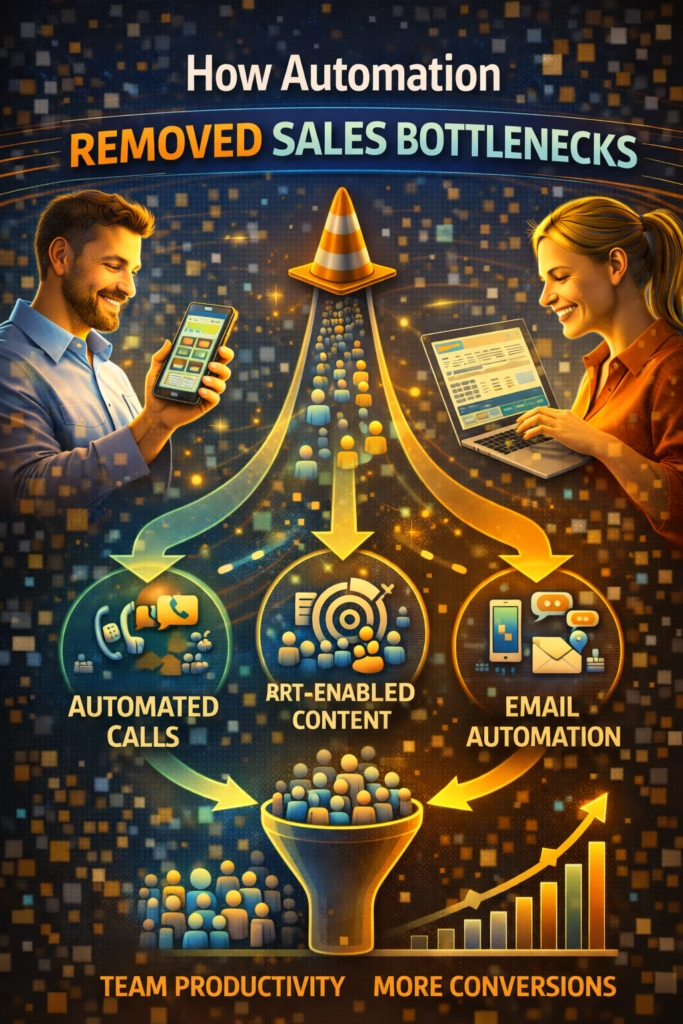
How Automation Removed Sales Bottlenecks

ChatGPT Image Feb 17 2026 02 01 59 PM
How Automation Removed Sales Bottlenecks

How Automation Removed Sales Bottlenecks

How Automation Removed Sales Bottlenecks is the system for turning inbound interest into booked next steps—without missed leads, slow replies, or inconsistent follow-up.

Bottleneck Removal Stack: Speed-to-Lead Routing Qualification Follow-Up Pipeline Reporting

Note: This is general guidance. Confirm compliance with platform policies, privacy rules, and consent requirements before automating messaging or outreach.

Introduction

How Automation Removed Sales Bottlenecks starts with an uncomfortable truth: most “sales problems” are actually process problems.

Leads don’t stop converting because they aren’t interested. They stop converting because the system fails them:

  • They wait hours for a response
  • They never get a follow-up
  • They get routed to the wrong person
  • They’re forced through friction (forms, long calls, unclear next steps)
  • No one owns the lead, so it falls through the cracks

Automation fixes these bottlenecks by making your best process happen every time.

Big idea: Automation doesn’t “make sales.” It removes the friction that kills sales.

Expanded Table of Contents

1) The 7 most common sales bottlenecks

Most businesses experience the same bottlenecks—regardless of industry.

1) Slow response time

Leads go cold fast. If response time is slow, conversion collapses.

2) Missed leads

Messages arrive after hours, during busy shifts, or to the wrong inbox.

3) Inconsistent follow-up

Most buyers need more than one touch to move forward.

4) Manual qualification

Sales time gets wasted answering the same questions repeatedly.

5) No pipeline ownership

If no one owns the lead, no one closes it.

6) Unclear next steps

Even interested leads stall when the process is vague.

7) No feedback loop

Without KPIs, teams can’t tell what’s working or breaking.

Rule: Fix bottlenecks before buying more traffic. Otherwise you just pay to leak leads faster.

2) How to diagnose bottlenecks in 30 minutes

You can identify where sales break down quickly by checking four numbers:

MetricWhat to checkWhat it indicates
Median response timeAverage time to first replySpeed-to-lead bottleneck
Lead-to-qualify rate% that provide city/timeline/budgetScript + clarity issues
Qualify-to-booked rate% that schedule next stepOffer/options issues
Booked-to-close rate% that buy/commitProcess/trust/value issues

Pro move: If response time is the worst number, fix it first. It’s the highest leverage bottleneck.

3) Automation #1: speed-to-lead (instant response)

Speed-to-lead is the conversion multiplier. Automation removes the delay by sending an instant first reply and collecting the minimum needed info.

Instant reply (universal)

Yes — I can help ✅
Are you looking to do this today or this week?

What city/zip are you in? I’ll confirm the fastest next step.

Why this works

  • Confirms availability instantly
  • Asks one qualifying question (timeline)
  • Collects location for routing and options

Rule: The first reply is not a pitch. It’s a qualifier + next-step trigger.

4) Automation #2: routing (right person, right time)

Routing automation prevents leads from going to the wrong inbox or being ignored during busy hours.

Common routing rules

  • Route by city/zip (territory-based)
  • Route by product/service category
  • Route by lead urgency (today vs this week)
  • Route by business hours (after-hours queue)

Avoid: “everyone sees everything.” It creates confusion and missed ownership.

5) Automation #3: qualification (protect capacity)

Qualification automation reduces wasted time by collecting the essentials and tagging leads before a human touches them.

Minimum viable qualification (MVQ)

  • Timeline: today / this week / later
  • Location: city/zip
  • Need: what they want (simple label)
  • Budget: optional, depending on industry

One-question qualifier (copy/paste)

Perfect ✅ What city are you in, and are you looking to do this today or this week?

Pro move: Route “today” leads to fastest-response coverage first.

6) Automation #4: follow-up SOP (recover revenue)

Most sales teams lose the majority of leads to silence—not rejection. Follow-up automation prevents that.

3-touch follow-up SOP

TimingMessageGoal
20–40 minutesQuick check-in + questionRe-engage
Same dayAvailability + optionsCreate action
Next dayAlternate optionSave lead

Follow-up #1

Quick check-in ✅
Did you still want to move forward?

Tell me your city and whether you want today or this week, and I’ll confirm options.

Follow-up #2

Heads up ✅ We’ve had a few inquiries today.
If you want the fastest option, tell me your city and I’ll confirm availability.

Follow-up #3

Still shopping? ✅
If this isn’t the perfect fit, tell me your budget + timeline and I’ll send a better option.

Rule: Follow-up is not nagging when it offers helpful options.

7) Automation #5: pipeline stages + ownership

Automation becomes powerful when every lead is automatically categorized and assigned.

Pipeline stages

  • New
  • Qualified
  • Options Sent
  • Booked
  • Closed
  • Lost

Ownership rules

  • Every stage has a responsible person
  • Every lead has a next action (and due time)
  • No lead stays “New” for more than X minutes

Avoid: leaving leads unassigned. That’s how automation still “fails.”

8) Automation #6: handoffs and scheduling

Friction kills sales. Scheduling automation turns interest into commitments.

Options-based scheduling (copy/paste)

Perfect ✅ I can do:
• Today: __:__ / __:__
• Tomorrow: __:__ / __:__

Which works best? And what city are you in?

Confirmation message

Booked ✅
You’re set for (day/time). If anything changes, reply here and we’ll adjust.

Rule: “Book the next step” is the moment your conversion becomes real.

9) Automation #7: reporting and KPI feedback loops

Reporting automation creates a weekly feedback loop so the system improves instead of drifting.

Weekly KPI snapshot

[ ] # of inbound leads
[ ] Median response time
[ ] % qualified
[ ] % booked
[ ] % closed
[ ] Top 3 sources
[ ] Top 3 bottlenecks observed

Pro move: If response time or booked rate slips, fix ops before scaling traffic.

10) Copy/paste scripts and templates

Universal first reply

Yes — I can help ✅
Are you looking to do this today or this week?
What city/zip are you in?

“What’s the price?” reply

Yep ✅ It’s $___.
Are you looking for today or this week—and what city are you in?

“Lowest price?” reply

I can help ✅
Is your priority the lowest price or the best overall value?
Tell me your city + timeline and I’ll send the best match.

Close to booking

Perfect ✅
Would you rather do today or tomorrow? I can send two time options.

11) KPIs to prove bottlenecks are gone

KPITargetWhy it matters
Median response time< 5 min (good), < 1 min (best)Highest leverage conversion lever
Qualified rateRising trend weeklyProof scripts are working
Booked rateRising trend weeklyDemand capture strength
Lead leakage (unanswered)Near zeroAutomation is doing its job
Close rateStable or risingRevenue impact

Truth: Automation wins when it makes your best process happen every time.

12) 30–60–90 day rollout plan

Days 1–30 (Eliminate the biggest leak: speed + follow-up)

  1. Deploy instant replies with MVQ questions
  2. Implement 3-touch follow-up SOP
  3. Create routing rules (city/zip + urgency)
  4. Track response time + booked rate weekly

Days 31–60 (Standardize qualification + pipeline)

  1. Implement pipeline stages with ownership
  2. Add tags (urgency, budget, category)
  3. Build options-based scheduling templates
  4. Reduce manual repetitive Q&A with scripted replies

Days 61–90 (Scale responsibly + optimize)

  1. Expand volume once lead leakage is near zero
  2. Optimize weekly based on KPI trends
  3. Improve proof and offer clarity to raise close rate
  4. Strengthen coverage for peak inquiry windows

13) 25 Frequently Asked Questions

1) What sales bottlenecks does automation remove first?

Slow response time, missed leads, and inconsistent follow-up.

2) Does automation replace sales people?

No. It replaces repetitive tasks and improves consistency so sales people can focus on closing.

3) What is speed-to-lead automation?

Instant responses that confirm availability and collect key info immediately.

4) Why do leads go cold?

Slow replies and unclear next steps cause buyers to choose someone else.

5) What is lead routing?

Automatically sending leads to the correct person based on rules like city, urgency, or category.

6) What is MVQ?

Minimum viable qualification: timeline, location, and need.

7) How many follow-ups should I send?

Three touches is a strong baseline.

8) Is follow-up annoying?

Not when it’s helpful and offers options.

9) What is lead leakage?

Leads lost due to no reply, no follow-up, or no owner.

10) What pipeline stages should I use?

New, Qualified, Options Sent, Booked, Closed, Lost.

11) What’s the most important KPI?

Median response time is often the highest leverage metric.

12) How do I improve booked rate?

Use options-based scheduling and make the next step obvious.

13) How do I handle “lowest price?”

Use a value vs budget question and offer options.

14) Can automation increase close rate?

Yes—by improving speed, consistency, and follow-up.

15) What should the first reply include?

Availability + one qualifying question + a next step.

16) What’s the biggest automation mistake?

Automating before fixing clarity and ownership.

17) Do I need a CRM?

Not required, but pipeline tracking is essential.

18) What if my team is small?

Automation helps the most when capacity is limited.

19) How do I know automation works?

Response time drops, booked rate rises, lead leakage falls.

20) What’s the fastest win I can do today?

Deploy instant replies and a 3-touch follow-up SOP.

21) Can automation work across industries?

Yes—the systems are universal, the scripts change by niche.

22) What should not be automated?

Claims you can’t verify, misleading offers, or spam duplication.

23) How long until results?

Often immediate improvements in response and follow-up; compounding results in 60–90 days.

24) What if leads come in after hours?

Use after-hours automation to acknowledge and queue for morning routing.

25) What’s the goal of automation?

To remove friction, reduce lead leakage, and make conversion predictable.

14) 25 Extra Keywords

  1. How Automation Removed Sales Bottlenecks
  2. sales bottlenecks automation
  3. automation for sales
  4. speed to lead automation
  5. instant reply automation
  6. automated lead routing
  7. lead qualification automation
  8. automated follow up SOP
  9. reduce lead leakage
  10. pipeline stages automation
  11. sales pipeline automation
  12. booked appointment automation
  13. options based scheduling
  14. sales conversion systems
  15. predictable sales system
  16. sales process automation
  17. messaging funnel automation
  18. CRM workflow automation
  19. lead management automation
  20. after hours lead response
  21. sales KPI reporting
  22. median response time improvement
  23. follow up message templates
  24. 30 60 90 day rollout plan
  25. automation improves close rate

© 2026 Your Brand. All Rights Reserved.
General information only—confirm compliance with platform policies and applicable privacy rules before automating messaging or outreach.

How Automation Removed Sales Bottlenecks Read More »

Replacing Outreach With Inbound Demand

ChatGPT Image Feb 17 2026 02 01 53 PM
Replacing Outreach With Inbound Demand

Replacing Outreach With Inbound Demand

Replacing Outreach With Inbound Demand is the blueprint for going from chasing prospects to attracting qualified inbound—through demand capture, surface area, proof, offer clarity, speed-to-lead, and follow-up systems.

Inbound Demand Stack: Capture Surface Area Proof Offer Clarity Speed Follow-Up

Note: This is general guidance. Keep claims accurate, avoid spam/duplicate behavior, and follow platform policies and applicable privacy/consent rules.

Introduction

Replacing Outreach With Inbound Demand is not a motivational idea—it’s an operational shift.

Outreach is linear: send more messages, get more conversations. Stop sending, pipeline slows.

Inbound is compounding: build visibility and trust assets once, then benefit repeatedly as prospects find you at the exact moment they’re already looking.

The businesses that successfully replaced outreach didn’t “get lucky.” They built a system that created inbound predictably:

  • They captured demand where intent already exists
  • They increased surface area with consistent posting and variations
  • They built trust with proof assets
  • They simplified the offer so buyers understood it instantly
  • They responded fast and followed up consistently

Big idea: Inbound replaces outreach when you build enough entry points and convert inquiries with speed and discipline.

Expanded Table of Contents

1) Why outreach breaks at scale

Outreach “works” until it consumes your calendar and becomes fragile. It breaks for three reasons:

1) It resets daily

No messages today? No pipeline tomorrow. There’s no compounding visibility.

2) It’s attention-expensive

Manual prospecting steals time from delivery and proof collection (which drive inbound).

3) It scales with effort

To double conversations, you usually have to double activity—unless you shift to inbound.

4) It creates burnout

Chasing leads daily is emotionally exhausting and inconsistent across team members.

Pro move: Use outreach strategically while inbound ramps, then reduce outreach as inbound stabilizes.

2) Demand capture vs demand creation

Inbound demand has two sides. If you only do one, results stall.

TypeWhat it targetsExamplesWhy it matters
Demand captureExisting intentMarketplaces, local search, “near me” queriesFastest path to inbound
Demand creationTrust and awarenessProof stories, short-form content, case studiesMakes you the default choice

Rule: Capture gets you messages. Creation gets you better conversion and higher quality leads.

3) The inbound channels that replace outreach fastest

When you want to reduce outreach quickly, focus on channels where buyers already browse with intent.

High-intent inbound channels

  • Marketplaces: low-friction tap-to-message behavior
  • Local search: “I need this now” mindset
  • Social discovery: proof-driven conversion
  • Referral loops: trust transfer

Pro move: Build a “minimum viable inbound stack” on 1–2 channels first. Add more only after conversion is stable.

4) Surface area: the inbound multiplier

Surface area is the number of quality entry points you create across buyer intents. More surface area means more inbound without more outreach.

Surface area is built by

  • Multiple angles for the same offer
  • Multiple proof assets and stories
  • Multiple titles and hooks for different buyer mindsets
  • Multiple formats (listing, post, short clip, proof image)

Example surface area map

IntentAngleWhat it attracts
Value“Best value option”Price shoppers
Premium“Upgraded / higher-end”Quality buyers
Urgency“Available today/this week”Immediate buyers
Trust“Real proof + transparent details”Skeptical buyers
Convenience“Fast delivery / easy process”Busy buyers
Payments“Budget-friendly payments”Monthly shoppers

Rule: If you want more inbound, don’t just post “more.” Post more variety.

5) Proof assets: trust that converts

Outbound can “push” people into conversation. Inbound requires trust. Proof reduces doubt instantly.

Proof system checklist

  1. Clean hero image (bright, clear)
  2. Multiple angles (coverage)
  3. Close-ups (details/condition/results)
  4. Context photo (professional environment)
  5. Transparent notes (availability, timelines, terms)

Pro move: Add one “trust line” in every post: “Tell me your city and timeline and I’ll confirm the best option.”

6) Offer clarity that triggers inbound messages

Inbound demand increases when the offer is instantly understandable and easy to act on.

Offer clarity rules

  • One clear price (or truthful range)
  • One clear next step (pickup/delivery/appointment)
  • One credibility line (proof, transparency, availability)
  • One question that moves the lead forward

Offer block (copy/paste)

✅ Price: $____
✅ Available: (today/this week)
✅ Options: (pickup / delivery / appointment)
✅ Reply with your city + timeline for fastest options

Avoid: hidden conditions, bait pricing, or confusing “DM for price” behaviors that reduce trust and inbound conversion.

7) Cadence: the daily rhythm that compounds

Inbound replaces outreach when cadence becomes habitual. Cadence is the behavior platforms reward—and buyers notice.

Cadence model

  • Daily: publish or refresh a set number of assets
  • Weekly: optimize winners (new first image + title variation)
  • Monthly: retire weak assets and replace with fresh angles

Rule: Don’t batch post and disappear. Inbound systems require presence.

8) Speed-to-lead: convert inbound before competitors

Inbound demand creates messages. Speed-to-lead turns messages into booked next steps.

Instant reply (universal)

Yes — got your message ✅
Quick question so I can help fast:
What city/zip are you in, and is this for today or this week?

Why speed matters

  • Inbound leads are time-sensitive
  • Buyers message multiple options
  • Fast response feels professional and reliable

Pro move: Build for “under 5 minutes” median response time. Under 1 minute is elite.

9) Follow-up SOP: where the hidden revenue lives

Outbound often “forces” multiple touches. Inbound requires follow-up to recover ghosts and increase conversion.

3-touch follow-up sequence

TimingMessageGoal
20–40 minQuick check-in + questionRe-engage
Same dayAvailability + optionsCreate action
Next dayAlternate matchSave the lead

Follow-up #1

Quick check-in ✅
Did you still want this?

Reply with your city + today/this week and I’ll confirm options.

Follow-up #2

Heads up ✅ We’ve had a few people asking today.
If you want it, reply with your city and I’ll confirm the fastest next step.

Follow-up #3

Still shopping? ✅
If this isn’t perfect, tell me your budget + must-haves and I’ll send the best match.

Important: Keep follow-ups helpful and compliant. Respect opt-outs and platform messaging rules.

10) Pipeline + tracking: prevent lead leakage

Inbound systems fail when leads aren’t tracked. Outreach “feels productive,” but inbound requires clean pipeline discipline.

Pipeline stages

  • New → inquiry received
  • Qualified → city + timeline captured
  • Options sent → offer and next step delivered
  • Booked → appointment/pickup/delivery scheduled
  • Closed → completed
  • Lost → no response after SOP

Weekly tracking checklist

[ ] inbound inquiries by channel
[ ] median response time
[ ] qualification rate
[ ] booked next steps
[ ] close rate
[ ] top angles by bookings

Pro move: Don’t measure “leads.” Measure “booked next steps.” That’s what replaces outreach.

11) KPIs that prove inbound is replacing outreach

KPIWhat it meansTarget direction
Inbound inquiries/weekDemand capture workingUp
Median response timeConversion speedDown
Qualification rateLead handling qualityUp
Booked next stepsPipeline strengthUp
Outreach hours/weekDependence on chasingDown

Truth: Inbound replaces outreach when booked next steps become stable enough that outreach becomes optional.

12) 30–60–90 day rollout plan

Days 1–30 (Build the inbound foundation)

  1. Pick 1–2 demand capture channels
  2. Build 30–50 assets with 5–7 angles
  3. Implement instant replies + qualification
  4. Deploy 3-touch follow-up SOP
  5. Track response time + booked next steps weekly

Days 31–60 (Improve conversion)

  1. Increase proof assets and clarity
  2. Replicate winners with variations
  3. Standardize pipeline for team use
  4. Reduce outreach volume where inbound is strong

Days 61–90 (Scale and reduce outreach dependence)

  1. Increase surface area responsibly
  2. Retire weak angles, double down on winners
  3. Automate reporting and weekly optimization
  4. Shift outreach to targeted, high-value only

Outcome: Outbound becomes targeted. Inbound becomes primary.

13) 25 Frequently Asked Questions

1) What does it mean to replace outreach with inbound demand?

It means building systems that attract qualified inbound consistently instead of manually chasing prospects daily.

2) Why do outreach-heavy businesses feel stuck?

Because outreach is linear and resets daily; inbound compounds over time.

3) Can inbound fully replace outreach?

Sometimes. Often it becomes the primary driver while outreach becomes targeted and occasional.

4) What is inbound demand generation?

Creating incoming interest through demand capture channels and trust-building content.

5) Demand capture vs demand creation?

Capture targets existing intent; creation builds awareness and trust.

6) Which channels replace outreach fastest?

Marketplaces, local search, proof content, and fast messaging systems.

7) What’s the fastest inbound lever?

Surface area + consistent posting + instant replies + follow-up.

8) What is surface area?

More quality entry points across buyer intents, keywords, and angles.

9) Why does proof matter?

Proof reduces skepticism and improves conversion.

10) What is offer clarity?

Clear price, options, and next step that buyers understand instantly.

11) How important is response time?

Critical. Fast response wins the inbox.

12) What is speed-to-lead?

How quickly you respond after a lead messages you.

13) Best first message?

Confirm, then ask city/zip and timeline.

14) Why do inbound leads ghost?

They message multiple options; slow replies and no follow-up lose them.

15) How many follow-ups?

Three touches is a strong baseline.

16) How does automation help?

It maintains speed and consistency across replies, follow-up, tagging, and reporting.

17) KPI that shows inbound is replacing outreach?

Booked next steps per week.

18) How do I build inbound without ads?

Consistent posting, proof assets, clear offers, local optimization, fast replies, follow-up.

19) Biggest mistake going inbound?

Inconsistent posting or scaling volume without proof and follow-up.

20) How do I avoid flags?

Rotate variations, avoid duplicates, keep details accurate, follow policies.

21) How long does it take?

Signals in 2–4 weeks; replacing most outreach often takes 60–120 days.

22) Do I still need a sales process?

Yes. Inbound increases volume; pipeline and scripts convert it.

23) Simplest inbound pipeline?

New → Qualified → Options Sent → Booked → Closed → Lost.

24) How do I increase lead quality?

Better proof, clearer offer, and a short qualification question.

25) Core takeaway?

Inbound replaces outreach when you build surface area + trust, then convert with speed and follow-up consistently.

14) 25 Extra Keywords

  1. Replacing Outreach With Inbound Demand
  2. replace outreach with inbound
  3. inbound demand generation
  4. inbound lead system
  5. organic demand creation
  6. lead engine without outreach
  7. inbound marketing system
  8. demand capture strategy
  9. demand creation content
  10. marketplace inbound leads
  11. local SEO inbound demand
  12. content surface area strategy
  13. proof assets for inbound
  14. offer clarity for leads
  15. speed to lead inbound
  16. instant reply scripts
  17. follow up SOP leads
  18. reduce lead leakage
  19. appointment booking inbound
  20. pipeline tracking system
  21. booked next steps KPI
  22. predictable inbound leads
  23. how to generate inbound demand
  24. organic lead generation 2026
  25. compounding visibility system

© 2026 Your Brand. All Rights Reserved.
General information only—confirm compliance with platform policies and applicable privacy/consent rules before automating messaging. Avoid spam/duplicate content and keep all claims accurate.

Replacing Outreach With Inbound Demand Read More »

How Consistent Posting Transformed Lead Volume

ChatGPT Image Feb 17 2026 02 01 55 PM
How Consistent Posting Transformed Lead Volume

How Consistent Posting Transformed Lead Volume

How Consistent Posting Transformed Lead Volume is the blueprint for turning posting into predictable inbound—through cadence, variety, proof, clear offers, fast replies, and follow-up.

Consistency Engine: Cadence Surface Area Variations Proof Speed Follow-Up

Note: This is general guidance. Keep content accurate, rotate responsibly, and follow platform rules to avoid spam/duplicate issues.

Introduction

How Consistent Posting Transformed Lead Volume starts with a simple truth: most businesses don’t lose because they “aren’t good.” They lose because they aren’t visible often enough.

Visibility is not a one-time event. It’s a rhythm. And on marketplaces, social feeds, and local discovery channels, rhythm is rewarded.

But posting more is not the same as posting smarter. The businesses that transformed lead volume didn’t spam duplicates. They built a repeatable system:

  • Cadence they could sustain
  • Surface area across buyer intents
  • Proof assets that built trust
  • Clear offers that triggered messages
  • Fast replies and follow-up to prevent leakage

Big idea: Consistent posting is the engine. Speed + follow-up is the converter. Together, they transform lead volume into revenue.

Expanded Table of Contents

1) Why consistency wins in modern platforms

Most platforms reward activity because activity signals freshness. Freshness improves distribution, which improves visibility, which improves inbound.

Consistency produces three advantages

1) Compounding visibility

Every post is another doorway. More doorways = more chances for buyers to enter.

2) Buyer repetition

People rarely buy on first view. Consistency creates repeated exposure and trust.

3) Data to optimize

Without a steady cadence, you can’t learn what works. Consistency creates feedback.

4) Momentum

Inboxes get warmer when platforms see steady engagement and responsiveness.

Pro move: Consistency isn’t about more work—it’s about predictable rhythm.

2) Cadence: the rhythm that compounds

A cadence is the schedule you can sustain while maintaining quality and variety.

Simple cadence model

  • Daily: post or refresh a set number of assets
  • Weekly: optimize winners (new first image + title variations)
  • Monthly: retire stale assets and replace with fresh angles

Why “daily” works

  • Keeps content fresh
  • Creates more buyer touchpoints
  • Builds a habit that compounds

Rule: The best cadence is the one you can keep for 90 days straight.

3) Surface area strategy: volume + variety

Posting more of the same is noise. Posting variety across buyer intents is surface area.

Surface area means

  • Multiple angles for the same offer
  • Multiple price points or options (when truthful)
  • Multiple proof assets and stories
  • Multiple “entry” titles and hooks

Surface area map (examples)

Buyer intentAngle to postWhat it catches
Value“Best value option”Deal shoppers
Premium“Upgraded / premium fit”Higher-ticket buyers
Urgency“Available today / this week”Immediate buyers
Trust“Proof photos / transparent details”Skeptical buyers
Convenience“Fast delivery / easy process”Time-poor buyers
Payments“Budget-friendly payments”Monthly shoppers

Pro move: If you want more leads, don’t just add posts—add angles.

4) Variation framework: post more without repeating

Consistency requires variety. Variety prevents fatigue and reduces risk of duplicate/spam issues.

The 5-lever variation system

  1. Title: change the hook and intent (“budget,” “premium,” “today,” “best fit”)
  2. First image: rotate the hero photo (most important lever)
  3. Angle: focus on different benefits or objections
  4. Offer block: change the order of details (price → availability → options)
  5. CTA question: end with a different qualifying question

Variation titles (examples)

Value: “Best Value Option — Available This Week”
Urgency: “Available Today — Quick Next Step”
Trust: “Real Photos + Clear Details — No Guesswork”
Premium: “Upgraded Option — Built for Comfort/Quality”
Convenience: “Easy Process — Fast Options in Your Area”
Payments: “Budget-Friendly Payments — Ask for Options”

Rule: Rotate variety, keep truth consistent. Never change facts to force variation.

5) Proof assets: the trust layer that converts

Consistency brings eyes. Proof converts eyes into messages. Proof also reduces suspicion and “is this legit?” friction.

Proof checklist

  1. Bright, clean hero photo
  2. Multiple angles (coverage)
  3. Close-ups that show condition/details
  4. Context photo (clean workspace/store/brand presence)
  5. Transparent notes (availability, timelines, terms)

Pro move: Add one trust line in every post: “Tell me your city and timeline—I’ll confirm the best option.”

6) Offer clarity that triggers inbound messages

Posting volume without clarity creates clicks that don’t convert. Clear offers trigger messages.

Offer clarity rules

  • Clear price (or truthful range)
  • Clear availability (today/this week/lead time)
  • Clear next step (pickup/delivery/appointment)
  • Clear question (city + timeline)

Offer block (copy/paste)

✅ Price: $____
✅ Available: (today/this week)
✅ Options: (pickup / delivery / appointment)
✅ Reply with your city + timeline for fastest options

Avoid: bait pricing, hidden conditions, or confusing “DM for price” setups that reduce trust.

7) Distribution: where consistent posting matters most

Consistency works best where buyer intent is already high and discovery favors freshness.

ChannelWhy cadence mattersBest cadence style
MarketplacesFreshness + active inventory visibilityDaily post/refresh variations
Social feedsAlgorithm rewards engagement + consistency3–7 posts/week + stories
Local searchTrust signals and activity improve conversionWeekly proof posts + reviews
Short videoVolume increases discovery and tests angles3–10 clips/week

Rule: Post where your buyers already browse. Consistency matters more than being everywhere.

8) Speed-to-lead: convert the inbound you earned

Posting increases inbound. If you reply late, you waste the effort. Speed-to-lead is the conversion multiplier.

Instant reply (universal)

Yes — it’s available ✅
Quick question so I can help fast:
What city/zip are you in, and is this for today or this week?

Why this matters

  • Faster replies win competitive inboxes
  • Asks a question (keeps conversation moving)
  • Captures intent for better matching

Pro move: Don’t measure “messages.” Measure “booked next steps.”

9) Follow-up SOP: recover ghosts

Consistency generates leads. Follow-up monetizes them. The difference between average and elite is follow-up discipline.

3-touch follow-up sequence

TimingMessageGoal
20–40 minQuick check-in + questionRe-engage
Same dayAvailability + optionsCreate action
Next dayAlternate optionSave the lead

Follow-up #1

Quick check-in ✅
Did you still want this?

Reply with your city + today/this week and I’ll confirm options.

Follow-up #2

Heads up ✅ We’ve had a few people asking today.
If you want it, reply with your city and I’ll confirm the fastest next step.

Follow-up #3

Still shopping? ✅
If this isn’t perfect, tell me your budget + must-haves and I’ll send the best match.

Important: Keep follow-ups helpful and compliant. Respect opt-outs and platform messaging rules.

10) Tracking + optimization: make posting predictable

Consistency without tracking is just effort. Tracking turns posting into a predictable system.

Weekly tracking checklist

[ ] # of active posts/listings (surface area)
[ ] inbound messages
[ ] median response time
[ ] qualification rate (city + timeline captured)
[ ] booked next steps
[ ] close rate
[ ] top 5 angles by bookings

Optimization rule

Every week:

  • Duplicate winners with new first images + title variations
  • Retire weak angles
  • Improve proof assets and offer clarity

Pro move: Improve “bookings per post,” not just “posts per week.”

11) KPIs that prove the system is working

KPIWhat it measuresTarget direction
Active assetsSurface areaUp (responsibly)
Inbound messages/weekLead flowUp
Median response timeConversion speedDown
Booked next stepsCommitmentUp
Close rateRevenue efficiencyUp

Truth: If bookings rise while post volume stays steady, your cadence system is maturing.

12) 30–60–90 day rollout plan

Days 1–30 (Build the posting engine)

  1. Choose a sustainable cadence (daily or 3–7x/week)
  2. Create 5–7 posting angles for your offer
  3. Build 30–50 assets/listings with variation
  4. Implement instant replies + one-question qualification
  5. Track inbound + response time weekly

Days 31–60 (Convert more of the same inbound)

  1. Identify winners by booked next steps
  2. Refresh winners with new first images + titles
  3. Implement 3-touch follow-up SOP
  4. Improve proof assets and offer clarity

Days 61–90 (Scale responsibly)

  1. Increase surface area with more variety
  2. Retire stale/weak angles monthly
  3. Optimize scripts from objections and lost reasons
  4. Measure bookings per post and improve weekly

Outcome: Consistent posting becomes predictable inbound—then speed and follow-up turn it into revenue.

13) 25 Frequently Asked Questions

1) Why does consistent posting increase lead volume?

It increases visibility surface area, builds trust through repetition, and improves platform freshness signals.

2) What is a posting cadence?

A repeatable schedule for posting and refreshing content.

3) Is consistency more important than viral posts?

Usually, yes—consistency builds compounding inbound reliably.

4) What is surface area?

The number of quality assets you have across buyer intents and angles.

5) How do I post more without repeating?

Rotate titles, first images, angles, offer blocks, and CTA questions while keeping details accurate.

6) What content converts best?

Proof-based content with clear offers and a simple next step.

7) Does consistent posting work without ads?

Yes—especially on marketplaces, social feeds, and local discovery.

8) How often should I post?

Daily or several times per week—choose what you can sustain.

9) Why do consistent posters win on marketplaces?

Freshness and activity improve visibility and buyer touchpoints.

10) What is refreshing?

Updating titles, first images, or details to keep content current and re-trigger distribution responsibly.

11) How does speed-to-lead relate?

More inbound requires fast replies to convert into bookings and revenue.

12) What’s the best instant reply?

Confirm, then ask city/zip and timeline.

13) Why do leads ghost?

They message multiple sellers; slow replies and no follow-up lose them.

14) How many follow-ups should I send?

Three touches is a strong baseline.

15) What KPI best measures success?

Booked next steps.

16) What posting mistakes kill results?

Inconsistency, duplicates, unclear offers, weak proof, slow response, no follow-up.

17) How do I avoid flags?

Rotate variety, avoid duplicates, keep details accurate, follow rules.

18) Should I use stock photos?

Real photos generally convert better and build trust.

19) What angles should I rotate?

Value, premium, urgency, trust, payments, bundles, and convenience.

20) How long until results show?

Signals often appear in 2–4 weeks; compounding results over 60–90 days.

21) Can consistency replace paid ads?

Sometimes; often it reduces dependency and makes ads optional.

22) What should I track weekly?

Assets, inbound, response time, qualification rate, bookings, closes, and top angles.

23) What’s a simple weekly posting system?

Daily post/refresh + weekly optimize winners + monthly retire/replace stale posts.

24) How do I scale across multiple locations?

Create accurate city variations and rotate proof assets per location.

25) What’s the core takeaway?

Consistency builds inbound; speed and follow-up turn it into predictable revenue.

14) 25 Extra Keywords

  1. How Consistent Posting Transformed Lead Volume
  2. consistent posting lead volume
  3. posting cadence strategy
  4. consistent posting system
  5. surface area marketing strategy
  6. marketplace posting for leads
  7. social posting for leads
  8. organic lead generation posting
  9. refresh listing strategy
  10. content variation framework
  11. proof-based marketing content
  12. offer clarity for inbound leads
  13. instant reply scripts
  14. follow up SOP leads
  15. reduce lead ghosting
  16. pipeline tracking for leads
  17. booked next steps KPI
  18. compounding visibility strategy
  19. how to increase inbound messages
  20. consistent marketing execution
  21. organic marketing system 2026
  22. posting schedule for businesses
  23. content cadence for growth
  24. marketplace lead engine
  25. predictable lead flow without ads

© 2026 Your Brand. All Rights Reserved.
General information only—confirm compliance with platform policies and applicable privacy rules before messaging leads. Avoid spam/duplicate content and keep posts accurate.

How Consistent Posting Transformed Lead Volume Read More »

How AI Changes Buyer Behavior

ChatGPT Image Feb 16 2026 02 59 13 PM
How AI Changes Buyer Behavior

How AI Changes Buyer Behavior

How AI Changes Buyer Behavior is the new reality of buying—faster discovery, more comparison, higher expectations, and messaging-based decisions.

AI Buyer Shift: AI-Assisted Discovery Faster Comparison Instant Expectations Messaging Funnels Proof Signals Personalization

Note: This is general guidance. Use AI responsibly, keep offers accurate, and stay compliant with platform policies when automating any messaging or posting.

Introduction

How AI Changes Buyer Behavior can be summed up in one sentence: buyers now move faster than your old process.

AI didn’t just add a new marketing channel. It changed how people decide. Buyers can now discover options, compare prices, read opinions, and draft questions instantly—often without ever visiting a website.

That means the “real funnel” happens in the first 30 seconds of discovery, not after a form fill.

Big idea: AI reduces friction for buyers, which raises expectations for sellers.

Expanded Table of Contents

1) The new AI-driven buyer journey

In many industries, the classic journey was linear: ad → website → form → call → close. AI made the journey non-linear and faster.

What the AI buyer journey looks like now

  1. Instant discovery: buyers find options via AI-assisted search, marketplaces, short-form social, and reviews.
  2. Rapid validation: they scan proof signals (photos, specifics, credibility, transparency).
  3. Fast messaging: they send multiple inquiries to compare speed, clarity, and availability.
  4. Decision by response: whoever responds fastest with the clearest next step often wins.

Translation: Buyers are testing your operational competence in the first message.

2) AI accelerates discovery (where buyers start now)

AI changes discovery by reducing the work required to explore options. Buyers can ask AI to:

  • Summarize choices by budget, features, or location
  • Generate comparison questions to ask sellers
  • Identify “best value” options
  • Find alternatives instantly

What this means for businesses

  • Visibility must be everywhere buyers look (marketplaces, social, search)
  • Listings and pages must be specific and structured
  • Proof content must be obvious at a glance

Rule: In the AI era, vague marketing disappears. Specificity wins.

3) AI increases comparison (why buyers shop harder)

AI doesn’t make buyers less serious—it makes them more informed. That increases comparison behavior:

  • More vendors get contacted
  • Buyers ask smarter questions
  • They expect clear answers and fast confirmation

The new comparison battleground

What buyers compareWhat they inferHow to win
Response timeReliabilityInstant replies + routing
Clarity of offerTrustSimple price + next step
Proof signalsLegitimacyReal photos, specifics
AvailabilityConvenienceOptions-based scheduling

Avoid: long explanations before asking the next-step question. Buyers will move on.

4) AI changes trust signals (what buyers believe)

AI didn’t eliminate scams—it made buyers more suspicious. That means trust signals matter more than ever.

New trust signals buyers look for

  • Real photos that show context (not just stock images)
  • Specific details (dimensions, condition, availability windows)
  • Transparent pricing and terms
  • Consistent branding (same name, same messaging, same proof)
  • Professional communication and fast replies

Rule: Proof beats persuasion.

5) AI raises speed expectations (instant is the baseline)

When AI gives buyers instant answers, they expect sellers to respond quickly too. Slow response feels like:

  • “They’re not serious.”
  • “They’re unreliable.”
  • “This isn’t real.”

Instant reply (universal)

Yes — I can help ✅
Are you looking to do this today or this week?

What city/zip are you in? I’ll confirm the fastest next step.

Pro move: Your first message should ask one question that qualifies timeline + location.

6) Chat-based buying (the new conversion pathway)

AI is pushing conversion into messaging. Buyers prefer fast, low-friction chats over forms and calls.

Why messaging converts in the AI era

  • Instant back-and-forth
  • Easy to compare sellers
  • Easy to ask “one last question”
  • Feels lower commitment than a call

The messaging funnel (simple)

Message → Qualify → Offer Options → Book Next Step → Confirm → Close

Rule: If you don’t have a messaging funnel, you don’t have a funnel.

7) Personalization and the “option menu” effect

AI makes buyers expect “options.” They don’t want one pitch—they want the best match for their context.

How to personalize without overworking

  • Create 3 option categories: Budget, Best Value, Premium
  • Ask one qualifier question
  • Respond with a simple option menu

Option menu reply (copy/paste)

Got it ✅ Based on what you said, here are 3 options:
A) Budget: $___ (fastest availability)
B) Best Value: $___ (most popular)
C) Premium: $___ (best upgrade)

Which one fits best—and what city are you in?

Pro move: Options reduce decision friction and increase bookings.

8) Price transparency and new negotiation behavior

AI makes pricing easier to compare. Buyers will ask:

  • “Is this the best price?”
  • “What’s included?”
  • “Can you do it sooner?”

How to handle “lowest price?”

I can help ✅
Is your priority the lowest price, or the best overall value/quality?

Tell me your city and timeline (today/this week) and I’ll send the best match.

Avoid: negotiating in circles. Move to options and next steps.

9) Content that wins in the AI era

AI-driven buyers respond to content that is:

  • Specific (details, numbers, real photos)
  • Structured (easy to scan, easy to understand)
  • Proof-led (trust signals are obvious)
  • Next-step focused (clear CTA)

High-performing content structure

Hook → Proof → Price/Offer → Availability → CTA (city + timeline)

Rule: If a buyer can’t understand the offer in 10 seconds, they keep scrolling.

10) The demand capture systems businesses need now

To adapt to AI-driven buyer behavior, you need systems that keep up with speed and volume.

Core systems

  • Speed-to-lead: instant replies + routing
  • Qualification: one-question filter + tags
  • Follow-up SOP: 3-touch sequence
  • Pipeline: stages + ownership
  • Tracking: response time, booked rate, close rate

Pro move: Most “marketing improvements” fail because the capture system is weak. Fix capture first.

11) KPIs that reveal AI-driven buyer behavior

KPIWhat it revealsTarget
Median response timeSpeed expectations< 5 min good, < 1 min best
Messages/weekDemand capture volumeTrack trend weekly
Qualified rateLead qualityImprove with scripts
Booked rateConversion powerImprove with options
Close rateRevenue impactOptimize offer + follow-up

Rule: Buyers may change behavior—KPIs tell you what’s real in your market.

12) 30–60–90 day rollout plan

Days 1–30 (Fix speed and follow-up)

  1. Deploy instant reply scripts and routing
  2. Implement 3-touch follow-up SOP
  3. Define pipeline stages and ownership
  4. Track response time and booked rate weekly

Days 31–60 (Build proof and option menus)

  1. Standardize proof photos and structured offers
  2. Create 3-tier option menus (budget/value/premium)
  3. Improve titles/descriptions for fast scanning
  4. Increase visibility cadence responsibly

Days 61–90 (Scale visibility + optimize)

  1. Expand surface area (more angles, not duplicates)
  2. Double down on best-performing offers and CTAs
  3. Optimize weekly using KPI trends
  4. Strengthen ops capacity as volume increases

13) 25 Frequently Asked Questions

1) How does AI change buyer behavior?

AI accelerates discovery, increases comparison, raises expectations for instant responses, and shifts more decisions into messaging-based conversations.

2) Are buyers more price-sensitive because of AI?

Often yes, because comparison is faster. But buyers also value speed, clarity, and trust.

3) What do buyers expect now?

Fast replies, clear offers, and proof signals that reduce uncertainty.

4) What is AI-assisted search?

Search behavior where buyers use AI tools to summarize options, compare features, and generate questions.

5) Does AI reduce the need for a website?

Not always, but many decisions happen before a website visit. Proof and messaging matter more.

6) Why is messaging more important now?

Because it’s the lowest-friction way for buyers to compare and move forward.

7) What’s the best first reply?

Confirm availability, ask timeline, ask city, and offer next steps.

8) How fast should I respond?

Under 5 minutes is good; under 1 minute is best.

9) What is “speed-to-lead”?

How quickly you respond to an inquiry.

10) Why does speed-to-lead matter?

Buyers message multiple options. The fastest responder often wins.

11) How do I reduce ghosting?

Use options-based replies and a follow-up SOP.

12) What is a follow-up SOP?

A simple sequence of messages sent at set times to re-engage leads.

13) How many follow-ups should I send?

Three touches is a strong baseline.

14) What is an option menu?

A 3-tier set of choices (budget/value/premium) that reduces decision friction.

15) Does personalization matter more now?

Yes. Buyers expect relevance, not generic pitches.

16) What proof signals matter most?

Real photos, specific details, transparent pricing, and consistent branding.

17) Should I use AI in customer messaging?

It can help with consistency, but keep responses accurate and compliant.

18) What should AI not do?

Spam duplicates, misrepresent offers, or invent details.

19) What’s the biggest mistake businesses make?

Trying to increase traffic without fixing conversion systems.

20) What KPIs matter in the AI era?

Response time, messages, qualified rate, booked rate, close rate.

21) How do I qualify leads faster?

Ask one question that reveals timeline and location.

22) Can AI make buyers more skeptical?

Yes—buyers are more aware of scams and demand more proof.

23) How long until systems show results?

Often weeks for conversion improvements; 60–90 days for compounding outcomes.

24) Does this apply to local services?

Yes—local buyers now discover and message faster than ever.

25) What’s the best next step today?

Deploy instant replies and a 3-touch follow-up SOP.

14) 25 Extra Keywords

  1. How AI Changes Buyer Behavior
  2. AI buyer behavior
  3. AI changes purchasing decisions
  4. AI search behavior
  5. AI assisted search
  6. chat based buying
  7. conversation based selling
  8. AI demand generation
  9. AI demand capture
  10. speed to lead expectations
  11. instant reply scripts
  12. follow up SOP leads
  13. reduce lead ghosting
  14. proof signals marketing
  15. trust signals in listings
  16. personalized offers system
  17. option menu sales script
  18. price transparency behavior
  19. marketplace buyer behavior
  20. social discovery buyer journey
  21. short form content conversion
  22. modern buyer journey 2026
  23. messaging funnel strategy
  24. KPI tracking for conversion
  25. 30 60 90 day rollout plan

© 2026 Your Brand. All Rights Reserved.
General information only—confirm compliance with platform policies and applicable privacy rules before sending marketing messages.

How AI Changes Buyer Behavior Read More »

The Future of Demand Generation Explained

ChatGPT Image Feb 16 2026 02 59 16 PM
The Future of Demand Generation Explained

The Future of Demand Generation Explained

The Future of Demand Generation Explained is the modern demand stack—where always-on visibility meets demand capture systems that convert conversations into booked next steps.

Modern Demand Stack: Always-On Visibility Demand Capture Marketplaces Social Discovery Speed-to-Lead Follow-Up

Note: This is general guidance. Use compliance-first automation, avoid spam duplication, and keep claims accurate across platforms.

Introduction

The Future of Demand Generation Explained starts with a shift in reality: buyers no longer “enter a funnel” the way they used to. They discover you in feeds, listings, reviews, and short-form clips—then they message instantly.

That means demand generation isn’t just about running campaigns. It’s about building an always-on system that does two jobs:

  • Create visibility in the places buyers naturally browse (search, social, marketplaces)
  • Capture demand with speed-to-lead, qualification, follow-up, and pipeline conversion

Big idea: The future belongs to demand systems—not one-off campaigns.

Expanded Table of Contents

1) The buyer behavior shift changing demand gen

Demand generation used to look like: ads → landing page → form → sales call. That still exists, but it’s no longer the dominant buyer path for many categories.

Today, buyers do this instead:

  • Discover options in marketplaces, social feeds, review platforms, and search results
  • Validate quickly by scanning photos, proof, and credibility signals
  • Message instantly to ask availability, price, and timing
  • Choose the fastest, clearest, most trustworthy responder

Pro insight: In the future, “messaging” is the new form-fill.

2) Demand generation vs demand capture (new model)

The future is not either/or. It’s both.

Demand generation

Creating awareness and interest through visibility: content, social, SEO, marketplaces, partnerships.

Demand capture

Converting existing intent into booked next steps: speed-to-lead, qualification, follow-up SOPs, pipeline stages.

Reality: Most businesses leak demand because they don’t have capture systems. They blame “marketing.”

3) The modern demand generation stack

Modern demand gen is a stack of systems that work together. You don’t need all of them on day one—but you need a plan.

LayerWhat it doesExamples
VisibilityCreates discoveryMarketplaces, social clips, SEO pages
TrustReduces skepticismProof photos, reviews, transparent offers
SpeedWins the buyer raceInstant replies, routing
QualificationProtects timeOne-question filters, tags
Follow-upRecovers revenue3-touch SOP, reminders
PipelinePrevents leakageStages, ownership, handoffs
MeasurementEnables optimizationResponse time, booked rate, close rate

Rule: Build the stack from the bottom up: capture systems first, then scale visibility.

4) Why marketplaces are becoming demand engines

Marketplaces are the new “local search” for many categories because they combine three things:

  • High intent: people browse with purchase intent, not just entertainment
  • Instant messaging: the barrier to inquiry is near zero
  • Local relevance: location is built into discovery

How marketplaces create predictable demand

  • More listings = more keyword coverage (visibility surface area)
  • Consistent cadence = sustained freshness and distribution
  • Proof photos + clear offers = higher message rates

Pro move: Marketplaces are a demand layer—your conversion systems determine how much you capture.

5) Why social discovery produces higher-intent conversations

Short-form social creates demand because it compresses trust faster than text. A buyer can see:

  • The product/service in action
  • The environment (proof you’re real)
  • The personality/authority behind the offer

Social demand gen wins when you

  • Lead with a strong hook in the first 1–2 seconds
  • Show proof quickly
  • Make the next step obvious (call, message, book)

Avoid: vague branding clips with no CTA and no proof. Entertainment without capture is expensive.

6) Content engines: building visibility that compounds

The future of demand generation is “always on.” Content engines do that by creating assets that keep working after you post them.

Compounding content principles

  • Template-driven (so publishing is sustainable)
  • Proof-led (so trust improves over time)
  • Cadence-controlled (so visibility doesn’t disappear)
  • Repurposed (one idea becomes multiple assets)

Repurpose map (simple)

Core assetRepurpose intoWhy
1 blog5–10 clips + 10 postsMore surface area
1 product video3 hooks + 3 CTAsMore conversion tests
1 offer5 angles (budget, urgency, premium)Matches different intent

Rule: Content engines create demand; capture systems convert it.

7) Speed-to-lead: the conversion advantage nobody fixes

In the future demand model, the fastest responder often wins—even if they are not the cheapest.

Instant reply (universal)

Yes — I can help ✅
Are you looking to do this today or this week?

What city/zip are you in? I’ll confirm the fastest next step.

Options-based close (books more)

Perfect ✅ I can do:
• Today: __:__ / __:__
• Tomorrow: __:__ / __:__

Which works best? And what city are you in?

Pro move: The first reply’s job is to qualify and book—don’t write an essay.

8) Follow-up systems: recovering lost demand

Ghosting is not rejection. It’s friction, distraction, or decision delay. Follow-up removes friction.

3-touch follow-up SOP

TimingMessageGoal
20–40 minQuick check-in + questionRe-engage
Same dayAvailability + optionsCreate action
Next dayAlternate optionSave lead
Quick check-in ✅
Did you still want to move forward?

Tell me your city and whether you want today or this week, and I’ll confirm options.

Rule: Every follow-up ends with a simple question to move the lead forward.

9) Measurement in the new era: what to track

Demand gen measurement is shifting from “clicks” to “conversations and bookings.”

MetricWhat it measuresWhy it matters
Messages / inquiriesDemand capture volumeShows real intent
Median response timeSpeed-to-leadPredicts conversion
Qualified rateLead qualityProtects capacity
Booked rateNext steps scheduledPredicts revenue
Close rateDeals wonProfit signal

Pro move: Track “booked next steps” weekly. It’s the clearest measure of demand capture performance.

10) AI workflows that scale demand gen responsibly

AI helps demand generation when it increases consistency and speed—without sacrificing accuracy or compliance.

High-impact AI workflows

  • Template-driven content production (titles, descriptions, offers)
  • Auto-variation rules (safe, structured changes)
  • Instant reply scripts and routing
  • Follow-up prompts and reminders
  • Weekly KPI summaries and recommendations

Guardrails: Keep inventory/offers accurate, avoid spam duplication, and ensure any automated messaging is transparent and respectful.

11) 30–60–90 day rollout plan

Days 1–30 (Fix capture systems first)

  1. Deploy instant replies and lead routing
  2. Implement 3-touch follow-up SOP
  3. Define pipeline stages and ownership
  4. Start weekly tracking (messages, response time, booked rate)

Days 31–60 (Build always-on visibility)

  1. Launch cadence on marketplaces and social
  2. Standardize proof-based content templates
  3. Test 3 offer angles (budget/urgency/premium)
  4. Repurpose content into multiple assets

Days 61–90 (Scale and optimize)

  1. Increase surface area while maintaining variation
  2. Double down on top-performing angles and platforms
  3. Strengthen ops capacity (scheduling + SOPs)
  4. Optimize weekly using KPI trends

12) 25 Frequently Asked Questions

1) What is demand generation in 2026?

An always-on system combining visibility (marketplaces, social, SEO, content) with demand capture (speed-to-lead, qualification, follow-up, pipeline conversion).

2) How is demand gen different from lead gen?

Demand gen includes awareness and discovery; lead gen often focuses on capture. Modern systems require both.

3) Why are marketplaces important for demand gen?

They combine high intent, local discovery, and instant messaging.

4) Why are social platforms important?

Short-form content builds trust quickly and triggers direct messages.

5) What’s the biggest demand gen shift?

Messaging and conversation-based conversion replacing form-driven funnels in many categories.

6) What matters more: traffic or conversion?

Conversion first. Fix speed-to-lead and follow-up before scaling traffic.

7) What is demand capture?

Turning existing intent into booked next steps with speed, qualification, and follow-up.

8) What’s the fastest capture improvement?

Instant replies and a follow-up SOP.

9) How fast should I respond?

Under 5 minutes is good; under 1 minute is best.

10) What KPIs matter most?

Messages, response time, booked rate, close rate.

11) Do ads still work?

Yes, but the best outcomes come when ads are part of an always-on system.

12) What is an always-on system?

Cadence-driven visibility paired with consistent capture and follow-up.

13) Why do leads ghost?

They message multiple options. Slow response and no next step causes drop-off.

14) How do I reduce ghosting?

Fast replies, options-based scheduling, and follow-up SOPs.

15) What’s the best first reply script?

Confirm availability, ask timeline, ask city, offer the next step.

16) How do I qualify leads quickly?

Ask one question that reveals timeline and location (or budget/intent).

17) What is “surface area”?

How many assets you have live: listings, posts, pages, and keyword coverage.

18) What is cadence?

A consistent publishing/refresh schedule that maintains visibility.

19) How does content compound?

By staying searchable, shareable, and repurposable over time.

20) What role does AI play?

It increases consistency and speed through templates, variation, routing, and reporting.

21) What should AI not do?

Spam duplicate content or misrepresent offers/inventory.

22) How long until results?

Often weeks for conversion improvements; 60–90 days for compounding demand.

23) Can demand gen work without a website?

Yes, but a website can increase trust and conversions.

24) What’s the best next step today?

Deploy instant replies and a follow-up SOP.

25) What wins in the future?

Always-on visibility plus demand capture systems that book the next step.

13) 25 Extra Keywords

  1. The Future of Demand Generation Explained
  2. future of demand generation
  3. modern demand generation
  4. demand generation systems
  5. demand capture strategy
  6. always on demand generation
  7. marketplace demand generation
  8. social discovery demand gen
  9. short form content lead generation
  10. speed to lead demand capture
  11. instant reply scripts
  12. follow up SOP leads
  13. reduce lead leakage
  14. pipeline conversion system
  15. booked appointment rate
  16. close rate optimization
  17. visibility surface area strategy
  18. posting cadence system
  19. proof based marketing
  20. AI demand generation workflows
  21. conversation based selling
  22. messaging funnel strategy
  23. predictable inbound leads
  24. 30 60 90 day demand plan
  25. demand gen measurement KPIs

© 2026 Your Brand. All Rights Reserved.
General information only—confirm compliance with platform policies and applicable privacy rules before sending marketing messages.

The Future of Demand Generation Explained Read More »

How Businesses Create Momentum With AI

ChatGPT Image Feb 16 2026 02 59 01 PM
How Businesses Create Momentum With AI

How Businesses Create Momentum With AI

How Businesses Create Momentum With AI is the blueprint for turning scattered effort into compounding growth—using AI to increase velocity, reduce lead leakage, strengthen trust, and optimize weekly.

AI Momentum Flywheel: Capture Respond Qualify Book Deliver Publish Proof Optimize

Note: This is general guidance. Keep claims accurate, follow platform policies, and comply with privacy/consent requirements when messaging leads.

Introduction

How Businesses Create Momentum With AI isn’t about replacing people. It’s about replacing friction.

Momentum is what happens when every week builds on the last: more visibility, more trust, faster response, more booked next steps, more proof, and better conversion.

Most businesses lose momentum because they rely on human bandwidth to do repeatable work: posting consistently, replying instantly, following up, tracking, and reporting.

AI fixes the momentum killers: delays, inconsistency, and lead leakage.

Big idea: Momentum is a loop. AI makes the loop faster and more consistent—so it compounds.

Expanded Table of Contents

1) What “momentum” means in business

Momentum is the compounding effect of consistent execution. When momentum exists, results continue even when you’re not “pushing” constantly.

When momentum is low

  • Leads spike and crash
  • Inbox chaos
  • Slow replies
  • Missed follow-up
  • Weekly reinvention

When momentum is high

  • Steady inbound
  • Fast response
  • Consistent follow-up
  • Pipeline clarity
  • Weekly optimization

Pro move: Momentum comes from systems. AI strengthens systems by enforcing speed and consistency.

2) The AI momentum flywheel

The flywheel is the loop that creates compounding growth. AI accelerates each step.

Flywheel stepWhat happensHow AI helps
CaptureBuyers discover youMore assets, more channels, better targeting
RespondInquiries come inInstant replies 24/7
QualifyIntent is clarifiedAsk city/timeline/budget automatically
BookNext steps are scheduledAutomated booking prompts and reminders
DeliverCustomer gets resultsStandardized checklists and messaging
Publish proofTrust assets increaseRepurpose proof into content quickly
OptimizePerformance improves weeklyReporting + iteration suggestions

Rule: The faster you complete the loop, the faster momentum builds.

3) Capture demand where buyers already are

Momentum starts with demand capture. The best channels are where buyers already browse with intent—then AI helps you show up more often and respond faster.

Demand capture channels

  • Marketplaces: high intent, low friction messaging
  • Local search: need-driven, trust-heavy
  • Social discovery: attention + proof
  • Referrals: trust transfer

Surface area rule

More quality assets across more intents increases inbound without increasing spend.

Pro move: Build 5–7 angles for the same offer (value, premium, urgency, trust, financing, bundle, “best fit”).

4) Content velocity without content chaos

Businesses lose momentum because they can’t publish consistently. AI creates velocity by turning one core idea into many variations.

The simple weekly velocity system

  1. Create 1 “pillar” asset (offer breakdown, case study, proof story)
  2. Extract 5 short clips or post angles
  3. Create 10 variations (titles, hooks, first images)
  4. Schedule distribution
  5. Track which angles generate booked next steps

Rule: Variety prevents repetition. Repetition causes fatigue and flags. AI helps you keep cadence without duplicating.

5) Speed-to-lead: the AI advantage

Momentum dies in the first five minutes if you respond late. AI keeps you fast 24/7.

Instant reply script (universal)

Yes — got your message ✅

Quick question so I can help fast:
What city/zip are you in, and is this for today or this week?

Why this builds momentum

  • Higher conversion from the same leads
  • More booked next steps
  • More closes → more proof → more inbound

Pro move: Momentum isn’t only traffic. It’s conversion. Speed-to-lead is conversion.

6) Qualification: fewer wasted conversations

AI creates momentum by filtering and routing. Your team should spend time on high-fit leads, not endless back-and-forth.

Minimum qualification fields

  • City/zip
  • Timeline
  • Budget range
  • Must-haves

Qualification message (copy/paste)

Perfect ✅
So I can match you to the best option:
1) What city/zip?
2) Today or this week?
3) Any must-haves?

Rule: Qualification increases speed to booking and protects your bandwidth.

7) Follow-up: recover ghosts and increase ROI

Most businesses stop after one reply. AI momentum systems don’t. They follow up with helpful, timed touches that recover revenue.

3-touch follow-up SOP

TimingMessageGoal
20–40 minHelpful check-inRe-engage
Same dayOptions + availabilityCreate action
Next dayAlternate matchSave the lead

Follow-up #1

Quick check-in ✅
Did you still want this?

Reply with your city + today/this week and I’ll confirm options.

Follow-up #2

Heads up ✅ We’ve had a few people asking today.
If you want it, reply with your city and I’ll confirm the fastest next step.

Follow-up #3

Still shopping? ✅
If this isn’t perfect, tell me your budget + must-haves and I’ll send the best match.

Important: Keep follow-ups helpful and respect opt-outs. Don’t spam or mislead.

8) Pipeline + tracking: stop leakage

Momentum requires cleanliness. A pipeline prevents chaos and makes improvement measurable.

Pipeline stages

  • New → inquiry received
  • Qualified → city + timeline captured
  • Options sent → offer delivered
  • Booked → next step scheduled
  • Closed → completed
  • Lost → no response after SOP

Weekly tracking checklist

[ ] inbound inquiries by source
[ ] median response time
[ ] qualification rate
[ ] booked next steps
[ ] close rate
[ ] top 5 angles that produced bookings

Pro move: Track “booked next steps” as the main KPI. It predicts revenue and momentum better than raw leads.

9) Proof loop: turn delivery into marketing fuel

The fastest-growing businesses build momentum by turning delivery into proof assets that increase trust and inbound.

Proof assets to collect

  • Before/after photos
  • Short customer reaction clips
  • Review screenshots
  • Process photos (clean, professional)
  • Outcome summaries (“what we did + results”)

Proof caption template

✅ Result delivered.
Here’s what we did:
• (1–2 lines of the work)
• Timeline: ___
• Outcome: ___

Want options? Reply with your city + timeline.

Rule: Proof isn’t bragging. Proof is removing buyer doubt.

10) Weekly optimization: compounding gains

Momentum becomes unstoppable when you improve weekly based on real data.

The weekly AI optimization routine

  1. Identify top 3 angles by booked next steps
  2. Duplicate winners with new variations
  3. Retire weak angles
  4. Update scripts based on objections
  5. Improve proof assets

Pro move: Don’t chase new ideas every week. Chase better execution of what already works.

11) KPIs that prove momentum is building

KPIWhat it measuresTarget direction
Active assetsVisibility surface areaUp
Inbound inquiries/weekLead flowUp
Median response timeSpeed-to-leadDown
Booked next stepsCommitmentUp
Close rateRevenue efficiencyUp

Truth: Momentum is visible when booking rate rises even if lead volume stays flat.

12) 30–60–90 day rollout plan

Days 1–30 (Stop leakage and build cadence)

  1. Deploy instant replies + one-question qualification
  2. Implement 3-touch follow-up SOP
  3. Set up pipeline stages and tagging
  4. Build 30–50 assets with 5–7 angles
  5. Track response time + booked next steps weekly

Days 31–60 (Increase conversion)

  1. Refine scripts based on objections
  2. Improve proof content and offer clarity
  3. Standardize booking prompts and reminders
  4. Double down on top-performing angles

Days 61–90 (Compound and scale)

  1. Increase surface area responsibly
  2. Automate reporting and weekly optimization reviews
  3. Retire weak angles, expand winners
  4. Build the proof loop into operations

Outcome: AI creates momentum by making visibility and conversion systems faster, more consistent, and easier to optimize.

13) 25 Frequently Asked Questions

1) What does it mean to create momentum with AI?

It means AI helps increase speed and consistency across visibility, lead handling, and follow-up so results compound.

2) Why does AI create momentum faster than manual effort?

It reduces delays and inconsistency in posting, replying, following up, and tracking.

3) What is the AI momentum flywheel?

Capture → respond → qualify → book → deliver → publish proof → optimize.

4) Is this only for marketing?

No. It applies to sales, operations, support, and reporting.

5) What should I automate first?

Instant replies + qualification + a 3-touch follow-up SOP.

6) What is lead leakage?

Lost revenue from slow replies, missed follow-up, and untracked leads.

7) How does AI improve speed-to-lead?

AI can respond immediately 24/7 and move leads toward booking.

8) What’s the best qualification question?

“What city/zip are you in, and is this for today or this week?”

9) How does AI help content momentum?

By generating variations, repurposing assets, and supporting cadence.

10) What channels benefit most?

Marketplaces, inbound DMs, local SEO, and any unpredictable lead source.

11) Will AI messaging feel spammy?

Not if it’s short, helpful, and asks one forward-moving question.

12) What KPI best reflects momentum?

Booked next steps.

13) Does AI replace salespeople?

No. It supports them by handling speed and consistency.

14) How does AI help follow-up?

It runs consistent touch sequences that recover ghosted leads.

15) How do you avoid getting flagged when scaling?

Use real content, rotate variations, avoid duplicates, keep details accurate.

16) What is an AI-assisted pipeline?

A pipeline where AI tags and routes leads through stages so nothing gets lost.

17) How does AI reduce CAC?

By increasing conversion from the same lead volume.

18) What’s the risk of using AI too early?

Automating volume before fixing offer clarity and qualification.

19) Can AI improve lead quality?

Yes—through qualification and routing.

20) What should be tracked weekly?

Assets, leads, response time, qualification rate, bookings, closes, and angles.

21) How long does momentum take?

Leakage fixes help quickly; compounding momentum shows over 30–90 days.

22) Can AI help local businesses specifically?

Yes—speed, follow-up, proof, and cadence drive local conversion.

23) What’s a simple AI content system?

1 pillar asset → 5 clips → 10 variations → schedule + track bookings.

24) What’s the core principle behind AI momentum?

Consistency at speed.

25) What’s the biggest takeaway?

AI turns scattered effort into compounding systems that improve weekly.

14) 25 Extra Keywords

  1. How Businesses Create Momentum With AI
  2. business momentum with AI
  3. AI momentum flywheel
  4. AI marketing systems
  5. AI automation for leads
  6. AI speed to lead
  7. AI follow up automation
  8. AI lead qualification
  9. AI appointment booking
  10. AI pipeline tracking
  11. reduce lead leakage with AI
  12. compounding business growth systems
  13. AI content velocity
  14. repurpose content with AI
  15. marketplace lead automation
  16. local business AI marketing
  17. inbound lead generation AI
  18. booked next steps KPI
  19. AI reporting and optimization
  20. AI-driven lead nurturing
  21. predictable lead flow with AI
  22. scalable marketing operations AI
  23. AI customer acquisition system
  24. modern marketing automation 2026
  25. how to build momentum in business

© 2026 Your Brand. All Rights Reserved.
General information only—confirm compliance with platform policies, consent rules, and applicable privacy laws before automating outreach or messaging leads.

How Businesses Create Momentum With AI Read More »

Why Automation Is the Foundation of Modern Marketing

ChatGPT Image Feb 16 2026 02 59 06 PM
Why Automation Is the Foundation of Modern Marketing

Why Automation Is the Foundation of Modern Marketing

Why Automation Is the Foundation of Modern Marketing explains why the winners don’t just “market harder”—they build systems that respond instantly, follow up consistently, track every lead, and scale without chaos.

Modern Marketing Foundation: Capture Respond Qualify Follow-Up Book Report

Note: This is general guidance. Keep claims accurate, follow platform rules, and comply with privacy/consent requirements when messaging leads.

Introduction

Why Automation Is the Foundation of Modern Marketing comes down to one reality: marketing is no longer “a few campaigns.” It’s an always-on competition where buyers expect fast answers, clear options, and consistent follow-up.

In the old world, you could run ads, collect leads, and respond later. In the modern world, leads choose whoever responds first and feels most trustworthy.

Automation isn’t a luxury. It’s the operating system that prevents lead leakage and makes growth predictable.

Big idea: Automation doesn’t replace strategy. It enforces strategy—so results don’t depend on memory, mood, or bandwidth.

Expanded Table of Contents

1) What “marketing automation” actually means now

Modern marketing automation isn’t just email sequences. It’s the system that ensures every lead gets handled correctly—at the right time—every time.

Old definition

  • Email drips
  • Simple autoresponders
  • Scheduled posts

Modern definition

  • Instant response + qualification
  • Consistent follow-up SOP
  • Pipeline tracking and routing
  • Appointment booking automation
  • Attribution and reporting

Pro move: The goal isn’t “automate everything.” The goal is to automate consistency so your best practices run daily.

2) Why modern marketing requires automation

Automation became foundational because buyer behavior changed and competition increased.

Three forces driving automation

  1. Speed expectations: Buyers message multiple options and choose the fastest, clearest response.
  2. Channel complexity: Leads arrive from marketplaces, social DMs, forms, calls, and local search—at random times.
  3. Operational limits: Humans are inconsistent. Automation makes your best performance repeatable.

Rule: If leads arrive 24/7 but you respond 9–5, you are donating revenue to competitors.

3) Lead leakage: the real reason ROI collapses

Most businesses don’t have a “lead problem.” They have a lead leakage problem.

Where leads leak

  • Slow response times
  • No question asked → conversation stalls
  • No follow-up SOP → ghosts vanish permanently
  • Inbox chaos → leads get lost
  • No tracking → waste continues

Reality: Adding more spend to a leaky system scales losses, not profit.

4) The 6 layers of automation (capture → report)

Automation is foundational because it covers the entire lead lifecycle.

1) Capture

Forms, calls, DMs, marketplace messages, chat widgets—everything routes into a system.

2) Respond

Instant replies that confirm receipt and ask one forward-moving question.

3) Qualify

Collect city/zip, timeline, budget, and must-haves to reduce wasted conversations.

4) Nurture

Short sequences that keep you top-of-mind without being spammy.

5) Book

Automated scheduling, confirmations, reminders, and rescheduling flows.

6) Report

Source tracking, stage conversion, booked next steps, and revenue attribution.

Pro move: If you automate only one layer, you get partial results. If you automate capture → report, you get predictability.

5) Speed-to-lead automation: your highest ROI lever

Speed-to-lead is the easiest conversion lever to improve, and automation makes it consistent.

Instant reply template (universal)

Yes — got your message ✅

Quick question so I can point you to the best option:
What city/zip are you in, and is this for today or this week?

Why this works

  • Confirms you’re real
  • Moves the lead forward
  • Captures intent fast
  • Sets you up to offer options

Rule: Every automated reply should create momentum with one clear question.

6) Qualification automation: reduce wasted conversations

Modern marketing isn’t about “more conversations.” It’s about the right conversations.

Minimum qualification fields

  • City/zip (service area + logistics)
  • Timeline (today / this week / this month)
  • Budget range (fit)
  • Must-have (match)

Qualification message (copy/paste)

Perfect ✅
So I can match you to the best option:
1) What city/zip?
2) Are you looking for today or this week?
3) Any must-haves I should know?

Pro move: Qualification reduces back-and-forth and speeds up booking.

7) Follow-up automation: where “hidden revenue” lives

Most leads don’t say “no.” They disappear. Follow-up automation recovers them.

3-touch follow-up SOP (baseline)

TimingMessageGoal
20–40 minutesHelpful check-in + questionRe-engage
Same dayOptions + availabilityCreate action
Next dayAlternate fitSave the lead

Follow-up #1

Quick check-in ✅
Did you still want this?

Reply with your city + whether you want today or this week and I’ll confirm options.

Follow-up #2

Heads up ✅ We’ve had a few people asking today.
If you want it, reply with your city and I’ll confirm the fastest next step.

Follow-up #3

Still shopping? ✅
If this isn’t perfect, tell me your budget + must-haves and I’ll send the best match.

Important: Follow-ups must be helpful and respect opt-outs. Don’t spam. Don’t mislead.

8) Pipeline automation: stop losing leads in the cracks

When leads arrive from multiple channels, pipelines keep you sane.

Simple pipeline stages

  • New → inquiry received
  • Qualified → city + timeline captured
  • Options sent → offer shared
  • Booked → next step scheduled
  • Closed → completed
  • Lost → no response after SOP

Weekly checklist

[ ] inbound inquiries by source
[ ] median response time
[ ] qualified rate
[ ] booked next steps
[ ] close rate
[ ] top 5 scripts/angles that produced bookings

Rule: Automation without a pipeline still creates chaos—just faster.

9) Content and distribution automation: scale visibility

Automation isn’t only messaging. It can also scale visibility—by making consistent publishing easier.

What to automate in content

  • Content repurposing (one video → multiple platform cuts)
  • Posting cadence and scheduling
  • Template-based listing creation (varied angles)
  • Basic performance tagging (what worked and why)

Pro move: Automation should protect cadence. Cadence builds compounding attention.

10) Tracking and attribution automation: stop guessing

If you can’t measure what produces booked next steps, you can’t scale intelligently.

Minimum attribution model

  • Source tag on every lead
  • Stage timestamps (received, responded, booked, closed)
  • Outcome + lost reason

Rule: Optimize cost per booked next step, not cost per click.

11) KPIs that prove automation is working

KPIWhat it measuresTarget direction
Median response timeSpeed-to-leadDown
Follow-up completionLeakage preventionUp
Qualified rateLead clarityUp
Booked next stepsCommitmentUp
Close rateRevenue efficiencyUp

Pro move: If lead volume stays the same but bookings increase, automation is working.

12) 30–60–90 day rollout plan

Days 1–30 (Stop leakage fast)

  1. Implement instant replies everywhere leads arrive
  2. Deploy one-question qualification (city + timeline)
  3. Implement a 3-touch follow-up SOP
  4. Set up pipeline stages and required fields
  5. Track response time and booked next steps weekly

Days 31–60 (Increase conversion)

  1. Refine scripts based on objections and lost reasons
  2. Standardize offers and options
  3. Add booking prompts, confirmations, and reminders
  4. Improve proof content and clarity

Days 61–90 (Scale the system)

  1. Automate reporting: source → booked → closed
  2. Scale channels that produce best cost per booked next step
  3. Retire weak scripts and double down on winners
  4. Expand automation to nurture and referral loops

Outcome: Marketing stops being a heroic effort and becomes a reliable machine.

13) 25 Frequently Asked Questions

1) Why is automation the foundation of modern marketing?

Because it makes speed, consistency, follow-up, and tracking reliable—reducing lead leakage and increasing conversion.

2) What does automation solve first?

Slow replies, missed follow-ups, inconsistent messaging, and lost leads.

3) Is automation only for big companies?

No. Smaller teams benefit the most because automation fills staffing gaps.

4) What is lead leakage?

Revenue lost due to missed messages, slow response, and lack of follow-up.

5) What is speed-to-lead?

How fast you respond to an inquiry.

6) Why does speed matter?

Faster response increases conversion and lowers cost per close.

7) What should an instant reply include?

Confirmation and one question (city/zip + timeline).

8) How many follow-ups should I send?

Three is a strong baseline.

9) Will automation feel spammy?

Not if messages are short, helpful, and relevant.

10) What are the layers of automation?

Capture, respond, qualify, nurture, book, and report.

11) What KPI predicts revenue best?

Booked next steps.

12) Does automation replace humans?

No. It supports humans by enforcing speed and consistency.

13) What should I automate first?

Instant replies + 3-touch follow-up SOP + pipeline tracking.

14) What is pipeline automation?

Tagging and moving leads through stages so nothing is lost.

15) How does automation lower CAC?

By improving conversion and reducing missed leads.

16) What’s the risk of automating too early?

Scaling conversations without fixing offer clarity and qualification.

17) How do I keep automation compliant?

Follow platform policies, respect opt-outs, and avoid misleading claims.

18) Can automation help organic lead gen?

Yes—by converting inbound faster and more consistently.

19) What channels benefit most?

Any channel where leads arrive unpredictably: DMs, marketplaces, local SEO, calls.

20) What should be tracked?

Source, response time, stage conversion, booked next steps, closes, and lost reasons.

21) How do I know it’s working?

Faster replies, higher booking rate, fewer missed leads, higher closes.

22) What’s a system vs a campaign?

A system is repeatable and produces results consistently; a campaign is temporary.

23) Does automation help with ghosting?

Yes—follow-up sequences recover leads.

24) What’s the simplest qualification question?

“What city/zip are you in, and is this for today or this week?”

25) What’s the core takeaway?

Automation turns marketing from effort-based to system-based growth.

14) 25 Extra Keywords

  1. Why Automation Is the Foundation of Modern Marketing
  2. marketing automation foundation
  3. automation in modern marketing
  4. speed to lead automation
  5. instant reply scripts
  6. follow up automation SOP
  7. lead leakage prevention
  8. pipeline automation system
  9. booked appointment KPI
  10. marketing operations automation
  11. automated lead qualification
  12. automated appointment booking
  13. conversion rate optimization automation
  14. inbound lead automation
  15. local marketing automation
  16. marketplace lead automation
  17. Facebook Marketplace automation
  18. Craigslist automation leads
  19. OfferUp lead follow up
  20. attribution and reporting automation
  21. predictable lead generation system
  22. scalable marketing systems
  23. reduce CAC with automation
  24. automated customer acquisition
  25. modern marketing playbook 2026

© 2026 Your Brand. All Rights Reserved.
General information only—confirm compliance with platform policies, consent rules, and applicable privacy laws before automating outreach or messaging leads.

Why Automation Is the Foundation of Modern Marketing Read More »

Scroll to Top