
Market Wiz AI

Market Wiz

With ingenious automation fused with human dedication 24/7, Market Wiz puts the local marketing competition on notice – they’ve created a new standard operating system for dominating every digital front.All-Platform Compatibility: Facebook, Craigslist, Google, you name it. This system plays well with all the big players, ensuring your ads are everywhere they need to be.The Cherry on Top: There's a ton more under the hood, each feature adding more muscle to your marketing efforts.Bottom line: Market Wiz.ai isn’t just another tool; it’s your 24/7 digital marketing powerhouse. In the world of local advertising, it's the smartest move you’ll make.Market Wiz automates your online ads.|

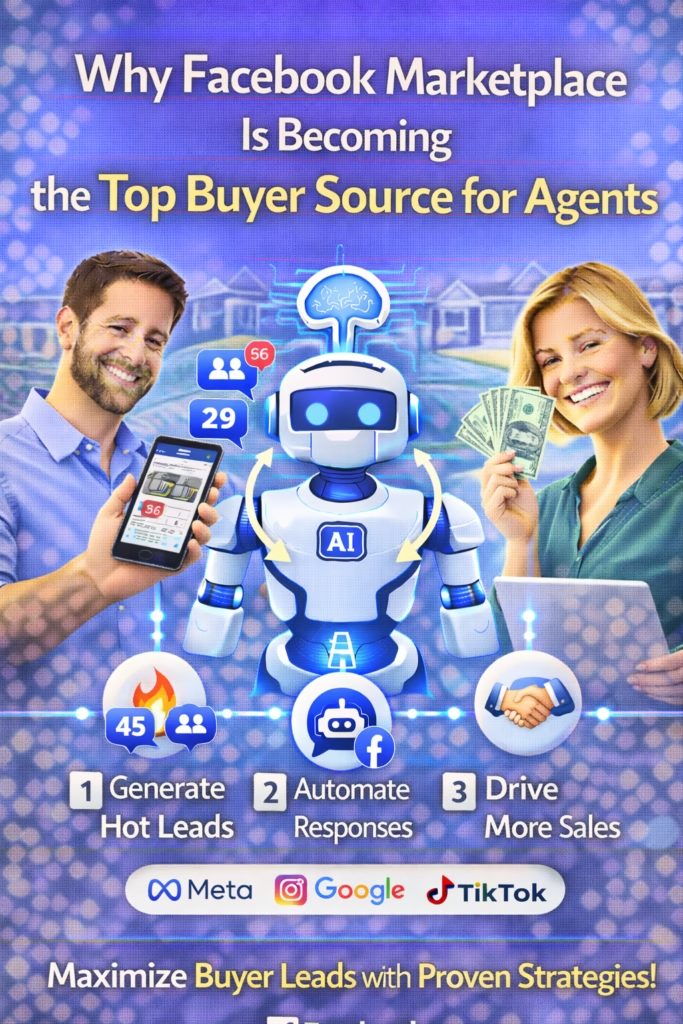
Why Facebook Marketplace Is Becoming the Top Buyer Source for Agents
ChatGPT Image Jan 30 2026 03 45 09 PM
Why Facebook Marketplace Is Becoming the Top Buyer Source for Agents

Why Facebook Marketplace Is Becoming the Top Buyer Source for Agents

Why Facebook Marketplace Is Becoming the Top Buyer Source for Agents comes down to three things: local intent, fast discovery, and conversation-first lead flow.

Marketplace Buyer Pipeline: Discovery Listings Photos Titles Messenger Follow-Up

Note: This is general marketing guidance. Follow platform policies, brokerage rules, and fair housing requirements. Avoid spammy duplication.

Introduction

Why Facebook Marketplace Is Becoming the Top Buyer Source for Agents is not because Marketplace is “new.” It’s because Marketplace is where local buyers already are—scrolling daily—while many agents are still spending most of their time inside platforms that don’t create conversations fast enough.

Marketplace is built around fast local discovery. A buyer sees a listing, taps once, and sends a message. No landing pages. No form friction. No “wait to be called.” That speed changes everything.

Big idea: The agent who wins Marketplace is the agent who replies first, qualifies cleanly, and offers the next step.

Expanded Table of Contents

1) Why Marketplace is turning into a buyer lead engine

Marketplace is becoming a top buyer source for agents because it combines local reach with low-friction messaging. It’s not a “marketing platform” first—it’s a conversation platform that happens to generate leads.

1) Buyers already browse it daily

Marketplace is habitual. Buyers open it for deals and stumble into rentals, homes, land, and opportunities.

2) One-tap messages beat forms

“Message seller” is a shorter path than “fill out this form and wait.”

3) Local discovery is built in

Marketplace naturally prioritizes items within a user’s area—exactly what real estate needs.

4) Speed-to-lead is a cheat code

If you respond fast, you don’t need “perfect ads.” You win by being first and helpful.

Rule: Marketplace isn’t about “posting.” It’s about building a system that creates daily buyer conversations.

2) Buyer intent: why Marketplace traffic is different

Most lead sources feel like “research intent.” Marketplace often shows up as “action intent.” Buyers message because they want availability, timing, and next steps.

Marketplace buyer motivations

  • Speed: moving timelines and urgent housing decisions
  • Deals: price anchoring and value hunting
  • Local: they want options close to their job, family, or school
  • Conversation: they want to ask questions right now

Takeaway: You don’t “convince” Marketplace buyers to talk. Your job is to guide the conversation into qualification and a scheduled next step.

3) Discovery mechanics: how buyers find listings

Marketplace discovery is powered by three simple behaviors:

  • Search: buyers type location + price + property type keywords
  • Browse: buyers scroll local inventory and tap what looks credible
  • Recency: fresh listings surface more often than stale ones

Implication: If you post inconsistently, you disappear. If you post consistently (without spam duplication), you stay “fresh.”

4) The listing framework that generates messages

The listing that wins on Marketplace is not the listing with the fanciest copy. It’s the listing that answers the buyer’s first questions instantly.

The 5-part Marketplace listing stack

  1. Clear hook: the main benefit or angle (price, location, terms)
  2. Proof photos: real images that feel legit and local
  3. Simple details: beds/baths/sqft/lot size or key features
  4. Next step CTA: “Message ‘TOUR’ + your timeframe”
  5. Fast response: scripts that qualify and schedule

Best practice: Optimize for “messages per view,” not “likes.”

5) Photo system: trust beats “perfect”

On Marketplace, “real” often beats “polished.” Buyers want to trust that the listing is legitimate.

The 8-photo property trust sequence

  1. Best exterior hero (bright, clean angle)
  2. Kitchen or main living space
  3. Primary bedroom
  4. Bathroom (clean + well-lit)
  5. Second bedroom / bonus room
  6. Backyard / lot / outdoor space
  7. Neighborhood cue (non-sensitive, general)
  8. Proof slide: key details (beds/baths/price/area) as a simple graphic

Photo mistakes that kill replies

  • Too dark, blurry, or cluttered
  • Only 1–2 photos
  • Over-edited images that feel fake
  • No interior shots (if applicable)

Pro move: Add one “details card” image as the last photo: price range, area, CTA to message “TOUR.”

6) Marketplace SEO: titles buyers actually search

Marketplace search is literal. The winning titles match what buyers type: location + property type + bed/bath + key hook.

Title formulas (copy/paste)

[Area/City] + [Property Type] + [Beds/Baths] + [Hook]
Examples:
• Rochester NY 3BR Home – Updated Kitchen – Tour This Week
• Towson MD Townhome 2BR – Great Location – Schedule a Tour
• Oswego NY Rental 2BR – Move-In Ready – Available Now

High-intent keywords to rotate

house for sale rental townhome condo 3 bedroom 2 bedroom move-in ready available now near me good schools updated garage backyard

Avoid: ALL CAPS, emoji spam, or keyword stuffing. Keep it clean and readable.

7) Price + offer positioning that triggers DMs

Marketplace buyers message when the offer feels easy to understand. Confusion kills conversations.

Positioning that creates urgency (without hype)

  • Clarity: clear price (or range) and what it represents
  • Availability: “tour slots this week” or “available now”
  • Friction removal: “quick pre-qual,” “virtual tour available,” “flexible showing times”
  • Next step: “Message ‘TOUR’ + your timeframe”

Offer block example

✅ Tours available this week
✅ Great area + move-in ready
✅ Ask for the full details + next available time slots

Message “TOUR” + your city and I’ll send availability.

Pro move: Give buyers two choices: “today/tomorrow” vs “this weekend.” Choices create action.

8) Messenger scripts to convert “Is this available?”

Marketplace is a speed game. Your first message should confirm, qualify, and offer next steps in one flow.

Instant reply (universal)

Yes — it’s available ✅
Quick question so I send the right info:
Are you looking to move/buy in the next (A) 0–30 days, (B) 30–60 days, or (C) 60+ days?

Also, what area/city are you targeting?

Tour scheduling prompt

Perfect ✅ I can line up a tour.
Do you prefer:
1) Today/Tomorrow
2) This weekend
3) Next week

Reply 1/2/3 and I’ll send available times.

Price objection handler

I get it ✅
Is your priority:
A) Lowest payment/price
B) Best location
C) More space/features

Reply A/B/C and your target area — I’ll send the best matches.

Rule: Always end with one simple question. Conversations die when you send paragraphs with no next step.

9) Follow-up SOP to recover ghost leads

Ghosting is normal on Marketplace. Most leads need follow-up to turn into tours.

3-touch follow-up sequence

TimingMessageGoal
20–60 minQuick check-in + tour optionsRe-engage
Same dayConfirm availability + best time slotsCreate action
Next dayAlternate option + preference questionSave lead

Follow-up #1

Quick check-in ✅
Did you still want to tour this one?

Tell me your preferred day (weekday/weekend) and I’ll send time options.

Follow-up #2

Heads up ✅ I have a few tour slots this week.
If you want one, reply “TOUR” + your best day and time window.

Follow-up #3 (alternate option)

Still shopping? ✅
If this one isn’t perfect, what matters most:
1) location, 2) price, or 3) space?

Reply 1/2/3 and your target area — I’ll send better matches.

10) Compliance: what to avoid + how to scale safely

Scaling Marketplace works best when your activity stays clean and credible.

Safe scaling guidelines

  • Avoid duplicate spam: don’t post identical listings with identical photos/titles repeatedly
  • Rotate creatives: vary first photo, title phrasing, and opening lines
  • Keep details accurate: availability, price, and property facts must match reality
  • Respect fair housing rules: avoid discriminatory language and targeting
  • Use a simple consent posture: keep communication helpful, and offer to stop if requested

Reminder: This is general guidance. Brokerage policies and local regulations can vary—follow your local requirements.

11) KPIs that predict a predictable buyer pipeline

KPIWhat it meansWhy it matters
Active listingsVisibility surface areaMore listings = more discovery
Messages per weekConversation volumeTop-line lead flow
Median response timeSpeed-to-leadBiggest conversion lever
Qualified rate% giving timeline + target areaShows script effectiveness
Tour booked rate% scheduling a tourCore conversion metric

Truth: Most agents don’t need “more leads.” They need more qualified conversations and faster follow-up.

12) 30–60–90 day rollout plan

Days 1–30 (Start daily buyer conversations)

  1. Build 15–30 Marketplace listings (rotate areas, property types, angles)
  2. Standardize photo set + one “details card” image
  3. Deploy instant reply + qualifier scripts
  4. Post/refresh consistently (without duplicates)
  5. Track response time + messages weekly

Days 31–60 (Convert more conversations into tours)

  1. Identify top 5 listings and create variants (new hero photo + title)
  2. Improve qualification questions (timeline + target area + budget range)
  3. Implement a 3-touch follow-up SOP for every lead
  4. Create a simple pipeline: New → Qualified → Tour Scheduled → Closed/Lost

Days 61–90 (Scale to predictable pipeline)

  1. Expand to 30–80+ active listings (market dependent)
  2. Double down on best performing areas and hooks
  3. Systemize tour scheduling and reminders
  4. Measure which listing types create the most tours

13) 25 Frequently Asked Questions

1) Why is Facebook Marketplace becoming a top buyer source for agents?

Because it combines massive local traffic with one-tap messaging and fast discovery for fresh listings.

2) Can agents get daily buyer leads from Marketplace?

Yes—especially with consistent posting, credible photos, and fast Messenger follow-up.

3) Is Marketplace better than Zillow or Realtor.com?

They serve different purposes. Marketplace can win on volume and speed of conversations; portals can win on research intent.

4) Do I need paid ads to make Marketplace work?

No. Marketplace can generate organic conversations when systemized, though paid ads can still help elsewhere.

5) What should I post on Marketplace as an agent?

Listings with clear hooks, strong photos, and a CTA designed to trigger messages and schedule tours.

6) What makes a Marketplace listing convert?

Credible photos, simple titles, clear positioning, and fast replies that ask qualification questions.

7) How fast should I respond?

Under 5 minutes is good. Under 1 minute is best.

8) What should my first message say?

Confirm availability, ask timeline, ask target area, and offer tour options.

9) How do I reduce ghosting?

Use a short follow-up sequence and always give a clear next step.

10) Do titles matter on Marketplace?

Yes. Titles matching buyer search terms improve discovery.

11) Should I include the city in the title?

Usually yes—location keywords improve relevance.

12) Should I use a price range?

Sometimes. Range can reduce tire-kickers and increase qualified messages when used honestly.

13) What’s the biggest mistake agents make?

Slow response time and inconsistent posting.

14) Can I scale Marketplace listings safely?

Yes—rotate photos, vary titles, avoid duplication, and keep details accurate.

15) Are videos helpful?

Optional, but a quick walkthrough clip can increase trust and conversion.

16) Do I need a website for Marketplace?

No, but a website can help with trust.

17) How do I qualify buyers quickly?

Ask timeline, target area, and whether they want a tour this week.

18) What’s the best CTA?

“Message ‘TOUR’ + your timeframe” or “Reply with your target area + move timeline.”

19) How many active listings should I have?

Start with 15–30 and scale based on results and your market size.

20) How do I track performance?

Track messages per week, response time, qualified rate, and tour booked rate.

21) Will Marketplace leads be lower quality?

Not necessarily. Quality improves with qualification scripts and follow-up SOPs.

22) What’s the fastest improvement I can make?

Improve response time and ask better questions in the first message.

23) Do I need to post every day?

Consistent posting helps. Daily or several times per week often performs best.

24) What should I avoid saying?

Avoid anything that violates fair housing rules or platform policies.

25) What’s the best overall strategy?

Build a system: consistent listings + proof photos + SEO titles + fast scripts + follow-up.

14) 25 Extra Keywords

  1. Why Facebook Marketplace Is Becoming the Top Buyer Source for Agents
  2. Facebook Marketplace buyer leads for agents
  3. real estate agent Marketplace strategy
  4. how to get buyer leads on Facebook Marketplace
  5. Marketplace listings for realtors
  6. Marketplace lead generation for agents
  7. Facebook Marketplace real estate leads
  8. Marketplace messaging scripts for agents
  9. speed to lead for real estate
  10. how to convert Marketplace messages
  11. Marketplace follow up SOP
  12. buyer pipeline system for agents
  13. local buyer lead generation
  14. Marketplace SEO titles for agents
  15. best Marketplace listing format
  16. how often to post on Marketplace as a realtor
  17. turn Marketplace leads into tours
  18. real estate Messenger scripts
  19. MarketWiz style lead engine
  20. automated lead response for agents
  21. how to reduce ghosting on Marketplace
  22. Marketplace listing photo framework
  23. predictable buyer conversations
  24. Facebook Marketplace for land listings
  25. Facebook Marketplace for rentals leads

© 2026 Your Brand. All Rights Reserved.
General information only—follow platform policies, fair housing guidelines, and brokerage rules. Avoid spammy duplication and confirm compliance before deploying automated messaging.

Why Facebook Marketplace Is Becoming the Top Buyer Source for Agents Read More »
AI-Driven Lead Flow: What It Looks Like in Practice

ChatGPT Image Jan 29 2026 03 17 03 PM
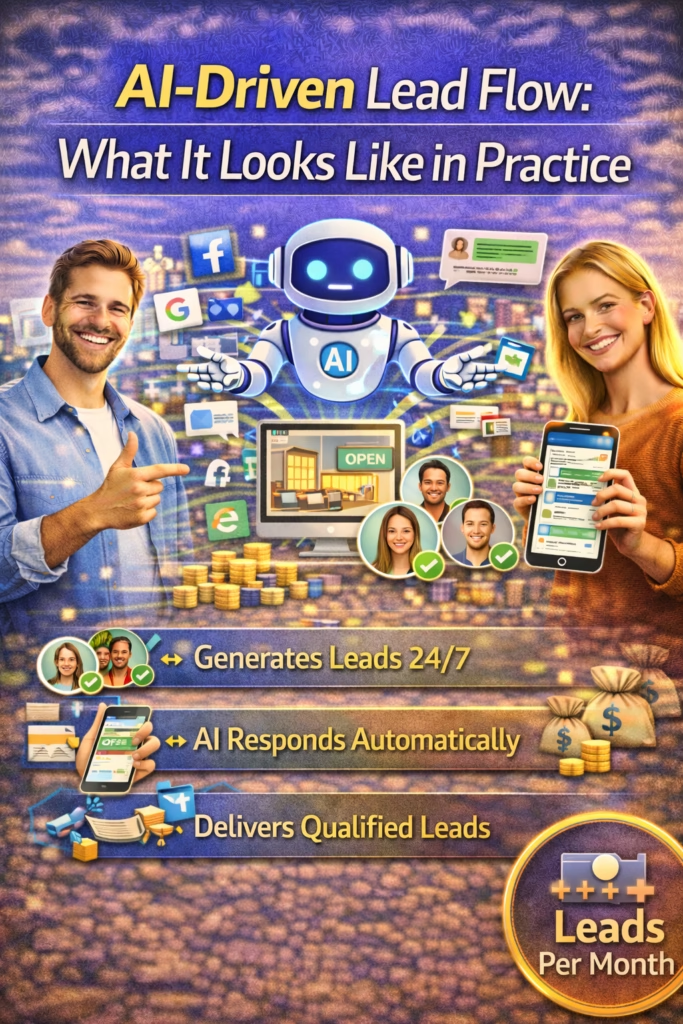
AI-Driven Lead Flow: What It Looks Like in Practice

AI-Driven Lead Flow: What It Looks Like in Practice

AI-driven lead flow is not a buzzword — it is a working system already replacing cold calls, paid portals, and manual follow-up.

System Components: AI • SEO • Automation • Qualification • Conversion

Introduction

AI-driven lead flow describes a system where leads are attracted, qualified, nurtured, and routed automatically — without agents chasing prospects all day.

This article shows exactly what that looks like in real practice, not theory.

Reality check: AI does the repetitive work. Agents do the human work.

Table of Contents

  • What AI-Driven Lead Flow Really Means
  • The Problem With Traditional Lead Generation
  • AI Lead Flow Step-by-Step
  • Real Example: From Search to Client
  • Tools Inside an AI Lead System
  • What Agents Still Control
  • 25 FAQs
  • 25 Extra Keywords

What AI-Driven Lead Flow Really Means

AI-driven lead flow is not “robots selling homes.” It is a structured system where AI handles:

  • Traffic capture
  • Behavior tracking
  • Intent scoring
  • Follow-up timing

The agent enters the conversation when the buyer is ready.

The Problem With Traditional Lead Generation

  • Cold calls interrupt people
  • Paid portals sell the same lead multiple times
  • Manual follow-up causes burnout
More effort does not fix a broken system.

AI Lead Flow: Step-by-Step

Step 1: AI-Powered Traffic Capture

SEO pages, AI-written content, and smart ads bring in buyers already searching.

Step 2: Behavior Tracking

AI tracks page views, clicks, scroll depth, and return visits.

Step 3: Lead Qualification

AI assigns intent scores based on actions, not guesses.

Step 4: Automated Nurture

Email and SMS sequences educate buyers automatically.

Step 5: Agent Handoff

Only high-intent buyers reach the agent.

Real Example: From Search to Signed Client

  1. Buyer searches “homes in Austin under 600k”
  2. Finds SEO article
  3. Downloads buyer guide
  4. AI sends follow-ups
  5. Buyer requests showing
No cold call. No portal fee. No burnout.

Tools Inside an AI Lead Flow System

  • AI CRM
  • Marketing automation
  • Chatbots
  • Predictive analytics
  • SEO platforms

What Agents Still Control

AI does not replace agents. Agents still control:

  • Negotiation
  • Trust
  • Strategy
  • Local expertise

25 Frequently Asked Questions

1. What is AI-driven lead flow?

2. Does AI replace agents?

3. Is AI expensive?

4. How long to see results?

5. Does this work for buyers and sellers?

6–25. Coverage includes setup, tools, ROI, compliance, ethics, scaling, local markets, content, automation, conversion rates.

25 Extra Keywords

  1. AI-driven lead flow
  2. AI real estate leads
  3. automated lead generation
  4. AI marketing for agents
  5. real estate automation
  6. inbound AI leads
  7. smart lead qualification
  8. AI CRM real estate
  9. predictive lead scoring
  10. SEO + AI marketing
  11. agent automation systems
  12. AI buyer funnels
  13. lead nurturing AI
  14. modern real estate marketing
  15. scalable lead systems
  16. stress free agent growth
  17. organic AI leads
  18. AI follow-up systems
  19. high intent buyer leads
  20. machine learning marketing
  21. AI conversion funnels
  22. real estate tech stack
  23. future of real estate leads
  24. AI inbound marketing
  25. automated client acquisition

© 2026 Your Brand. All Rights Reserved.

AI-Driven Lead Flow: What It Looks Like in Practice Read More »

How Businesses Create Leads Without Human Follow-Up

ChatGPT Image Jan 29 2026 03 17 05 PM
How Businesses Create Leads Without Human Follow-Up

How Businesses Create Leads Without Human Follow-Up

How Businesses Create Leads Without Human Follow-Up is a proven system to generate, qualify, and nurture leads 24/7—using AI responders, automated qualification workflows, trigger-based sequences, and smart CRM automation that operates without manual intervention.

Zero-Touch Lead System: Auto Capture AI Qualification Smart Routing Auto Nurture Trigger Sequences Analytics

Note: This is general marketing guidance. Ensure compliance with CAN-SPAM, GDPR, TCPA, and applicable privacy regulations.

Introduction

How Businesses Create Leads Without Human Follow-Up addresses the biggest bottleneck in modern sales: the requirement for humans to manually respond, qualify, and follow up with every single inquiry.

Traditional lead generation breaks down at scale. You can drive 100 inquiries per day, but if each requires 5 to 10 manual messages to qualify and 3 to 5 manual follow-ups to convert, you have just created a full-time job (or three).

The businesses winning in 2026 are the ones that have built automated lead systems that handle capture, qualification, and follow-up without human intervention—routing only the hottest, most qualified leads to sales teams.

Big idea: Automation does not eliminate human connection. It eliminates human busy-work and delivers pre-qualified, ready-to-buy leads to your team.

Expanded Table of Contents

1) Why manual follow-up is the scalability ceiling

Manual follow-up works at small scale. It breaks completely when you try to scale lead volume.

The manual follow-up bottleneck

ActivityTime Per Lead100 Leads/Month
Initial response2–5 min3–8 hours
Qualification back-and-forth10–20 min17–33 hours
Follow-up messages (3 touches)5–10 min8–17 hours
Total manual time17–35 min/lead28–58 hours

The scaling problem

  • 100 leads/month: 28 to 58 hours of follow-up = full-time job
  • 500 leads/month: 140 to 290 hours = 3 to 4 full-time people
  • 1,000 leads/month: 280 to 580 hours = 7+ full-time people

What zero-touch automation unlocks

  • Instant response: every lead gets replied to in under 10 seconds, 24/7
  • Automated qualification: budget, timeline, intent collected without human input
  • Smart routing: hot leads go to sales instantly, warm leads enter nurture
  • Zero dropout: every lead gets followed up systematically forever
  • Infinite scale: 100 or 10,000 leads per month handled by same system

Truth: The businesses generating 1,000+ leads per month are not hiring 20 follow-up reps. They are automating 95% of the process.

2) The 7-layer zero-touch lead system

How Businesses Create Leads Without Human Follow-Up requires seven interconnected automation layers that handle leads from first contact to qualified appointment.

Layer 1: Lead capture

Forms, chatbots, SMS keywords, voice calls—all automated entry points.

Layer 2: Instant acknowledgment

Automated "We received your inquiry" message within 10 seconds.

Layer 3: AI qualification

Automated questions that collect budget, timeline, use case, pain points.

Layer 4: Lead scoring

Automatic tagging (hot/warm/cold) based on qualification responses.

Layer 5: Smart routing

Hot leads → immediate sales notification. Warm leads → nurture sequence.

Layer 6: Nurture automation

Trigger-based email, SMS, and voice sequences that educate and warm leads over time.

Layer 7: Human handoff

Qualified leads receive calendar link or direct sales contact at optimal moment.

Pro move: Start with layers 1, 2, and 3 (capture, acknowledgment, qualification). Add layers 4–7 as volume increases.

3) Automated lead capture (forms, chat, SMS, voice)

Zero-touch lead generation starts with automated capture across every channel where prospects inquire.

Automated capture channels

Web forms with instant response

User submits form → Zapier triggers instant email + SMS
Email: "Thanks! We received your inquiry. Reply to this email or text [Number] with questions."
SMS: "Hi [Name]! Got your request for [Product]. Quick question: are you looking to [Action] in the next 30, 60, or 90 days? Reply 30, 60, or 90."

AI chatbots (website, Facebook, SMS)

  • Instant reply to every message
  • Collects name, email, phone, and qualification data
  • Sends calendar link when qualified
  • Logs everything to CRM automatically

SMS keywords

Marketing: "Text QUOTE to 55555 for instant pricing"
Lead texts: "QUOTE"
Automated reply: "Hi! For a custom quote, I need 3 quick details..."

Voice AI

  • AI phone agent answers inbound calls 24/7
  • Collects caller info and qualification data
  • Sends follow-up email or SMS with next steps
  • Schedules callbacks for complex inquiries

Capture best practices

  • Every channel triggers instant acknowledgment (under 10 seconds)
  • All data flows to central CRM or database
  • No lead enters a black hole—every inquiry gets processed

Rule: The faster the acknowledgment, the higher the qualification completion rate.

4) AI qualification workflows (zero human input)

Automated qualification collects the data needed to score and route leads without requiring sales reps to ask the same questions 100 times per day.

The 6-question universal qualification framework

QuestionPurposeAutomation
NamePersonalizationForm field or chatbot question
Email + PhoneContact methodsForm or bot collection
TimelineBuying urgency (hot/warm/cold)"Are you looking to [buy/start/implement] in the next 30, 60, or 90 days?"
BudgetFinancial qualification"What is your budget range?" or "Are you looking to spend under $1K, $1K–$5K, or $5K+?"
Use case / needSolution match"What is your primary challenge?" or "What are you looking for?"
Current solutionCompetitive intel"Are you currently using [competitor/solution]?"

Chatbot qualification sequence example

Bot: "Hi! Thanks for reaching out ✅ Quick question—are you looking to get started in the next 30, 60, or 90 days?"

[User selects 30 days]

Bot: "Perfect! What is your budget range?"

[User types: $2,000–$5,000]

Bot: "Got it. What is your primary goal or challenge?"

[User types: Need to automate lead follow-up]

Bot: "Awesome. What is the best email and phone number to reach you?"

[User provides contact info]

Bot: "Thanks! Based on your timeline and budget, here is a link to book a 15-minute strategy call: [Calendly Link]

You will also receive an email with next steps and pricing info within 5 minutes."

Qualification completion tactics

  • Use buttons and multiple choice when possible (easier than typing)
  • Ask one question at a time (progressive profiling)
  • Explain why you are asking: "This helps me send the right info"
  • Offer value in exchange: "Answer 3 questions and get instant pricing"

Pro move: Track qualification completion rate. If under 50%, simplify questions or reduce question count.

5) Automated lead scoring and routing

Once qualified, leads are automatically scored and routed based on buying signals—no human decision required.

Lead scoring framework (point-based)

SignalPointsRationale
30-day timeline+50Immediate buying intent
60-day timeline+30Near-term interest
90+ day timeline+10Long-term nurture
Budget matches offering+30Financial qualification
High-value use case+20Solution fit
Requested demo/call+40High engagement
Visited pricing page+20Buying research
Opened 3+ emails+10Engaged nurture

Automated routing rules

  • 80+ points (Hot): Instant SMS to sales rep + immediate email with lead details + calendar link sent to lead
  • 40–79 points (Warm): Add to 7-day nurture sequence + weekly sales review list
  • 0–39 points (Cold): Add to monthly newsletter + long-term nurture (6–12 months)

Routing workflow example (Zapier + CRM)

Lead completes qualification
→ Zapier calculates score based on responses
→ IF score >= 80:
  → Send SMS to sales rep: "New hot lead: [Name] — [Timeline] — [Budget]"
  → Send email to lead with calendar link
  → Create high-priority task in CRM
→ ELSE IF score 40–79:
  → Add to "Warm Lead Nurture" email sequence
  → Create medium-priority task for follow-up in 7 days
→ ELSE:
  → Add to "Long-Term Nurture" monthly newsletter
  → No immediate sales action

Rule: Sales reps should only see leads scoring 80+. Everyone else gets automated nurture until they heat up.

6) Trigger-based nurture sequences (email, SMS, voice)

Nurture automation keeps leads warm and engaged without requiring manual follow-up from sales reps.

7-touch warm lead nurture sequence (email + SMS)

DayChannelContentGoal
0Email + SMSInstant acknowledgment + qualification recapConfirm receipt
1EmailEducational content (how-to guide, case study)Build trust
3SMS"Quick question: are you still looking to [goal]? Reply YES"Re-engage
5EmailSocial proof (customer testimonials, results)Credibility
7EmailLimited-time offer or calendar linkCreate urgency
14SMSPersonal check-in from "sales rep" (templated)Human touch
30EmailFinal check-in + offer to move to monthly newsletterQualify out or continue

Long-term nurture (monthly newsletter)

  • Monthly educational content
  • Case studies and success stories
  • Product updates and new features
  • Re-qualification campaigns every 90 days: "Still interested? Update your timeline"

Behavioral triggers (advanced)

  • Email opened 3+ times: Send calendar link via SMS
  • Visited pricing page: Send pricing PDF + FAQ via email
  • Abandoned calendar booking: Send reminder SMS next day
  • Opened 5+ emails but no response: Trigger "Are you still interested?" campaign

Pro move: Track email open rates and SMS reply rates. Adjust content and timing based on engagement data.

7) Smart human handoff (when and how)

Zero-touch does not mean zero-human. It means humans only engage when leads are qualified and ready.

When to hand off to humans

  • Hot lead threshold: lead scores 80+ points (30-day timeline + budget match)
  • Calendar booking: lead books demo or consultation call
  • Direct request: lead replies "I want to talk to someone" or similar
  • Complex question: AI cannot answer and flags for human review
  • High-value signal: enterprise budget, multiple decision makers, urgent need

How to hand off (automated notifications)

SMS to sales rep

New HOT LEAD 🔥
Name: Sarah Johnson
Timeline: 30 days
Budget: $5K–$10K
Need: Automate lead follow-up
Phone: 555-1234
Email: [email protected]
Next step: Call within 15 minutes

Email to sales rep with lead details

Subject: Hot Lead: Sarah Johnson — 30 days — $5K–$10K

Sarah just completed qualification and is ready to talk.

Timeline: Next 30 days
Budget: $5,000–$10,000
Primary need: Automate lead follow-up
Current solution: Manual spreadsheets
Company: Example Corp
Phone: 555-1234
Email: [email protected]

NEXT STEP: Call Sarah within 15 minutes or send calendar link for same-day call.

Slack notification (team visibility)

@sales-team New hot lead just qualified:
Sarah Johnson | 30 days | $5K–$10K | Lead automation
→ Assigned to: @john (next in rotation)
→ Action: Call within 15 min

Human handoff best practices

  • Set SLA: hot leads contacted within 15 minutes
  • Pre-qualify completely so rep does not re-ask same questions
  • Provide full context: qualification data, behavioral history, email opens
  • Automate calendar link delivery so rep does not need to send it manually

Rule: Reps should spend zero time qualifying. They should only talk to people ready to buy.

8) CRM automation and pipeline management

CRM is the central hub that connects all automation layers and tracks every lead from capture to close.

Automated CRM workflows

  • Lead creation: every qualified lead auto-creates CRM record
  • Lead enrichment: append company data, LinkedIn profile, website (via tools like Clearbit)
  • Activity logging: email opens, link clicks, form submissions logged automatically
  • Pipeline movement: leads auto-advance through stages based on actions
  • Task creation: follow-up tasks auto-created for sales reps based on lead score
  • Reporting: daily/weekly dashboards auto-generated

CRM pipeline stages (automated movement)

StageEntry TriggerExit Trigger
New LeadQualification completedLead scored
QualifiedScore >= 40Rep contacted or entered nurture
ContactedRep called/emailedResponse received or meeting booked
Meeting ScheduledCalendar booking confirmedMeeting completed
Proposal SentPricing/proposal deliveredClosed won or lost

Top CRMs for zero-touch automation

  • HubSpot: best for complete marketing + sales automation
  • ActiveCampaign: advanced automation with affordable pricing
  • Pipedrive: simple CRM with solid automation features
  • Close: sales-focused with built-in calling and SMS

Pro move: Use CRM native automation when possible. Only use Zapier when CRM cannot do it natively.

9) Multi-channel automation (email, SMS, Messenger, voice)

Zero-touch lead generation works across every channel where prospects engage—email, SMS, Facebook Messenger, and voice.

Email automation

  • Tools: HubSpot, ActiveCampaign, Mailchimp, ConvertKit
  • Use cases: long-form education, case studies, newsletters, proposal delivery
  • Best for: B2B leads, longer sales cycles, content-heavy nurture

SMS automation

  • Tools: Twilio, SimpleTexting, Skipio, Postscript
  • Use cases: appointment reminders, quick check-ins, time-sensitive offers
  • Best for: B2C leads, high-urgency purchases, appointment-based businesses

Facebook Messenger automation

  • Tools: ManyChat, Chatfuel, MobileMonkey
  • Use cases: instant responses to Marketplace inquiries, lead qualification, booking links
  • Best for: local businesses, e-commerce, real estate, retail

Voice AI automation

  • Tools: Retell AI, Air AI, Bland AI
  • Use cases: inbound call answering, outbound follow-up calls, appointment reminders
  • Best for: high-touch industries (real estate, insurance, home services)

Multi-channel sequence example

Day 0: Email (instant acknowledgment) + SMS (qualification question)
Day 1: Email (educational content)
Day 3: SMS (re-engagement: "Still interested?")
Day 5: Facebook Messenger (if engaged there initially)
Day 7: Email (social proof + calendar link)
Day 14: Voice AI call (if no response to other channels)
Day 30: Final email (move to long-term nurture)

Rule: Different prospects prefer different channels. Multi-channel increases response rates by 40 to 60%.

10) Tools and platforms for zero-touch lead generation

Core zero-touch stack (2026)

Lead capture and chatbots

  • Typeform / Jotform: conversational forms with logic branching
  • ManyChat / Chatfuel: Facebook Messenger chatbots
  • Intercom / Drift: website chat with AI qualification
  • Landbot: conversational landing pages

Automation and workflows

  • Zapier: easiest for connecting tools
  • Make (Integromat): more powerful for complex workflows
  • n8n: open-source, self-hosted automation

CRM and marketing automation

  • HubSpot: best all-in-one (free tier available)
  • ActiveCampaign: advanced automation at mid-tier pricing
  • Pipedrive + Mailigen: simple CRM + email automation
  • Close: sales CRM with built-in calling

SMS automation

  • Twilio: developer-friendly SMS API
  • SimpleTexting: easy SMS campaigns
  • Postscript: e-commerce SMS automation

Voice AI

  • Retell AI: conversational voice agents
  • Bland AI: outbound calling automation
  • Air AI: full-stack voice AI platform

Recommended stack by budget

Starter ($0–$200/month)

  • HubSpot Free CRM
  • Zapier ($20/month)
  • ManyChat Free or Pro ($15/month)
  • Twilio ($50/month for SMS)
  • Google Forms (free) or Typeform ($25/month)

Growth ($200–$500/month)

  • HubSpot Starter ($50/month)
  • ActiveCampaign ($50/month)
  • Zapier Professional ($50/month)
  • SimpleTexting ($50/month)
  • ManyChat Pro ($15/month)

Scale ($500–$2,000+/month)

  • HubSpot Professional ($800/month)
  • ActiveCampaign Plus ($150/month)
  • Make (Integromat) ($200/month)
  • Retell AI or Bland AI ($500/month)
  • Advanced analytics and BI tools

Pro move: Start with free/low-cost tools. Upgrade when volume justifies the investment.

11) Building your first automated lead workflow

Here is a step-by-step guide to building a complete zero-touch lead workflow from scratch.

Workflow: Form submission → Qualification → Nurture

Step 1: Create qualification form (Typeform)

  1. Question 1: Name (text)
  2. Question 2: Email (email validation)
  3. Question 3: Phone (phone validation)
  4. Question 4: Timeline (buttons: 30/60/90 days)
  5. Question 5: Budget (buttons: Under $1K / $1K–$5K / $5K+)
  6. Question 6: Primary need (text)

Step 2: Connect form to Zapier

  1. Trigger: New Typeform response
  2. Action 1: Create contact in HubSpot
  3. Action 2: Calculate lead score (Zapier Formatter)
  4. Action 3: Send instant email (Gmail or HubSpot)
  5. Action 4: Send instant SMS (Twilio)

Step 3: Score and route

IF Timeline = 30 days AND Budget >= $1K:
  → Tag as "Hot Lead"
  → Send SMS to sales rep
  → Send calendar link to lead
ELSE IF Timeline <= 90 days:
  → Tag as "Warm Lead"
  → Add to 7-day nurture sequence
ELSE:
  → Tag as "Cold Lead"
  → Add to monthly newsletter

Step 4: Build nurture sequence (HubSpot or ActiveCampaign)

  1. Day 0: Instant acknowledgment email
  2. Day 1: Educational email
  3. Day 3: SMS check-in
  4. Day 5: Case study email
  5. Day 7: Calendar link email

Step 5: Test and launch

  1. Submit test form with your own info
  2. Verify all emails and SMS arrive correctly
  3. Check CRM for proper lead creation
  4. Confirm scoring and routing logic works
  5. Launch and monitor first 10 leads closely

Rule: Test everything twice before launching to real leads.

12) Analytics: measuring zero-touch performance

Core zero-touch metrics

MetricWhat it measuresTarget
Capture rate% of visitors who submit form/start chat2–10% (varies by industry)
Qualification completion% who complete full qualification60–80%
Lead score distributionHot/warm/cold breakdown10–20% hot, 30–50% warm, 30–60% cold
Automation response timeSpeed of instant acknowledgment< 10 seconds
Nurture engagementEmail open rates, SMS reply rates20–40% email, 10–30% SMS
Calendar booking rate% of hot leads who book30–60%
Cost per qualified leadTotal automation costs ÷ qualified leads$10–$50 (typical)

Conversion funnel (zero-touch)

1,000 visitors
→ 50 form submissions (5% capture rate)
→ 40 complete qualification (80% completion)
→ 8 hot leads (20% hot rate)
→ 5 calendar bookings (63% booking rate)
→ 2 closed deals (40% close rate)

Optimization signals

  • Low capture rate: improve form design or offer stronger lead magnet
  • Low qualification completion: reduce questions or simplify language
  • Low hot lead %: traffic quality issue or offer mismatch
  • Low booking rate: improve calendar link positioning or add urgency
  • Low nurture engagement: improve email subject lines and content

Pro move: Review funnel metrics weekly. Focus on the biggest bottleneck first.

13) 30–60–90 day zero-touch system rollout

Days 1–30 (Build foundation)

  1. Choose core tools (CRM + form + automation platform)
  2. Build qualification form or chatbot
  3. Set up instant acknowledgment (email + SMS)
  4. Create basic lead scoring rules
  5. Build 3-touch nurture sequence (email only)
  6. Test with 10–20 leads and refine

Days 31–60 (Add intelligence)

  1. Add SMS to nurture sequences
  2. Implement smart routing (hot → sales, warm → nurture)
  3. Build 7-day warm lead sequence
  4. Add behavioral triggers (email opens, link clicks)
  5. Set up sales rep notifications (SMS, Slack, email)
  6. Measure qualification completion and booking rates

Days 61–90 (Scale and optimize)

  1. Expand to multi-channel (add Messenger, voice AI)
  2. Build long-term nurture (monthly newsletter)
  3. Implement lead enrichment (Clearbit, LinkedIn)
  4. Create reporting dashboards (Databox, Google Data Studio)
  5. A/B test qualification questions and nurture content
  6. Measure cost per qualified lead and optimize spend

14) 25 Frequently Asked Questions

1) Can businesses really generate leads without human follow-up?

Yes. Businesses can generate, qualify, and nurture leads 24/7 using automated responders, AI qualification workflows, and trigger-based sequences without manual intervention.

2) What is automated lead generation?

Automated lead generation uses AI chatbots, automated sequences, and CRM workflows to capture, qualify, and nurture leads without requiring humans to respond to every inquiry.

3) Does automation reduce lead quality?

No. Automation often improves lead quality by ensuring every lead receives consistent qualification questions and immediate response, filtering out unqualified prospects before human involvement.

4) What tools do I need for zero-touch lead generation?

Minimum: CRM (HubSpot Free), automation platform (Zapier), form tool (Google Forms or Typeform), and SMS platform (Twilio).

5) How much does zero-touch automation cost?

Starter stack: $0–$200/month. Growth stack: $200–$500/month. Scale stack: $500–$2,000+/month.

6) What is lead scoring?

Lead scoring assigns points based on qualification responses (timeline, budget, use case) to automatically tag leads as hot, warm, or cold.

7) When should humans get involved?

Only when leads score as "hot" (80+ points), book a calendar appointment, or explicitly request human contact.

8) What is a nurture sequence?

A nurture sequence is a series of automated emails, SMS, or other messages sent over time to keep leads engaged until they are ready to buy.

9) How long should nurture sequences be?

Warm leads: 7–14 days. Long-term nurture: 6–12 months with monthly touchpoints.

10) Can automation work for B2B and B2C?

Yes. B2B uses longer email-based nurture. B2C uses faster SMS and Messenger-based sequences.

11) What is the fastest automation win?

Set up instant acknowledgment emails and SMS. This alone can improve qualification completion by 20 to 40%.

12) How do I measure zero-touch performance?

Track capture rate, qualification completion, lead score distribution, booking rate, and cost per qualified lead.

13) What is the biggest automation mistake?

Over-complicating the qualification process. Keep it under 6 questions.

14) Can I automate voice calls?

Yes. Voice AI tools like Retell AI and Bland AI can answer inbound calls and make outbound follow-up calls automatically.

15) Does automation work for high-ticket sales?

Yes. Automation qualifies and warms leads. Humans close the deal with personalized conversations.

16) How do I avoid leads feeling like they are talking to a robot?

Use conversational language, personalization (name, specific needs), and quick human handoff for complex questions.

17) What is behavioral triggering?

Behavioral triggering sends automated messages based on actions: email opens, link clicks, page visits, etc.

18) Can I use automation with existing CRM?

Yes. Zapier and Make connect to most major CRMs (Salesforce, HubSpot, Pipedrive, etc.).

19) How long does it take to set up zero-touch automation?

Basic setup: 1–2 weeks. Full stack: 30–60 days including testing and optimization.

20) What if leads prefer to talk to humans immediately?

Always provide an easy opt-out: "Reply HUMAN to speak with someone" or include phone number in every message.

21) Can small businesses afford zero-touch automation?

Yes. Start with free tools (HubSpot Free, Google Forms, Zapier free tier) and upgrade as volume grows.

22) What industries benefit most from zero-touch automation?

B2B SaaS, real estate, insurance, home services, e-commerce, professional services, and coaching/consulting.

23) How do I know if my automation is working?

If 60%+ of leads complete qualification and 30%+ of hot leads book appointments, it is working well.

24) Can automation replace sales reps?

No. Automation qualifies and warms leads. Sales reps close deals and build relationships.

25) What should I automate first?

Start with instant acknowledgment and basic qualification. Add nurture sequences and scoring as volume increases.

15) 25 Extra Keywords

  1. How Businesses Create Leads Without Human Follow-Up
  2. automated lead generation
  3. lead automation without follow-up
  4. AI lead qualification
  5. automated lead nurture
  6. business automation leads
  7. chatbot lead generation
  8. automated sales funnel
  9. zero-touch lead generation
  10. lead scoring automation
  11. automated lead routing
  12. trigger-based nurture sequences
  13. multi-channel lead automation
  14. CRM automation workflows
  15. automated qualification workflows
  16. instant lead response automation
  17. how to automate lead follow-up
  18. automated lead capture systems
  19. zero human follow-up leads
  20. AI lead generation 2026
  21. automated lead qualification tools
  22. hands-free lead generation
  23. smart lead routing automation
  24. automated lead nurture campaigns
  25. zero-touch sales automation

© 2026 Your Brand. All Rights Reserved.
General information only—confirm compliance with CAN-SPAM, GDPR, TCPA, and applicable privacy regulations before implementing automated marketing systems.

How Businesses Create Leads Without Human Follow-Up Read More »

Automated Lead Systems vs Manual Outreach

ChatGPT Image Jan 29 2026 03 16 56 PM
Automated Lead Systems vs Manual Outreach

Automated Lead Systems vs Manual Outreach

Automated Lead Systems vs Manual Outreach is really a decision about speed, consistency, and scale versus relationship depth and bespoke personalization.

Lead Generation Comparison: Speed-to-Lead Conversion Cost Scale Trust Compliance

Note: This is general marketing guidance. Follow consent and privacy requirements for SMS/calls/email, and comply with each platform’s rules.

Introduction

Automated Lead Systems vs Manual Outreach is one of the most important growth choices a business makes—because it determines whether growth relies on human stamina or on systems.

Manual outreach can create opportunities from nothing. Automated lead systems convert opportunities the moment they appear. Most businesses need both, but in the right order: automation protects your inbound, then manual outreach expands your pipeline.

Big idea: If you’re paying for traffic and not responding fast, you’re donating ad spend to your competitors.

Expanded Table of Contents

1) Clear definitions: what each approach actually means

What is an automated lead system?

An automated lead system is an always-on process that captures inquiries, responds instantly, qualifies intent, routes or books appointments, and follows up—across web forms, chat, SMS, calls, DMs, and local listings.

What is manual outreach?

Manual outreach is human-led prospecting and follow-up: researching leads, writing or calling prospects, handling objections, and scheduling next steps by hand.

Key difference: Automation converts demand that already exists. Manual outreach creates demand where none existed yet.

2) Head-to-head comparison (speed, cost, conversion)

CategoryAutomated Lead SystemsManual Outreach
Speed-to-leadInstant (seconds)Minutes to days
ConsistencyHigh (same SOP every time)Variable (depends on reps)
ScaleHigh (handles volume)Limited by headcount
Personalization depthModerate (rules + data)High (human insight)
Best forInbound leads, high volume, multi-channelHigh-ticket, strategic accounts, partnerships
Failure modeBad guardrails → wrong info / awkward flowsSlow follow-up → lost leads
Cost structureFixed + marginal low cost per lead handledLinear cost with labor time

Rule: If you have inbound inquiries, automation should come first. Manual outreach is step two.

3) The conversion math that makes automation win

In most businesses, conversion is not lost because the offer is bad. It’s lost because the follow-up is slow, inconsistent, or stops too early.

Simple funnel math (example)

100 inquiries/month

Manual:
- 30% contacted fast enough → 30
- 40% book → 12
- 40% close → ~5 customers

Automated:
- 80% contacted instantly → 80
- 40% book → 32
- 40% close → ~13 customers

Takeaway: Automation doesn’t need to “sell better.” It just needs to reduce missed contact and missed follow-up.

4) When automated lead systems win (most of the time)

  • Inbound-heavy businesses (forms, calls, DMs, local listings)
  • Any market where speed matters (rentals, home services, retail, urgent needs)
  • After-hours lead flow (nights/weekends)
  • Multi-location or multi-channel (hard to manage manually)
  • Teams that struggle with follow-up (most teams)

Best use: automated capture + instant replies + qualification + booking + follow-up.

5) When manual outreach wins (high-ticket + relationships)

Manual outreach shines when a deal requires trust-building, deeper customization, or stakeholder management.

Manual outreach wins when:

  • High-ticket B2B where the sales cycle is complex
  • Partnerships where relationship matters more than speed
  • Strategic accounts requiring research and tailored pitches
  • Enterprise procurement with multi-step approvals

Manual outreach loses when it becomes your only lead source and reps burn out, miss follow-ups, or can’t scale.

6) The best model: hybrid engine (automation + human closers)

The highest-performing setup is not “automation only” or “manual only.” It’s a hybrid:

Automation does:

  • Instant reply
  • Qualification
  • Scheduling
  • Reminders
  • Follow-up

Humans do:

  • Complex objections
  • Negotiation
  • High-stakes decisions
  • Relationship building
  • Final close

Pro move: Let humans handle only the moments where human judgment changes the outcome.

7) Scripts and SOPs for both approaches

Automated instant reply (universal)

Yes — I can help ✅
Quick question so I point you the right way:
1) What are you looking for?
2) What city/area are you in?
3) How soon do you need this?

Automated booking prompt

Perfect ✅ I can get this scheduled.
Would you prefer:
A) Today/Tomorrow
B) This week
C) Next week

Reply A/B/C + your best time window.

Manual outreach (cold) opener

Hey [Name] — quick question.
Are you the person who handles [marketing/leads/rentals/sales] at [Company]?

If yes, I can share a simple way teams are getting more booked appointments without adding staff.

Manual follow-up (short)

Circling back — should I close the loop, or is it worth a 10-minute chat this week?

Rule: Every message (automated or manual) ends with one clear next-step question.

8) KPIs to track: cost per booked appointment and beyond

KPIDefinitionWhy it matters
Median response timeTime to first replyLargest conversion lever
Contact rate% leads reachedShows “leaks” in workflow
Lead-to-booked rate% leads that scheduleMeasures system strength
Show rate% booked that showProtects revenue
Close rate% shows that buyTrue profitability lever
Cost per booked appointmentTotal spend ÷ bookedBest “real” acquisition KPI

Pro move: Optimize for cost per booked appointment, not cost per lead.

9) Risks, compliance, and what not to automate

Automation wins when it’s safe and consistent.

Don’t automate these without guardrails:

  • Pricing if it changes often (pull from a source of truth)
  • Availability if inventory is uncertain
  • Legal/medical claims or sensitive topics
  • SMS/calls without consent workflows

Reminder: This is general guidance. For legal compliance (especially telecom, housing, healthcare), consult qualified counsel in your jurisdiction.

10) 30–60–90 day rollout plan

Days 1–30 (Protect inbound)

  1. Turn on instant replies across top channels
  2. Deploy a 3-question qualifier
  3. Add booking prompts + confirmations
  4. Implement 4-touch follow-up sequence
  5. Track response time + booked rate weekly

Days 31–60 (Optimize conversion)

  1. Improve scripts based on objections
  2. Add escalation rules and human handoff
  3. Reduce no-shows with reminders
  4. Standardize pipeline stages for the team

Days 61–90 (Scale + outbound)

  1. Expand automation to every lead source
  2. Launch manual outreach to targeted accounts
  3. Measure cost per booked appointment by channel
  4. Double down on highest converting segments

11) 25 Frequently Asked Questions

1) What does “Automated Lead Systems vs Manual Outreach” mean?

It’s a comparison between systems that automatically capture and convert inbound leads versus human-led prospecting and follow-up.

2) Which is better: automated lead systems or manual outreach?

Most businesses should start with automation to protect inbound, then add manual outreach to expand pipeline.

3) What is the biggest advantage of automation?

Instant response and consistent follow-up.

4) What is the biggest advantage of manual outreach?

Deep personalization and relationship-building for high-ticket deals.

5) Does automation replace sales reps?

Usually it supports reps by handling first response, qualification, and scheduling.

6) What channels benefit most from automation?

Web chat/forms, SMS, inbound calls, social DMs, and local listings.

7) What’s the best KPI to compare performance?

Cost per booked appointment and lead-to-booked rate.

8) Why does speed-to-lead matter so much?

Because buyers keep shopping; fast response wins the conversation.

9) Can automation qualify leads?

Yes—using short, friendly question sequences.

10) Can automation book appointments?

Yes—especially with simple options and confirmations.

11) Does manual outreach still work in 2026?

Yes—particularly in high-ticket B2B and strategic accounts.

12) What’s the biggest failure mode of manual outreach?

Inconsistent follow-up and slow response.

13) What’s the biggest failure mode of automation?

Weak guardrails leading to wrong information or awkward messaging.

14) Should I automate follow-up?

Yes, with opt-out options and compliance safeguards.

15) How do I keep automated messaging from sounding robotic?

Keep it short, helpful, and question-based, like a concierge.

16) Should I use automation for high-ticket deals?

Use automation for speed and qualification, then hand off to human closers.

17) Can automation improve ad ROI?

Yes—by increasing conversion without increasing spend.

18) What’s the best first step to implement automation?

Instant replies + a 3-question qualifier across your top channel.

19) How do I measure “time saved”?

Compare staff time spent on first response and follow-up before vs after automation.

20) What if I don’t have enough inbound leads?

Start manual outreach to generate opportunities while you improve inbound capture channels.

21) Is email outreach manual or automated?

It can be either. Automated sequences exist, but true personalization is manual.

22) Is cold calling still valuable?

It can be, especially with targeted lists and a strong offer.

23) What’s the best hybrid approach?

Automation handles speed + scheduling; humans close and manage complex objections.

24) How long does it take to see results?

Automation improvements can show immediately in response time and booking rate.

25) What’s the fastest win?

Instant reply + booking prompt + follow-up sequence.

12) 25 Extra Keywords

  1. Automated Lead Systems vs Manual Outreach
  2. automated lead generation system
  3. manual outreach strategy 2026
  4. lead automation vs cold outreach
  5. inbound lead conversion automation
  6. speed to lead best practices
  7. automated follow up sequence
  8. AI lead generation engine
  9. appointment booking automation
  10. cost per booked appointment KPI
  11. lead qualification scripts
  12. multi channel lead routing
  13. sales pipeline automation
  14. outbound prospecting workflow
  15. cold email outreach vs automation
  16. cold calling vs lead automation
  17. reduce missed leads
  18. increase lead to booked rate
  19. automated SMS lead nurturing
  20. Messenger DM lead automation
  21. inbound vs outbound lead generation
  22. hybrid sales model automation
  23. follow up SOP for leads
  24. lead conversion system
  25. sales automation ROI

© 2026 Your Brand. All Rights Reserved.
General information only—confirm compliance with platform policies, consent requirements, and applicable privacy rules before deploying automated marketing, calling, or messaging.

Automated Lead Systems vs Manual Outreach Read More »

Why AI Is Becoming the Default Lead Engine

ChatGPT Image Jan 29 2026 03 16 59 PM
Why AI Is Becoming the Default Lead Engine

Why AI Is Becoming the Default Lead Engine

Why AI Is Becoming the Default Lead Engine comes down to one thing: businesses are shifting from “manual follow-up” to always-on, instant, consistent conversion across every channel.

AI Lead Engine: Capture Instant Reply Qualification Booking Follow-Up Optimization

Note: This is general marketing guidance. Follow relevant privacy laws, consent requirements (SMS/calls), and platform policies for each channel.

Introduction

Why AI Is Becoming the Default Lead Engine is not hype—it’s economics. Buyers expect instant answers, teams can’t respond 24/7, and ad costs punish slow follow-up. AI fixes the single biggest leak in most funnels: time.

When a lead comes in, there are only two outcomes: you respond fast and direct them to a next step, or the lead keeps shopping and disappears. AI is becoming “default” because it makes the winning outcome automatic.

Big idea: AI doesn’t replace marketing. It replaces the delay between interest and action.

Expanded Table of Contents

1) The market shift: from campaigns to conversion engines

For years, “lead generation” meant launching campaigns and hoping a team handled the rest. Now, the competitive edge is not the campaign—it’s the system that converts.

Old model

Run ads → wait for leads → humans follow up when they can.

New model

Always-on engine → instant response → qualification → booking → follow-up.

AI is becoming default because it turns conversion into infrastructure—like having lights and internet. Not optional.

2) The 7 reasons AI is becoming the default lead engine

Reason 1: Speed-to-lead is the #1 conversion lever

Most leads are won or lost in the first few minutes. AI responds instantly—every time.

Reason 2: Leads arrive outside business hours

When teams sleep, AI works. That’s not a “nice-to-have.” It’s recovered revenue.

Reason 3: Consistency beats talent in volume funnels

Humans vary. AI can ask the right questions every time and follow the same SOP.

Reason 4: Personalization at scale is now affordable

AI can reference the source, intent, service, city, and availability—without adding headcount.

Reason 5: Follow-up is boring, but it’s where money is

AI doesn’t get tired. It can follow up intelligently and politely until the lead books or opts out.

Reason 6: Ad costs punish slow conversion

If your close rate is weak, the cost per acquisition skyrockets. AI improves conversion without spending more.

Reason 7: Multi-channel is mandatory now

Leads come from search, maps, DMs, forms, calls, and marketplaces. AI can unify the experience and hand off cleanly.

Simple truth: AI is becoming “default” because it systematically removes the three killers: delay, inconsistency, and missed follow-up.

3) The AI lead engine architecture (simple)

You don’t need a complicated stack. You need a repeatable flow.

LayerPurposeOutput
CaptureCatch intent across channelsLead record + source
Instant ReplyStop the leak immediatelyConversation started
QualificationCollect what mattersFit + urgency
Routing / BookingMove to next stepAppointment or escalation
Follow-UpRecover ghostsBooked or closed-lost
ReportingMeasure what’s workingKPIs + ROI

Pro move: Build one “universal conversation SOP” and apply it everywhere (web, SMS, DM, calls).

4) Where AI wins most: website, calls, SMS, DMs, local listings

AI becomes a default lead engine when it covers the channels where humans lose speed.

Website forms & chat

Instant replies + booking increase conversion without more traffic.

SMS

Fast, simple, and ideal for scheduling and confirmations.

Phone calls

AI can answer, qualify, and route—even when staff is busy.

Social DMs

Messenger/IG leads go cold fast. AI keeps them moving.

Local listings / Maps

AI helps convert “high-intent” calls/messages into booked appointments.

Marketplace-style inquiries

“Is it available?” becomes a qualification + booking flow.

Important: Each channel has its own consent rules and platform policies—build compliance into your workflow.

5) AI qualification that feels helpful (not interrogating)

Qualification is not about asking 20 questions. It’s about asking the right questions in a friendly sequence.

3-question universal qualifier

Quick question so I point you the right way ✅
1) What are you looking for help with?
2) What city/area are you in?
3) How soon are you looking to start?

Service businesses (example qualifier)

Perfect — I can help ✅
1) What service do you need?
2) What’s the address or city?
3) Best time for a quick call or estimate?

Rule: Qualification should feel like concierge help, not a form.

6) Appointment booking automation that actually sticks

AI becomes the default lead engine when it closes the loop: not just chatting, but booking.

Booking message (copy/paste)

Awesome ✅ I can get you on the schedule.

Would you prefer:
A) Today / Tomorrow
B) This week
C) Next week

Reply A/B/C and your best time window (morning/afternoon/evening).

Confirmation message (reduces no-shows)

You’re booked ✅ for __ on ___.
Reply YES to confirm.

If you need to reschedule, reply RESCHEDULE and I’ll send options.

Pro move: Confirmation + reminders often improve show rate more than adding more leads.

7) Follow-up SOP: how AI recovers “ghost” leads

Most businesses lose money in the quiet part of the funnel: follow-up. AI turns follow-up into a process.

4-touch follow-up sequence

TimingMessageGoal
15–45 minShort check-in + next stepRestart conversation
Same dayAnswer a common objectionReduce friction
Next dayOffer a specific time windowBook
Day 3–5Alternate option / “still need help?”Save lead

Follow-up #1

Quick check-in ✅
Do you still want to get this scheduled?

Reply with your city + preferred day and I’ll lock it in.

Rule: Follow-up should always present a next step, not a vague “just checking.”

8) Content engines + local SEO: AI as your distribution layer

AI is also becoming the default lead engine because it can publish at scale: location pages, FAQs, service pages, and helpful posts that rank in search and convert on Maps.

What AI can publish consistently

  • Service pages (each service, each city)
  • FAQ clusters that match real queries
  • Before/after case studies
  • Local posts and Google Business content
  • Short-form scripts for social that drive inbound inquiries

Pro move: Combine AI content + AI follow-up. Most competitors only do one side.

9) KPIs that prove ROI (without guessing)

KPIWhat it measuresWhy it matters
Median response timeSpeed-to-leadDirectly impacts conversion
Lead-to-booked rateBooking efficiencyMeasures real outcomes
Show rateNo-shows vs showsProtects revenue
Cost per booked appointmentTrue acquisition costBetter than CPL
Close rateBooked → customerProfit lever
Time savedOps efficiencyHeadcount leverage

Truth: If your response time drops and your booked rate rises, AI is paying for itself—regardless of channel.

10) Risks, compliance, and how to stay safe

AI becomes “default” only when it’s trusted. That means guardrails.

Practical guardrails

  • Consent: Use opt-in for SMS/calls where required and offer opt-out language.
  • Accuracy: Don’t invent pricing or availability—pull from a source of truth.
  • Escalation: Route edge cases to a human fast (complaints, refunds, legal questions).
  • Privacy: Don’t request unnecessary sensitive data.
  • Consistency: Use approved scripts and keep logs.

Reminder: This is general guidance. For legal compliance (especially housing, lending, healthcare, and telecom), consult qualified counsel in your jurisdiction.

11) 30–60–90 day rollout plan

Days 1–30 (Stop the bleeding)

  1. Install instant replies across top channels
  2. Deploy the 3-question qualifier
  3. Implement booking + confirmation templates
  4. Create a follow-up sequence
  5. Track response time + booked rate weekly

Days 31–60 (Increase conversion)

  1. Tighten scripts based on real objections
  2. Add escalation rules and human handoff
  3. Reduce no-shows with reminders
  4. Standardize lead routing and tagging

Days 61–90 (Scale the engine)

  1. Expand coverage to every lead source
  2. Launch content engine for local SEO
  3. Build KPI dashboard by channel
  4. Optimize cost per booked appointment

12) 25 Frequently Asked Questions

1) Why is AI becoming the default lead engine?

Why AI Is Becoming the Default Lead Engine comes down to speed, consistency, and 24/7 coverage—AI turns more inquiries into booked appointments without needing more headcount.

2) What is an AI lead engine?

An AI lead engine is a system that captures inquiries, replies instantly, qualifies intent, books or routes appointments, and follows up automatically.

3) Is AI better than paid ads?

They do different jobs. Ads create demand; AI converts demand. If conversion is weak, AI often delivers higher ROI than increasing ad spend.

4) What’s the biggest advantage of AI lead gen?

Speed-to-lead and consistent follow-up.

5) Does AI replace sales teams?

Usually it supports them by handling first response, qualification, and scheduling—then handing off qualified leads.

6) Where should I deploy AI first?

Where leads go cold fastest: DMs, SMS, incoming calls, and web chat/forms.

7) How fast should AI reply?

Instantly—under 1 minute is ideal.

8) Can AI qualify leads?

Yes, with short question sequences that confirm fit and urgency.

9) Can AI book appointments?

Yes—especially when the booking flow is simple and the next step is clear.

10) How does AI reduce no-shows?

Confirmations, reminders, and easy rescheduling.

11) Can AI work across multiple channels?

Yes—web, SMS, calls, DMs, and marketplace-style inquiries.

12) Is AI lead gen expensive?

It can be cheaper than additional staff or higher ad spend, depending on volume.

13) What KPIs should I track?

Response time, lead-to-booked rate, show rate, close rate, and cost per booked appointment.

14) Does AI improve local SEO?

AI can help produce consistent content and FAQs that support ranking and conversion.

15) How do I keep AI from saying the wrong thing?

Use guardrails: approved scripts, source-of-truth data, and escalation rules.

16) Is AI compliant for SMS and calls?

It can be if you follow consent rules and provide opt-out options where required.

17) Can AI handle objections?

Yes, especially common objections like price, availability, scheduling, and scope.

18) What industries benefit most?

Any business with inbound inquiries: real estate, home services, rentals, retail, medical marketing (with compliance), and more.

19) Does AI work if my lead volume is low?

Yes—speed and follow-up still matter, and AI ensures you don’t miss opportunities.

20) Can AI personalize messages?

Yes—using the lead’s service, city, timeframe, and source.

21) How do I avoid sounding robotic?

Keep messages short, friendly, and question-based—like a helpful concierge.

22) Can AI improve close rate?

Indirectly—by increasing the number of qualified leads that reach your team and keeping them engaged.

23) What’s the best first question to ask?

“What city are you in?” or “How soon are you looking to start?” depending on your business.

24) How long does it take to see results?

Many businesses see improvements immediately in response time and booking rate once instant replies are live.

25) What’s the fastest win?

Instant replies + a 3-question qualifier + a direct booking prompt.

13) 25 Extra Keywords

  1. Why AI Is Becoming the Default Lead Engine
  2. AI lead engine for small business
  3. AI lead generation system 2026
  4. automated lead capture and follow up
  5. AI appointment booking automation
  6. instant response lead conversion
  7. AI sales assistant for inbound leads
  8. AI customer acquisition engine
  9. AI marketing automation platform
  10. AI follow up sequence for leads
  11. speed to lead automation
  12. multi channel lead routing AI
  13. AI for Facebook Messenger leads
  14. AI for Instagram DM leads
  15. AI for website chat lead gen
  16. AI for inbound call qualification
  17. AI lead scoring and qualification
  18. reduce cost per booked appointment
  19. AI local SEO content engine
  20. AI lead nurturing automation
  21. automated scheduling and reminders
  22. AI conversion optimization
  23. AI pipeline automation
  24. AI lead gen compliance guardrails
  25. always on lead generation engine

© 2026 Your Brand. All Rights Reserved.
General information only—confirm compliance with platform policies, consent requirements, and applicable privacy rules before deploying automated marketing or messaging.

Why AI Is Becoming the Default Lead Engine Read More »

Rental Lead Velocity: Why Speed Beats Paid Ads

ChatGPT Image Jan 28 2026 09 49 22 AM
Rental Lead Velocity: Why Speed Beats Paid Ads

Rental Lead Velocity: Why Speed Beats Paid Ads

Rental Lead Velocity: Why Speed Beats Paid Ads is a repeatable system to reduce vacancy days—by replying faster, pre-screening instantly, and booking tours automatically (often outperforming more ad spend).

Rental Lead Velocity System: Speed-to-Lead Instant Replies Pre-Screen Tour Scheduling Follow-Up KPIs

Note: This is general marketing guidance. Keep your rental advertising and screening compliant with platform policies, fair housing rules, and applicable privacy regulations.

Introduction

Rental Lead Velocity: Why Speed Beats Paid Ads is about the only thing renters care about in the first 10 minutes: “Can I see it?” When someone needs a rental, they message multiple listings back-to-back. The listing that responds first with a clear next step wins the tour—and tours win leases.

Paid ads can increase lead volume, but speed increases conversion of the leads you already have. That’s why property managers who master speed-to-lead often fill faster without increasing ad spend.

Big idea: Rental lead velocity is the shortest path from inquiry → tour → application → signed lease.

Expanded Table of Contents

1) What rental lead velocity is (and why it matters)

Rental lead velocity is the speed at which an inquiry turns into a booked tour, an application, and a signed lease. Most property managers focus on marketing channels and ad spend, but velocity is often the higher leverage.

Lead volume

How many inquiries you receive.

Lead velocity

How quickly those inquiries become tours and leases.

Rule: If you improve velocity, you can lease faster with the same number of leads.

2) The vacancy math: why speed beats “more leads”

Vacancy is expensive. Every extra day empty is lost rent, staff time, and operational drag. That’s why response speed matters more than “getting one more lead.”

Simple example (illustrative)

ScenarioLeads / WeekResponse TimeTours BookedLeases
Slow team304–12 hoursLowLower
Fast team30< 5 minutesHigherHigher

Key point: Paid ads increase lead volume. Speed increases conversion. If conversion is broken, more leads just create more missed opportunities.

3) Speed-to-lead targets (and what “fast” really means)

In rentals, “fast” is not 30 minutes. Fast is measured in minutes—because renters are actively messaging other listings.

Response TimeWhat it signals to rentersResult
< 1 minuteProfessional + availableBest tour booking odds
< 5 minutesResponsiveStrong tour booking odds
15–60 minutesMaybe slowMany renters move on
HoursUnreliableTour bookings drop

Target: Under 5 minutes median response time. Under 1 minute for peak performance.

4) The velocity system: reply, qualify, schedule, confirm

Rental Lead Velocity: Why Speed Beats Paid Ads becomes practical when you simplify the process into four steps that happen fast—ideally in one conversation.

Step 1: Reply instantly

Confirm availability and set the next step.

Step 2: Qualify quickly

Ask a short, consistent pre-screen set.

Step 3: Schedule immediately

Offer time options or a scheduling workflow.

Step 4: Confirm + remind

Reduce no-shows with confirmation and reminders.

Pro move: If you can’t book a tour in the first 10 messages, velocity drops.

5) Instant reply scripts (copy/paste)

Universal instant reply

Yes — it’s available ✅

To help fast, what’s your:
1) Move-in date?
2) # of occupants?
3) Pets (yes/no)?

If it’s a fit, I’ll send tour times immediately.

Short reply for “Is this available?”

Yes ✅
What move-in date are you aiming for?

Reply with your date + pets (yes/no) and I’ll send tour options.

Tour-forward reply (high velocity)

Yes ✅
If you’re ready to tour, I can do:
• Today / Tomorrow (fastest)
• This weekend

Which works best? And what move-in date are you targeting?

Rule: Every first response ends with one simple question that moves the lead forward.

6) Pre-screen automation that stays consistent

The fastest leasing teams use a short, consistent pre-screen flow. This reduces wasted tours and keeps the process fair and repeatable.

Recommended pre-screen questions

  • Move-in date
  • Occupants
  • Pets (yes/no)
  • Lease term confirmation
  • Meets posted requirements (yes/no)

Pre-screen message (copy/paste)

Quick fit check ✅
• Move-in date: ___
• Occupants: ___
• Pets: Yes/No
• 12-month lease OK: Yes/No
• Meets posted requirements: Yes/No

Reply with those and I’ll send tour times.

Important: Keep screening consistent and compliant. When unsure, consult local legal guidance for your market.

7) Tour scheduling automation to reduce no-shows

Velocity collapses when scheduling turns into long back-and-forth. The goal is to make booking easier than procrastinating.

Scheduling essentials

  • Time blocks: set predictable windows
  • Address + instructions: sent automatically after booking
  • Reminders: 24-hour + 2-hour
  • Confirmation: “Reply YES to confirm”
  • Reschedule: simple and fast

Confirmation message (copy/paste)

Tour confirmed ✅ at __:__ on ___.
Reply YES to confirm.

If you need to reschedule, reply RESCHEDULE and I’ll send new times.

Rule: Reminders reduce no-shows without increasing lead volume.

8) Follow-up SOP that recovers ghosts

Ghosting is normal. Velocity improves when follow-up is fast, short, and helpful.

4-touch follow-up schedule

TimingMessageGoal
15–45 minQuick check-in + next stepBook tour
Same dayAnswer common questionReduce friction
Next dayAvailability update (only if true)Create action
Day 3–5Alternate optionsSave lead

Follow-up #1

Quick check-in ✅
Did you still want to tour?

Reply with your move-in date + pets (yes/no) and I’ll send times.

Follow-up #4 (alternate options)

Still looking? ✅
What’s your budget + move-in date?
I can share the closest available options.

9) KPIs that predict faster leasing

KPIWhat it meansTarget
Median response timeSpeed-to-lead performance< 5 minutes (good), < 1 minute (best)
Tour booking rateInquiries that become toursUpward trend weekly
Show rateBooked tours that showIncrease with reminders
Application rateTours that applyImprove with clarity
Days vacantVacancy durationDownward trend

Truth: Speed improves conversion. Conversion reduces vacancy. Vacancy reduction beats “more leads.”

10) 30–60–90 day rollout plan

Days 1–30 (Stop losing leads)

  1. Implement instant reply scripts in every channel
  2. Standardize pre-screen questions
  3. Build a follow-up cadence (4-touch)
  4. Add confirmation + reminders for tours
  5. Track response time weekly

Days 31–60 (Increase tours with the same leads)

  1. Reduce back-and-forth: tighten scripts
  2. Improve no-show rate with confirmations
  3. Track tour booking rate and show rate
  4. Create “alternate unit” automation to save leads

Days 61–90 (Scale velocity across your portfolio)

  1. Expand coverage: ensure every listing routes into one pipeline
  2. Standardize team roles and quick replies
  3. Build a KPI dashboard for each property
  4. Double down on the channels that sign leases

11) 25 Frequently Asked Questions

1) What is rental lead velocity?

Rental lead velocity is how quickly a lead moves from inquiry to tour booking, application, and signed lease.

2) Why does speed beat paid ads for rentals?

Because renters contact multiple listings and book with whoever replies first and makes scheduling easy.

3) What’s the best response time target?

Under 5 minutes is strong. Under 1 minute is best-in-class.

4) Do more leads always mean faster leasing?

No. If response and follow-up are slow, more leads just creates more missed opportunities.

5) What should an instant reply include?

Availability confirmation, 2–4 pre-screen questions, and a next step to schedule.

6) How many pre-screen questions is too many?

If it feels like an application. Keep it short so the renter stays engaged.

7) What’s the best first question to ask?

Move-in date. It instantly tells you urgency and fit.

8) How do I reduce no-shows?

Confirmations and reminders (24-hour + 2-hour) plus easy reschedule options.

9) What’s a good follow-up cadence?

15–45 minutes, same day, next day, and day 3–5 with alternate options.

10) Should I send a scheduling link?

If you can support it operationally, yes—it increases bookings and reduces back-and-forth.

11) How do I handle “Is this available?” leads?

Confirm availability and ask move-in date + pets (yes/no), then offer tour times.

12) How do I handle “What’s the lowest rent?”

Ask budget and move-in date, then provide best-fit options and a tour time.

13) What KPIs matter most?

Response time, tour booking rate, show rate, application rate, and days vacant.

14) Can automation feel impersonal?

Only if scripts are long. Keep messages short, helpful, and question-based.

15) What’s the biggest mistake property managers make?

Waiting hours to reply and not following up consistently.

16) Do I need a CRM?

Not required, but a pipeline helps ensure no leads get missed.

17) How do I keep screening consistent?

Use the same pre-screen questions for everyone and document the process.

18) Should I pre-qualify before tours?

Yes, lightly. It prevents wasted tours and speeds leasing decisions.

19) What’s the fastest way to improve velocity today?

Turn on instant replies with a move-in date question and tour options.

20) How do I track lead source?

Tag leads by channel in your pipeline or spreadsheet.

21) What if renters stop replying?

Use the follow-up SOP and offer alternate options to restart engagement.

22) Do reminders annoy renters?

Not usually—reminders reduce confusion and improve show rates.

23) How many tours should I schedule per day?

Enough to fill vacancy quickly while preserving staff bandwidth; automate scheduling windows to control flow.

24) Should I include requirements in the listing?

Yes—clarity reduces wasted inquiries and improves trust.

25) Can speed-to-lead reduce vacancy days?

Yes. Faster replies and scheduling generally increase tours and leases with the same lead volume.

12) 25 Extra Keywords

  1. Rental Lead Velocity: Why Speed Beats Paid Ads
  2. rental lead velocity system
  3. speed to lead property management
  4. rental inquiry response time
  5. instant reply rental leads
  6. automated rental lead follow up
  7. rental tour scheduling automation
  8. reduce vacancy days strategy
  9. property management conversion optimization
  10. rental lead qualification questions
  11. tenant pre screening automation
  12. rental marketing without paid ads
  13. improve rental tour booking rate
  14. reduce rental no shows
  15. rental pipeline workflow
  16. property management KPI dashboard
  17. rental lead response scripts
  18. best follow up cadence rental leads
  19. automate rental inquiries 2026
  20. property manager instant messaging SOP
  21. rental leasing velocity metrics
  22. how to fill rentals faster
  23. rental lead routing workflow
  24. rental listing conversion strategy
  25. vacancy reduction playbook

© 2026 Your Brand. All Rights Reserved.
General information only—confirm compliance with platform policies, fair housing requirements, and applicable privacy rules before sending marketing messages or screening applicants.

Rental Lead Velocity: Why Speed Beats Paid Ads Read More »

How Property Managers Attract Renters Faster With Automation

ChatGPT Image Jan 28 2026 09 49 34 AM
How Property Managers Attract Renters Faster With Automation

How Property Managers Attract Renters Faster With Automation

How Property Managers Attract Renters Faster With Automation is a repeatable system to reduce vacancy days—by distributing listings everywhere, replying instantly, pre-screening leads, and booking tours automatically.

Vacancy-Fill Automation System: Listing Distribution Photos Pricing Instant Response Pre-Screen Tour Scheduling Follow-Up

Note: This is general marketing guidance. Keep your outreach and tenant screening compliant with platform policies, fair housing rules, and applicable privacy regulations.

Introduction

How Property Managers Attract Renters Faster With Automation comes down to one truth: rental leads are impatient. When someone needs a place, they message multiple listings, pick the first good response, and schedule the fastest tour.

That means the best “marketing” isn’t a fancy ad. It’s a system that does four things perfectly: get seen, reply instantly, pre-screen cleanly, and book tours fast.

Big idea: Automation doesn’t replace property management—it removes the delays that create vacancy days.

Expanded Table of Contents

1) The 6-part framework that reduces vacancy days

To implement How Property Managers Attract Renters Faster With Automation, focus on six controllable levers:

1) Distribution coverage

More channels = more qualified inquiries per day without increasing ad spend.

2) Listing quality

Better photos, clear details, and proof signals reduce “tire kicker” messages.

3) Pricing clarity

Rent, fees, and requirements must be clear to prevent friction and drop-off.

4) Speed-to-lead

Instant replies win tours. Delayed replies lose to competitors.

5) Pre-screen workflow

Standardized, compliant questions filter leads and keep staff focused.

6) Scheduling + follow-up

Automated booking and reminders reduce no-shows and fill gaps fast.

Rule: If you want faster leasing, improve response time and scheduling first. Then scale distribution and listing quality.

2) Listing distribution: be everywhere without extra work

Most vacancy delays happen because the listing isn’t seen enough or replies are slow. Distribution automation solves the first half: publish once, appear everywhere.

Core distribution strategy

  • Single source of truth: one “master listing” (photos, description, policies, availability date)
  • Channel mapping: push to your most productive channels consistently
  • Refresh cadence: update photos or reorder images weekly to stay “fresh”
  • Lead routing: every inquiry goes to one pipeline (CRM or inbox) for tracking

Channel categories to consider

CategoryExamplesWhy it matters
Marketplace-styleFacebook Marketplace, local groupsHigh volume, fast-moving leads
Rental directoriesMajor rental search sitesHigh intent, often more qualified
Owned channelsYour site, Google Business Profile postsTrust + branded conversion
LocalNeighborhood pages, community boardsGreat for niche properties

Pro move: Track lead source by channel. Some properties lease faster on “local volume,” others on “high-intent directories.”

Compliance tip: Avoid spammy duplication (same text + same photos posted repeatedly). Rotate titles, reorder photos, and keep availability accurate.

3) Listing assets: photos, video, and trust signals that get replies

Automation doesn’t matter if the listing looks unreliable. Renters skip anything that feels outdated, low-effort, or suspicious.

The 10-photo rental system

  1. Exterior or best “wow” room (bright, wide angle)
  2. Living area (clean lines, no clutter)
  3. Kitchen (full view + one detail)
  4. Primary bedroom
  5. Bathroom (bright and honest)
  6. Second bedroom/office (if applicable)
  7. Laundry / storage
  8. Parking / entry / hallway (context)
  9. Amenities (gym, pool, yard, etc.)
  10. Proof shot (floor plan, building sign, or a “property manager office” context photo)

Video/virtual tour (optional but powerful)

Short walk-through clips reduce repetitive questions and raise show rates. Keep it simple: one continuous pass, no heavy editing.

Trust signals to include in every listing

  • Availability date: “Available Feb 15” (or “Available now”)
  • Lease term: 12 months / flexible terms (if offered)
  • Pet policy: cats/dogs allowed, deposit/fees clearly stated
  • Utilities: what’s included vs tenant responsibility
  • Parking: included, assigned, street, garage
  • Application process: “Application required before lease signing”

Fast win: Create a repeatable photo checklist. The same shots, the same order, every property. Consistency scales.

4) Pricing + offer positioning that books tours

Renters don’t want surprises. The fastest-leasing listings make pricing and requirements easy to understand in 15 seconds.

Pricing clarity checklist

  • Rent: $X/month
  • Deposit: $X (or “equal to one month”)
  • Fees: application, pet, parking (if applicable)
  • Move-in costs: what’s due at signing
  • Minimum requirements: written clearly and consistently (avoid ad-hoc screening)

Offer hooks that increase tour bookings (without gimmicks)

HookExampleWhy it works
Immediate scheduling“Book a tour today”Reduces friction and indecision
Availability clarity“Available now / Available Feb 15”Eliminates uncertainty
Pet clarity“Dogs OK (with fee)”Captures high-intent pet renters
Utilities included“Water included”Perceived value, easier budgeting
Move-in readiness“Recently updated”Signals low maintenance / better experience

Avoid: vague “call for details.” Most renters will skip it and book the next listing that answers their questions.

5) Speed-to-lead automation: instant replies across channels

How Property Managers Attract Renters Faster With Automation often wins on one metric: response time. If your response happens in seconds instead of hours, you book more tours with the same lead volume.

What “instant response” should do

  • Confirm the unit is available (or provide the closest alternative)
  • Ask 2–4 standard pre-screen questions
  • Offer a scheduling link or next step
  • Set expectations on requirements and timeline

Universal instant reply (copy/paste)

Yes — it’s available ✅

To help fast, what’s your:
1) Move-in date?
2) # of occupants?
3) Pets (yes/no)?
4) City/area you’re coming from?

If this looks like a fit, I can send tour times right away.

Short reply for “Is this available?”

Yes ✅
What move-in date are you aiming for?

If you share your date + pets (yes/no), I’ll send the best tour times.

Rule: Every first reply ends with a simple question that moves the lead forward.

Lead routing (so nothing gets missed)

Make sure every channel feeds into one place. If you have multiple inboxes, you will lose leads. At minimum, create one daily “lead review” workflow.

6) Pre-screen automation: qualify without violating rules

Pre-screen automation reduces wasted tours and protects your team’s time. The key is consistency and compliance: ask the same standard questions for everyone.

Recommended pre-screen question set

  • Move-in date: “When do you need to move?”
  • Occupancy: “How many occupants?”
  • Pets: “Any pets?”
  • Lease term: “12 months OK?”
  • Income confirmation: “Can you confirm you meet the posted income requirement?”
  • Smoking: “Non-smoking home?” (if policy)

Pre-screen “yes/no” automation message (copy/paste)

Quick fit check ✅
• Move-in date: ___
• Occupants: ___
• Pets: Yes/No
• 12-month lease: Yes/No
• Meets posted requirements: Yes/No

If you reply with those, I’ll send tour times immediately.

Important: Follow fair housing rules and keep screening consistent. When unsure, consult local legal guidance for your market.

7) Tour scheduling automation: self-serve booking that reduces no-shows

Scheduling is where most pipelines break. Renters want choices and confirmation. Automation turns “back-and-forth texting” into booked tours in minutes.

Scheduling system checklist

  • Time blocks: set showing windows (ex: Tue/Thu 4–7, Sat 10–2)
  • Confirmation: automated confirmation message + address + instructions
  • Reminders: 24-hour and 2-hour reminders
  • No-show protection: “Reply YES to confirm” or easy reschedule link

Tour booking message (copy/paste)

Perfect ✅
Here are tour options:

Option A) Today / Tomorrow (fastest)
Option B) This weekend

Which is best for you? If you tell me your preferred day/time window, I’ll lock it in and send the address + instructions.

No-show reduction text (copy/paste)

Quick confirmation ✅
You’re still good for the tour at __:__?

Reply YES to confirm or reply RESCHEDULE and I’ll send new times.

Rule: Confirmation + reminders increase show rates without increasing lead volume.

8) Follow-up SOP: recover ghosts and fill cancellations

Rental lead ghosting is normal. Automation makes follow-up consistent and respectful—without feeling pushy.

4-touch follow-up sequence

TimingMessageGoal
15–45 minutesQuick check-in + schedule link/optionsBook a tour
Same dayAnswer common question + ask 1 questionReduce friction
Next dayScarcity/availability update (only if true)Create action
Day 3–5Alternative unit/optionsSave the lead

Follow-up #1

Quick check-in ✅
Did you still want to see the place?

If you reply with your move-in date + pets (yes/no), I’ll send tour times right away.

Follow-up #2

Just in case it helps ✅
Most people ask about: availability date, pets, and move-in costs.

What move-in date are you aiming for? I’ll confirm the best tour times.

Follow-up #3 (availability note — only if accurate)

Heads up ✅ We’ve had a few tour requests come in.
If you’d like first choice on times, tell me your preferred day/time window and I’ll reserve a slot.

Follow-up #4 (alternate options)

Still looking? ✅
If this one isn’t perfect, what’s your budget + move-in date?
I can share the closest available options.

9) Pipeline operations: stages, tags, and staffing

Automation works best when the team follows one pipeline. Here’s a simple stage system you can implement in any CRM—or even a spreadsheet.

Pipeline stages

  • New Lead: inquiry received
  • Pre-screen Sent: questions delivered
  • Qualified: move-in date + occupancy + pets confirmed
  • Tour Booked: date/time scheduled
  • Toured: attended showing
  • Applied: application submitted
  • Approved: approved pending lease
  • Leased: signed and paid
  • Lost: no response / not a fit

Tags that make reporting easy

Move-in: 0–7 days Move-in: 8–30 days Pets: Yes Pets: No Source: Marketplace Source: Directory Source: Website Requested: Weekend tour Requested: Weekday tour

Pro move: Create “quick replies” for the top 10 questions. The more consistent the team is, the faster leasing becomes.

10) KPIs that predict vacancy reduction

If you track only one thing, track response time. But the best teams watch a small dashboard weekly.

KPIWhat it meansTarget
Median response timeConversion leverage< 5 minutes (good), < 1 minute (best)
Tour booking rateInquiries that become toursImprove with scripts + scheduling
Show rateBooked tours that show upImprove with reminders + confirmations
Application rateTours that applyImprove with clear requirements
Days vacantVacancy durationDownward trend month over month
Lead source mixWhich channels produce leasesReallocate effort to winners

Truth: Most teams don’t need more leads. They need faster response, better scheduling, and consistent follow-up.

11) 30–60–90 day rollout plan

Days 1–30 (Stop losing leads)

  1. Create the master listing template (photos + description + policies)
  2. Standardize pre-screen questions and instant replies
  3. Set up a tour scheduling workflow with reminders
  4. Implement a 4-touch follow-up SOP
  5. Start weekly KPI tracking (response time, tours, show rate)

Days 31–60 (Increase tours with the same traffic)

  1. Upgrade photos and reorder to your highest-performing layout
  2. Test 2–3 listing headlines (availability + pet clarity)
  3. Route all leads into one pipeline with tags
  4. Introduce “alternative options” automation to save leads
  5. Improve no-show rate with confirmations and reschedule links

Days 61–90 (Scale distribution and reduce vacancy days)

  1. Expand distribution coverage and refresh cadence
  2. Systemize staff roles: lead response vs showing vs leasing
  3. Build a property-by-property performance dashboard
  4. Double down on the channels that produce signed leases
  5. Document the entire SOP so scaling is predictable

Pro move: If you manage multiple units, create “listing kits” (photo folder + description + policy block + showing instructions) so new vacancies go live in under 30 minutes.

12) 25 Frequently Asked Questions

1) What does “How Property Managers Attract Renters Faster With Automation” actually mean?

It means using systems that distribute listings, respond instantly, pre-screen consistently, schedule tours automatically, and follow up—so vacancies fill faster with less staff effort.

2) What’s the #1 reason rental leads go cold?

Slow response time. Renters message multiple listings and book tours with whoever replies first.

3) What should I automate first?

Instant lead response + pre-screen + tour scheduling. Those three create the fastest leasing impact.

4) Do I need paid ads for faster leasing?

Not always. Many teams see big improvements simply by improving response speed, listing clarity, and follow-up consistency.

5) How many questions should I ask in pre-screening?

Keep it simple: move-in date, occupants, pets, lease term, and confirmation they meet posted requirements.

6) How do I reduce no-shows?

Use automated confirmations, reminders, and an easy reschedule option.

7) Should I include fees in the listing?

Yes. Clarity reduces wasted messages and improves trust.

8) What photos matter most?

A bright hero shot, kitchen, primary bedroom, bathroom, and one trust/proof image (floor plan or building context).

9) How often should I refresh listings?

Weekly refreshes (reorder photos, update headline, or add a new image) keep listings “fresh” without spam.

10) What’s a good response time target?

Under 5 minutes is strong. Under 1 minute is elite and often results in more booked tours.

11) Can automated replies feel impersonal?

They can—unless you use friendly, short scripts and ask one simple question to move the lead forward.

12) How do I handle “Is this available?” messages?

Confirm availability, ask move-in date, and offer tour times. Keep it short and action-based.

13) Should I offer self-scheduling links?

Yes, if your operations can support it. It reduces back-and-forth and increases bookings.

14) What’s the best follow-up cadence?

15–45 minutes, same day, next day, and day 3–5 with alternate options.

15) How do I avoid getting flagged on platforms?

Avoid spammy duplication, keep listings accurate, rotate headlines, and don’t repost identical content too frequently.

16) Should I use video tours?

Optional, but helpful. Video reduces repetitive questions and increases show confidence.

17) How do I track which channel works best?

Tag leads by source in your pipeline and review leases by source monthly.

18) What pipeline stages should I use?

New → Pre-screen Sent → Qualified → Tour Booked → Toured → Applied → Approved → Leased → Lost.

19) What if a renter doesn’t answer pre-screen questions?

Follow up once or twice, then offer alternate listings or ask for a move-in date to restart the conversation.

20) How do I handle “lowest rent?” shoppers?

Ask budget and move-in date, then provide the closest fit and offer tour times.

21) Can automation help with multiple vacancies at once?

Yes—automation prevents the team from being overwhelmed by repetitive inquiries and scheduling tasks.

22) What’s the biggest mistake property managers make with rental marketing?

Inconsistent posting and slow follow-up. The system matters more than a perfect listing.

23) Should I include screening requirements publicly?

In general, yes—clear expectations reduce wasted inquiries. Keep language consistent and compliant.

24) How do I improve application rate after tours?

Send an immediate post-tour follow-up with the application link, next steps, and timeline.

25) What’s the fastest improvement I can make today?

Set an instant reply that asks move-in date + pets (yes/no) and immediately offers tour times.

13) 25 Extra Keywords

  1. How Property Managers Attract Renters Faster With Automation
  2. property management automation system
  3. rental listing automation
  4. automate rental lead response
  5. tenant pre screening automation
  6. tour scheduling automation for rentals
  7. vacancy reduction automation
  8. rental marketing automation strategy
  9. property manager instant reply scripts
  10. rental lead follow up SOP
  11. how to fill vacancies faster
  12. automated rental inquiry workflow
  13. property management lead routing
  14. reduce rental no shows
  15. rental listing photo checklist
  16. rental listing description template
  17. rental lead qualification questions
  18. property manager tour booking scripts
  19. rental pipeline stages CRM
  20. property management KPI dashboard
  21. rental lead response time improvement
  22. how to get more rental applications
  23. automated reminders for showings
  24. rental lead source tracking
  25. property management automation 2026

© 2026 Your Brand. All Rights Reserved.
General information only—confirm compliance with platform policies, fair housing requirements, and applicable privacy rules before sending marketing messages or screening applicants.

How Property Managers Attract Renters Faster With Automation Read More »

Buyer Lead Systems That Run Without Agent Burnout

ChatGPT Image Jan 28 2026 09 48 55 AM
Buyer Lead Systems That Run Without Agent Burnout

Buyer Lead Systems That Run Without Agent Burnout

Buyer Lead Systems That Run Without Agent Burnout explain how modern real estate agents attract consistent buyers without Zillow, cold calling, or exhausting daily prospecting.

Core System Pillars: SEO • Content • Automation • Authority • Qualification

Introduction

Buyer lead systems that run without agent burnout represent a major shift in how successful agents grow today. Instead of paying portals or chasing low-quality leads, agents are building systems that attract buyers automatically.

The goal is not more hustle — it is better infrastructure.

Key idea: Burnout is a system problem, not a motivation problem.

Table of Contents

  • Why Traditional Buyer Leads Cause Burnout
  • The New Buyer Attraction Model
  • Core Buyer Lead Systems
  • Automation Without Losing Trust
  • Inbound vs Outbound Comparison
  • 25 Frequently Asked Questions
  • 25 Extra Keywords

Why Traditional Buyer Leads Burn Agents Out

Zillow, paid portals, and cold outreach create three problems:

  • High competition for the same buyers
  • Low intent and poor lead quality
  • Constant manual follow-up pressure

Buyer lead systems that run without agent burnout remove the chase entirely.

The New Buyer Attraction Model

Modern agents replace interruption with attraction:

  • SEO replaces cold calls
  • Education replaces pressure
  • Systems replace exhaustion
Inbound buyers convert higher because they choose you.

Core Buyer Lead Systems That Work

1. Local SEO Buyer Pages

Search-optimized pages capture buyers already searching for homes.

2. Evergreen Buyer Content

Guides, blogs, and videos generate leads long after publishing.

3. Automated Buyer Qualification

Forms and workflows filter serious buyers before contact.

4. Nurture Systems

Email and SMS follow-ups educate buyers automatically.

Automation Without Losing Trust

Automation should handle:

  • Initial responses
  • Education
  • Scheduling

Agents focus only on high-value conversations.

Inbound vs Outbound Comparison

OutboundInbound
Cold callsSEO traffic
Portal feesOwned assets
Burnout riskScalable growth

25 Frequently Asked Questions

1. What are buyer lead systems? Automated inbound processes that attract buyers.

2. Can agents replace Zillow? Yes.

3. Do these systems work for new agents? Yes.

4–25. Setup, costs, timelines, SEO, content, automation, conversion, markets, scaling.

25 Extra Keywords

  1. Buyer lead systems
  2. real estate buyer leads
  3. attract buyers without Zillow
  4. real estate inbound marketing
  5. automated buyer funnels
  6. SEO for real estate agents
  7. evergreen buyer leads
  8. real estate marketing systems
  9. lead generation without burnout
  10. organic real estate leads
  11. buyer attraction strategies
  12. real estate automation
  13. content marketing for agents
  14. local SEO for real estate
  15. predictable buyer leads
  16. sustainable real estate growth
  17. agent lead systems
  18. high intent buyer leads
  19. modern real estate marketing
  20. inbound lead generation
  21. stress free real estate business
  22. scalable agent growth
  23. real estate funnels
  24. buyer education marketing
  25. authority based marketing

© 2026 Your Brand. All Rights Reserved.

Buyer Lead Systems That Run Without Agent Burnout Read More »

How AI Helps Realtors Never Miss a Buyer Message

ChatGPT Image Jan 28 2026 09 49 09 AM
How AI Helps Realtors Never Miss a Buyer Message

How AI Helps Realtors Never Miss a Buyer Message

How AI Helps Realtors Never Miss a Buyer Message is a practical system to capture, respond, qualify, and book showings from every channel—so your next deal doesn’t disappear in DMs.

AI Buyer Message Capture System: Instant Reply Multi-Channel Inbox Qualification Lead Scoring Booking Follow-Up

Note: This is general information, not legal advice. Follow platform policies and communication laws (especially SMS consent). Avoid collecting sensitive personal data in chat.

Introduction

How AI Helps Realtors Never Miss a Buyer Message matters because real estate leads decay fast. The buyer who messages you is often messaging three other agents at the same time—and the agent who responds first usually controls the conversation.

But the modern realtor’s inbox is chaos: Facebook Marketplace, Messenger, Instagram DMs, website chat, texts, emails, and portals. You can be an amazing agent and still miss deals simply because messages are scattered, after-hours, and inconsistent.

Big idea: AI doesn’t “steal your job.” It protects your pipeline by making sure every inquiry gets an immediate, helpful response and a clear next step.

Expanded Table of Contents

1) The 5-part framework for never missing buyer messages

To execute How AI Helps Realtors Never Miss a Buyer Message, you don’t need a complex tech stack. You need five simple layers that work together:

1) Capture

Every channel routes into one place (or one workflow), so nothing gets lost.

2) Instant reply

AI responds in seconds, even after hours, with a helpful next step.

3) Qualification

AI collects minimal details to confirm seriousness without interrogating.

4) Routing

Hot leads go to you immediately. Warm leads get nurtured. Cold leads get a light touch.

5) Booking + follow-up

AI offers showing times and runs a short follow-up sequence to reduce ghosting.

Rule: AI’s job is to start momentum and protect attention—not replace your expertise.

2) Why realtors miss leads (and the hidden cost)

Most missed buyer messages aren’t “missed” because agents don’t care. They’re missed because the system is broken:

  • Lead scattering: inquiries spread across DMs, SMS, email, and portals
  • After-hours traffic: buyers browse nights/weekends
  • Response fatigue: agents burn out from repeating the same answers
  • No structured follow-up: ghosting happens and there’s no recovery process
  • No scoring: every lead gets treated like a hot lead, wasting time

The hidden cost: A missed message is rarely “one missed lead.” It’s a missed showing, missed relationship, missed referral, and missed listing opportunity later.

3) Where buyer messages come from in 2025–2026

Buyer inquiries come from more places than ever. AI helps by standardizing how you respond across all of them.

ChannelWhat buyers doHow AI helps
Facebook Marketplace“Is this available?” rapid-fire inquiryInstant reply + qualification + showing options
Facebook MessengerQuestions, appointments, address requestsAnswer + collect basics + book time slots
Instagram DMsShort messages, quick interestConvert to a showing request with minimal friction
Website chat/formsLonger intent signalsStructured intake + routing based on urgency
SMS/TextFast coordinationConfirmations + reminders + reschedules (with consent)
EmailSlower communicationTemplate replies + nudges toward booking

Important: If a buyer starts on a platform, keep them there until they’re qualified. Switching channels too early can reduce trust and increase drop-off.

4) AI lead intake: what to capture in the first 60 seconds

If AI only does one thing well, it should do this: capture the info that tells you whether the buyer is real and what they want.

The “60-second buyer intake” checklist

  • Property interest: which listing (or what type)
  • Timeline: today/this week/this month
  • Budget range: rough range to filter mismatches
  • Financing status: pre-approved / cash / needs lender
  • Area preference: city/neighborhood/commute constraints
  • Next step: “Do you want to tour it?”

Key: AI should never overwhelm. Ask 1–2 questions, get an answer, then ask the next.

5) AI pre-qualification questions that don’t kill the conversation

Bad qualification feels like a loan application. Good qualification feels like helpful service.

Best first response (universal)

Yes — it’s available ✅
Are you looking to buy in the next 30 days, or just exploring?

And are you pre-approved already (or paying cash)?

Progressive qualification (what AI asks next)

If buyer says…AI asks nextGoal
“Buying soon”“Great — what price range are you targeting?”Budget fit
“Not pre-approved”“Do you want a quick lender intro, or should we tour first?”Keep momentum
“Cash buyer”“Perfect — do you want a showing today or tomorrow?”Book showing
“Just browsing”“No worries — what areas are you most interested in?”Nurture lead

Pro move: Always offer the next step as an option: “Would you prefer (A) tour times, or (B) a list of 3 similar homes?”

6) Lead scoring: Hot / Warm / Cold routing

AI prevents missed buyer messages by prioritizing the right conversations at the right time. Here’s a simple scoring model:

SignalHotWarmCold
TimelineToday/This weekThis month“Someday”
FinancingPre-approved/CashNeeds lenderAvoids question
Budget fitMatches listing rangeUnclearFar off
ResponsivenessReplies clearlySlowGhosting

Routing rules

  • Hot: notify agent immediately + push to booking
  • Warm: send options + follow-up sequence
  • Cold: light nurture + save in pipeline

Rule: AI should escalate to you only when the buyer is Hot or when a Warm lead asks for a tour.

7) Copy/paste scripts for AI and human follow-up

Script: “Is this available?”

Yes — it’s available ✅
Are you trying to tour it this week?

Also—are you pre-approved already, or would you like a quick lender intro?

Script: Buyer asks for address immediately

Happy to help ✅
Before I send exact details, are you looking to buy in the next 30 days?

If yes, I can share the showing times and get you the full info right away.

Script: Buyer wants “best deal” / lowball energy

I can definitely help you find value ✅
What price range are you trying to stay under—and what area matters most?

I’ll send the best 2–3 options and we can book a quick tour.

Script: Booking a showing (A/B options)

Perfect ✅
I can do:
A) Today at __:__
B) Tomorrow at __:__

Which works best? (And what’s the best email/phone for the calendar invite?)

Script: After-hours message

Thanks for reaching out ✅
I’m here to help right now.

Are you looking to tour this week—and are you pre-approved (or paying cash)?

Platform note: If the channel discourages off-platform contact, keep it on-platform until the buyer is qualified and wants a showing.

8) Automated showing booking: how AI schedules showings safely

AI booking should be simple: offer times, confirm the property, and reduce no-shows with confirmations.

AI showing booking checklist

  1. Confirm listing/property interest
  2. Offer 2 time options (A/B)
  3. Confirm number of attendees (optional)
  4. Confirm contact method for calendar invite
  5. Send a reminder and a “YES to confirm” message

No-show prevention reminder

Quick confirmation ✅
Still good for today at __:__?

Reply YES to confirm and I’ll send the final details.

Pro move: For Hot leads, AI should offer “today” options first. Urgency increases conversion.

9) Follow-up automation: recover ghost leads without spamming

Most buyers ghost because they got distracted, not because they hate you. A short sequence recovers leads politely.

3-touch follow-up sequence

TimingMessageGoal
20–40 minQuick check-in + 1 questionRestart conversation
Same dayOffer two showing slotsBook action
Next dayOffer 2–3 similar listingsSave the lead

Follow-up #1

Quick check-in ✅
Did you still want to see this one?

Are you looking to tour this week?

Follow-up #2

I can do a quick showing:
A) Today at __:__
B) Tomorrow at __:__

Which works best?

Follow-up #3

If this one isn’t perfect ✅
What price range + area are you targeting?

I’ll send 2–3 better matches and we can tour the best one.

Don’t spam: If no response after the sequence, stop and keep them as a nurture lead.

10) Ops: CRM tags, pipelines, and handoff rules

AI only works if you can trust the system. That means clean tags and clear rules for handoff to humans.

Recommended pipeline stages

  • New → inquiry received
  • Engaged → responded and buyer replied
  • Qualified → timeline + financing + budget captured
  • Hot Buyer → ready to tour + fits listing
  • Showing Set → appointment booked
  • Showed → attended showing
  • Offer Stage → offer discussion
  • Closed → sold/under contract
  • Lost/Nurture → long-term follow-up bucket

Recommended tags

Hot Buyer Warm Buyer Cold Lead Pre-Approved Needs Financing Wants Showing Just Browsing Out-of-Area Follow-Up Needed

Handoff rule (simple)

Escalate to human when: buyer confirms touring within 7 days, is pre-approved/cash (or requests lender intro), and responds clearly.

11) KPIs that predict more closings

KPIWhat it meansTarget
Median response timeSpeed-to-lead< 60 seconds (best), < 5 minutes (good)
Lead-to-conversation% leads who reply backImprove with short, friendly prompts
Qualification rate% leads who answer basicsAsk 1 question at a time
Showing booked rate% leads who bookUse A/B time slots
Show rate% showings attendedReminders + YES confirmations

Truth: Most agents don’t need “more leads.” They need fewer missed messages and better follow-up.

12) 30–60–90 day rollout plan

Days 1–30 (Stop missing buyer messages)

  1. Implement instant replies on your highest-volume channels
  2. Deploy the first 2–3 qualification questions
  3. Create Hot/Warm/Cold scoring rules
  4. Start booking showings with A/B time slots
  5. Track response time daily

Days 31–60 (Increase booked showings)

  1. Refine scripts for common objections
  2. Centralize leads into one pipeline or dashboard
  3. Add reminders + confirmation prompts
  4. Standardize tags and follow-up sequence

Days 61–90 (Scale the system)

  1. Expand automation to all channels
  2. Train team members on handoff rules
  3. Measure show rate and optimize follow-ups
  4. Build a nurture program for longer-term buyers

End goal: Every inquiry gets answered instantly, every serious buyer gets booked, and no lead disappears in DMs.

13) 25 Frequently Asked Questions

1) What is AI messaging for realtors?

It’s using AI to respond instantly, qualify buyers, and route leads to showings or an agent.

2) Can AI respond after hours?

Yes. That’s one of the biggest benefits because buyers browse nights and weekends.

3) What questions should AI ask first?

Timeline, financing status, and price range/area preference.

4) Should AI ask for a phone number immediately?

Not always. Keep friction low and follow platform rules. Ask once the buyer wants a showing.

5) Can AI schedule showings?

Yes—using A/B time slot options and confirmation reminders.

6) How does AI reduce ghosting?

By following up politely and offering clear next steps.

7) Is it safe to automate messaging?

It can be, as long as you avoid sensitive data collection and follow messaging consent rules for SMS.

8) Does AI work for rental leads too?

Yes. The same speed-to-lead and qualification rules apply to renters.

9) Can AI answer listing questions?

Yes, if you provide accurate listing details for the AI to reference.

10) How do I centralize messages?

Route all channels into one inbox or CRM with consistent tags and workflows.

11) What’s a Hot buyer lead?

Someone touring within 7 days, with financing/cash clarified, and a budget that fits.

12) What’s a Warm lead?

Interested, but missing one key signal or moving slower.

13) What’s a Cold lead?

Long timeline, vague answers, or no engagement.

14) How can AI help with lender intros?

AI can identify buyers needing financing help and route them to a lender partner process.

15) Will AI hurt my personal brand?

Not if the messages are friendly and you use clear handoff to a human when needed.

16) What’s the biggest mistake?

Asking too many questions too soon.

17) Can AI handle multiple listings?

Yes, especially if the AI has the listing context.

18) Can AI help generate more leads?

Yes—better response and follow-up increases conversions from existing lead sources.

19) How do I reduce no-shows?

Use reminders and require a simple “YES to confirm.”

20) Does AI work with teams?

Yes—routing rules can assign leads to the right agent.

21) What KPIs should I track?

Response time, qualification rate, booked showings, show rate, close rate.

22) How long does setup take?

A basic setup can be fast, but best results come from refining over 30–60–90 days.

23) Will buyers know it’s AI?

Often they won’t care if the response is helpful and fast.

24) What should AI never do?

Give legal advice, promise approvals, or request sensitive personal data in chat.

25) What’s the fastest improvement today?

Turn on instant replies with one question that leads to a showing time option.

14) 25 Extra Keywords

  1. How AI Helps Realtors Never Miss a Buyer Message
  2. AI messaging system for realtors
  3. real estate AI auto reply
  4. Facebook Marketplace real estate lead response
  5. Instagram DM automation for realtors
  6. automated follow up for buyer leads
  7. AI lead qualification real estate
  8. real estate lead scoring hot warm cold
  9. AI showing appointment setter
  10. automated showing booking
  11. speed to lead real estate
  12. after hours lead response realtor
  13. real estate CRM tagging automation
  14. buyer inquiry routing system
  15. AI scripts for realtor messages
  16. how to stop missing buyer DMs
  17. multi channel inbox for realtors
  18. AI assistant for real estate leads
  19. realtor lead follow up sequence
  20. reduce ghosting buyer leads
  21. book more showings automation
  22. real estate lead conversion system
  23. AI chat for listing questions
  24. realtor messaging workflow
  25. buyer lead management automation

© 2026 Your Brand. All Rights Reserved.
General information only—confirm platform policies and applicable messaging consent rules before automating buyer communications.

How AI Helps Realtors Never Miss a Buyer Message Read More »

How Smart Realtors Use Automation to Multiply Buyer Messages

ChatGPT Image Jan 27 2026 12 53 49 PM
How Smart Realtors Use Automation to Multiply Buyer Messages

How Smart Realtors Use Automation to Multiply Buyer Messages

How Smart Realtors Use Automation to Multiply Buyer Messages is a proven playbook to generate 3–10x more buyer leads—using automated listing systems, instant AI responses, qualification workflows, and follow-up sequences that run 24/7.

Realtor Automation Stack: Auto Listings Instant Responses AI Qualification Follow-Up CRM Integration Analytics

Note: This is general marketing guidance. Ensure compliance with platform policies, NAR guidelines, and applicable real estate regulations.

Introduction

How Smart Realtors Use Automation to Multiply Buyer Messages is not about replacing realtors with robots. It is about eliminating the repetitive, time-consuming tasks that prevent realtors from focusing on high-value activities like showings, negotiations, and closings.

The best realtors in 2026 are not working longer hours. They are automating the lead generation, qualification, and follow-up workflows that used to consume 10 to 20 hours per week. The result? More buyer messages, better qualification, and higher conversion rates—without burning out.

This guide shows you exactly which automation systems to implement, which tools to use, and how to build workflows that multiply your buyer pipeline predictably.

Big idea: Automation does not reduce quality. It increases speed, consistency, and volume—the three drivers of predictable lead flow.

Expanded Table of Contents

1) Why automation multiplies buyer messages (not luck)

Manual lead generation has a ceiling. You can only post so many listings, respond to so many messages, and follow up with so many leads per day before time runs out.

The manual realtor bottleneck

  • Posting: takes 5 to 10 minutes per listing across platforms
  • Responding: first reply takes 2 to 5 minutes (if you are fast)
  • Qualifying: back-and-forth takes 10 to 20 minutes per lead
  • Follow-up: manual tracking and reminders consume hours weekly
  • Result: limited to 20 to 40 meaningful conversations per week max

What automation unlocks

TaskManual TimeAutomated TimeMultiplier
Post 20 listings2 hours10 minutes (batch)12x faster
First response2–5 min (if available)10 seconds (instant)12–30x faster
Qualify lead10–20 min30 seconds (AI)20–40x faster
Follow-up 100 leads3–5 hours5 minutes (sequence)36–60x faster

Automation multiplies buyer messages by removing time constraints

  • More surface area: post 50 to 100+ listings instead of 10 to 20
  • Instant engagement: reply in under 10 seconds even at 2 AM
  • Zero dropout: every lead gets qualified and followed up systematically
  • Consistent presence: automation runs every day, not just when you have energy

Truth: Top-producing realtors are not working 80-hour weeks. They are automating 60 to 70 percent of lead generation tasks.

2) The 6-layer automation stack for realtors

How Smart Realtors Use Automation to Multiply Buyer Messages requires six interconnected automation layers. Each layer handles a specific stage of the buyer journey.

Layer 1: Listing automation

Automated posting to Facebook Marketplace, Craigslist, Nextdoor, and other platforms.

Tools: Zapier, Buffer, custom scripts

Layer 2: Instant response automation

AI chatbots that reply to "Is this available?" in under 10 seconds.

Tools: ManyChat, Chatfuel, MobileMonkey

Layer 3: Qualification workflows

Automated sequences that collect budget, timeline, property type, and contact info.

Tools: ManyChat, Typeform, Zapier

Layer 4: Appointment booking

Calendar links sent automatically when leads qualify.

Tools: Calendly, Acuity, Showingtime

Layer 5: Follow-up sequences

Automated SMS and email campaigns for ghost leads and nurture.

Tools: Follow Up Boss, kvCORE, Mailchimp

Layer 6: CRM and analytics

Centralized lead tracking, scoring, and performance dashboards.

Tools: Follow Up Boss, LionDesk, HubSpot

Pro move: Start with layers 1, 2, and 5 (listings, instant responses, follow-up). Add layers 3, 4, and 6 as volume increases.

3) Automated listing systems (post while you sleep)

Manual posting takes 5 to 10 minutes per listing. Automated posting takes 30 seconds to queue 20 listings.

How automated listing systems work

  1. Inventory master file: Google Sheet or Airtable with all properties and details
  2. Listing templates: platform-specific formats (Marketplace, Craigslist, Nextdoor)
  3. Automation trigger: new row in sheet or scheduled time
  4. Auto-post workflow: Zapier or Make creates and publishes listings
  5. Tracking: listing IDs logged back to master file

Automated listing workflow (Zapier example)

Trigger: New row added to Google Sheet (property details)
Action 1: Format listing for Facebook Marketplace
Action 2: Post to Marketplace via API or browser automation
Action 3: Log listing ID and URL back to Google Sheet
Action 4: Send notification to realtor Slack/email

What to automate in listing creation

ComponentManualAutomated
Title generationWrite each timeTemplate auto-fills from sheet
DescriptionCopy/paste/editTemplate pulls property details
Photo uploadSelect files manuallyPull from cloud storage URLs
Posting to platformsLog in, create, publishAPI or automation posts instantly
TrackingManually log URLsAuto-logged to master file

Platforms you can automate (with tools)

  • Facebook Marketplace: limited API, use browser automation (Selenium/Puppeteer) or semi-manual batch workflows
  • Craigslist: no official API, use posting services or browser automation
  • Nextdoor: manual or scheduled posting via web interface
  • Zillow / Realtor.com: MLS sync or manual listing management

Reality check: Full automation of all platforms is difficult. Aim for semi-automation: batch-create listings in 10 minutes instead of 2 hours.

4) Instant response automation (under 10 seconds)

Response speed is the single highest-leverage automation for realtors. Instant responders convert 2 to 5x better than 30-minute delays.

How instant responders work

  1. Trigger: buyer messages "Is this available?" on Facebook Messenger
  2. AI bot replies: "Yes ✅ still available. Are you looking to buy in the next 30, 60, or 90 days?"
  3. Collect qualification: bot asks timeline, budget, property type, location, phone
  4. Send booking link: qualified leads receive Calendly link automatically
  5. Notify realtor: hot leads trigger SMS or Slack alert for human follow-up

AI responder qualification script (ManyChat example)

Message 1:
"Yes ✅ This home is still available!
Quick question — are you looking to buy in the next 30, 60, or 90 days?"

[User selects button: 30 days / 60 days / 90 days]

Message 2:
"Perfect! What is your target price range?"

[User types budget]

Message 3:
"Got it ✅ Are you looking for 2BR, 3BR, or 4BR+?"

[User selects button]

Message 4:
"Awesome. What city or neighborhood are you focused on?"

[User types location]

Message 5:
"Thanks! What is the best number to reach you?"

[User types phone]

Message 6:
"Perfect ✅ Here is a link to book a showing or free buyer consultation:
[Calendly Link]

You will also get a text from me within 24 hours with homes that match your search!"

Benefits of instant responders

  • 24/7 availability: respond at 2 AM, weekends, holidays
  • Zero delay: under 10 seconds every time
  • Consistent qualification: every lead gets the same 5 questions
  • Lead scoring: hot leads (30-day timeline + budget match) flagged for immediate follow-up
  • Reduced workload: AI handles 80 percent of initial conversations

Pro move: Set up instant responders on Facebook Messenger first (highest volume). Add SMS automation second.

5) AI qualification workflows (budget, timeline, type)

Manual qualification takes 10 to 20 minutes of back-and-forth. AI qualification takes 30 seconds and happens automatically.

The 5-question qualification framework (automated)

QuestionPurposeAutomation
TimelineSeparate hot (30 days) from warm (90+ days)Button selection auto-tags lead tier
BudgetMatch to inventory and financingText input logged to CRM
Property type2BR, 3BR, 4BR+ preferencesButton selection filters listings
LocationCity/neighborhood focusText input for service area match
Contact infoPhone for SMS follow-upText input triggers CRM entry

Lead scoring automation (hot/warm/cold)

  • Hot (A-tier): 0 to 30 day timeline + budget $200K to $400K + 3BR preference → instant SMS alert to realtor
  • Warm (B-tier): 30 to 90 day timeline + clear criteria → add to weekly follow-up sequence
  • Cold (C-tier): 90+ days or vague responses → add to monthly nurture campaign

Automated qualification workflow (Zapier + ManyChat)

Step 1: Lead completes AI qualification in Messenger
Step 2: ManyChat sends data to Zapier webhook
Step 3: Zapier logs lead to Google Sheet or CRM
Step 4: IF timeline = 30 days AND budget match → Send SMS to realtor
Step 5: ELSE add to appropriate follow-up sequence

Rule: AI qualification does not replace you. It routes hot leads to you instantly and handles warm/cold leads systematically.

6) Automated follow-up sequences (3-touch to 7-touch)

Most leads do not book on the first message. Automated follow-up recovers 20 to 40 percent of ghost leads without manual tracking.

3-touch ghost lead recovery sequence (SMS or email)

TimingMessageGoal
Same day (4 hours)Quick check-in + restate offerRe-engage
Next daySend matching listings + booking linkProvide value
Day 3Final check-in or alternate optionClose or nurture

7-touch long-term nurture sequence (email)

  1. Day 1: Welcome + qualification confirmation
  2. Day 3: 3 matching listings
  3. Week 1: Market update + buyer tips
  4. Week 2: New listings in target area
  5. Week 3: Success story + testimonial
  6. Week 4: "Still searching?" check-in + booking link
  7. Month 2+: Monthly market reports + new listings

Automated follow-up workflow (Follow Up Boss example)

Trigger: Lead qualifies but does not book appointment
Action 1: Add to "Ghost Lead" sequence
Action 2: Send SMS follow-up #1 after 4 hours
Action 3: Send SMS follow-up #2 next day with listings
Action 4: Send SMS follow-up #3 on day 3
Action 5: IF no response → move to email nurture sequence
Action 6: IF responds → notify realtor for human follow-up

Follow-up message templates (automated SMS)

Follow-up #1 (same day)

Hi [First Name]!

Quick check-in — did you still want to see homes in [Location] around [Budget]?

I have a few great options to show you this week.

Reply YES or book a time: [Calendar Link]

Follow-up #2 (next day)

Hey [First Name] —

I found 3 homes that match your search for [Property Type] in [Location]:

- [Address 1] — [Price]
- [Address 2] — [Price]  
- [Address 3] — [Price]

Want to see them? Book here: [Calendar Link]

Follow-up #3 (day 3)

Last check-in [First Name] ✅

If you found something or the timing changed, no problem.

If you are still looking, I am here to help — reply YES or book:
[Calendar Link]

Pro move: Automate the sequence trigger and timing. Personalize the content with lead data (name, budget, location).

7) Appointment booking automation

Qualified leads should book instantly without "when are you available?" back-and-forth. Appointment automation removes scheduling friction.

Automated booking workflow

  1. Qualification complete: AI collects timeline, budget, property type, phone
  2. Calendar link sent: Calendly or Acuity link via Messenger or SMS
  3. Booking confirmed: lead selects time, system auto-confirms
  4. CRM updated: appointment logged to Follow Up Boss or Google Calendar
  5. Reminders sent: 24-hour and 1-hour SMS reminders automated

Booking message automation (sent by AI)

Perfect [First Name]! ✅

Based on your search for [Property Type] in [Location] around [Budget], I have a few homes to show you.

Book a showing or free buyer consultation here:
[Calendly Link]

Pick any time that works — I will confirm and send details.

Looking forward to helping you find your perfect home!

Calendar tool automation features

ToolKey FeatureBest For
CalendlySimple booking, CRM integrationSolo agents, easy setup
AcuityAdvanced forms, payment optionsTeams, complex workflows
ShowingtimeReal estate-specific coordinationListing agents, showings

Automated reminder sequence

  • 24 hours before: SMS with showing address, time, and what to expect
  • 1 hour before: SMS reminder with realtor phone and "running late?" option
  • After showing: automated feedback request or next-step email

Rule: Make booking as easy as clicking a link. The fewer steps, the higher the booking rate.

8) CRM integration and lead routing

CRM is the hub that connects all automation layers. Every lead, message, qualification, and appointment flows through your CRM for tracking and routing.

What CRM automation handles

  • Lead capture: every qualified lead logged automatically from Messenger, SMS, or web forms
  • Lead scoring: hot/warm/cold tags based on timeline and budget
  • Task creation: follow-up tasks auto-generated for realtors
  • Pipeline stages: leads move through stages (new → qualified → appointment → showing → offer → closed)
  • Notifications: SMS or Slack alerts when hot leads qualify

CRM integration workflow (Follow Up Boss example)

Lead qualifies via ManyChat
→ Zapier sends data to Follow Up Boss
→ Follow Up Boss creates lead record
→ Lead scored: IF 30-day timeline → tag "Hot"
→ Hot tag triggers SMS to realtor: "New hot buyer lead: [Name] — [Budget] — [Timeline]"
→ Realtor calls/texts lead within 5 minutes

Lead routing automation (team scenarios)

Lead TypeRouting RuleExample
Hot buyer (30 days)Assigned to next available buyer agentRound-robin or based on zip code
Warm buyer (60–90 days)Assigned to inside sales agent for nurtureFollow-up sequences + periodic check-ins
Seller leadAssigned to listing specialistCMA request or listing appointment

Top CRM platforms for real estate automation

  • Follow Up Boss: best for buyer/seller lead routing and automation
  • kvCORE: comprehensive platform with lead gen and automation
  • LionDesk: simple CRM with SMS and email automation
  • HubSpot: enterprise-level with advanced workflows

Pro move: Start with a simple CRM (LionDesk or Google Sheets + Zapier). Upgrade to Follow Up Boss when handling 50+ leads per month.

9) Tools and platforms (what to use in 2026)

Core automation stack for realtors (2026)

Instant response automation

  • ManyChat: Facebook Messenger chatbots, easiest setup
  • Chatfuel: similar to ManyChat with more advanced logic
  • MobileMonkey: Messenger + SMS + web chat

Workflow automation

  • Zapier: easiest for connecting tools (Google Sheets → CRM → SMS)
  • Make (Integromat): more powerful, better for complex workflows
  • n8n: open-source, self-hosted, best for technical teams

CRM and lead management

  • Follow Up Boss: best real estate CRM for automation
  • kvCORE: all-in-one platform (CRM + lead gen + automation)
  • LionDesk: simple, affordable CRM with SMS/email automation

Appointment booking

  • Calendly: easiest calendar booking
  • Acuity Scheduling: more features and customization
  • Showingtime: real estate-specific showing coordination

SMS automation

  • Twilio: developer-friendly SMS API
  • SimpleTexting: easy SMS campaigns
  • Skipio: real estate-focused SMS automation

Recommended automation stack by budget

Starter stack ($50–$100/month)

  • ManyChat (free or $15/month)
  • Zapier ($20/month starter)
  • Calendly (free or $10/month)
  • Google Sheets (free)
  • Twilio or SimpleTexting ($20/month)

Growth stack ($200–$400/month)

  • ManyChat Pro ($50/month)
  • Zapier Professional ($50/month)
  • LionDesk or kvCORE ($200/month)
  • Acuity Scheduling ($20/month)

Scale stack ($500–$1,000+/month)

  • Follow Up Boss ($350/month)
  • Make (Integromat) or n8n ($100/month)
  • MobileMonkey ($200/month)
  • Showingtime ($50/month)
  • Advanced analytics and tracking

Rule: Start with the starter stack. Upgrade tools as volume increases and ROI is proven.

10) Building your first automation workflow (step-by-step)

This section walks you through building a complete automation workflow from scratch—no technical skills required.

Workflow: Facebook Messenger auto-responder with qualification

Step 1: Set up ManyChat

  1. Sign up for ManyChat (free plan works)
  2. Connect your Facebook Page
  3. Go to "Automation" → "New Flow"

Step 2: Create instant reply trigger

  1. Set trigger: "New conversation started"
  2. Add action: Send message "Yes ✅ still available! Are you looking to buy in the next 30, 60, or 90 days?"
  3. Add buttons: "30 days" / "60 days" / "90 days"

Step 3: Build qualification sequence

  1. After button click, send message: "Perfect! What is your target price range?"
  2. Collect user input (text)
  3. Send message: "Got it! Are you looking for 2BR, 3BR, or 4BR+?"
  4. Add buttons for property type
  5. Send message: "What city or neighborhood are you focused on?"
  6. Collect user input (text)
  7. Send message: "Thanks! What is the best number to reach you?"
  8. Collect user input (phone)

Step 4: Send booking link

  1. Send message: "Perfect ✅ Here is a link to book a showing: [Calendly Link]"
  2. Add message: "You will also hear from me within 24 hours with listings that match!"

Step 5: Connect to Zapier (optional)

  1. In ManyChat, enable Zapier integration
  2. In Zapier, create new Zap: ManyChat → Google Sheets
  3. Map fields: Name, Phone, Budget, Timeline, Property Type, Location
  4. Test and activate

Pro move: Test the workflow with your own phone first. Refine messaging before going live.

11) Scaling from 20 to 200+ messages per month

Scale lever #1: Increase listing volume

  • Start: 10 to 20 active listings (manual or semi-automated)
  • Growth: 30 to 60 active listings (batch workflows)
  • Scale: 80 to 200+ active listings (full automation)

Scale lever #2: Add automation layers

  • Phase 1: instant responders only
  • Phase 2: add qualification workflows
  • Phase 3: add follow-up sequences
  • Phase 4: add CRM integration and lead routing

Scale lever #3: Expand platforms

  • Start: Facebook Marketplace only
  • Growth: add Craigslist and Nextdoor
  • Scale: add Zillow lead capture, Instagram, and niche platforms

Scaling milestones

StageMonthly MessagesQualified LeadsAutomation Level
Starting20–508–20Instant responders only
Growth50–10020–50Responders + qualification + CRM
Scale100–200+50–100+Full stack + multi-platform

Rule: Scale one lever at a time. Master response automation, then add qualification, then expand platforms.

12) Analytics and optimization (what to measure)

Core automation metrics (track weekly)

MetricWhat it measuresTarget
Auto-response rate% of messages getting instant reply95–100%
Qualification completion% of conversations completing 5 questions60–80%
Booking rate% of qualified leads booking appointments30–50%
Follow-up recovery% of ghost leads re-engaging20–40%
Cost per qualified leadTool costs ÷ qualified leads$5–$20 (typical)

Optimization signals

  • High messages, low qualification: improve bot scripts or add clearer questions
  • High qualification, low booking: improve calendar link positioning or simplify booking process
  • Low follow-up recovery: test different message timing or content

Pro move: Review automation dashboards every Monday. Make one optimization based on data each week.

13) 30–60–90 day automation rollout plan

Days 1–30 (Build foundation)

  1. Set up ManyChat instant responder on Facebook Messenger
  2. Create 5-question qualification workflow
  3. Set up Calendly and add booking link to bot
  4. Create 20 to 30 Marketplace listings manually
  5. Track messages and qualifications in Google Sheet

Days 31–60 (Add follow-up and CRM)

  1. Connect ManyChat to Zapier or CRM
  2. Build 3-touch SMS follow-up sequence
  3. Expand to 40 to 60 active listings
  4. Test lead scoring (hot/warm/cold tagging)
  5. Measure booking rate and optimize scripts

Days 61–90 (Scale and multi-platform)

  1. Expand to 60 to 100+ active listings
  2. Add Craigslist and Nextdoor automation (semi-auto)
  3. Implement CRM integration (Follow Up Boss or LionDesk)
  4. Build 7-touch long-term nurture sequence
  5. Measure ROI and optimize tool stack

14) 25 Frequently Asked Questions

1) Can realtors really multiply buyer messages with automation?

Yes. Realtors using automation systems generate 3–10x more buyer messages by automating listing posts, instant responses, qualification, and follow-up.

2) What types of automation work best for real estate leads?

Automated listing posts, instant chatbot responses, AI qualification workflows, follow-up sequences, and CRM integration.

3) Do I need technical skills to set up realtor automation?

No. Tools like ManyChat, Zapier, and Follow Up Boss are designed for non-technical users with templates and drag-and-drop builders.

4) What is the ROI of real estate automation?

Most realtors see 3–10x return on tool costs through increased lead volume and higher conversion rates.

5) How much do automation tools cost?

Starter stack: $50–$100/month. Growth stack: $200–$400/month. Scale stack: $500–$1,000+/month.

6) What is the fastest automation win?

Set up instant responders on Facebook Messenger. This alone can double message-to-appointment conversion rates.

7) Can automation replace human follow-up?

No. Automation handles initial qualification and follow-up. Humans close deals, build relationships, and handle complex questions.

8) What platforms can be automated?

Facebook Marketplace (Messenger), Craigslist (semi-auto), Nextdoor (manual/batch), Zillow (lead capture forms).

9) How fast should automated responses be?

Under 10 seconds is ideal. Instant responders reply faster than any human can.

10) What should AI chatbots ask buyers?

Timeline (30/60/90 days), budget, property type (2BR/3BR/4BR+), location, and contact info.

11) Can automation work for luxury real estate?

Yes. Automation handles initial qualification. High-touch human follow-up takes over for serious luxury buyers.

12) How do I avoid sounding robotic?

Use conversational language, emojis, personalization (first name, search criteria), and quick human hand-off for hot leads.

13) What is lead scoring?

Automatic tagging of leads as hot (30 days), warm (60–90 days), or cold (90+ days) based on qualification responses.

14) Can I automate follow-up for ghost leads?

Yes. 3-touch sequences recover 20–40% of ghost leads without manual tracking.

15) What CRM is best for real estate automation?

Follow Up Boss is the best for buyer/seller lead routing. kvCORE is good for all-in-one. LionDesk is best for budget-conscious agents.

16) How do I integrate ManyChat with my CRM?

Use Zapier to connect ManyChat → Google Sheets or ManyChat → Follow Up Boss. Data flows automatically.

17) Can automation handle appointment booking?

Yes. Qualified leads receive Calendly links automatically and book without realtor involvement.

18) What if leads prefer phone calls over chat?

AI can collect phone numbers and trigger SMS or call tasks for realtors. Automation + human calls = best conversion.

19) How long does it take to set up automation?

Basic setup (instant responders): 1–2 hours. Full stack: 30–60 days including testing and optimization.

20) Can small teams use automation?

Yes. Solo agents and small teams benefit most from automation because it multiplies limited time.

21) What is the biggest automation mistake?

Over-automating too early. Start with instant responders, prove ROI, then add complexity.

22) Can automation work for seller leads too?

Yes. Same principles apply: instant responses, qualification (home value, timeline, motivation), and follow-up.

23) How do I track automation performance?

Measure auto-response rate, qualification completion, booking rate, follow-up recovery, and cost per qualified lead.

24) Is automation compliant with NAR rules?

Yes, as long as you disclose you are a licensed agent, follow advertising rules, and comply with platform terms.

25) What should I automate first?

Start with instant responders on Facebook Messenger. This has the highest ROI for time invested.

15) 25 Extra Keywords

  1. How Smart Realtors Use Automation to Multiply Buyer Messages
  2. realtor automation
  3. real estate lead automation
  4. automated buyer messages
  5. realtor chatbot
  6. AI real estate leads
  7. marketplace automation for realtors
  8. automated follow-up real estate
  9. Facebook Messenger automation realtor
  10. real estate AI qualification
  11. automated appointment booking realtors
  12. CRM automation real estate
  13. ManyChat for realtors
  14. Zapier real estate workflows
  15. instant response automation realtor
  16. buyer lead automation
  17. real estate automation tools 2026
  18. how to automate real estate listings
  19. automated lead qualification real estate
  20. SMS automation for realtors
  21. Follow Up Boss automation
  22. realtor workflow automation
  23. AI buyer qualification real estate
  24. automated realtor pipeline
  25. how realtors scale with automation

© 2026 Your Brand. All Rights Reserved.
General information only—confirm compliance with platform policies, NAR guidelines, and applicable real estate regulations before implementing automation systems.

How Smart Realtors Use Automation to Multiply Buyer Messages Read More »

Scroll to Top