
AI Automation for More Leads
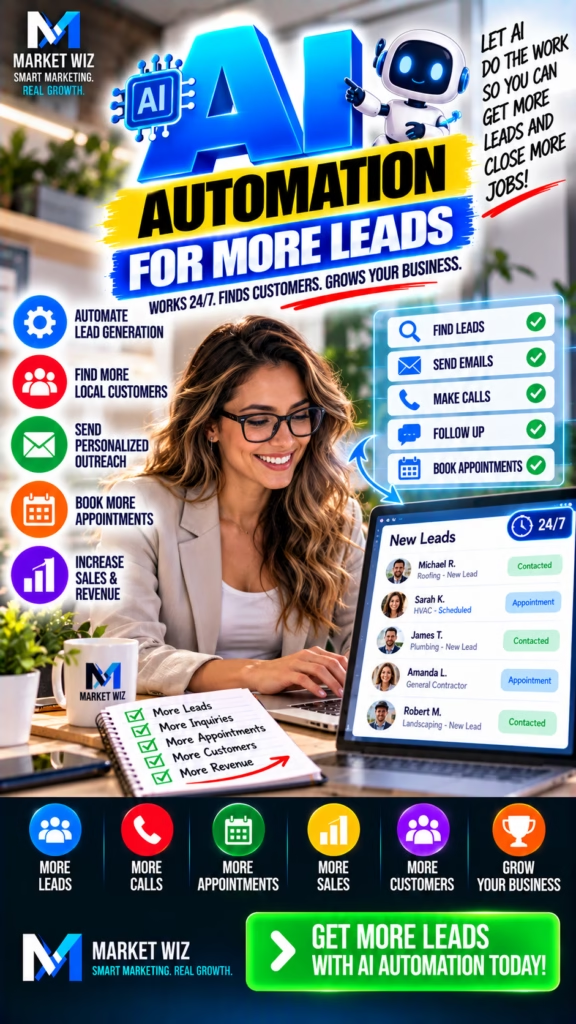
AI automation can help businesses turn more marketing activity into organized sales opportunities by improving response speed, capturing customer information, qualifying prospects, routing leads, scheduling appointments, updating CRM systems, automating follow-up, and keeping potential customers moving through the sales pipeline.
Why AI Automation Can Help Businesses Generate More Leads
Many businesses do not have a traffic problem alone. They have a customer acquisition workflow problem.
Marketing may already be generating phone calls, website forms, emails, social media messages, marketplace inquiries, advertising leads, Google Maps activity, referrals, and other potential opportunities.
The problem begins when those opportunities are not handled consistently.
A lead may arrive while the sales team is busy. A website inquiry may sit unanswered. A missed call may never receive a follow-up. A promising prospect may not be entered into the CRM. A customer who is interested but not ready today may never hear from the company again.
AI automation can help businesses close these operational gaps.
More leads do not always require more advertising. Businesses can often create additional sales opportunities by responding faster, recovering missed inquiries, qualifying prospects more efficiently, following up consistently, and getting more value from the leads their marketing already produces.
Think Beyond AI Lead Generation and Build an AI Lead System
The phrase AI lead generation is often used as if artificial intelligence automatically creates customers.
In practice, a stronger strategy connects AI to a complete customer acquisition process.
The system begins with visibility and lead sources. It then connects those sources to response, qualification, scheduling, CRM management, sales follow-up, and measurement.
AI becomes more valuable when the workflow is connected
Automating one isolated task may save time. Connecting multiple customer acquisition steps can create a much larger operational advantage.
Connect AI Automation to Multiple Lead Sources
Modern businesses often generate prospects through many different channels.
Without a centralized process, every channel can become another place where opportunities are lost.
Website Leads
Forms, chat interactions, quote requests, consultation requests, and other website conversion points can enter structured lead workflows.
Phone Calls
Incoming calls and missed-call workflows can connect with notifications, CRM records, follow-up, and sales routing.
Google Maps
Prospects discovering the business through local search can move into organized response and customer acquisition workflows.
Social Media
Social inquiries can be routed into an organized process rather than remaining disconnected from the primary sales pipeline.
Advertising
Paid lead sources can connect directly to response, qualification, appointment, and CRM processes.
Organic Marketing
SEO, marketplaces, directories, content, referrals, and other organic channels can feed the same centralized sales system.
Use AI Automation to Capture More Lead Information
An inquiry becomes more useful when the business knows enough about the prospect to take the correct next step.
AI systems can support structured information collection during the early stages of the customer journey.
Depending on the business, useful information may include a customer's name, phone number, email address, location, desired product or service, project type, timeline, budget considerations, purchase intent, preferred appointment time, or other relevant details.
Collect information with a purpose
Businesses should avoid creating unnecessarily long automated interviews.
The objective is to collect enough information to move the customer forward while keeping the experience efficient.
Improve Lead Response Time With AI Automation
Lead response speed can influence whether a prospective customer remains engaged.
Many prospects contact multiple businesses during the same research session.
A company that responds efficiently can begin the conversation while the customer's interest is still active.
AI can support immediate first-touch workflows
Depending on the channel and configuration, automation can acknowledge the inquiry, ask an initial question, collect contact information, notify the appropriate team member, create a CRM record, or move the prospect toward scheduling.
Capture Leads After Business Hours
Customers do not limit their research to a company's operating hours.
They may browse websites at night, search Google on weekends, respond to advertisements during lunch, or send inquiries whenever they have time.
A business that relies entirely on manual response may leave these opportunities untouched until the next workday.
AI automation can provide an appropriate initial interaction, collect information, communicate expectations, and prepare the opportunity for follow-up.
Automation does not require pretending the business is open when it is not. A well-designed system can clearly manage expectations while still capturing the customer's information and intent.
Qualify Leads Automatically Before Sales Follow-Up
Not every inquiry represents the same potential value.
Some prospects are ready to buy. Some are conducting early research. Others may be outside the company's territory, looking for something the business does not provide, or lacking other important qualification criteria.
AI can help organize these differences.
Build qualification around the business model
A contractor may qualify by project type, location, timeline, and scope.
A dealership may qualify by vehicle interest, financing needs, trade-in status, and purchase timeframe.
A B2B company may qualify by industry, company size, location, decision-maker status, need, and timing.
The questions should match the actual sales process.
Prioritize High-Intent Leads With AI Workflows
Sales teams can lose time when every inquiry is treated as equally urgent.
AI-supported workflows can organize prospects according to company-defined criteria.
A high-intent lead may trigger an immediate notification. A longer-term prospect may enter a nurture workflow. An inquiry outside the company's market may receive an appropriate response without consuming the same level of sales attention.
Help salespeople focus where human attention matters most
The objective is not to ignore lower-priority prospects. It is to organize the pipeline so valuable sales time is allocated intelligently.
Route Leads Automatically to the Right Person
Larger businesses may have multiple salespeople, departments, territories, stores, branches, products, services, or markets.
Manual lead distribution can create delays and confusion.
Automated routing can use predefined business rules to send a prospect to the appropriate destination.
Routing rules can consider:
- Customer location
- Sales territory
- Product interest
- Service category
- Project type
- Lead source
- Business location
- Sales representative
- Availability
- Qualification level
Use AI Automation to Generate More Appointments
For many businesses, a lead is only the beginning.
Revenue depends on moving the prospect toward a concrete next step.
That next step may be a consultation, demonstration, estimate, showroom visit, discovery call, property tour, inspection, sales call, or other appointment.
AI automation can support the transition from inquiry to scheduled conversation.
Reduce unnecessary scheduling friction
When appropriate, the system can collect qualification information, identify scheduling options, create the appointment, record it, and notify the relevant team.
Connect AI Lead Automation With Your CRM
A CRM should become the operational record of the customer acquisition process.
When lead information remains scattered across inboxes, spreadsheets, text threads, social messages, and employee notes, opportunities become difficult to manage.
AI automation can help move relevant customer information into a structured system.
Useful CRM automation can include:
- Creating new lead records
- Recording contact information
- Recording lead sources
- Adding qualification information
- Updating pipeline stages
- Adding conversation notes
- Creating follow-up tasks
- Recording appointment information
- Notifying salespeople
- Tracking outcomes
Automate Lead Follow-Up Without Losing Organization
Many prospects do not purchase during the first interaction.
A customer may need time to compare options, discuss the decision, arrange financing, wait for a project date, obtain approval, sell another asset, or simply think about the purchase.
Businesses without a follow-up system often lose these prospects.
Create follow-up based on customer stage
A prospect who requested an estimate yesterday should not receive the same communication as someone who inquired six months ago.
Automated workflows can help organize follow-up according to the prospect's stage, previous interaction, and appropriate next action.
Use AI Automation to Reactivate Older Leads
Old lead databases can contain significant unrealized value.
Businesses may have hundreds or thousands of former inquiries that never became customers.
Some prospects may no longer be relevant. Others may simply have been contacted at the wrong time.
An organized reactivation strategy can reconnect with eligible prospects and determine whether their needs have changed.
Turn dormant data into a measurable campaign
Businesses can segment old prospects, define appropriate outreach rules, record responses, identify renewed interest, and route engaged leads back into the active sales pipeline.
Recover Opportunities From Missed Calls
Phone calls remain important for many local and high-consideration businesses.
But employees cannot answer every call.
A call may arrive while the team is speaking with another customer, driving, working on-site, attending a meeting, or outside normal business hours.
Missed-call workflows can help ensure the opportunity is not silently abandoned.
Build a clear recovery process
The system can create an internal alert, initiate an appropriate customer follow-up, create a CRM task, or route the opportunity to another available team member depending on the business process.
Turn Website Traffic Into More Leads With AI
Website traffic has little value if visitors cannot easily take the next step.
Businesses can improve website conversion by creating clear paths for prospects to ask questions, request information, call, submit a form, schedule a conversation, or begin another appropriate sales action.
AI can support these conversion points by helping capture information and moving the prospect into an organized workflow.
Connect every website conversion point to the sales process
Forms and chat experiences should not create isolated messages that employees must manually rediscover later.
They should connect to notifications, CRM tracking, qualification, scheduling, and follow-up where appropriate.
Combine AI Automation With Google Maps Lead Generation
Google Maps and local search can generate high-intent customer discovery for many local businesses.
A prospect may find the company, read reviews, view photos, visit the website, or call.
AI automation can support what happens after that discovery.
The lead can be acknowledged, recorded, qualified, routed, scheduled, and followed up instead of being treated as an isolated phone call or form submission.
Use AI Workflows to Support Marketplace Leads
Marketplace and classified channels can create large numbers of customer inquiries for eligible products and offers.
The operational challenge is often response management.
Repetitive questions, incomplete contact information, low-intent messages, and inconsistent employee response can make these channels difficult to scale.
Create a structured path from inquiry to sales opportunity
Where appropriate and consistent with platform requirements, businesses can use organized workflows to capture information, identify serious prospects, record leads, notify sales teams, and move qualified opportunities toward phone calls, appointments, or other next steps.
Use AI Automation for B2B Lead Generation
AI automation is not limited to consumer marketing.
B2B organizations can use AI-supported systems to organize prospecting, lead research, outreach preparation, qualification, CRM updates, follow-up, and appointment generation.
The workflow can be built around specific target industries, geographic markets, company types, buyer roles, or business needs.
Combine prospect discovery with sales organization
Finding a potential business customer is only one part of B2B customer acquisition.
The company also needs accurate data, relevant outreach, follow-up, qualification, routing, and sales pipeline tracking.
AI Lead Automation for Local Businesses
Local businesses can benefit significantly from faster and more consistent customer response.
A contractor may receive inquiries while employees are on jobsites. A retailer may receive messages while staff members are assisting customers. A dealership may receive leads after closing. A property company may receive inquiries across many listings.
AI can help bridge these gaps.
Local lead workflows can support:
- Contractors
- Home improvement companies
- HVAC companies
- Plumbing companies
- Painting companies
- Roofing companies
- Furniture retailers
- Mattress stores
- Automotive dealerships
- RV dealerships
- Real estate companies
- Property managers
- Commercial real estate companies
- Professional businesses
- Multi-location companies
Use AI to Make Sales Teams More Efficient
Salespeople create the most value when they are communicating with qualified prospects, understanding customer needs, building relationships, answering complex questions, presenting solutions, and closing business.
They create less value when spending large portions of the day copying information between systems, repeatedly asking basic qualification questions, manually setting reminders, or searching through inboxes for old leads.
Automate administrative friction
AI can support repetitive work so salespeople have more time for conversations requiring human judgment and relationship-building.
Send Real-Time Sales Notifications for Important Leads
Not every lead requires the same notification urgency.
AI workflows can trigger alerts when a prospect meets important criteria.
For example, a high-value project inquiry, qualified commercial prospect, ready-to-buy customer, scheduled appointment, or returning lead may justify immediate attention.
Give sales teams context with the alert
A useful notification should include enough information for the salesperson to understand who the prospect is, what they want, where the lead originated, and what has already happened.
Use Customer Data to Make Automated Follow-Up More Relevant
Automation should not require every prospect to receive identical communication.
Customer information can help determine which follow-up path is appropriate.
A business may organize leads by product, location, project type, buying stage, appointment status, previous conversation, lead source, or other relevant characteristics.
Relevant automation is more useful than generic automation
The purpose of personalization is not to create artificial familiarity. It is to make the customer journey more relevant to the prospect's actual needs.
Scale AI Lead Automation Across Multiple Locations
Multi-location companies face additional complexity because leads may need to reach different branches, stores, territories, managers, or sales teams.
Automation can create standardized routing rules while preserving location-specific ownership.
Centralize standards while keeping local execution organized
The company can standardize lead fields, qualification criteria, response expectations, CRM stages, reporting, and follow-up while routing opportunities to the appropriate local team.
Measure AI Automation With Sales Metrics
Businesses should evaluate AI automation using more than the number of automated messages sent.
The system should ultimately support measurable customer acquisition outcomes.
| Stage | Metric | What It Shows |
|---|---|---|
| Lead Capture | Total inquiries | How many opportunities enter the system |
| Response | Response time | How quickly new prospects receive attention |
| Qualification | Qualified lead rate | How many inquiries match the business's target criteria |
| Scheduling | Appointments | How many prospects move toward a concrete sales action |
| Opportunity | Sales opportunities | How many leads become serious potential customers |
| Conversion | Closed customers | How many opportunities produce sales |
| Revenue | Attributed revenue | The financial value created by the lead system |
| Efficiency | Cost per qualified lead | How efficiently marketing and automation produce viable prospects |
Use Lead Data to Continuously Improve AI Automation
AI automation should not be treated as a set-it-and-forget-it project.
Real customer interactions can reveal where the workflow should improve.
Businesses may discover that a qualification question creates unnecessary friction, one lead source produces stronger opportunities, certain follow-up timing performs better, or specific markets create more profitable customers.
Optimize around business outcomes
Workflow changes should be based on what improves customer experience, lead quality, sales efficiency, appointments, conversion, and revenue.
Common AI Lead Automation Mistakes to Avoid
Automation can create efficiency, but poor automation can create new problems.
Common mistakes include:
- Automating a broken sales process
- Using too many qualification questions
- Failing to define clear lead ownership
- Sending irrelevant follow-up
- Failing to route important leads to humans
- Leaving CRM data incomplete
- Ignoring older prospects
- Failing to create missed-call workflows
- Using automation without clear customer expectations
- Measuring message volume instead of sales outcomes
- Failing to monitor workflow quality
- Using inaccurate business information
- Over-automating complex customer conversations
- Failing to respect applicable communication requirements
- Allowing leads to move between systems without consistent tracking
Build a Repeatable AI Lead Generation Workflow
A strong AI lead system can be developed step by step.
Map Every Lead Source
Identify where phone calls, forms, emails, social inquiries, marketplace leads, advertisements, referrals, Google Maps prospects, and other opportunities originate.
Define the First Response
Determine what should happen immediately after a new lead enters the business.
Define Qualification Criteria
Identify the information needed to determine whether a prospect fits the company's target customer profile.
Route the Lead
Send qualified opportunities to the correct salesperson, branch, department, territory, or workflow.
Create the CRM Record
Preserve important customer and source information in a centralized sales system.
Move Toward the Next Action
Guide qualified prospects toward a call, estimate, consultation, demonstration, appointment, or other appropriate next step.
Automate Follow-Up
Create appropriate follow-up paths for prospects who do not immediately move forward.
Track Sales Outcomes
Measure which leads become qualified opportunities, appointments, customers, and revenue.
Improve the Workflow
Use real performance data to refine qualification, routing, response, follow-up, and sales processes.
Turn AI Automation Into a Long-Term Growth System
The largest opportunity with AI automation is not one chatbot, one automated email, or one lead form.
It is the ability to connect customer acquisition activities into a repeatable operating system.
Marketing generates visibility. Lead sources capture interest. Automation creates a faster first response. Qualification identifies stronger prospects. Routing places those prospects with the right people. CRM tracking creates organization. Follow-up keeps future opportunities active. Reporting shows what creates revenue.
AI automation is most powerful when it supports the entire path from inquiry to customer. The business can use automation to reduce avoidable delays and repetitive work while preserving human involvement where judgment, trust, expertise, negotiation, and relationship-building matter most.
30 FAQs About AI Automation for More Leads
1. What is AI automation for lead generation?
AI automation for lead generation uses artificial intelligence and automated workflows to support lead capture, response, qualification, routing, CRM updates, appointment scheduling, follow-up, nurturing, and sales pipeline management.
2. Can AI automation help businesses generate more leads?
AI automation can help businesses capture and manage more opportunities by improving response speed, reducing missed inquiries, supporting outreach, organizing follow-up, and helping sales teams handle larger lead volumes.
3. How does AI improve lead response time?
AI systems can acknowledge inquiries quickly, collect initial information, answer appropriate routine questions, route prospects, notify team members, and trigger the next step without waiting for a manual process to begin.
4. Can AI qualify leads automatically?
AI can support lead qualification by asking predefined questions, collecting customer information, applying business rules, and organizing prospects according to criteria established by the company.
5. Can AI schedule appointments with leads?
AI can support appointment scheduling by identifying qualified prospects, presenting appropriate scheduling options, recording appointments, and sending information to the relevant team or calendar workflow.
6. Can AI automate lead follow-up?
AI and workflow automation can support follow-up through approved email, text, phone, CRM, and other communication processes based on the company's sales strategy and applicable requirements.
7. Can AI update a CRM automatically?
AI automation can support CRM updates by recording lead information, changing pipeline stages, adding notes, creating tasks, triggering notifications, and preserving relevant conversation data.
8. Can AI help recover missed leads?
Automation can help reduce missed opportunities by creating workflows for unanswered inquiries, missed calls, abandoned forms, older prospects, and leads that require additional follow-up.
9. Can AI respond to leads after business hours?
Properly configured AI systems can provide appropriate initial responses outside normal business hours, collect information, set expectations, and prepare the opportunity for human follow-up when necessary.
10. Can AI lead generation work for local businesses?
Local businesses can use AI automation to support inquiries from websites, Google Maps, social media, advertising, marketplaces, phone calls, and other customer acquisition channels.
11. Can AI automation help home service companies?
Home service companies can use AI automation to support customer inquiries, qualification, scheduling, lead routing, reminders, CRM workflows, and follow-up.
12. Can AI automation help B2B companies?
B2B companies can use AI to support prospect research, outreach preparation, lead capture, qualification, sales routing, CRM management, follow-up, and appointment workflows.
13. Does AI replace a sales team?
AI does not need to replace a sales team. It can support repetitive and time-sensitive tasks while salespeople focus on conversations, relationships, negotiations, complex questions, and closing opportunities.
14. Can AI improve lead conversion rates?
AI can support conversion by improving response speed, consistency, qualification, routing, follow-up, and sales organization, although results depend on the offer, market, lead quality, implementation, and sales process.
15. What lead sources can connect with AI automation?
Depending on the technology and integrations used, businesses may connect websites, forms, phone systems, email, social channels, advertising sources, CRM platforms, spreadsheets, marketplaces, and other lead sources.
16. Can AI prioritize high-quality leads?
AI workflows can help prioritize prospects using company-defined information such as location, project type, purchase intent, timeline, budget range, company size, product interest, or other relevant criteria.
17. Can AI reactivate old leads?
Businesses can use appropriately configured follow-up campaigns to reconnect with older prospects who previously expressed interest but did not purchase.
18. Can AI automate sales notifications?
AI workflows can notify salespeople when new leads arrive, when qualification criteria are met, when appointments are scheduled, or when prospects take important actions.
19. Can AI help businesses get more phone calls?
AI can support marketing and follow-up systems designed to move qualified prospects toward phone conversations while helping businesses respond efficiently to incoming calls and inquiries.
20. Can AI work with Google Maps lead generation?
AI automation can support leads generated through Google Maps and local search by improving response, routing, qualification, appointment workflows, CRM tracking, and follow-up.
21. Can AI work with Facebook Marketplace leads?
Where appropriate and consistent with platform requirements, businesses can use automation and organized sales workflows to support inquiries originating from Facebook Marketplace.
22. Can AI work with website leads?
Website forms, chat experiences, calls, and other conversion points can feed lead information into automated response, qualification, CRM, scheduling, and follow-up workflows.
23. How quickly should businesses respond to leads?
Businesses should generally respond as promptly as practical because prospective customers may contact multiple companies and may become harder to reach as time passes.
24. What should businesses track with AI lead automation?
Businesses can track inquiries, response time, qualified leads, appointments, follow-up activity, sales opportunities, conversion rates, acquisition costs, closed customers, revenue, and other relevant performance indicators.
25. Can AI help multi-location businesses manage leads?
AI workflows can help route leads by location, territory, department, product, service, salesperson, or other company-defined rules.
26. What is AI lead nurturing?
AI lead nurturing uses automated workflows and customer information to support appropriate follow-up with prospects who are interested but not yet ready to purchase.
27. Can AI help reduce lost leads?
AI automation can help reduce lost opportunities by improving response consistency, creating reminders, recording information, routing prospects, and maintaining follow-up workflows.
28. What businesses can use AI lead automation?
AI lead automation can support many businesses, including local service companies, retailers, dealerships, real estate companies, contractors, professional firms, B2B companies, multi-location organizations, and other businesses with repeatable lead workflows.
29. How should businesses start with AI automation?
Businesses can begin by mapping existing lead sources, response processes, qualification criteria, CRM stages, appointment workflows, follow-up steps, and performance metrics before deciding which repetitive tasks should be automated.
30. What is the goal of AI automation for more leads?
The goal is to create a more responsive and organized customer acquisition system that captures opportunities, moves qualified prospects forward, reduces avoidable lead loss, and helps the business convert marketing activity into measurable sales outcomes.
30 Additional SEO Keywords
These keyword themes can support website pages, long-form content, local SEO, AI marketing pages, sales automation content, lead generation campaigns, videos, and customer acquisition strategies.
Turn AI Automation Into a More Powerful Lead Generation System
AI automation can change how a business thinks about lead generation.
Traditional marketing discussions often focus almost entirely on generating additional traffic.
More website visitors.
More advertisement clicks.
More impressions.
More social media reach.
More marketplace visibility.
More Google searches.
These activities can be valuable, but visibility alone does not create customers.
The business still needs to capture the prospect.
It needs to respond.
It needs to understand what the customer wants.
It needs to determine whether the prospect is qualified.
It needs to move the opportunity toward a concrete sales action.
It needs to record what happened.
It needs to follow up when the customer is not immediately ready.
And eventually, it needs to determine whether the marketing investment produced revenue.
AI automation can support each of these stages.
The process begins with lead capture.
Businesses often generate inquiries across many disconnected channels.
A customer may call after finding the company on Google Maps.
Another may submit a website form.
Someone else may send a social media message.
A prospect may respond to a marketplace listing.
A commercial buyer may reply to an outreach campaign.
Another customer may arrive from paid advertising.
If every source has a different manual process, opportunities become difficult to manage.
A connected AI workflow can help create consistency.
The prospect enters the system.
Relevant information is collected.
The source is recorded.
The appropriate response begins.
The lead is routed.
The CRM is updated.
The next action is created.
This reduces the dependence on employees remembering every administrative step.
Response speed is another major opportunity.
Prospective customers often have multiple options.
A homeowner may contact several contractors.
A vehicle shopper may inquire with multiple dealerships.
A commercial tenant may contact multiple property representatives.
A business buyer may evaluate several vendors.
A consumer may send messages to several marketplace sellers.
The company does not control how many competitors the customer contacts.
It can control how organized its own response process is.
AI can help acknowledge inquiries quickly.
It can begin collecting information.
It can notify the correct person.
It can prepare the prospect for the next step.
This is particularly useful outside normal business hours.
Customer research does not stop when the office closes.
People search, browse, compare, and submit inquiries whenever it is convenient for them.
A well-designed automated workflow can capture the opportunity without misleading the customer about employee availability.
The system can explain what happens next.
It can collect useful information.
It can create an internal record.
And it can prepare the lead for follow-up.
Qualification can create another major efficiency gain.
Businesses frequently waste sales time on prospects who are outside their geographic territory, interested in something the company does not provide, too early in the buying process, or otherwise misaligned with the company's customer profile.
A structured qualification workflow can identify these differences earlier.
The exact criteria will vary by business.
A home service company may care about ZIP code, project type, urgency, and property details.
A retailer may care about product interest, location, delivery needs, financing, and purchase timing.
A dealership may care about inventory interest, trade-in information, financing needs, and appointment availability.
A B2B company may care about industry, company size, buyer role, geographic market, current problem, and purchasing timeline.
A commercial real estate company may care about desired square footage, location, use, move-in date, lease requirements, and contact information.
AI can help collect these details before a salesperson invests significant time.
The objective is not to make the customer navigate a complicated interrogation.
The strongest workflow asks only what is useful.
Qualification should reduce friction rather than create it.
Once the lead is qualified, routing becomes important.
A single-location company may simply need to notify one salesperson.
A larger organization may require more sophisticated logic.
Leads may need to be routed according to city, territory, department, product, service, property, salesperson, business unit, or qualification level.
Automation can create consistency in this process.
The customer does not need to wait while employees manually determine who should handle the inquiry.
The correct team can receive the opportunity with relevant context.
Appointment generation is another critical stage.
Businesses should define what action moves a qualified prospect closer to becoming a customer.
For one company, that may be a phone call.
For another, it may be an estimate.
It may be a showroom appointment.
It may be a property tour.
It may be a demonstration.
It may be a consultation.
It may be a discovery call.
AI automation can help guide qualified prospects toward that action.
This creates a more meaningful metric than raw lead volume.
A business may receive 500 inquiries, but if only five become viable sales opportunities, the raw number tells an incomplete story.
Another campaign may produce only 100 inquiries but create 25 qualified appointments.
The second campaign may be much more valuable.
This is why CRM integration matters.
Every meaningful lead should have a place in the sales pipeline.
The CRM can record where the prospect came from.
It can record what the customer wants.
It can record qualification information.
It can record conversations.
It can record appointments.
It can record follow-up.
It can record sales outcomes.
Over time, this creates data that can improve marketing decisions.
The company can compare lead sources.
It can determine which channels create the most qualified prospects.
It can measure appointment rates.
It can monitor conversion.
It can identify which markets produce stronger customers.
It can compare product or service categories.
It can connect sales activity with revenue.
Follow-up becomes easier when the CRM and automation system work together.
Not every customer is ready immediately.
Some prospects need a few days.
Some need a few weeks.
Some may not be ready for several months.
Without organization, these prospects often disappear.
A salesperson may intend to call back but forget.
An employee may leave the company.
Notes may remain in a personal inbox.
A spreadsheet may stop being updated.
An old message thread may never be reopened.
Automation can create structured follow-up paths.
Prospects can remain organized according to their stage.
Salespeople can receive reminders when human outreach is needed.
Older prospects can be re-evaluated later.
This creates the possibility of lead reactivation.
A business with years of historical inquiries may already possess a valuable audience.
Those prospects once expressed interest.
Their circumstances may have changed.
A customer who was not ready last year may be ready today.
A business that postponed a purchase may now have budget approval.
A homeowner may finally be ready to begin a project.
A buyer may need a replacement product.
An organized reactivation workflow can identify renewed demand.
This demonstrates an important principle.
More leads do not always mean finding completely new people.
Sometimes growth comes from managing existing opportunities better.
Missed calls provide another example.
A customer who calls has taken a meaningful action.
If nobody answers, the business should have a defined recovery process.
That may involve an internal notification, an automated task, an appropriate customer communication, or routing to another team member.
The important point is that the missed call should not simply vanish.
The same principle applies to abandoned forms, unanswered messages, incomplete appointment requests, and other interrupted customer journeys.
AI automation can help businesses identify these gaps.
It can create a workflow for what happens next.
Multi-location companies can gain additional value from automation.
As the organization grows, lead management becomes more complex.
Different locations may have different salespeople.
Different territories may have different availability.
Certain products may only be offered in specific markets.
Leads may need to reach specialized teams.
Automation can standardize the overall customer acquisition process while preserving local routing.
This can help management compare performance across locations.
One branch may respond faster.
Another may generate higher appointment rates.
One market may produce more qualified leads.
Another may convert better after follow-up.
Centralized data makes these patterns easier to identify.
AI can also improve sales team efficiency.
Salespeople should spend as much time as possible on high-value human activities.
Understanding customer needs.
Explaining solutions.
Building relationships.
Answering complex questions.
Preparing proposals.
Negotiating.
Closing business.
Repetitive administrative work can reduce the amount of time available for those activities.
AI automation can support data entry, notifications, qualification, routing, task creation, appointment workflows, and other repeatable processes.
This does not eliminate the need for human sales expertise.
It can make that expertise more scalable.
The business should still determine where human involvement is required.
Complex pricing questions may require an employee.
Technical recommendations may require a specialist.
Contractual issues require appropriate oversight.
Sensitive customer situations may require human judgment.
High-value negotiations should not be reduced to generic automation.
AI should support these processes rather than obscure responsibility.
Measurement is what turns automation from a technology experiment into a business system.
Businesses should monitor how many opportunities enter the pipeline.
They should measure response speed.
They should measure qualification rates.
They should track appointments.
They should track opportunities.
They should track closed customers.
They should track revenue when attribution is practical.
These metrics reveal whether automation is actually improving customer acquisition.
The business may discover that response time improved dramatically but conversion did not.
That may indicate a qualification, offer, sales, or lead quality problem.
The company may discover that appointments increased but attendance remained low.
That may reveal an opportunity to improve reminders or scheduling workflows.
It may discover that one channel creates many leads but very few customers.
That may justify shifting marketing resources.
Data creates better decisions.
AI automation can help collect that data consistently.
Over time, the entire system can become more intelligent operationally.
The company learns which questions identify strong prospects.
It learns which sources create valuable customers.
It learns how quickly different leads need attention.
It learns which follow-up sequences create responses.
It learns which markets produce stronger opportunities.
It learns which appointment types convert.
It learns where customers are dropping out of the sales process.
These insights can guide future workflow improvements.
The strongest AI lead generation strategy therefore extends far beyond installing a chatbot.
It begins by understanding how customers enter the business.
It maps what should happen after each inquiry.
It defines qualification.
It defines routing.
It defines the next sales action.
It creates CRM visibility.
It creates follow-up.
It measures outcomes.
Then automation is applied where it creates meaningful efficiency.
This approach can help businesses generate more value from organic marketing, Google Maps, SEO, social media, marketplaces, websites, paid advertising, B2B outreach, referrals, phone calls, and other lead sources.
Every channel can feed the same organized customer acquisition engine.
The result is a business that is less dependent on employees manually remembering every next step.
Leads are captured more consistently.
Prospects receive faster attention.
Qualification becomes more organized.
Salespeople receive better context.
Follow-up becomes more reliable.
Management receives better data.
Marketing performance becomes easier to evaluate.
And more of the opportunities already entering the business have a chance to become real customers.
That is the larger opportunity behind AI automation for more leads.
AI can support visibility.
AI can support response.
AI can support qualification.
AI can support routing.
AI can support scheduling.
AI can support CRM management.
AI can support follow-up.
AI can support reactivation.
AI can support reporting.
But the real value comes from connecting those capabilities into a coherent sales system.
When marketing, AI automation, CRM workflows, salespeople, and performance tracking work together, businesses can build a more responsive and scalable customer acquisition operation.
Build a Smarter AI Lead Generation System
Market Wiz AI helps established businesses connect AI-powered lead response, Google Maps optimization, SEO, social marketing, marketplace visibility, customer qualification, appointment generation, CRM workflows, follow-up automation, B2B customer acquisition, and performance tracking into a more organized growth system.
Get Started With Market Wiz AI© Market Wiz AI. AI automation capabilities vary by platform, integration, business process, data quality, configuration, and applicable communication requirements. Businesses should maintain appropriate human oversight for important customer, financial, contractual, technical, legal, and operational decisions.