

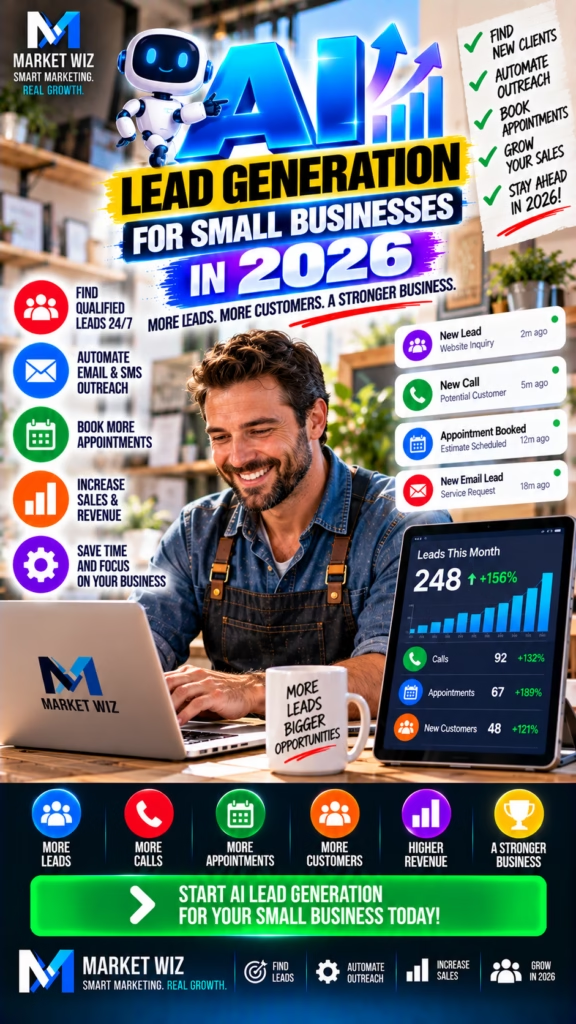
AI Lead Generation for Small Businesses in 2026
Small businesses in 2026 can use AI to build faster, more organized customer acquisition systems that capture inquiries, respond to prospects, qualify leads, schedule appointments, automate follow-up, update CRM pipelines, support local marketing, and help smaller teams manage more sales opportunities without depending entirely on manual processes.
AI Is Changing Small Business Lead Generation in 2026
Small business lead generation has traditionally required a difficult balance between marketing, sales, customer service, administrative work, and follow-up.
Larger companies can assign different employees or departments to these responsibilities. Small businesses often cannot.
The same owner, manager, salesperson, office administrator, or small team may be responsible for answering calls, responding to website forms, monitoring social inquiries, following up with estimates, managing advertising leads, updating customer records, scheduling appointments, and trying to close new business.
AI creates an opportunity to reorganize this process.
Instead of treating artificial intelligence as a standalone chatbot or content-writing tool, small businesses can use AI as part of a larger customer acquisition system.
The major AI opportunity for small businesses in 2026 is operational leverage. AI can help a smaller team respond to more opportunities, perform repetitive tasks consistently, organize lead data, automate follow-up, and give employees more time for customer conversations that require human judgment.
What AI Lead Generation Means for a Small Business
AI lead generation is broader than using software to find names and email addresses.
A complete AI lead generation strategy can support the entire path between customer discovery and a qualified sales opportunity.
That path may include generating visibility, capturing an inquiry, responding to the prospect, collecting information, determining whether the lead is a good fit, routing the opportunity, scheduling a conversation, recording data in a CRM, following up, and tracking the final sales outcome.
AI should connect marketing with sales execution
Small businesses receive the greatest value when AI is connected to real customer acquisition workflows instead of operating as an isolated technology.
Why Small Businesses Can Benefit From AI Lead Generation
Small businesses frequently compete against organizations with larger advertising budgets and bigger sales teams.
AI does not remove those differences, but it can reduce some of the operational disadvantages created by limited staffing.
Faster Response
Automation can help new inquiries receive attention quickly instead of waiting until an employee becomes available.
Better Organization
Lead information can move into consistent CRM, spreadsheet, notification, and sales workflows.
More Consistent Follow-Up
Businesses can create defined follow-up processes instead of relying entirely on employees remembering every prospect.
Greater Capacity
A small team can manage a larger volume of routine lead activity when repetitive tasks are automated appropriately.
Better Lead Prioritization
Qualification workflows can help employees identify which prospects require immediate human attention.
Improved Measurement
Connected systems can help businesses understand which marketing channels create qualified leads, appointments, customers, and revenue.
Connect Every Small Business Lead Source
Small businesses rarely depend on only one marketing channel.
A local company may receive phone calls from Google Maps, forms from its website, messages from social media, inquiries from advertising, referrals from existing customers, marketplace responses, email inquiries, and prospects from local SEO.
B2B companies may also use prospecting, email outreach, professional networking, directories, databases, trade organizations, and outbound sales.
AI automation can help connect these sources to a centralized process.
Lead source visibility matters
The business should know where each opportunity originated whenever practical.
Without source tracking, it becomes difficult to determine which marketing investments create meaningful customers.
Combine AI Lead Generation With Local Search
Local search remains an important customer discovery channel for many small businesses.
Consumers looking for contractors, retailers, professional companies, home improvement providers, dealerships, property companies, and other nearby businesses frequently begin with search engines and map results.
AI does not replace the need for local visibility.
Instead, AI can improve what happens after visibility produces an inquiry.
Connect discovery with response
A customer finds the business, visits the website or calls, enters a lead workflow, receives an appropriate response, provides additional information, and moves toward the next sales action.
This creates a more complete customer acquisition system than local visibility alone.
Use AI With Google Maps Lead Generation
Google Maps can place local businesses directly in front of consumers who are searching for nearby products and providers.
Those prospects may review business information, read customer reviews, view photos, visit the website, request directions, or call.
Businesses should have a process for handling the demand generated by that visibility.
AI can support incoming leads by organizing contact information, triggering notifications, helping with qualification, updating sales records, and supporting follow-up.
Visibility and response should be treated as one customer journey. Ranking locally creates an opportunity. The lead management system determines what the business does with that opportunity.
Turn Small Business Website Traffic Into Leads
A small business website should do more than describe the company.
It should create clear opportunities for potential customers to take action.
Depending on the business, that may include calling, requesting a quote, submitting a form, asking a question, scheduling a consultation, requesting product information, or starting another appropriate sales conversation.
Connect website conversions to automated workflows
A submitted form should not simply arrive in an inbox and wait.
The system can create a lead record, record the source, notify the appropriate employee, trigger an initial response, collect additional information, and create the next sales task.
Use AI to Improve Small Business Lead Response Time
Small business owners are often busy doing the actual work their customers pay them to perform.
Contractors may be on jobsites. Retail employees may be assisting customers. Real estate professionals may be showing properties. Business owners may be in meetings. Salespeople may already be on calls.
New inquiries can arrive during all of these situations.
AI automation can support a faster initial response without requiring an employee to abandon the work already in progress.
Speed should support quality
A fast but inaccurate response can create problems.
Businesses should define what the automated system is allowed to communicate, what information it should collect, and when a human should take over.
Capture Leads Outside Normal Business Hours
Prospective customers may research businesses early in the morning, late at night, during weekends, or on holidays.
A small company may not have employees available around the clock.
AI-supported workflows can help capture the inquiry, collect relevant information, set appropriate expectations, and prepare the opportunity for later follow-up.
Do not confuse automation with false availability
Businesses can communicate clearly when an employee is unavailable while still creating a useful customer experience.
Qualify Small Business Leads Automatically
Lead volume alone does not determine marketing success.
A small business may receive many inquiries that are outside its territory, unrelated to its offerings, too early in the buying process, or otherwise unlikely to become customers.
Qualification helps separate general interest from stronger sales opportunities.
Useful qualification criteria may include:
- Customer location
- Desired product or service
- Project type
- Project size
- Purchase timeframe
- Appointment availability
- Budget range when relevant
- Business type for B2B leads
- Company size
- Decision-maker status
- Property type
- Inventory interest
- Urgency
- Other company-specific requirements
Use AI to Prioritize the Best Sales Opportunities
A small team cannot always contact every prospect at exactly the same moment.
Prioritization helps employees determine where immediate attention is most valuable.
A prospect requesting an appointment for a high-value project may deserve faster escalation than an early-stage visitor requesting general information.
A B2B prospect matching the company's ideal customer profile may require a different workflow from an unqualified inquiry.
Prioritization should follow transparent business rules
Businesses should define the factors that make a lead important rather than allowing an automated system to operate without clear sales criteria.
Turn AI Leads Into Appointments
Small businesses should identify the action that moves a qualified prospect closer to revenue.
That action varies by company.
Contractors may want an estimate appointment. A professional business may want a consultation. A dealership may want a showroom visit or sales call. A property company may want a tour. A B2B company may want a discovery meeting.
AI can support the transition between initial inquiry and the appropriate next step.
Use AI to Keep the Small Business CRM Updated
CRM systems are useful only when information reaches them consistently.
Small teams frequently struggle with manual data entry because employees naturally prioritize immediate customer work over administrative updates.
Automation can reduce this burden.
AI-supported CRM workflows may help:
- Create lead records
- Record contact details
- Identify lead sources
- Save qualification information
- Assign lead ownership
- Update pipeline stages
- Create follow-up tasks
- Record appointment information
- Trigger sales notifications
- Preserve relevant notes
Automate Small Business Lead Follow-Up
One of the most common sources of lost revenue is inconsistent follow-up.
A prospect may be genuinely interested but not ready to make a decision immediately.
If the business never reconnects, a competitor may eventually receive the sale.
AI-supported workflows can help businesses maintain organized follow-up without requiring employees to remember every future action manually.
Follow-up should reflect the customer's stage
A new inquiry, completed estimate, missed appointment, old lead, and previous customer should not automatically receive identical communication.
Reactivate Old Leads With AI
Many established small businesses have years of customer inquiries stored in CRMs, spreadsheets, inboxes, form systems, and other databases.
These records can represent potential future demand.
Some people who did not buy previously may now have different timing, budgets, needs, or circumstances.
An organized reactivation strategy can help identify prospects who have renewed interest.
Small business growth does not always require starting from zero. Existing lead databases can contain opportunities that were never fully developed because timing, follow-up, or sales capacity was limited.
Recover Missed Calls and Unanswered Inquiries
Small businesses miss calls for normal operational reasons.
Employees may be assisting customers, driving, working in the field, attending meetings, or handling another conversation.
The important issue is what happens after the missed call.
AI-supported workflows can create alerts, tasks, customer response processes, CRM records, and follow-up actions so the opportunity does not disappear unnoticed.
Support Marketplace and Classified Leads With AI
Marketplaces and classified channels can create valuable local visibility for eligible products, inventory, properties, and offers.
These channels can also create repetitive inquiries.
An organized sales process can help businesses collect useful information, identify stronger prospects, create lead records, and move appropriate inquiries toward the next step while following relevant platform requirements.
Use AI for Small Business B2B Lead Generation
Small B2B companies often face a different lead generation challenge.
Their ideal customer may be another company rather than a consumer.
That means the business needs to identify relevant companies, determine the appropriate buyer roles, organize prospect data, create relevant outreach, follow up, qualify responses, and schedule sales conversations.
AI can support the B2B prospecting workflow
AI-supported systems can assist with research, segmentation, data organization, outreach preparation, CRM workflows, response classification, follow-up, and appointment processes.
AI Lead Generation for Contractors and Home Service Businesses
Contractors are particularly well suited for structured lead automation because employees are frequently working away from a desk.
HVAC companies, plumbers, painters, roofers, remodelers, electricians, flooring companies, insulation contractors, garage builders, deck builders, landscapers, and other trades may receive inquiries while their teams are already performing customer work.
AI can support project qualification, location screening, appointment requests, estimate workflows, notifications, CRM records, and follow-up.
AI Lead Generation for Local Retailers and Dealers
Local retailers and dealerships can receive customer inquiries about inventory, availability, pricing, financing, delivery, product specifications, trade-ins, appointments, and store visits.
AI can support routine information collection and sales routing while helping employees focus on customers who require personalized assistance.
This can be useful for furniture stores, mattress retailers, vehicle dealerships, RV dealers, equipment companies, building sellers, and other inventory-driven businesses.
AI Lead Generation for Real Estate and Property Businesses
Real estate and property companies often manage many inquiries across multiple listings.
AI can help collect information such as desired location, property type, size requirements, timeline, contact information, budget considerations, and other qualification details.
Leads can then be routed to the appropriate property manager, leasing representative, agent, salesperson, or follow-up workflow.
Build a Multi-Channel AI Lead Generation Strategy
Small businesses should avoid becoming completely dependent on one customer acquisition source.
Search algorithms change. Advertising costs change. Social platforms evolve. Marketplaces adjust rules. Customer behavior changes.
A more resilient strategy combines several channels.
Local SEO
Capture customers actively searching for nearby products and businesses.
Google Maps
Strengthen local discovery and convert map visibility into calls and website activity.
Website SEO
Create search visibility for specific products, services, problems, markets, and customer questions.
Social Media
Build awareness, demonstrate expertise, show results, and remain visible to potential customers.
Marketplaces
Create additional local visibility for appropriate inventory, products, listings, and offers.
Outbound B2B
Proactively identify and engage relevant business prospects when the business model supports outbound sales.
Combine AI Automation With Human Sales Expertise
The strongest small business AI strategy does not require eliminating human interaction.
Human employees remain important for trust, recommendations, technical expertise, complex questions, negotiations, proposals, customer relationships, problem-solving, and closing many types of sales.
AI can support the repetitive steps surrounding those interactions.
Use AI where consistency and speed matter
AI can help with data collection, routine qualification, CRM updates, notifications, reminders, routing, and other repeatable processes.
Use people where judgment and relationships matter
Employees can focus on understanding nuanced customer needs, explaining solutions, building confidence, resolving concerns, and completing the sale.
Measure AI Lead Generation With Real Business Metrics
AI performance should not be measured only by how many automated interactions occur.
Small businesses should connect automation to meaningful sales outcomes.
| Metric | What It Measures | Why It Matters |
|---|---|---|
| Total Leads | Number of new inquiries | Shows overall opportunity volume |
| Response Time | Time before a prospect receives attention | Shows customer response efficiency |
| Qualified Lead Rate | Percentage of inquiries meeting target criteria | Shows lead quality |
| Appointment Rate | Percentage moving to a scheduled action | Shows pipeline progression |
| Contact Rate | Percentage of leads successfully reached | Shows effectiveness of response and follow-up |
| Conversion Rate | Percentage becoming customers | Shows sales effectiveness |
| Cost Per Qualified Lead | Marketing cost divided by qualified opportunities | Shows acquisition efficiency |
| Revenue | Sales associated with customer acquisition activity | Connects marketing to business outcomes |
Common AI Lead Generation Mistakes Small Businesses Should Avoid
AI can improve customer acquisition, but poorly designed automation can create unnecessary friction.
Common mistakes include:
- Buying AI tools before mapping the sales process
- Automating an already disorganized workflow
- Using inaccurate business information
- Asking too many qualification questions
- Failing to define when humans should take over
- Ignoring CRM organization
- Failing to track lead sources
- Using identical follow-up for every prospect
- Failing to create after-hours workflows
- Ignoring missed calls
- Failing to follow up with older leads
- Measuring lead quantity without measuring quality
- Failing to track appointments and customers
- Over-automating complex conversations
- Depending entirely on one marketing channel
- Failing to review automation performance
- Ignoring applicable communication and platform requirements
How Small Businesses Can Build an AI Lead Generation System in 2026
Small businesses do not need to automate everything at once.
A phased implementation can make the system easier to manage and measure.
Identify Every Lead Source
Document where customer opportunities currently originate, including calls, website forms, Google Maps, SEO, social media, advertising, referrals, marketplaces, email, and outbound campaigns.
Map the Current Customer Journey
Document what happens from the moment a new prospect contacts the business until the lead becomes a customer or leaves the pipeline.
Define Qualification Criteria
Determine which information employees actually need before deciding how a lead should be handled.
Improve Initial Response
Create a clear first-touch workflow so new prospects do not remain unnoticed when employees are busy.
Connect the CRM
Make sure important lead information reaches a centralized system where the team can track ownership, stage, follow-up, and outcomes.
Create Lead Routing Rules
Determine which employee, location, territory, or department should receive different types of opportunities.
Create Appointment Workflows
Define the next meaningful sales action and make it easier for qualified prospects to reach that stage.
Build Follow-Up
Create appropriate processes for leads that do not immediately purchase, respond, schedule, or make a decision.
Measure Outcomes
Track lead volume, response, qualification, appointments, opportunities, customers, and revenue whenever practical.
Optimize Continuously
Use real customer and sales data to improve questions, routing, follow-up, marketing channels, and automation logic.
Use AI to Scale Without Creating Operational Chaos
Growth creates new operational demands.
More marketing creates more inquiries.
More inquiries create more customer conversations.
More conversations create more follow-up.
More customers create more records, appointments, notifications, and administrative work.
Without systems, a successful marketing campaign can overwhelm a small business.
AI automation can help the company increase customer acquisition capacity without allowing every additional lead to create the same amount of additional manual work.
The Future of Small Business AI Lead Generation
The competitive advantage of AI is increasingly moving away from simply having access to artificial intelligence.
Many businesses can access AI tools.
The larger difference is how effectively those tools are connected to real business processes.
Small businesses that build organized systems around customer discovery, response, qualification, CRM management, scheduling, follow-up, sales execution, and measurement can use AI as operational infrastructure rather than a novelty.
The strongest AI strategy is not to automate everything. It is to automate the right repetitive tasks so employees can spend more time on the customer interactions, expertise, judgment, and relationships that create value.
30 FAQs About AI Lead Generation for Small Businesses in 2026
1. What is AI lead generation for small businesses?
AI lead generation for small businesses uses artificial intelligence and automation to support prospect discovery, lead capture, customer response, qualification, appointment setting, CRM organization, follow-up, and sales pipeline management.
2. Why is AI lead generation important for small businesses in 2026?
AI lead generation can help smaller teams manage more customer opportunities, respond more consistently, automate repetitive tasks, improve follow-up, and compete with businesses that have larger marketing and sales departments.
3. Can AI help a small business get more leads?
AI can support lead growth by improving marketing workflows, capturing inquiries, supporting outreach, increasing response consistency, organizing follow-up, and helping businesses convert more existing opportunities.
4. Can small businesses use AI without a large sales team?
Yes. AI automation can be particularly useful for businesses with smaller teams because it can support repetitive lead management and customer response tasks that would otherwise require additional manual labor.
5. Can AI respond to small business leads automatically?
Properly configured AI systems can support initial responses, collect information, answer appropriate routine questions, route leads, create notifications, and prepare prospects for human follow-up.
6. Can AI qualify small business leads?
AI can support qualification by collecting company-defined information such as location, product or service interest, project type, timeline, budget range, purchase intent, and other relevant criteria.
7. Can AI schedule appointments for a small business?
AI can support appointment workflows by collecting qualification information, presenting appropriate scheduling options, recording appointments, and notifying the correct team member.
8. Can AI follow up with leads?
AI and workflow automation can support appropriate follow-up through connected communication and CRM systems according to the business's sales process and applicable requirements.
9. Can AI help local businesses generate leads?
Local businesses can combine AI automation with websites, Google Maps, local SEO, social media, advertising, marketplaces, phone calls, and other channels to build more organized customer acquisition workflows.
10. Can AI work with Google Maps leads?
AI automation can support prospects generated through Google Maps and local search by improving lead response, qualification, routing, CRM tracking, scheduling, and follow-up.
11. Can AI work with website leads?
Website forms, chat experiences, quote requests, calls, and consultation requests can feed information into automated response, qualification, CRM, appointment, and follow-up workflows.
12. Can AI work with social media leads?
Depending on the platforms and integrations involved, businesses can connect social inquiries to organized lead management, customer response, sales routing, and follow-up processes.
13. Can AI help small businesses with missed calls?
AI-supported workflows can help businesses create notifications, follow-up tasks, customer response processes, and CRM records when important calls are missed.
14. Can AI generate B2B leads for small businesses?
B2B businesses can use AI to support prospect research, lead organization, outreach preparation, qualification, CRM workflows, follow-up, and appointment generation.
15. Does AI replace small business salespeople?
AI does not need to replace salespeople. It can support repetitive and time-sensitive tasks while employees focus on customer relationships, complex questions, recommendations, negotiation, and closing.
16. What types of small businesses can use AI lead generation?
Contractors, home service companies, retailers, dealerships, real estate businesses, property companies, professional firms, B2B companies, local businesses, and many other organizations with repeatable lead workflows can use AI lead generation.
17. Can AI help contractors generate leads?
Contractors can use AI to support customer inquiries, project qualification, appointment requests, estimate workflows, CRM organization, local marketing, and follow-up.
18. Can AI help small businesses respond after hours?
Properly configured AI systems can provide appropriate initial responses outside normal business hours, collect information, communicate expectations, and prepare leads for later human follow-up.
19. Can AI improve small business lead conversion?
AI can support conversion by improving response consistency, qualification, routing, appointment workflows, CRM organization, and follow-up, although actual results depend on lead quality, offer, market, sales execution, and implementation.
20. Can AI reactivate old small business leads?
Businesses can use appropriately configured reactivation workflows to reconnect with eligible older prospects who previously expressed interest but did not purchase.
21. Can AI connect with a CRM?
AI automation can support CRM workflows by creating records, updating lead stages, recording information, generating tasks, sending notifications, and organizing follow-up.
22. Can AI help small businesses prioritize leads?
AI-supported workflows can help prioritize prospects according to company-defined factors such as purchase intent, project type, location, timeline, budget range, product interest, or other qualification criteria.
23. How quickly should a small business respond to a lead?
Small businesses should generally respond as promptly as practical because customers may contact multiple providers and interest can decline as time passes.
24. What should small businesses measure with AI lead generation?
Useful metrics can include lead volume, response time, qualification rate, appointments, sales opportunities, follow-up activity, conversion rate, customer acquisition cost, closed customers, and revenue.
25. Can AI reduce lost leads?
AI automation can help reduce avoidable lead loss by improving response consistency, notifications, qualification, routing, CRM tracking, reminders, and follow-up.
26. Is AI lead generation only for online businesses?
No. Local and offline businesses can use AI to support phone calls, local search leads, appointment requests, estimates, showroom visits, property inquiries, and other real-world customer acquisition activities.
27. How can small businesses use AI with local SEO?
Local SEO can help create customer discovery while AI automation supports what happens after the prospect calls, visits the website, submits an inquiry, or enters another lead channel.
28. Can AI help a small business scale?
AI can help businesses handle larger lead volumes by automating repetitive workflows, creating standardized processes, improving sales organization, and reducing manual administrative work.
29. How should a small business start using AI lead generation?
A small business can start by mapping its lead sources, response process, qualification criteria, appointment workflow, CRM stages, follow-up process, and sales metrics before selecting tasks to automate.
30. What is the goal of AI lead generation for small businesses in 2026?
The goal is to create a faster, more organized, and more scalable customer acquisition system that helps the business capture opportunities, improve follow-up, support sales teams, and convert more marketing activity into measurable business results.
30 Additional SEO Keywords
These additional keyword themes can support long-form content, service pages, local SEO, AI marketing pages, social content, videos, lead generation campaigns, and customer acquisition strategies.
Build a Smarter Small Business Lead Generation System in 2026
AI lead generation gives small businesses an opportunity to rethink how customer acquisition works.
For years, many companies have treated lead generation primarily as a marketing problem.
The solution was often assumed to be more advertising.
More website traffic.
More social media activity.
More search visibility.
More marketplace listings.
More outbound prospecting.
More impressions.
More clicks.
More inquiries.
But increasing the number of people entering a disorganized sales process does not automatically create more customers.
The business also needs to manage what happens after the lead appears.
Someone has to notice the inquiry.
Someone has to respond.
Someone has to collect the right information.
Someone has to determine whether the prospect is a good fit.
Someone has to decide who should handle the opportunity.
Someone has to schedule the next action.
Someone has to record the information.
Someone has to follow up.
And eventually, the business needs to know whether the lead became a customer.
These are exactly the areas where smaller businesses often experience operational pressure.
The owner may be selling and delivering the work.
A manager may be responsible for both operations and customer communication.
Salespeople may also be handling administrative tasks.
Office staff may be managing several systems simultaneously.
Leads can be lost even when the company is generating plenty of interest.
AI can help create structure.
The first opportunity is lead capture.
Small businesses increasingly receive customer inquiries from many sources.
A homeowner may find the company through Google Maps.
Another customer may discover a service page through organic search.
A shopper may respond to a social post.
Someone may submit a website form.
A prospect may call after seeing an advertisement.
A buyer may respond to a marketplace listing.
A business customer may reply to an outbound campaign.
A referral may arrive through email.
Every one of these opportunities needs a destination.
AI-supported workflows can help create that destination.
Instead of scattering customer information across multiple inboxes, phones, accounts, and spreadsheets, businesses can create a structured lead management process.
The source can be recorded.
Contact information can be collected.
Relevant qualification details can be captured.
The correct employee can be notified.
The CRM can be updated.
The next task can be created.
This creates consistency.
Response time is the next opportunity.
Small businesses cannot always answer every inquiry immediately.
This is not necessarily a staffing failure.
It is often a normal consequence of running the business.
Contractors are on jobsites.
Retail employees are assisting customers.
Salespeople are already speaking with prospects.
Owners are managing operations.
Real estate professionals are showing properties.
Employees take breaks.
Offices close.
Weekends happen.
Customers continue searching anyway.
AI can help provide an appropriate first layer of responsiveness.
It can acknowledge an inquiry.
It can collect information.
It can explain the next step.
It can trigger a notification.
It can create a record.
It can prepare the opportunity for human follow-up.
This is especially useful after hours.
Small businesses do not need to staff a full sales department around the clock simply because customers browse the internet at night.
An automated workflow can capture demand while communicating expectations accurately.
Qualification creates another important advantage.
Small businesses cannot afford to spend unlimited employee time on every inquiry.
Some leads are outside the company's market.
Some want products the company does not sell.
Some need services the business does not provide.
Some are simply researching.
Others are ready to buy.
A structured qualification process helps the company understand the difference.
The exact questions should depend on the business.
An HVAC company may need the customer's location, system issue, property type, urgency, and appointment availability.
A remodeling company may need project type, location, approximate scope, desired timeline, and contact information.
A furniture retailer may need product interest, delivery location, financing needs, and purchase timing.
An RV dealer may need inventory interest, trade-in information, financing requirements, and visit availability.
A commercial real estate company may need desired location, square footage, property use, move-in timeline, and contact information.
A B2B company may need industry, company size, decision-maker role, location, need, and buying timeline.
AI can collect this information consistently.
This makes routing easier.
The system can determine which salesperson, branch, department, territory, or workflow should receive the opportunity.
That is especially useful as the business expands.
A company operating in one market may initially have simple routing.
A company operating in ten markets needs stronger organization.
Different territories may have different employees.
Different services may have different specialists.
Different products may have different sales teams.
AI automation can help standardize the process without requiring every decision to be made manually.
The CRM becomes central to this strategy.
Small businesses sometimes avoid CRM systems because maintaining them feels like additional work.
That concern is understandable.
A CRM that requires constant manual data entry can become another administrative burden.
Automation can reduce that burden.
Lead records can be created automatically.
Sources can be recorded.
Qualification details can be saved.
Sales ownership can be assigned.
Tasks can be created.
Appointments can be recorded.
Pipeline stages can be updated.
This creates a more accurate view of customer acquisition.
Follow-up becomes easier when the data is organized.
Many small business prospects do not make immediate decisions.
A homeowner may wait until the next month to begin a project.
A customer may compare several products.
A business buyer may need internal approval.
A property prospect may have a future move date.
A shopper may be waiting for financing.
A commercial customer may be gathering multiple proposals.
If the business only focuses on people who purchase immediately, it can lose a large portion of future opportunities.
AI-supported follow-up can keep these leads organized.
The workflow can create reminders.
It can identify prospects requiring human outreach.
It can help segment leads according to their stage.
It can prevent valuable opportunities from disappearing into old inboxes.
Historical leads create another opportunity.
Established small businesses may already have hundreds or thousands of previous inquiries.
Some were never contacted properly.
Some were contacted once.
Some requested estimates but did not purchase.
Some postponed their decisions.
Some may now have new needs.
A structured reactivation process can help determine which prospects are worth revisiting.
This can generate opportunities without requiring the business to acquire every prospect from scratch.
AI can also support outbound B2B growth.
Many small businesses sell products or services to other businesses.
Their challenge is finding the right companies and the right people inside those companies.
AI-supported research and workflow automation can help organize target markets.
Businesses can define industries.
They can define geographic areas.
They can define company types.
They can define buyer roles.
They can organize prospect information.
They can prepare outreach.
They can record responses.
They can route interested prospects.
They can schedule sales conversations.
This creates a repeatable B2B customer acquisition process.
Multi-channel marketing becomes increasingly important in this environment.
A business should not assume one channel will remain equally effective forever.
Search behavior changes.
Advertising costs fluctuate.
Platforms change features.
Customer preferences evolve.
Competition changes.
A diversified system can combine local SEO, Google Maps, website SEO, social media, marketplaces, video, referrals, paid advertising, and outbound B2B prospecting where appropriate.
AI can help connect those channels to one lead management system.
This is important because the marketing channel and the sales process should not operate as separate worlds.
Marketing creates attention.
Lead capture records interest.
AI supports response.
Qualification identifies fit.
Routing creates ownership.
Scheduling creates momentum.
CRM tracking creates visibility.
Follow-up preserves future opportunities.
Human sales expertise builds trust and closes business.
Reporting shows what worked.
This is the complete customer acquisition cycle.
Small businesses should measure the entire cycle.
Raw lead volume is useful but incomplete.
A company should also know how many leads were qualified.
It should know how many were contacted.
It should know how many scheduled appointments.
It should know how many became real sales opportunities.
It should know how many purchased.
It should understand customer acquisition costs when possible.
It should understand which sources generate stronger customers.
These metrics can guide marketing decisions.
A channel producing large numbers of low-quality inquiries may not be as valuable as a channel producing fewer but stronger prospects.
A campaign producing inexpensive leads may still be inefficient if those leads rarely convert.
A more expensive channel may be profitable if it consistently creates high-value customers.
AI can help organize the data required to make these distinctions.
Small businesses should also avoid over-automation.
Not every conversation should be handled entirely by AI.
Some customers need technical expertise.
Some need reassurance.
Some have unusual situations.
Some are negotiating complex purchases.
Some require customized proposals.
Some need an experienced professional to understand the problem.
The objective should be to automate repetitive friction rather than remove valuable human interaction.
AI can handle routine data collection.
It can create notifications.
It can organize records.
It can support scheduling.
It can trigger follow-up.
It can assist with lead prioritization.
Employees can then focus on the work where experience and judgment create the most value.
This is particularly important for small businesses because employee time is limited.
Every hour spent on repetitive administrative work is an hour that cannot be spent serving customers, selling, improving operations, or growing the company.
AI can help recover some of that capacity.
In 2026, the businesses that benefit most from AI may not be the ones using the largest number of AI tools.
They may be the businesses with the clearest workflows.
They know where leads come from.
They know what information matters.
They know how quickly prospects should receive attention.
They know what makes a lead qualified.
They know who owns each opportunity.
They know what next action moves the customer closer to a sale.
They know how follow-up works.
They know what metrics determine success.
AI then helps execute those processes more consistently.
That distinction matters.
Technology cannot fix a sales process the business has never defined.
But once the process is clear, automation can make it substantially easier to execute at scale.
A company that once handled 20 inquiries manually may be able to organize significantly more activity with the right workflows.
A salesperson who once spent hours updating records may spend more time speaking with qualified prospects.
An owner who once worried about every missed inquiry may have a defined process for capturing and routing opportunities.
A business that once forgot older leads may have a structured reactivation process.
A multi-location company may manage leads consistently across territories.
A B2B company may build a repeatable prospecting engine.
A local business may connect Google Maps visibility directly to a measurable sales pipeline.
These are practical applications of AI lead generation.
They are not based on replacing the entire company with automation.
They are based on improving the flow of information and customer opportunities through the organization.
The most effective system starts with visibility.
Customers need to discover the business.
Then the system captures demand.
AI supports the response.
Qualification creates clarity.
Routing creates accountability.
Appointments create forward movement.
CRM workflows create organization.
Follow-up preserves opportunities.
Salespeople create human connection.
Measurement creates insight.
Optimization creates improvement.
Together, these elements can create a scalable customer acquisition system.
That is the real potential of AI lead generation for small businesses in 2026.
Build a Smarter AI Lead Generation System for Your Business
Market Wiz AI helps established businesses connect AI-powered lead generation, customer response, Google Maps optimization, SEO, social media marketing, marketplace visibility, B2B customer acquisition, lead qualification, appointment workflows, CRM automation, follow-up, and performance tracking into a more organized growth system.
Get Started With Market Wiz AI© Market Wiz AI. AI tools, platforms, integrations, search features, marketing channels, and automation capabilities may change over time. Results vary based on market conditions, implementation, competition, offer quality, lead quality, sales execution, data quality, and other business factors. Businesses should maintain appropriate human oversight and follow applicable platform, privacy, communication, and advertising requirements.














Connect AI Lead Generation With Social Media
Social media can generate awareness before customers are ready to contact a business.
Educational content, project photos, product demonstrations, before-and-after results, short videos, customer stories, and local content can introduce the business to potential buyers.
When those viewers become prospects, AI can support the next stage of the journey.
Move from attention to customer acquisition
The objective is not simply to accumulate views or followers.
Businesses should create clear paths from social visibility to calls, website visits, inquiries, appointments, or other meaningful conversion actions.