Market Wiz AI

Uncategorized

Best Keywords for “Land for Sale Near Me” Local SEO

ChatGPT Image Dec 7 2025 08 40 00 AM
Best Keywords for "Land for Sale Near Me" Local SEO — 2025 Field Guide

Best Keywords for "Land for Sale Near Me" Local SEO

Best Keywords for "Land for Sale Near Me" Local SEO is not just about stuffing one phrase into your homepage—it’s about understanding buyer intent, geography, and land use so you can show up first when serious buyers and sellers are searching.

Keyword Quick Wins: City + county + land type “Near me” + “by owner” + price Acreage + use case (hunting, off-grid) Seller lead phrases (“we buy land”)

Note: This guide on the Best Keywords for "Land for Sale Near Me" Local SEO is general marketing information—not legal, tax, or financial advice. Always verify advertising rules and MLS/board policies in your area.

Introduction

Best Keywords for "Land for Sale Near Me" Local SEO is one of the most profitable topics you can understand as a land investor, broker, or wholesaler. When someone types “land for sale near me,” they are past the dreaming stage—they’re actively hunting for a parcel they can buy.

The problem is that everyone else is targeting the exact same phrase. The secret is not just ranking for one keyword, but building a cluster of hyper-relevant local phrases that connect:

  • Where the buyer is searching (city, county, region).
  • What kind of land they want (recreational, infill, farm, development).
  • How they want to buy (cash, owner-finance, by owner vs agent).
  • And sometimes, what they want to avoid (HOA, zoning restrictions, floodplain).

This field guide shows you how to turn the broad idea of “Best Keywords for 'Land for Sale Near Me' Local SEO” into a practical, repeatable system across your website, Google Business Profile, and listing platforms.

Expanded Table of Contents

1) What “Best Keywords for "Land for Sale Near Me" Local SEO” Really Means

When people say they want the Best Keywords for "Land for Sale Near Me" Local SEO, they usually mean two different but related things:

  1. Buyer-side keywords — phrases used by people actively looking to purchase land near them.
  2. Seller-side keywords — phrases used by owners wanting to sell land quickly for cash or terms.

The magic happens when your site and listings are optimized for both. That means you’re the obvious answer when someone wants to buy a parcel and when someone wants to sell one.

Instead of chasing a few generic keywords, we’ll build a layered structure:

  • Top-level: state and region keywords (e.g., “land for sale in Oklahoma”).
  • Mid-level: county and city keywords (e.g., “vacant land for sale Tulsa County”).
  • Granular: land use and motivation keywords (e.g., “off grid land for sale near me,” “hunting land for sale owner finance”).

2) Understanding Buyer & Seller Intent Behind Local Land Searches

To pick the Best Keywords for "Land for Sale Near Me" Local SEO, you must first understand what’s in the searcher’s head. Here’s a simple breakdown:

Buyer Intent Examples

  • “5 acres land for sale near me cheap” → budget-conscious buyer.
  • “hunting land for sale near me with creek” → recreational buyer.
  • “infill lot for sale near me r2 zoning” → small developer or builder.
  • “owner finance land near me no credit check” → financing-constrained buyer.

Seller Intent Examples

  • “sell my land fast near me” → motivated seller, likely off-market.
  • “we buy land reviews” → seller researching land companies.
  • “how to sell land by owner” → FSBO-style seller.
  • “vacant lot cash buyer near me” → distressed or tired owner.

Each of these intents suggests different supporting keywords, page content, and calls to action. That’s why this guide doesn’t just hand you a list—it shows you how to build a system.

3) Keyword Research Framework for Land Investors

To build your own set of the Best Keywords for "Land for Sale Near Me" Local SEO, use this framework:

Step 1: Start with Base Phrases

  • “land for sale near me”
  • “vacant land for sale near me”
  • “rural land for sale near me”
  • “we buy land near me”

Step 2: Add Location Modifiers

  • City (e.g., “land for sale near me Tulsa”).
  • County (e.g., “Acreage for sale in Payne County OK”).
  • Region or nickname (e.g., “Ozarks land for sale”).

Step 3: Add Land Use & Features

  • “hunting land,” “recreational land,” “off grid,” “waterfront,” “timber.”
  • “infill lot,” “development site,” “commercial corner.”
  • “farm land,” “pasture,” “ranch land.”

Step 4: Add Deal Structure & Motivation

  • “owner finance,” “seller finance,” “no credit check,” “low down.”
  • “cash buyer,” “sell fast,” “as-is,” “no realtor.”

Combine these systematically and you’ll have dozens of high-intent keyword ideas for your local land SEO strategy.

4) Grouping Keywords by City, County, Land Type & Intent

Once you’ve brainstormed the Best Keywords for "Land for Sale Near Me" Local SEO, you need to organize them into logical groups so you can build focused pages and sections.

GroupExamplesBest Use
City-level buyer keywords“land for sale near me <city>”, “vacant land in <city>”Dedicated city landing pages, Google Business Profile
County & rural area keywords“acreage for sale in <county>”, “rural land <county> state”Blog guides, category pages, FAQ content
Use-case buyer keywords“hunting land for sale near me”, “off grid land near me”Specialty pages, listing titles, blog posts
Seller & acquisition keywords“sell my land near me”, “we buy land cash”Acquisition pages, ad campaigns, funnels

Each group should have at least one core landing page and multiple internal links pointing to it using partial match anchor text.

5) On-Page SEO: Where to Put Your “Land for Sale Near Me” Keywords

Good on-page SEO is where the Best Keywords for "Land for Sale Near Me" Local SEO turn into actual rankings and traffic. Use this checklist for your main land pages:

Essential Placement Checklist

  • Title tag: e.g., “Land for Sale Near Me in <City> — Rural & Recreational Parcels”.
  • H1 heading: include “land for sale near me” plus city/county variants.
  • First 100 words: mention the focus keyword in natural language.
  • Subheadings (H2/H3): use related phrases like “vacant land,” “rural lots,” “farm land.”
  • Body copy: describe types of land, sizes, pricing ranges, and use cases.
  • Image alt text: “10 acres land for sale near <city> with trees and road access.”
  • Internal links: when referencing other pages, use anchors like “view all land for sale near you in <county>.”

Rule of thumb: if a human reads your page and immediately understands what kind of land you offer and where, you’re probably using your Best Keywords for "Land for Sale Near Me" Local SEO correctly.

6) Google Business Profile: Local SEO Powerhouse for Land

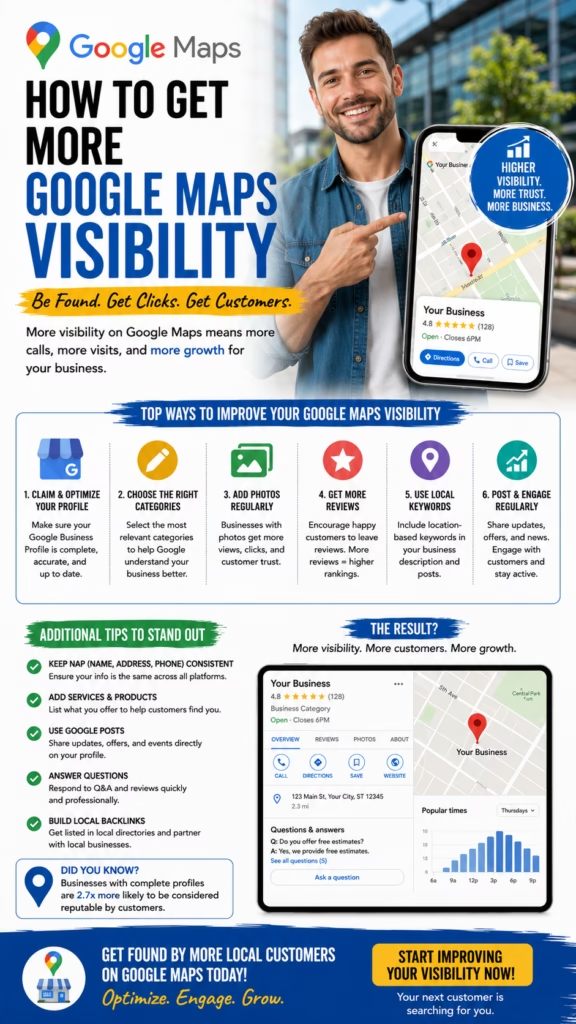
Your Google Business Profile (GBP) is often the first place local buyers see you. It’s also a perfect place to align with the Best Keywords for "Land for Sale Near Me" Local SEO.

GBP Optimization Ideas

  • Business description: mention “land for sale near me” variations plus key counties you serve.
  • Services section: add services like “rural land sales,” “we buy land,” “owner finance land.”
  • Posts: share new listings with short recaps of size, county, and use case.
  • Q&A: answer questions like “Do you have land for sale near <city>?” using natural keyword language.
  • Photos: upload maps, parcel photos, and closing day shots with descriptive filenames.

7) Content Ideas That Naturally Use the Best Keywords

Content is where you can fully deploy the Best Keywords for "Land for Sale Near Me" Local SEO without sounding robotic. Some high-impact content ideas:

Buyer-Focused Content

  • “Best Places to Find Affordable Land for Sale Near Me in <State>.”
  • “How to Evaluate Rural Land for Sale Near You (Access, Water, Utilities).”
  • “Hunting Land for Sale Near Me: 7 Things to Check Before You Buy.”

Seller-Focused Content

  • “How to Sell Land Near Me Without a Realtor.”
  • “What Cash Buyers Look for When They Buy Land Near You.”
  • “Land for Sale Near Me vs Off-Market: Which Gets You Better Offers?”

8) Marketplaces, Classifieds & Map Sites: Keyword Strategy

Many of the people typing the Best Keywords for "Land for Sale Near Me" Local SEO will also browse marketplaces and classifieds. Align your listing titles and descriptions with your keyword groups:

Sample Listing Title Templates

{ACRES} Acres of Rural Land for Sale Near {CITY}, {STATE ABBR}
Hunting Land for Sale Near Me – {ACRES} Acres in {COUNTY} County
Owner Finance Land for Sale Near {CITY} – Low Down, Easy Terms

Use short, clean descriptions that mention city/county, land type, basic features, and a link or prompt to get maps and full details.

9) Tracking Performance: Rankings, CTR, and Lead Quality

To know whether your Best Keywords for "Land for Sale Near Me" Local SEO are working, you need clear tracking:

  • Rank tracking: monitor positions for your primary city and county phrases.
  • Click-through rate: compare impressions vs clicks for pages targeting local land terms.
  • Lead volume: form fills, calls, and chat conversations from local organic traffic.
  • Lead quality: how many of those leads match your ideal buyer/seller profile.

Pro tip: Tag phone numbers and forms with hidden fields noting “organic land SEO” so you can directly tie closed deals to your Best Keywords for "Land for Sale Near Me" Local SEO work.

10) Multi-Market Expansion: Scaling Your Keyword Footprint

Once one region is working, the same Best Keywords for "Land for Sale Near Me" Local SEO framework can be cloned into new states and counties.

Expansion Steps

  1. Start with a main “Land for Sale in <State>” page.
  2. Build out county hubs for your target counties.
  3. Layer in city-level and metro-area pages where demand justifies it.
  4. Localize content with real examples: county names, features, and photos.

11) Common Keyword Mistakes Land Investors Make

Even if you know the Best Keywords for "Land for Sale Near Me" Local SEO, it’s easy to trip over common mistakes:

MistakeSymptomFix
Only targeting one keywordRankings plateau; little long-tail trafficBuild groups by city, county, land type, and intent
Thin location pagesPages with just a title and one paragraphAdd FAQs, maps, sample listings, and internal links
Ignoring seller/acquisition keywordsLots of buyer leads, few off-market dealsDedicate pages to “we buy land” and “sell land near me” phrases
Keyword stuffingAwkward copy and potential ranking issuesFocus on readability and variations, not repetitions

12) 30–60–90 Day Roadmap to Deploy Local Land SEO

Here’s a simple roadmap for rolling out the Best Keywords for "Land for Sale Near Me" Local SEO in stages.

Days 1–30: Foundation & Research

  1. List your top 3 states, 10 counties, and 10 cities.
  2. Brainstorm and research base keywords for each area.
  3. Decide on your primary buyer and seller intent phrases.
  4. Optimize your main state and home pages with better titles and intros.

Days 31–60: Page Build-Out

  1. Build or expand county pages around your grouped keywords.
  2. Add 1–2 blog posts per month focusing on specific use cases.
  3. Update your Google Business Profile with improved descriptions and Q&A.
  4. Align your listing titles and descriptions with your keyword groups.

Days 61–90: Optimization & Scaling

  1. Review rankings and traffic; identify keyword gaps.
  2. Improve internal linking from blogs to county and city pages.
  3. Launch targeted campaigns (if desired) around your best-converting keywords.
  4. Repeat the system in new states or counties.

13) Practical Playbook: Sample Keyword Lists & Templates

To make the Best Keywords for "Land for Sale Near Me" Local SEO more concrete, here’s a sample set you can adapt.

Sample Buyer Keyword Cluster (Tulsa County Example)

land for sale near me tulsa
vacant land for sale tulsa county
rural land for sale near tulsa ok
5 acres land for sale near tulsa
hunting land for sale near me oklahoma

Sample Seller Keyword Cluster

sell my land near me tulsa
we buy land tulsa county
cash buyer for land near me
sell vacant lot fast oklahoma
how to sell land by owner near me

Build similar clusters for each of your target markets, then tie them to specific pages and content pieces.

14) 25 Frequently Asked Questions

1) What are the Best Keywords for "Land for Sale Near Me" Local SEO?

They’re a mix of “land for sale near me” phrases plus city, county, land type, and motivation modifiers that match how real buyers and sellers search in your market.

2) Should I use the exact phrase "land for sale near me" on my site?

Yes, but naturally. Use it in your title tags, headings, and intro paragraphs as part of complete, readable sentences.

3) How many times should I repeat my Best Keywords for "Land for Sale Near Me" Local SEO on a page?

Focus on clarity rather than a specific count. If a human reads your page and it sounds natural, you’re usually safe.

4) Are city or county keywords more important?

Both matter. City keywords capture local urban searches; county keywords capture rural and regional demand.

5) Do I need a separate page for every city I serve?

Not always. Start with your largest markets and expand as you have content and inventory to support those pages.

6) How do I find actual search volume for land keywords?

Use keyword tools, your own search console data, and marketplace search suggestions to see what people are really typing.

7) Can I rank for "land for sale near me" if I don’t live in that city?

You can rank in areas where you have a real presence, inventory, and a properly set up Google Business Profile.

8) What’s the difference between buyer and seller keywords?

Buyer keywords focus on finding land to purchase; seller keywords focus on finding companies or methods to sell land quickly.

9) Should I target “we buy land” keywords too?

Yes, if you’re an investor or buyer. They’re powerful for attracting acquisition leads and off-market deals.

10) How do I optimize my Google Business Profile for land SEO?

Mention your land services and locations in the description, add relevant services, Q&A, and upload land photos with descriptive text.

11) Does blog content really help with local land keywords?

Yes. Blog posts allow you to cover specific questions and use cases that buyers and sellers search for, supporting your main location pages.

12) How long does it take to see results from the Best Keywords for "Land for Sale Near Me" Local SEO work?

In many markets you’ll see early movement within a few weeks, but stronger, stable rankings typically take a few months.

13) Should I worry about keyword cannibalization?

Avoid creating multiple pages targeting the exact same keyword with the same intent. Use one main page per core intent and support it with related content.

14) How important are internal links?

Very important. Internal links help search engines understand which pages are most important and how topics relate.

15) Do I need to change my domain name to include “land for sale”?

No. A keyword in the domain is not required. Good content and structure are far more important.

16) Can I copy keyword lists from other markets?

You can reuse the structure, but you should localize names, counties, and features for each new area.

17) How do I use these keywords in my listing titles?

Combine acreage, land type, and location: “10 Acres of Hunting Land for Sale Near <City>.”

18) Are long-tail keywords really worth the effort?

Yes. Long-tail phrases often have less competition and higher conversion rates because they reflect specific intent.

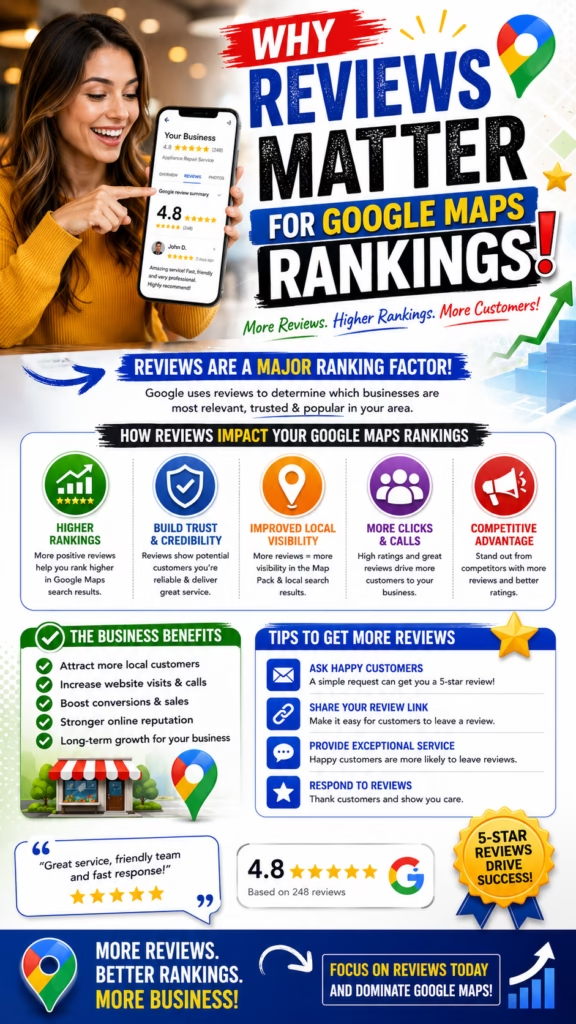
19) What role do reviews play in land local SEO?

Strong reviews and photos on your GBP can increase clicks and trust, even if your competitor has similar keywords.

20) Should I use state abbreviations or full names?

Use both. People search with “OK” and “Oklahoma,” for example, so mix them naturally in your content.

21) Do I need separate pages for buyers and sellers?

It’s helpful. Dedicated pages let you focus each set of Best Keywords for "Land for Sale Near Me" Local SEO on the right audience.

22) How do I avoid keyword stuffing?

Write for humans first. Use synonyms, related phrases, and clear explanations instead of repeating the exact keyword too often.

23) Can social media help with these keywords?

Yes. Posts and profiles that mention your markets and land types can support your brand and drive branded searches.

24) What’s the first step if I’m starting from scratch?

Pick your top three markets, identify 10–20 Best Keywords for "Land for Sale Near Me" Local SEO in each, and create or update one strong page per market.

25) How often should I update my keyword strategy?

Check in quarterly. Add new markets, refine underperforming pages, and keep building content that aligns with real search behavior.

15) 25 Extra Keywords

  1. Best Keywords for "Land for Sale Near Me" Local SEO
  2. land for sale near me SEO strategy
  3. local SEO for land investors
  4. vacant land for sale near me keywords
  5. rural land for sale local search
  6. hunting land for sale near me optimization
  7. off grid land for sale SEO
  8. county land for sale keyword list
  9. we buy land near me keywords
  10. sell my land near me SEO
  11. cash buyer land local SEO
  12. owner finance land for sale near me
  13. land acquisition keyword strategy
  14. local land buyer lead generation
  15. land investor Google Business optimization
  16. regional land for sale keyword mapping
  17. state land for sale SEO pages
  18. long tail land keywords 2025
  19. land listing title templates
  20. vacant lot near me search phrases
  21. farm and ranch land for sale SEO
  22. development land local SEO keywords
  23. land for sale near me content ideas
  24. land investor local marketing playbook
  25. land for sale keyword research guide

© 2025 Your Brand. All Rights Reserved.
Information in this Best Keywords for "Land for Sale Near Me" Local SEO guide is for general marketing education only. Always consult local professionals before making investment or legal decisions.

Best Keywords for “Land for Sale Near Me” Local SEO Read More »

Land Investor CRM: Deal Pipeline Management

ChatGPT Image Dec 7 2025 08 39 58 AM
Land Investor CRM: Deal Pipeline Management — 2025 Field Guide

Land Investor CRM: Deal Pipeline Management

Land Investor CRM: Deal Pipeline Management turns scattered spreadsheets, notebooks, and inbox chaos into a single, clean pipeline that shows you exactly which parcels need attention today to move your business forward.

Pipeline Power Highlights: Centralize every seller and buyer Visual stages for each land deal Automated follow-up & reminders KPIs tied to real revenue, not guesses

Note: This Land Investor CRM: Deal Pipeline Management guide is general marketing and process information—not legal, tax, or financial advice. Always consult licensed professionals for contracts, compliance, and regulations in your area.

Introduction

Land Investor CRM: Deal Pipeline Management is the difference between guessing how your land business is doing and knowing your numbers in real time. With a proper land investor CRM, every lead, parcel, offer, and closing step lives in one system, tracked by pipeline stages instead of scattered across email, sticky notes, and half-updated spreadsheets.

When your Land Investor CRM: Deal Pipeline Management is set up correctly, you can open your dashboard and instantly see:

  • How many new seller leads came in this week.
  • How many parcels are in “research,” “offer sent,” and “under contract.”
  • Which deals are stuck in negotiation or due diligence.
  • Which buyers are circling the same parcels without a decision.
  • Exactly how much revenue is projected if your current pipeline closes.

This guide walks you through how to design your pipeline, configure your CRM, automate follow-up, and build dashboards that tell you, at a glance, where to focus today.

Expanded Table of Contents

1) What Is Land Investor CRM: Deal Pipeline Management?

Land Investor CRM: Deal Pipeline Management is the practice of mapping a clear path for every land opportunity—from “new lead” to “closed deal”—inside a customer relationship management system (CRM). Instead of treating each parcel as a one-off project, you build a repeatable pipeline that handles:

  • Seller leads from mail, Marketplace, PPC, SEO, and referrals.
  • Acquisitions and offers on on-market and off-market land.
  • Dispositions to buyers, wholesalers, hedge funds, and local investors.
  • Renewed deals with past sellers and recurring buyers.

The goal of Land Investor CRM: Deal Pipeline Management is simple: no lead is lost, no follow-up is forgotten, and no deal’s status is unclear.

2) Core Pipeline Stages for Land Deals

Before you touch any software, define the stages of your Land Investor CRM: Deal Pipeline Management. A clear stage design prevents chaos later.

StageMeaningKey Actions
New LeadSeller or buyer just submitted info or called in.Verify contact info, assign owner, log parcel basics.
Contact MadeFirst conversation or message exchange started.Confirm motivation, timeline, price expectations.
Needs ResearchDeal requires comps, access, utilities, zoning checks.Pull GIS data, verify ownership, estimate ARV / resale.
Offer DraftingYou’re preparing a verbal or written offer.Set max offer, terms, and contingencies.
Offer SentSeller has your offer in writing or verbally.Set follow-up tasks, manage counteroffers.
NegotiationSeller is actively discussing price/terms.Track counters, adjust terms, decide walk-away.
Under ContractExecuted agreement in place.Open escrow, schedule inspections, order title.
Due DiligenceYou’re verifying access, title, and risks.Confirm deal assumptions, decide go/no-go.
Closing ScheduledSigning date set with closing attorney/title.Prepare funds, final docs, buyer coordination.
Closed / WonDeal closed successfully (bought or sold).Log final numbers, tag deal type, trigger nurture.
Lost / DeadDeal not proceeding (seller cold, offer rejected).Tag reason, add to long-term nurture if appropriate.

These stages become the backbone of Land Investor CRM: Deal Pipeline Management across acquisitions and dispositions.

3) Setting Up Your Land Investor CRM From Day One

Good Land Investor CRM: Deal Pipeline Management starts with the right fields and structure. At minimum, configure:

Core Lead & Parcel Fields

  • Owner name, email, phone, mailing address.
  • Parcel ID, county, state, acreage, GPS or address.
  • Source (mail, Marketplace, PPC, SEO, referral, MLS, cold call).
  • Motivation (taxes, inherited, tired landlord, developer, etc.).
  • Asking price, your max offer, current offer status.
  • Notes and attachments (photos, GIS, title docs).

Deal Object vs Contact

For advanced Land Investor CRM: Deal Pipeline Management, treat each parcel or opportunity as a deal object, linked to the seller contact. That way, one seller can have multiple parcels and separate deal histories.

4) Lead Capture & Intake: Getting Data into the CRM

Your Land Investor CRM: Deal Pipeline Management fails if leads never get into the system. Build standard intake flows for:

Inbound Lead Sources

  • Website forms (sell land / buy land pages).
  • Call tracking numbers pointing into the CRM.
  • Marketplace and classified DMs forwarded via email or integration.
  • Mail campaigns with vanity URLs and QR codes.

Manual & Bulk Imports

  • List pulls from county records or data providers.
  • Spreadsheets of returned mail or skip traced data.
  • Past deals and contacts being migrated from old systems.

Every new lead should land in the “New Lead” stage of your Land Investor CRM: Deal Pipeline Management with source, parcel basics, and contact info already attached.

5) Lead Qualification & Deal Scoring for Land

The next step in Land Investor CRM: Deal Pipeline Management is knowing which deals to prioritize. Use a simple score based on:

  • Owner motivation: delinquent taxes, out-of-state, inherited, repeated outreach.
  • Parcel quality: access, utilities, floodplain, nearby comps, days on market for similar parcels.
  • Spread potential: difference between realistic resale value and your maximum offer.
  • Timeline: seller’s urgency vs your pipeline capacity.

Example Scoring Snippet

+3 points: tax delinquent
+3 points: out-of-state owner
+2 points: seller requested fast close
+2 points: paved access and power at road
-2 points: heavy floodplain or access issues
-3 points: seller price unrealistic vs comps

Attach this as a numeric field in your Land Investor CRM: Deal Pipeline Management and build views for “High Priority Deals” sorted by score.

6) Follow-Up Systems: Tasks, Sequences & Reminders

Most deals are won in follow-up, not first contact. That’s why Land Investor CRM: Deal Pipeline Management must include:

  • Immediate tasks: schedule a same-day or next-day call after every new lead.
  • Automated sequences: SMS/email drips to warm but undecided sellers and buyers.
  • Stage-based reminders: e.g., if a deal sits in “Offer Sent” for 3 days, remind you to follow up.
  • Recycling tasks: for leads marked “not now” but still potentially good future deals.

Your Land Investor CRM: Deal Pipeline Management should make it harder to forget a follow-up than to do it.

7) Offers, Counteroffers & Negotiation Tracking

Offer chaos will destroy even the best Land Investor CRM: Deal Pipeline Management if you’re not careful. Standardize how you record and track:

Key Offer Fields

  • Offer type (cash, terms, option, assignment, JV).
  • Offer amount, expiration date, and contingencies.
  • Date sent, channel used (email, mail, in person).
  • Counteroffers (seller counters and your responses).
  • Decision (accepted, rejected, ghosted, re-opened later).

In your Land Investor CRM: Deal Pipeline Management, keep negotiations in the “Offer Sent” and “Negotiation” stages until the contract is signed or clearly dead.

8) Under Contract & Due Diligence Management

Once a deal hits “Under Contract,” Land Investor CRM: Deal Pipeline Management shifts focus from acquisition to execution:

  • Attach contract docs, title reports, and GIS screenshots.
  • Track key dates: option deadline, inspection period, closing date.
  • Task out responsibilities to team members or vendors.
  • Log any issues discovered in due diligence (access, encroachments, HOA restrictions).

Each contract stage should have pre-built checklists so your team can move quickly and consistently.

9) Dispositions: Buyers, Listings & Closing Coordination

Dispositions are where cash hits the bank. Land Investor CRM: Deal Pipeline Management should let you run a parallel pipeline for buyers and exit strategies:

Buyer Management

  • Tag buyers by interest: hunting, off-grid, infill, development.
  • Match new acquisitions to relevant buyer tags.
  • Log offers received, earnest money, and timelines.

Listing & Marketing

  • Record listing URLs for MLS, land platforms, Marketplace.
  • Track showings, inquiries, and feedback.
  • Monitor price changes and marketing campaigns.

This way, your Land Investor CRM: Deal Pipeline Management tracks both buy side and sell side of the same parcel without confusion.

10) KPIs, Dashboards & Reporting for Land Investor CRM

Without KPIs, Land Investor CRM: Deal Pipeline Management is just a fancy Rolodex. Track:

Top of Funnel: new seller leads, new buyer registrations, reply rate
Middle of Funnel: offers sent, contracts signed, average days in stage
Bottom of Funnel: deals closed, average profit per deal, revenue per channel
Velocity: days from first contact to contract; contract to close

Use your dashboards to ask: “Which stage is bottlenecked?” and “Which channels generate the most profitable land deals?”

11) Automation & Integrations: Email, SMS & Phones

Automation is where Land Investor CRM: Deal Pipeline Management starts to feel like you hired an invisible operations team. Common automations include:

  • Auto-creating deals when forms, calls, or DMs arrive.
  • Sending confirmation texts or emails to new leads.
  • Triggering follow-up tasks when a deal changes stage.
  • Updating status when contracts are signed via e-sign tools.
  • Pushing closed deals into accounting or reporting tools.

Keep automations simple at first. Your goal is to remove repetitive manual clicks, not to build a fragile Rube Goldberg machine.

12) Common Land Investor CRM Mistakes (and Fixes)

Even with a strong Land Investor CRM: Deal Pipeline Management strategy, investors often trip on avoidable mistakes:

MistakeSymptomFix
Too many stagesConfusion; deals stuck; no one knows what “Stage X” meansSimplify to clear, mutually exclusive stages
Incomplete data entryMissing parcel IDs, sources, or contact infoMake key fields required at creation; train team
No owner assignedLeads float in the pipeline with no accountabilityAssign every deal to a named owner from day one
Ignoring dead dealsLost knowledge of why deals failedTag reasons; use them to refine offers & marketing

13) 30–60–90 Day Rollout Plan for Your Pipeline

Here’s a simple rollout plan to implement Land Investor CRM: Deal Pipeline Management without overwhelming your team.

Days 1–30: Design & Setup

  1. Define your acquisition and disposition stages.
  2. Configure core fields and deal objects in your CRM.
  3. Connect at least one lead source (website form or phone line).
  4. Import existing deals and tag them correctly.

Days 31–60: Daily Use & Light Automation

  1. Use the CRM daily for every new lead and deal update.
  2. Set up basic automations (new lead creation, simple drips).
  3. Create dashboards for lead volume, offers, and closed deals.
  4. Train team members on stage definitions and responsibilities.

Days 61–90: Optimization & Scaling

  1. Identify bottleneck stages and adjust processes.
  2. Add integrations (e-sign, phone, SMS) as needed.
  3. Create views for high-priority deals and VIP buyers.
  4. Document your Land Investor CRM: Deal Pipeline Management SOPs for future team members.

14) Practical Playbook: Fields, Tags & Views

To make Land Investor CRM: Deal Pipeline Management instantly usable, here’s a starter playbook.

Recommended Fields

Deal Name: {County} {Acres} ac - {Owner Last Name}
Owner Type: individual / LLC / trust
Deal Type: acquisition / disposition / JV
Source: mail / SEO / PPC / Marketplace / referral / MLS
Max Offer: numeric
Motivation: inheritance / taxes / moving / tired landlord / developer
Stage: pipeline stage
Close Probability: % estimate
Projected Profit: numeric

Suggested Tags

  • Use tags for land type: “recreational,” “infill,” “waterfront,” “farm,” “timber.”
  • Use tags for special conditions: “access_issue,” “floodplain,” “HOA,” “utilities_unknown.”
  • Use tags for lists: “mail_batch_Q1,” “tax_list_2025,” “probate.”

Helpful Saved Views

  • Today’s Follow-Ups: deals with tasks due today or overdue.
  • Hot Deals: high score, in early stage, within your ideal counties.
  • Stuck Deals: deals in one stage for more than X days.
  • Upcoming Closings: under contract or closing scheduled within 30 days.

15) 25 Frequently Asked Questions

1) What is Land Investor CRM: Deal Pipeline Management in simple terms?

It’s a structured way to track every land deal from first contact to closing inside a CRM, with clear stages, tasks, and notes so nothing gets missed.

2) Do I really need a CRM or can I just use spreadsheets?

Spreadsheets work for a handful of deals. Once you’re handling dozens or hundreds of parcels and leads, a CRM becomes essential for visibility and automation.

3) What’s the biggest benefit of Land Investor CRM: Deal Pipeline Management?

Clarity. You can see exactly where each deal stands, who owns it, what’s next, and how much revenue is in the pipeline.

4) How many pipeline stages should I use?

Start with 8–12 clear stages that reflect your real-world process. Too few and you lose detail; too many and your team gets confused.

5) Should acquisitions and dispositions be in the same pipeline?

You can use one pipeline with different tags, or separate pipelines for acquisitions and dispositions. Choose whichever makes reporting and daily work simpler.

6) How often should I update deal stages?

Any time a deal meaningfully moves forward: after calls, offers, contract changes, and major due diligence milestones.

7) What CRM is best for land investors?

Many CRMs can work if they support custom fields, stages, automations, and integrations. The key is how you configure Land Investor CRM: Deal Pipeline Management, not brand names.

8) How do I avoid letting leads fall through the cracks?

Make sure every new lead automatically creates a deal, assign an owner, and always attach at least one follow-up task.

9) What data should I capture on each parcel?

Owner info, parcel ID, county, acreage, basic access/utilities, source, asking price, your max offer, and motivation.

10) How do I track multiple parcels from the same owner?

Use separate deals for each parcel, all linked to the same contact. That’s a core pattern in Land Investor CRM: Deal Pipeline Management.

11) Can I use my CRM to manage buyers too?

Yes. Tag buyers by interest, track what they’ve looked at, and log offers, so you can match new acquisitions to the right buyers quickly.

12) How does automation help with pipeline management?

Automations handle repetitive tasks like creating deals, sending confirmations, and reminding you to follow up when deals stall.

13) How important are notes and call logs?

Critical. Good notes prevent re-asking the same questions, help you negotiate better, and let team members pick up where you left off.

14) What KPIs should I watch?

New leads, offers sent, contracts signed, deals closed, average profit per deal, and time between stages.

15) How do I know if a stage is too crowded?

If most deals are stuck in one stage for weeks, it’s a bottleneck. Examine your process and either split the stage or improve your actions there.

16) Should I mark dead deals as “Closed Lost”?

Yes. Closing deals as lost (with reasons) is part of clean Land Investor CRM: Deal Pipeline Management and helps you improve over time.

17) How do I handle old leads that ghosted?

Tag them with a “cold” or “long-term nurture” status and occasionally run win-back campaigns.

18) Can a CRM help me manage JV or wholesale deals?

Yes. Use tags and fields to mark JV partners and wholesale buyers, and treat these as distinct deal types in your pipeline.

19) How does a CRM tie into my marketing channels?

Integrations let leads from mail, PPC, SEO, and marketplaces flow directly into Land Investor CRM: Deal Pipeline Management with the correct source attached.

20) What’s the first thing to configure in a new CRM?

Define your pipeline stages and core fields before importing data or building complex automations.

21) How do I keep my CRM data clean?

Set required fields, build simple naming conventions, merge duplicates regularly, and train your team on best practices.

22) Can I export data if I switch CRMs later?

Most CRMs allow exports. Clean, structured Land Investor CRM: Deal Pipeline Management makes migrations much easier.

23) How often should I review my pipeline?

Daily for active deals, weekly for strategy and bottlenecks, and monthly for KPIs and channel ROI.

24) What’s the biggest mistake beginners make?

They set up a CRM but don’t use it consistently. The power of Land Investor CRM: Deal Pipeline Management comes from disciplined daily use.

25) What’s my first step today?

Write out your ideal stages on paper, then configure them in your CRM and move your current deals into the correct stage.

16) 25 Extra Keywords

  1. Land Investor CRM: Deal Pipeline Management
  2. land investor CRM system
  3. vacant land deal pipeline
  4. land investing CRM stages
  5. land acquisition pipeline management
  6. land wholesaling CRM workflow
  7. land flipping deal tracking
  8. off-market land lead management
  9. rural land investor CRM setup
  10. seller lead tracking for land investors
  11. land buyer CRM database
  12. land investing follow-up automation
  13. land contract and due diligence CRM
  14. real estate investor CRM for land
  15. pipeline KPIs for land investors
  16. land investing CRM dashboard
  17. multi-market land pipeline management
  18. land investor acquisition and dispo CRM
  19. land deal scoring and prioritization
  20. land investor team pipeline visibility
  21. land investor CRM best practices
  22. land investor closing pipeline workflow
  23. automation for land investor CRM
  24. land investing lead intake system
  25. land investor deal pipeline SOP

© 2025 Your Brand. All Rights Reserved.
This Land Investor CRM: Deal Pipeline Management article is for general educational purposes only—always verify legal, tax, and regulatory details with qualified professionals.

Land Investor CRM: Deal Pipeline Management Read More »

Tiny Home Marketing: Buyers vs DIY Enthusiasts

ChatGPT Image Dec 6 2025 01 28 15 PM
Tiny Home Marketing: Buyers vs DIY Enthusiasts — 2025 Complete Guide

Tiny Home Marketing: Buyers vs DIY Enthusiasts

Two audiences. Two journeys. One system that turns design-scrolls into deposits.

At-a-glance (first 90 days): CPQC ↓ Reply < 20s Qualified Consults ↑ Deposits ↑

Introduction

Tiny Home Marketing: Buyers vs DIY Enthusiasts starts by admitting a simple truth: people searching for a turn-key tiny home are not the same as those hunting for plans, shells, or kits. Mixing them in one funnel raises your cost per qualified consultation and clutters your sales calendar. This guide shows you how to segment, message, and automate for each audience—so every click moves toward a real outcome: a deposit or a plan/kit sale.

Positioning note: Use distinct pages, offers, and FAQs for Buyers vs DIY. Let visitors self-select within 5 seconds, then keep the path laser-focused.

Expanded Table of Contents

1) Personas & Journeys

PersonaGoalConcernsBest CTA
Turn-Key BuyerDelivered, inspected, move-in readyFinancing, permits, delivery logistics, warranty“Book a 15-min Cost & Delivery Call”
DIY EnthusiastPlans, kits, shells; learning & communityTools, materials, time, how-to support“Download Build Plans” or “Get a Shell Quote”

Let visitors choose a lane immediately with two clear buttons: Buy Turn-Key and Build It Yourself.

2) Buying Signals to Watch

  • Budget: Under $25k leans plans/kits; $60k–$120k leans turn-key/ADU.
  • Timeline: “This summer” = buyers; “next year” often = DIY research mode.
  • Site readiness: Utility/land questions indicate buyer; tool/material questions indicate DIY.
  • Content depth: Long watch time on build tutorials = DIY; delivery/inspection videos = buyers.

3) Channel Mix by Persona

Turn-Key Buyer

  • Google Maps/SEO (local proof, reviews, delivery photos)
  • Facebook Marketplace (spec-rich listings, financing link)
  • YouTube owner tours; short-form Reels with testimonials
  • Remarketing with warranty/inspection proof

DIY Enthusiast

  • YouTube deep-dives, tool lists, materials breakdowns
  • Pinterest boards (floor plans, loft ideas, storage)
  • Blog posts with step-by-steps; gated plan previews
  • Community forum or Discord for build support

4) Page Architecture (Two Funnels, Two CTAs)

SectionBuyer PageDIY Page
HeroValue + permit/warranty badgesValue + plan preview image
ProofDelivery videos, reviews, inspectionsCommunity builds, tool lists, case studies
Offer15-min cost & delivery callDownload plans / shell quote
FAQFinancing, delivery routes, zoningMaterials, tools, time, skills

5) Offer Strategy

  • Deposits: Lock build slots; show refund and change-order policy.
  • Plans: Credit plan purchase toward shell/kit within 6 months.
  • Kits/Shells: Include BOM, cut lists, and assembly video library.
  • Consults: Paid “Site & Route Check” credited toward final invoice.

6) Content That Converts

For Buyers

  • 90-sec owner tour + pricing band
  • Delivery/installation timelapse
  • Financing/how-it-works explainer
  • Warranty & inspection checklist

For DIY

  • Tools/materials videos and downloadable lists
  • Frame/roof/electrical step-by-step
  • Common mistakes & fixes
  • “From kit to finished” series

7) Pricing & Delivery Pages

  • Show price bands by region (transport bands, escort/permits if required)
  • Route photo uploader (gate calendar behind basic site info)
  • Financing pre-qual link; “no hard pull” messaging where applicable

UTM idea: utm_source=website&utm_medium=pricing&utm_campaign=tiny_home_delivery_2025

8) Facebook Marketplace Playbook

Listing Blueprint

{Model Name} • {Sq Ft} • {Loft/Bath/Kitchen}
Delivery options • Financing available • Warranty included
Reply "PRICE" for estimate with your zip code.
  • Lead photo: bright interior with scale (person or common object)
  • Specs: sq ft, dimensions, insulation, roof, weight, power/water options
  • Delivery: regions served + estimate band
  • CTA: comment keyword or DM for instant quote

9) YouTube & Pinterest

  • YouTube: owner tours, deep dives, Q&A lives
  • Pinterest: boards by floor plan, loft ideas, storage hacks
  • Pin Idea: “8 layouts under 28′ that still sleep 4”

10) Google Maps + Local Proof

  • Add delivery photos with location notes
  • Q&A: “Do you deliver to <County>?” with helpful answers
  • Reviews tied to model names and delivery regions

11) CRM Stages & Automation

StageTriggerAutomation
NewLead form/DMAI reply under 20s + intake quiz
QualifiedBudget + timeline providedCalendar link + reminders
ConsultCall heldQuote + financing links
DepositInvoice paidProduction timeline + welcome kit
ProductionBuild startedMilestone updates + delivery scheduling

12) AI Responder Scripts

Hi {FirstName}! Quick fit check:
1) Budget range?
2) Timeline?
3) Zip (for delivery estimate)?
Reply with numbers and I’ll show models in your range + an install window.
DIY plans? I can send a preview + materials list.
Want that, or a shell quote with delivery?

Add channel tags with UTMs: utm_source=marketplace&utm_medium=dm&utm_campaign=tiny_home_buyers

13) KPIs & Dashboards

Acquisition

Impressions, CTR, CPC, CPM

Qualification

CPQC, form completion rate

Sales

Deposit rate, average deposit, production lead time

DIY

Plan sales, kit upsell rate

14) Budget Mix by Stage

StageBuyer FocusDIY Focus
LaunchMaps/SEO + MarketplaceYouTube/Pinterest + plan preview
ScaleRemarketing + delivery proof adsKit/shell campaigns + tutorials
OptimizeLocal partnerships (installers, lenders)Community forum & course upsells

15) 30–60–90 Day Rollout Plan

Days 1–30

  1. Publish two landing pages: Buyers vs DIY
  2. Set AI replies + intake quiz; connect CRM
  3. Post spec-rich Marketplace listing + one YouTube tour

Days 31–60

  1. Add pricing/delivery calculator
  2. Launch remarketing with delivery proof
  3. Publish DIY plan preview + materials list

Days 61–90

  1. Open a community forum/Discord
  2. Start monthly owner interview series
  3. Negotiate local installer partnerships

16) Quality, Warranty & Compliance Signals

  • Warranty terms, inspection checklist, and service response times
  • Safety certifications and insurance/ licensure disclosures
  • Clear materials/spec sheets and model identifiers

17) Troubleshooting & Optimization

SymptomLikely CauseFix
High DM volume, few consultsNo pre-qualAdd budget/timeline/zip gate before calendar
Great traffic, low deposit rateWeak proofAdd delivery videos, warranty badges, reviews
DIY questions on buyer pageBlended funnelSplit pages and CTAs; route with AI intent tags
Price objectionsNo financing clarityProminent pre-qual and payment examples

18) 25 Frequently Asked Questions

1) What is “Tiny Home Marketing: Buyers vs DIY Enthusiasts”?

A segmentation framework that tailors pages, offers, and automation for two audiences to raise conversion and lower CPL.

2) Should I keep one homepage for both?

Yes, but force a choice above the fold with two hero buttons.

3) Do I need separate email flows?

Yes—buyers get delivery/financing content; DIYers get tools/plans.

4) What’s a good reply-time goal?

Under 20 seconds for first response with AI; under 5 minutes human follow-up.

5) What file types should plan previews be?

Watermarked PDF with key dimensions and a BOM excerpt.

6) How many Marketplace photos?

10–15: mix of interiors, loft, bathroom, kitchen, exterior, and delivery.

7) Do I advertise price on Marketplace?

Show a band; invite zip for delivery-inclusive estimate.

8) Should I sell plans and kits globally?

Yes; clarify code/permit differences by region.

9) What about permits?

Provide a zoning/permit guide and offer paid site checks.

10) How do I handle warranty questions?

Publish a simple warranty table and FAQs; add service form.

11) Can I upsell DIY plan buyers?

Offer credits toward shells/kits and discounted consult hours.

12) Best first video?

Owner tour + pricing band + delivery timeline.

13) What social proof matters most?

Delivery/installation videos and owner testimonials.

14) How often should I email?

Weekly cadence with value; product drops monthly.

15) Should I list on RV or ADU directories?

Test—track deposit rate and refund claims carefully.

16) What’s a healthy show rate?

70–85% with reminders and SMS confirmations.

17) Do I need a community forum?

It reduces support load and drives DIY upsells.

18) How do I photograph models?

Golden hour exteriors; scale cues; wide but natural interiors.

19) Should I disclose lead times?

Yes—show ranges and post current queue notices.

20) Can AI quote delivery?

Yes—use a band by zip and request route photos for accuracy.

21) How do I manage cancellations?

Clear deposit terms; offer transfer or plan credit options.

22) What analytics are must-have?

UTMs, call tracking, CRM stage conversion, refund/chargeback rate.

23) How do I handle code compliance questions?

Publish a jurisdiction map and direct to your compliance guide.

24) What’s first if I have 10 hours this week?

Split pages, add AI intake quiz, post a spec-rich Marketplace listing.

25) Why does this segmentation work?

Different intent, risk, and information needs—one message can’t serve both efficiently.

19) 25 Extra Keywords

  1. Tiny Home Marketing: Buyers vs DIY Enthusiasts
  2. tiny home buyers
  3. tiny house DIY plans
  4. tiny home kits and shells
  5. tiny house delivery cost
  6. tiny home financing options
  7. Facebook Marketplace tiny homes
  8. YouTube tiny house tour
  9. Pinterest tiny home floor plans
  10. Google Maps tiny home builder
  11. ADU marketing strategy
  12. off-grid cabin marketing
  13. tiny home warranty and inspection
  14. DIY materials list tiny house
  15. tiny home pricing calculator
  16. shell vs turn-key tiny house
  17. tiny home CRM stages
  18. AI DM responder tiny homes
  19. delivery route tiny house
  20. zoning guide tiny homes
  21. loft storage tiny house
  22. best photos tiny home listing
  23. plan preview tiny house PDF
  24. kit upsell tiny home
  25. 2025 tiny home marketing

© 2025 Your Brand. All Rights Reserved.

Tiny Home Marketing: Buyers vs DIY Enthusiasts Read More »

Best Platforms for Custom Builder Lead Generation

ChatGPT Image Dec 6 2025 01 28 17 PM 1
Best Platforms for Custom Builder Lead Generation — 2025 Complete Guide

Best Platforms for Custom Builder Lead Generation

Where real homeowners and developers actually look—and how to turn attention into booked consultations.

At-a-glance (first 90 days): Maps Rank ↑ CPQC ↓ Speed-to-Lead < 60s Booked Consults ↑

Introduction

Best Platforms for Custom Builder Lead Generation is your 2025 blueprint for selecting channels that match real buyer intent, cycle length, and average contract value. You’ll compare search, social, design directories, and partner routes—then stitch them together with clear CTAs, AI-assisted replies, and a CRM that proves ROI.

Note: High-ticket projects have long timelines. Prioritize platforms with measurable intent, trust-building content, and fast follow-up.

Expanded Table of Contents

1) Platform–Project Fit

PlatformIntent LevelBest UseNotes
Google Maps/SEOHighCapture in-market homeownersReviews + local proof win
Google AdsHighExact terms (custom home builder + city)Tight negatives + call tracking
Meta (FB/IG)MediumShowcase, remarketing, lead formsVideo first; sync to CRM
HouzzMediumPortfolio credibility & referralsKeep reviews fresh
LinkedInMediumABM to developers/architectsThought leadership
NextdoorMediumNeighborhood social proofBefore/after + permits
YouTubeMediumEducation & trust buildingLonger sales cycles
PinterestMediumDesign discoveryBoards → case studies

2) Scoring Criteria

  • CPQC: Cost per Qualified Consultation
  • Speed: First reply time and time-to-book
  • Proof: Reviews, permits, testimonials, timelapses
  • Scale: Volume potential without lead quality collapse

3) Google Business Profile & Maps

  • Post weekly project updates; add geotagged photos
  • Request reviews tied to specific project types
  • Fill services (custom homes, additions, design-build)

Add UTM to the website button: utm_source=google&utm_medium=maps&utm_campaign=builder_local_2025

4) Organic SEO

Essentials

  • Flagship case studies with budgets & timelines
  • Location hubs covering service areas
  • FAQ schema for “cost,” “timeline,” “permit” topics

Content Ideas

  • “Custom Home Cost by County (2025)”
  • “Design-Build vs Architect + GC: Pros/Cons”
  • “Permits & Inspections: What Homeowners Should Know”

6) Facebook/Instagram

  • Reels: 15–30s timelapses + homeowner interviews
  • Lead forms with budget/timeline pre-qual
  • Remarket site/GBP visitors with proof assets

7) Houzz

  • Curate project galleries by style and budget range
  • Request detailed reviews with project photos
  • Promote “Book a Consultation” with calendar link

8) LinkedIn

  • ABM lists: developers, architects, lenders, real estate attorneys
  • Monthly thought pieces (code, zoning, supply chain)
  • Case study slides with structural details and outcomes

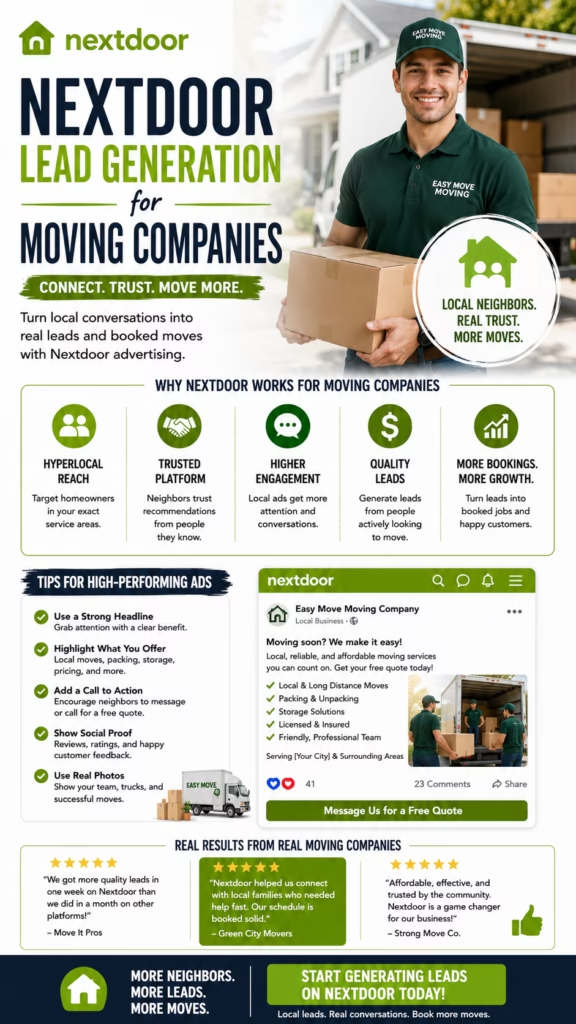
9) Nextdoor

  • Before/after with material callouts
  • Neighborhood-focused promos (consultation days)
  • Encourage word-of-mouth; respond quickly

10) YouTube

  • Explain budgets, timelines, change orders
  • Client interviews and walkthroughs
  • Use chapters, cards to book a consult

11) Pinterest

  • Boards by style: modern farmhouse, mountain, coastal
  • Idea Pins linking to long-form case studies
  • Seasonal trend boards with materials

12) Directories & Marketplaces

Use selectively for additions or smaller projects; track CPQC rigorously and avoid lead resellers that spam multiple builders.

13) Partnerships

  • Architects: co-branded landing pages & referral terms
  • Realtors: teardown/new-build referrals
  • Lenders: construction-to-perm education webinars

14) Landing Pages, CTAs & Lead Capture

ElementBest PracticeWhy It Converts
HeroOne-line value + proof badgesInstant trust
CTA“Book a 15-min cost & timeline call”Specific outcome
FormBudget, zip, timeline, financingPre-qualifies
Social proofReviews, permits, warrantyRisk reduction

15) AI Responders

  • First reply under 20 seconds on chat/SMS/DM
  • Budget/timeline quiz before calendar link
  • Human escalation for design questions
Hi {FirstName}! Quick fit check to get you a cost range:
1) Target budget?  2) Ideal start month?
Then I’ll share openings for a 15-min consult.

16) KPIs & Dashboards

Acquisition

Impressions, CTR, CPC, CPM

Lead Quality

CPQC, show rate, project fit

Sales

Close rate, cycle time, pipeline

Trust

Reviews added, GBP photo count

Track with UTMs: utm_source=meta&utm_medium=remarketing&utm_campaign=builder_proof_2025

17) Budget Mix by Stage

StageChannel FocusNotes
LaunchSEO/Maps + Google Search + remarketingClaim demand + build proof
ScaleMeta video, YouTube, Houzz, LinkedIn ABMStorytelling + partnerships
OptimizePinterest, Nextdoor, selective directoriesFill seasonal gaps

18) 30–60–90 Day Rollout Plan

Days 1–30

  1. Polish GBP and publish one flagship case study
  2. Launch exact-match Search and remarketing
  3. Connect forms to CRM with call tracking

Days 31–60

  1. Spin up Reels + YouTube shorts
  2. Open Houzz portfolio; request 5 reviews
  3. Start LinkedIn ABM outreach

Days 61–90

  1. Test Pinterest + Nextdoor
  2. Add architect/Realtor referral program
  3. AI responder: under-20s reply, calendar link

19) Troubleshooting & Optimization

SymptomCauseFix
Many low-budget leadsWeak pre-qualAdd budget/timeline fields; adjust targeting
High CPC, low bookingsBroad keywordsTighten match; improve landing page proof
Slow repliesNo automationTurn on AI replies + SMS reminders
Great traffic, poor form fillsCTA mismatchOffer “15-min cost & timeline call”

20) 25 Frequently Asked Questions

1) What does “Best Platforms for Custom Builder Lead Generation” actually mean?

A prioritized list of channels where custom-home buyers and partners look—and how to turn them into booked consultations.

2) Which one should I launch first?

Google Maps + one flagship case study page, then remarketing.

3) How many platforms should I run at once?

Two core + one experiment. Add more only when CPQC stays efficient.

4) Are Facebook lead forms good enough?

Yes if you pre-qualify for budget/timeline and follow up fast.

5) Should I use LSAs?

Test availability in your region; verify category fit and lead quality.

6) How important are reviews?

Critical—target one detailed review per project type per month.

7) Do I need video?

Video dramatically improves trust. Start with timelapses and interviews.

8) How do I measure ROI?

CPQC and sourced pipeline value per channel in your CRM.

9) What landing page converts best?

Case study + cost/timeline overview + “Book 15-min consult.”

10) How fast should a first reply be?

Under 60 seconds; under 20 with AI is ideal.

11) Should I gate pricing?

Offer ranges with variables; save exact quotes for consults.

12) How often should I post on Houzz?

Monthly project updates; reply to questions within 24 hours.

13) Is LinkedIn worth it for residential?

Great for referral partners and higher-end custom markets.

14) Do Pinterest visitors convert?

Yes, over time—optimize pins to case study pages and lead magnets.

15) What’s a good show rate for consults?

65–85% with reminders and calendar integration.

16) How do I stop tire-kickers?

Pre-qual forms, budget/timeline ranges, and content that sets expectations.

17) Should I outsource SEO?

Often yes—ensure they build real case studies and location hubs.

18) Do directories hurt brand perception?

Not if used selectively with strong follow-up and filtering.

19) Can AI schedule site visits?

Yes—AI can propose times and confirm with SMS/email reminders.

20) What proof builds the most trust?

Permits pulled, warranties, testimonials, and timelapse builds.

21) How many keywords should I target at launch?

Start narrow with geo + “custom home builder” variations.

22) Is remarketing privacy-safe?

Use consent banners and platform tools; avoid sensitive categories.

23) What if my photo assets are weak?

Shoot one project thoroughly; prioritize golden hour exteriors and clean interiors.

24) How do I keep follow-ups consistent?

Use AI scripts + CRM sequences with two-choice replies.

25) First step today?

Update GBP, publish one flagship case study, and connect form → CRM → calendar.

21) 25 Extra Keywords

  1. Best Platforms for Custom Builder Lead Generation
  2. custom home builder leads
  3. home builder marketing 2025
  4. Google Business Profile for builders
  5. builder SEO case studies
  6. Google Ads custom home keywords
  7. Facebook builder lead forms
  8. Instagram Reels home building
  9. Houzz builder reviews
  10. LinkedIn ABM for builders
  11. Nextdoor neighborhood marketing
  12. YouTube custom home walkthrough
  13. Pinterest home design boards
  14. architect referral program
  15. realtor new build referrals
  16. construction to perm lender leads
  17. CPQC for builders
  18. builder remarketing strategy
  19. lead qualification script
  20. AI responder for builders
  21. case study landing page
  22. maps ranking for builders
  23. permit proof marketing
  24. timelapse construction video
  25. custom builder budget ranges

© 2025 Your Brand. All Rights Reserved.

Best Platforms for Custom Builder Lead Generation Read More »

Case Study: Shed Builder Eliminated Showroom Overhead

ChatGPT Image Dec 6 2025 01 28 09 PM
Case Study: Shed Builder Eliminated Showroom Overhead — 2025 Playbook

Case Study: Shed Builder Eliminated Showroom Overhead

Case Study: Shed Builder Eliminated Showroom Overhead breaks down how one regional shed company went from paying for acres of inventory, sales staff, and roadside banners to a lean digital-first model that sells more sheds with less overhead.

Snapshot Results: Showroom rent: -100% Lead volume: +72% Avg profit per shed: +31% Sales staff: 5 → 2 high-performers

Note: This Case Study: Shed Builder Eliminated Showroom Overhead is marketing education only—not legal, financial, or tax advice. Always verify regulations, zoning, and platform policies in your area.

Introduction

Case Study: Shed Builder Eliminated Showroom Overhead starts in a place many shed dealers recognize: a big corner lot on a busy highway, dozens of units on display, and a monthly expense line that keeps creeping up while walk-in traffic slowly declines.

The owner of “Mountain Ridge Sheds” (name changed) realized something uncomfortable: people were using the showroom like a free shed museum, then price-shopping online with competitors who didn’t carry the same overhead. If nothing changed, margins would keep shrinking until the business was just a stressful job with inventory risk.

This case study walks you through the strategy that allowed this shed builder to eliminate showroom overhead in stages, move to a primarily digital sales model, and actually grow revenue and profit per unit using online listings, virtual tours, marketplace posts, and AI-assisted follow-up.

Expanded Table of Contents

1) Case Study Background: The Old Showroom Model

Before the Case Study: Shed Builder Eliminated Showroom Overhead transition, Mountain Ridge Sheds followed the classic shed dealer model:

  • A two-acre highway lot with 40–60 sheds staged at any time.
  • Three full-time salespeople plus weekend help.
  • Paper brochures, laminated price sheets, and handwritten orders.
  • Basic website with a few photos and a phone number.
  • Occasional print ads and billboard placements.

For years, this worked. But buyer behavior changed faster than the business did. Customers were now:

  • Googling “shed dealer near me” and reading reviews.
  • Comparing prices across multiple websites.
  • Expecting to see inside-and-out photos and delivery options online.
  • Messaging on Facebook at night instead of calling during the day.

2) The Problem: High Overhead, Low Visibility

The turning point in this Case Study: Shed Builder Eliminated Showroom Overhead came when the owner looked at a simple chart: monthly lot traffic vs monthly digital traffic.

Metric (Average)20182022
Walk-in visits to showroom280/month115/month
Website visitors400/month2,100/month
Monthly showroom overhead (rent, utilities, staff share)$9,800$11,600

The lot, which used to be the main sales engine, was now the most expensive “billboard” the company owned. Meanwhile, online visitors were high, but there was no system to convert them into booked deliveries.

3) Diagnosis: Where the Money Was Leaking

During the early phase of the Case Study: Shed Builder Eliminated Showroom Overhead project, the team mapped every part of the customer journey and where money was leaking out:

  • Leak 1: Untracked walk-ins. No reliable way to track lot visitors who “would think about it” and never returned.
  • Leak 2: Weak online inventory. Only 10–12 sheds online out of 50+ on the lot, often missing sizes or prices.
  • Leak 3: Slow response times. Messages sat in inboxes overnight or over the weekend.
  • Leak 4: Static pricing. Seasonal demand and lumber price changes weren’t reflected quickly online.
  • Leak 5: Overbuilt inventory. Too many units built “on spec” with no data about what was actually selling.

The conclusion was clear: if the company kept trying to “fix” the showroom instead of rethinking the model, it would keep chasing a shrinking pool of walk-in customers while paying more each year to keep the lights on.

4) Strategy Overview: From Lot Traffic to Lead Funnels

The new direction behind this Case Study: Shed Builder Eliminated Showroom Overhead was simple but bold:

Main Goal:
Replace the physical showroom as the primary sales engine with a digital-first model
that uses photos, virtual tours, clear pricing, and automated follow-up to sell sheds.

The strategy rested on five pillars:

  1. Inventory visibility: Every shed (and common configuration) visible online with photos, pricing ranges, and delivery options.
  2. Multi-platform presence: Website, Google Business Profile, Facebook Marketplace, classifieds, and partner lots.
  3. 24/7 response: AI-assisted messaging to answer basic questions and book appointments.
  4. Lean physical footprint: Move from a giant flagship lot to smaller “micro-lots” hosted at partner locations.
  5. Data-driven build schedule: Use online interest data to decide what to build next instead of guessing.

5) Creative System: Photos, Virtual Tours & Configurator Screenshots

To make the Case Study: Shed Builder Eliminated Showroom Overhead model convincing for buyers, the team had to “bring the lot to the screen.” They built a repeatable creative system:

Photo Checklist for Each Shed

  • Front 3/4 angle with door(s) visible.
  • Side angle showing roof line and overhang.
  • Interior shot from each corner.
  • Detail shots: door hardware, windows, floor.
  • Scale shot: person, truck, or known object.

Virtual Tour & Configurator Assets

  • Short walkaround video (15–45 seconds).
  • Simple 360° interior (phone-based is fine).
  • Configurator screenshots: color options, window layouts.
  • Delivery & setup photos to reduce anxiety.

Every listing in the Case Study: Shed Builder Eliminated Showroom Overhead system included a “See inside & configure your shed” call-to-action that linked to a simple configurator or photo album.

6) Platforms: Website, Marketplace, Google, and Partner Lots

Once the creative system was nailed, the Case Study: Shed Builder Eliminated Showroom Overhead strategy pushed that content everywhere the local shed buyer already spends attention.

PlatformRole in FunnelKey Tactics
WebsiteCentral “source of truth” and quote request hubInventory browser, configurator, FAQ, financing, delivery map
Google Business ProfileTrust, reviews, local map presenceWeekly posts, “see our shed gallery,” Q&A, photo uploads
Facebook MarketplaceHigh-intent buyers browsing local inventoryFlag-safe listings with clear photos, short descriptions, link to website
Classifieds / Local AppsExtra reach to bargain-focused shoppers“Starting at” pricing and clear delivery zones
Partner Micro-LotsSmall physical presence without full showroom cost3–6 sample units at hardware stores, farm supply, garden centers

7) Automation: AI Messaging, Quotes & Follow-Up

A major lever in this Case Study: Shed Builder Eliminated Showroom Overhead was replacing random, slow manual responses with structured automation.

AI & Automation Components

  • Website chat assistant: Answered common questions about sizes, siding options, and delivery requirements.
  • Marketplace messaging assistant: Helped triage “Is this available?” messages with quick replies and links.
  • Lead-scoring rules: Flagged leads that mentioned “ready now,” “need financing,” or specific dates.
  • Follow-up workflows: Sent reminders, shed photos, and delivery prep checklists automatically.

Sample Messaging Flow

Lead: "Is this 10x16 available? Do you deliver to <town>?"
Bot: "Yes, we regularly deliver to <town>. Do you plan to place it on grass, gravel, or a concrete pad?"
Lead: "Gravel."
Bot: "Perfect. Most customers in <town> do gravel. Do you want a quick delivered price range,
or would you like to see a few similar sheds we've recently delivered nearby?"

By the time a human salesperson stepped in, they knew size, use-case, town, and timeline. This is where the Case Study: Shed Builder Eliminated Showroom Overhead approach saved hours of back-and-forth and let two people handle what used to take five.

8) Financial Impact: Overhead, Profit, and Cash Flow

Now for the part of the Case Study: Shed Builder Eliminated Showroom Overhead everyone wants: the numbers.

Metric (Annualized)Before (Full Showroom)After (Digital-First + Micro-Lots)
Showroom & lot rent + utilities$116,000$18,000 (micro-lot stipends & storage)
Sales payroll (base + commissions)$235,000$148,000
Marketing & tech stack$22,000$39,000
Total overhead in these categories$373,000$205,000
Units sold410452
Average profit per unit$1,650$2,160

Even after increasing spend on digital tools and ads, the Case Study: Shed Builder Eliminated Showroom Overhead model freed more than $150,000 in annual overhead and increased per-unit profit by over $500.

9) Operational Changes: Inventory, Delivery, and Sales Roles

The numbers were possible because the Case Study: Shed Builder Eliminated Showroom Overhead also transformed operations.

Inventory

  • Moved from “build and hope” to “build what gets clicked.”
  • Used a simple dashboard to see which sizes and styles generated the most leads.
  • Focused on fast-moving bestsellers plus a smaller set of display-only “showpiece” units.

Delivery & Setup

  • Standardized delivery pricing by zone instead of case-by-case quotes.
  • Created a delivery-prep guide with photos to reduce surprises.
  • Offered “priority delivery” upsell during peak seasons.

Sales Roles

  • Replaced three generalist sales reps with two consultative “shed specialists.”
  • Freed them from chasing low-intent messages by using AI filters.
  • Paid bonuses based on margin, not just volume, aligning behavior with the Case Study: Shed Builder Eliminated Showroom Overhead goals.

10) 30–60–90 Day Timeline to Eliminate Showroom Overhead

Here’s how the Case Study: Shed Builder Eliminated Showroom Overhead played out in phases, which you can adapt to your own shed operation.

Days 1–30: Visibility & Data

  1. Photograph and document every shed on the lot.
  2. Upload full inventory to the website with basic filters.
  3. Clean up Google Business Profile and add a shed photo gallery.
  4. Launch a simple CRM to track web forms and messages.

Days 31–60: Funnels & Micro-Lots

  1. Start posting 10–20 sheds across Marketplace and classifieds weekly.
  2. Install chat on the website and connect to an AI assistant.
  3. Negotiate 1–2 small micro-lots at partner locations.
  4. Measure where leads come from and how quickly they close.

Days 61–90: Showroom Exit Plan

  1. Reduce lot inventory to a minimal “transition set.”
  2. Schedule end-of-lease or sublease options for the old showroom property.
  3. Reinvest saved overhead into targeted digital campaigns.
  4. Document and refine your new standard operating procedures.

11) Lessons Learned & Transferable Plays

The Case Study: Shed Builder Eliminated Showroom Overhead offers several lessons any shed builder or portable building dealer can borrow:

  • Lesson 1: Your website is your new main lot; treat it that way.
  • Lesson 2: Customers don’t need to touch every shed in person; they need to trust you and see enough detail.
  • Lesson 3: Responding quickly beats having the biggest physical display.
  • Lesson 4: Data helps you build sheds people actually want, not just designs you like.
  • Lesson 5: Automation lets a small team perform like a large one.

12) Risks, Objections & How They Were Addressed

The transition in this Case Study: Shed Builder Eliminated Showroom Overhead wasn’t risk-free. Common objections included:

ConcernHow It Showed UpResponse Strategy
“People won’t buy without a lot.”Staff assumed walk-ins were essential.Ran test campaigns and proved that online leads converted at equal or better rates.
“We’ll lose impulse traffic.”Fears about losing drive-by buyers.Partner micro-lots preserved some physical visibility at a fraction of the cost.
“The tech will confuse us.”Sales reps nervous about automation.Training, clear scripts, and showing how AI handled repetitive questions while they focused on closing.
“We’re different; our customers want to walk the lot.”Legacy beliefs about the local market.Surveyed customers and discovered most had already researched online before visiting.

13) Future Roadmap for Digital-First Shed Sales

The Case Study: Shed Builder Eliminated Showroom Overhead is not a one-time event; it’s the foundation for an ongoing evolution.

  • Enhanced configurators: Let customers build and price sheds in real time, then send designs to sales.
  • AR yard previews: Show how the shed will look sitting in their backyard.
  • Even smarter AI: Use past sales data to recommend sizes, doors, and options based on use case.
  • Regional expansion: Enter nearby markets with digital campaigns before investing in any physical presence.
  • Partner ecosystems: Bundle sheds with fencing, concrete, or landscaping partners in shared offers.

For this shed builder, eliminating showroom overhead unlocked the ability to reinvest into the future instead of just paying for the past.

14) 25 Frequently Asked Questions

1) What does “Case Study: Shed Builder Eliminated Showroom Overhead” actually mean?

It means a real shed builder shut down their expensive physical showroom as the main sales engine, shifted to digital channels, and still managed to sell more sheds with better margins.

2) Can any shed dealer follow this model, or was this a special situation?

Most of the plays in this Case Study: Shed Builder Eliminated Showroom Overhead are transferable—especially the focus on better photos, online inventory, fast messaging, and micro-lots.

3) Did the shed builder close their showroom overnight?

No. The transition happened over several months, with overlapping phases of online build-out, micro-lot experiments, and gradual inventory reduction at the old lot.

4) How did customers react when the physical showroom closed?

Some long-time customers were surprised, but most new buyers didn’t mind once they saw clear photos, delivery options, and trusted reviews online.

5) What marketing channels drove most leads in this case study?

The biggest contributors were Google Business Profile, the website inventory browser, and Marketplace listings that linked back to the site.

6) How important were reviews in this Case Study: Shed Builder Eliminated Showroom Overhead?

Reviews were crucial. With no giant lot to impress people, social proof and photos from real deliveries did the heavy lifting.

7) Did they still need salespeople after eliminating showroom overhead?

Yes, but fewer. Two consultative sales reps handled higher-quality, warmed-up leads instead of three or more reps managing random walk-ins.

8) Was financing part of the strategy?

Yes. Rent-to-own and simple financing options made it easier to close deals entirely online or by phone.

9) How did they handle customers who insisted on seeing sheds in person?

Those customers were directed to smaller partner micro-lots with a curated selection of bestsellers that represented the full lineup.

10) What role did AI play in this case study?

AI assisted with answering common questions, routing leads, and scheduling appointment calls—reducing response times to minutes instead of hours or days.

11) Did the company lose any sales because of the transition?

There were some short-term dips during the changeover, but within one season the new model exceeded the old showroom’s performance.

12) How did they track the impact of eliminating showroom overhead?

They compared overhead, lead volume, close rates, and profit per unit before and after the change, using simple dashboards in their CRM.

13) What was the biggest unexpected benefit?

More focused builds. Instead of guessing, they built what online data showed people wanted—reducing slow-moving inventory.

14) What was the biggest challenge?

Internal mindset. Some staff were attached to the showroom model and had to see data and results from the Case Study: Shed Builder Eliminated Showroom Overhead approach before fully buying in.

15) How did they keep marketplace listings from getting overwhelming?

They created templates, batched uploads, and used automation tools where allowed to update prices and availability.

16) Did they offer custom sheds, stock models, or both?

Both. Stock models were promoted heavily online, while the configurator and sales calls handled customization.

17) How did they deal with “Is this still available?” messages?

AI and quick-reply templates handled initial questions, then passed qualified leads to a human for pricing and scheduling.

18) Can this strategy work in rural areas?

Yes. In rural regions, digital visibility and delivery mapping can matter even more than a single physical lot.

19) What metrics should another shed dealer watch first?

Website visitors, inventory page views, lead form submissions, response time, and close rate by channel.

20) How long does it take to see results from this kind of transition?

Many improvements—like better lead tracking and faster follow-up—can show results within a few weeks, while full showroom overhead reduction may take a few months.

21) Do you need expensive software to copy this case study?

No. A decent website, a basic CRM or spreadsheet, simple chat tools, and consistent listing practices are enough to get started.

22) What happens if digital ads get more expensive?

The overhead saved from the old showroom gives you more flexibility to invest in targeted campaigns that still produce strong ROI.

23) How does this model affect the customer experience?

Customers get more convenient browsing, clearer information, faster answers, and transparent delivery details—all without needing to drive to a lot.

24) What’s the first step for a shed dealer who likes this case study?

Photograph your current inventory properly, upload it to your website, and make sure every listing includes pricing ranges and delivery info.

25) How does the Case Study: Shed Builder Eliminated Showroom Overhead apply to other industries?

Any business that relies on a large display lot or showroom—such as carports, tiny homes, or outdoor furniture—can adapt the same pattern: better digital inventory, faster messaging, and smaller, smarter physical footprints.

15) 25 Extra Keywords

  1. Case Study: Shed Builder Eliminated Showroom Overhead
  2. shed dealer digital marketing case study
  3. how to sell sheds without showroom
  4. online shed builder sales funnel
  5. portable building lead generation
  6. virtual shed showroom strategy
  7. shed inventory photo checklist
  8. Facebook Marketplace shed listings
  9. Google profile for shed builders
  10. micro-lot shed display locations
  11. AI messaging for shed dealers
  12. rent to own shed marketing
  13. shed delivery zone mapping
  14. no showroom overhead shed sales
  15. outdoor building digital-first strategy
  16. local shed business automation
  17. shed dealer CRM and follow-up
  18. virtual tour marketing for sheds
  19. inventory-based shed advertising
  20. portable building lead nurture
  21. shed builder online configurator
  22. high profit shed sales model
  23. shed marketing case study 2025
  24. digital transformation for shed dealers
  25. eliminate showroom overhead strategy

© 2025 Your Brand. All Rights Reserved.
This Case Study: Shed Builder Eliminated Showroom Overhead is for general educational purposes only. Consult your own legal, financial, and tax advisors before making business changes.

v

Case Study: Shed Builder Eliminated Showroom Overhead Read More »

Deck Builder Lead Generation: Wood vs Composite Strategy

ChatGPT Image Dec 6 2025 01 28 10 PM
Deck Builder Lead Generation: Wood vs Composite Strategy — 2025 Playbook

Deck Builder Lead Generation: Wood vs Composite Strategy

Deck Builder Lead Generation: Wood vs Composite Strategy helps contractors turn the “wood vs composite” decision into a powerful filter that attracts higher-quality leads, sets expectations early, and fills your calendar with profitable outdoor living projects.

Quick Differentiators: Wood: upfront savings Composite: low maintenance Portfolio: before/after storytelling Funnels: quote paths for each buyer

Note: This Deck Builder Lead Generation: Wood vs Composite Strategy guide is general marketing information, not legal, engineering, or building code advice. Always follow local codes, manufacturer instructions, and platform policies.

Introduction

Deck Builder Lead Generation: Wood vs Composite Strategy starts from one simple observation: your best customers rarely ask, “How cheap can you build this?” They ask, “What’s the right deck for how we’ll actually live outside?”

Some homeowners love the traditional look and lower upfront cost of wood. Others are excited about the “install it once, enjoy it for years” promise of composite. When your marketing treats all of them the same, you attract price-only shoppers and endless quote requests.

This guide shows you how to use Deck Builder Lead Generation: Wood vs Composite Strategy to segment buyers, position your offers, showcase the right photos, and build funnels that move people from scrolling to scheduled on-site estimates.

Expanded Table of Contents

1) What Is Deck Builder Lead Generation: Wood vs Composite Strategy?

At its core, Deck Builder Lead Generation: Wood vs Composite Strategy is a way to align your marketing with how homeowners actually shop:

  • They Google “wood vs composite deck,” watch a few videos, and get overwhelmed.
  • They see stunning composite decks on social media but worry about price.
  • They hear horror stories about splinters, staining, and maintenance—but also about plastic-looking boards that fade.

Your job as a deck builder is to stand in the middle of this confusion as a trusted guide. The strategy in this guide helps you:

  • Show clear visual differences between wood and composite projects.
  • Offer tailored paths for each material preference.
  • Use smart lead forms to understand budget and priorities.
  • Focus your time on leads that match your ideal project size and profit margin.

2) Why Wood vs Composite Matters for Lead Quality

Most deck ads just say “Free Estimate” and “Custom Decks.” The Deck Builder Lead Generation: Wood vs Composite Strategy approach goes deeper.

DimensionWood-Focused BuyerComposite-Focused Buyer
Main ConcernUpfront cost, natural lookMaintenance, lifespan, long-term value
Typical BudgetLower to mid-range, flexible on extrasMid to high-range, open to add-ons
Decision SpeedOften slower, collecting multiple bidsOften faster once trust and value are clear
Upgrade PotentialRailing, lighting, small layout changesLighting, privacy screens, multi-level, built-ins
Lead Quality ImpactMore tire-kickers if you only market “cheap decks”Higher-value leads if you position outdoor living experiences

By purposely designing Deck Builder Lead Generation: Wood vs Composite Strategy campaigns, you can choose whether to attract more volume (wood) or more margin (composite)—or a smart mix of both.

3) Buyer Avatars: Wood, Composite & “Undecided but Serious”

Wood-First Avatars

  • Budget-Conscious Remodeler: Wants a big deck for a reasonable price, okay with future maintenance.
  • Natural Look Purist: Loves real wood grain, is comfortable with staining and sealing.
  • DIY Adjacent: Might help with demo or prep but wants pro-level framing and structure.

Composite-First Avatars

  • Busy Professional: Wants low maintenance, hates the idea of sanding or staining.
  • Forever Home Owner: Sees the deck as a long-term investment in lifestyle and resale.
  • Design Lover: Cares about colors, patterns, picture framing, hidden fasteners, and lighting.

The “Undecided but Serious” Segment

In every Deck Builder Lead Generation: Wood vs Composite Strategy campaign, there’s a third group: people who genuinely don’t know. They’ve saved a few inspiration photos, read some opinions, and want a pro to walk them through options.

These are gold-tier leads—if your content explains trade-offs without pressure and your forms simply ask, “Leaning wood, composite, or not sure yet?” you can convert them into high-trust, high-value projects.

4) Positioning Framework: Good/Better/Best Offers

Deck Builder Lead Generation: Wood vs Composite Strategy gets stronger when your offers are structured instead of random. A simple Good/Better/Best model works extremely well:

TierMaterial MixHeadline PromiseIdeal Buyer
GoodAll wood or wood surface with basic railing“Beautiful new deck on a budget”Price-sensitive families needing more usable space
BetterComposite surface, wood framing, upgraded railing“Low-maintenance deck without luxury price tag”Buyers balancing maintenance and cost
BestPremium composite, hidden fasteners, lighting, add-ons“Resort-style outdoor living at home”Forever-home owners and design-focused buyers

Use this structure in every channel that supports Deck Builder Lead Generation: Wood vs Composite Strategy: your website, ads, landing pages, and even printed brochures.

5) Creative System: Photos, Video & Visual Proof

What your photos show (and don’t show) determines whether your Deck Builder Lead Generation: Wood vs Composite Strategy pulls in the right people.

Wood Deck Creative Checklist

  • Wide shots that show yard, steps, and transitions to the house.
  • Close-ups of railings, stairs, and board layout.
  • “After stain” photos that show realistic maintenance expectations.
  • Family or furniture scenes demonstrating real-life use.

Composite Deck Creative Checklist

  • Angles highlighting color variation and grain patterns.
  • Detail shots of seams, picture framing, and borders.
  • Evening photos with deck lighting turned on.
  • Before/after comparisons with old wood decks.

Label each project on your website portfolio as “Wood” or “Composite” so the Deck Builder Lead Generation: Wood vs Composite Strategy is visible at a glance.

6) Funnels: Website, Marketplace, Social & Local Ads

Deck Builder Lead Generation: Wood vs Composite Strategy really shines when your traffic sources feed into clear funnels.

ChannelAngleLead Magnet / CTANext Step
Website“Wood vs Composite: What’s right for your yard?”Short quiz or guide PDFOffer site visit or virtual design call
Facebook / InstagramBefore/after transformations, time-lapses“See similar projects in your neighborhood”Messenger/DM lead capture or landing page
Marketplace / Local ClassifiedsPhoto-driven posts of recent wood and composite builds“Comment DECK for more photos and a price range”Move interested contacts to SMS or call
Search Ads / Local SEO“Composite deck builder near me”, “wood vs composite deck cost”Estimate request form with wood vs composite questionAutomated SMS + call back workflow

7) Copy & Lead Forms that Qualify Without Scaring People Off

Good Deck Builder Lead Generation: Wood vs Composite Strategy copy does three things:

  • Respects that people don’t know all the terminology.
  • Sets a realistic “ballpark” without giving away full proposals for free to everyone.
  • Asks just enough questions to sort serious buyers from casual browsers.

Sample Hero Copy Block

Deck Builder Lead Generation: Wood vs Composite Strategy in action:
New wood or composite deck, custom-designed for how you live outside.
Tell us your dream, your rough budget, and whether you're leaning wood, composite, or not sure yet —
we'll walk you through the options and give you a clear next step, not a pushy sales pitch.

Smart Lead Form Questions

  • What type of deck are you interested in? (Wood / Composite / Not sure yet)
  • Rough size or layout ideas? (Check-boxes + free text)
  • Ideal timeline? (Next 30 days / 1–3 months / 3+ months)
  • Ballpark budget range? (Tiered ranges instead of open text)

8) Pricing Transparency, Financing & “Sticker Shock” Management

One of the hidden powers of Deck Builder Lead Generation: Wood vs Composite Strategy is how it handles price.

  • Use ranges, not rigid numbers: “Most wood decks this size range from $X–$Y installed.”
  • Show lifetime value for composite: Compare 15–25 years of use vs repeated staining and board replacement.
  • Offer financing: “From around $Z per month” on composite tiers to make premium projects feel accessible.
  • Explain why quotes vary: Soil, structure, stairs, railings, and design all contribute.

Use a simple calculator on your website to support Deck Builder Lead Generation: Wood vs Composite Strategy — even a “good/better/best” price range widget can pre-qualify leads.

9) Follow-Up Automation: From First Click to Signed Contract

You don’t need a giant CRM to use Deck Builder Lead Generation: Wood vs Composite Strategy effectively. You do need a consistent follow-up rhythm.

Sample Follow-Up Cadence
- Instant: Thank-you page + confirmation email/text with next steps.
- +10–20 minutes: Quick personalized reply acknowledging their ideas.
- +24 hours: Send 2–3 similar projects (same material) with photos and quick summaries.
- +3 days: Answer common questions about wood vs composite and mention your calendar filling up.
- Weekly (if no response): Share a recent project highlight and an easy “Ready to talk?” CTA.

Segment your follow-up emails or texts by material preference when possible. This keeps Deck Builder Lead Generation: Wood vs Composite Strategy aligned with what each lead actually cares about.

10) KPIs & Dashboards for Deck Builder Lead Generation

To know whether Deck Builder Lead Generation: Wood vs Composite Strategy is working, track more than just “leads.” Look at the journey:

Top-of-Funnel:
- Website visitors to deck pages
- Quiz or guide downloads (wood vs composite)
- Ad click-through rates by campaign

Mid-Funnel:
- Form submissions
- Percentage of leads choosing wood vs composite vs undecided
- Estimate appointments scheduled

Bottom-of-Funnel:
- Close rate by material type
- Average job value (wood vs composite)
- Gross margin per job and per lead source

Tag leads in your CRM as “Wood,” “Composite,” or “Undecided.” Over a season, this reveals how your Deck Builder Lead Generation: Wood vs Composite Strategy performs in real numbers.

11) 30–60–90 Day Implementation Roadmap

Here’s how to roll out Deck Builder Lead Generation: Wood vs Composite Strategy without overwhelming your team.

Days 1–30: Foundation

  1. Sort your project photos into “Wood” and “Composite” folders.
  2. Update website portfolio with clear material tags and short summaries.
  3. Add one simple wood vs composite explainer section to your main deck page.
  4. Launch a basic lead form that asks about material preference.

Days 31–60: Funnels & Content

  1. Create one landing page for wood-focused leads and one for composite-focused leads.
  2. Run small-budget test ads pointing to each landing page.
  3. Film a short “walkthrough” video explaining wood vs composite trade-offs.
  4. Implement the follow-up cadence for all new leads.

Days 61–90: Optimization & Scaling

  1. Study which campaigns generate bigger jobs or better margins.
  2. Double down on the best-performing material (or mix) in your market.
  3. Refine your Good/Better/Best offers and update website copy.
  4. Systematize lead tracking and reporting with simple dashboards.

12) Common Mistakes & How to Fix Them

MistakeHow It Shows UpFix
Marketing only “custom decks”Leads don’t understand differences or why you cost more.Adopt Deck Builder Lead Generation: Wood vs Composite Strategy and show clear options.
Generic photosShadowy, empty decks that all look the same.Capture lifestyle, details, and labeled material examples.
No material questions on formsYou walk into every estimate blind.Add simple “wood/composite/unsure” questions to all lead flows.
Price-only conversationsEvery call turns into a race to the bottom.Lead with benefits, lifespan, and design—then discuss budget ranges.
Inconsistent follow-upHot leads go cold if you get busy on jobs.Use automation for reminders, examples, and calls to action.

13) Future of Deck Builder Lead Generation: Wood vs Composite Strategy

Looking ahead, Deck Builder Lead Generation: Wood vs Composite Strategy will become even more visual and data-driven:

  • 3D design previews: Homeowners will expect quick mockups of wood vs composite options.
  • Interactive calculators: Visitors will slide between materials, sizes, and features to see impact.
  • More AI assistance: Bots will answer basic wood vs composite questions before you even pick up the phone.
  • Neighborhood targeting: Ads will showcase decks similar to nearby homes and yards.

The deck builders who win will be those who treat Deck Builder Lead Generation: Wood vs Composite Strategy as a long-term system—constantly refined, never “set and forget.”

14) 25 Frequently Asked Questions

1) What is Deck Builder Lead Generation: Wood vs Composite Strategy in simple terms?

It’s a way of using the wood vs composite decision to segment your marketing, so you attract the right buyers with the right budget and priorities instead of treating every lead the same.

2) Do I need separate landing pages for wood and composite leads?

It’s not mandatory, but highly recommended. Dedicated pages make Deck Builder Lead Generation: Wood vs Composite Strategy clearer and improve conversion rates.

3) How can I pre-qualify composite deck leads without scaring people away?

Use ranges and “starting at” language, and explain that you can design to a budget. Avoid asking for exact budgets as the first question.

4) Should I stop offering wood decks if I prefer composite projects?

No. You can still offer wood, but emphasize composite in your marketing and show why it’s usually the better long-term value.

5) What kind of photos work best for composite deck marketing?

Lifestyle photos with furniture, evening lighting, and close details of borders, stairs, and railing systems.

6) How do I handle homeowners who only want the cheapest wood deck?

Use your Deck Builder Lead Generation: Wood vs Composite Strategy to educate on trade-offs and still provide a clear, honest wood option with defined scope.

7) Can I use the same lead form for wood and composite campaigns?

Yes—just make sure the form includes a question about material preference and how they heard about you.

8) Do Google Ads work for deck builder lead generation?

They can, especially when combined with strong landing pages and clear wood vs composite messaging.

9) How important is social media for deck builders?

Social is critical for visuals. Your Deck Builder Lead Generation: Wood vs Composite Strategy should include regular posts, stories, and before/after reels.

10) Should I post prices on my website?

Posting realistic ranges or “typical project” examples helps filter leads and reduce sticker shock.

11) How do I keep from getting overwhelmed by quote requests?

Qualify leads with forms, use phone or virtual consultations before site visits, and set minimum project sizes in your messaging.

12) Are marketplace and classifieds worth it for deck projects?

Yes, when you use strong visuals and move interested prospects quickly to phone or SMS, not endless chat.

13) What’s the best call to action for deck ads?

Clear, low-friction steps like “Get a ballpark estimate,” “See similar decks near you,” or “Schedule a 15-minute project call.”

14) How do I stand out from cheaper deck contractors?

Show your process, warranties, reviews, and design support—not just finished decks. People pay more for confidence.

15) Can I automate follow-up without sounding robotic?

Yes. Use friendly, short messages, personalize with their name, and reference their material preference or project ideas.

16) Should I use AI chatbots on my deck builder website?

Chatbots can help answer basic questions and capture leads 24/7, supporting Deck Builder Lead Generation: Wood vs Composite Strategy by asking about material interest.

17) How often should I update my project photos?

At least each season, and anytime you complete a particularly strong wood or composite project.

18) What if my area is mostly older homes with small decks?

Highlight replacement and expansion projects, and use “turn your old deck into your favorite room” messaging.

19) Do financing options really help close composite deck deals?

Yes. Monthly payment examples make higher-ticket composite projects feel accessible.

20) How can I reduce no-shows for deck estimates?

Send confirmation texts, reminders, and a quick intro explaining what will happen during the visit.

21) Should I show wood and composite on the same landing page?

You can, but make sure the differences are clearly explained and that you still give people a path that fits their preference.

22) How do reviews fit into this strategy?

Ask happy composite and wood clients to mention materials, durability, and your communication in their reviews.

23) What’s the minimum tech stack I need?

A decent website, a simple CRM or spreadsheet, online forms, and basic email/SMS follow-up is enough to start.

24) How long until I see results from this approach?

Many deck builders see improved lead quality within one season of consistently applying Deck Builder Lead Generation: Wood vs Composite Strategy.

25) What’s the first step I should take today?

Organize your past projects into wood vs composite, update your website to show that clearly, and add one question about material preference to your main lead form.

15) 25 Extra Keywords

  1. Deck Builder Lead Generation: Wood vs Composite Strategy
  2. deck builder lead generation ideas
  3. wood vs composite deck marketing
  4. composite deck contractor leads
  5. wood deck builder advertising
  6. deck builder Facebook ads strategy
  7. local SEO for deck builders
  8. deck builder Google Ads campaigns
  9. before and after deck marketing
  10. deck builder photo checklist
  11. composite deck lead funnel
  12. wood vs composite deck cost ranges
  13. outdoor living lead generation
  14. home improvement contractor leads
  15. deck builder website landing pages
  16. local deck contractor marketing 2025
  17. deck builder quote form questions
  18. deck builder CRM and follow-up
  19. deck contractor financing offers
  20. social media content for deck builders
  21. deck builder marketplace listing tips
  22. multi-channel deck lead strategy
  23. high ticket composite deck projects
  24. deck builder pipeline management
  25. deck builder marketing system wood vs composite

© 2025 Your Brand. All Rights Reserved.
Information in this Deck Builder Lead Generation: Wood vs Composite Strategy guide is for general marketing education. Always verify local building codes, manufacturer requirements, and advertising rules in your area.

Deck Builder Lead Generation: Wood vs Composite Strategy Read More »

Case Study: AI Generated $500K Without Human Intervention

ChatGPT Image Dec 5 2025 11 37 05 AM
Case Study: AI Generated $500K Without Human Intervention — 2025 Complete Guide

Case Study: AI Generated $500K Without Human Intervention

How one company built a zero-touch revenue engine—AI agents, automations, and dashboards that worked while the team slept.

Highlights (first 180 days): Booked Revenue: $500K Median Reply < 20s No-Show Rate −28% Human Hours Saved: 140+/mo

Introduction

Case Study: AI Generated $500K Without Human Intervention breaks down, step by step, how a mid-market company assembled a compliant, zero-touch pipeline. The goals were simple: respond instantly, qualify consistently, accept payments securely, and log everything in the CRM—without manual chasing. The result was a repeatable engine that produced meaningful revenue with dramatically fewer human hours.

Ethics & Claims: Results vary. This case is anonymized and intended as a blueprint, not a guarantee. Respect platform policies, obtain consent, and escalate sensitive conversations to humans.

Expanded Table of Contents

1) Context & Baseline Metrics

Metric (Pre-AI)ValuePain
Speed-to-Lead8–20 minutesMissed “hot” windows
Manual Touches per Sale10–16Expensive & inconsistent
No-Show Rate34%Wasted calendar time
CAC (blended)$520Margin pressure

Objective: compress response time to seconds, automate predictable steps, and make humans the “special forces” for exceptions and strategy.

2) Stack Overview: Agents, Automations, and Data

Core Components

  • CRM (deals, activities, SLAs, UTMs)
  • Conversation AI (site chat, SMS, voice)
  • Scheduling (round-robin, buffers, guardrails)
  • Payments (links, invoices, subscriptions)
  • Automation Engine (webhooks, rules, RAG)
  • Enrichment & Lead Hygiene
  • Analytics/Attribution Layer

Optional Add-Ons

  • Call transcription & call-reason analytics
  • Knowledge base / retrieval packs
  • Quote builder & contract e-sign
  • Warehouse/inventory sync (for productized offers)

3) Zero-Touch Architecture (Click → Cash)

  1. Capture: Form, chat, call, Marketplace DM, partner link
  2. Triage: AI greets, verifies intent, gathers basics
  3. Score: Source × behavior × fit signals
  4. Route: Auto-book demo or drop payment link for “instant-buy” SKUs
  5. Confirm: Multi-channel reminders and calendar blocks
  6. Pay: Secure checkout; invoice if required
  7. Onboard: Automated welcome + setup wizard

Every step is logged to the CRM with timestamps, consent flags, and source/medium/campaign data.

4) Agent Roles: Acquire, Qualify, Book, Pay, Onboard

Acquisition Agent

  • Instant reply on chat/SMS/DM
  • Offer quiz or quick-quote path
  • Capture email/phone with clear opt-in

Qualification Agent

  • Need + Timeline + Budget + Role (NTBR)
  • Scores intent with dwell time & page paths
  • Routes to instant checkout or scheduling

Scheduling Agent

  • Round-robin booking with buffers
  • Time-zone aware reminders
  • No-show recovery with one-tap reschedule

Payments & Onboarding Agent

  • Shares secure payment links or invoices
  • Dunning & failed-payment retries
  • Kick-off wizard + resource links

5) Data Layer: Enrichment, Scoring, and Routing

SignalExampleImpact
BehaviorPricing page dwell > 45s, return visitsBoost score; offer “instant-buy”
FirmographicsBusiness domain, industry, regionRoute to proper tier/rep pool
Source QualityOrganic maps vs paid socialAdjust nurturing and offer
ConsentSMS opt-in, DNC listsEnable/disable channels

6) Checkout & Payments: Links, Invoices, Dunning

  • Offer “Buy Now” for standardized SKUs; invoice for scoped work
  • Reminders at T-24h, T-3h, T-30m for scheduled demos
  • Dunning after failed card: T+1h, T+24h, T+72h with alternative payment options

Payment Link Template

Hi {FirstName} — here’s your secure link:
{https://pay.example.com/abc123}

Includes: {SKU/Plan}, {Term}, {Onboarding steps}
Reply HELP for a quick walkthrough.

7) Attribution & Revenue Math

We used blended attribution with conservative rules. Instant-buy orders received last-click credit; assisted conversions split credit among touchpoints. Recaptured revenue from dunning counted at the original channel unless a partner referral drove the final click.

ComponentMonthly ValueNotes
Labor Saved140 hours@ $42/hr fully loaded → $5,880
Incremental Revenue$92,000Faster replies, after-hours capture
AI/Infra Cost$4,100Agents + telephony + CRM + payments
Net Monthly Benefit$93,780Labor + revenue − costs

Cumulative booked revenue crossed $500K within the first 180 days.

8) KPIs, Dashboards & Targets

Speed

First Response (chat/voice), Time-to-Book, Time-to-Pay

Quality

MQL→SQL%, CSAT, Escalation Rate

Revenue

Close Rate, AOV, LTV:CAC, Cycle Time

Efficiency

% Steps Automated, Hours Saved, Cost/Contact

UTM example: utm_source=facebook&utm_medium=dm&utm_campaign=zero_touch_2025

9) Experiments: Offers, Scripts, and Cadence

  1. Offer packaging: “Lite” intro plan vs annual discount
  2. Script tone: Short prompts with two-choice replies
  3. Cadence: After-hours callbacks + weekend coverage
  4. Instant-buy: Enabled for top 2 SKUs → fastest wins

11) 30–60–90 Implementation Plan

Days 1–30 (Ship One Path)

  1. Map funnel and clean CRM fields used for routing
  2. Launch one end-to-end flow: capture → qualify → pay → confirm
  3. Enable audit logs and consent capture

Days 31–60 (Optimize)

  1. A/B test prompts and offers; add after-hours voice callbacks
  2. Build dashboards; weekly QA of transcripts
  3. Turn on winback/reactivation sequences

Days 61–90 (Scale)

  1. Expand channels (Marketplace DMs, partner embeds)
  2. Introduce round-robin multi-calendar booking
  3. Harden dunning, refunds, and policy guardrails

12) SOPs & Prompts (Copy-Paste)

Welcome (Chat/SMS)

You're in the right place 👋 
I can match you to the best option and, if you're ready, share a secure payment link.
Are you exploring for yourself or for a team?

Qualification (Two-Choice)

Quick fit check: timeline this month or later?
1) This month  2) Later
(Reply 1 or 2.)

Instant-Buy Hand-Off

Based on what you shared, the {Plan} is a great fit. 
Here's a secure checkout link: {https://pay.example.com/plan}
I can stay here if you need help.

No-Show Recovery

We missed you earlier—no worries. 
Pick a new time here (2 clicks): {https://example.com/rebook}
Prefer a 10-minute quickstart instead?

13) Troubleshooting & Risk Management

SymptomLikely CauseFixPrevent
Off-brand repliesWeak retrieval or stale reply packUpdate KB; raise confidence thresholdWeekly transcript QA
Falling show rateReminder cadence too lightAdd SMS at T-3h; offer one-tap rescheduleTwo-channel reminders
Spam complaintsNo consent/throttlingHonor opt-out; tighten frequencyOpt-in at capture
Dropped paymentsCard failure/dunning gapsRetry ladder; alternate methodsReal-time payment events

14) What’s Next: Scaling & New Channels

  • Partner co-selling (co-branded landing pages)
  • AI-assisted proposals and dynamic quotes
  • Localized, multilingual packs for expansion markets
  • Predictive upsell/cross-sell based on behavior clusters

15) 25 Frequently Asked Questions

1) Does “Case Study: AI Generated $500K Without Human Intervention” mean zero humans forever?

No—humans design the system, review metrics, and handle exceptions or enterprise deals.

2) What channel produced the fastest payback?

After-hours chat/SMS with instant payment links for standardized SKUs.

3) Is voice required?

Not required but helpful for high-intent leads that prefer a quick callback.

4) What’s a good first KPI target?

Median first response under 30 seconds; escalate once stable.

5) How do we avoid “bot fatigue”?

Short messages, two-choice replies, and clear “talk to a human” options.

6) Can we do this with custom products?

Yes—gate instant-buy and route to scoped quotes with e-sign.

7) How do refunds work?

AI gathers facts, applies policy, and escalates sensitive cases.

8) How do we maintain tone?

Style guide + reply packs + prompt tests in a staging environment.

9) What’s the ideal escalation rate?

15–20% once stable; higher during early weeks is normal.

10) What about long legal cycles?

AI logs discovery, schedules stakeholders, and hands off to humans.

11) Can we integrate with legacy CRMs?

Often yes via webhooks or middleware; map fields early.

12) Are transcripts stored?

Yes, per policy. Mask PII and set retention windows.

13) How do we score leads?

Combine behavior (pages, time), fit (industry/size), and source quality.

14) What if a platform changes policy?

Use compliant posting, test canary markets, and keep human fallbacks.

15) Does AI upsell effectively?

Yes when trained on success stories and eligibility rules.

16) How do we report attribution?

UTMs, session stitching, and blended models; standardize weekly.

17) What is the biggest failure mode?

Stale knowledge—fix with a content owner and update cadence.

18) Can this work for agencies?

Absolutely—package offers, automate onboarding, and tier SLAs.

19) What’s a good first experiment?

Instant payment link for your most common SKU or deposit.

20) How do we manage partners?

Tag referrals, partner-specific scoring, and monthly co-reports.

21) How do we keep brand safety?

Guardrails, confidence thresholds, and off-limits topics list.

22) What copy principle mattered most?

Clarity + immediacy—short CTAs beat clever lines.

23) How did we reduce no-shows?

T-24h, T-3h, T-30m reminders, plus one-tap reschedule.

24) Do we need multi-language?

Consider it when 10%+ of leads arrive in other languages.

25) First step today?

Automate one clean path: capture → qualify → pay → confirm → CRM log.

16) 25 Extra Keywords

  1. Case Study: AI Generated $500K Without Human Intervention
  2. zero-touch revenue engine
  3. AI checkout links
  4. conversational commerce 2025
  5. AI lead qualification
  6. speed to lead under 30s
  7. AI appointment setting
  8. dunning automation
  9. AI CRM workflows
  10. marketplace DM responder
  11. after-hours chat conversions
  12. round-robin scheduling
  13. retrieval-augmented answers
  14. escalation guardrails
  15. consent-compliant messaging
  16. attribution modeling
  17. AI sales dashboard
  18. instant-buy SKU strategy
  19. payment link best practices
  20. winback/reactivation flows
  21. policy-safe automation
  22. self-serve onboarding
  23. AI revenue playbook
  24. automation coverage
  25. 2025 AI growth stack

© 2025 Your Brand. All Rights Reserved.

Case Study: AI Generated $500K Without Human Intervention Read More »

Case Study: Business Eliminated Sales Team with AI

ChatGPT Image Dec 5 2025 11 36 53 AM
Case Study: Business Eliminated Sales Team with AI — 2025 Complete Guide

Case Study: Business Eliminated Sales Team with AI

From manual cold outreach to always-on AI agents—how one company re-engineered its funnel, protected quality, and scaled profitably.

Highlights: -63% CAC +41% Show Rate Median Reply < 20s Human Hours Saved: 120+/mo

Introduction

Case Study: Business Eliminated Sales Team with AI documents how a mid-market services company replaced low-value SDR/BDR tasks with AI agents, automations, and CRM workflows—without sacrificing deal quality or customer experience. Instead of layoffs, the company redeployed team members into demos, partnerships, and success. This guide shares the stack, scripts, KPIs, and rollout plan so you can adapt it to your own operation.

Ethics & Compliance: Use AI transparently. Obtain consent, honor opt-outs, respect platform policies, and escalate complex or sensitive conversations to humans.

Expanded Table of Contents

1) Company Context & Baseline Metrics

Metric (Pre-AI)ValuePain
Speed-to-Lead (median)12–18 minutesProspects cooled; missed windows
Manual Touches per SQL11–17Expensive and inconsistent
No-Show Rate32%Wasted calendar blocks
CAC (Blended)$540Unprofitable segments

Goal: compress response time, automate predictable steps, and reassign humans to complex conversations and revenue-creative work.

2) AI Tech Stack Overview (Core & Optional)

Core

  • CRM (deals, activities, SLAs, UTM storage)
  • Conversation AI (website chat + SMS + voice)
  • Scheduling with round-robin + calendar sync
  • Data enrichment & lead hygiene
  • Automation engine (webhooks, rules, RAG)

Optional

  • Call transcription + call-reason analytics
  • Attribution modeling & reporting layer
  • Knowledge base / retrieval packs
  • Payments & invoicing integrations

3) Funnel Map: From Click to Closed-Won

  1. Capture: Forms, chats, calls, Marketplace DMs
  2. Triage: AI greets, verifies intent, gathers basics
  3. Score: Source × behavior × fit
  4. Route: Auto-book demo or escalate
  5. Confirm: Multi-channel reminders reduce no-shows
  6. Convert: Human demo; AI logs notes & next steps
  7. Nurture: Winback/reactivation sequences

4) Lead Routing, Scoring & Qualification Rules

  • BANT-lite: Need + Timeline + Budget Range + Role
  • Signals: Pricing page dwell > 45s, return visits, email domain quality
  • Routing: Score ≥ threshold → auto-book; else nurture
  • Suppression: DNC, unsubscribed, or duplicate account

5) Chat & Voice Agents (Scripts, Triggers, Guardrails)

Welcome Script (Chat)

"Hey there — we can get you a quote and book a time in ~30 seconds.
Are you looking for {product/service} for yourself or your team?"

Qualification (Voice)

"To tailor pricing, I’ll ask three quick questions: timeline, team size, and location.
Shall we book a 15-minute slot for tomorrow afternoon or Thursday morning?"
  • Guardrails: Stick to approved reply packs; escalate at low confidence or on keywords (contract, legal, enterprise)
  • Memory: Persist form fields and preferences across channels

6) Scheduling, Reminders & No-Show Recovery

  • Two-way calendar, buffers, time-zone detection
  • Reminders: T-24h, T-3h, T-30m (email + SMS)
  • No-show: instant reschedule link + recap

7) Nurture: Drips, Reactivation, and Cross-Sell

7-Day Fast-Start

  1. Welcome + quick explainer
  2. Case study snippet + CTA
  3. Pricing FAQ + scheduler
  4. “Stuck?” open loop question

Winback (90 Days)

  1. Usage tips + checklist
  2. Offer: lite tier / pilot
  3. “New features since you visited”
  4. “Still relevant?” single-tap reply

8) CRM Automation: Objects, Stages, and SLA Timers

ObjectKey FieldsAutomation
LeadSource, Score, Consent, UTMAuto-create + dedupe + route
DealStage, Amount, OwnerStage changes via bot actions
ActivityType, Outcome, SLATimers for response & follow-up

9) Quality Assurance: Retrieval Packs & Human Escalation

  • Answers must cite the internal knowledge base
  • Confidence < 0.6 → human takeover
  • Weekly transcript review for tone & accuracy

10) Policy, Consent & Data Governance

  • Consent capture for SMS/voice; audit log of all messages
  • Do-Not-Call and unsubscribe enforcement
  • PII minimization and role-based access

11) KPIs & Dashboards (Definition & Targets)

Speed

First response (chat/voice), time-to-book

Quality

MQL→SQL rate, CSAT, escalation rate

Revenue

Close rate, LTV:CAC, cycle time

Efficiency

% automated steps, hours saved

12) ROI Math: Labor Saved vs Revenue Uplift

ComponentMonthlyNotes
Labor Saved120 hoursSDR tasks automated
Value of Hours$4,800@ $40/hr fully loaded
Revenue Uplift$18,000More shows + faster follow-ups
AI & Infra Cost$3,200Agents + telephony + CRM
Net Benefit$19,600(4,800 + 18,000 − 3,200)

Break even achieved in month 2 with conservative attribution.

13) 30–60–90 Day Implementation Timeline

Days 1–30 (Stabilize)

  1. Map funnel; clean CRM fields used for routing
  2. Ship one end-to-end flow (inbound→schedule→confirm)
  3. Create retrieval pack; define guardrails & escalation

Days 31–60 (Optimize)

  1. A/B test scripts; add voice callback
  2. Deploy winback/reactivation flows
  3. Build KPI dashboard; set weekly QA review

Days 61–90 (Scale)

  1. Expand channels (Marketplace DMs, partners)
  2. Introduce round-robin and multi-calendar logic
  3. Harden compliance logs and consent capture

14) Playbooks & Templates (Copy-Paste)

Instant Reply (Website Chat)

"You're in the right place 👍
We can match you to the best plan and book a time. Are you exploring for yourself or your team?"

After-Hours SMS

"Thanks for reaching out! Quick 2 options: {Tomorrow 10:30a} or {Thu 2:00p}. 
Reply 1 or 2 and I’ll lock it in."

No-Show Recovery

"Missed you earlier—totally fine. Here are the next 3 slots today and tomorrow: {links}. 
Want a 10-min quickstart instead?"

15) Troubleshooting & Risk Management

SymptomLikely CauseFixPrevent
Weird repliesMissing retrieval or low confidenceAdd KB docs; raise thresholdWeekly transcript QA
Low show rateWeak remindersAdd SMS at T-3h; offer alt timesTwo-channel reminders
Spam complaintsNo consent or too frequent pingsThrottle cadence; honor opt-outsConsent at capture
Data driftOutdated pricing/termsSync source of truth; version repliesContent owner assignment

16) Lessons Learned & Next Experiments

  • Automate narrow paths first; complexity later
  • Guardrails + retrieval unlock quality at scale
  • Dashboards keep humans focused on creative work
  • Next: offer-based routing, partner co-selling, AI-assisted proposals

17) 25 Frequently Asked Questions

1) Will AI fully replace human sellers?

No—AI excels at repetitive tasks. Humans shine in nuanced discovery, negotiation, and relationships.

2) What’s the minimum data needed?

Accurate products/pricing, service areas, FAQs, and scheduling rules.

3) Do I need a new CRM?

Not always. Many modern CRMs integrate with AI tools via APIs and webhooks.

4) How are leads scored?

Behavioral signals + form data + firmographics, tuned to conversion backtests.

5) What about international leads?

Use time-zone aware scheduling, language packs, and locale-specific compliance.

6) Can AI handle pricing objections?

To a point. It provides context and offers tiers, then escalates for negotiation.

7) How do I prevent off-brand tone?

Style guide + reply packs + examples, enforced in prompts.

8) Does voice outperform chat?

Voice improves speed-to-book for high-intent leads; chat converts volume cost-effectively.

9) Are transcripts stored?

Yes, per your policy. Mask PII where possible and set retention windows.

10) How do I track attribution?

UTMs + session stitching + first/last touch models, reported weekly.

11) What kickstarts ROI fastest?

After-hours triage + instant scheduling + no-show recovery.

12) Can AI chase open quotes?

Yes—detect inactivity and send tailored nudges with scheduler links.

13) How do I handle partners?

Offer co-branded landing pages with partner-specific scoring rules.

14) Does this work for B2C?

Yes—booking and qualification translate well to home services, retail, and rentals.

15) What if chat volume spikes?

Autoscale agent capacity; keep an overflow human queue.

16) How to avoid “bot fatigue”?

Short messages, clear choices, and quick escalation options.

17) Will my team accept it?

Involve them early; show time saved and give ownership of reply packs.

18) Can AI reschedule across multiple calendars?

Yes—use round-robin with conflict checks and buffers.

19) What about refunds and disputes?

AI gathers facts and surfaces policy; humans finalize sensitive decisions.

20) How often should we QA?

Weekly at minimum; daily during launch windows.

21) Can it post to Marketplace or social?

Use policy-compliant posting tools and respect rate limits and platform rules.

22) What’s a healthy escalation rate?

Start under 35% and drive toward 15–20% as knowledge improves.

23) How do we document changes?

Maintain a change log for prompts, reply packs, and routing rules.

24) Any red flags to watch?

Rising opt-outs, falling CSAT, or longer time-to-book—pause and review.

25) First step today?

Automate one path: inbound chat → qualify → book → confirm → CRM log.

18) 25 Extra Keywords

  1. Case Study: Business Eliminated Sales Team with AI
  2. AI sales automation
  3. AI appointment setting
  4. AI marketplace responder
  5. voice AI for sales
  6. chatbot lead qualification
  7. AI lead scoring real-time
  8. CRM automation playbook
  9. speed to lead benchmark
  10. no-show reduction SMS
  11. after-hours lead triage
  12. AI SDR replacement
  13. pipeline automation tools
  14. BANT qualification bot
  15. sales guardrails prompts
  16. retrieval augmented answers
  17. AI sales ROI calculator
  18. consent compliant messaging
  19. escalation to human agent
  20. round-robin scheduling
  21. transcript QA workflow
  22. multi-channel reminders
  23. reactivation sequences
  24. partner co-selling automation
  25. 2025 AI sales guide

© 2025 Your Brand. All Rights Reserved.

Case Study: Business Eliminated Sales Team with AI Read More »

Complete Guide to AI Chatbots for Local Businesses

ChatGPT Image Dec 5 2025 11 36 47 AM
Complete Guide to AI Chatbots for Local Businesses — 2025 Playbook

Complete Guide to AI Chatbots for Local Businesses

Complete Guide to AI Chatbots for Local Businesses shows how modern local brands can turn missed calls and unread DMs into booked jobs, repeat visits, and five-star reviews—without adding headcount.

Quick Differentiators: 24/7 lead capture Instant FAQ answers Automated booking & reminders Omni-channel: web • social • SMS

Note: This Complete Guide to AI Chatbots for Local Businesses provides general marketing and operations information. It is not legal, financial, or data-privacy advice. Always follow platform rules and local regulations.

Introduction

Complete Guide to AI Chatbots for Local Businesses starts with a simple reality: your customers expect instant answers, even when your team is on another job, in a treatment room, or closing up for the night.

Whether you run a salon, dental practice, HVAC company, real estate office, law firm, gym, or restaurant, the Complete Guide to AI Chatbots for Local Businesses helps you turn chats, texts, and messages into a reliable, always-on front desk—one that actually follows your rules, brand voice, and scheduling policies.

In this guide, you’ll learn how to design, deploy, and optimize AI chatbots that feel human enough to convert, structured enough to stay compliant, and smart enough to learn from every conversation.

Expanded Table of Contents

1) What Are AI Chatbots for Local Businesses?

In the context of this Complete Guide to AI Chatbots for Local Businesses, an AI chatbot is a conversational assistant that lives on your website, social channels, SMS, or Google profile and can:

  • Answer common questions (hours, pricing ranges, services, directions).
  • Capture and qualify leads (budget, timeline, location, service type).
  • Book or reschedule appointments based on your rules.
  • Collect reviews, testimonials, and feedback after visits.
  • Route complex issues to a human or create tickets for your team.

Unlike old-school scripted bots that break as soon as a customer types something unexpected, modern AI chatbots use large language models (LLMs) and your own content to understand intent and respond in a more natural way.

2) Why AI Chatbots Matter for Local Businesses in 2025

The Complete Guide to AI Chatbots for Local Businesses would be incomplete without the “why now?” Local businesses live and die by responsiveness:

  • Missed calls = missed revenue: Many local businesses still lose leads to voicemail or hold tones.
  • Customers message at odd hours: Evenings, weekends, holidays—exactly when your front desk is offline.
  • Platforms are fragmented: Website, Facebook, Instagram, WhatsApp, Google Business, SMS… customers don’t care which one you prefer.
  • Hiring is expensive: Every extra receptionist or support agent adds payroll, training, and turnover risk.

AI chatbots help local businesses meet modern expectations without turning into a call center. Done right, they create a 24/7 “digital receptionist” that captures and qualifies opportunities while your team focuses on delivering service.

3) Core Use Cases: Leads, Support, Reviews & Bookings

This Complete Guide to AI Chatbots for Local Businesses focuses on practical use cases:

Lead Capture & Qualification

  • Welcome website visitors and ask why they’re visiting today.
  • Collect name, phone, email, and preferred contact channel.
  • Qualify by service type, budget, location, and timeframe.
  • Send hot leads directly to SMS or CRM with a clear summary.

Customer Support & FAQs

  • Answer “how much does it cost?” without committing exact quotes.
  • Handle hours, directions, parking, insurance, or warranty questions.
  • Provide simple troubleshooting steps for common issues.
  • Escalate sensitive or complex questions to humans.

Appointments & Bookings

  • Show available time windows (not real-time slots if your system is limited).
  • Book consultations, service visits, or table reservations.
  • Collect deposits via secure payment integrations.
  • Send confirmations and reminder messages.

Reviews, Referrals & Upsells

  • After service, send links to Google, Yelp, or Facebook review pages.
  • Offer referral incentives with trackable codes.
  • Upsell maintenance plans, memberships, or add-on services.

4) Channels: Website, Facebook, Instagram, SMS & Google Business Messages

A key theme of the Complete Guide to AI Chatbots for Local Businesses is meeting customers where they already are. Your bot can unify messaging across channels:

ChannelHow Customers Use ItAI Chatbot Superpower
Website Chat WidgetFirst contact for search traffic and repeat visitors.Turn anonymous visitors into warm, qualified leads in real time.
Facebook & InstagramMessages from posts, ads, and marketplace listings.Respond instantly to “Is this available?” “How much?” and “Where are you located?”
SMS / TextOngoing communication with existing customers.Answer quick questions, confirm appointments, and send reminders.
Google Business MessagesQuestions from people who just found you on Google Maps.Convert map searches into booked appointments and directions.

5) Designing Your AI Persona and Brand Voice

A hidden gem in the Complete Guide to AI Chatbots for Local Businesses is personality design. Your AI should feel like an extension of your brand, not a generic robot.

  • Tone: Friendly and plain-language for B2C; professional and concise for B2B.
  • Formality: First names vs titles; emojis or no emojis, depending on industry.
  • Boundaries: Topics it should never answer (legal, medical, financial advice).
  • Escalation phrases: How it hands off to humans while reassuring customers.
Sample AI Persona Prompt
- You are a helpful front-desk assistant for a local business.
- You always be honest about your limitations.
- You never provide legal, medical, or tax advice.
- You keep answers short, clear, and action-focused.
- When you're not sure, you ask for permission to collect contact info and escalate.

6) Training Data: FAQs, Documents & Guardrails

The heart of this Complete Guide to AI Chatbots for Local Businesses is that your bot is only as good as what it’s allowed to read.

  • Website pages: services, pricing ranges, about page, FAQs, policies.
  • Internal PDFs: procedure docs, intake forms, policies, disclaimers.
  • Existing chat/email transcripts (redacted for privacy).
  • Google Docs or knowledge base articles that your staff uses.

Create a single “master FAQ” document with your most common questions and the exact phrasing you prefer in answers. This aligns staff and bot behavior.

7) Conversation Playbooks for Local Business Niches

To keep this Complete Guide to AI Chatbots for Local Businesses concrete, here are sample playbooks:

Home Services (HVAC, Plumbing, Roofing)

Flow Outline
1) Greet and identify issue type (heating, cooling, leak, inspection).
2) Collect address and preferred time window.
3) Ask about urgency and system type.
4) Offer available slots or “tech will text you within X minutes.”
5) Send confirmation and prep instructions.

Health & Beauty (Spa, Salon, Clinic)

Flow Outline
1) Greet and ask if they want pricing, availability, or treatment info.
2) Share key packages and expected visit length.
3) Capture preferred date/time and provider preference (if applicable).
4) Book provisional slot or push to online scheduler.
5) Share pre-visit instructions and cancellation policy.

8) Integrations: CRM, Calendar, Payments & Internal Tools

Another pillar of the Complete Guide to AI Chatbots for Local Businesses is integration. A chatbot that doesn’t talk to your other systems quickly becomes a silo.

  • CRM: Create or update contact records with conversation summaries.
  • Calendars & Scheduling: Connect to booking tools so the bot can offer real slots or pass details to staff.
  • Payments: Use secure links or integrated processors for deposits and prepayments.
  • Ticketing: Automatically create support tickets for complex issues.

Use UTM parameters and source tags so that leads captured by your AI chatbot can be attributed to specific campaigns and channels.

9) Compliance, Privacy & Safe Guardrails

This Complete Guide to AI Chatbots for Local Businesses is not complete without guardrails. Even if you’re not in a heavily regulated industry, you must:

  • Disclose that users are chatting with an AI assistant.
  • Avoid collecting sensitive data you cannot safely store.
  • Limit medical, legal, or financial advice to high-level, “information only” statements.
  • Provide a clear path for human contact (phone, email, or live agent).
  • Follow region-specific privacy rules for data retention and consent.

10) KPIs & Dashboards for AI Chatbot Performance

Measurement is central to the Complete Guide to AI Chatbots for Local Businesses. You can’t improve what you don’t track.

Sample AI Chatbot KPI Stack
Top: Total conversations • Unique users • Channel distribution
Middle: Lead capture rate • Form completion rate • Booking rate
Bottom: Revenue per chat • Support deflection rate • CSAT/NPS scores

Add tracking parameters like utm_source=chatbot and utm_medium=website so you can attribute sales or bookings directly to AI conversations.

11) 30–60–90 Day Implementation Roadmap

The Complete Guide to AI Chatbots for Local Businesses wouldn’t be complete without a rollout plan.

Days 1–30: Foundation

  1. Define goals: more leads, faster replies, fewer missed calls, better reviews.
  2. Collect FAQs, policies, scripts, and key web content.
  3. Select a chatbot platform that supports your priority channels.
  4. Launch on a single channel (usually website) as a controlled test.

Days 31–60: Expansion

  1. Refine responses based on real conversations.
  2. Connect to CRM and scheduling tools.
  3. Expand to Facebook, Instagram, and/or SMS.
  4. Introduce post-visit review and referral flows.

Days 61–90: Optimization & Scale

  1. Set KPI targets and alert thresholds.
  2. Automate more workflows (cancellations, reminders, nurture sequences).
  3. Segment response logic by service line or location.
  4. Run A/B tests on greetings, offers, and booking flows.

12) Buy vs Build: Choosing the Right AI Chatbot Platform

Another key decision in the Complete Guide to AI Chatbots for Local Businesses is whether to buy a ready-made solution or build from scratch.

OptionProsCons
No-code / Low-code PlatformFast to launch, prebuilt integrations, support, templates for local niches.Less control over the underlying models and infrastructure.
Custom DevelopmentFull control, tailored flows, unique features and integrations.Higher cost, longer launch time, ongoing maintenance and updates.

For most readers of the Complete Guide to AI Chatbots for Local Businesses, a no-code or low-code platform with strong local business features is the best starting point.

13) Common Mistakes & How to Fix Them

MistakeHow It Shows UpFix
Bot is too genericFeels like a random assistant, not your brand.Use persona guidelines and train on your own content and tone.
Endless small talkChats never reach a clear next step.Design flows that move toward booking, quote requests, or FAQs.
No human handoffCustomers get stuck when questions are nuanced.Provide clear “talk to a human” paths and working hours.
OverpromisingBot gives guarantees or quotes you can’t honor.Use ranges, disclaimers, and clear language about estimates.
No KPI trackingYou don’t know if the chatbot is helping.Implement the KPI framework from this Complete Guide to AI Chatbots for Local Businesses.

14) Future Trends in AI Chatbots for Local Businesses

Looking ahead, the Complete Guide to AI Chatbots for Local Businesses predicts several key trends:

  • Voice + Chat: Customers will move between voice calls and chat seamlessly.
  • Deeper personalization: Chatbots will remember preferences and context across visits.
  • Richer media: Bots will send annotated images, short explainer clips, and interactive forms.
  • Smarter routing: AI will predict which conversations need a human and which can stay automated.
  • Vertical specialization: Niche-specific bots for dental, legal, property management, and more.

The constant theme of the Complete Guide to AI Chatbots for Local Businesses: the best results come when AI amplifies your team—never replaces your judgment, expertise, or care for your customers.

15) 25 Frequently Asked Questions

1) What is the Complete Guide to AI Chatbots for Local Businesses?

It is a detailed playbook that explains why and how local businesses can deploy AI chatbots to capture leads, respond faster, and automate routine conversations across website, social, and messaging channels.

2) Are AI chatbots only for big companies?

No. The Complete Guide to AI Chatbots for Local Businesses focuses on small and mid-sized companies that want “big brand” responsiveness without the enterprise budget.

3) How fast can a local business launch an AI chatbot?

With a modern platform and the steps in this guide, most local businesses can launch a simple AI chatbot in days and refine it over 30–90 days.

4) Which channels should I start with?

Most readers of the Complete Guide to AI Chatbots for Local Businesses start with a website chat widget, then add Facebook/Instagram messages and SMS once they see value.

5) Will an AI chatbot replace my front desk staff?

In local businesses, AI usually supports staff by handling routine questions and intake, allowing humans to focus on complex tasks and in-person service.

6) How do I keep my chatbot “on brand”?

Define a clear persona, tone, and list of phrases you like or dislike. Train the bot on your own website copy and FAQs.

7) Can AI chatbots handle multiple locations?

Yes. This Complete Guide to AI Chatbots for Local Businesses recommends adding location-specific data (addresses, hours, offers) and logic to route users to the right branch.

8) What about pricing questions?

Use ranges, starting prices, or “typical” examples. Your chatbot can explain how pricing works without giving binding quotes.

9) How do I stop the chatbot from giving bad advice?

Set strict guardrails: topics it must avoid, when it should escalate, and language it must not use. Regularly review transcripts.

10) Does an AI chatbot work in multiple languages?

Many platforms support multi-language chat. The Complete Guide to AI Chatbots for Local Businesses suggests starting with your main language, then adding support for your top secondary language once the core flows work.

11) How secure is customer data in an AI chatbot?

Security depends on your vendor and configuration. Choose partners with encryption, access controls, and clear data-handling policies.

12) Can I integrate the chatbot with my CRM?

Yes. One central recommendation in this guide is to connect AI chatbots to your CRM so that conversations turn into usable customer records.

13) How do I measure success?

Track conversations, leads captured, bookings created, support deflection, and revenue influenced, as outlined in the KPI section of this Complete Guide to AI Chatbots for Local Businesses.

14) What if customers don’t like talking to bots?

Be transparent that it’s an assistant, respond quickly, and always provide a way to reach a human. When bots are helpful, most customers accept them.

15) How much does an AI chatbot cost for a local business?

Costs range from low monthly subscriptions to more advanced solutions. The key is comparing cost with the value of saved time and captured leads.

16) Do I need technical skills to manage a chatbot?

Not necessarily. Many tools are designed for non-technical owners and managers, with drag-and-drop flows and simple settings.

17) How often should I update my chatbot?

Review transcripts weekly at first, then monthly once stable. Update FAQs, promotions, and scripts as your business changes.

18) Can AI chatbots send reminders and follow-ups?

Yes. Many platforms support automated follow-ups for missed calls, saved carts, service reminders, and review requests.

19) What industries benefit most from AI chatbots?

Any local business with frequent questions or bookings—home services, health and beauty, professional services, education, and hospitality.

20) Will AI chatbots hurt my SEO or rankings?

No. The Complete Guide to AI Chatbots for Local Businesses focuses on on-site widgets and messaging, which typically has no negative SEO impact when implemented correctly.

21) Can I use AI chatbots with Google Business Messages?

Yes. Some platforms integrate with Google Business Messages so you can respond instantly to questions from your Google Business Profile.

22) How do I train an AI chatbot on my own content?

Upload key documents, link your website, and provide structured FAQs. Many systems let you specify which sources are “trusted.”

23) How do I handle after-hours emergencies?

Configure special logic to detect urgent keywords and offer on-call options, disclaimers, or emergency instructions that align with your policies.

24) What’s the first step to get started?

List your top 20 FAQs, choose one channel (usually your website), and follow the 30–60–90 day roadmap from this Complete Guide to AI Chatbots for Local Businesses.

25) How will AI chatbots change local business over the next 5 years?

They will become the default first point of contact, triaging requests, collecting details, and routing to humans or systems so your team can focus on delivery—not data entry.

16) 25 Extra Keywords

  1. Complete Guide to AI Chatbots for Local Businesses
  2. AI chatbot for small business website
  3. local business AI receptionist
  4. 24/7 AI chat support for local services
  5. AI chatbot for appointment booking
  6. Facebook Messenger bot for local business
  7. Instagram DM automation for local brands
  8. Google Business Messages AI chat
  9. AI chatbot for HVAC and home services
  10. AI chat assistant for dental office
  11. AI chatbot for salon and spa bookings
  12. AI chatbot for real estate leads
  13. AI chatbot for law firm intake
  14. AI chatbot for restaurant reservations
  15. AI chatbot for gym membership sales
  16. local business chatbot integration with CRM
  17. AI chatbot lead qualification script
  18. multi-channel chatbot for local businesses
  19. chatbot KPI dashboard for small business
  20. no-code AI chatbot builder for local brands
  21. AI chatbot marketing strategy 2025
  22. chatbot for Google reviews and feedback
  23. AI chatbot follow-up and reminders
  24. safe and compliant AI chatbot for local business
  25. how to deploy AI chatbots for local businesses

© 2025 Your Brand. All Rights Reserved.
This Complete Guide to AI Chatbots for Local Businesses is for educational purposes only. Always consult your legal, compliance, and data protection advisors before deploying AI in your organization.

Complete Guide to AI Chatbots for Local Businesses Read More »

Enterprise Rollout Strategy: Phased vs Full Launch

ChatGPT Image Dec 5 2025 11 36 38 AM
Enterprise Rollout Strategy: Phased vs Full Launch — 2025 Implementation Guide

Enterprise Rollout Strategy: Phased vs Full Launch

Enterprise Rollout Strategy: Phased vs Full Launch is the decision that often defines whether a transformation feels like a smooth upgrade or a career-defining incident.

Quick Differentiators: Phased rollout: lower blast radius Full launch: faster time-to-value Parallel systems vs clean cutover Incremental learning vs decisive shift

Note: This guide offers general best practices for Enterprise Rollout Strategy: Phased vs Full Launch. It is not legal, financial, or compliance advice. Always align with your internal risk, security, and regulatory teams.

Introduction

Enterprise Rollout Strategy: Phased vs Full Launch is no longer just a technical question. It is a business, risk, and culture decision that affects every department touched by your new platform.

For CIOs, transformation leads, and operations teams, the wrong bet on Enterprise Rollout Strategy: Phased vs Full Launch can turn a promising initiative into months of disruption. The right choice—backed by pilots, communication, and measured risk—can compress adoption time, build trust with stakeholders, and unlock value faster.

This long-form guide walks through decision frameworks, real-world tradeoffs, rollout blueprints, and KPIs so you can defend and execute your Enterprise Rollout Strategy: Phased vs Full Launch with confidence.

Expanded Table of Contents

1) Foundations of an Enterprise Rollout Strategy

Your Enterprise Rollout Strategy: Phased vs Full Launch should never start with “What does IT prefer?” The starting point is business outcomes and constraints:

  • What value are we trying to unlock? Revenue, cost reduction, risk reduction, compliance, or experience.
  • What is our risk tolerance? Can we live with localized disruption or is any downtime unacceptable?
  • What dependencies exist? Upstream and downstream systems that must stay in sync.
  • What deadlines matter? Regulatory cutovers, contract expirations, fiscal calendar, or public launch dates.
  • What culture do we operate in? Conservative, experiment-friendly, or “decide-and-drive” oriented.

Only after clarifying these can you properly frame the Enterprise Rollout Strategy: Phased vs Full Launch discussion in a way that executives and domain leaders will understand.

2) Phased vs Full Launch: Side-by-Side Comparison

DimensionPhased RolloutFull Launch (Big Bang)
Risk ExposureLower blast radius; issues can be contained within pilot groups or regions.High initial risk; issues may impact the entire organization at once.
Time-to-ValueValue accumulates gradually as phases go live.Potential for faster enterprise-wide value once stabilized.
ComplexityRequires managing parallel processes and versions for a period of time.Requires intense preparation and thorough testing before go-live.
Change FatigueChanges are incremental; risk of fatigue if phases drag on too long.Change is intense but more concentrated in time.
CommunicationOngoing communication waves aligned to each phase.One large, high-stakes communication campaign.
GovernanceStage gates and checkpoints between phases.Heavier upfront governance, then stabilization governance.

This comparison is the heart of Enterprise Rollout Strategy: Phased vs Full Launch. Notice that neither is universally “better”—each has tradeoffs.

3) When a Phased Rollout is Usually the Better Choice

In many organizations, Enterprise Rollout Strategy: Phased vs Full Launch tilts toward phased for these reasons:

  • High operational risk: Core systems for billing, logistics, or patient care cannot fail dramatically.
  • Large user base: Tens of thousands of users with different roles, languages, and locations.
  • Complex integrations: Many downstream systems rely on data from the new platform.
  • Low change maturity: The organization is not used to frequent large changes.
  • Regulated environments: You need controlled pilots and traceable evidence of testing.

If you can say “We can learn safely from a subset of users,” your Enterprise Rollout Strategy: Phased vs Full Launch should strongly consider phased deployment.

4) When a Full Launch (Big Bang) is Justified

There are situations where a full launch is not only justified, but practical. For example:

  • Parallel systems aren’t feasible: The old and new systems cannot safely run side-by-side.
  • Cross-team workflows are tightly coupled: Having different teams on different systems would break the process.
  • Hard regulatory or commercial deadlines: You must switch by a specific date.
  • Simple footprint: A small number of teams and integrations, or greenfield environments.
  • Clear rollback options: You can revert quickly if needed.

Here, Enterprise Rollout Strategy: Phased vs Full Launch may favor a decisive full launch, with extra investment in testing, rehearsals, and cutover planning.

5) Technical & Data Architecture Impacts

Your architecture can determine which side of the Enterprise Rollout Strategy: Phased vs Full Launch debate is even possible:

Implications for Phased Rollout

  • Requires data synchronization between old and new systems.
  • May use feature flags, tenant-based segmentation, or environment routing.
  • Often relies on APIs and integration middleware to keep data in sync.
  • Needs clear “source of truth” definitions during transition.

Implications for Full Launch

  • Requires precise cutover scripts for data migration.
  • Load and performance testing must simulate full enterprise traffic.
  • Disaster recovery and rollback plans must be rehearsed.
  • Monitoring and alerting must be live from minute one.

Bring architects into the Enterprise Rollout Strategy: Phased vs Full Launch conversation early. Some rollout patterns may be technically impractical without significant rework.

6) Governance, Risk & Compliance for Rollout Strategy

Good governance transforms Enterprise Rollout Strategy: Phased vs Full Launch from a gut feel into a documented, defensible decision.

  • Steering committee: Include IT, operations, security, compliance, finance, and business owners.
  • Risk register: Capture and rank risks unique to phased vs full launch.
  • Decision log: Document why Enterprise Rollout Strategy: Phased vs Full Launch was decided a certain way.
  • Stage gates: Entry and exit criteria for pilots, phases, and full go-live.
  • Audit trail: Evidence of testing, controls, and approvals, especially in regulated industries.

7) Pilots, Proof-of-Concepts & Champion Teams

Pilots are the most visible expression of a phased approach in Enterprise Rollout Strategy: Phased vs Full Launch.

Pilot Design Checklist
- Choose representative teams (not only the easiest teams).
- Align pilot scope with measurable outcomes (support tickets, cycle time, NPS).
- Ensure sufficient volume to stress test the solution.
- Provide white-glove support to pilot users.
- Capture structured feedback: surveys, interviews, analytics.

Champion users from pilot groups become internal advocates, especially when rolling out in waves across departments or regions.

8) Communication & Change Management Plan

Without communication, even a brilliant Enterprise Rollout Strategy: Phased vs Full Launch feels like chaos. Consider three layers of messaging:

  • Executive narrative: Why this change, why now, why this approach.
  • Manager-level talking points: How to explain impact to teams and answer common questions.
  • End-user guidance: What changes, what stays the same, where to get help.

Time your major comms waves around key milestones of your Enterprise Rollout Strategy: Phased vs Full Launch—pilot start, expansion, and full adoption.

9) Training, Enablement & Support Structures

Training is where rollout strategy meets reality. The same Enterprise Rollout Strategy: Phased vs Full Launch decision dramatically changes how training is structured:

Training in a Phased Rollout

  • Staggered training waves aligned to each phase.
  • Room to adjust content based on pilot feedback.
  • Longer support window as the system expands.

Training in a Full Launch

  • Intense pre-launch training across all impacted teams.
  • “Hypercare” period with extended support hours.
  • On-demand resources: videos, guides, FAQs.

10) KPIs, Dashboards & Go/No-Go Gates

Measurement is how you govern an Enterprise Rollout Strategy: Phased vs Full Launch instead of just hoping it works.

Sample Rollout KPI Stack
Top: System availability • Error rates • Performance
Middle: Adoption (logins, active users) • Task completion time • Support ticket volume
Bottom: Business outcomes (cycle time, revenue, margin, satisfaction)

Define quantitative thresholds for go/no-go decisions between phases or before full launch. For example, “Error rate below X% for 14 days” or “Task completion time within ±10% of baseline.”

11) Phased Rollout Playbook (Step-by-Step)

Here is a high-level playbook for the “phased” side of Enterprise Rollout Strategy: Phased vs Full Launch:

  1. Define scope and sequencing: Choose regions, business units, or use cases that will go first.
  2. Run technical and user pilots: Validate integrations, performance, and user workflows.
  3. Stabilize phase one: Fix priority issues; refine training and documentation.
  4. Expand to phase two: Roll out to additional groups with improved playbook.
  5. Iterate and de-risk: Address new edge cases or process variations.
  6. Complete coverage: Transition remaining users and decommission legacy systems.

12) Full Launch Playbook (Step-by-Step)

For a full launch, your Enterprise Rollout Strategy: Phased vs Full Launch emphasizes rehearsal and cutover precision:

  1. Hardening the system: Load testing, security reviews, backup & recovery drills.
  2. Data migration rehearsals: Multiple practice runs with timing metrics.
  3. End-to-end business simulations: Walk through full workflows across departments.
  4. Detailed cutover plan: Tasks, owners, start/end timestamps, rollback conditions.
  5. Hypercare team: Cross-functional war room for the first days/weeks post-launch.
  6. Stabilization and optimization: Fix top issues, tune performance, and capture lessons learned.

13) Hybrid Approaches: Phased Inside a Full Launch

Real-world Enterprise Rollout Strategy: Phased vs Full Launch often converges into hybrids:

  • Phased rollout by region, but full launch within each region.
  • Phased by feature set (core features first, advanced modules later).
  • Full launch for internal staff, phased rollout for external partners or customers.
  • Full launch for a single business unit, phased expansion to others.

Hybrids give you optionality: you can still make big moves while retaining the ability to control risk and learn as you scale.

14) Common Pitfalls in Enterprise Rollout Strategy: Phased vs Full Launch

PitfallHow It Shows UpMitigation
No clear ownerRollout drifts; decisions are slow or contested.Appoint a named rollout lead with authority and a clear mandate.
Endless phasingPhased rollout never completes, leaving parallel systems indefinitely.Set a firm end-state date and decommission plan.
Overconfident big bangFull launch without adequate testing or rollback options.Require rehearsals and documented rollback criteria as gate checks.
Underestimating changeTraining, comms, and support are afterthoughts.Build change management into the Enterprise Rollout Strategy: Phased vs Full Launch from day one.
No KPI thresholdsDecisions are based on anecdotes instead of data.Define measurable success criteria and use them at each stage gate.

15) 25 Frequently Asked Questions

1) What is the main difference in Enterprise Rollout Strategy: Phased vs Full Launch?

Phased rollout introduces the new solution in stages to specific groups or regions, while full launch cuts over the entire scope at once. Enterprise Rollout Strategy: Phased vs Full Launch is about balancing risk, speed, and complexity.

2) Is phased rollout always safer?

Phased rollout typically reduces the scope of impact when issues arise, but it also adds complexity and parallel operations. “Safer” depends on integration constraints, data flows, and your ability to manage multiple versions.

3) How do I choose between phased and full launch?

Evaluate business criticality, risk tolerance, architecture, integration complexity, and operational readiness. Use the Enterprise Rollout Strategy: Phased vs Full Launch comparison table as a structured lens.

4) Can I start phased and then switch to a full launch?

Yes. Many organizations run a pilot or first phase and, once confident, execute a larger wave that resembles a full launch for the remaining groups.

5) How long should a phased rollout last?

It depends on scale, but most enterprises aim for a window of months, not years. Very long transitions increase cost and change fatigue.

6) Does full launch mean I can’t test with pilots?

No. Even with a big-bang Enterprise Rollout Strategy: Phased vs Full Launch, you can run pilots in test environments or limited scopes to de-risk the cutover.

7) What role does data migration play in the decision?

Data migration complexity is crucial. If incremental migration is feasible, phased rollout gets easier. If data can only be migrated once, a full launch may be more realistic.

8) How do I manage parallel systems during a phased rollout?

Define a clear source of truth, use integration patterns to keep data aligned, and set explicit rules for where different processes run at each phase.

9) Is Enterprise Rollout Strategy: Phased vs Full Launch different for cloud vs on-prem?

The principles are similar, but cloud platforms often make feature flags, tenant separation, and incremental rollout easier than tightly coupled on-prem systems.

10) What KPIs should I use to judge rollout success?

Track availability, error rates, adoption, user satisfaction, process cycle time, and business outcomes (revenue, costs, risk indicators) before and after rollout.

11) How do I avoid change fatigue in a phased rollout?

Bundle meaningful improvements into each phase, communicate the end-state clearly, and avoid dragging phases on without visible progress.

12) Who should own the rollout strategy?

A named rollout lead or transformation director, accountable to a steering committee that represents IT, business, operations, and risk.

13) Can small organizations use a full launch safely?

Yes. When user counts, integrations, and risks are lower, a carefully planned full launch can be efficient and effective.

14) What is a hybrid rollout?

A hybrid approach uses elements of both phased and full launch—for example, rolling out by region in phases, but launching all features at once in each region.

15) How do regulatory requirements affect Enterprise Rollout Strategy: Phased vs Full Launch?

Regulated industries often require stronger documentation, pilots, and evidence of controls. This leans toward phased rollout or heavily rehearsed full launches.

16) What happens if the full launch goes badly?

You rely on your rollback or remediation plan. That’s why every full launch strategy should include rehearsed rollback criteria and tested recovery procedures.

17) Should I involve end-users in the rollout decision?

Yes. Input from representative end-users can surface workflow risks and usability issues that influence Enterprise Rollout Strategy: Phased vs Full Launch.

18) How do I align rollout strategy with vendor timelines?

Negotiate with vendors early. Share your rollout roadmap, ask about their best practices, and ensure support capacity aligns with your critical windows.

19) How important is executive sponsorship?

Crucial. A strong sponsor helps unblock decisions, secure resources, and communicate the rationale for Enterprise Rollout Strategy: Phased vs Full Launch.

20) Can each business unit choose its own rollout strategy?

That’s risky. While local nuance matters, the enterprise should maintain a cohesive strategy to avoid fragmentation and integration headaches.

21) How do I handle training for shift-based or frontline workers?

Offer multiple training slots, micro-learning modules, and job-aid materials. Align training windows with the timing of each phase or launch wave.

22) What documentation should accompany the rollout?

System runbooks, user guides, process maps, incident playbooks, and a clearly documented Enterprise Rollout Strategy: Phased vs Full Launch decision log.

23) How do I communicate risk without creating fear?

Be transparent but solution-focused: explain risks, mitigations, pilots, and support structures. Position the rollout as managed change, not uncontrolled disruption.

24) How can I capture lessons learned for future rollouts?

Run post-mortems and retrospectives at each phase or after full launch. Document what worked, what didn’t, and how future Enterprise Rollout Strategy: Phased vs Full Launch decisions should be improved.

25) What is the first step after reading this guide?

Map your current initiative against the comparison table, gather key stakeholders, and explicitly decide on your Enterprise Rollout Strategy: Phased vs Full Launch with documented rationale and KPIs.

16) 25 Extra Keywords for Enterprise Rollout SEO

  1. Enterprise Rollout Strategy: Phased vs Full Launch
  2. phased rollout vs big bang deployment
  3. enterprise software rollout plan
  4. global SaaS implementation strategy
  5. multi-site rollout playbook
  6. IT change management strategy 2025
  7. enterprise cutover planning checklist
  8. pilot program for software rollout
  9. hybrid rollout approach for enterprises
  10. enterprise go live readiness assessment
  11. phased implementation governance model
  12. full launch risk mitigation plan
  13. enterprise rollout KPIs and metrics
  14. data migration strategy phased rollout
  15. feature flag rollout enterprise scale
  16. enterprise change management communications
  17. training strategy for enterprise rollout
  18. hypercare support model after go live
  19. phased vs full launch decision framework
  20. enterprise implementation best practices 2025
  21. enterprise rollout risk register template
  22. big bang implementation lessons learned
  23. parallel systems rollout strategy
  24. global system rollout by region
  25. enterprise rollout steering committee guide

© 2025 Your Brand. All Rights Reserved.
This article on Enterprise Rollout Strategy: Phased vs Full Launch provides general guidance only. Always consult your internal governance, security, and compliance teams for organization-specific decisions.

Enterprise Rollout Strategy: Phased vs Full Launch Read More »

Scroll to Top