
Market Wiz AI

Uncategorized

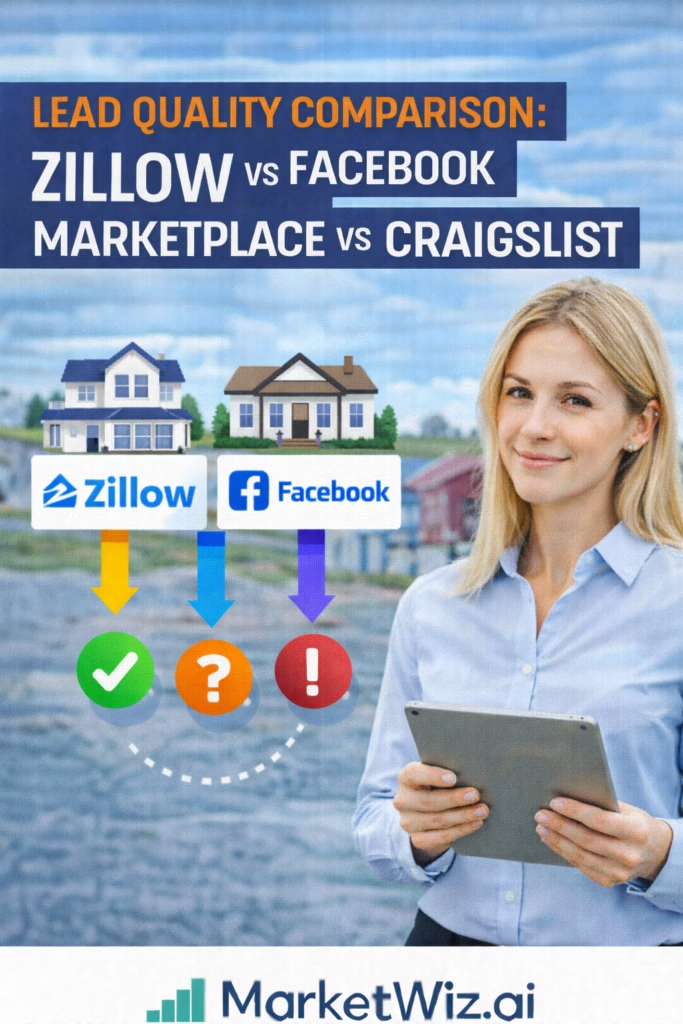
Lead Quality Comparison: Zillow vs Facebook Marketplace vs Craigslist
ChatGPT Image Dec 31 2025 09 18 41 AM
Lead Quality Comparison: Zillow vs Facebook Marketplace vs Craigslist

Lead Quality Comparison: Zillow vs Facebook Marketplace vs Craigslist

Lead Quality Comparison: Zillow vs Facebook Marketplace vs Craigslist breaks down intent, cost, speed-to-lead, and close probability—so you can spend time and budget where it actually converts.

Quick Win Stack: Intent Rubric Qualification Scripts Channel KPIs Routing Rules

Note: “Best channel” depends on your offer and market. This guide shows how to measure quality consistently and improve it per platform.

Introduction

Lead Quality Comparison: Zillow vs Facebook Marketplace vs Craigslist exists because “more leads” can still mean “more wasted time.” The best lead source is the one that produces the most closed revenue per hour of follow-up—not the one that produces the most messages.

Different platforms create different buyer mindsets:

  • Zillow: higher-intent shoppers, often further down the decision path
  • Facebook Marketplace: massive volume, mixed intent, fast chats
  • Craigslist: fewer leads in many markets, but can be “ready now” in the right categories/cities

This article gives you a channel-by-channel framework to score quality, improve conversion, and route your team efficiently.

Expanded Table of Contents

1) What “lead quality” actually means

Lead quality is not how excited someone sounds. It’s how likely they are to move forward through your sales steps.

Quality = intent + fit + responsiveness

Intent

Do they want to act soon? Are they asking about next steps, timeline, availability, or pricing?

Fit

Are they in your service area? Do they match your target buyer profile and budget range?

Responsiveness

Do they answer basic questions quickly, or do they disappear after “Is this available?”

Outcome

The only “real” proof: did they book, show, and buy?

Rule: The best channel is the one that produces the most closed deals per hour of follow-up.

2) Quick summary: Zillow vs Marketplace vs Craigslist

ChannelTypical IntentVolumeSpeedBest For
ZillowHigherMediumMediumReal estate-focused shoppers ready to compare
Facebook MarketplaceMixedHighFastBroad reach, quick convos, inventory-style offers
CraigslistMixed → High (in right markets)Low–MediumMediumValue shoppers and “ready now” buyers in some categories

Important: “Low quality” usually means “weak qualification + slow response,” not “bad platform.”

3) Buyer intent spectrum: browsing → buying

Every channel contains three buyer types:

  • Browsers: curious, price fishing, not ready
  • Comparers: collecting options, asking real questions
  • Buyers: timeline + budget + next steps

Your job: identify buyers fast, route comparers into nurture, and filter browsers politely.

4) Zillow lead quality breakdown

Zillow often attracts people who are already in a “housing decision” mindset. That tends to lift intent.

Why Zillow can produce higher quality leads

  • Buyers are usually comparing listings intentionally
  • Many are motivated by timing (moving, lease ending)
  • Contact forms can signal stronger intent than casual messages

Where Zillow can still disappoint

  • Leads can be distributed to multiple agents/providers
  • Some inquiries are mass-sent “info requests”
  • Slow response times still kill conversion

Zillow best practice: respond fast and ask timeline + budget + location immediately.

5) Facebook Marketplace lead quality breakdown

Marketplace is the fastest conversation engine—but it contains mixed intent.

Marketplace strengths

  • Massive reach and high daily activity
  • Fast messaging and quick back-and-forth
  • Great for visual offers (inventory, deals, bundles)

Marketplace weaknesses

  • Lots of “Is this available?” messages
  • Price shoppers and casual browsing
  • Ghosting is common without a script and follow-up

Marketplace quality boost: ask 3 qualification questions in the first reply and route fast-lane buyers immediately.

6) Craigslist lead quality breakdown

Craigslist can be high quality in certain cities/categories because many users are actively hunting for value and ready to act quickly.

Craigslist strengths

  • Can produce decisive buyers when the offer is clear
  • Simple posts can outperform “fancy” marketing
  • Great for specific categories and local intent

Craigslist weaknesses

  • Lower overall volume in many markets
  • Spam/scam noise exists (requires filtering)
  • Formatting and posting discipline matter a lot

Craigslist quality boost: use strong city targeting + a simple, direct CTA (ZIP + timeline).

7) The lead quality scoring rubric (copy/paste)

Use this to compare channels fairly. Score every lead 0–100.

LEAD QUALITY SCORE (0–100)

INTENT (0–40)
+20 Asked about timeline / availability / next steps
+10 Asked about pricing with specifics (not just “lowest?”)
+10 Willing to book call / viewing / quote process

FIT (0–35)
+15 In service area / target city
+10 Budget range matches offer
+10 Correct buyer type (end user / investor / homeowner etc.)

RESPONSIVENESS (0–25)
+10 Replies within 15 minutes
+10 Answers qualification questions
+5  Provides details (ZIP, timeline, size, etc.)

NEGATIVES
-25 Scam signals / weird payment / refusal to answer basics
-15 Outside service area
-10 “Just browsing” + no details after 2 prompts

Use it weekly: Average score by channel tells you true lead quality, not opinions.

8) Qualification scripts that increase quality instantly

Universal first reply (copy/paste)

Thanks for reaching out! I can help fast — quick questions:
1) What ZIP/city are you in?
2) What’s your budget range?
3) What timeline are you looking at? (ASAP / this month / just researching)

Once I have that, I’ll send the best options + next steps.

“Is this available?” reply

Yes — it’s available. What ZIP are you in and what timeline are you looking at?
(ASAP / this month / just pricing)

Why scripts matter: They convert mixed-intent channels into higher-quality conversations by forcing clarity early.

9) Speed-to-lead: why response time changes quality

Many “bad leads” are actually “late responses.” When you respond quickly:

  • Buyers are still online and ready to answer questions
  • You beat competitors to the conversation
  • You reduce ghosting by building momentum

Target: Respond within 5 minutes for high-volume channels like Marketplace.

10) Filters: how to cut tire-kickers fast

Use polite filters to protect your time.

Filter reply (copy/paste)

Totally get it — to make sure I point you to the right option:
What ZIP are you in and what timeline are you aiming for?

If you’re just browsing, no worries — I can send a quick range and examples.

Key: Don’t argue with browsers—route them to ranges, examples, and nurture.

11) Tracking + attribution: measure channel truth

To compare Zillow vs Marketplace vs Craigslist fairly, track:

  • Channel (Zillow / Marketplace / Craigslist)
  • City/market
  • Lead quality score (0–100)
  • Outcome stage: qualified → appointment → show → close
  • Time-to-first-response

Common mistake: judging a channel by “leads” instead of “closed revenue.”

12) KPIs that prove quality (not vanity)

Quality KPIs
• Qualified rate (qualified / total)
• Appointment rate
• Show rate
• Close rate

Efficiency KPIs
• Avg response time
• Touches per close
• Time spent per closed deal

Channel ROI
• Revenue per channel
• Gross profit per channel
• Revenue per hour of follow-up

If you track only one: close rate by channel.

13) Routing rules: where each lead type should go

Lead TypeExampleBest Route
Fast laneZIP + budget + timeline givenImmediate human follow-up
ComparerAsks real questions, no timeline yetNurture + follow-up in 24 hours
Browser“Lowest price?” no detailsSend range + require ZIP/timeline to proceed
Bad fitOutside service area or wrong buyer typePolite decline or referral route

14) 30–60–90 day rollout plan

Days 1–30 (Measurement)

  1. Implement channel tracking in your CRM/spreadsheet.
  2. Use the 0–100 rubric on every lead for 14 days.
  3. Deploy instant reply scripts and measure response time.
  4. Identify top cities/markets per channel.

Days 31–60 (Optimization)

  1. Improve Marketplace and Craigslist quality via strict qualification.
  2. Improve Zillow conversion with speed and follow-up discipline.
  3. Build channel-specific nurture sequences.
  4. Route fast-lane leads to priority response.

Days 61–90 (Scale)

  1. Double down on the highest close-rate channel(s).
  2. Expand geo targeting where quality holds steady.
  3. Automate reporting and weekly channel reviews.
  4. Document the SOP so quality stays consistent.

Outcome: You stop guessing and start investing in the channels that actually close.

15) 25 Frequently Asked Questions

1) Which channel has the best lead quality?

It depends on your offer and market. Measure by close rate and revenue per hour of follow-up.

2) Is Zillow always higher intent?

Often, but not always. Some leads are broad inquiries—speed and qualification still matter.

3) Why does Marketplace feel lower quality?

Because it’s high volume and mixed intent. Scripts and fast responses improve quality significantly.

4) Can Craigslist produce high-quality leads?

Yes in certain categories and cities. Clear posts and strong targeting are key.

5) What’s the best way to qualify quickly?

Ask ZIP/city, budget, and timeline in the first reply.

6) How do I reduce ghosting?

Respond faster, ask simple questions, and keep the next step clear.

7) What metrics matter most?

Qualified rate, appointment rate, show rate, and close rate by channel.

8) What’s a “fast lane” lead?

A lead that provides details (ZIP + budget + timeline) and is ready for immediate human follow-up.

9) Should I use different scripts by channel?

Yes—Zillow may need more consultative responses; Marketplace needs speed and clarity.

10) Are more leads always better?

No—more leads can waste time if quality is low and routing is weak.

11) How do I compare channels fairly?

Use the same scoring rubric and track outcomes through close.

12) What if Marketplace generates the most leads but lowest close rate?

Improve qualification and response time, then measure again for 14 days.

13) What if Craigslist has fewer leads but higher close rate?

That can be a great channel—scale it carefully while keeping quality consistent.

14) How do I stop unqualified Zillow leads?

Ask timeline and budget early and route low-intent leads to nurture.

15) What if I can’t respond fast?

Use instant auto-replies and route fast-lane leads to priority notifications.

16) Should I include pricing in listings?

Ranges can reduce low-intent leads and accelerate qualification.

17) What’s the best first question?

ZIP/city—because fit matters first for local and regional offers.

18) How many follow-ups should I send?

Usually 2–4 touches in 48 hours for high-intent channels is a strong baseline.

19) How do I measure “quality” quickly?

Track the % of leads that become qualified, then appointments, then closes.

20) What’s the biggest mistake with channel decisions?

Choosing based on lead volume instead of closed outcomes.

21) Can I use one CRM pipeline for all channels?

Yes—just tag the source and track quality score and outcomes.

22) What’s the best way to improve lead quality on Marketplace?

Fast response + qualification script + routing fast-lane leads.

23) What’s the best way to improve lead quality on Craigslist?

City targeting, clear offer, and filtering scams/tire-kickers fast.

24) What’s the best way to improve lead quality on Zillow?

Speed-to-lead plus consultative replies that guide the next step.

25) What’s the main takeaway?

Lead quality is measurable. Track outcomes, score leads, and invest where deals close.

16) 25 Extra Keywords

  1. Lead Quality Comparison: Zillow vs Facebook Marketplace vs Craigslist
  2. Zillow lead quality
  3. Facebook Marketplace lead intent
  4. Craigslist lead conversion
  5. real estate lead generation comparison
  6. lead scoring rubric
  7. speed to lead real estate
  8. qualified lead rate
  9. appointment rate by channel
  10. show rate optimization
  11. close rate benchmarking
  12. cost per lead comparison
  13. lead source tracking
  14. CRM routing rules
  15. marketplace qualification script
  16. Craigslist scam filtering
  17. Zillow inquiry conversion
  18. multi channel lead generation
  19. lead quality KPIs
  20. revenue per hour follow up
  21. marketing attribution for leads
  22. reduce tire kickers
  23. high intent leads
  24. local lead generation channels
  25. optimize lead conversion funnel

© 2025 Your Brand. All Rights Reserved.
General information only. Platform performance varies by location, category, offer, and execution.

Lead Quality Comparison: Zillow vs Facebook Marketplace vs Craigslist Read More »

Time Investment: Manual Posting vs Automated Distribution (Breakdown)

ChatGPT Image Dec 31 2025 09 18 40 AM
Time Investment: Manual Posting vs Automated Distribution (Breakdown)

Time Investment: Manual Posting vs Automated Distribution (Breakdown)

Time Investment: Manual Posting vs Automated Distribution (Breakdown) is the “real math” guide—because the biggest cost of manual posting isn’t the posting… it’s the repeat work and the context switching.

Quick Win Stack: Time Math Workflow Maps QC Checklist ROI Benchmarks

Note: Times below are averages. Your numbers vary based on platform friction, photo count, listings per day, team experience, and whether you handle messages in real-time.

Introduction

Time Investment: Manual Posting vs Automated Distribution (Breakdown) exists because most businesses underestimate the labor cost of “just post a few listings.”

Manual posting feels cheap because it’s paid with your attention instead of your budget. But as soon as you try to scale to 50, 100, or 200+ active listings, manual becomes a treadmill: constant re-uploads, edits, location changes, and inbox follow-ups—across multiple platforms.

This breakdown gives you:

  • Realistic time-per-listing estimates
  • Manual vs automated workflow maps
  • Daily/weekly schedule examples
  • Quality-control checklists that prevent “automation spam”
  • KPIs and ROI math you can use to justify the shift

Expanded Table of Contents

1) Definitions: manual posting vs automated distribution

Manual posting

A human completes every step on every platform: selecting category, uploading photos, writing titles/descriptions, setting location, responding to platform prompts, publishing, and repeating the process again and again.

Cost form: time + attention + context switching.

Automated distribution

A system takes structured listing data (titles, images, templates, locations) and publishes across multiple platforms with consistent cadence, while a human handles exceptions and quality review.

Cost form: setup + quality control + sales follow-up.

Time Investment: Manual Posting vs Automated Distribution (Breakdown) is less about “AI” and more about this truth: systems scale, humans burn out.

2) The hidden work nobody counts

When people estimate manual posting time, they usually count only the “publish” moment. They forget:

  • Asset prep: cropping, renaming, compressing, and re-ordering photos
  • Text rewriting: changing titles to avoid duplicates or improve SEO
  • Category friction: platform-specific fields (condition, delivery, price, tags)
  • Location targeting: city switching, map pin adjustments, zip targeting
  • Verification steps: phone/email prompts and security checks
  • Edits after posting: “tiny tweaks” across many listings
  • Inbox management: replies, follow-up nudges, spam filtering
  • Reposting/renewing: the never-ending refresh cycle

Reality: Manual posting time is not linear—it grows with scale because the admin overhead multiplies.

3) Time per listing: realistic ranges

Below are practical, real-world averages for most small businesses.

TaskManual TimeAutomated TimeNotes
Pick photos + order them2–6 min0–2 minAutomation can pull from pre-set sets
Write title + body3–8 min0–1 minTemplates + variables reduce rewrite time
Category + fields1–4 min0–1 minRules map listings to categories
Location targeting1–4 min0–1 minAutomation rotates city/zip schedules
Publish + verification1–5 min0–2 minDepends on platform friction
Post-edit / fix issues1–5 min0–2 minAutomation reduces repeats, not exceptions

Typical per-listing total: Manual = 8–20 minutes. Automated distribution = 1–5 minutes including review.

4) Manual workflow map (end-to-end)

Manual Posting Workflow
1) Find listing idea / product
2) Collect photos (download / crop / reorder)
3) Write title (platform-friendly) + description
4) Choose category and fill required fields
5) Select city / set location / choose delivery options
6) Publish
7) Fix errors or re-submit if blocked
8) Repeat on next platform
9) Respond to messages
10) Repost/renew listings

Manual pain point: The same listing becomes 3–4 different workflows across platforms, every day.

5) Automated workflow map (end-to-end)

Automated Distribution Workflow
1) Build listing data once (product + photos + templates)
2) Define rules:
   • platform mapping
   • category mapping
   • geo rotation schedule
   • posting cadence
3) System publishes across platforms on schedule
4) Human reviews exceptions and handles edge cases
5) Inbox workflow triggers follow-ups + qualification
6) Dashboard shows results by city/platform

Automation advantage: You create the listing once, then distribute it many times with controlled variation.

6) Scenario math: 10/day, 25/day, 50/day

Here’s why scale breaks manual posting.

Listings/dayManual (8–20 min each)Automated (1–5 min each)Time saved/day
1080–200 min (1.3–3.3 hrs)10–50 min~70–150 min
25200–500 min (3.3–8.3 hrs)25–125 min~175–375 min
50400–1000 min (6.6–16.6 hrs)50–250 min~350–750 min

Translation: Manual posting at volume becomes a full-time job (or multiple jobs). Automation turns it into a review task.

7) The multi-platform multiplier effect

The moment you post on multiple platforms, manual time multiplies.

Example: 10 listings/day across 3 platforms:

  • Manual: 10 listings × 3 platforms × (8–20 min) = 240–600 minutes (4–10 hours/day)
  • Automation: 10 listings × 3 platforms × (1–5 min) = 30–150 minutes (0.5–2.5 hours/day)

Key point: Automation isn’t just “faster posting.” It’s removing the repeated work across platforms.

8) Quality control: how to automate without getting sloppy

The fastest way to ruin automation is letting it publish low-quality posts at scale. The fix is a QC checklist.

QC checklist (copy/paste)

  • First image is clear and not cluttered
  • Title includes: product + city + high-intent keyword
  • Description answers: what it is, options, delivery, next step
  • No misleading claims (pricing, “in stock,” delivery times)
  • Unique variation: headline + first paragraph + photos differ across sets
  • CTA asks for the right qualifier (ZIP, size, timeline)

Rule: Automation should multiply quality—never multiply mistakes.

9) Cadence strategy: posting schedules that compound

Consistency matters more than spikes. A simple cadence that scales:

Starter cadence

  • 5–10 listings/day
  • Top 5 cities
  • Rotate 2 creative sets weekly

Scale cadence

  • 15–30 listings/day
  • Top 15 cities
  • Rotate 4–6 creative sets monthly

Posting mistake: Posting 50 in one day and 0 for the next 6 days. Algorithms reward steady presence.

10) Team structure: who should do what

Manual posting often forces sales people into admin work. A better structure:

RoleManual Posting WorldAutomated Distribution World
SalesPosts + respondsResponds + closes (stays in revenue work)
Ops/AdminFixes errors + editsQC review + exception handling
MarketingWrites everything manuallyBuilds templates + creative sets

Goal: Keep revenue people focused on revenue.

11) KPIs to track time savings and performance

Time KPIs
• Minutes per listing (by platform)
• Total posting minutes per week
• Exceptions per 100 listings

Performance KPIs
• Leads per listing (by platform)
• Qualified lead rate
• Response time (median)
• Close rate by city

Quality KPIs
• Rejection/limit rate
• Duplicate/flag rate
• Buyer complaints / low-quality inquiries

Best KPI combo: minutes saved + response time improved + qualified leads increased.

12) ROI math: when automation “pays for itself”

Automation usually pays for itself when either of these is true:

  • You post frequently enough that manual labor becomes expensive (hours/week).
  • Your response time improves and you close more deals (conversion lift).

Simple ROI equation

ROI = (Hours saved × hourly value) + (Extra deals × profit per deal) - automation cost

Real-world note: Most teams underestimate the “conversion lift” value. Faster replies often add more profit than the labor savings.

13) 30–60–90 day rollout plan

Days 1–30 (Foundation)

  1. Track current manual time per listing for 7 days.
  2. Build templates for titles and descriptions.
  3. Create 3–5 photo sets per product/service.
  4. Define top cities and a rotation schedule.
  5. Implement instant reply scripts.

Days 31–60 (Distribution)

  1. Start automated posting for one platform + 1–2 city groups.
  2. Introduce QC checks and exception handling.
  3. Track leads per listing and response times.
  4. Expand to more listings/day and more cities.

Days 61–90 (Scale + Optimize)

  1. Expand to multi-platform distribution.
  2. Build dashboards by platform/city.
  3. Refine templates and creative sets monthly.
  4. Set weekly SOP reviews for QA + performance.

Outcome: Posting becomes a system. Your team’s time shifts from admin to sales.

14) Troubleshooting

IssueLikely CauseFix
Automation posts feel repetitiveLow variationAdd headline sets, creative sets, use-case blocks
Leads increase but quality dropsToo broad geo targetingTighten city list; ask ZIP + timeline immediately
Listings get limitedSpam patternsReduce spikes; increase uniqueness; slow cadence if needed
Time savings are smallStill doing manual prepStandardize photo sets + templates; automate inputs
Sales team still overwhelmedFollow-up not structuredTier leads; fast lane only gets instant human follow-up

15) 25 Frequently Asked Questions

1) What is Time Investment: Manual Posting vs Automated Distribution (Breakdown)?

It’s a real-world comparison of time, workflows, and ROI between manual posting and automated distribution across multiple platforms.

2) How long does manual posting take per listing?

Often 8–20 minutes once you include photos, writing, categories, location targeting, and corrections.

3) How long does automated distribution take per listing?

Usually 1–5 minutes including review and exception handling, depending on platform friction and setup quality.

4) What’s the biggest time savings?

Removing repeated tasks: re-uploading photos, rewriting text, and selecting categories/locations per platform.

5) Is automation only for big businesses?

No. Even small businesses benefit once posting volume becomes consistent and multi-platform.

6) What’s the hidden cost of manual posting?

Context switching plus repetitive admin work that steals time from responding to leads.

7) Why does multi-platform posting break manual workflows?

Because each platform has different fields and friction, multiplying time and errors.

8) Does automation replace sales?

No. It replaces repetitive posting so sales can focus on follow-up and closing.

9) What should always be automated first?

Templates, photo sets, city rotation, and consistent posting schedules.

10) What should stay human?

Quality control, exceptions, and high-intent lead conversations.

11) Can automation hurt listing quality?

Yes if you automate bad content. Use a QC checklist and structured variation.

12) What is structured variation?

Changing headlines, use cases, photos, and geo targeting meaningfully so listings stay unique and useful.

13) How do I prevent repetitive templates?

Create multiple headline sets, intro paragraphs, and image sets that rotate by city and product.

14) What’s a good starting cadence?

5–10 listings/day in top cities, then scale up once the workflow is stable.

15) How do I measure time savings?

Track minutes per listing and total posting time per week before and after automation.

16) What KPI matters most for revenue?

Response time—faster replies usually increase conversions.

17) What if automation increases leads but lowers quality?

Tighten geo targeting and qualify leads with ZIP + timeline in the first reply.

18) What if listings get limited?

Reduce spikes, increase uniqueness, rotate creative, and avoid copy/paste patterns.

19) Does automation help with renew/repost cycles?

Yes—automation can schedule renewals and maintain consistent presence without manual effort.

20) What’s the simplest ROI formula?

(Hours saved × hourly value) + (extra deals × profit per deal) − automation cost.

21) When does automation pay for itself?

When posting volume is consistent and response speed improves enough to lift conversions.

22) Do I need a CRM for this?

At least a simple tracker by platform/city is needed to optimize reliably.

23) What’s the biggest mistake teams make?

Automating posting but not improving follow-up speed and structure.

24) What’s the fastest win?

Standardize templates + photo sets and deploy instant reply scripts.

25) What’s the big takeaway?

Manual posting doesn’t scale. Automated distribution turns posting into a system—and frees time for sales.

16) 25 Extra Keywords

  1. Time Investment: Manual Posting vs Automated Distribution (Breakdown)
  2. manual posting time per listing
  3. automated listing distribution
  4. multi platform posting automation
  5. facebook marketplace posting workflow
  6. craigslist posting workflow
  7. offerup listing workflow
  8. listing automation ROI
  9. time savings marketing automation
  10. marketplace listing templates
  11. how to automate follow up
  12. speed to lead improvement
  13. posting cadence strategy
  14. city rotation posting plan
  15. geographic targeting marketplaces
  16. reduce admin work marketing
  17. lead generation automation system
  18. workflow optimization small business
  19. sales team productivity automation
  20. reduce context switching work
  21. quality control checklist listings
  22. prevent duplicate listing patterns
  23. marketplace SEO titles
  24. automated distribution dashboard
  25. 30 60 90 automation rollout

© 2025 Your Brand. All Rights Reserved.
General information only. Times and outcomes vary by platform rules, category, market demand, listing quality, and execution.

Time Investment: Manual Posting vs Automated Distribution (Breakdown) Read More »

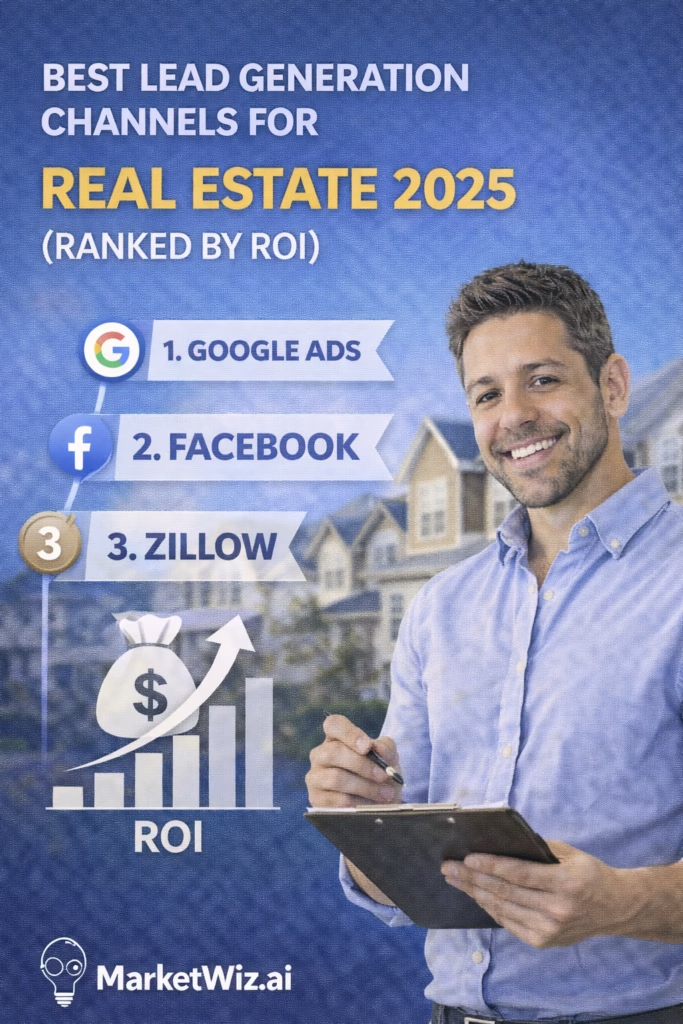
Best Lead Generation Channels for Real Estate 2025 (Ranked by ROI)

ChatGPT Image Dec 31 2025 09 18 32 AM
Best Lead Generation Channels for Real Estate 2025 (Ranked by ROI) — 2025 Playbook

Best Lead Generation Channels for Real Estate 2025 (Ranked by ROI)

Best Lead Generation Channels for Real Estate 2025 (Ranked by ROI) is a field-tested ranking for agents and teams who want more closings—without wasting money on low-intent leads.

Quick Win Stack: Referrals / SOI Google Business Profile Local SEO High-Intent Search Ads

Note: This is general marketing guidance—not legal, compliance, or brokerage policy advice. Always follow your MLS, brokerage, and advertising rules.

Introduction

Best Lead Generation Channels for Real Estate 2025 (Ranked by ROI) is not a list of “what’s popular.” It’s a ranking based on what actually produces profit when you include:

  • Lead quality (intent + trust)
  • Close rate (appointments → contracts → closings)
  • Cost (spend + tools + labor time)
  • Speed-to-lead (minutes, not hours)
  • Time-to-close (pipeline velocity)

In 2025, the truth is simple: most agents don’t lose because they lack leads. They lose because leads aren’t handled consistently, follow-up isn’t systemized, and attribution is fuzzy.

Goal of this guide: help you pick 2–3 primary channels to dominate, plus 2 supporting channels—then build a predictable conversion system behind them.

Expanded Table of Contents

1) The ROI ranking model (how we score channels)

To rank channels fairly, you need one scoring system across all lead sources.

ROI definition (agent-friendly)

ROI =
(Net Commission Income − Total Channel Cost) / Total Channel Cost

Total Channel Cost =
Ad spend + tools + labor hours (valued) + follow-up overhead

Our 2025 ROI scoring rubric (1–10 per category)

CategoryWhat “10” meansWhy it matters
Intent / QualityHigh-intent buyer/seller + trust already builtHigher close rate = higher ROI
Cost EfficiencyLow ongoing cost per closed transactionProtects margins
ScalabilityCan grow without doubling your timePrevents burnout
SpeedLead-to-appointment happens fastVelocity increases wins
ControlYou control the asset (list, GBP, website, community)Stability over time

Important: A channel can be “expensive” and still have great ROI if it produces closings reliably. ROI is profit, not popularity.

2) 2025 ROI ranking: Best lead generation channels for real estate

Here’s the Best Lead Generation Channels for Real Estate 2025 (Ranked by ROI) list, built for most agents and small-to-mid teams. Your market will vary, but these rankings hold up across a wide range of U.S. metros and suburbs.

RankChannelBest ForROI Score (Typical)
#1Referrals + Sphere of Influence (SOI)Highest trust, highest close rates9.5 / 10
#2Google Business Profile + Reviews (Maps)Local “ready now” sellers/buyers searching for an agent9.0 / 10
#3Local SEO (Neighborhood + City Pages)Compounding inbound leads over time8.8 / 10
#4High-Intent Google Search Ads (PPC)Fast pipeline fill for listings and buyers8.3 / 10
#5Open Houses (w/ strong capture + follow-up)Listings → buyers → neighbors → sellers8.1 / 10
#6Strategic Partnerships (lenders, attorneys, builders)Steady referrals outside your SOI7.9 / 10
#7Organic Short-Form Social (Reels/TikTok/Shorts)Brand + inbound + retargeting fuel7.6 / 10
#8Retargeting Ads (Meta/YouTube/Display)Turning “not ready” into “ready”7.4 / 10
#9Portals (Zillow/Realtor/etc.)Volume—if you have speed + nurture7.0 / 10
#10Direct Mail (Hyperlocal + tracked)Listings in specific neighborhoods6.8 / 10
#11Cold Outreach (FSBO/Expired/Absentee)High upside—but labor heavy6.5 / 10
#12Community + Local EventsTrust-building in smaller markets6.3 / 10

Reality check: The top ROI winners are “trust-first channels.” The biggest marketing job in real estate is earning trust before the transaction.

3) Channel breakdowns (cost, effort, best use cases)

#1) Referrals + Sphere of Influence (SOI)

Why it ranks #1: Trust is transferred. Close rates are typically higher, objections are lower, and time-to-close is faster.

Best use cases

  • Repeat and referral business
  • Move-up buyers + downsizers
  • Listing-heavy strategies

Common mistakes

  • Only “checking in” when you need business
  • No referral language or ask
  • No system (random outreach)

SOI system that works: monthly value touch + quarterly personal touch + annual “life update” touch.

SOI value touch ideas (quick list)

  • Monthly neighborhood snapshot (prices, DOM, inventory)
  • “What your home might sell for this season” mini-CMA offer
  • Local vendor recommendations (contractor list)
  • Home maintenance calendar

#2) Google Business Profile (Maps) + Reviews

Why it ranks top-3: People searching “real estate agent near me” are often closer to taking action. A strong profile converts with minimal friction.

What to optimize first

  • Accurate categories + services
  • High-quality photos (you, team, closings, neighborhoods)
  • Weekly posts (listings, open houses, tips)
  • Review velocity (consistent new reviews)
  • Fast reply to calls/messages

ROI lever: higher trust at the moment of decision. When your reviews + profile are strong, you win “comparison shopping” searches.

#3) Local SEO (Neighborhood Pages + Seller/Bayer Guides)

Why it ranks #3: SEO compounds. Each strong page becomes an asset that can produce leads for years.

High-ROI SEO page types

  • Neighborhood guides (schools, amenities, lifestyle)
  • “Sell my house in [City]” seller pages
  • “Best suburbs near [City]” pages
  • First-time buyer guide + timeline
  • Relocation guides (moving to [City])

SEO warning: Don’t write generic fluff. You need specific, local, lived-in detail: neighborhoods, landmarks, commute patterns, and real market updates.

SEO ROI playbook

  1. Pick 10 “money pages” (top neighborhoods + top intents).
  2. Optimize GBP + link to those pages.
  3. Get 1–2 local backlinks/month (chambers, local orgs, sponsorships).
  4. Post weekly market content and interlink it.

#4) High-Intent Google Search Ads (PPC)

Why it ranks #4: PPC is the fastest way to “buy time” and fill pipeline—if you do it right. Bad campaigns burn money. Good campaigns print appointments.

What makes PPC profitable (real talk)

  • High intent keywords (seller/buyer action terms)
  • Dedicated landing pages (one goal: appointment)
  • Call + form tracking (UTMs + call tracking)
  • Speed-to-lead under 5 minutes
  • Follow-up sequences (text + email + call cadence)

ROI lever: control and scale. You can increase spend on what proves it closes.

#5) Open Houses (with strong lead capture + follow-up)

Open houses can be a top ROI channel because they produce multiple lead types at once:

  • buyers who are actively shopping
  • neighbors who might sell
  • move-up buyers (future listings)

Open house capture system

  1. Offer a value exchange: “Neighborhood price sheet” or “Home-buying checklist.”
  2. QR code sign-in (name, phone, email, timeline).
  3. Immediate text: “Thanks for coming—want the list of homes like this?”
  4. Follow-up within 2 hours, then 24 hours, then 3 days.

Biggest mistake: collecting sign-ins and never turning them into scheduled consultations.

#6) Strategic Partnerships (Lenders, Attorneys, Builders, CPAs, Relocation)

Partnerships produce high-trust, high-intent leads when structured correctly.

How to structure a partnership that actually produces

  • Define lead handoff rules (who gets what and when)
  • Co-branded content (buyer guide, webinar, local event)
  • Monthly “pipeline review” call (10 minutes)
  • Shared tracking sheet (source, status, outcome)

ROI lever: borrowed trust + steady pipeline with low ad spend.

#7) Organic Short-Form Social (Reels / TikTok / Shorts)

Organic social often gets misunderstood. It’s not just “views.” It’s:

  • trust-building (you become familiar)
  • proof (results, local knowledge)
  • retargeting fuel (build audiences)
  • DM inbound when you post consistently

Best-performing video themes for real estate

  • Neighborhood tours (30 seconds)
  • Market myth-busting (“3 things buyers get wrong…”)
  • Seller tips (“1 upgrade that helps offers…”)
  • Relocation tips (commute, safety, vibe)
  • Behind the scenes: “How we price a home”

ROI rule: social converts when it drives a next step: DM keyword, book link, home valuation, or call.

#8) Retargeting Ads (Meta / YouTube / Display)

Retargeting is where you win the “not ready yet” crowd—especially in real estate where decisions take time.

High-ROI retargeting offers

  • Home valuation (seller lead magnet)
  • Buyer checklist + lender intro
  • Neighborhood price alerts
  • “Moving to [City]” relocation guide

ROI lever: increases conversion of traffic you already paid for (or earned organically).

#9) Portals (Zillow / Realtor / etc.)

Portal leads can be profitable, but the ROI hinges on one thing: speed and nurture.

Make portal leads profitable with a simple SLA

  • Respond in < 2 minutes (yes, really)
  • Ask 3 qualification questions (timeline, location, financing)
  • Offer 2 next steps: call now or book a time
  • Use a 7-day nurture sequence

Portal reality: you’re not just competing with other agents—you’re competing with the lead’s attention span.

#10) Direct Mail (Hyperlocal + tracked)

Direct mail still works—when it’s tight, tracked, and consistent.

Direct mail that tends to convert

  • Just sold / just listed (proof + neighborhood relevance)
  • Market update postcard (value first)
  • Handwritten-style letter to a micro-farm area

Tracking requirement (non-negotiable)

  • Use a unique call tracking number or unique URL/QR
  • Ask “What street are you on?” to confirm geography
  • Log every call with outcome

ROI lever: neighborhood dominance for listings.

Honorable mentions (situationally high ROI)

Expired / FSBO outreach

High upside. Labor heavy. Works best with a tight script and daily consistency.

Community events

Best in smaller or relationship-driven markets. Converts slower, but builds trust.

Local sponsorships

Great for brand + backlinks + community trust, especially when paired with GBP/SEO.

4) The conversion layer that makes any channel profitable

The channel is only half the equation. The other half is the system behind it.

The 5-piece conversion layer

  1. Speed-to-lead: reply fast (minutes, not hours).
  2. Qualification: timeline, location, motivation, financing.
  3. Next step: book a consult, schedule a showing, start a CMA.
  4. Follow-up: consistent touches with value.
  5. Attribution: track source → appointment → close.

North Star: cost per booked consult (seller) and cost per pre-approved buyer consult (buyer).

Simple follow-up cadence (works in 2025)

Day 0: Instant reply + qualification + book link
Day 1: Value message + ask to schedule
Day 3: Proof message (recent wins / market data)
Day 5: Soft close (“still looking to…?”)
Day 7: Option message (“quick call or text answers?”)
Then: weekly value touches for 4–8 weeks

5) Copy/paste scripts that increase appointments

Script 1: First reply (buyer lead)

Hey! Thanks for reaching out — I can help.
Quick 3 questions so I can send the best matches:
1) What areas/neighborhoods are you considering?
2) Are you buying in the next 0–3 months or 3–6+ months?
3) Are you already pre-approved (or want a quick lender intro)?

If you want, we can do a 10-min call and I’ll map out a simple plan.

Script 2: First reply (seller lead)

Absolutely — happy to help.
Quick 3 questions so I can give you an accurate range:
1) What’s the address (or nearest cross-street)?
2) Any major upgrades in the last 5 years?
3) Are you thinking 0–3 months or later?

If you’d like, I can send a quick price range today and we can refine it on a short call.

Script 3: “Are you a real agent?” trust objection

Totally fair question.
Yes — I’m a licensed agent and I keep it simple:
• Clear plan and timelines
• Straight answers
• Consistent communication
If you tell me your timeline and the area you’re focused on, I’ll send next steps right away.

Script 4: Move to appointment (universal)

Perfect — the fastest way is a quick 10–15 min call.
I can do:
• Today: [time], [time]
• Tomorrow: [time], [time]
Which works best?

Appointment rule: You don’t “close” the deal in DMs. You close the next step.

6) KPIs to track ROI (what to measure weekly)

Pipeline KPIs
• Leads by source
• Contact rate (% reached)
• Booked consults
• Showings (buyers) / listing appointments (sellers)
• Closed transactions

Speed KPIs
• Speed-to-lead (minutes)
• Missed call rate
• Follow-up completion rate

ROI KPIs
• Cost per booked consult
• Cost per close
• Net commission per channel
• Time-to-close (days)

Weekly habit: double down on sources that produce booked consults at the lowest cost—not just leads.

7) 30–60–90 day rollout plan

Days 1–30 (Foundation + speed)

  1. Pick 2 primary channels (one trust channel + one intent channel).
  2. Set up tracking: UTMs + call tracking + pipeline stages.
  3. Install scripts and follow-up cadence.
  4. Fix speed-to-lead: aim under 5 minutes.
  5. Collect reviews weekly and post on GBP.

Days 31–60 (Compounding assets)

  1. Publish 5–10 local SEO pages (neighborhood + seller intent).
  2. Run high-intent search ads to a single landing page per offer.
  3. Start retargeting to site visitors and video viewers.
  4. Build 3 partnerships (lender, attorney, builder).

Days 61–90 (Scale + optimize)

  1. Scale budgets based on cost per booked consult and cost per close.
  2. Improve conversion: test scripts, landing pages, and offers.
  3. Standardize a weekly reporting dashboard.
  4. Train your team on one consistent process (SOP).

Scaling rule: Don’t scale spend until your follow-up and tracking are consistent.

8) 25 Frequently Asked Questions

1) What are the Best Lead Generation Channels for Real Estate 2025 (Ranked by ROI)?

They’re the channels that produce the highest profit after costs—typically referrals/SOI, Google Business Profile + reviews, local SEO, and high-intent Google search campaigns.

2) What’s the #1 ROI channel for most agents?

Referrals and SOI usually win because trust is pre-built and close rates are higher.

3) What’s the fastest channel to produce leads?

High-intent PPC (Google search ads) and portals can produce leads quickly, but require strong speed-to-lead and follow-up to stay profitable.

4) Which channel is best for listings?

Referrals/SOI, GBP (Maps), direct mail in target neighborhoods, and seller-intent SEO pages.

5) Which channel is best for buyer leads?

Open houses, Google search ads, SEO neighborhood pages, and strong organic social that drives DMs.

6) Are portal leads worth it in 2025?

They can be, but ROI depends on speed, scripts, and nurture. Without a system, they often become expensive “busy work.”

7) What’s the best KPI to replace cost per lead?

Cost per booked consult and cost per close are more meaningful.

8) How fast should I respond to leads?

As fast as possible. Under 5 minutes is an excellent target for high-intent inbound.

9) Why does GBP rank so high?

Because it captures local intent at the decision moment, and reviews act as immediate trust proof.

10) How many reviews do I need?

There’s no magic number, but consistency matters: steady new reviews plus thoughtful responses.

11) What’s the biggest mistake agents make with SEO?

Publishing generic content that doesn’t show local expertise or match buyer/seller intent.

12) How long does SEO take to work?

Often months for meaningful results, which is why it’s ranked high—compounding ROI over time.

13) What should I post on social to get leads?

Neighborhood tours, market myth-busting, seller tips, relocation tips, and proof-based stories.

14) Do open houses still work?

Yes—especially with a QR sign-in, a value offer, and follow-up within hours.

15) What’s the best way to convert open house leads?

Immediate text follow-up + a short call offer + curated matches.

16) Are partnerships really scalable?

Yes, when you define handoff rules and do regular pipeline reviews.

17) What’s the most scalable channel?

SEO + GBP + PPC together create a scalable inbound engine with measurable attribution.

18) What’s the best channel for new agents?

Open houses + partnerships + consistent SOI touches while building GBP and social presence.

19) What if I have a small budget?

Start with SOI + GBP + organic social. Add PPC only when you can track and follow up consistently.

20) How do I track which leads turned into closings?

Use pipeline stages and require a “source” field on every lead plus closed-won logging.

21) What’s the biggest ROI killer?

Slow response and inconsistent follow-up—leads leak out fast in competitive markets.

22) Should I use retargeting?

Yes if you have traffic from SEO/social/PPC. Retargeting improves conversion of existing audiences.

23) What’s the best lead magnet for sellers?

Home valuation + neighborhood market report + “pricing strategy” mini-guide.

24) What’s the best lead magnet for buyers?

Buyer checklist, pre-approval guide, and neighborhood match list.

25) What’s the fastest improvement I can make today?

Install a fast first-reply script, respond within minutes, and move every lead to a scheduled next step.

9) 25 Extra Keywords

  1. Best Lead Generation Channels for Real Estate 2025 (Ranked by ROI)
  2. real estate lead generation 2025
  3. best real estate lead sources
  4. real estate marketing ROI
  5. realtor leads ranked by ROI
  6. referral marketing for real estate agents
  7. sphere of influence real estate
  8. Google Business Profile for realtors
  9. local SEO for real estate agents
  10. Google ads for real estate agents
  11. real estate PPC strategy
  12. open house lead generation
  13. convert open house leads
  14. real estate partnerships leads
  15. mortgage lender referral strategy
  16. real estate social media leads
  17. real estate short form video strategy
  18. real estate retargeting ads
  19. Zillow leads ROI
  20. portal leads conversion
  21. direct mail for real estate agents
  22. expired listings outreach
  23. FSBO lead generation
  24. cost per booked listing appointment
  25. real estate lead tracking KPIs

© 2025 Your Brand. All Rights Reserved.
General information only—comply with MLS, brokerage, and advertising regulations applicable to your region.

Best Lead Generation Channels for Real Estate 2025 (Ranked by ROI) Read More »

AI Lead Generation vs Traditional Methods: ROI Analysis

ChatGPT Image Dec 31 2025 09 18 23 AM
AI Lead Generation vs Traditional Methods: ROI Analysis — 2025 Playbook

AI Lead Generation vs Traditional Methods: ROI Analysis

AI Lead Generation vs Traditional Methods: ROI Analysis breaks down what actually drives profit: cost per lead, close rate, speed-to-lead, follow-up consistency, and the hidden cost of time.

Quick Win Stack: Speed-to-Lead Lead Qualification Follow-Up Automation Attribution Tracking

Note: This is general marketing guidance—not financial or legal advice. Always comply with platform policies and outreach regulations in your region.

Introduction

AI Lead Generation vs Traditional Methods: ROI Analysis matters because most businesses don’t have a lead problem—they have a lead leakage problem.

Leads come in… then:

  • calls are missed,
  • messages sit for hours,
  • follow-up is inconsistent,
  • no one knows which channel produced the sale.

Traditional marketing can still be great (referrals, word-of-mouth, networking, radio, direct mail, or standard PPC). But in 2025, AI-driven systems often win ROI by improving the operations layer—the part between inquiry and booked appointment.

This playbook shows you how to compare ROI honestly, pick the right mix, and build a system that scales.

Expanded Table of Contents

1) Definitions: what counts as “AI lead gen” vs “traditional”

AI lead generation (in practical terms)

AI lead generation typically means a system that uses automation + intelligence to:

  • capture leads from multiple sources (forms, calls, DMs, chat)
  • respond instantly (or near instantly)
  • qualify leads (budget, timeline, location, needs)
  • route leads to the right person
  • follow up consistently (without forgetting)
  • book appointments automatically
  • report what actually closed

Traditional lead generation (in practical terms)

Traditional methods usually rely on:

  • referrals and word-of-mouth
  • networking, partnerships, local events
  • print, radio, billboards, direct mail
  • manual outreach (calls, emails, door hangers)
  • standard advertising without automation workflows

Key insight: AI is often less about “finding new leads” and more about converting the leads you already have.

2) The ROI formula most businesses forget

Most people compare channels using cost per lead (CPL). That’s a trap.

True ROI (per channel) =
(Gross Profit from Closed Deals − Total Channel Cost) / Total Channel Cost

Total Channel Cost =
Ad spend + tools + labor time + management overhead + missed-opportunity cost

Why “missed-opportunity cost” matters: if a lead sits for 2 hours and buys from someone else, your cost isn’t $0. Your cost is the profit you didn’t get.

ROI reality: A higher CPL can be more profitable if the close rate and gross profit are higher.

3) Cost structure comparison (what you actually pay for)

CategoryAI Lead GenerationTraditional Methods
Primary costSoftware + automation + content/distributionMedia spend, labor, or relationship-building time
LaborFront-loaded setup; lower ongoing hours per leadOngoing manual time (calls, follow-up, admin)
SpeedInstant response and consistent follow-upDepends on staff availability; often slower
ScalabilityScale with systems and processesScale with people and time
AttributionUsually easier if set up (tracking/CRM automation)Often fuzzy unless tracked intentionally

Bottom line: AI tends to reduce “labor per conversion.” Traditional tends to increase “labor per conversion.”

4) Channel-by-channel ROI comparison

Here’s the most useful way to compare ROI: what happens after the lead appears.

Channel exampleTraditional approachAI-driven approachTypical ROI lever
Inbound callsManual answering, voicemail, callbacksImmediate routing, auto-text follow-up, bookingAnswer rate + booking rate
Website formsReply later, inconsistent follow-upInstant reply + lead scoring + sequencesSpeed-to-lead
DMs / MarketplaceManual responses when availableAuto-reply + qualification + appointment settingReduce leakage
ReferralsStrong trust; manual schedulingAI assists with scheduling + follow-upTime-to-book
Direct mail / flyersCall tracking sometimes missingUnique numbers + landing pages + automationAttribution clarity

Important: AI rarely replaces your best traditional channel. It amplifies it by fixing the conversion layer.

5) When AI lead generation wins (and why)

AI Lead Generation vs Traditional Methods: ROI Analysis usually points to AI winning when any of these are true:

AI wins when…

  • You miss calls or respond slowly
  • You rely on one person for follow-up
  • You have high lead volume and low organization
  • You don’t have consistent scripts
  • You don’t track what closed
  • Your market is competitive (speed matters)

Why it wins

  • Instant response increases contact rate
  • Qualification reduces wasted time
  • Consistent follow-up increases close rate
  • Lead routing prevents “dead inbox”
  • Better attribution improves budget decisions

Translation: AI wins ROI by reducing lost leads and labor hours per sale.

6) When traditional methods win (and why)

Traditional methods can still dominate ROI—especially when trust and relationships are the real product.

Traditional wins when…

  • Your business is built on deep trust (referrals, community reputation)
  • Your average ticket is very high and buyers want human reassurance
  • Your conversion depends on in-person relationships
  • Your market has limited digital competition
  • Your sales team is already disciplined and fast

Best use of AI here: Don’t replace the relationship—automate the admin (scheduling, reminders, follow-up, reporting).

7) The hybrid model that usually produces the best ROI

If you want a simple answer to AI Lead Generation vs Traditional Methods: ROI Analysis, it’s this:

Use traditional channels for trust and demand. Use AI to convert and scale.

A high-ROI hybrid stack (simple)

  • Demand sources (traditional + digital): referrals, networking, Google/Maps, social, mailers
  • AI conversion layer: instant response, qualification, booking, follow-up sequences
  • Human close layer: consult, quote, demo, final objection handling
  • Reporting layer: closed-won tracking by source

Don’t automate the relationship. Automate the parts humans forget.

8) Tracking and attribution that makes ROI real

ROI debates usually happen because nobody trusts the numbers. Fix the tracking and the argument disappears.

Minimum viable tracking (do this first)

  • Unique phone number per major channel (or at least per “bucket”)
  • UTM links for ads and social posts
  • Lead sheet/CRM fields: source, status, estimated value, closed result
  • Weekly report: leads → appointments → closed deals

Better tracking (for serious scaling)

  • Call recording + disposition tagging
  • Pipeline stages: NewContactedQualifiedBookedClosed
  • Automated follow-up with stop rules (stop when booked/closed)
  • Closed-won reason codes (why they bought)

Golden KPI: cost per booked appointment (more reliable than CPL).

9) Copy/paste scripts for instant qualification

AI or not, conversion improves when qualification is consistent.

Script 1: Fast first reply (universal)

Hey! Thanks for reaching out — I can help.
Quick 3 questions so I can point you to the best option:
1) What are you looking to solve / get done?
2) What’s your ideal timeline?
3) What city/area are you in?

Once I have that, I’ll send next steps.

Script 2: Price-first lead (without losing control)

Totally — pricing depends on scope and timeline.
If you tell me the goal + your timeline, I’ll give you the best 2 options:
• Best value option
• Fastest option

What city are you in and how soon do you want this done?

Script 3: Booking push (high intent)

Perfect — the fastest way is to book a quick time.
I can do:
• Today: [2 times]
• Tomorrow: [2 times]

Which works best? I’ll lock it in and send confirmation.

Conversion rule: Ask fewer questions, faster. Move to a booked step as soon as intent is clear.

10) KPIs to measure ROI improvements

Core ROI KPIs
• Cost per booked appointment
• Close rate (% booked → closed)
• Gross profit per closed deal
• Lead-to-close time (days)

Speed & Coverage KPIs
• Speed-to-lead (minutes)
• Contact rate (% leads reached)
• Follow-up completion rate

Quality KPIs
• Qualified rate (% that meet budget/timeline/location rules)
• Refund/complaint rate (if applicable)
• No-show rate (appointments)

North Star: more booked appointments + higher close rate + fewer hours spent per closed deal.

11) 30–60–90 day rollout plan

Days 1–30 (Foundation)

  1. Define your ROI baseline: leads, booked, closed, gross profit, response time.
  2. Set up minimal tracking: unique numbers + UTMs + pipeline stages.
  3. Create standardized scripts: first reply, price, booking.
  4. Fix the biggest leakage point (missed calls, slow replies, no follow-up).

Days 31–60 (Automation + optimization)

  1. Implement automation sequences (follow-up, reminders, reactivation).
  2. Add lead scoring (high intent vs low intent routing).
  3. Build a simple dashboard report weekly.
  4. Refine your offer clarity (what’s included, next steps, turnaround time).

Days 61–90 (Scale)

  1. Scale the best-performing channels by cost per booked appointment.
  2. Reduce labor per sale with smarter qualification and routing.
  3. Train team on one consistent process (SOP).
  4. Run monthly ROI reviews and keep improving conversion rates.

Most important: Don’t scale spend until your conversion layer is stable and measurable.

12) 25 Frequently Asked Questions

1) What is AI Lead Generation vs Traditional Methods: ROI Analysis?

It’s a comparison framework to measure profitability across AI-driven lead capture/automation versus traditional marketing methods using cost, conversion, time, and attribution.

2) Does AI lead generation always beat traditional?

No. AI tends to win when speed, follow-up, and organization are weak. Traditional can win when trust-based referrals dominate and sales coverage is strong.

3) What’s the biggest ROI advantage of AI?

Reducing leakage: instant response, consistent qualification, and follow-up without adding headcount.

4) What’s the biggest ROI advantage of traditional methods?

Trust and intent. Referrals and partnerships often close at higher rates with lower price pressure.

5) What metric should I use instead of cost per lead?

Cost per booked appointment and cost per closed deal are more meaningful.

6) What’s “lead leakage”?

When leads come in but don’t get handled quickly and consistently—so they never become appointments or sales.

7) Can AI replace my sales team?

AI can handle first response, qualification, and scheduling. Most businesses still need humans for final close and complex cases.

8) What’s the simplest AI workflow to start with?

Instant reply + 3-question qualification + booking link + follow-up reminders.

9) How do I know if AI will improve my ROI?

If you have slow response time, inconsistent follow-up, or missed calls, AI will likely increase conversion.

10) What if my leads are low quality?

Use qualification rules and tighten your offer clarity to filter low-intent inquiries.

11) Is AI lead gen only for online businesses?

No. Local service businesses often see major ROI gains because speed-to-lead matters.

12) Which businesses benefit most from AI lead gen?

Businesses with high lead volume, competitive markets, or limited staff for follow-up.

13) What’s the biggest mistake with AI lead gen?

Automating without tracking—then you can’t prove ROI or improve it.

14) What’s the biggest mistake with traditional lead gen?

Not measuring outcomes and relying on “it feels like it works.”

15) How do I track ROI if I don’t have a CRM?

Start with a spreadsheet: source, lead date, status, booked, closed, value.

16) What’s lead scoring?

Ranking leads based on intent signals like budget, timeline, and service area fit.

17) What’s the best way to improve close rates?

Faster response, clearer next steps, and consistent follow-up.

18) Do AI chatbots hurt trust?

They can if they sound robotic. Keep responses clear, helpful, and escalate when needed.

19) Can traditional marketing be automated?

Yes. Even referral and direct mail campaigns can use automation for follow-up and tracking.

20) What’s a good follow-up schedule?

Short and consistent: multiple touches in the first 24–72 hours, then spaced out.

21) What’s more important: more leads or better conversion?

Better conversion often increases profit faster than buying more leads.

22) How do I reduce no-shows?

Use reminders, confirmations, and clear expectations—automation helps a lot.

23) Can AI improve traditional referral pipelines?

Yes—by speeding up scheduling, reminders, and post-visit follow-ups.

24) How long until I see ROI from AI improvements?

Often within weeks if your baseline response time and follow-up are weak.

25) What’s the fastest ROI win?

Instant first reply + qualification + booking workflow with simple tracking.

13) 25 Extra Keywords

  1. AI Lead Generation vs Traditional Methods: ROI Analysis
  2. AI lead generation ROI
  3. traditional lead generation ROI
  4. marketing automation ROI
  5. AI sales automation
  6. AI appointment booking
  7. speed to lead ROI
  8. lead follow up automation
  9. AI lead qualification
  10. lead scoring for small business
  11. reduce lead leakage
  12. cost per booked appointment
  13. cost per closed deal
  14. lead conversion rate improvement
  15. AI customer service agent
  16. AI SMS follow up
  17. AI chatbot for lead capture
  18. local business lead generation
  19. traditional marketing methods ROI
  20. referral marketing ROI
  21. direct mail ROI tracking
  22. sales pipeline automation
  23. CRM automation workflow
  24. business growth automation
  25. lead generation performance metrics

© 2025 Your Brand. All Rights Reserved.
General information only—comply with platform policies and outreach regulations applicable to your region.

AI Lead Generation vs Traditional Methods: ROI Analysis Read More »

Case Study: Metal Building Dealer Automated 200+ Listings

ChatGPT Image Dec 30 2025 08 12 28 AM
Case Study: Metal Building Dealer Automated 200+ Listings — Full Breakdown

Case Study: Metal Building Dealer Automated 200+ Listings

Case Study: Metal Building Dealer Automated 200+ Listings reveals how a dealer built a repeatable lead engine by combining listing automation, geographic targeting, instant follow-up, and conversion tracking.

Quick Win Stack: 200+ Unique Listings City Rotation Instant Replies Lead Dashboard

Note: This case study is generalized and anonymized. Results vary based on offer, pricing, market demand, response time, inventory availability, and platform changes.

Introduction

Case Study: Metal Building Dealer Automated 200+ Listings is a complete breakdown of what happens when a business stops relying on “a couple posts here and there” and starts operating a real distribution system.

The dealer sold a high-consideration product—metal buildings—where most buyers want:

  • Clear options (sizes, styles, add-ons)
  • Trust (real photos, proof, clear process)
  • Fast pricing and delivery answers
  • A simple path to a quote

Before automation, they had sporadic visibility and slow follow-up. After, they had a predictable system that stayed “in the market” across multiple cities and platforms—every single day.

Expanded Table of Contents

1) Snapshot: before vs after

MetricBeforeAfterWhat changed
Active listingsLow and inconsistent200+ maintainedTemplate-driven creation + rotation
Geographic coverageRandom citiesPlanned city listPrimary/secondary zones + schedule
Response timeHours to daysSeconds to minutesInstant auto-reply + routed tasks
Lead qualityMixedImproving weeklyZIP + timeline qualification
Visibility stabilitySpikyConsistentCadence + multi-platform distribution
AttributionNoneTrackedPlatform + city + outcome fields

Core lesson: 200+ listings didn’t “flood the market.” It created consistent relevance for hundreds of buyer searches across dozens of cities.

2) Baseline: the exact problems holding lead flow back

Before automation, the dealer’s lead flow was capped by fundamentals:

  • Low listing count: not enough “surface area” to be discovered.
  • Weak variety: listings didn’t match different search intents (size, price, delivery, financing).
  • Unclear geo targeting: inquiries came from areas outside profitable delivery zones.
  • Slow follow-up: buyers were choosing faster competitors.
  • No feedback loop: no visibility into which cities and listings drove revenue.

Hard truth: Even the best offer can’t convert if it isn’t consistently seen, and it can’t close if responses are slow.

3) Strategy overview: why 200+ listings worked

The strategy was simple: create a system that produced consistent, searchable inventory visibility without sacrificing quality.

Pillar 1: Coverage

More listings meant more chances to match how buyers searched—by size, by budget, by city, and by intent.

Pillar 2: Consistency

Daily posting and rotating cities created stable exposure instead of random spikes.

Pillar 3: Conversion speed

Instant replies captured buyer intent before it cooled, and qualification kept time focused on real buyers.

Pillar 4: Optimization loop

Tracking revealed the best cities, listings, and scripts—then we doubled down on the winners.

Result: the dealer didn’t just “get more leads.” They built a system that made lead flow predictable.

4) The listing automation system (how we built it)

“Automated 200+ listings” sounds complicated, but the system was mostly templates + structured variation.

System components

  • Product catalog matrix: sizes, models, bundles, use cases
  • City list: top markets inside the delivery radius
  • Headline templates: buyer-intent phrasing + city insertion
  • Body templates: consistent structure for trust and clarity
  • Creative sets: multiple photo/overlay combinations per product
  • Cadence calendar: posting schedule + rotation rules

Listing template (copy/paste)

Title:
[CITY] Metal Building — [SIZE] [STYLE] (Quick Quote + Delivery)

Opening (first 2 lines):
✅ Delivery available to [CITY] + nearby areas
Message your ZIP + preferred size to get pricing + earliest install date.

Body:
• Sizes/styles available: [OPTIONS]
• Materials/features: [FEATURES]
• Install/timeline: [TIMELINE]
• Financing: [IF TRUE]
• Proof: photos + examples + simple process
CTA:
Send ZIP + size + timeline (this week / this month / just pricing)

Important: Automation doesn’t mean “posting the same thing 200 times.” It means generating structured variation so each listing is useful.

5) How we kept listings unique (without spam)

Uniqueness was non-negotiable. This kept lead quality high and reduced restriction risk.

Where uniqueness came from

  • Product variation: different sizes, styles, bundles, add-ons
  • Intent variation: “price,” “financing,” “delivery,” “install,” “quick quote”
  • Geo variation: city-specific headlines and delivery text
  • Use-case variation: farm, workshop, storage, commercial, garages
  • Creative variation: different first images and overlays

Quality rule: If a buyer sees two listings side-by-side, they should feel like two different “offers” or “options,” not duplicates.

6) Geographic targeting: service radius + city rotation

The dealer’s old approach was random posting. The new approach used two zones:

  • Primary zone: closest markets with best margin and easiest delivery
  • Secondary zone: larger markets still profitable but not every day

City rotation plan

• Pick Top 15 cities inside delivery radius
• Post heavier in top 5 converters
• Rotate remaining cities weekly
• Replace low performers monthly

Geo mistake to avoid: Expanding radius before you dominate the highest-margin zone.

7) Platform distribution: FB Marketplace, Craigslist, OfferUp, Google

Multi-platform distribution was the stability layer. We didn’t want “one platform risk.”

PlatformPrimary BenefitHow we used it
Facebook MarketplaceVolumeDaily listing rotation + fast messaging
CraigslistHigh intentCity-specific postings with clear CTA
OfferUpConsumer + contractorsMetro-heavy markets and entry options
Google (GBP + pages)Compounding inboundWeekly posts, photos, and city-based SEO content

Compounding effect: Marketplaces produced daily leads; Google built long-term trust and “near me” inbound.

8) Marketplace SEO: titles, keywords, and ranking triggers

Marketplaces reward matching terms. If buyers search “metal building 30x40,” you need listings that include that phrase naturally.

Title formula that consistently ranked

[CITY] + Metal Building + [SIZE/USE] + [High-Intent Phrase]
Examples:
• “[CITY] Metal Building 30x40 — Quick Quote + Delivery”
• “[CITY] Steel Garage — Install Available (Message ZIP)”

High-intent keywords (used naturally)

  • quick quote
  • delivery available
  • installed / install available (only if true)
  • financing available (only if true)
  • in stock / available now (only if true)

Do not overpromise: Don’t claim guaranteed timelines or availability unless it’s accurate.

9) Creative upgrades: photos, overlays, and click-through

Clicks came from clarity. We optimized first images to communicate options fast.

Creative checklist

  • Clear “hero” image first (clean, bright, readable)
  • Overlay showing size/style options (not cluttered)
  • Real installations and examples (trust builder)
  • One consistent brand-like style across listings

Click rule: Buyers click what looks like a real business, not a vague random listing.

10) Follow-up automation: scripts + speed-to-lead

Automation didn’t replace sales—it protected sales time and increased conversion by responding instantly.

Instant auto-reply script (copy/paste)

Thanks for reaching out! I can get you pricing fast—just reply with:
1) Delivery ZIP code
2) Size you want (example: 20x30, 30x40, etc.)
3) Timeline (this week / this month / just pricing)

I’ll send options + a quote right after.

Why it worked

  • Collected the 3 data points needed to quote
  • Filtered “just browsing” without being rude
  • Created momentum (buyers replied quickly)

Speed standard: Under 5 minutes response time for hot buyers.

11) Qualification rules: filtering tire-kickers fast

Qualification was kept simple and consistent so the team didn’t waste hours on low-intent chats.

Lead BehaviorWhat it meansNext step
Provides ZIP + size + timelineHigh intentQuote fast + book call / next action
Asks “lowest price” onlyPrice-firstGive range + ask use case + timeline
No response after 2 touchesLow intentNurture + follow up later
Outside delivery zoneHigher costQuote surcharge or decline politely

Remember: Qualification isn’t rejection. It’s routing.

12) Tracking and KPIs: the dashboard that revealed winners

The dealer started tracking what mattered:

Required tracking fields

  • Platform
  • City posted
  • Lead ZIP
  • Product size/type
  • Status (new → qualified → quoted → won/lost)
  • Response time

KPIs that proved the system worked

Visibility KPIs
• Active listings count (weekly)
• Views/messages per listing cohort

Speed KPIs
• Average first response time
• % responded under 5 minutes

Quality KPIs
• Qualified lead rate
• Quote rate per city/platform
• Close rate per platform

Optimization rule: Double down on the cities and listing types that produce closed deals—not just inquiries.

13) Results: what changed week-by-week

Results didn’t arrive instantly. They compounded as the listing footprint grew and the rotation became consistent.

Typical progression pattern

Weeks 1–2:
• New templates + better first images
• More consistent posting
• Lead lift begins

Weeks 3–5:
• Listing count hits a visibility threshold
• Faster responses increase conversion
• Best cities emerge

Weeks 6–8:
• 200+ listings maintained
• Top converting cities get heavier coverage
• Lead flow becomes stable and predictable

Reality: The big win was stability. Once stable, scaling was just repeating what worked.

14) Platform safety: reducing restrictions and keeping quality high

High volume requires discipline. We followed “quality scale” principles:

  • Don’t copy/paste identical listings across cities.
  • Rotate creative sets and vary headlines meaningfully.
  • Keep claims accurate (delivery times, pricing, financing).
  • Avoid spam behavior (rapid posting spikes, repeated edits, repetitive text blocks).
  • Prioritize buyer experience: clarity, photos, and helpful replies.

Best practice: If a listing isn’t useful to a buyer, it shouldn’t exist.

15) 30–60–90 day rollout plan

Days 1–30 (Build)

  1. Create a product matrix (sizes, styles, bundles, use cases).
  2. Choose Top 10–15 cities inside a profitable delivery radius.
  3. Build templates: titles, bodies, and qualification scripts.
  4. Launch consistent posting cadence and track results.
  5. Deploy instant auto-reply + routing rules.

Days 31–60 (Scale)

  1. Expand to 100–150 active listings with variation.
  2. Improve creative sets and first-image clarity.
  3. Refine city rotation based on qualified leads and quotes.
  4. Shorten response time and improve follow-up discipline.
  5. Build a simple dashboard for platform + city performance.

Days 61–90 (Optimize)

  1. Maintain 200+ active listings with quality control.
  2. Double down on top converting cities and top listing types.
  3. Add compounding inbound: GBP posts + basic city pages.
  4. Document the SOP and keep the system consistent.
  5. Replace weak cities monthly with new tests.

16) 25 Frequently Asked Questions

1) What does “Automated 200+ Listings” mean?

It means a template-driven system created and maintained 200+ unique listings across cities and platforms with structured variation.

2) Is posting 200+ listings allowed?

It depends on platform rules and behavior. It’s safer when listings are unique, accurate, and useful—not repetitive spam.

3) What platform worked best?

Facebook Marketplace drove volume. Craigslist often produced higher-intent leads. Google compounded trust over time.

4) What was the biggest conversion unlock?

Instant follow-up. Speed-to-lead dramatically increased the number of conversations that turned into quotes.

5) What should the first reply ask?

ZIP code, size needed, and timeline—so you can quote quickly and qualify intent.

6) How do you keep listings unique?

Vary products, use cases, headlines, cities, and creative sets—while keeping the structure consistent.

7) How many cities should you target?

Start with 10–15 cities and rotate weekly. Increase only if you can maintain consistent cadence.

8) What is a city rotation plan?

A schedule that rotates posts across top cities so each market gets consistent exposure.

9) How do you pick top cities?

Choose markets inside your delivery radius with strong demand and good margins.

10) How long does it take to see results?

Many see early improvements in 2–4 weeks, with compounding gains over 60–90 days.

11) Do you need paid ads?

No. This case study focused on organic marketplace visibility plus conversion speed.

12) What if leads increase but sales don’t?

Improve qualification, quote speed, and follow-up discipline. Track conversion per lead type.

13) What KPIs matter most?

Response time, qualified lead rate, quote rate, and close rate by city and platform.

14) How do you reduce tire-kickers?

Ask ZIP + timeline, provide ranges, and route low-intent leads to nurture.

15) What’s marketplace SEO?

Using buyer search terms in titles and descriptions naturally so listings appear in more searches.

16) Should you include pricing?

If possible, use “starting at” or ranges to reduce friction and qualify faster.

17) How do you prevent platform restrictions?

Avoid spam behavior, keep listings unique, rotate creative, and keep claims accurate.

18) What creative changes helped?

Cleaner first images, clear size/options overlays, and real examples increased clicks and trust.

19) Can this work for other industries?

Yes—especially inventory-based or quote-first businesses like sheds, containers, and equipment.

20) What’s the biggest mistake when scaling listings?

Copy/paste duplication. It reduces buyer trust and increases restriction risk.

21) Do you need a CRM?

At least a simple tracker for platform, city, and outcome is required to optimize.

22) What’s a “fast lane” lead?

A lead that provides ZIP + size + timeline and should get immediate human follow-up.

23) How do you keep results stable?

Maintain cadence, review winners weekly, and keep city rotation consistent.

24) What’s the fastest improvement most sellers can make?

Instant auto-reply plus a standardized qualification script.

25) What’s the main takeaway?

Visibility at scale + speed-to-lead + tracking creates predictable lead flow.

17) 25 Extra Keywords

  1. Case Study: Metal Building Dealer Automated 200+ Listings
  2. metal building lead generation
  3. metal building dealer marketing
  4. marketplace listing automation
  5. facebook marketplace metal buildings
  6. craigslist metal building ads
  7. offerup marketing strategy
  8. geographic targeting local sales
  9. city rotation posting plan
  10. marketplace SEO for listings
  11. how to scale marketplace leads
  12. 200 listings strategy
  13. instant follow up automation
  14. speed to lead best practices
  15. lead qualification script
  16. lead tracking dashboard KPIs
  17. conversion optimization for inquiries
  18. organic lead generation system
  19. high ticket marketplace sales
  20. multi platform posting cadence
  21. reduce tire kickers leads
  22. improve close rate marketplace
  23. local SEO compounding strategy
  24. GBP posts for lead generation
  25. 30 60 90 day marketing rollout

© 2025 Your Brand. All Rights Reserved.
General information only. This case study is generalized and anonymized; results vary by market conditions, offer, inventory, platform rules, and execution.

Case Study: Metal Building Dealer Automated 200+ Listings Read More »

Geographic Targeting for Shipping Container Sales (Where to Post)

ChatGPT Image Dec 30 2025 08 12 30 AM
Geographic Targeting for Shipping Container Sales (Where to Post) — 2025 Guide

Geographic Targeting for Shipping Container Sales (Where to Post)

Geographic Targeting for Shipping Container Sales (Where to Post) turns “post everywhere” into a predictable system—so you reach buyers who can actually take delivery and pay.

Quick Win Stack: Delivery Radius Map Top 15 Cities Marketplace + Classifieds Local SEO Coverage

Note: This is general marketing guidance—not legal advice. Follow platform policies and local rules for advertising, delivery claims, taxes, and financing language.

Introduction

Geographic Targeting for Shipping Container Sales (Where to Post) is one of the fastest ways to increase lead quality without spending more money.

Most container sellers do this wrong by “posting everywhere.” That creates three problems:

  • Bad leads from areas you don’t deliver to profitably
  • Wasted time explaining logistics to far-away buyers
  • Inconsistent results because the best cities don’t get consistent exposure

This guide gives you a repeatable framework for choosing cities, setting a profitable delivery radius, and building a posting strategy across Facebook Marketplace, Craigslist, OfferUp, and local search.

Expanded Table of Contents

2) Setting your delivery radius (profit-first)

Your delivery radius determines your entire geographic targeting strategy. The right radius is the one that stays profitable after hauling costs and time.

Start with a “primary zone” and “secondary zone”

  • Primary zone: where you can deliver quickly and profitably (often 0–75 miles)
  • Secondary zone: still profitable but less frequent (often 75–150 miles)
  • Outside zone: only quote case-by-case

Radius checklist (quick math)

Profit per container = (Sale price - Cost of goods) - Delivery cost - Handling/Admin cost

If delivery cost grows too much with distance:
• Reduce radius, or
• Add a delivery surcharge beyond X miles, or
• Only target bigger-ticket buyers farther away

Common mistake: marketing to far-away cities before you’ve dominated your profitable radius.

3) City selection framework: where demand is strongest

Great geographic targeting picks cities where containers are bought for real use—not just curiosity.

High-demand city signals

Industrial + construction activity

More job sites and contractors = more container demand for storage and jobsite offices.

Warehousing + logistics corridors

Distribution hubs and freight routes create consistent demand for onsite storage.

Rural + agricultural regions

Farms and landowners buy containers for equipment storage and secure storage.

High land availability

Where property sizes are bigger, buyers have space to place containers.

Storm-prone or seasonal storage need

Areas with storms or seasonal businesses often need durable storage solutions.

Low “big box” competition

Smaller markets can outperform large cities if competitors are weak.

Build your “Top 15 Cities” list

Choose:

  • 5 cities in your primary zone (closest + easiest deliveries)
  • 5 cities in your secondary zone (bigger markets + good margins)
  • 5 “expansion cities” (test markets)

Tip: Your best cities are usually a mix of population + industrial demand + easy delivery routes.

4) Buyer types by geography (and what to emphasize)

Region TypeBuyer TypesWhat to Emphasize in Listings
Metro / SuburbanSmall businesses, contractors, homeownersFast delivery, clean units, financing, simple placement
Industrial corridorsConstruction firms, warehouses, manufacturersBulk availability, jobsite storage, secure lockbox, volume pricing
Rural / agriculturalFarmers, landowners, hunting clubsDurability, security, weather resistance, delivery access requirements
Coastal / storm-proneMarinas, seasonal businesses, homeownersSecurity, water resistance, elevated placement tips, quick delivery

Geo copy rule: The best listing isn’t “containers for sale.” It’s “containers delivered to your city for your use case.”

5) Where to post: platforms + city strategy

To win geographically, you don’t just choose platforms—you choose posting zones per platform.

Core platforms

  • Facebook Marketplace: broad reach, high volume, fast messaging
  • Craigslist: strong intent, especially for industrial buyers and local deals
  • OfferUp: consumer-heavy but effective for local storage buyers
  • Google Business Profile (GBP): local search capture + trust + calls

Strategy: Use Marketplace and classifieds to generate daily leads, then use GBP + local SEO to build compounding inbound over time.

6) Facebook Marketplace geo strategy

Facebook Marketplace is perfect for geographic targeting because the buyer experience is location-based.

Marketplace geo targeting rules

  • Post in your closest high-demand city first (primary zone).
  • Rotate listings across your Top 15 Cities instead of blasting one city.
  • Use city-specific headlines: “20ft Shipping Container Delivered to Dallas”.
  • In the first 2 lines, clarify: delivery available + service area.

Geo-friendly listing opener (copy/paste)

✅ Delivery available to [CITY] + surrounding areas
New/Used 20ft & 40ft containers in stock — message your ZIP for pricing + fastest delivery date.

Important: Don’t claim “free delivery everywhere.” Use “delivery available” and confirm ZIP to reduce bad leads.

7) Craigslist geo strategy

Craigslist is city-based, so your geographic targeting is literally “which city you post in.”

How to choose Craigslist cities

  • Pick 5–10 Craigslist markets inside your delivery radius.
  • Prioritize markets with construction activity and business buyers.
  • Use a consistent posting cadence (daily or every other day) per city.

Craigslist headline formula (geo + product)

[CITY] Shipping Containers Delivered — 20ft / 40ft Conex (In Stock)

Craigslist advantage: Leads are often higher intent because they searched a specific market.

8) OfferUp geo strategy

OfferUp tends to perform best in dense markets and consumer-heavy regions. Use it for:

  • 20ft units
  • Local storage buyers
  • Homeowners and small contractors

OfferUp geo best practices

  • Post in cities where OfferUp usage is strong (larger metro areas).
  • Use delivery clarity: “Delivered to your property (ZIP-based quote).”
  • Include strong photos and simple pricing ranges if possible.

Lead quality tip: Add a qualifier question: “What ZIP code are you delivering to?” and “20ft or 40ft?”

9) Local SEO geo targeting (GBP + city pages)

Marketplaces drive immediate leads. Local SEO builds compounding inbound—especially for “near me” searches.

GBP geo strategy

  • Optimize service area and categories (avoid keyword stuffing).
  • Post weekly updates mentioning service areas naturally.
  • Add photos of inventory, delivery equipment, and before/after placements.
  • Collect reviews that include city and use case (naturally, not forced).

City pages strategy (simple and effective)

Create pages for your top cities:

  • “Shipping Containers in [City]”
  • “20ft Shipping Containers Delivered to [City]”
  • “40ft Conex Containers for Sale in [City]”

Local SEO win: Use the same Top 15 Cities list for city pages, GBP posts, and marketplace rotation.

10) Posting cadence and city rotation plan

The fastest way to stabilize leads is to build a rotation schedule.

Example rotation (Top 15 Cities)

Week 1: Cities 1–5 (primary zone)
Week 2: Cities 6–10 (secondary zone)
Week 3: Cities 11–15 (expansion tests)
Week 4: Repeat, keep top performers, replace weak cities

Cadence rules

  • Post most frequently in your top 5 revenue cities.
  • Test new cities in small doses (don’t change everything at once).
  • Keep messaging consistent so you can compare performance fairly.

Consistency beats intensity: 1 post/day for 60 days will outperform 30 posts in one weekend.

11) Geo-specific copy: how to write listings per city

Headline formulas

  • “[CITY] Shipping Containers Delivered — 20ft & 40ft In Stock”
  • “Conex Containers in [CITY] — Fast Delivery, Lockbox Options”
  • “[CITY] Storage Containers for Sale — Message ZIP for Quote”

Geo-proof body structure

1) Delivery to [CITY] + nearby towns (ask for ZIP)
2) Inventory (20ft/40ft, new/used, wind/water tight)
3) Use cases (jobsite, farm storage, business storage)
4) Trust (photos, warranty, business info)
5) CTA (message ZIP + size needed)

Best qualifier: “Send your ZIP code and whether you need a 20ft or 40ft.”

12) Tracking + attribution (which cities actually close)

If you don’t track city performance, you’ll keep posting in cities that “feel busy” but don’t convert.

Minimum tracking fields

  • City posted
  • Platform (FBMP / Craigslist / OfferUp)
  • Lead ZIP code
  • Product requested (20ft/40ft, new/used)
  • Outcome (quoted, booked, won, lost)

City performance metric: Revenue per city posted (not just leads per city).

13) 30–60–90 day rollout plan

Days 1–30 (Foundation)

  1. Define your profitable delivery radius and primary/secondary zones.
  2. Build your Top 15 Cities list inside those zones.
  3. Launch listings on FB Marketplace + Craigslist in your top 5 cities.
  4. Standardize your listing template and qualifying questions.

Days 31–60 (Consistency)

  1. Expand rotation to 10–15 cities using a weekly schedule.
  2. Add OfferUp for metro-heavy cities where it performs best.
  3. Start GBP weekly posts mentioning service areas naturally.
  4. Track city performance weekly (leads → quotes → sales).

Days 61–90 (Optimization)

  1. Double down on the top 5 revenue cities.
  2. Replace weak cities with new tests.
  3. Create 5–10 city pages for SEO compounding.
  4. Refine geo-specific copy based on buyer types and objections.

14) 25 Frequently Asked Questions

1) What is geographic targeting for shipping container sales?

It’s choosing cities and posting locations based on delivery logistics, demand, competition, and lead quality.

2) Where should I post shipping containers for sale?

Facebook Marketplace, Craigslist, OfferUp, and Google Business Profile are core channels for local demand.

3) What radius should I target?

Start with a profitable range (often 50–150 miles) and expand only when primary zones close consistently.

4) Should I post in big cities only?

No. Smaller industrial and rural markets can convert better with less competition.

5) How do I pick the best cities?

Use signals like construction activity, logistics corridors, rural land availability, and delivery route ease.

6) How many cities should I target?

Start with 5, then expand to 10–15 once you can post consistently and track outcomes.

7) How often should I post?

Consistency matters—daily or every other day in your best cities typically outperforms random bursts.

8) What’s a city rotation plan?

A schedule that rotates posts through your Top Cities list so each market gets consistent exposure.

9) Should I use different copy per city?

Yes. Mention delivery to the city and tailor use cases to local buyer types.

10) What’s the best headline format?

City + product + delivery clarity: “[CITY] Shipping Containers Delivered — 20ft / 40ft In Stock.”

11) How do I reduce bad leads?

Ask for ZIP and size (20ft/40ft) immediately and clarify delivery availability.

12) How do I avoid far-away tire kickers?

Don’t market outside your profitable radius unless you quote delivery surcharges clearly.

13) Does OfferUp work for containers?

It can, especially in metro markets and for 20ft units targeting consumers and small contractors.

14) Does Craigslist still work?

Yes, particularly for buyers with higher intent and industrial use cases.

15) How do I use Google for geographic targeting?

Use GBP optimization, weekly posts, reviews, and city pages targeting “in [City]” searches.

16) Should I list pricing publicly?

If possible, share starting prices or “message ZIP for quote” to qualify without misleading claims.

17) What photos matter most?

Inventory photos, door seals, lockbox, inside condition, and delivery examples build trust.

18) How do I track which cities convert?

Track city posted, lead ZIP, quote, and closed revenue. Optimize for revenue, not lead volume.

19) What’s the fastest way to increase sales?

Dominate your top 5 cities with consistent posting and fast follow-up.

20) Should I expand to multiple states?

Only if delivery remains profitable and you can maintain consistent posting and support.

21) How do I handle delivery questions quickly?

Use a script: “Send ZIP + size needed and we’ll confirm delivery price and timeline.”

22) What’s a “primary zone”?

The closest area where you deliver most profitably and should focus marketing first.

23) What’s a “secondary zone”?

A wider ring where delivery still works but should receive fewer posts until proven profitable.

24) How long until geo targeting improves results?

Usually within 2–4 weeks once posting cadence becomes consistent and cities are optimized.

25) What’s the biggest geographic targeting mistake?

Posting everywhere instead of owning a profitable radius with a city rotation plan.

15) 25 Extra Keywords

  1. Geographic Targeting for Shipping Container Sales (Where to Post)
  2. where to post shipping containers for sale
  3. shipping container delivery radius marketing
  4. facebook marketplace shipping containers strategy
  5. craigslist shipping containers posting cities
  6. offerup shipping containers marketing
  7. shipping container city rotation plan
  8. best cities to sell shipping containers
  9. conex containers near me marketing
  10. 20ft shipping container delivered marketing
  11. 40ft conex for sale city targeting
  12. shipping container local SEO cities
  13. google business profile shipping containers
  14. shipping container leads by city
  15. shipping container marketing plan 2025
  16. shipping container classified ads strategy
  17. shipping container marketplace listing template
  18. shipping container regional demand targeting
  19. shipping container industrial corridor targeting
  20. shipping container rural market targeting
  21. shipping container metro market targeting
  22. shipping container posting cadence
  23. shipping container zip code quote script
  24. shipping container sales territory planning
  25. shipping container marketing rollout plan

© 2025 Your Brand. All Rights Reserved.
General information only—follow platform policies and confirm delivery/advertising rules in your jurisdiction.

Geographic Targeting for Shipping Container Sales (Where to Post) Read More »

Best Mattress Brands to Feature in Facebook Marketplace Ads

ChatGPT Image Dec 30 2025 08 12 24 AM
Best Mattress Brands to Feature in Facebook Marketplace Ads — 2025 Playbook

Best Mattress Brands to Feature in Facebook Marketplace Ads

Best Mattress Brands to Feature in Facebook Marketplace Ads is a practical 2025 playbook for choosing a brand mix that gets clicks, messages, and store visits—without drowning in tire-kickers.

Quick Win Stack: Recognizable Brands Clear Pricing Proof (Reviews) Fast Reply Scripts

Note: This is general marketing guidance. Follow Facebook Marketplace policies and local consumer protection rules. Use only approved brand assets and avoid misleading claims.

Introduction

Best Mattress Brands to Feature in Facebook Marketplace Ads is less about “the best mattress in the world” and more about what converts in a Marketplace environment.

On Marketplace, buyers scroll fast. They decide in seconds based on:

  • Brand recognition (reduces risk)
  • Price clarity (reduces back-and-forth)
  • Proof (reviews, warranty, store legitimacy)
  • Convenience (delivery, pickup, financing)

This guide shows you which brands tend to perform best in ads, how to choose a profitable mix, and how to present each brand so you get more appointments and fewer “is this available?” dead ends.

Expanded Table of Contents

1) What converts on Marketplace (and what doesn’t)

Marketplace is a scroll-and-message platform. People don’t want a dissertation—they want quick certainty.

What converts

  • Recognizable brand names (or a strong “store trust” signal)
  • Price anchors (starting at / was vs now / bundle value)
  • Simple product matching (size + comfort + budget)
  • Convenience hooks (same-day delivery, pickup, financing, setup)
  • Proof blocks (review rating, warranty length, real store photos)

What doesn’t convert (or kills ROI)

  • Vague posts with no sizes or pricing
  • Stock photos only (looks scammy)
  • Over-hypey language (“BEST EVER!!!”)
  • Slow replies (leads go cold in minutes)
  • No next-step CTA (no clear way to buy or book)

Marketplace truth: Your ad is the beginning. Your reply speed + script is what actually closes.

2) The 7 criteria for choosing winning brands

Use these criteria to pick brands that win in your market—not just nationally.

  1. Recognizability: Will an average shopper recognize it instantly?
  2. Price band fit: Does it match the budgets your Marketplace buyers actually have?
  3. Margin: Can you profit after delivery, setup, and time spent messaging?
  4. Story clarity: Can you explain the “why” in 10 seconds?
  5. Inventory stability: Can you keep the ad accurate and in stock?
  6. Warranty/quality cues: Does it come with trust signals buyers understand?
  7. Offer flexibility: Can you bundle (pillows, protector, delivery) without losing margin?

Simple heuristic: Feature brands that reduce skepticism and make the decision feel safe.

3) The best brand mix: premium + mid + value

Most mattress stores get the best Marketplace ROI with a 3-tier mix:

TierBuyer mindsetWhat they wantYour goal
Premium“I want the best / I have pain”Trust, comfort, warranty, legitimacyBook an appointment
Mid-tier“Best value”Comfort + price balanceConvert on options + availability
Value / Entry“I need something now”Price, delivery, speedFast close with clear rules

Why this works: Premium builds trust, mid-tier produces steady sales, value drives volume.

4) Best Mattress Brands to Feature in Facebook Marketplace Ads (by tier)

Premium / Trust-First Brands (great for “appointment” ads)

These brands help you win because they carry built-in trust. They typically perform best when you target shoppers who care about comfort, pain relief, cooling, and long-term durability.

  • Tempur-Pedic (premium foam, strong recognition)
  • Stearns & Foster (luxury innerspring/hybrid positioning)
  • Beautyrest (strong national recognition, hybrid story)
  • Saatva (premium online-to-consumer recognition)

Best hook for premium: “Try in-store today” or “Match your sleep style in 10 minutes.”

Mid-Tier / Best-Value Brands (great for “message and match” ads)

These brands often drive the highest overall ROI because they fit the budgets and expectations of a large segment of Marketplace buyers.

  • Sealy (recognized, broad lineup)
  • Serta (recognized, broad lineup)
  • Casper (well-known bed-in-a-box)
  • Purple (distinct feel; curiosity-driven clicks)
  • Nectar (strong value perception online)
  • DreamCloud (value-luxury story)
  • Leesa (quality/value story)

Best hook for mid-tier: “We’ll match you to 2–3 best options in your budget.”

Value / Fast-Mover Brands (great for “clearance + delivery” ads)

Value brands win when your operational speed is strong (fast replies, clear pickup/delivery rules, and no confusing options).

  • Tuft & Needle (simple story)
  • Store-brand value line (if you present it correctly)
  • Overstock / clearance sets (bundle value + speed)

Important: Value ads need strict qualification scripts so you don’t spend 40 messages to close one sale.

Niche / Differentiation Brands (great for “stop the scroll”)

These brands can outperform when you use them as a “curiosity hook” and handle questions fast.

  • Helix (sleep-style matching angle)
  • Hybrid/cooling-forward lines (position around temperature)
  • Adjustable base bundles (premium upsell path)

Pro move: Your best “brand” may be your store identity when you add proof (reviews) + a strong process.

5) How to position each tier for higher ROI

Premium positioning (Tempur / luxury)

  • Lead with the problem: back pain, pressure relief, overheating
  • Lead with trust: warranty, store reviews, try-before-you-buy
  • CTA: book visit or “message your sleep style”

Mid-tier positioning (Sealy/Serta/Casper/Purple/Nectar)

  • Lead with value: “best comfort in your budget”
  • Lead with clarity: sizes + price range + what’s included
  • CTA: “Send size + budget”

Value positioning (clearance/fast movers)

  • Lead with speed: “available today”
  • Lead with rules: delivery window, payment expectations, hold policy
  • CTA: “Message ‘TODAY’ for pickup times”

Simple conversion rule: The cheaper the offer, the stricter the process must be (or you drown in time-wasters).

6) Listing templates that work (copy/paste)

Template A: Premium “Appointment” listing

Title: [Brand] [Model/Type] Mattress — Try In Store Today (Delivery Available)

Price: Starting at $___ (based on size)

Description:
✅ Brand new in-stock [Brand] options (Queen/King available)
✅ Great for: back pain relief / pressure relief / cooling (pick 1–2)
✅ Warranty + receipt included (ask for details)

How it works:
1) Message your size + sleep style (side/back/stomach)
2) We send 2–3 best options in stock
3) Try in store or schedule delivery

Reply with: SIZE + BUDGET + DELIVERY/PICKUP
(Example: Queen, under $900, delivery)

Template B: Mid-tier “Value Match” listing

Title: Mattress Sale — [Brand] Queen/King Options (Delivery + Financing)

Price: From $___ (Queen)

Description:
✅ New mattresses in stock (multiple comfort levels)
✅ Delivery + setup options available
✅ Financing available (if offered)

To help fast, message:
1) Size (Twin/Full/Queen/King)
2) Budget range
3) Firm / Medium / Plush

We’ll send the best 2–3 matches right away.

Template C: Value “Fast Close” listing

Title: Clearance Mattress — Queen Sets From $___ (Pick Up Today / Delivery)

Price: $___

Description:
✅ Clearance options available today
✅ Pickup or delivery (limited windows)
✅ First come, first served — can hold with deposit (if applicable)

Message “TODAY” + your size for current options.

Tip: Put the 3 questions inside your description so your inbox fills with qualified leads.

7) Photo checklist (the “stop the scroll” set)

Marketplace is visual. The right photo set reduces distrust and increases qualified messages.

Minimum photo set (7 images)

  • Hero shot (clean, well-lit)
  • Side angle showing thickness
  • Label shot (model/brand, if appropriate)
  • Close-up of cover/quilting
  • Storefront (trust signal)
  • Delivery/setup photo (trust + convenience)
  • Simple offer graphic (sizes + starting price)

Optional “proof” set

  • Review screenshot (blur personal info)
  • Warranty mention graphic
  • “What’s included” graphic
  • Before/after: old mattress vs new (if applicable)
  • Short video: hand press + edge support (15s)

Avoid: messy rooms, dim lighting, misleading “like new” claims, or brand assets you don’t have rights to use.

8) Reply scripts to convert Marketplace leads

Script 1: First reply (fast + qualification)

Hey! Yes — available. To match you fast:
1) What size do you need? (Twin/Full/Queen/King)
2) Any budget you want to stay under?
3) Firm / Medium / Plush?

I’ll send the best 2–3 options in stock right now.

Script 2: Price question (without losing control)

Totally — pricing depends on size and comfort.
If you tell me: SIZE + BUDGET, I’ll send the best matches.
Are you looking for pickup or delivery?

Script 3: “Is this new?”

Yes — brand new with receipt/warranty info available.
What size and comfort do you prefer (firm/medium/plush)?
I’ll send what we have in stock today.

Script 4: Move to appointment

Based on what you said, these 2 options fit best:
Option A: ____ (best value)
Option B: ____ (best comfort)

Want to come try them today or tomorrow?
I can set a quick time and hold your top choice.

Goal: convert messages into a visit, delivery booking, or payment step—fast.

9) Tracking ROI without guessing

Marketplace ROI is often underestimated because it’s hard to track. Don’t overcomplicate it—start with clean source signals.

Minimum tracking stack

  • Unique phone number for Marketplace (optional but helpful)
  • Lead intake fields: size, budget, delivery/pickup
  • Simple pipeline: NewQualifiedAppointmentSold
  • Weekly tally: sold count + gross profit from Marketplace

Better tracking (for scale)

  • UTM link to a “Marketplace Specials” landing page
  • QR in store: “If you came from Marketplace, scan here”
  • POS note: sale source = Marketplace / Google / Walk-in

Don’t just track leads. Track cost per appointment and gross profit per sale.

10) KPIs to monitor weekly

Marketplace Performance KPIs
• Messages per listing (7-day)
• Time-to-first-reply (minutes)
• Qualified rate (% of messages that provide size + budget)
• Appointment rate (qualified → visit/delivery scheduled)
• Close rate (appointments → sale)
• Gross profit per sale
• Labor time per sale (estimated)

Creative / Listing KPIs
• “Save” count and shares
• Which titles generate the most qualified messages
• Which brands generate the highest appointment rate

North Star: qualified messages → appointments → sales (not raw message volume).

11) 30–60–90 day rollout plan

Days 1–30 (Foundation)

  1. Select your brand mix: 2 premium + 3 mid-tier + 2 value movers.
  2. Build 3 listing templates and standardize photo sets.
  3. Install scripts and enforce a speed-to-lead standard.
  4. Start tracking: qualified rate + appointment rate + sold count.

Days 31–60 (Optimization)

  1. Double down on the brands with the highest appointment rate.
  2. Add proof blocks (reviews, storefront, warranty cues).
  3. Refine titles by size + price anchor + hook.
  4. Introduce simple retargeting: repost winners and refresh photos weekly.

Days 61–90 (Scale)

  1. Expand winners into more sizes and promos.
  2. Create bundle offers (delivery + protector + pillows).
  3. Systemize follow-up for non-buyers (2–4 touches over 7 days).
  4. Review weekly KPI report and keep pruning low-ROI listings.

12) 25 Frequently Asked Questions

1) What are the best mattress brands to feature in Facebook Marketplace ads?

The best brands are recognizable, fit your buyers’ budgets, and can be explained quickly. A balanced premium + mid-tier + value mix usually produces the best ROI.

2) Do brand names matter on Marketplace?

Yes. Brand names reduce perceived risk and can increase click-through and message rate.

3) Should I only promote premium brands?

No. Premium builds trust, but mid-tier and value often drive volume and consistent sales.

4) Which tier converts best?

Mid-tier often produces the best ROI because it matches typical Marketplace budgets and expectations.

5) Why do some listings get lots of “Is this available?” but no sales?

Usually the listing lacks price clarity, proof, or a clear next step. Add qualification questions and a CTA.

6) Should I include pricing?

Yes. Clear pricing filters time-wasters and improves lead quality.

7) Should I use “starting at” pricing?

You can, but make it honest and explain what changes by size or model.

8) What’s the best CTA for mattress Marketplace ads?

“Send size + budget + delivery/pickup” is one of the highest-converting CTAs.

9) How many photos should I use?

Typically 7–12. Include trust photos like storefront and delivery/setup.

10) Are stock photos okay?

Real photos usually convert better because they prove legitimacy.

11) How fast should we reply?

Under 5 minutes during business hours whenever possible.

12) How do we reduce tire-kickers?

Use clear pricing, clear rules, and qualification questions in the first reply.

13) Should we offer financing in ads?

If you have it, yes—financing reduces purchase friction.

14) Do warranties matter in Marketplace ads?

Yes. Warranty cues increase trust and can justify higher pricing.

15) Should we promote delivery?

Yes. Convenience hooks increase conversion and average order value.

16) What if people only ask “lowest price?”

Reply with “pricing depends on size + comfort” and ask for size + budget.

17) How do we position premium mattresses?

Lead with comfort outcomes, trust signals, and “try in store today.”

18) How do we position value mattresses?

Lead with speed and clear rules (pickup/delivery windows and hold policy).

19) Can we sell adjustable bases on Marketplace?

Yes—bundle them as an upgrade path and keep the offer simple.

20) How do we handle inventory changes?

Use a “top performers” set of listings and refresh those weekly with accurate availability.

21) Should we repost listings?

Yes—refresh winners with new photos and updated hooks rather than spamming duplicates.

22) How do we track Marketplace ROI?

Track qualified messages, appointments, closed sales, and gross profit by source.

23) What’s the best KPI to start with?

Qualified rate (size + budget captured) and appointment rate.

24) What’s the biggest mistake stores make?

Chasing message volume instead of qualified appointments.

25) What’s the fastest improvement I can make today?

Add a 3-question CTA (size + budget + delivery/pickup) and enforce fast replies.

13) 25 Extra Keywords

  1. Best Mattress Brands to Feature in Facebook Marketplace Ads
  2. Facebook Marketplace mattress ads
  3. mattress brands for Marketplace
  4. best mattress brands to sell locally
  5. mattress store Marketplace strategy
  6. Marketplace mattress listing template
  7. mattress Marketplace lead conversion
  8. how to sell mattresses on Marketplace
  9. mattress sale Marketplace
  10. best mattress brands for ads
  11. Tempur-Pedic Marketplace ads
  12. Beautyrest Marketplace ads
  13. Serta Marketplace ads
  14. Sealy Marketplace ads
  15. Casper Marketplace ads
  16. Nectar Marketplace ads
  17. Purple Marketplace ads
  18. DreamCloud Marketplace ads
  19. mattress delivery Marketplace
  20. mattress financing Marketplace
  21. mattress ad copy Marketplace
  22. Marketplace reply scripts mattress
  23. Marketplace ROI mattress store
  24. local mattress marketing
  25. increase mattress leads Marketplace

© 2025 Your Brand. All Rights Reserved.
General information only—follow platform rules and use accurate, non-misleading product claims.

Best Mattress Brands to Feature in Facebook Marketplace Ads Read More »

Mattress Store Marketing: Google Ads vs Marketplace ROI

ChatGPT Image Dec 30 2025 08 12 21 AM
Mattress Store Marketing: Google Ads vs Marketplace ROI — 2025 Playbook

Mattress Store Marketing: Google Ads vs Marketplace ROI

Mattress Store Marketing: Google Ads vs Marketplace ROI compares two lead engines that behave very differently—so you can pick the right mix, track ROI accurately, and scale without wasting budget.

Quick Win Stack: High Intent (Google) High Volume (Marketplace) Speed-to-Lead Proof + Pricing Clarity

Note: This is general marketing guidance—not financial advice. Results vary by market size, competition, inventory, seasonality, and execution quality.

Introduction

Mattress Store Marketing: Google Ads vs Marketplace ROI is a question every mattress retailer hits sooner or later:

Do we invest in high-intent traffic from Google, or do we lean into Marketplace where people message fast and in volume?

The honest answer is:

  • Google Ads often produces fewer leads—but they’re usually closer to purchase.
  • Marketplace often produces more conversations—but requires strong messaging, qualification, and follow-up to turn volume into sales.

This playbook compares the ROI mechanics of both channels, the hidden costs (labor/time), and the best hybrid strategy for most mattress stores.

Expanded Table of Contents

1) What “ROI” actually means for mattress stores

Most owners track “cost per lead” and miss the bigger picture. True ROI includes:

  • Lead cost (ad spend / lead count)
  • Close rate (leads that become purchases)
  • Average gross profit per sale (not just revenue)
  • Time and labor cost (how many messages/calls per sale)
  • Time-to-sale (how quickly cash comes in)

Real ROI formula: (Gross profit from channel − total channel cost) ÷ total channel cost

Total channel cost = ad spend + tools + labor hours (valued realistically).

2) Google vs Marketplace: the intent difference

The biggest difference is buyer intent:

ChannelBuyer intentCommon behaviorTypical win condition
Google AdsHigh intent (“buy near me”)Calls, directions, appointment requestsWin by relevance + trust + speed
MarketplaceMixed intent (browse + deal hunt)Messages, price questions, availability checksWin by proof + clarity + follow-up

Translation: Marketplace can flood you with conversations. Google can deliver fewer but “ready now” shoppers.

3) Google Ads ROI: when it wins and why

Google Ads wins when you can convert high-intent shoppers quickly and reliably.

Why Google Ads can be extremely profitable for mattress stores

  • People searching “mattress store near me” already want to buy
  • Calls and map actions often convert faster than messages
  • You can target your exact service area and hours
  • Brand defense protects you from competitors bidding on your name

Where Google Ads fails

  • Landing page is weak (no trust, no CTA, too slow)
  • Phone handling is inconsistent (missed calls kill ROI)
  • Offer is unclear (no price guidance, no financing, no “why you”)
  • Tracking is broken (no call tracking, no conversion tracking)

High-ROI Google campaign structure (simple)

  • Campaign 1: “Mattress Store Near Me” (high intent)
  • Campaign 2: “Memory Foam / Hybrid / Adjustable Bed” (product intent)
  • Campaign 3: Brand (defensive)
  • Optional: Clearance / Financing / Same-Day Delivery

Google ROI improves dramatically when you answer calls fast and have strong proof (reviews, store photos, policies).

4) Marketplace ROI: when it wins and why

Marketplace wins when you can handle volume efficiently and convert price-first buyers into appointments.

Why Marketplace can outperform Google on cost-per-lead

  • Low friction: people message instantly
  • High volume: you can post many SKUs and promos
  • Deal shoppers: great for clearance, overstock, financing hooks
  • Organic reach potential (if listings perform well)

Where Marketplace fails

  • Slow response (leads go cold within minutes)
  • Unclear listings (endless “How much?” “Where are you?”)
  • No qualification (wasting time on non-buyers)
  • No follow-up system (messages die after the first question)

Marketplace listing structure that boosts ROI

  • Title: product + size + key hook (financing, delivery, sale)
  • Price: clear, real, with “starting at” if needed
  • 3 bullets: comfort + warranty/quality + delivery/financing
  • Proof: reviews screenshot or “4.8★ on Google”
  • CTA: “Message ‘SIZE’ for today’s options”

Marketplace ROI is mostly an operations game: speed + scripts + follow-up + inventory clarity.

5) The hidden cost: time, staffing, and lead handling

Two channels can produce the same number of sales but feel totally different operationally:

ChannelWhat you pay forHidden costBest fix
GoogleClicks/callsMissed calls and weak close processCall handling + booking process
MarketplaceVolume conversationsTime spent in DMs with low-intent shoppersScripts + qualification + automation

Rule: Marketplace needs a “message handling machine.” Google needs a “call/appointment machine.”

6) Tracking: how to measure ROI correctly

If you can’t track it, you can’t scale it. Here’s a practical tracking stack:

Minimum tracking (works today)

  • Unique phone number for Google Ads calls
  • Unique phone number or message tag for Marketplace
  • Simple lead intake: name, city, size needed, budget range
  • Spreadsheet/CRM fields: source → booked → showed → sold

Better tracking (for scaling)

  • UTM links from Marketplace to a landing page
  • Conversion tracking: calls, form submits, booked appointments
  • Weekly report: CPL, booked rate, show rate, close rate, gross profit

Don’t compare CPL alone. Compare cost per booked appointment and cost per sale.

7) The best hybrid strategy (most stores)

For most mattress stores, the best ROI comes from using both channels intentionally:

Marketplace (Top of Funnel)

  • Volume listings (clearance, financing, delivery)
  • Message capture with scripts
  • Qualification and appointment setting
  • Retargeting warm visitors

Google Ads (High Intent + Defense)

  • High-intent search campaigns
  • Brand defense campaign
  • Call and map conversion focus
  • Landing page optimized for booking

Simple budget split starting point: 60% Marketplace / 40% Google — then rebalance monthly based on cost per sale.

8) Copy/paste scripts to convert Marketplace leads

Script 1: First reply (fast + qualification)

Hey! Yes — still available. Quick question so I can match you fast:
1) What size are you looking for? (Twin/Full/Queen/King)
2) Any budget range you want to stay under?
3) Pickup or delivery?
I’ll send the best options in stock right now.

Script 2: Price shopper → appointment

Totally get it — price matters.
We have a few options in your range depending on comfort and warranty.
If you tell me size + budget, I’ll send 2–3 best picks.
Want to stop in today or tomorrow? I can hold your top choice.

Script 3: “Is this legit?” trust builder

Fair question. We’re a local store with real inventory and reviews.
We can confirm stock, share details, and set pickup/delivery clearly.
What size and comfort do you prefer (firm/medium/plush)?

Tip: Your goal isn’t to “win the chat.” It’s to book the visit.

9) KPIs and benchmarks to watch weekly

Marketplace KPIs
• Messages per post
• Reply rate after first response
• Time-to-first-reply
• Message → appointment rate
• Appointment → sale rate

Google Ads KPIs
• Calls + direction requests
• Cost per call / cost per lead
• Call answer rate
• Landing page conversion rate
• Cost per booked appointment

Shared ROI KPIs
• Cost per sale
• Gross profit per sale (by channel)
• Labor hours per sale (Marketplace especially)

Reality check: A “cheap lead” can be expensive if it takes 30 messages to close.

10) 30–60–90 day rollout plan

Days 1–30 (Foundation)

  1. Standardize Marketplace listing templates (titles, pricing, proof, CTA).
  2. Install fast-reply scripts and a speed-to-lead standard.
  3. Launch Google brand + high-intent campaigns.
  4. Set up tracking: unique numbers, conversion actions, lead sheet.

Days 31–60 (Conversion)

  1. Optimize landing page: proof near CTA, simplified form, booking option.
  2. Build a review engine to increase trust and close rate.
  3. Launch retargeting to bring warm shoppers back to booking.
  4. Track cost per booked appointment and cost per sale weekly.

Days 61–90 (Scale)

  1. Scale the winning channel based on cost per sale.
  2. Expand SKU posting and add seasonal promo creatives.
  3. Add follow-up sequences for unbooked leads.
  4. Implement weekly ROI reporting and monthly strategy adjustments.

11) 25 Frequently Asked Questions

1) Which is better for mattress stores: Google Ads or Marketplace?

Google usually wins for high-intent buyers ready to purchase; Marketplace often wins on lead volume and low CPL. Most stores do best with a hybrid strategy.

2) Why do Marketplace leads feel low quality?

Marketplace has more casual browsers and deal hunters. Quality improves with clear listings, proof, and fast scripts.

3) Is Marketplace “free marketing”?

It can be low-cost, but the real expense is time spent handling messages.

4) What’s the biggest ROI killer in Google Ads?

Missed calls and weak landing pages.

5) What’s the biggest ROI killer in Marketplace?

Slow response and no follow-up process.

6) Should I publish prices on Marketplace?

Yes—pricing clarity reduces distrust and improves lead quality.

7) What Google keywords convert best for mattress stores?

High intent queries like “mattress store near me,” “buy mattress near me,” and brand/product intent terms.

8) How do I track Marketplace ROI?

Use unique phone numbers, source tags, and record booked appointments and closed sales by source.

9) What’s more important: CPL or cost per sale?

Cost per sale and gross profit per sale matter most.

10) How fast should we respond to Marketplace messages?

Ideally under 5 minutes during business hours.

11) Do reviews help Marketplace conversion?

Yes—proof increases trust and reduces skepticism.

12) Do reviews help Google conversion?

Yes—especially for calls and map actions.

13) Should we run retargeting?

Yes—warm traffic converts cheaper than cold traffic.

14) How many Marketplace posts should we run?

Enough to cover your key SKUs, promos, and sizes—then optimize what gets messages.

15) Should we promote financing?

Often yes—financing reduces purchase friction in mattress sales.

16) How do we reduce tire-kickers?

Clear price, clear store location, and qualification questions in your first reply.

17) What’s the best CTA for Marketplace?

“Message ‘SIZE’ for today’s in-stock options” or “Send size + budget and we’ll match you.”

18) What’s the best CTA for Google traffic?

“Call now,” “Get directions,” or “Book an appointment.”

19) Should we use a booking page?

Yes—booking reduces phone tag and increases appointment volume.

20) How do we handle inventory changes?

Use listing templates and update a small set of top-performing posts consistently.

21) Can Marketplace replace Google Ads?

Sometimes for volume, but Google captures high-intent buyers you might otherwise miss.

22) Can Google Ads replace Marketplace?

Yes, but Marketplace can deliver additional volume and deal-driven buyers.

23) What’s the best starting budget split?

A common starting point is 60% Marketplace / 40% Google, then adjust based on cost per sale.

24) How do we improve close rates from Marketplace leads?

Fast replies, qualification, proof, and moving to an appointment quickly.

25) What’s the fastest win today?

Install scripts + speed-to-lead and put proof (reviews) directly in listings and near CTAs.

12) 25 Extra Keywords

  1. Mattress Store Marketing: Google Ads vs Marketplace ROI
  2. mattress store marketing
  3. Google Ads for mattress stores
  4. Facebook Marketplace mattress marketing
  5. marketplace ROI
  6. Google Ads ROI
  7. mattress store lead generation
  8. mattress leads
  9. cost per lead mattress store
  10. cost per sale mattress store
  11. local mattress advertising
  12. mattress store near me ads
  13. mattress financing marketing
  14. clearance mattress marketing
  15. retargeting for mattress stores
  16. speed to lead mattress store
  17. marketplace message scripts
  18. call tracking for mattress stores
  19. landing page for mattress store
  20. Google Business Profile mattress store
  21. review strategy mattress store
  22. book more mattress appointments
  23. local PPC mattress store
  24. organic marketplace posting
  25. mattress marketing playbook

© 2025 Your Brand. All Rights Reserved.
General information only—results vary by market size, competition, seasonality, and execution.

Mattress Store Marketing: Google Ads vs Marketplace ROI Read More »

Best Communication Tools for Remote Marketing

ChatGPT Image Dec 29 2025 12 09 22 PM
Best Communication Tools for Remote Marketing — 2025 Stack

Best Communication Tools for Remote Marketing

Best Communication Tools for Remote Marketing help distributed teams ship faster by making work visible, decisions searchable, and approvals painless—without endless meetings.

Quick Win Stack: Async Docs (Single Source) Messaging Channels PM Board + Ownership Creative Approvals

Note: This is general operations guidance—not legal advice. Confirm data handling, retention policies, and consent requirements for recording meetings and storing communications.

Introduction

Best Communication Tools for Remote Marketing aren’t just “apps.” They’re a system that prevents the three killers of remote execution:

  • Lost context (the decision happened in a meeting nobody recorded)
  • Invisible work (no one knows what’s in progress or blocked)
  • Approval chaos (feedback scattered across threads, screenshots, and DMs)

Remote marketing teams move fastest when communication is designed around two realities:

  • Async beats sync for most updates.
  • Documentation beats memory for alignment.

This guide lays out the best communication tool categories, the stack patterns that work, and the workflows that keep marketing execution clean.

Expanded Table of Contents

1) The remote communication principles marketing teams must follow

Principle 1: Write the brief before the meeting

Remote marketing fails when everyone “talks” but nobody documents. Written briefs create alignment and reduce calls.

Principle 2: Make work visible

If progress can’t be seen in a board or dashboard, people assume nothing is happening—and start pinging.

Principle 3: Default to async updates

Status updates should be written or recorded. Meetings are for decisions, not reporting.

Principle 4: One place for final decisions

Decisions belong in a decision log or project card. Otherwise they disappear in chat history.

Principle 5: Centralize feedback

Creative feedback must live in one approvals workflow—never scattered across email, Slack, and DMs.

Principle 6: Use conventions and enforce them

Channel naming, tagging rules, response SLAs, and handoff checklists create speed.

Remote truth: The best communication tools for remote marketing reduce the need for communication.

2) The 6 categories of communication tools you actually need

CategoryPurposeWhat “good” looks like
MessagingFast coordinationChannels are organized; decisions are summarized elsewhere
VideoDecisions + collaborationShort meetings; clear agenda; notes captured
Async videoStatus + walkthroughs5–10 minute updates replace recurring calls
Docs/WikiBriefs, SOPs, decision logSearchable, standardized templates
Project managementVisibility + ownershipEvery task has owner, due date, and status
ApprovalsCreative feedbackSingle place for comments + version control

Most teams overbuy: They have 3 messaging tools and no decision log. Fix that first.

3) Async vs sync: what to do where (so meetings drop)

A remote marketing team gets faster when it separates what needs real-time discussion from what doesn’t.

Use CaseBest ModeWhy
Status updatesAsyncStops recurring meetings; makes updates searchable
Creative feedbackAsync (in approvals tool)Prevents scattered comments and version confusion
BrainstormingHybridAsync ideas first; short live session to finalize
Decision-makingSyncBest when stakeholders align in real time
Training/SOP reviewAsyncRecorded walkthroughs scale better than live sessions

Meeting reducer: “Write it first” is the fastest way to cut meeting time by 30–50%.

4) Messaging tools: channels, conventions, and rules

Messaging is where remote marketing teams win or lose daily speed. The tool matters less than the rules.

Channel structure that works

  • #announcements — read-only updates and deadlines
  • #daily-ops — quick coordination and blockers
  • #creative-review — links to approval threads (not feedback inside chat)
  • #campaign-{name} — campaign-specific execution
  • #clients-{name} — client communication and status

Messaging conventions (simple and strict)

  • Put the ask in the first line.
  • Include deadline in plain language (by EOD, tomorrow 2pm).
  • Use threads for context; pin the final decision in the project card.
  • Use tags consistently: BLOCKED, NEEDS REVIEW, APPROVED.

Anti-pattern: Using chat as your project management system. Chat is for coordination, not tracking.

5) Video meetings + async video updates: best practices

Meetings: the 3-rule system

  1. Agenda required (or it’s canceled)
  2. Decision required (or it becomes async)
  3. Notes required (or it didn’t happen)

Async video updates (the secret weapon)

Short recorded updates replace long sync calls, especially for:

  • Campaign performance walkthroughs
  • Creative direction explanations
  • SOP training and onboarding
  • Technical “how to” demonstrations
Async Video Template (5 minutes max)
1) Goal (1 sentence)
2) What changed since last update
3) What’s blocked (if anything)
4) Next actions + owner
5) Link to the project card

Remote win: When async video is normal, meetings become smaller and faster.

6) Documentation tools: briefs, SOPs, and decision logs

The strongest remote teams treat documentation as an operational asset.

What to document (minimum)

  • Campaign briefs
  • Creative brief templates
  • Brand guidelines
  • SOPs for publishing and QA
  • Decision log (what was decided, by whom, and why)

Brief template (copy/paste)

Campaign Brief
Goal:
Audience:
Offer:
Primary CTA:
Channels:
Creative requirements:
Success metrics:
Timeline:
Owner:
Links/assets:

Reality: Without docs, remote teams build “tribal knowledge” that breaks during turnover.

7) Project management tools: visibility, ownership, and handoffs

Remote marketing needs a single place where work lives. The best communication tools for remote marketing always include a PM layer.

Non-negotiables for the PM board

  • Every task has one owner
  • Every task has a due date
  • Every task has a definition of done
  • Every task has links to briefs/assets/approvals

Execution rule: If it’s not on the board, it doesn’t exist.

8) Creative review & approvals: how to stop endless revisions

Marketing is creative—so feedback will happen. The goal is to make feedback fast and structured.

The approval pipeline

  1. Brief approved (requirements locked)
  2. Draft v1 (reviewers comment in one place)
  3. Revision v2 (only changes requested)
  4. Final approved (publish-ready)

Approval rules that reduce revisions

  • Feedback must include what to change and why.
  • One reviewer consolidates stakeholder feedback.
  • Approve with “minor edits” allowed vs “needs revision.”
  • Stop feedback once requirements are met.

Common mistake: Stakeholders giving conflicting feedback across multiple channels.

9) AI meeting notes + transcripts: when they help (and when they don’t)

AI note tools can be helpful for remote marketing teams—but only if they feed the real system (docs + PM board).

Where AI notes help

  • Capturing action items and owners
  • Summarizing decisions
  • Creating searchable transcripts

Where AI notes fail

  • When the output isn’t reviewed or updated
  • When actions aren’t moved into tasks
  • When sensitive data is recorded without consent

Best practice: End every meeting with a 60-second “decision recap” and paste it into the project card.

10) Governance: permissions, retention, and team hygiene

Permissions

  • Limit admin access to essential team members
  • Use role-based access for clients and contractors
  • Protect brand assets and ad accounts

Retention and hygiene

  • Define what gets archived monthly
  • Standardize naming conventions for campaigns and channels
  • Document onboarding/offboarding steps

Remote security tip: Most leaks happen through shared links and unmanaged permissions—not hacking.

11) KPIs that prove your remote communication stack is working

Communication KPIs
• Time-to-decision (brief → approved)
• Revision cycles per asset (lower is better)
• Meeting hours per week (target: down)
• % tasks with owner + due date (target: 90%+)
• Blocker resolution time

Execution KPIs (Marketing outcomes)
• Launch velocity (brief → live)
• SLA compliance (response time / handoff time)
• Lead follow-up consistency (touches per lead)
• Campaign throughput (assets shipped per week)

Proof: If approvals get faster and launches happen more frequently, your communication tools are working.

12) 30–60–90 day rollout plan

Days 1–30 (Foundation)

  1. Pick one documentation hub (briefs + SOPs + decision log).
  2. Standardize channel naming and response expectations.
  3. Create a single PM board for marketing execution.
  4. Implement a simple approvals workflow for creative.

Days 31–60 (Consistency)

  1. Replace recurring status meetings with async updates.
  2. Introduce brief templates and “write it first” rule.
  3. Track revision cycles and approval time-to-decision.
  4. Set governance: permissions, retention, and onboarding steps.

Days 61–90 (Optimization)

  1. Improve handoffs with checklists and definitions of done.
  2. Add dashboards for throughput and blocker time.
  3. Optimize meeting cadence and shorten agendas.
  4. Document your system as a repeatable remote marketing SOP.

13) 25 Frequently Asked Questions

1) What are the best communication tools for remote marketing?

The best set combines messaging, docs, project management, approvals, and video—so work is visible and decisions are searchable.

2) Is one tool enough?

Usually not. Remote marketing needs at least docs + PM + messaging to stay organized.

3) What’s the most important tool category?

Documentation, because it prevents lost context and makes decisions repeatable.

4) How do we reduce meetings?

Use written briefs, async updates, and decision logs—meet only to decide.

5) What’s the biggest remote communication mistake?

Letting chat become the system of record.

6) How should channels be organized?

By function (#announcements, #ops) and by campaign/client when needed.

7) How do we prevent feedback chaos?

Use one approvals workflow where comments live alongside the asset.

8) Should creative feedback happen in Slack?

No—Slack can link to the approval thread, but feedback belongs in the review tool.

9) How do we manage time zones?

Async-first rules, clear deadlines, and written briefs reduce time-zone friction.

10) What’s a decision log?

A single place that records what was decided, by whom, and why.

11) How do we keep work visible?

Use a PM board with owners, due dates, and clear statuses.

12) What should be pinned or linked?

Briefs, SOPs, and the “current” version of important assets.

13) How do we handle urgent issues?

Define escalation rules and a dedicated channel for urgent blockers.

14) What are async video updates used for?

Status, walkthroughs, and explanations that would otherwise require long calls.

15) How long should async videos be?

Ideally under 5–10 minutes.

16) Do AI meeting notes help?

Yes if action items are reviewed and moved into tasks.

17) What’s the risk of AI notes?

Storing sensitive data without consent or retention policies.

18) What permissions matter most?

Ad accounts, analytics, brand assets, and client workspaces.

19) How do we onboard new team members fast?

SOPs, templates, and a clear PM board structure.

20) What KPIs show communication is improving?

Fewer meeting hours, faster approvals, fewer revisions, faster time-to-launch.

21) How do we stop “drive-by feedback”?

Require feedback in one place and consolidate stakeholder comments.

22) What’s the best approach to approvals?

Brief approved first, then structured review rounds with version control.

23) How do we keep channels clean?

Archive old campaigns monthly and enforce naming conventions.

24) What’s a definition of done?

A checklist of requirements that make a task complete and publish-ready.

25) What’s the fastest improvement to make?

Implement written briefs + a single PM board, then add a centralized approvals flow.

14) 25 Extra Keywords

  1. Best Communication Tools for Remote Marketing
  2. remote marketing communication stack
  3. async communication for marketing teams
  4. remote marketing collaboration tools
  5. marketing team messaging best practices
  6. remote marketing workflow system
  7. marketing project management for remote teams
  8. creative review approvals workflow
  9. remote marketing documentation templates
  10. decision log for marketing teams
  11. reduce meetings remote marketing
  12. async video updates for teams
  13. marketing approvals process
  14. remote team execution framework
  15. distributed marketing team tools
  16. marketing handoff checklist
  17. remote marketing SOP system
  18. marketing communication governance
  19. channel naming conventions
  20. meeting agenda template
  21. marketing throughput KPI
  22. revision cycles KPI
  23. time to decision marketing
  24. remote marketing best practices
  25. remote marketing stack rollout plan

© 2025 Your Brand. All Rights Reserved.
General information only—confirm consent, data retention, and security policies before recording meetings or storing communication logs.

Best Communication Tools for Remote Marketing Read More »

Complete Guide to Marketing Tech Stack

ChatGPT Image Dec 29 2025 12 09 20 PM
Complete Guide to Marketing Tech Stack — 2025 Playbook

Complete Guide to Marketing Tech Stack

Complete Guide to Marketing Tech Stack is your blueprint for building a lean, integrated system that captures leads, automates follow-up, tracks ROI, and scales without tool sprawl.

Quick Win Stack: CRM (System of Record) Automation Layer Tracking + Attribution Dashboards

Note: This is general marketing and operations guidance—not legal advice. Confirm privacy and consent requirements for tracking and messaging.

Introduction

Complete Guide to Marketing Tech Stack exists for one reason: most businesses don’t have a “marketing problem.” They have a systems problem.

Leads come in—then disappear. Ads run—but attribution is fuzzy. Content gets posted—but follow-up is inconsistent. Sales says marketing sends “bad leads,” marketing says sales doesn’t follow up, and nobody has one source of truth.

A proper marketing tech stack fixes that by creating a connected pipeline from attention → lead → conversation → booking → revenue → retention. The goal is not “more tools.” It’s fewer tools that work together.

Expanded Table of Contents

1) What a marketing tech stack is (and why most fail)

A marketing tech stack (often called a martech stack) is the set of tools, integrations, and workflows used to:

  • Attract attention (ads, SEO, social, content)
  • Capture leads (forms, landing pages, chat, calls)
  • Convert leads (follow-up, scheduling, proposals)
  • Measure performance (analytics, attribution, reporting)
  • Retain customers (email, SMS, reviews, referrals)

Most stacks fail because they are assembled like a shopping cart instead of a system:

  • Tools overlap (duplicate functions) and conflict (data mismatch).
  • No system of record exists, so reporting is inconsistent.
  • Automations run without QA, so the database gets dirty.
  • Teams can’t measure outcomes, so the stack grows randomly.

Stack success metric: You can answer “Where did this lead come from?” and “What happened to them?” in under 10 seconds.

2) The 7 principles of a stack that scales

Principle 1: One system of record

Your CRM (or core database) is the source of truth. Everything should write to it.

Principle 2: Fewer tools, stronger workflows

Most businesses don’t need more software—they need tighter routing and follow-up.

Principle 3: Track outcomes, not activity

Measure booked calls, closed revenue, retention—not just clicks and opens.

Principle 4: Automate the repetitive 80%

Follow-up, reminders, nurturing, review requests—these should not be manual.

Principle 5: Build for reliability

Stable integrations beat fancy ones. The best stack is boring and dependable.

Principle 6: Keep the data clean

Required fields, dropdowns, dedupe rules, and QA checks prevent CRM rot.

Principle 7: Security + consent matter

Follow privacy rules, consent policies, and access controls from day one.

Reality: A “perfect” stack is less important than a stack people actually use consistently.

3) The 6 core layers of a modern marketing tech stack

Layer 1: System of Record (CRM)

This is where contacts, pipeline stages, tasks, attribution, and outcomes live.

Layer 2: Acquisition (traffic + leads)

  • Ads: search + social
  • SEO/content
  • Marketplaces/listings
  • Landing pages + forms

Layer 3: Messaging + Conversations

  • SMS and email
  • Chat/DM workflows
  • Call tracking and call routing

Layer 4: Automation + Orchestration

Where triggers and workflows live: lead routing, follow-up sequences, reminders, lifecycle automation.

Layer 5: Analytics + Attribution

Tracking, UTMs, event data, conversion tracking, and dashboards that tie revenue to source.

Layer 6: Content + Creative Ops

Tools for planning, producing, repurposing, and publishing content consistently.

Stack rule: If a tool doesn’t clearly support one of these layers, it’s probably extra.

4) Minimum viable stack (MV Stack) by business size

Solo / early-stage

  • CRM (basic pipeline + tasks)
  • Simple forms/landing page
  • Email + SMS (basic templates)
  • Analytics (basic web + conversion events)

Small team (2–10 people)

  • CRM with lifecycle stages and owner assignment
  • Automation layer for follow-up + reminders
  • Call tracking + scheduling
  • Dashboards for response time + conversion

Scaling team (10+)

  • Role-based access controls
  • Attribution and revenue reporting
  • Standard operating procedures + QA reviews
  • Integration reliability + audit logs

Tool sprawl warning: If you can’t explain what a tool does in one sentence, pause before buying it.

5) Stack architecture: system of record + system of engagement

Clean architecture is what separates a stack from a pile of software.

ConceptWhat it isExamples
System of RecordWhere truth livesCRM + pipeline + outcomes
System of EngagementWhere conversations happenSMS/email/chat/calls
System of InsightWhere performance is measuredAnalytics + dashboards

Simple rule: Engagement tools can change. Your system of record should remain stable.

6) Integration patterns (simple, stable, and measurable)

Integrations should do two things: move data reliably and preserve attribution.

Pattern A: Direct integrations (best when available)

  • Form → CRM
  • Scheduling → CRM
  • Ads lead forms → CRM

Pattern B: Middleware (best for custom workflows)

Use an automation layer to route leads, tag sources, and trigger sequences.

Pattern C: Event tracking + backfill

Track events (views, clicks, conversions) and write only meaningful milestones into the CRM.

Reliability tip: Prefer fewer integrations with clear ownership and monitoring over dozens of fragile connections.

7) Tracking, attribution, and the data model that actually works

Most teams overcomplicate attribution. The solution is a simple data model with consistent fields.

Minimum attribution fields

  • Lead Source (channel)
  • Campaign (optional, if running multiple)
  • UTM parameters (source/medium/campaign/content)
  • First touch and last touch (optional but useful)
  • Outcome (booked, won, lost, revenue)

Attribution truth: If you can tie leads to revenue by source, you’re ahead of 90% of businesses.

8) Automation playbooks (lead response, nurture, retention)

Playbook 1: Speed-to-lead

Trigger: New lead
Action: Instant reply + 2 qualifying questions
Action: Assign owner + create task due in 15 minutes
Action: Start follow-up cadence if no response

Playbook 2: Nurture (warm leads)

Trigger: Lead tagged as “Warm”
Action: 5–7 day sequence (proof, FAQs, objections, offer)
Action: Soft CTA to book/schedule

Playbook 3: Retention + referrals

Trigger: Deal marked Won
Action: Onboarding / next-steps message
Action: Review request at day 7–14
Action: Referral ask at day 30–45

Automation rule: Every automation should have a measurable goal (reply rate, booked rate, retention rate).

9) Governance & QA: keeping your stack clean

Stacks break when nobody owns quality. Add simple governance:

Weekly QA (30 minutes)

  • Leads with no owner
  • Leads with no next task
  • Duplicates and bad data
  • Stalled deals by stage

Monthly optimization

  • Win/loss reasons
  • Source performance
  • Sequence performance
  • Automation errors and gaps

Clean-stack metric: 90%+ of active leads have an owner and a next task.

10) Dashboards & KPIs (what to measure weekly)

Core KPIs (Weekly)
• New leads by source
• Median first response time
• Reply rate (inquiry → reply)
• Booked rate (reply → booking)
• Close rate (booking → won)
• Revenue by source
• No-show rate (if appointments)

Don’t over-measure: If KPIs aren’t driving decisions, remove them.

11) Tool selection checklist (avoid tool sprawl)

Use this checklist before you add anything new:

  • What bottleneck does this solve? (Write it in one sentence.)
  • What metric improves? (Reply rate, booked rate, close rate, retention.)
  • Does it integrate cleanly with the CRM?
  • Does it reduce steps or add steps?
  • Who owns it? (Admin, training, QA, maintenance.)
  • Can we replace an existing tool?

Best practice: Review tools quarterly and cut what isn’t improving outcomes.

12) 30–60–90 day rollout plan

Days 1–30 (Foundation)

  1. Pick a CRM as system of record and define lifecycle stages.
  2. Set up lead capture (forms/landing pages) and routing to CRM.
  3. Implement UTMs and minimum attribution fields.
  4. Launch speed-to-lead automation and owner assignment.

Days 31–60 (Consistency)

  1. Add nurture sequences for warm leads and stalled deals.
  2. Implement call tracking / scheduling integration.
  3. Build dashboards for response time and conversion rates.
  4. Create weekly QA routine (ownership + next tasks + duplicates).

Days 61–90 (Optimization)

  1. Refine attribution and revenue reporting by source.
  2. Improve scripts/templates using real conversation data.
  3. Automate retention: review requests, referral asks, reactivation.
  4. Document the stack as an SOP so it scales and stays clean.

13) 25 Frequently Asked Questions

1) What is a marketing tech stack?

A set of tools and workflows that attract leads, capture data, automate follow-up, and measure revenue outcomes.

2) What’s the most important tool in the stack?

Usually the CRM, because it becomes the system of record for pipeline and outcomes.

3) How do I stop buying too many tools?

Start with an MV stack and add tools only when you can name the bottleneck and metric improvement.

4) What’s the MV stack for most businesses?

CRM + lead capture + automation + tracking + dashboards.

5) What’s “system of record” mean?

The place where truth lives—contacts, stages, tasks, attribution, and outcomes.

6) What’s “system of engagement” mean?

The tools where conversations happen—SMS, email, chat, calls.

7) Do I need attribution tools?

Not always. Many teams succeed with simple source tracking and revenue by source dashboards.

8) How do I track ROI properly?

Ensure every lead has a source field and every deal has an outcome and revenue value.

9) What integrations matter most?

Lead capture → CRM, scheduling → CRM, and messaging → CRM.

10) What’s the biggest stack mistake?

Not having one system of record and letting tools store different truths.

11) Should I track email opens?

Lightly. Replies and clicks are usually more meaningful.

12) What should be automated first?

Speed-to-lead and follow-up sequences.

13) How do I prevent lead leakage?

Owner assignment, next tasks, and stale-lead automations.

14) How often should I QA the stack?

Weekly for hygiene, monthly for optimization.

15) What KPIs matter weekly?

Leads by source, response time, reply rate, booked rate, close rate, revenue by source.

16) What if my team won’t use the CRM?

Make it easier than manual work and enforce simple rules: owner + stage + next task.

17) How do I reduce tool overlap?

Standardize categories and eliminate tools that don’t improve outcomes.

18) What’s the best stack architecture?

CRM as core, automation layer orchestrating, dashboards measuring outcomes.

19) How do I handle multiple channels?

Use UTMs, source fields, and standardized naming conventions for campaigns.

20) Do I need AI tools?

Not required. AI can help with content, intent classification, and follow-up once basics are strong.

21) What’s a stable integration pattern?

Direct integrations when possible; middleware for routing; event tracking for insights.

22) How do I keep data clean?

Required fields, dropdowns, dedupe rules, and weekly QA checks.

23) How do I choose tools?

Pick tools that integrate cleanly and improve a measurable metric tied to revenue.

24) How long does it take to build a stack?

Foundations can be built quickly; optimization is ongoing as the business grows.

25) What’s the fastest win from a better stack?

Faster response times and consistent follow-up—those usually improve conversions immediately.

14) 25 Extra Keywords

  1. Complete Guide to Marketing Tech Stack
  2. marketing tech stack blueprint
  3. martech stack for small business
  4. CRM marketing stack
  5. marketing automation stack
  6. lead generation tech stack
  7. speed to lead automation
  8. CRM pipeline setup
  9. marketing attribution basics
  10. UTM tracking setup
  11. revenue tracking by source
  12. marketing dashboards KPIs
  13. integrated marketing stack
  14. minimal viable martech stack
  15. stack architecture system of record
  16. marketing workflow automation
  17. lead routing automation
  18. sales follow up automation
  19. CRM data hygiene
  20. tool sprawl prevention
  21. marketing reporting framework
  22. content ops tech stack
  23. customer retention automation
  24. review request automation
  25. marketing tech stack rollout plan

© 2025 Your Brand. All Rights Reserved.
General information only—confirm consent, privacy, and platform policies before implementing tracking and automated messaging.

Complete Guide to Marketing Tech Stack Read More »