Market Wiz AI

Uncategorized

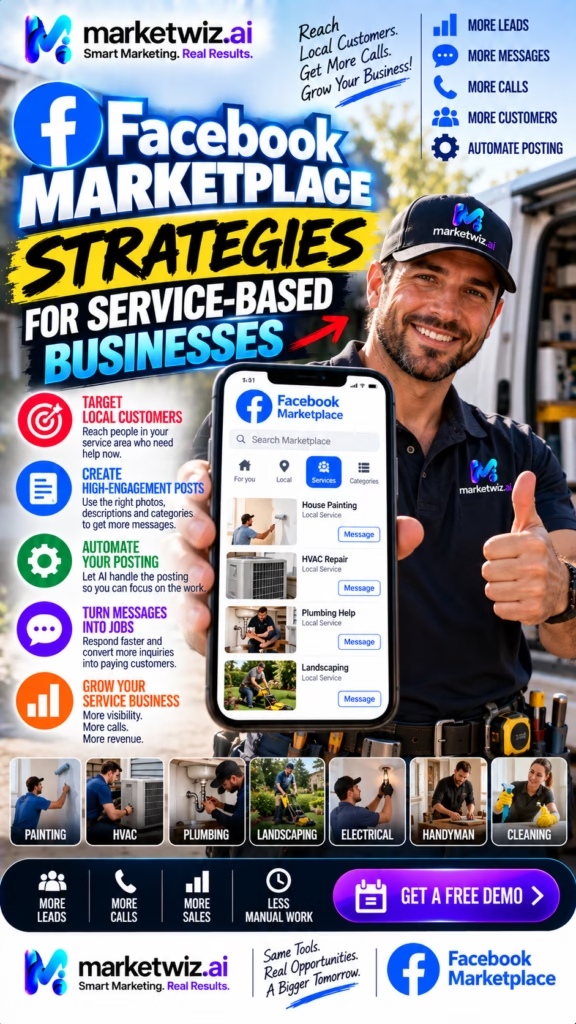
Facebook Marketplace Advertising That Brings More Messages

ChatGPT Image Jul 1 2026 10 53 37 AM
Facebook Marketplace Advertising That Brings More Messages

Facebook Marketplace Advertising That Brings More Messages

Facebook Marketplace Advertising That Brings More Messages explains how businesses can create better listings, stronger CTAs, clearer offers, and faster replies to generate more local buyer conversations.

Introduction

Facebook Marketplace Advertising That Brings More Messages starts with one simple goal: getting real local people to start conversations. Views are useful. Clicks are useful. Saves are useful. But for most businesses, the real value begins when a buyer, homeowner, renter, shopper, or service lead sends a message.

Marketplace advertising works best when the listing gives people a clear reason to ask a question, request a quote, check availability, schedule service, ask about delivery, compare options, or start a buying conversation. That means every part of the listing should be designed around message intent.

The best Facebook Marketplace advertising does not just get attention. It makes messaging feel easy, useful, and worth doing right now.

This guide is built for local service companies, contractors, retailers, product sellers, car dealers, mattress stores, moving companies, pest control businesses, flooring companies, remodelers, junk removal companies, and any business that wants more Marketplace conversations from nearby customers.

Main idea: Facebook Marketplace Advertising That Brings More Messages is about turning better listing visibility into more customer replies, quote requests, appointment opportunities, product inquiries, and sales conversations.

Table of Contents

  • 1) Why messages matter more than views
  • 2) What makes people message on Marketplace
  • 3) Building a message-focused Marketplace strategy
  • 4) Writing titles that trigger more messages
  • 5) Choosing photos that create confidence
  • 6) Writing descriptions that make messaging easy
  • 7) Local keywords that attract nearby buyers
  • 8) Offer angles that create more conversations
  • 9) Pricing language that reduces hesitation
  • 10) CTAs that increase message volume
  • 11) Trust signals that make buyers comfortable
  • 12) Message strategy for service businesses
  • 13) Message strategy for product sellers
  • 14) Message strategy for contractors
  • 15) Message strategy for local retailers
  • 16) Lead questions that improve message quality
  • 17) Follow-up scripts for Marketplace messages
  • 18) Posting consistency and listing rotation
  • 19) Tracking message performance
  • 20) Final thoughts
  • 21) FAQs
  • 22) Extra keywords

1) Why Messages Matter More Than Views

Views show that people saw the listing, but messages show real intent. A Marketplace listing can get hundreds of views and still fail if no one reaches out. A better listing turns attention into action by making the next step clear and simple.

Messages are where lead qualification begins. A business can ask questions, explain options, confirm availability, provide pricing guidance, schedule appointments, send delivery details, and move the customer closer to buying.

Marketplace messages can lead to:

  • Product inquiries
  • Service quote requests
  • Appointment bookings
  • Pickup scheduling
  • Delivery requests
  • Showroom visits
  • Project estimates
  • Test drive requests
  • Follow-up conversations
  • Closed sales and booked jobs

More messages usually means more opportunities to turn Marketplace attention into revenue.

2) What Makes People Message on Marketplace

People message when a listing feels relevant, clear, trustworthy, and easy to respond to. They need to understand what is being offered, whether it is available near them, how pricing works, and what question they should ask next.

If the listing feels confusing, incomplete, fake, or too generic, many buyers will scroll past it. If the listing answers the right questions and invites a simple reply, message volume can improve.

People usually message when they see:
Clear offer
Strong main photo
Specific title
Local availability
Helpful description
Pricing or estimate guidance
Trust signals
Simple CTA
Fast response language
Easy next step

Messages increase when the listing removes hesitation before the customer has to ask.

3) Building a Message-Focused Marketplace Strategy

A message-focused strategy starts with specific listings. A broad listing may get some attention, but specific listings make it easier for customers to know what to ask about. A moving company can post apartment moving, labor-only moving, and furniture delivery separately. A retailer can post individual product categories. A contractor can post project-specific offers.

The goal is to create listings that invite a useful message, not just a passive view.

Message-focused Marketplace strategy elements:

  • Specific listing angles
  • Clear message CTAs
  • Strong title keywords
  • Professional photos
  • Local service-area language
  • Pricing clarity
  • Trust signals
  • Lead qualification prompts
  • Fast reply scripts
  • Message tracking

A message-focused listing is built to start a conversation, not just display an offer.

4) Writing Titles That Trigger More Messages

The title should quickly tell the buyer what the listing is about. Strong titles create curiosity and clarity at the same time. They name the service, product, benefit, location, availability, or customer need.

Weak titles are often too vague. Strong titles make the buyer know exactly what they can message about.

Weak title:
Service Available

Better title:
Local Moving Help - Message for a Quick Quote

Weak title:
Great Mattress Deal

Better title:
Queen Mattresses Available - Ask About Local Delivery

Weak title:
Pest Control

Better title:
Ant & Roach Control - Message for Local Availability

Weak title:
Flooring Work

Better title:
LVP Flooring Installation - Send Photos for an Estimate

The best titles make the customer know what question to ask next.

5) Choosing Photos That Create Confidence

Photos can make or break message volume. A buyer may message because the photo looks real, clean, professional, and relevant. A weak photo can make the same offer feel risky or low quality.

For products, use bright real product photos. For services, use finished work, before-and-after examples, clean trucks, team photos, branded graphics, or proof of real service activity.

Photos that bring more messages:

  • Real product photos
  • Before-and-after results
  • Finished project photos
  • Clean service truck images
  • Team or technician photos
  • Showroom photos
  • Close-up detail shots
  • Photos showing size or condition
  • Professional branded graphics
  • Clear delivery or service visuals

Better photos make customers feel safer sending a message.

6) Writing Descriptions That Make Messaging Easy

The description should answer the customer’s first questions and then tell them what to send. A strong description reduces hesitation and creates a clear message path.

Do not make customers guess what information you need. Ask for the details that help you reply quickly.

Strong message-focused description structure:
Opening benefit
What is being offered
Who it helps
Local service or pickup area
Pricing or estimate process
Trust signals
Availability
What the buyer should send
Best contact method
Clear message CTA

A good description tells people what to message, not just that they can message.

7) Local Keywords That Attract Nearby Buyers

Local keywords help Marketplace buyers understand that the offer is relevant to them. Location matters for pickup, delivery, appointments, estimates, service areas, and response timing.

Use local wording naturally. The listing should feel nearby and convenient without looking like keyword spam.

Useful local message keywords:

  • message for local availability
  • local pickup available
  • delivery available nearby
  • local estimates available
  • serving nearby homeowners
  • message with your city
  • same-week openings when available
  • local quote available
  • nearby appointment openings
  • serving the surrounding area

Local keywords make the message feel more relevant and easier to start.

8) Offer Angles That Create More Conversations

The offer angle is the reason someone messages. Different buyers respond to different reasons: price, speed, delivery, convenience, expertise, availability, proof, urgency, product quality, or local service.

Testing multiple offer angles can help businesses discover what creates the most messages.

Message-focused offer angles:
Message for local delivery
Send photos for a quick estimate
Ask about same-week openings
Message for current inventory
Ask about pickup times
Message for available sizes
Ask about service areas
Message for quote details
Ask about bundle options
Message to schedule a visit

The right offer angle gives the customer a reason to start the conversation now.

9) Pricing Language That Reduces Hesitation

Pricing confusion reduces messages. Some customers will not reach out if they do not understand whether the price is fixed, estimated, negotiable, starting-based, or dependent on details.

Clear pricing language helps buyers feel comfortable asking the next question.

Useful pricing phrases:

  • Message for current options
  • Pricing depends on project size
  • Send photos for faster estimate guidance
  • Starting at $___ if accurate
  • Delivery available for an additional fee if applicable
  • Ask about current availability
  • Bundle pricing available if offered
  • Quote available after basic details
  • Message with your budget range if helpful
  • Price varies by size, service, or condition

Better pricing language creates more serious messages and fewer confused replies.

10) CTAs That Increase Message Volume

The call to action is where many listings fail. “Message me” is okay, but a stronger CTA tells the customer exactly what to message about.

Specific CTAs increase message quality because they guide the buyer’s first reply.

Weak CTA:
Message me

Better CTA:
Message with your city and what you need help with.

Weak CTA:
Ask for details

Better CTA:
Message with the size you need and whether you want pickup or delivery.

Weak CTA:
Contact for quote

Better CTA:
Send your project photos, city, and timeline for estimate guidance.

Weak CTA:
Available now

Better CTA:
Message with your preferred pickup or delivery time.

A strong CTA makes the first message easier to write.

11) Trust Signals That Make Buyers Comfortable

Trust signals help buyers decide whether it is safe to message. This matters for service businesses, contractors, product sellers, dealers, movers, and any company asking for appointments, quotes, delivery, pickup, or in-home service.

Use real proof and clear business details. Avoid fake reviews or exaggerated claims.

Trust signals that improve messages:
Business name
Real photos
Local service area
Years of experience
Reviews if available
Before-and-after examples
Licensed or insured status if accurate
Showroom or store details
Clear pickup or delivery process
Fast response language
Warranty or guarantee if offered
Professional communication

Trust signals make the customer more comfortable starting a conversation.

12) Message Strategy for Service Businesses

Service businesses should create listings that ask for the details needed to quote or schedule. A good service listing should mention the service type, area, availability, estimate process, and what the customer should send.

Service listings that can bring more messages:

  • Move-out cleaning
  • Junk removal help
  • Local moving help
  • Pest control service
  • Pressure washing
  • Interior painting
  • Flooring installation
  • Furniture delivery
  • Handyman repairs
  • Tree trimming estimates

Service messages improve when the listing asks for location, timeline, photos, and project details.

13) Message Strategy for Product Sellers

Product sellers should make it easy for buyers to ask about availability, pickup, delivery, size, condition, price, and similar items. Complete listings reduce basic confusion and create better conversations.

Product listing message prompts:
Message for pickup details
Ask about local delivery
Message for more photos
Ask about current availability
Message with the size you need
Ask about similar items
Message for bundle options
Ask about showroom pickup
Message with your preferred pickup time
Ask about current inventory

Product messages increase when buyers know what is available and what to ask next.

14) Message Strategy for Contractors

Contractors should use Marketplace listings to start estimate conversations. Project-specific listings usually perform better than broad contractor ads because customers instantly understand the service.

Contractor listing message prompts:

  • Send photos for estimate guidance
  • Message with your project timeline
  • Ask about local estimate openings
  • Message with room size or square footage
  • Ask about material options
  • Message with your city and project type
  • Ask about same-week availability if accurate
  • Message with before photos

Contractor messages improve when the listing makes estimate requests easy.

15) Message Strategy for Local Retailers

Local retailers can use Marketplace to start conversations around inventory, delivery, pickup, bundles, showroom visits, new arrivals, and clearance items. The listing should make the buyer feel comfortable asking what is currently available.

Retail message angles:
Message for current inventory
Ask about delivery options
Message for showroom details
Ask about pickup availability
Message for bundle pricing
Ask about new arrivals
Message for clearance options
Ask about similar products
Message with size or style preference
Ask about weekend availability

Retail messages increase when buyers know they can ask for options, availability, and delivery details.

16) Lead Questions That Improve Message Quality

More messages are good, but better messages are even better. Lead questions help customers send useful details in the first reply. This saves time and helps the business respond with a better answer.

Ask buyers to send:

  • City or neighborhood
  • Service or product needed
  • Timeline
  • Photos if helpful
  • Approximate size or quantity
  • Pickup or delivery preference
  • Budget range if relevant
  • Preferred appointment time
  • Best contact method
  • Any special details

Better lead questions turn simple messages into qualified opportunities.

17) Follow-Up Scripts for Marketplace Messages

Fast follow-up is critical. Customers often message multiple listings. A clear first reply can keep the conversation moving before the lead goes cold.

General reply:

Thanks for reaching out. This is available. Are you looking for pickup, delivery, a quote, or more details first?

Service reply:

Happy to help. What city are you in, what service do you need, and what timeline are you hoping for? Photos help if you want faster estimate guidance.

Product reply:

Thanks for the message. This item is currently available. Would you like pickup details, delivery options, or more photos?

The faster and clearer the reply, the more likely the message becomes a real customer conversation.

18) Posting Consistency and Listing Rotation

Posting consistency helps businesses stay visible, but the listings should not all look identical. Rotation helps create fresh message opportunities by changing titles, photos, descriptions, CTAs, offer angles, and local wording.

Message-focused rotation ideas:
Message for delivery listing
Send photos for estimate listing
Ask about current inventory listing
Same-week availability listing
Product-specific listing
Service-specific listing
Review-based listing
Before-and-after listing
Local area listing
Seasonal offer listing

Listing rotation gives buyers more reasons to message across different needs and timing.

19) Tracking Message Performance

Tracking helps businesses understand which Marketplace listings produce real conversations. Views matter, but messages, qualified leads, appointments, quote requests, booked jobs, and sales matter more.

Track these Marketplace message metrics:
Listing title
Main photo
Offer angle
Category
Local area
Date posted
Messages received
Qualified messages
Response time
Appointments booked
Quotes requested
Sales or jobs closed
Revenue generated
Best-performing CTA

Tracking shows which listings bring messages and which messages become revenue.

20) Final Thoughts

Facebook Marketplace Advertising That Brings More Messages is about making every listing easier to notice, understand, trust, and reply to. More messages come from better titles, better photos, stronger descriptions, clearer pricing, local keywords, trust signals, specific CTAs, and fast follow-up.

The strongest strategy includes message-focused listing angles, lead questions, local wording, listing rotation, and performance tracking.

Final takeaway: To get more Marketplace messages, make every listing more specific, more local, more trustworthy, and easier for the customer to respond to.

21) FAQs

1) What is Facebook Marketplace Advertising That Brings More Messages?

Facebook Marketplace Advertising That Brings More Messages is the process of creating listings designed to generate more buyer messages, service inquiries, quote requests, and sales conversations.

2) How do I get more messages on Facebook Marketplace?

Use clear titles, strong photos, helpful descriptions, local keywords, trust signals, pricing clarity, specific CTAs, and fast replies.

3) Do titles affect message volume?

Yes. Specific titles make it easier for buyers to understand what they can message about.

4) Do photos help bring more messages?

Yes. Clear, real, professional photos help buyers trust the listing and feel more comfortable messaging.

5) What CTA works best for Marketplace messages?

The best CTA tells the buyer exactly what to send, such as city, service needed, delivery preference, photos, timeline, or product size.

6) Should listings include pricing?

Yes, when possible. If pricing varies, explain what details are needed for a quote or estimate.

7) Should businesses use local keywords?

Yes. Local keywords help buyers understand whether pickup, delivery, or service is available near them.

8) How fast should businesses reply to Marketplace messages?

As fast as possible. Buyers often message multiple listings and may choose whoever replies clearly first.

9) What should the first reply say?

The first reply should confirm availability, answer the main question, and ask for the details needed to move forward.

10) Can service businesses get messages from Marketplace?

Yes. Service businesses can generate messages by posting specific services with clear quote instructions and trust signals.

11) Can product sellers get more Marketplace messages?

Yes. Product sellers can improve messages with complete listings, real photos, clear prices, pickup details, and delivery options.

12) Can contractors get Marketplace messages?

Yes. Contractors can get messages by posting project-specific listings with photos, estimate language, and lead questions.

13) What should buyers be asked to send?

Ask for location, service or product needed, timeline, photos if helpful, pickup or delivery preference, and best contact method.

14) Should listings be broad or specific?

Specific listings usually bring better messages because buyers can quickly tell whether the offer matches their need.

15) Should businesses rotate Marketplace listings?

Yes. Rotation helps test titles, photos, CTAs, offers, and local wording to find what brings the most messages.

16) What is a message-focused listing?

A message-focused listing is built to invite a clear first reply from the buyer instead of only showing information.

17) What trust signals should be included?

Use business name, real photos, reviews if available, local service area, years of experience, clear process, and professional communication.

18) What hurts Marketplace message volume?

Weak titles, poor photos, vague descriptions, unclear pricing, no CTA, no local details, and slow replies can reduce messages.

19) Should businesses use branded graphics?

Yes, if they are clean and clear. Real photos should also be used when possible.

20) How do I improve message quality?

Ask better lead questions and tell buyers exactly what details to send in the listing.

21) What should businesses track?

Track listing title, photo, offer angle, messages, qualified messages, response time, appointments, quotes, sales, and revenue.

22) Can Marketplace messages become booked jobs?

Yes. With fast follow-up and clear qualification, Marketplace messages can become appointments, quotes, sales, and booked services.

23) Can Marketplace replace paid ads?

Marketplace can replace part of paid ad spend for some businesses and can also support Google, SEO, social media, and referral marketing.

24) How does Marketplace fit into local marketing?

Marketplace should support a larger system that includes Google Business Profile, local SEO, reviews, website pages, social media, and follow-up automation.

25) What is the main goal of Marketplace advertising that brings more messages?

The main goal is to turn local visibility into more buyer conversations, qualified leads, appointments, sales, booked jobs, and revenue.

25) Extra Keywords

  1. Facebook Marketplace Advertising That Brings More Messages
  2. Facebook Marketplace messages
  3. Marketplace lead generation
  4. Facebook Marketplace advertising
  5. Marketplace posting strategy
  6. local Marketplace leads
  7. Facebook Marketplace business ads
  8. Facebook Marketplace message strategy
  9. Facebook Marketplace listing tips
  10. Facebook Marketplace CTAs
  11. Marketplace message scripts
  12. Facebook Marketplace local keywords
  13. Facebook Marketplace response strategy
  14. Facebook Marketplace service leads
  15. Facebook Marketplace product messages
  16. Facebook Marketplace contractor leads
  17. Marketplace quote requests
  18. Marketplace buyer messages
  19. Facebook Marketplace follow-up
  20. Marketplace trust signals
  21. Facebook Marketplace ad rotation
  22. Marketplace message tracking
  23. Facebook Marketplace conversion tips
  24. Facebook Marketplace local advertising
  25. Facebook Marketplace growth strategy

© 2026 Your Brand

```

Facebook Marketplace Advertising That Brings More Messages Read More »

Facebook Marketplace Marketing for Long-Term Growth

ChatGPT Image Jul 1 2026 10 52 49 AM
Facebook Marketplace Marketing for Long-Term Growth

Facebook Marketplace Marketing for Long-Term Growth

Facebook Marketplace Marketing for Long-Term Growth helps local businesses build lasting visibility, stronger buyer trust, better listing systems, and steady customer conversations over time.

Introduction

Facebook Marketplace Marketing for Long-Term Growth is about building a repeatable system that keeps producing local visibility, qualified buyer messages, appointments, sales, and service leads over time. Many businesses treat Marketplace like a quick posting channel, but the strongest results come from consistency, trust, variation, tracking, and follow-up.

Long-term Marketplace growth does not come from random posts or copied listings. It comes from understanding buyer intent, creating clear listings, using real photos, building profile trust, rotating different offer angles, qualifying leads, and improving based on performance.

The goal is not just a quick spike in messages. The goal is a long-term Marketplace system that keeps creating useful conversations month after month.

Businesses that sell furniture, mattresses, appliances, sheds, mobile homes, vehicles, local services, contractor estimates, repair appointments, junk removal, cleaning, or home improvement services can all use Marketplace for long-term local growth when their listings are structured properly.

Main idea: Facebook Marketplace Marketing for Long-Term Growth works best when every listing supports trust, visibility, qualification, and repeatable conversion.

Table of Contents

  • 1) Why long-term Marketplace strategy matters
  • 2) How buyer trust compounds over time
  • 3) Building a healthy Marketplace profile
  • 4) Creating a repeatable listing system
  • 5) Writing titles that support long-term visibility
  • 6) Using photos that build lasting confidence
  • 7) Writing descriptions that convert over time
  • 8) Using local keywords naturally
  • 9) Pricing listings for sustainable lead quality
  • 10) Creating product listings for long-term growth
  • 11) Creating service listings for long-term growth
  • 12) Marketplace growth for contractors
  • 13) Marketplace growth for showrooms
  • 14) Creating stronger calls to action
  • 15) Qualifying buyers for better conversion
  • 16) Following up consistently
  • 17) Tracking listings and improving performance
  • 18) Avoiding long-term growth mistakes
  • 19) Common Marketplace marketing mistakes
  • 20) Final thoughts
  • 21) FAQs
  • 22) Extra keywords

1) Why Long-Term Marketplace Strategy Matters

A long-term Marketplace strategy matters because one good listing is not enough to build predictable growth. Marketplace visibility can change based on listing quality, buyer demand, seasonality, response speed, pricing, photos, local relevance, and trust.

Businesses that win long term build a system. They create different listing angles, track what works, update weak listings, rotate offers, respond quickly, and keep improving lead quality.

Long-term Marketplace strategy helps businesses create:

  • Steadier local visibility
  • More qualified buyer messages
  • Better appointment requests
  • More product inquiries
  • More showroom visits
  • More service leads
  • Better estimate conversations
  • Stronger local brand familiarity
  • Improved follow-up systems
  • More repeatable customer acquisition

Marketplace becomes more valuable when businesses treat it as a long-term lead channel, not a one-time posting task.

2) How Buyer Trust Compounds Over Time

Buyer trust compounds when people repeatedly see clear, helpful, professional listings from the same business. Even if they do not message the first time, repeated exposure can make the seller feel more familiar.

Trust compounds through:
Consistent listing quality
Real photos
Clear service area
Honest pricing
Professional replies
Accurate descriptions
Useful listing variation
Strong profile identity
Fast follow-up
Reliable next steps

Long-term growth depends on becoming familiar and trustworthy before the buyer is ready to act.

3) Building a Healthy Marketplace Profile

A healthy Marketplace profile supports every listing. If your profile looks incomplete, inconsistent, or suspicious, buyers may hesitate. Long-term growth requires a profile that feels real, local, and professional.

Profile health checklist:

  • Clear profile photo or business identity
  • Accurate local area
  • Consistent seller or business name
  • Clean listing history
  • Real photos across listings
  • Professional tone
  • Clear pickup, delivery, or appointment details
  • Fast response habits

A strong profile makes long-term posting more effective.

4) Creating a Repeatable Listing System

A repeatable listing system helps businesses post consistently without losing quality. The structure should stay consistent, but each listing should still feel unique and relevant.

Repeatable listing system:
Specific title
Real photo
Clear offer
Local area
Price or estimate note
Pickup, delivery, appointment, or quote option
Trust signal
Qualification question
Simple CTA
Follow-up process

Long-term success comes from repeatable quality, not duplicate content.

5) Writing Titles That Support Long-Term Visibility

Titles should help buyers understand the listing immediately. For long-term growth, create title variations around different products, services, problems, benefits, and locations.

Weak title:
Great Deal

Better title:
Queen Mattress Available - Local Delivery Options

Weak title:
Repair Help

Better title:
Dryer Not Heating? Repair Appointments Available

Weak title:
Home Service

Better title:
Interior Painting Estimate Openings This Week

Weak title:
Mobile Home

Better title:
3 Bedroom Manufactured Home Models Available for Tour

Strong titles help Marketplace listings stay useful and searchable over time.

6) Using Photos That Build Lasting Confidence

Photos should make buyers feel confident. Over time, photo quality becomes part of your brand. If every listing has real, clear, useful visuals, buyers are more likely to trust future posts.

Photo ideas for long-term Marketplace growth:

  • Real product photos
  • Multiple angles
  • Before-and-after project photos
  • Showroom photos
  • Service vehicle photos
  • Team or technician photos
  • Floor plans or layout images
  • Clean branded graphics

Consistent photo quality strengthens buyer confidence over time.

7) Writing Descriptions That Convert Over Time

Descriptions should explain the offer, reduce confusion, and guide the buyer toward the next step. A strong description creates better messages and helps your team convert faster.

Long-term growth description structure:
Opening benefit
Main offer details
Who it helps
Location or service area
Price or estimate note
Availability
Trust signal
What the buyer should message
Simple next step

Descriptions convert better when they are clear, helpful, and easy to act on.

8) Using Local Keywords Naturally

Local keywords help buyers understand where your offer is available. Use city names, neighborhoods, counties, delivery areas, pickup areas, and service areas naturally.

Natural local keyword examples:

  • Local pickup available
  • Delivery available nearby
  • Serving local homeowners
  • Message with your city for availability
  • Showroom visits available locally
  • Estimate appointments available this week

Natural local wording works better than stuffing the same location repeatedly.

9) Pricing Listings for Sustainable Lead Quality

Pricing affects lead quality. Misleading pricing may create short-term messages, but it hurts long-term trust. Clear pricing or honest estimate language creates better buyer conversations.

Pricing examples:
$250 firm
Starting at $99
Free estimate available
Delivery available for an additional fee
Message for current inventory and pricing
Bundle pricing available
Financing options may be available for qualified buyers
Price depends on project size

Sustainable growth depends on clear expectations, not bait pricing.

10) Creating Product Listings for Long-Term Growth

Product sellers need listings that help buyers compare options quickly. Include enough detail to reduce back-and-forth and improve message quality.

Product listing details to include:

  • Product name
  • Brand or model
  • Condition
  • Size or dimensions
  • Price
  • Pickup option
  • Delivery option
  • Availability
  • Included items
  • Best way to message

Product listings support long-term growth when buyers can understand the offer quickly.

11) Creating Service Listings for Long-Term Growth

Service listings should focus on one specific problem or appointment type. This makes each listing easier to find, easier to understand, and easier to respond to.

Service listing examples:
Move-Out Cleaning Appointments
Garage Cleanout and Junk Removal Help
Washer and Dryer Repair Service Calls
Interior Painting Estimate Openings
Fence Repair Estimate Requests
Local Handyman Repair Appointments

Service listings create better long-term leads when they solve one clear customer problem.

12) Marketplace Growth for Contractors

Contractors can use Marketplace for long-term estimate generation by creating project-specific listings. Each listing should focus on one project type and show proof whenever possible.

Contractor listing ideas:

  • Interior painting estimates
  • Fence installation quotes
  • Deck repair consultations
  • Drywall repair appointments
  • Flooring installation estimates
  • Bathroom update appointments
  • Garage project consultations
  • Seasonal home improvement estimates

Contractors grow long term when their listings consistently turn project interest into estimate requests.

13) Marketplace Growth for Showrooms

Showroom businesses can use Marketplace to keep inventory visible and create steady visit intent. This works for furniture stores, mattress stores, appliance stores, mobile home dealers, shed dealers, and similar businesses.

Showroom CTA examples:
Message before visiting to confirm availability.
Ask what models are in stock today.
Schedule a time to compare options.
Message with your size, budget, and delivery needs.
Ask about showroom appointments this week.

Showrooms grow long term when Marketplace listings turn browsing into planned visits.

14) Creating Stronger Calls to Action

A strong CTA gives buyers a clear next step. It should ask for details that make the conversation easier to qualify and move forward.

Marketplace CTA examples:

  • Message with your city and what you are looking for.
  • Send your preferred pickup or delivery option.
  • Ask about current appointment times this week.
  • Message with your budget and timeline.
  • Send a quick photo for a faster estimate.
  • Message before visiting to confirm availability.

Clear CTAs make long-term lead handling easier.

15) Qualifying Buyers for Better Conversion

Buyer qualification helps long-term growth because it reduces wasted time. Listings should tell buyers what to send so your first reply can be more useful.

Ask buyers to include:

  • City or neighborhood
  • Product or service needed
  • Budget range if relevant
  • Pickup or delivery preference
  • Timeline
  • Photos if useful
  • Preferred appointment time
  • Best contact method

Better qualification creates better conversion and better long-term growth.

16) Following Up Consistently

Follow-up turns Marketplace messages into real business. Buyers may message multiple sellers or providers. A consistent reply process helps prevent missed opportunities.

Simple follow-up script:
Thanks for reaching out. What city are you located in, and are you looking for pickup, delivery, an estimate, or an appointment time?

Consistent follow-up turns Marketplace visibility into actual revenue opportunities.

17) Tracking Listings and Improving Performance

Long-term growth requires tracking. Views matter, but leads, appointments, sales, quote requests, showroom visits, and booked jobs matter more.

Track these Marketplace results:

  • Listing views
  • Messages
  • Qualified leads
  • Appointment requests
  • Quote requests
  • Pickup requests
  • Delivery requests
  • Showroom visits
  • Sales
  • Booked jobs

Long-term growth improves when you know which listings produce real customers.

18) Avoiding Long-Term Growth Mistakes

Some posting habits may create short-term activity but hurt long-term results. The best Marketplace strategy is stable, honest, and buyer-focused.

Avoid:
Random posting with no system
Duplicate-looking listings
Weak titles
Blurry photos
Fake low prices
No local details
No clear CTA
No lead qualification
Slow replies
No tracking

Long-term Marketplace growth fails when listings lack structure, trust, and follow-up.

19) Common Marketplace Marketing Mistakes

Many businesses get occasional Marketplace messages but fail to build long-term growth because they do not have a real system.

Common mistakes include:

  • No repeatable posting plan
  • No clear growth goal
  • Generic titles
  • Poor photos
  • No pricing context
  • No trust signals
  • No local relevance
  • No CTA
  • No qualification questions
  • No performance tracking

Marketplace marketing improves when every listing supports a larger growth system.

20) Final Thoughts

Facebook Marketplace Marketing for Long-Term Growth works when businesses create a repeatable system built around trust, visibility, local relevance, lead qualification, and consistent follow-up.

The strongest long-term strategy includes clear titles, real photos, helpful descriptions, natural local keywords, honest pricing, trust signals, strong CTAs, lead qualification, fast replies, testing, tracking, and ongoing improvement.

Final takeaway: Long-term Marketplace growth comes from consistent listing quality, consistent buyer trust, and consistent follow-up.

21) FAQs

1) What is Facebook Marketplace Marketing for Long-Term Growth?

It is a strategy for using Marketplace listings to build steady visibility, qualified messages, appointments, sales, and customer growth over time.

2) Can Facebook Marketplace support long-term business growth?

Yes. Marketplace can support long-term growth when listings are consistent, trustworthy, local, and conversion-focused.

3) What businesses can use Marketplace for long-term growth?

Retailers, contractors, repair companies, home services, showrooms, dealers, product sellers, and local service providers can use Marketplace.

4) What makes a Marketplace listing effective long term?

Clear titles, real photos, honest pricing, strong descriptions, local keywords, trust signals, CTAs, and fast replies help listings perform long term.

5) Should I post duplicate listings?

No. Use a consistent structure, but create unique listings with different titles, photos, descriptions, and buyer angles.

6) Are photos important?

Yes. Clear real photos help build trust and improve buyer message quality.

7) What CTA works best?

A good CTA asks buyers to message with city, product or service need, timeline, pickup or delivery preference, or appointment interest.

8) How do I improve lead quality?

Ask for location, need, budget if relevant, timeline, photos, and preferred next step inside the listing.

9) Should listings include pricing?

Yes, when possible. If pricing varies, use honest starting-price or estimate language.

10) How fast should I reply?

Reply as quickly as possible because buyers often message multiple sellers or businesses.

11) Can contractors use Marketplace long term?

Yes. Contractors can create project-specific listings that generate estimate requests over time.

12) Can product sellers use Marketplace long term?

Yes. Product sellers can build steady inquiries with clear product details, pricing, photos, pickup, and delivery options.

13) Can home services use Marketplace?

Yes. Home services can use Marketplace to generate repair appointments, cleaning leads, junk removal requests, and estimate inquiries.

14) Can showrooms use Marketplace?

Yes. Showrooms can use listings to encourage visits, inventory questions, and appointment requests.

15) Should I use local keywords?

Yes. Local keywords help buyers know whether your offer is available nearby.

16) What should I track?

Track messages, qualified leads, appointments, quote requests, pickup requests, delivery requests, sales, and booked jobs.

17) What should I avoid?

Avoid random posting, duplicate-looking listings, weak titles, blurry photos, fake pricing, no CTA, and slow replies.

18) How do I make Marketplace marketing more sustainable?

Use a repeatable listing system, rotate unique angles, track performance, and improve based on lead quality.

19) Why do I get views but no leads?

Your listing may lack trust, clear pricing, strong photos, a direct CTA, or buyer qualification.

20) Why do I get messages but no sales?

Your leads may be unqualified, or your follow-up may not be moving buyers toward the next step.

21) Can Marketplace reduce paid ad costs?

It can create additional local lead opportunities outside traditional paid advertising.

22) Should every listing have one goal?

Yes. Each listing should focus on one goal such as purchase, appointment, quote, pickup, delivery, or showroom visit.

23) What makes a Marketplace profile trustworthy?

A clear profile image, accurate location, real listings, consistent identity, and professional replies build trust.

24) What is the biggest long-term Marketplace mistake?

The biggest mistake is posting randomly without a listing structure, tracking system, or follow-up process.

25) What is the best tip for long-term Marketplace growth?

Create unique listings with a repeatable structure, track results, and respond quickly with a clear next step.

25) Extra Keywords

  1. Facebook Marketplace Marketing for Long-Term Growth
  2. Facebook Marketplace marketing
  3. Marketplace long-term growth
  4. Facebook Marketplace lead generation
  5. local Marketplace advertising
  6. Marketplace posting strategy
  7. Facebook Marketplace business growth
  8. Facebook Marketplace local leads
  9. Facebook Marketplace lead quality
  10. Marketplace listing optimization
  11. Facebook Marketplace appointment leads
  12. Facebook Marketplace service leads
  13. Facebook Marketplace product leads
  14. Marketplace customer acquisition
  15. Facebook Marketplace conversion
  16. Facebook Marketplace response strategy
  17. Facebook Marketplace local marketing
  18. Marketplace repeat posting
  19. Facebook Marketplace posting system
  20. Marketplace listing structure
  21. Facebook Marketplace qualified leads
  22. Marketplace tracking strategy
  23. Facebook Marketplace sustainable growth
  24. Marketplace long-term lead strategy
  25. Facebook Marketplace trust signals

© 2026 Market Wiz AI

```

Facebook Marketplace Marketing for Long-Term Growth Read More »

Facebook Marketplace Posting for Consistent Leads

ChatGPT Image Jul 1 2026 10 52 34 AM
Facebook Marketplace Posting for Consistent Leads

Facebook Marketplace Posting for Consistent Leads

Facebook Marketplace Posting for Consistent Leads helps local businesses build repeatable visibility, attract better buyers, qualify messages, and turn Marketplace activity into steady lead flow.

Introduction

Facebook Marketplace Posting for Consistent Leads is about building a repeatable system instead of relying on random posts. Many businesses get occasional Marketplace messages, but they struggle to create steady leads because their listings are inconsistent, too broad, poorly written, or not built for conversion.

Consistent leads come from consistent structure. Strong Marketplace posting uses clear titles, real photos, local keywords, trustworthy descriptions, service-specific or product-specific listing angles, better CTAs, lead qualification, and fast follow-up.

The goal is not just to post more. The goal is to create a repeatable Marketplace system that produces useful buyer conversations every week.

Whether you sell mattresses, furniture, appliances, sheds, mobile homes, vehicles, local services, repair appointments, contractor estimates, junk removal, cleaning, or handyman work, Marketplace can help when listings match real buyer intent.

Main idea: Facebook Marketplace Posting for Consistent Leads works best when each listing has a clear purpose, a local angle, a trust signal, and one simple next step.

Table of Contents

  • 1) Why consistency matters on Marketplace
  • 2) How Marketplace buyers decide who to message
  • 3) Building profile trust before posting more
  • 4) Creating a repeatable listing structure
  • 5) Writing titles that attract steady clicks
  • 6) Using photos that build buyer confidence
  • 7) Writing descriptions that convert consistently
  • 8) Using local keywords naturally
  • 9) Pricing listings for better lead quality
  • 10) Creating product listings for consistent leads
  • 11) Creating service listings for consistent leads
  • 12) Creating contractor listings for estimate requests
  • 13) Creating showroom listings for visits
  • 14) Creating stronger calls to action
  • 15) Qualifying leads before the first reply
  • 16) Responding faster to Marketplace messages
  • 17) Tracking what listings produce leads
  • 18) Avoiding inconsistent posting mistakes
  • 19) Common Marketplace lead mistakes
  • 20) Final thoughts
  • 21) FAQs
  • 22) Extra keywords

1) Why Consistency Matters on Marketplace

Consistency matters because Marketplace activity can rise and fall quickly. A single listing may generate a few messages, but steady lead flow usually requires a repeatable posting system. Businesses need multiple listing angles, clear content standards, and regular follow-up habits.

Consistent posting also helps you learn what buyers respond to. When you track titles, photos, CTAs, service angles, and response quality, you can improve over time.

Consistency helps businesses improve:

  • Local visibility
  • Buyer message volume
  • Lead quality
  • Appointment requests
  • Product inquiries
  • Estimate conversations
  • Showroom visits
  • Delivery requests
  • Follow-up speed
  • Weekly lead predictability

Marketplace becomes more valuable when posting is structured, tracked, and repeated.

2) How Marketplace Buyers Decide Who to Message

Marketplace buyers make fast decisions. They compare the first photo, title, price, distance, seller trust, description, and response speed. If the listing looks unclear, they may move to the next option.

Marketplace buyers usually ask:
Is this available?
Is it close enough?
Is the price believable?
Can I trust this seller?
Are the photos real?
Can I get delivery or pickup?
Can I book an appointment?
Will they respond quickly?
What should I send first?

Consistent leads come from consistently answering buyer questions inside the listing.

3) Building Profile Trust Before Posting More

More posts will not help much if buyers do not trust the profile. A trustworthy profile makes each listing more believable and can increase message quality.

Profile trust checklist:

  • Clear profile photo or business identity
  • Accurate local area
  • Consistent seller or business name
  • Real listing photos
  • Professional message tone
  • Clear pickup, delivery, or appointment information
  • Clean listing history
  • Fast reply behavior

Trust gives consistent posting a stronger foundation.

4) Creating a Repeatable Listing Structure

A repeatable listing structure helps your team post faster while keeping quality high. Every listing should include the same core ingredients, even when the product, service, or angle changes.

Repeatable Marketplace listing structure:
Specific title
Real photo
Clear offer
Location or service area
Price or estimate note
Pickup, delivery, appointment, or quote option
Trust signal
Qualification question
Simple CTA

Consistency does not mean copying the same post. It means using the same quality standard across different listing angles.

5) Writing Titles That Attract Steady Clicks

Titles should be specific enough to match buyer intent. A consistent lead system needs titles that clearly name the product, service, result, or appointment type.

Weak title:
Great Deal

Better title:
Queen Mattress Available - Local Delivery Options

Weak title:
Home Services

Better title:
Interior Painting Estimate Appointments Available

Weak title:
Repair Help

Better title:
Washer and Dryer Repair Service Calls

Weak title:
Hauling

Better title:
Garage Cleanout and Junk Removal Help

Specific titles create more consistent clicks from serious buyers.

6) Using Photos That Build Buyer Confidence

Photos help buyers decide whether to click and message. Consistent lead generation requires consistent visual quality. Use real, bright, clear photos that support the listing.

Photo ideas for consistent leads:

  • Real product photos
  • Multiple angles
  • Before-and-after photos
  • Showroom photos
  • Service vehicle photos
  • Team or technician photos
  • Finished project photos
  • Clean branded graphics

Better visual consistency builds stronger buyer trust.

7) Writing Descriptions That Convert Consistently

The description should confirm the buyer is in the right place and make the next step clear. Consistent descriptions reduce confusion and improve message quality.

Consistent description structure:
Opening benefit
Main product or service details
Who it is for
Location or service area
Price or estimate note
Availability
Trust signal
What the buyer should message
Simple next step

A strong description makes the buyer feel informed enough to message.

8) Using Local Keywords Naturally

Local keywords help Marketplace buyers know whether the listing is relevant to them. Use city names, neighborhoods, counties, delivery areas, pickup areas, and service areas naturally.

Natural local keyword examples:

  • Local pickup available
  • Delivery available nearby
  • Serving local homeowners
  • Message with your city for availability
  • Showroom visits available locally
  • Estimate appointments available this week

Do not stuff the same location repeatedly. Natural local wording builds more trust.

9) Pricing Listings for Better Lead Quality

Pricing clarity helps create consistent leads because buyers know what to expect. Misleading pricing may create more messages, but those messages often waste time.

Pricing examples:
$250 firm
Starting at $99
Free estimate available
Delivery available for an additional fee
Message for current inventory and pricing
Bundle pricing available
Financing options may be available for qualified buyers
Price depends on project size

Clear pricing creates steadier, higher-quality conversations.

10) Creating Product Listings for Consistent Leads

Product sellers need listings that are easy to compare. Buyers want the product name, condition, price, pickup option, delivery details, and availability.

Product listing details to include:

  • Product name
  • Brand or model
  • Condition
  • Size or dimensions
  • Price
  • Pickup option
  • Delivery option
  • Availability
  • Included items
  • Best way to message

Product leads become more consistent when buyers do not have to guess.

11) Creating Service Listings for Consistent Leads

Service listings should focus on one household or business problem. A broad service listing usually creates weaker messages than a listing built around one specific need.

Service listing examples:
Move-Out Cleaning Appointments
Garage Cleanout and Junk Removal Help
Washer and Dryer Repair Service Calls
Interior Painting Estimate Openings
Fence Repair Estimate Requests
Local Handyman Repair Appointments

Service leads become more consistent when listings match specific customer problems.

12) Creating Contractor Listings for Estimate Requests

Contractors can use Marketplace to create consistent estimate requests by building listings around project types. Each listing should show proof, explain the service area, and ask for details.

Contractor listing ideas:

  • Interior painting estimates
  • Fence installation quotes
  • Deck repair consultations
  • Drywall repair appointments
  • Flooring installation estimates
  • Bathroom update appointments
  • Garage project consultations
  • Seasonal home improvement estimates

Contractor listings work best when each post leads toward an estimate request.

13) Creating Showroom Listings for Visits

Showroom businesses can create consistent leads by using Marketplace to invite buyers to compare inventory in person. This works for mattresses, furniture, appliances, mobile homes, sheds, hot tubs, and similar products.

Showroom CTA examples:
Message before visiting to confirm availability.
Ask what models are in stock today.
Schedule a time to compare options.
Message with your size, budget, and delivery needs.
Ask about showroom appointments this week.

Showroom listings create steady leads when they turn browsing into visit intent.

14) Creating Stronger Calls to Action

A strong CTA gives buyers a clear reason to message and tells them what to send. This makes lead flow more consistent because messages are easier to qualify.

Marketplace CTA examples:

  • Message with your city and what you are looking for.
  • Send your preferred pickup or delivery option.
  • Ask about current appointment times this week.
  • Message with your budget and timeline.
  • Send a quick photo for a faster estimate.
  • Message before visiting to confirm availability.

Clear CTAs turn casual clicks into usable lead conversations.

15) Qualifying Leads Before the First Reply

Lead qualification should start inside the listing. When buyers know what details to send, your first reply can move toward scheduling, quoting, delivery, pickup, or appointment booking.

Ask leads to include:

  • City or neighborhood
  • Product or service needed
  • Budget range if relevant
  • Pickup or delivery preference
  • Timeline
  • Photos if useful
  • Preferred appointment time
  • Best contact method

Qualified leads create more consistent conversions.

16) Responding Faster to Marketplace Messages

Fast replies help turn consistent visibility into consistent leads. Marketplace buyers often message several sellers or businesses. A fast, helpful reply can win the conversation.

Simple reply script:
Thanks for reaching out. What city are you located in, and are you looking for pickup, delivery, an estimate, or an appointment time?

Consistent follow-up turns messages into revenue opportunities.

17) Tracking What Listings Produce Leads

Tracking helps you understand which listings create real results. Do not only track views. Track conversations, appointments, showrooms visits, sales, booked jobs, and lead quality.

Track these Marketplace results:

  • Listing views
  • Messages
  • Qualified leads
  • Appointment requests
  • Quote requests
  • Pickup requests
  • Delivery requests
  • Showroom visits
  • Sales
  • Booked jobs

Consistent leads come from knowing which listings actually create customers.

18) Avoiding Inconsistent Posting Mistakes

Inconsistent posting happens when listings are random, rushed, copied, or not connected to a clear buyer need. This makes lead flow unpredictable.

Avoid:
Random posting with no plan
Duplicate-looking listings
Weak titles
Blurry photos
Fake low prices
No local details
No clear CTA
No lead qualification
Slow replies
No tracking

Consistency fails when posting lacks structure and follow-up.

19) Common Marketplace Lead Mistakes

Many businesses get Marketplace messages but struggle to convert them because listings are not specific enough or follow-up is too slow.

Common mistakes include:

  • No repeatable listing system
  • No clear lead goal
  • Generic titles
  • Poor photos
  • No pricing context
  • No trust signals
  • No local relevance
  • No CTA
  • No qualification questions
  • No tracking process

Marketplace lead generation improves when listings are built with conversion in mind.

20) Final Thoughts

Facebook Marketplace Posting for Consistent Leads works when businesses treat Marketplace as a repeatable local marketing system. Consistency comes from better titles, better photos, better descriptions, stronger local relevance, clear pricing, trust signals, lead qualification, fast replies, and tracking.

The businesses that generate steady Marketplace leads are not just posting more often. They are posting smarter, improving based on response quality, and making it easy for buyers to take the next step.

Final takeaway: Consistent Marketplace leads come from consistent listing quality, consistent local visibility, and consistent follow-up.

21) FAQs

1) What is Facebook Marketplace Posting for Consistent Leads?

It is a strategy for using repeatable Marketplace listings to generate steady local buyer messages, appointments, sales, and service leads.

2) Can Facebook Marketplace create consistent leads?

Yes. Consistent leads are possible when listings are specific, local, trustworthy, and supported by fast follow-up.

3) What businesses can use Marketplace for consistent leads?

Retailers, contractors, repair companies, home services, showrooms, dealers, product sellers, and local service providers can use Marketplace.

4) What makes a listing generate steady leads?

Clear titles, real photos, honest pricing, strong descriptions, local keywords, trust signals, and CTAs help generate steady leads.

5) Should I post the same listing repeatedly?

No. Use a consistent structure, but create unique listings with different angles, photos, titles, and descriptions.

6) Are photos important?

Yes. Clear real photos help build trust and increase message quality.

7) What CTA works best?

A good CTA asks buyers to message with city, product or service need, timeline, pickup or delivery preference, or appointment interest.

8) How do I improve lead quality?

Ask for location, need, budget if relevant, timeline, photos, and preferred next step inside the listing.

9) Should listings include pricing?

Yes, when possible. If pricing varies, use honest starting-price or estimate language.

10) How fast should I reply?

Reply as quickly as possible because buyers often message multiple sellers or businesses.

11) Can contractors get consistent leads?

Yes. Contractors can create project-specific listings that lead to estimate requests.

12) Can product sellers get consistent leads?

Yes. Product sellers can create steady inquiries with clear product details, pricing, photos, pickup, and delivery options.

13) Can home services use Marketplace?

Yes. Home services can use Marketplace to generate repair appointments, cleaning leads, junk removal requests, and estimate inquiries.

14) Can showrooms use Marketplace?

Yes. Showrooms can use listings to encourage visits, inventory questions, and appointment requests.

15) Should I use local keywords?

Yes. Local keywords help buyers know whether your offer is available nearby.

16) What should I track?

Track messages, qualified leads, appointments, quote requests, pickup requests, delivery requests, sales, and booked jobs.

17) What should I avoid?

Avoid random posting, duplicate-looking listings, weak titles, blurry photos, fake pricing, no CTA, and slow replies.

18) How do I make posting more consistent?

Use a repeatable listing structure, plan different listing angles, track results, and improve based on lead quality.

19) Why do I get views but no leads?

Your listing may lack trust, clear pricing, strong photos, a direct CTA, or buyer qualification.

20) Why do I get messages but no sales?

Your leads may be unqualified, or your follow-up may not be moving buyers toward the next step.

21) Can Marketplace reduce paid ad costs?

It can create additional local lead opportunities outside traditional paid advertising.

22) Should every listing have one goal?

Yes. Each listing should focus on one goal such as purchase, appointment, quote, pickup, delivery, or showroom visit.

23) What makes a Marketplace profile trustworthy?

A clear profile image, accurate location, real listings, consistent identity, and professional replies build trust.

24) What is the biggest consistency mistake?

The biggest mistake is posting randomly without a listing structure, tracking system, or follow-up process.

25) What is the best tip for consistent Marketplace leads?

Create unique listings with a repeatable structure and respond quickly with a clear next step.

25) Extra Keywords

  1. Facebook Marketplace Posting for Consistent Leads
  2. Facebook Marketplace posting
  3. Marketplace lead generation
  4. consistent leads
  5. Facebook Marketplace marketing
  6. local Marketplace leads
  7. Marketplace posting strategy
  8. Facebook Marketplace local leads
  9. Facebook Marketplace business leads
  10. Facebook Marketplace lead quality
  11. Marketplace listing optimization
  12. Facebook Marketplace appointment leads
  13. Facebook Marketplace service leads
  14. Facebook Marketplace product leads
  15. Marketplace customer acquisition
  16. Facebook Marketplace conversion
  17. Facebook Marketplace response strategy
  18. Facebook Marketplace local marketing
  19. Marketplace repeat posting
  20. Facebook Marketplace posting system
  21. Marketplace listing structure
  22. Facebook Marketplace qualified leads
  23. Marketplace tracking strategy
  24. Facebook Marketplace business growth
  25. Marketplace consistent lead strategy

© 2026 Market Wiz AI

```

Facebook Marketplace Posting for Consistent Leads Read More »

Facebook Marketplace Posting for Better Visibility

ChatGPT Image Jun 30 2026 10 50 10 AM
Facebook Marketplace Posting for Better Visibility

Facebook Marketplace Posting for Better Visibility

Facebook Marketplace Posting for Better Visibility explains how businesses can improve listings, local keywords, titles, photos, descriptions, trust signals, and posting rotation to get seen by more local buyers.

Introduction

Facebook Marketplace Posting for Better Visibility starts with one simple truth: visibility does not happen by accident. Businesses that post clear, local, attractive, and customer-focused listings have a better chance of standing out than businesses that post vague, rushed, or repetitive Marketplace ads.

Facebook Marketplace is highly local and highly visual. Buyers scroll quickly, compare listings fast, and often decide within seconds whether a post deserves attention. That means every detail matters: title, main photo, category, location, price, description, keywords, trust signals, and response speed.

Better Marketplace visibility comes from creating listings that are easier to find, easier to understand, easier to trust, and easier to respond to.

This guide is built for local service businesses, contractors, retailers, product sellers, car dealers, mattress stores, moving companies, pest control businesses, remodelers, flooring companies, junk removal companies, and other businesses that want more local attention without relying only on paid ads.

Main idea: Facebook Marketplace Posting for Better Visibility is about turning better listings into more views, more messages, more leads, more appointments, and more sales opportunities.

Table of Contents

  • 1) Why Facebook Marketplace visibility matters
  • 2) How buyers decide what to click
  • 3) Building a Marketplace visibility strategy
  • 4) Writing titles that help listings get noticed
  • 5) Choosing better main photos
  • 6) Writing descriptions that support visibility
  • 7) Using local keywords naturally
  • 8) Choosing the right category and offer angle
  • 9) Pricing language that improves response
  • 10) Trust signals that improve listing performance
  • 11) Visibility tips for service businesses
  • 12) Visibility tips for product sellers
  • 13) Visibility tips for contractors
  • 14) Visibility tips for local retailers
  • 15) Avoiding spammy posting patterns
  • 16) Follow-up scripts that help convert visibility
  • 17) Posting consistency and listing rotation
  • 18) Tracking Marketplace visibility performance
  • 19) Common Marketplace visibility mistakes
  • 20) Final thoughts
  • 21) FAQs
  • 22) Extra keywords

1) Why Facebook Marketplace Visibility Matters

Facebook Marketplace visibility matters because buyers cannot message listings they never see. A business may have a great offer, strong service, quality product, or excellent pricing, but if the listing does not appear clearly in front of the right local audience, response will stay limited.

Visibility is the first step. More visibility can lead to more clicks, more saves, more questions, more messages, more quote requests, and more sales opportunities. But visibility alone is not enough. The listing also has to create trust and action.

Better Marketplace visibility can help generate:

  • More local listing views
  • More buyer clicks
  • More saved listings
  • More Marketplace messages
  • More product inquiries
  • More service leads
  • More quote requests
  • More appointment opportunities
  • More showroom visits
  • More booked jobs and sales

Marketplace visibility is valuable when it connects the right offer with the right local buyer.

2) How Buyers Decide What to Click

Buyers decide quickly. They look at the main image, title, price, location, and first impression. If the listing feels relevant, real, and easy to understand, they are more likely to click. If the listing feels generic, confusing, or low-trust, they often keep scrolling.

Marketplace users are usually comparing options. A strong listing should make the buyer understand what is being offered before they even open the full post.

Buyers usually click when they see:
Clear main photo
Specific title
Relevant price
Local availability
Helpful description preview
Trustworthy seller or business
Useful offer angle
Recognizable service or product
Simple next step
No confusing claims

Visibility improves when the listing instantly communicates value.

3) Building a Marketplace Visibility Strategy

A strong visibility strategy starts with focused listings. One broad listing is usually weaker than multiple specific listings. A moving company can post separate listings for apartment moves, labor-only moving, and furniture delivery. A flooring company can post separate listings for LVP, hardwood, tile, and carpet. A retailer can post different product categories instead of one generic store post.

Each listing should have its own keyword focus, photo angle, service or product angle, and call to action.

Marketplace visibility strategy elements:

  • Specific listing angles
  • Clear titles
  • Strong main photos
  • Local keyword wording
  • Useful descriptions
  • Category alignment
  • Trust signals
  • Pricing or estimate clarity
  • Posting rotation
  • Performance tracking

A focused strategy helps Marketplace understand and display the listing to better-matched local buyers.

4) Writing Titles That Help Listings Get Noticed

The title is one of the strongest visibility elements. A good title should be specific, searchable, local when useful, and connected to what buyers actually want. Vague titles reduce clarity and can weaken response.

Use simple language that names the product, service, category, benefit, or buyer need.

Weak title:
Great Deal

Better title:
Queen Mattress Available - Local Delivery Options

Weak title:
Service Available

Better title:
Local Junk Removal Help - Same Week Openings

Weak title:
Flooring Work

Better title:
Luxury Vinyl Plank Flooring Installation - Local Estimates

Weak title:
Moving Help

Better title:
Apartment Moving Help - Loading, Unloading & Local Moves

A strong title helps the buyer understand the offer before opening the listing.

5) Choosing Better Main Photos

The main photo often controls the first impression. A strong photo can stop the scroll. A weak photo can make the listing invisible even if the offer is good.

Product sellers should use clear, bright product photos. Service businesses should use real work photos, before-and-after images, equipment, team photos, trucks, or professional branded graphics. Contractors should show finished projects. Retailers should show appealing inventory.

Better main photo ideas:

  • Bright product photo
  • Clean before-and-after image
  • Finished project result
  • Service truck photo
  • Team or technician photo
  • Showroom image
  • Clear branded offer graphic
  • Photo showing size or scale
  • Close-up quality detail
  • Photo showing local service proof

Better photos make Marketplace posts more noticeable and more trustworthy.

6) Writing Descriptions That Support Visibility

A strong description helps buyers understand the listing after they click. While the title and photo attract attention, the description turns that attention into action. It should explain what is offered, who it helps, where it is available, how pricing works, and what to do next.

Descriptions should be easy to scan and should include natural keywords without sounding stuffed or robotic.

Strong Marketplace description structure:
Opening benefit
Product or service offered
Key details
Local service area or pickup area
Price or estimate process
Trust signals
Availability
What the buyer should send
Best contact method
Clear call to action

Descriptions improve visibility value by turning clicks into real conversations.

7) Using Local Keywords Naturally

Local keywords help buyers understand that the listing is relevant to their area. This matters because Marketplace is local by design. Customers often want pickup nearby, delivery nearby, local service, same-week scheduling, or nearby availability.

Use local keywords naturally in titles and descriptions. Avoid long city lists or repeated phrases that make the listing look spammy.

Useful local keyword phrases:

  • local pickup available
  • delivery available nearby
  • local service available
  • serving nearby homeowners
  • local estimates available
  • same-week openings when available
  • available in the local area
  • nearby appointment openings
  • local showroom options
  • serving surrounding neighborhoods

Local keywords should help buyers recognize that the listing applies to them.

8) Choosing the Right Category and Offer Angle

Category and offer angle can affect how buyers understand the listing. A product should be placed where buyers expect to find it. A service should be described clearly enough that buyers know what help is available.

The offer angle is the reason someone should click. It may be price, speed, quality, convenience, delivery, local service, same-week openings, before-and-after proof, or specialty expertise.

Offer angles to test:
Same-week availability
Local delivery
Free estimate if offered
Before-and-after result
Budget-friendly option
Premium service
Fast response
Seasonal offer
Limited inventory
Service-specific solution
New arrivals
Customer favorite

Better visibility comes from matching the right listing angle to the right buyer intent.

9) Pricing Language That Improves Response

Pricing language can support visibility because buyers often filter options quickly. If pricing is confusing or missing, they may ignore the listing. If pricing depends on details, explain that clearly.

Product listings should be clear about price. Service listings should explain whether pricing is fixed, starting-based, estimate-based, or dependent on the project.

Useful pricing phrases:

  • Price listed is firm if accurate
  • Starting at $___ if accurate
  • Pricing depends on project size
  • Local estimates available
  • Send photos for faster guidance
  • Delivery available for an additional fee if applicable
  • Bundle pricing available if offered
  • Ask about current inventory
  • Quote available after basic details
  • Message for current options

Clear pricing language helps turn visibility into better-quality messages.

10) Trust Signals That Improve Listing Performance

Trust signals help buyers feel safer clicking, saving, and messaging. This is especially important for businesses selling high-value products, entering homes, offering delivery, performing services, or asking customers to schedule appointments.

Trust signals should be honest and simple. Use real proof, not exaggerated claims.

Trust signals to include:
Business name
Real photos
Local service area
Years of experience
Customer reviews if available
Before-and-after examples
Licensed or insured status if accurate
Showroom or store details
Clear pickup or delivery process
Fast response language
Warranty or guarantee if offered
Professional communication

Trust signals make buyers more comfortable taking the next step.

11) Visibility Tips for Service Businesses

Service businesses can improve Marketplace visibility by posting specific services instead of broad company descriptions. Customers respond better when the listing clearly solves one problem.

A cleaning company should post move-out cleaning, deep cleaning, and rental cleaning separately. A moving company should post apartment moving, labor-only moving, and furniture delivery separately. A pest control company should post ant control, rodent help, and mosquito treatments separately.

Service business listing ideas:

  • Move-out cleaning
  • Junk removal help
  • Apartment moving
  • Labor-only moving
  • Ant and roach control
  • Interior painting
  • Flooring installation
  • Pressure washing
  • Handyman repairs
  • Furniture assembly

Service visibility improves when each listing targets one clear local need.

12) Visibility Tips for Product Sellers

Product sellers can improve visibility by making listings complete and easy to compare. Buyers want clear product names, price, condition, size, color, brand, pickup details, delivery options, and availability.

Photos should show the actual product clearly. The title should name what the buyer is searching for.

Product listing details to include:
Product name
Brand or model
Condition
Price
Size or dimensions
Color or style
Pickup location
Delivery option
Included items
Availability
Best contact method

Complete product listings are easier for buyers to understand and respond to.

13) Visibility Tips for Contractors

Contractors can improve Marketplace visibility by showing project proof and using project-specific listings. A general contractor listing is weaker than separate listings for bathroom remodels, flooring installation, interior painting, drywall repair, deck repair, fencing, or tile work.

Finished project photos, before-and-after examples, estimate language, and local service wording can improve attention and lead quality.

Contractor listing ideas:

  • Bathroom remodeling estimates
  • Kitchen updates
  • LVP flooring installation
  • Interior painting
  • Drywall repair
  • Fence repair
  • Deck staining
  • Tile installation
  • Basement finishing
  • Rental property upgrades

Contractor listings get more attention when they show a real finished result.

14) Visibility Tips for Local Retailers

Local retailers can use Facebook Marketplace to promote products, inventory, seasonal offers, new arrivals, clearance items, delivery options, and showroom visits. Marketplace can act like a local discovery channel for shoppers already browsing products nearby.

Retail visibility depends on strong product photos, searchable titles, clear prices, pickup or delivery details, and consistent inventory rotation.

Retail listing ideas:
New arrivals
Clearance items
Mattress delivery options
Furniture sets
Appliance deals
Seasonal products
Customer favorites
Bundle offers
Showroom highlights
Local pickup specials

Retail visibility improves when listings feel current, visual, and easy to buy.

15) Avoiding Spammy Posting Patterns

Better visibility does not mean copying the same listing repeatedly. Spammy posting can weaken trust and reduce response quality. A stronger approach is to rotate unique listings with different titles, photos, descriptions, and offer angles.

Each listing should provide a real reason to exist. It should target a different product, service, problem, season, or buyer need.

Avoid these posting patterns:

  • Posting the exact same listing repeatedly
  • Using vague titles
  • Stuffing keywords unnaturally
  • Using misleading prices
  • Using fake urgency
  • Using low-quality images
  • Posting unrelated offers
  • Ignoring messages
  • Using no local details
  • Failing to track performance

Visibility should come from useful consistency, not spammy repetition.

16) Follow-Up Scripts That Help Convert Visibility

Visibility only matters if the business can convert attention into conversations. Fast, clear follow-up helps turn Marketplace messages into real leads, appointments, and sales.

General reply:

Thanks for reaching out. This is available. Are you looking for pickup, delivery, a quote, or more details first?

Service business reply:

Happy to help. What city are you in, what service do you need, and what timeline are you hoping for? Photos help if you want faster estimate guidance.

Product seller reply:

Thanks for the message. This item is currently available. Would you like pickup details, delivery options, or more photos?

Better follow-up turns Marketplace visibility into real customer action.

17) Posting Consistency and Listing Rotation

Posting consistency helps businesses stay visible, but rotation keeps listings fresh. Instead of repeating one listing, rotate by service type, product type, customer need, photo, title, description, location wording, and CTA.

Listing rotation also helps businesses test what customers respond to best.

Listing rotation ideas:
Change the main photo
Rewrite the title
Test a new opening line
Promote a different service
Promote a different product
Use a different local keyword
Add a different trust signal
Test a new CTA
Change pricing language
Target a different customer problem

Consistent rotation helps improve visibility without making listings look stale.

18) Tracking Marketplace Visibility Performance

Tracking helps businesses understand which listings actually work. Views are useful, but the real goal is qualified messages, appointments, quote requests, product sales, booked jobs, and revenue.

Track each listing by title, photo, category, price, local area, messages, qualified leads, appointments, sales, and revenue.

Track these Marketplace metrics:
Listing title
Main photo
Category
Offer type
Price
Local area
Date posted
Views if available
Messages
Qualified leads
Appointments
Sales or booked jobs
Revenue generated
Best-performing listing angle

Tracking turns Marketplace posting from guesswork into a measurable visibility system.

19) Common Marketplace Visibility Mistakes

Many businesses struggle with Marketplace visibility because their listings are unclear, generic, or incomplete. A listing that says “service available” or “great deal” does not tell buyers enough.

Better visibility usually comes from improving the title, photo, category, description, local wording, pricing language, and response process.

Common visibility mistakes include:

  • Generic listing titles
  • Weak main photos
  • No clear product or service focus
  • No local details
  • Thin descriptions
  • Unclear pricing
  • No trust signals
  • No lead questions
  • No posting rotation
  • No performance tracking

Most visibility problems come from unclear listings and weak first impressions.

20) Final Thoughts

Facebook Marketplace Posting for Better Visibility is about creating listings that local buyers can find, understand, trust, and respond to. Better visibility comes from stronger titles, better photos, natural local keywords, helpful descriptions, accurate pricing language, trust signals, listing rotation, and fast follow-up.

The strongest strategy includes specific listing angles, clear product or service focus, local relevance, professional visuals, customer-friendly descriptions, and performance tracking.

Final takeaway: To get better visibility on Facebook Marketplace, make every listing more specific, more local, more visual, more trustworthy, and easier to act on.

21) FAQs

1) What is Facebook Marketplace Posting for Better Visibility?

Facebook Marketplace Posting for Better Visibility is the process of improving listings so more local buyers can find, click, understand, trust, and respond to them.

2) How do I get more visibility on Facebook Marketplace?

Use clear titles, strong photos, accurate categories, local keywords, helpful descriptions, trust signals, fair pricing language, and consistent listing rotation.

3) Do titles affect Marketplace visibility?

Yes. Specific titles help buyers quickly understand the listing and may improve clicks and response.

4) Do photos affect Marketplace visibility?

Yes. The main photo is one of the biggest first-impression factors and can influence whether buyers stop scrolling.

5) Should Marketplace listings include local keywords?

Yes. Local keywords help buyers understand pickup, delivery, service area, and nearby availability.

6) What makes a good Marketplace title?

A good title clearly names the product, service, category, benefit, or buyer need.

7) What makes a good Marketplace description?

A good description explains the offer, key details, local area, pricing or estimate process, trust signals, availability, and next step.

8) Should businesses post one listing or multiple listings?

Multiple specific listings usually work better because each listing targets a clearer buyer need.

9) What is listing rotation?

Listing rotation means changing titles, photos, descriptions, services, products, CTAs, and local wording instead of repeating the same listing.

10) Can service businesses use Facebook Marketplace?

Yes. Service businesses can use Marketplace to promote specific services such as moving, cleaning, pest control, flooring, painting, junk removal, and handyman work.

11) Can product sellers improve Marketplace visibility?

Yes. Product sellers can improve visibility with complete listings, clear photos, pricing, pickup details, delivery options, and searchable titles.

12) Can contractors get more visibility on Marketplace?

Yes. Contractors can post project-specific listings with finished work photos, local estimates, and clear service descriptions.

13) Should Marketplace listings include pricing?

Yes, when possible. If pricing varies, use estimate-based language and explain what details are needed.

14) What trust signals should Marketplace listings include?

Trust signals include business name, real photos, reviews, years of experience, service area, licensed or insured status if accurate, and clear communication.

15) How often should businesses post on Marketplace?

Businesses should post consistently while rotating unique listing angles and tracking response quality.

16) Is copying the same Marketplace listing a good idea?

No. It is better to create useful variations instead of posting the same listing repeatedly.

17) How can Marketplace visibility turn into leads?

Visibility turns into leads when buyers click, trust the listing, understand the offer, and receive fast helpful follow-up.

18) What should the first reply say?

The first reply should confirm availability, answer the main question, and ask for the details needed to move forward.

19) How can businesses reduce low-quality messages?

Ask buyers to send location, service or product needed, timeline, photos if useful, budget if relevant, and best contact method.

20) What should businesses track on Marketplace?

Track title, photo, category, price, local area, messages, qualified leads, appointments, sales, booked jobs, and revenue.

21) What is the biggest Marketplace visibility mistake?

The biggest mistake is posting vague listings without strong titles, clear photos, local details, trust signals, or a clear next step.

22) Can Facebook Marketplace replace paid ads?

Marketplace can replace part of paid ad spend for some businesses and can also work alongside Google, SEO, paid ads, social media, and reviews.

23) Should businesses use branded graphics?

Branded graphics can help when they are clean, clear, and professional, but real photos are also important.

24) How does Marketplace fit into local marketing?

Marketplace should support a larger system that includes Google Business Profile, local SEO, reviews, website pages, social media, and lead follow-up.

25) What is the main goal of Facebook Marketplace visibility?

The main goal is to turn local listing exposure into more clicks, messages, qualified leads, appointments, sales, and revenue.

25) Extra Keywords

  1. Facebook Marketplace Posting for Better Visibility
  2. Facebook Marketplace visibility
  3. Facebook Marketplace posting
  4. Marketplace listing optimization
  5. Facebook Marketplace local marketing
  6. Marketplace lead generation
  7. Facebook Marketplace business posting
  8. Facebook Marketplace listing tips
  9. Facebook Marketplace local keywords
  10. Facebook Marketplace ad titles
  11. Facebook Marketplace descriptions
  12. Facebook Marketplace photos
  13. Marketplace trust signals
  14. Facebook Marketplace response strategy
  15. Facebook Marketplace service ads
  16. Facebook Marketplace product listings
  17. Facebook Marketplace contractor leads
  18. Facebook Marketplace retail marketing
  19. Marketplace posting rotation
  20. Facebook Marketplace customer response
  21. Facebook Marketplace local leads
  22. Marketplace business visibility
  23. Facebook Marketplace lead tracking
  24. Facebook Marketplace conversion tips
  25. Facebook Marketplace growth strategy

© 2026 Your Brand

```

Facebook Marketplace Posting for Better Visibility Read More »

The Future of AI Marketing for Local Businesses

ChatGPT Image Jun 30 2026 10 50 23 AM
The Future of AI Marketing for Local Businesses

The Future of AI Marketing for Local Businesses

The Future of AI Marketing for Local Businesses explains how small companies can use AI to improve local SEO, social posting, marketplace advertising, lead response, reviews, reporting, and customer growth.

Introduction

The Future of AI Marketing for Local Businesses is about more than faster content creation. It is about smarter visibility, better customer response, stronger local search presence, automated posting, cleaner reporting, and more consistent lead generation across the channels where local customers already spend time.

Local businesses are under more pressure than ever. They need to show up on Google, Facebook, Instagram, TikTok, Nextdoor, Craigslist, OfferUp, Facebook Marketplace, review platforms, maps results, directory listings, and their own websites. Most small teams do not have enough time to manually post, optimize, reply, track, and improve every day.

The future of AI marketing for local businesses is not replacing human trust. It is helping local businesses become faster, more visible, more consistent, and more responsive.

AI can help local businesses create better content, answer leads faster, find keyword opportunities, write local landing pages, improve Google Business Profile activity, generate marketplace ads, respond to reviews, organize reporting, and understand which campaigns are producing revenue.

Main idea: The Future of AI Marketing for Local Businesses is about using automation and intelligence to turn local visibility into leads, appointments, customers, reviews, and growth.

Table of Contents

  • 1) Why AI marketing matters for local businesses
  • 2) Local marketing is becoming more automated
  • 3) AI and local SEO
  • 4) AI for Google Business Profile growth
  • 5) AI for marketplace advertising
  • 6) AI for social media posting
  • 7) AI for lead response
  • 8) AI for reputation and reviews
  • 9) AI for local landing pages
  • 10) AI for content personalization
  • 11) AI for ad testing and optimization
  • 12) AI for customer follow-up
  • 13) AI for reporting and analytics
  • 14) AI for service businesses
  • 15) AI for retailers and product sellers
  • 16) AI for contractors and home services
  • 17) Human trust still matters
  • 18) Risks of using AI the wrong way
  • 19) How local businesses should prepare
  • 20) Final thoughts
  • 21) FAQs
  • 22) Extra keywords

1) Why AI Marketing Matters for Local Businesses

AI marketing matters for local businesses because small companies need to compete with bigger brands while working with smaller teams, tighter budgets, and less time. AI can help local businesses do more without adding unnecessary workload.

A local business may need daily social posts, marketplace listings, Google Business Profile updates, SEO pages, review responses, ad testing, lead follow-up, and reporting. Without AI, that workload can become overwhelming. With AI, the business can create a system that is more consistent and easier to manage.

AI marketing can help local businesses improve:

  • Local SEO visibility
  • Google Maps activity
  • Social media consistency
  • Marketplace posting
  • Lead response speed
  • Review management
  • Customer follow-up
  • Content creation
  • Campaign reporting
  • Revenue tracking

AI matters because local businesses win when they are visible, fast, consistent, and trustworthy.

2) Local Marketing Is Becoming More Automated

Local marketing is moving toward automation because customers expect faster answers and more consistent visibility. A customer may search for a service on Google, check reviews, browse Facebook Marketplace, message through social media, compare options on Craigslist, and expect a quick reply.

AI helps businesses keep up with that behavior. Instead of manually managing every channel, local companies can use AI-assisted systems to publish, respond, track, and improve campaigns across multiple platforms.

Local marketing automation can include:
Scheduled social posts
Marketplace ad creation
Google Business Profile content
Review response drafts
Lead response workflows
Follow-up messages
SEO page generation
Keyword research
Ad testing
Performance reporting

The businesses that automate intelligently will usually move faster than businesses relying only on manual marketing.

3) AI and Local SEO

AI is changing local SEO by making it easier to create service pages, location pages, FAQs, blog content, schema, internal links, meta descriptions, and keyword-focused content. Local businesses can use AI to build stronger search visibility around cities, services, neighborhoods, and customer problems.

The future of local SEO will not be about publishing random AI content. It will be about useful, specific, locally relevant pages that help customers choose the right business.

AI can support local SEO with:

  • City landing pages
  • Service-area pages
  • Local blog posts
  • FAQ sections
  • Schema markup
  • Meta titles and descriptions
  • Internal linking ideas
  • Keyword clusters
  • Competitor content gaps
  • Search-intent mapping

AI local SEO works best when content is accurate, useful, local, and built for real customers.

4) AI for Google Business Profile Growth

Google Business Profile is one of the most important local visibility assets. AI can help businesses create posts, service descriptions, product updates, review replies, Q&A content, photo captions, and reporting summaries.

AI can also help identify which services, cities, categories, and customer questions should be emphasized more often. This helps a local business stay active and relevant in its local market.

AI can help Google Business Profile with:
Weekly post ideas
Service descriptions
Product descriptions
Review response drafts
Q&A content
Photo caption ideas
Local keyword planning
Offer updates
Seasonal reminders
Performance summaries

The future of Google Business Profile marketing is consistent local activity supported by smarter automation.

5) AI for Marketplace Advertising

Marketplace advertising is a major opportunity for local businesses because many customers browse platforms like Facebook Marketplace, Craigslist, OfferUp, and Nextdoor with local intent. AI can help businesses create better titles, descriptions, keywords, image prompts, offer angles, and follow-up scripts.

AI can also rotate listings intelligently so the business does not rely on one stale ad. Different offers can be written for different customer needs, cities, services, products, or seasons.

AI can improve marketplace advertising by creating:

  • Listing titles
  • Product descriptions
  • Service ads
  • Local keyword variations
  • Offer angles
  • FAQ-style listings
  • Lead qualification questions
  • Reply scripts
  • Posting calendars
  • Performance summaries

AI marketplace advertising helps local businesses stay visible where nearby buyers are already browsing.

6) AI for Social Media Posting

Social media requires consistency, but most local businesses struggle to post regularly. AI can help create captions, short-form video scripts, image ideas, local promotions, customer education posts, review highlights, and platform-specific content.

The future of social media for local businesses will be less about random posting and more about structured content systems. AI can help create posts for awareness, trust, offers, proof, education, and lead generation.

AI social media content can include:
Facebook posts
Instagram captions
TikTok scripts
YouTube Shorts scripts
LinkedIn updates
Google Business Profile posts
Review highlight posts
Before-and-after captions
Seasonal reminders
Local offer posts

AI helps local businesses post more consistently without making every post sound the same.

7) AI for Lead Response

Lead response speed can determine whether a business wins or loses a customer. AI can help local businesses reply faster to messages from websites, social media, marketplace listings, Google Business Profile, email, and chat forms.

A good AI response system should not feel robotic. It should ask useful questions, gather details, qualify the lead, and guide the customer toward a call, quote, appointment, or purchase.

AI lead response can help ask for:

  • Customer location
  • Service needed
  • Timeline
  • Photos if useful
  • Budget range if relevant
  • Product preference
  • Appointment availability
  • Pickup or delivery details
  • Project size
  • Best contact method

The future of lead response is fast, helpful, personalized, and available beyond normal business hours.

8) AI for Reputation and Reviews

Reviews are critical for local businesses. AI can help draft professional review responses, identify common customer themes, summarize reputation trends, and create follow-up reminders for satisfied customers.

AI should never create fake reviews. The future of AI reputation management is about helping real customer feedback become easier to manage, understand, and respond to.

AI can support reputation management with:
Review response drafts
Positive review summaries
Negative review response support
Common complaint analysis
Customer feedback themes
Review request reminders
Reputation reporting
Service improvement insights
Local trust content
Customer appreciation posts

AI can help manage reviews, but real customer trust still has to be earned.

9) AI for Local Landing Pages

Local landing pages help businesses rank for city, service, and neighborhood searches. AI can help create landing pages for different locations and services while keeping the content structured and SEO-friendly.

The future will reward pages that are useful and specific. Thin pages with swapped city names will not be enough. AI should help create better pages with service details, FAQs, proof, local language, calls to action, and schema.

Strong AI-assisted landing pages can include:

  • City-specific headlines
  • Service descriptions
  • Local customer problems
  • Proof points
  • FAQs
  • Internal links
  • Meta tags
  • Schema markup
  • Calls to action
  • Trust signals

AI local landing pages work best when they are built for customers first and search engines second.

10) AI for Content Personalization

AI will make local marketing more personalized. Instead of sending every customer the same message, businesses can create content based on service type, location, customer stage, season, product interest, or previous inquiry.

A moving company can speak differently to an apartment mover than a full-house mover. A flooring company can speak differently to a landlord than a homeowner. A mattress store can speak differently to someone looking for a guest room bed than someone looking for a king mattress and adjustable base.

AI personalization can adjust:
Service angle
Customer location
Offer type
Follow-up timing
Product recommendations
Content tone
CTA
FAQ suggestions
Pricing guidance
Appointment next steps

The future of AI marketing is more relevant messaging for each local customer.

11) AI for Ad Testing and Optimization

AI can help local businesses test different versions of ads, titles, descriptions, CTAs, offers, landing pages, and follow-up scripts. This helps businesses learn which messages create the best response.

Instead of guessing, local businesses can test multiple angles and use performance data to improve campaigns over time.

AI can help test:

  • Ad headlines
  • Opening lines
  • Offer angles
  • Local keywords
  • Image concepts
  • CTA wording
  • Follow-up scripts
  • Landing page sections
  • Email messages
  • Review request language

AI optimization helps local businesses improve based on real response instead of opinions.

12) AI for Customer Follow-Up

Many local businesses lose leads because follow-up is inconsistent. AI can help create follow-up sequences for missed calls, quote requests, estimates, abandoned forms, marketplace messages, appointment reminders, and post-service review requests.

Good follow-up should be helpful, not annoying. The best AI systems help customers move forward while respecting timing and context.

AI follow-up can support:
Missed call replies
Quote request follow-ups
Appointment reminders
Estimate follow-ups
Review requests
Customer check-ins
Product availability messages
Service reminders
Seasonal reactivation
Referral prompts

The future of local follow-up is timely, helpful, and harder to forget.

13) AI for Reporting and Analytics

Local businesses need simple reporting. Many owners do not want overwhelming dashboards. They want to know what worked, what did not, where leads came from, which campaigns created calls, and what should be improved next.

AI can turn raw marketing data into useful summaries. It can identify trends across ads, marketplace posts, SEO pages, reviews, calls, forms, and revenue.

AI reporting can summarize:

  • Lead sources
  • Top-performing posts
  • Best local keywords
  • Customer message trends
  • Review themes
  • Call volume
  • Appointment rates
  • Sales outcomes
  • Revenue by campaign
  • Next recommended actions

AI reporting helps local businesses make faster marketing decisions.

14) AI for Service Businesses

Service businesses can benefit heavily from AI marketing because they need steady local visibility and fast response. Movers, cleaners, pest control companies, restoration businesses, junk removal companies, landscapers, tree services, HVAC companies, roofers, painters, and handyman businesses can all use AI to generate more consistent demand.

AI can help create service ads, city pages, seasonal reminders, review responses, quote scripts, and lead qualification workflows.

AI can help service businesses with:
Local service pages
Google Business Profile posts
Marketplace service listings
Quote request scripts
Lead qualification questions
Before-and-after captions
Review replies
Seasonal campaigns
Follow-up reminders
Performance reports

AI helps service businesses stay visible when local customers suddenly need help.

15) AI for Retailers and Product Sellers

Retailers and product sellers can use AI to create better product descriptions, marketplace listings, social posts, inventory updates, promotional campaigns, delivery language, and customer follow-up.

This is especially valuable for mattress stores, furniture stores, appliance sellers, car dealers, local shops, equipment sellers, and specialty retailers that rely on local discovery.

AI can help product sellers with:

  • Product descriptions
  • Marketplace listings
  • Inventory promotion
  • Clearance ads
  • Delivery messaging
  • Social posts
  • Customer reply scripts
  • Review highlights
  • Category pages
  • Sales reporting

AI helps local retailers turn inventory into more consistent local visibility.

16) AI for Contractors and Home Services

Contractors and home service companies can use AI to create project-specific content, local estimate ads, before-and-after captions, service pages, follow-up workflows, and seasonal campaigns.

Flooring, remodeling, roofing, fencing, garage building, painting, drywall, concrete, decks, and restoration companies can use AI to explain services more clearly and respond to customers faster.

AI can help contractors with:
Project landing pages
City service pages
Before-and-after posts
Estimate request forms
Craigslist ads
Facebook Marketplace listings
OfferUp posts
Follow-up scripts
Review response drafts
Lead tracking summaries

AI helps contractors turn project expertise into better local marketing assets.

17) Human Trust Still Matters

AI can make marketing faster, but human trust still matters. Local customers want real businesses, real reviews, real photos, real service, and honest communication. AI should support those things, not replace them.

The strongest local businesses will use AI to become more consistent while still sounding human, proving quality, and delivering real customer value.

Human trust still comes from:

  • Real customer service
  • Honest offers
  • Accurate pricing language
  • Real reviews
  • Professional work
  • Clear communication
  • On-time appointments
  • Local reputation
  • Quality results
  • Follow-through

AI can create attention, but trust is earned through real business performance.

18) Risks of Using AI the Wrong Way

AI can hurt marketing when it is used carelessly. Generic content, fake claims, duplicate pages, robotic replies, inaccurate service details, misleading offers, and low-quality automation can damage trust.

Local businesses should review AI content, keep it accurate, use real proof, and make sure every message matches the actual service or product being offered.

AI marketing mistakes to avoid:
Publishing generic content
Inventing reviews
Making false guarantees
Using inaccurate service details
Over-automating replies
Ignoring customer context
Posting duplicate content everywhere
Using fake urgency
Skipping human review
Tracking vanity metrics only

AI should make marketing smarter, not sloppier.

19) How Local Businesses Should Prepare

Local businesses should prepare for AI marketing by organizing their services, offers, locations, reviews, photos, FAQs, customer questions, lead sources, and reporting. AI performs better when it has better business information to work with.

The future belongs to businesses that build systems. A local business should not just ask AI for random posts. It should create repeatable workflows for content, posting, response, reviews, reporting, and optimization.

Local businesses should prepare by organizing:

  • Service list
  • Product list
  • Service areas
  • Customer FAQs
  • Real reviews
  • Project photos
  • Brand voice
  • Pricing guidance
  • Lead follow-up process
  • Campaign tracking

The better the business information, the better the AI marketing output.

20) Final Thoughts

The Future of AI Marketing for Local Businesses is about building smarter, faster, more consistent local growth systems. AI can help businesses improve SEO, social media, marketplace posting, lead response, reviews, reporting, follow-up, and customer personalization.

The winning businesses will not use AI as a shortcut for low-quality marketing. They will use it as a system for better visibility, better response, better tracking, and better customer experience.

Final takeaway: The future of AI marketing for local businesses belongs to companies that combine automation with real trust, local relevance, strong offers, fast follow-up, and measurable results.

21) FAQs

1) What is The Future of AI Marketing for Local Businesses?

The Future of AI Marketing for Local Businesses is the shift toward smarter automation for local SEO, social media, marketplace ads, lead response, reviews, reporting, and customer follow-up.

2) How can AI help local businesses?

AI can help with content creation, SEO, ad writing, social posting, customer replies, review responses, reporting, lead tracking, and follow-up.

3) Can AI improve local SEO?

Yes. AI can help create service pages, city pages, FAQs, meta tags, internal links, schema, and local keyword strategies.

4) Can AI help with Google Business Profile?

Yes. AI can help create posts, service descriptions, review replies, Q&A content, photo captions, and reporting summaries.

5) Can AI create marketplace ads?

Yes. AI can help write Craigslist, Facebook Marketplace, OfferUp, and Nextdoor listings with better titles, descriptions, local keywords, and CTAs.

6) Can AI respond to leads?

Yes. AI can help respond quickly, ask qualifying questions, and guide customers toward quotes, appointments, or purchases.

7) Will AI replace local marketers?

AI will not replace trust, strategy, or real customer service. It will help marketers and business owners work faster and more consistently.

8) Is AI content good for local businesses?

AI content can be valuable when it is accurate, local, helpful, reviewed by humans, and connected to real services or products.

9) What businesses benefit most from AI marketing?

Service businesses, contractors, retailers, product sellers, car dealers, home service companies, restaurants, and local shops can benefit.

10) Can AI help with reviews?

Yes. AI can draft review responses, summarize feedback, identify customer themes, and support review request workflows.

11) Can AI personalize marketing?

Yes. AI can adjust messaging by location, service type, customer stage, product interest, season, and follow-up need.

12) Can AI help with social media?

Yes. AI can create captions, video scripts, post calendars, promotional posts, review highlights, and local content ideas.

13) Can AI help reduce missed leads?

Yes. AI can help with instant replies, missed call follow-up, appointment reminders, quote follow-ups, and customer reactivation.

14) What is the biggest AI marketing risk?

The biggest risk is using AI to publish generic, inaccurate, misleading, or robotic content without human review.

15) Should local businesses use AI for paid ads?

Yes, AI can help test headlines, offers, audience angles, landing page copy, and performance summaries.

16) Can AI help contractors get more leads?

Yes. AI can help contractors create project pages, local ads, before-and-after captions, marketplace listings, and follow-up scripts.

17) Can AI help retailers sell more products?

Yes. AI can help retailers create product listings, inventory posts, delivery messaging, promotions, and customer reply scripts.

18) Can AI help service businesses book appointments?

Yes. AI can improve lead response, quote collection, appointment reminders, and follow-up timing.

19) Should AI marketing sound human?

Yes. AI marketing should sound clear, helpful, local, and natural, not robotic or generic.

20) How can businesses prepare for AI marketing?

They should organize services, products, locations, reviews, photos, FAQs, pricing guidance, brand voice, and lead follow-up steps.

21) Can AI help with reporting?

Yes. AI can summarize lead sources, campaign performance, review trends, top ads, revenue impact, and next steps.

22) Is AI marketing affordable for small businesses?

AI marketing can be cost-effective because it helps reduce manual work, improve consistency, and increase output without always adding staff.

23) What should AI not do?

AI should not invent reviews, make false claims, mislead customers, publish inaccurate details, or replace real customer care.

24) How does AI fit into a local marketing system?

AI should support SEO, Google Business Profile, social media, marketplace ads, reviews, website pages, lead response, follow-up, and reporting.

25) What is the main goal of AI marketing for local businesses?

The main goal is to turn local visibility into more leads, faster responses, stronger trust, better customer experiences, and measurable revenue growth.

25) Extra Keywords

  1. The Future of AI Marketing for Local Businesses
  2. AI marketing for local businesses
  3. local AI marketing
  4. AI local SEO
  5. AI lead generation
  6. AI social media marketing
  7. small business AI marketing
  8. AI marketing automation
  9. AI for Google Business Profile
  10. AI marketplace advertising
  11. AI Craigslist posting
  12. AI Facebook Marketplace ads
  13. AI OfferUp marketing
  14. AI Nextdoor marketing
  15. AI review management
  16. AI customer follow-up
  17. AI lead response
  18. AI marketing reporting
  19. AI content personalization
  20. AI landing pages
  21. AI contractor marketing
  22. AI service business marketing
  23. AI retail marketing
  24. AI local advertising
  25. AI small business growth strategy

© 2026 Your Brand

```

The Future of AI Marketing for Local Businesses Read More »

Facebook Marketplace Advertising for Home Service Leads

ChatGPT Image Jun 30 2026 10 50 35 AM
Facebook Marketplace Advertising for Home Service Leads

Facebook Marketplace Advertising for Home Service Leads

Facebook Marketplace Advertising for Home Service Leads helps local contractors, repair companies, cleaners, painters, landscapers, junk removal businesses, and other service providers turn Marketplace visibility into booked jobs.

Introduction

Facebook Marketplace Advertising for Home Service Leads is about using Marketplace to reach homeowners who already need help. Many people browse Marketplace for household solutions, repair help, local services, furniture, appliances, moving help, cleanouts, home improvement ideas, and nearby providers.

For home service businesses, Marketplace can become more than a listing platform. It can become a lead channel when listings are specific, local, visual, trustworthy, and easy to respond to. A strong listing should explain the service, show proof, mention the service area, qualify the buyer, and guide the homeowner toward an appointment or estimate.

Home service leads improve when Marketplace listings solve one clear household problem and make requesting help simple.

The best approach is not to post one broad “home services available” listing. A better strategy is to create focused listings for each service need, such as appliance repair, junk removal, fence repair, interior painting, cleaning, landscaping, pressure washing, handyman repairs, garage cleanouts, or moving help.

Main idea: Facebook Marketplace Advertising for Home Service Leads works best when every listing turns local homeowner intent into a qualified service conversation.

Table of Contents

  • 1) Why Marketplace works for home service leads
  • 2) How homeowners search for help
  • 3) Building profile trust before advertising
  • 4) Writing service listing titles that get clicks
  • 5) Using photos that build confidence
  • 6) Writing descriptions that generate appointments
  • 7) Using local keywords naturally
  • 8) Explaining pricing and estimates clearly
  • 9) Advertising repair services
  • 10) Advertising cleaning services
  • 11) Advertising painting and remodeling services
  • 12) Advertising junk removal and cleanouts
  • 13) Advertising landscaping and outdoor services
  • 14) Advertising handyman services
  • 15) Creating stronger calls to action
  • 16) Qualifying home service leads
  • 17) Following up with Marketplace messages
  • 18) Testing service listing angles
  • 19) Common Marketplace mistakes
  • 20) Final thoughts
  • 21) FAQs
  • 22) Extra keywords

1) Why Marketplace Works for Home Service Leads

Facebook Marketplace works for home service leads because many homeowners are already browsing for household needs. They may be shopping for appliances, furniture, materials, rentals, repairs, or local help. When your listing matches a real need, it can create a direct message from a homeowner who is ready to ask questions.

Home services are often urgent or practical. A washer breaks, a fence leans, a room needs paint, a garage needs clearing, or a yard needs cleanup. Marketplace listings can put your service in front of local buyers at the right time.

Marketplace can help home service companies generate:

  • Estimate requests
  • Repair appointments
  • Cleaning leads
  • Painting inquiries
  • Junk removal bookings
  • Landscaping requests
  • Handyman leads
  • Fence repair leads
  • Moving help inquiries
  • Service-area conversations

Marketplace works best when each listing is tied to one real homeowner need.

2) How Homeowners Search for Help

Homeowners usually search by problem, timing, location, price, and trust. They may not know the exact technical term for the service. They just know what is wrong or what they want done.

Homeowners usually ask:
Can you help with this problem?
Do you work in my area?
How soon can you come?
How does pricing work?
Can I send photos?
Do you offer estimates?
Can I book an appointment?
Do you seem trustworthy?
What details do you need?

Home service listings should speak in the customer’s language, not just contractor language.

3) Building Profile Trust Before Advertising

Homeowners need trust before they invite someone to their property. Your Marketplace profile should look professional, local, and consistent. If the profile feels unclear or suspicious, buyers may not message.

Profile trust checklist:

  • Clear profile image or business identity
  • Accurate local area
  • Consistent business name
  • Real listing photos
  • Professional tone
  • Service-area clarity
  • Clean listing history
  • Fast replies

Trustworthy profiles create better home service conversations.

4) Writing Service Listing Titles That Get Clicks

Marketplace titles should name the service and the problem clearly. Vague titles attract weak messages. Specific titles attract homeowners who need the service now.

Weak title:
Home Services

Better title:
Interior Painting Estimate Appointments Available

Weak title:
Repair Help

Better title:
Washer and Dryer Repair Service Calls

Weak title:
Hauling

Better title:
Garage Cleanout and Junk Removal Help

Weak title:
Yard Work

Better title:
Lawn Cleanup and Landscaping Openings

Specific titles help homeowners recognize your service faster.

5) Using Photos That Build Confidence

Photos can help homeowners trust your business before messaging. Use photos that show real work, finished projects, vehicles, tools, team members, before-and-after transformations, or clean branded service graphics.

Good home service photo ideas:

  • Before-and-after photos
  • Finished project photos
  • Service vehicle photos
  • Technician or team photos
  • Tool or equipment photos
  • Cleanout results
  • Painted room examples
  • Landscaping results

Real visuals help homeowners believe the service is legitimate.

6) Writing Descriptions That Generate Appointments

The description should guide the homeowner toward booking or requesting an estimate. It should explain the service, who it helps, where it is available, how estimates work, and what details the homeowner should send.

Home service description structure:
Opening problem or benefit
Service offered
Jobs handled
Service area
Availability
Pricing or estimate note
Trust signal
What the homeowner should message
Simple next step

A strong description turns a Marketplace click into a service lead.

7) Using Local Keywords Naturally

Local keywords help homeowners know whether your service is available nearby. Use city names, neighborhoods, counties, and service-area phrases naturally.

Natural local keyword examples:

  • Serving local homeowners
  • Appointments available nearby
  • Message with your city for availability
  • Estimate openings in your area
  • Local repair help available
  • Service calls available this week

Do not stuff city names. Natural local wording builds more trust.

8) Explaining Pricing and Estimates Clearly

Home service pricing often varies by project size, materials, labor, travel, access, timing, and condition. Listings should explain pricing honestly without using fake low-price bait.

Pricing language examples:
Free estimate available
Pricing depends on project size
Send photos for a faster estimate
Same-week appointments may be available
Material and labor costs may vary
Message with details for next steps

Clear estimate language creates better leads than misleading pricing.

9) Advertising Repair Services

Repair service listings should focus on specific problems. Homeowners often search when something is broken, leaking, not heating, not cooling, not spinning, stuck, noisy, or damaged.

Repair listing ideas:

  • Washer and dryer repair
  • Refrigerator not cooling
  • Dishwasher not draining
  • Oven not heating
  • Garage door repair
  • Fence repair
  • Small plumbing repair
  • Handyman repair appointments

Repair listings perform better when they name the exact problem.

10) Advertising Cleaning Services

Cleaning companies can use Marketplace to promote specific cleaning needs. Instead of one generic cleaning listing, create posts for move-out cleaning, deep cleaning, rental turnover, office cleaning, and one-time cleanup.

Cleaning listing examples:
Move-Out Cleaning Appointments
Deep Cleaning for Homes and Apartments
Rental Turnover Cleaning Help
Office Cleaning Openings
One-Time Cleaning Appointments
Post-Project Cleanup Help

Cleaning listings work best when they match the customer’s situation.

11) Advertising Painting and Remodeling Services

Painting and remodeling listings should focus on project-specific estimate requests. Homeowners want proof, photos, and a simple way to ask for pricing.

Painting and remodeling listing ideas:

  • Interior painting estimates
  • Bedroom painting openings
  • Rental repaint service
  • Drywall repair appointments
  • Bathroom update estimates
  • Flooring installation quotes
  • Small remodel consultations
  • Before-and-after project posts

Project-specific listings attract better estimate requests.

12) Advertising Junk Removal and Cleanouts

Junk removal listings can generate strong home service leads because customers usually need fast help. Ask for photos, city, volume, heavy items, stairs, and preferred pickup time.

Junk removal listing example:
Garage cleanout or old furniture taking up space? Message with photos, your city, and what needs to go for pickup availability and estimate details.

Junk removal listings work best when they make photo-based quoting easy.

13) Advertising Landscaping and Outdoor Services

Landscaping and outdoor service listings should be seasonal and specific. Yard cleanup, mowing, mulch, brush clearing, pressure washing, hedge trimming, and debris hauling can each become separate listing angles.

Outdoor service listing ideas:

  • Spring yard cleanup
  • Lawn mowing availability
  • Mulch installation help
  • Brush clearing
  • Leaf removal
  • Pressure washing
  • Fence repair
  • Patio cleanup

Outdoor service listings perform well when they match seasonal homeowner needs.

14) Advertising Handyman Services

Handyman listings should explain the types of small jobs accepted. Broad “handyman available” posts are weaker than clear examples of what the homeowner can request.

Handyman listing examples:
Small Home Repairs Available This Week
Drywall Patch and Minor Repair Help
Door, Fixture, and Shelf Installation
Rental Property Repair Appointments
Home Maintenance Task Help
Minor Carpentry Repair Service

Handyman listings should list practical jobs homeowners recognize.

15) Creating Stronger Calls to Action

A strong CTA tells the homeowner what to send. This improves lead quality and makes the first reply easier.

Home service CTA examples:

  • Message with your city and service needed.
  • Send photos for a faster estimate.
  • Ask about appointment openings this week.
  • Reply with your project type and timeline.
  • Send your preferred appointment time.
  • Message with the issue and your neighborhood.

Clear CTAs turn vague messages into usable service leads.

16) Qualifying Home Service Leads

Lead qualification saves time. A good listing should ask for the right details before the homeowner sends the first message.

Ask leads to include:

  • City or neighborhood
  • Service needed
  • Project details
  • Photos if useful
  • Timeline
  • Preferred appointment time
  • Access details if relevant
  • Budget range if appropriate

Qualified leads are easier to quote, schedule, and convert.

17) Following Up With Marketplace Messages

Fast follow-up matters because homeowners may contact multiple providers. A helpful first reply should confirm the service need, location, and next step.

Simple follow-up script:
Thanks for reaching out. What city are you located in, and what service do you need help with? If you can send a few details or photos, I can check the best next step.

Fast, helpful replies turn Marketplace messages into booked appointments.

18) Testing Service Listing Angles

Testing helps home service businesses find the listing angles that create the best leads. Test different services, titles, photos, CTAs, local wording, and follow-up scripts.

Elements to test:

  • Service type
  • Problem-focused title
  • Main photo
  • Description opening
  • CTA wording
  • Local keyword use
  • Pricing language
  • Same-week availability wording
  • Posting time
  • Follow-up script

Better home service lead generation comes from testing what homeowners actually respond to.

19) Common Marketplace Mistakes

Many home service businesses underperform because their listings are too broad, too vague, or not trust-building enough. Homeowners need clarity before they request service.

Common mistakes include:

  • Generic service titles
  • No service-specific listings
  • No local details
  • No real photos
  • No pricing or estimate explanation
  • No appointment CTA
  • No qualification questions
  • Slow replies
  • Duplicate-looking listings
  • No trust signals

Marketplace service leads improve when listings are specific, local, and easy to respond to.

20) Final Thoughts

Facebook Marketplace Advertising for Home Service Leads gives local businesses a way to reach homeowners who need help with repairs, cleaning, painting, landscaping, junk removal, handyman work, and other household projects.

The strongest strategy includes service-specific titles, real photos, local keywords, honest pricing language, estimate-focused descriptions, strong CTAs, lead qualification, fast follow-up, and consistent testing.

Final takeaway: Home service businesses win on Facebook Marketplace when every listing makes it easy for homeowners to understand the service, trust the provider, and request help.

21) FAQs

1) What is Facebook Marketplace Advertising for Home Service Leads?

It is a strategy for using Marketplace listings to promote local services, attract homeowners, and generate appointment or estimate requests.

2) Can home service businesses get leads from Facebook Marketplace?

Yes. Home service businesses can get leads when listings are specific, local, trustworthy, and easy to message.

3) What services can be advertised?

Repair services, cleaning, painting, junk removal, landscaping, handyman work, moving help, pressure washing, and contractor services can be advertised.

4) What makes a home service listing get clicks?

A problem-focused title, real photo, local wording, service details, trust signal, and direct CTA can help get more clicks.

5) Should every service have its own listing?

Yes. Separate listings usually perform better because they match specific homeowner needs.

6) What should a listing include?

Include service type, jobs handled, service area, pricing or estimate note, photos, trust signals, and CTA.

7) Should pricing be included?

Use honest pricing or estimate language because service pricing may vary by project size, materials, access, and labor.

8) What is a good CTA?

Ask homeowners to message with their city, service needed, photos, timeline, and preferred appointment time.

9) How can home service companies improve lead quality?

Ask for location, photos, project details, timeline, access details, and appointment preferences.

10) Can repair companies use Marketplace?

Yes. Repair companies can create problem-specific listings that generate appointment requests.

11) Can cleaning companies use Marketplace?

Yes. Cleaning companies can post listings for move-out cleaning, deep cleaning, office cleaning, and rental turnover cleaning.

12) Can painters use Marketplace?

Yes. Painting companies can create listings for interior painting, room painting, rental repaints, and estimate appointments.

13) Can junk removal companies use Marketplace?

Yes. Junk removal businesses can use listings for garage cleanouts, furniture removal, appliance pickup, and debris hauling.

14) Can landscapers use Marketplace?

Yes. Landscapers can post seasonal listings for yard cleanup, mowing, mulch, brush clearing, and outdoor services.

15) Can handyman services use Marketplace?

Yes. Handyman listings work best when they clearly list the types of small jobs accepted.

16) Should local keywords be used?

Yes. Local keywords help homeowners know whether your company serves their area.

17) How fast should businesses reply?

As quickly as possible because homeowners often contact multiple service providers.

18) What should a follow-up message ask?

Ask for city, service needed, project details, photos if useful, and preferred appointment time.

19) What should businesses avoid?

Avoid vague titles, fake pricing, no local details, no photos, no CTA, and duplicate-looking listings.

20) Can Marketplace reduce paid ad costs?

It can create additional local service lead opportunities outside traditional paid advertising.

21) What makes a listing trustworthy?

Real photos, clear service details, local area, professional tone, honest pricing language, and fast replies build trust.

22) Can small home service companies use Marketplace?

Yes. Small companies can use Marketplace to build local visibility and generate direct homeowner messages.

23) Should every listing have one focus?

Yes. One listing should focus on one service or one homeowner problem for better lead quality.

24) What is the biggest Marketplace mistake for home services?

The biggest mistake is posting generic service listings that do not match specific homeowner problems.

25) What is the best Facebook Marketplace tip for home service leads?

Create service-specific listings and make it easy for homeowners to send the details needed to book an estimate or appointment.

25) Extra Keywords

  1. Facebook Marketplace Advertising for Home Service Leads
  2. Facebook Marketplace advertising
  3. home service leads
  4. Marketplace service leads
  5. local service advertising
  6. Facebook Marketplace lead generation
  7. home service marketing
  8. Facebook Marketplace home service leads
  9. Facebook Marketplace contractor leads
  10. Facebook Marketplace repair leads
  11. Facebook Marketplace cleaning leads
  12. Facebook Marketplace painting leads
  13. Facebook Marketplace junk removal leads
  14. Facebook Marketplace landscaping leads
  15. Facebook Marketplace handyman leads
  16. home service lead generation
  17. local home service marketing
  18. Marketplace appointment leads
  19. Marketplace estimate requests
  20. Facebook Marketplace service listings
  21. home service customer acquisition
  22. local homeowner leads
  23. Facebook Marketplace local services
  24. home service business growth
  25. Marketplace advertising strategy

© 2026 Market Wiz AI

```

Facebook Marketplace Advertising for Home Service Leads Read More »

Facebook Marketplace Marketing for Faster Growth

ChatGPT Image Jun 30 2026 10 50 46 AM
Facebook Marketplace Marketing for Faster Growth

Facebook Marketplace Marketing for Faster Growth

Facebook Marketplace Marketing for Faster Growth helps local businesses create better listings, reach more nearby buyers, improve lead quality, and turn Marketplace messages into appointments, visits, sales, and booked jobs.

Introduction

Facebook Marketplace Marketing for Faster Growth is about using Marketplace as a serious local acquisition channel. Many businesses treat Marketplace like a simple listing board, but the companies that grow faster use it with structure. They create stronger listings, test different buyer angles, use better photos, qualify messages, respond quickly, and guide buyers toward a real next step.

Facebook Marketplace can help furniture stores, mattress stores, appliance companies, local service businesses, contractors, repair companies, mobile home dealers, shed dealers, real estate businesses, moving companies, junk removal businesses, and other local sellers reach buyers who are already browsing with intent.

Faster growth on Marketplace comes from better listings, better trust, better follow-up, and better lead qualification.

The goal is not just more views. Views only matter when they turn into useful buyer conversations. A growth-focused Marketplace strategy should help people understand what is offered, why it matters, where it is available, what it may cost, and how to take the next step.

Main idea: Facebook Marketplace Marketing for Faster Growth works best when every listing is designed to attract the right buyer and move that buyer toward action.

Table of Contents

  • 1) Why Marketplace can accelerate local growth
  • 2) How Marketplace buyers make decisions
  • 3) Building profile trust before scaling
  • 4) Writing titles that create faster clicks
  • 5) Using photos that increase response quality
  • 6) Writing descriptions that move buyers forward
  • 7) Using local keywords naturally
  • 8) Pricing listings for better lead quality
  • 9) Creating product listings for faster growth
  • 10) Creating service listings for faster growth
  • 11) Marketplace growth for contractors
  • 12) Marketplace growth for showrooms
  • 13) Marketplace growth for high-ticket sellers
  • 14) Creating stronger calls to action
  • 15) Qualifying buyers inside listings
  • 16) Responding faster to Marketplace messages
  • 17) Testing listing angles for scale
  • 18) Avoiding growth-killing posting mistakes
  • 19) Common Marketplace growth mistakes
  • 20) Final thoughts
  • 21) FAQs
  • 22) Extra keywords

1) Why Marketplace Can Accelerate Local Growth

Facebook Marketplace can accelerate local growth because buyers are already looking for products, services, deals, pickup options, delivery options, and local providers. Instead of interrupting people with an unrelated ad, Marketplace lets businesses appear where buyers are already comparing options.

For local businesses, this creates a direct path from listing to message. When the listing is clear and the follow-up is fast, Marketplace can become a strong source of appointments, sales, quote requests, and showroom traffic.

Marketplace can support growth through:

  • Local buyer messages
  • Product inquiries
  • Pickup requests
  • Delivery leads
  • Appointment bookings
  • Estimate requests
  • Showroom visits
  • Service calls
  • High-ticket buyer conversations
  • Repeat customer opportunities

Marketplace grows faster when listings connect local buyer intent with a simple next step.

2) How Marketplace Buyers Make Decisions

Marketplace buyers move quickly. They judge the title, photo, price, distance, seller trust, and response speed before deciding whether to message. A listing that feels incomplete or unclear can lose the buyer immediately.

Marketplace buyers usually ask:
Is this available?
Is it close to me?
Is the price fair?
Can I trust this seller?
Are the photos real?
Can I pick it up or get delivery?
Can I schedule a visit or appointment?
Will they reply quickly?
What should I send first?

Faster growth starts by answering buyer questions before they become objections.

3) Building Profile Trust Before Scaling

Before posting at higher volume, businesses should make sure the seller profile looks trustworthy. Buyers may check your profile before messaging. If the profile feels incomplete, inconsistent, or suspicious, growth slows down.

Profile trust checklist:

  • Clear profile photo or brand identity
  • Accurate local area
  • Consistent business or seller name
  • Professional communication style
  • Real listing photos
  • Clean listing history
  • Clear pickup, delivery, or appointment details
  • Fast reply behavior

Trust makes every listing more likely to generate a serious message.

4) Writing Titles That Create Faster Clicks

The title is one of the strongest growth levers. A title should clearly describe the offer and attract the right buyer. Vague titles create weak clicks. Specific titles create stronger intent.

Weak title:
Great Deal

Better title:
Queen Mattress Available - Local Delivery Options

Weak title:
Nice Furniture

Better title:
Gray Sectional Sofa - Pickup or Delivery Available

Weak title:
Repair Help

Better title:
Washer and Dryer Repair Appointments Available

Weak title:
Home Service

Better title:
Interior Painting Estimate Openings This Week

Clear titles help the right buyers stop scrolling faster.

5) Using Photos That Increase Response Quality

Photos can determine whether a buyer clicks, trusts, and messages. For faster growth, use photos that show the offer clearly. Avoid blurry images, generic stock photos, dark photos, and confusing graphics.

Photo ideas that support faster growth:

  • Real product photos
  • Multiple angles
  • Close-up detail photos
  • Before-and-after service photos
  • Showroom photos
  • Delivery vehicle photos
  • Team or technician photos
  • Floor plans or layout images

Better photos create better trust, better clicks, and better messages.

6) Writing Descriptions That Move Buyers Forward

The description should quickly confirm that the buyer is in the right place. It should explain what is offered, who it is for, where it is available, pricing details, delivery or appointment options, and what the buyer should send.

Growth-focused description structure:
Opening benefit
Main offer details
Who it helps
Location or service area
Price or estimate note
Pickup, delivery, appointment, or quote option
Trust signal
What the buyer should message
Simple next step

A strong description turns a click into a qualified conversation.

7) Using Local Keywords Naturally

Local keywords help Marketplace buyers understand whether your offer is close enough and relevant enough to act on. Use city names, nearby towns, neighborhoods, delivery areas, pickup areas, and service areas naturally.

Natural local keyword examples:

  • Local pickup available
  • Delivery available nearby
  • Serving local homeowners
  • Message with your city for availability
  • Showroom visits available locally
  • Estimate appointments available this week

Local wording helps buyers know the next step is realistic and convenient.

8) Pricing Listings for Better Lead Quality

Pricing affects both volume and quality. Misleading pricing may create more messages, but those messages often waste time. Clear pricing attracts better buyers and creates smoother conversations.

Pricing examples:
$250 firm
Starting at $99
Free estimate available
Delivery available for an additional fee
Message for current inventory and pricing
Bundle pricing available
Financing options may be available for qualified buyers
Price depends on project size

Faster growth comes from clear expectations, not fake low prices.

9) Creating Product Listings for Faster Growth

Product listings should make comparison easy. Buyers want to know what it is, what condition it is in, what it costs, where it is, and how to get it.

Product listing details to include:

  • Product name
  • Brand or model
  • Condition
  • Size or dimensions
  • Price
  • Pickup option
  • Delivery option
  • Current availability
  • Included items
  • Best way to message

Product growth improves when listings remove uncertainty.

10) Creating Service Listings for Faster Growth

Service listings should focus on one clear problem. A broad listing that says “services available” is usually weaker than a listing for a specific service need.

Service listing examples:
Interior Painting Estimate Appointments
Garage Cleanout and Junk Removal Help
Washer and Dryer Repair Service Calls
Move-Out Cleaning Appointments
Fence Repair Estimate Requests
Local Handyman Repair Appointments

Service businesses grow faster when listings match the exact customer problem.

11) Marketplace Growth for Contractors

Contractors can use Marketplace to generate estimate requests and project conversations. The best contractor listings focus on one project type and show proof when possible.

Contractor growth listing ideas:

  • Interior painting estimates
  • Deck repair consultations
  • Fence installation quotes
  • Bathroom update appointments
  • Flooring installation estimates
  • Drywall repair appointments
  • Garage project consultations
  • Seasonal home improvement estimates

Contractor listings grow faster when buyers can see the project type and request an estimate easily.

12) Marketplace Growth for Showrooms

Showroom businesses can use Marketplace to turn browsing into visits. Furniture stores, mattress stores, appliance stores, mobile home dealers, shed dealers, and similar businesses can use listings to promote inventory and appointment options.

Showroom CTA examples:
Message before visiting to confirm availability.
Ask what models are in stock today.
Schedule a time to compare options.
Message with your size, budget, and delivery needs.
Ask about showroom appointments this week.

Showrooms grow faster when listings turn product interest into visit intent.

13) Marketplace Growth for High-Ticket Sellers

High-ticket sellers need stronger trust. Buyers considering mobile homes, vehicles, premium furniture, appliances, sheds, hot tubs, or major services need more information before messaging.

High-ticket listing trust elements:

  • Real photos
  • Clear specifications
  • Financing language if available
  • Appointment or tour option
  • Delivery or setup information
  • Business identity
  • Location or showroom details
  • Simple qualification questions

High-ticket growth depends on confidence before the first message.

14) Creating Stronger Calls to Action

A strong CTA tells buyers what to do next. Instead of ending with “message me,” ask for details that help your team move the buyer toward a sale, appointment, estimate, or visit.

Marketplace CTA examples:

  • Message with your city and what you are looking for.
  • Send your preferred pickup or delivery option.
  • Ask about current appointment times this week.
  • Message with your budget and timeline.
  • Send a quick photo for a faster estimate.
  • Message before visiting to confirm availability.

A clear CTA turns interest into action faster.

15) Qualifying Buyers Inside Listings

Lead qualification should begin before your first reply. A growth-focused listing tells buyers what information to send so the conversation can move faster.

Ask buyers to include:

  • Name if comfortable
  • City or neighborhood
  • Product or service needed
  • Budget range if relevant
  • Pickup or delivery preference
  • Timeline
  • Photos if needed
  • Preferred appointment time

Qualified messages help businesses scale without wasting time on poor-fit conversations.

16) Responding Faster to Marketplace Messages

Fast response is one of the simplest ways to grow faster. Marketplace buyers often message multiple sellers. A quick, helpful reply can win the buyer before the competition responds.

Simple follow-up script:
Thanks for reaching out. What city are you located in, and are you looking for pickup, delivery, an estimate, or an appointment time?

Speed plus clarity can turn a Marketplace message into revenue.

17) Testing Listing Angles for Scale

Testing helps you find the listing angles that create the fastest growth. Do not guess. Test titles, photos, descriptions, CTAs, pricing language, local wording, and follow-up scripts.

Elements to test:

  • Title wording
  • Main photo
  • Description opening
  • Pricing language
  • CTA wording
  • Product angle
  • Service angle
  • Local keywords
  • Posting time
  • Follow-up script

Faster growth comes from improving based on buyer response patterns.

18) Avoiding Growth-Killing Posting Mistakes

Some Marketplace habits can slow growth by attracting poor leads or reducing trust. More listings are not helpful if they feel spammy, confusing, or misleading.

Avoid:
Fake low prices
Duplicate-looking listings
Blurry photos
All caps titles
Unsupported claims
No local details
No clear next step
Slow replies
No lead qualification
No testing or tracking

Marketplace growth slows when listings create confusion instead of confidence.

19) Common Marketplace Growth Mistakes

Many businesses post on Marketplace but do not grow because they do not have a real conversion system. The listing gets attention, but the message does not become a sale, appointment, or visit.

Common mistakes include:

  • No clear growth goal
  • Weak titles
  • Poor photos
  • No pricing context
  • No trust signals
  • No local relevance
  • No CTA
  • No lead qualification
  • Slow replies
  • No tracking system

Marketplace growth improves when every listing has a clear conversion purpose.

20) Final Thoughts

Facebook Marketplace Marketing for Faster Growth works when businesses treat Marketplace like a structured acquisition channel. The strongest results come from clear titles, real photos, helpful descriptions, local keywords, honest pricing, trust signals, strong CTAs, lead qualification, fast replies, testing, and tracking.

Faster growth does not come from random posting. It comes from building listings that attract serious buyers and moving those buyers toward a simple next step.

Final takeaway: Facebook Marketplace grows faster when every listing is clear enough to click, trustworthy enough to message, and simple enough to act on.

21) FAQs

1) What is Facebook Marketplace Marketing for Faster Growth?

It is a strategy for using Marketplace listings to attract better buyers, generate more qualified messages, and turn local visibility into sales, appointments, and leads.

2) Can Facebook Marketplace help local businesses grow?

Yes. Marketplace can help local businesses grow when listings are clear, trustworthy, local, and easy to respond to.

3) What businesses can use Marketplace for growth?

Retailers, contractors, repair companies, service businesses, showrooms, dealers, rental providers, and local product sellers can use Marketplace.

4) What makes a Marketplace listing grow faster?

Strong titles, real photos, clear descriptions, pricing context, trust signals, local wording, and fast follow-up help listings perform better.

5) Should Marketplace listings include pricing?

Yes, when possible. If pricing varies, use honest estimate or starting-price language.

6) Are photos important for growth?

Yes. Photos help buyers trust the listing and decide whether to message.

7) What CTA works best?

A good CTA asks buyers to message with city, budget, timeline, product interest, pickup preference, delivery need, or appointment request.

8) How do I get better Marketplace leads?

Use clearer listings, stronger photos, honest pricing, local keywords, and lead qualification questions.

9) How fast should I reply?

Reply as quickly as possible because buyers often contact multiple sellers or businesses.

10) Can contractors use Marketplace?

Yes. Contractors can use project-specific listings to generate estimate requests and appointments.

11) Can product sellers use Marketplace?

Yes. Product sellers can use Marketplace to generate pickup, delivery, showroom, and purchase conversations.

12) Can showrooms use Marketplace?

Yes. Showroom businesses can use listings to drive visits and inventory inquiries.

13) Can high-ticket sellers use Marketplace?

Yes. High-ticket sellers should use strong photos, detailed descriptions, trust signals, and appointment CTAs.

14) Should I use local keywords?

Yes. Local keywords help buyers know whether the offer is available nearby.

15) What should buyers include in their first message?

Ask for city, product or service interest, budget if relevant, timeline, delivery or pickup preference, and appointment interest.

16) What should I avoid?

Avoid fake pricing, vague titles, blurry photos, duplicate listings, no local details, no CTA, and slow replies.

17) How do I test Marketplace listings?

Test title wording, photos, pricing language, descriptions, CTAs, local keywords, and follow-up scripts.

18) Can Marketplace reduce paid ad costs?

It can create additional local growth opportunities outside traditional paid advertising.

19) Why do I get messages but no customers?

Your listings may be attracting unqualified buyers, or your follow-up may not be moving people toward the next step.

20) What makes a Marketplace profile trustworthy?

A clear profile image, real listings, accurate location, consistent identity, and fast professional replies build trust.

21) Should every listing have one goal?

Yes. Each listing should have a clear goal such as purchase, appointment, quote, delivery, pickup, or showroom visit.

22) Can Marketplace help local service businesses?

Yes. Local services can use Marketplace to generate estimate requests and service appointments.

23) Can Marketplace work for dealers?

Yes. Car dealers, mobile home dealers, shed dealers, and other high-ticket sellers can use Marketplace for buyer acquisition.

24) What is the biggest Marketplace growth mistake?

The biggest mistake is posting listings without a clear conversion and follow-up system.

25) What is the best tip for faster growth?

Build every listing around buyer intent, qualification, trust, and one simple next step.

25) Extra Keywords

  1. Facebook Marketplace Marketing for Faster Growth
  2. Facebook Marketplace marketing
  3. Marketplace growth strategy
  4. Facebook Marketplace lead generation
  5. local Marketplace advertising
  6. Facebook Marketplace posting
  7. Marketplace customer acquisition
  8. Facebook Marketplace local leads
  9. Facebook Marketplace business growth
  10. Marketplace listing optimization
  11. Facebook Marketplace sales leads
  12. Facebook Marketplace appointment leads
  13. Facebook Marketplace service leads
  14. Facebook Marketplace product listings
  15. Marketplace marketing strategy
  16. Facebook Marketplace conversion
  17. Facebook Marketplace customer leads
  18. Marketplace lead quality
  19. Facebook Marketplace follow-up
  20. Facebook Marketplace local marketing
  21. Facebook Marketplace showroom visits
  22. Facebook Marketplace quote requests
  23. Facebook Marketplace sales strategy
  24. Facebook Marketplace acquisition strategy
  25. Facebook Marketplace growth tips

© 2026 Market Wiz AI

```

Facebook Marketplace Marketing for Faster Growth Read More »

Craigslist Posting for Local Brand Awareness

ChatGPT Image Jun 29 2026 10 56 28 AM
Craigslist Posting for Local Brand Awareness

Craigslist Posting for Local Brand Awareness

Craigslist Posting for Local Brand Awareness helps local businesses build recognition, trust, visibility, and customer familiarity through smarter Craigslist posting.

Introduction

Craigslist Posting for Local Brand Awareness is not only about getting one fast lead from one ad. It is about helping local customers repeatedly see your business name, service offer, product category, location, proof, and value until your brand becomes familiar in the market.

Many local businesses use Craigslist only when they need leads immediately. That can work, but it misses a bigger opportunity. Craigslist can also support long-term recognition. When a business posts clear, helpful, local, and trustworthy ads over time, buyers may remember that company when they are finally ready to call, message, visit, or buy.

Local brand awareness on Craigslist comes from consistency, clarity, helpful messaging, local relevance, and trust-building repetition.

This matters for contractors, movers, cleaning companies, flooring installers, car dealers, mattress stores, restoration businesses, pest control companies, tree service businesses, retailers, remodelers, junk removal companies, and home service providers. Craigslist gives these businesses another local touchpoint where customers can discover them before they make a decision.

Main idea: Craigslist Posting for Local Brand Awareness turns repeated local exposure into recognition, trust, direct response, referrals, and future revenue.

Table of Contents

  • 1) Why Craigslist still helps local brand awareness
  • 2) Brand awareness vs. direct lead generation
  • 3) How repeated Craigslist visibility builds recognition
  • 4) Writing brand-aware Craigslist ad titles
  • 5) Creating a consistent brand message
  • 6) Using local keywords for service-area recognition
  • 7) Visual consistency and proof
  • 8) Trust signals that strengthen the brand
  • 9) Soft CTAs for early-stage buyers
  • 10) Service-based brand awareness ads
  • 11) Product-based brand awareness ads
  • 12) Contractor and home service examples
  • 13) Retail and dealership examples
  • 14) Posting frequency for brand awareness
  • 15) Ad rotation without losing consistency
  • 16) Avoiding repetitive spam
  • 17) Follow-up that reinforces the brand
  • 18) Tracking awareness and response
  • 19) Common mistakes
  • 20) Final thoughts
  • 21) FAQs
  • 22) Extra keywords

1) Why Craigslist Still Helps Local Brand Awareness

Craigslist still helps local brand awareness because many buyers browse it with practical intent. They may be looking for a vehicle, mattress, appliance, contractor, moving help, cleaning service, rental, flooring installer, furniture, repair service, or local deal. Even if they do not respond immediately, they may notice a business that appears often with useful ads.

Brand awareness grows when customers repeatedly see the same business connected to real solutions. If the ads are professional, specific, and helpful, the business becomes more familiar over time.

Craigslist can support brand awareness by creating:

  • Repeated local exposure
  • Service-area recognition
  • Better customer recall
  • More trust before first contact
  • More visibility across categories
  • More direct inquiries over time
  • More referral recognition
  • More product or service familiarity
  • More local market presence
  • More future response opportunities

Craigslist awareness works because local customers often remember businesses they have seen before.

2) Brand Awareness vs. Direct Lead Generation

Direct lead generation focuses on immediate calls, texts, messages, appointments, and sales. Brand awareness focuses on making the business familiar before the customer is ready to act. Both are valuable, and Craigslist can support both when used correctly.

A direct-response ad might push a same-week offer. A brand-awareness ad might introduce the business, show proof, answer a common question, or remind customers that a local service is available.

Direct lead generation goal:
Get the customer to call, message, request a quote, or buy now.

Brand awareness goal:
Make the customer remember the business, trust the name, and consider it later.

Best Craigslist strategy:
Use both direct-response ads and brand-awareness ads together.

Strong Craigslist marketing builds visibility today and trust for future decisions.

3) How Repeated Craigslist Visibility Builds Recognition

Recognition happens when customers repeatedly see a business name, visual style, service offer, or message. The more consistent the business appears, the easier it becomes to remember.

However, repeated visibility must be useful. If every post looks identical, the brand can feel spammy. If every post has a clear angle, helpful wording, and consistent identity, the brand feels more established.

Repeated visibility works best with:

  • Consistent business name
  • Clear service categories
  • Local service-area wording
  • Professional tone
  • Helpful ad descriptions
  • Real photos or branded visuals
  • Rotating offers
  • Trust signals
  • Fast replies
  • Trackable results

The goal is to be familiar, not annoying.

4) Writing Brand-Aware Craigslist Ad Titles

A brand-aware Craigslist title should connect the business to a real customer need. In most cases, the title should not only be the business name. Customers usually search by service, product, price, location, or problem first.

The strongest title explains what the business does while making the offer sound local and useful.

Weak title:
ABC Local Services

Better title:
Local Moving Help - Apartment, House & Small Moves

Weak title:
Smith Flooring

Better title:
Luxury Vinyl Plank Flooring Installation - Local Estimates

Weak title:
Best Mattress Store

Better title:
Queen & King Mattresses Available - Local Delivery Options

Weak title:
Auto Sales Company

Better title:
Reliable Used Cars - Local Test Drives Available

Brand-aware titles should make the business discoverable by need, not just by name.

5) Creating a Consistent Brand Message

A consistent brand message helps customers understand what the business is known for. The message should be simple enough to repeat across multiple ads without sounding copied.

For example, a flooring company may want to be known for clean installs and local estimates. A moving company may want to be known for careful local moves. A mattress store may want to be known for local delivery and comfortable options. A car dealer may want to be known for reliable inventory and test drives.

A strong brand message should explain:

  • Who the business helps
  • What service or product it provides
  • Where it serves
  • What makes it trustworthy
  • What result customers can expect
  • How customers can take the next step

Consistent messaging makes the brand easier to understand and remember.

6) Using Local Keywords for Service-Area Recognition

Local keywords help connect the brand to a specific area. This is important because most Craigslist buyers are looking for nearby services, pickup options, delivery options, showrooms, vehicles, products, or contractors.

Good local keywords should feel natural inside the ad. Avoid long keyword lists that make the post look spammy.

Helpful local keyword examples:
local service available
serving nearby homeowners
local estimates available
pickup available nearby
delivery available locally
same-week openings when available
local showroom options
serving the surrounding area
local appointments available
trusted local service provider

Local keywords help customers connect the business name with their area.

7) Visual Consistency and Proof

Visual consistency makes the business more recognizable. This can include similar image style, clean branded graphics, project photos, product photos, team photos, showroom images, service vehicles, or before-and-after results.

Proof matters because awareness without credibility is weak. Customers need to see why the business is worth remembering.

Visual proof ideas:

  • Before-and-after project photos
  • Clean product images
  • Branded service graphics
  • Service truck photos
  • Team photos
  • Showroom photos
  • Completed work examples
  • Customer result images
  • Inventory photos
  • Consistent photo layout

Consistent visuals make Craigslist ads feel more professional and memorable.

8) Trust Signals That Strengthen the Brand

Trust signals help customers remember the business in a positive way. A business that appears often but lacks trust may not benefit from awareness. Strong awareness requires both visibility and credibility.

Trust signals should be honest and relevant. Do not invent reviews, awards, licenses, or guarantees. Use real proof.

Useful trust signals:
Business name
Local service area
Years of experience
Real photos
Customer reviews if available
Before-and-after examples
Licensed or insured status if accurate
Warranty or guarantee if offered
Showroom or office details
Clear estimate process
Fast response language
Professional communication

Trust signals turn recognition into confidence.

9) Soft CTAs for Early-Stage Buyers

Not every customer is ready to buy today. Some are researching, comparing, budgeting, or planning. Soft calls to action can help these early-stage buyers engage without feeling pressured.

A soft CTA invites questions, saves the conversation, or helps the customer learn more.

Soft CTA examples:

  • Message with questions about current options
  • Ask about local availability
  • Send photos for estimate guidance
  • Message when you are comparing options
  • Ask about service areas nearby
  • Contact us for current inventory
  • Reach out for pickup or delivery details
  • Ask about current scheduling openings
  • Message with your project details
  • Save this post for when you are ready

Soft CTAs build future response without sounding too pushy.

10) Service-Based Brand Awareness Ads

Service businesses can use Craigslist to become familiar in their local market by showing up with useful, service-specific ads. Each post should connect the brand to one clear customer problem.

This works well for moving, cleaning, pest control, junk removal, landscaping, tree service, restoration, painting, handyman work, and home improvement companies.

Service brand-awareness ad angles:
Local moving help
Move-out cleaning
Junk removal openings
Pest inspection availability
Tree trimming estimates
Storm cleanup support
Interior painting estimates
Handyman repair help
Pressure washing reminders
Seasonal property cleanup

Service brands grow awareness by repeatedly solving local problems in clear ways.

11) Product-Based Brand Awareness Ads

Product sellers can build brand awareness by posting consistent product offers with recognizable store identity. Buyers may not purchase immediately, but they may remember the store when they need that product later.

This works for mattress stores, furniture sellers, appliance shops, car dealers, equipment sellers, retail stores, and local product businesses.

Product brand-awareness ad angles:

  • New arrivals
  • Clearance products
  • Customer favorites
  • Delivery available
  • Pickup options
  • Bundle deals
  • Seasonal inventory
  • Showroom highlights
  • Budget-friendly options
  • Premium product options

Product brands become memorable when inventory ads look consistent, useful, and trustworthy.

12) Contractor and Home Service Examples

Contractors and home service companies can use Craigslist awareness ads to show expertise before customers are ready to schedule. Project photos, specific services, local estimate language, and before-and-after results can all support recognition.

Contractor awareness examples:
Flooring installation - local estimates
Bathroom remodeling updates
Kitchen renovation planning
Fence repair and installation
Deck staining and repair
Drywall patching
Interior painting
Tile flooring
Garage building
Rental property upgrades

Contractor awareness works when the business repeatedly shows specific project expertise.

13) Retail and Dealership Examples

Retailers and car dealers can use Craigslist to stay visible with local buyers by rotating inventory, promoting categories, and reminding customers about pickup, delivery, financing, or test drive options.

Retail and dealership awareness examples:

  • Used car inventory updates
  • Truck and SUV availability
  • Trade-ins welcome
  • Test drive openings
  • Mattress delivery options
  • Furniture showroom specials
  • Appliance pickup and delivery
  • Weekend retail offers
  • Clearance inventory
  • New product arrivals

Retail awareness grows when local buyers keep seeing useful inventory from the same source.

14) Posting Frequency for Brand Awareness

Posting frequency matters, but frequency alone is not the strategy. A business should post consistently enough to stay visible, but not so often that ads feel repetitive or low quality.

The best frequency depends on the category, competition, market size, and how many useful ad angles the business can create.

Simple brand-awareness frequency guide:
Low competition market: 1-3 quality posts per week
Moderate competition market: 3-5 quality posts per week
High competition market: 5-7 quality posts per week
Multiple services or products: rotate by category
Always track response and quality signals

Consistent useful posting builds awareness better than random high-volume posting.

15) Ad Rotation Without Losing Consistency

Ad rotation means changing the angle while keeping the brand recognizable. A business can rotate titles, services, photos, proof points, CTAs, and descriptions while maintaining the same core tone and identity.

This prevents ads from feeling stale while still building recognition.

Rotate these elements:

  • Service focus
  • Product category
  • Main photo
  • Opening line
  • Local area wording
  • Trust signal
  • CTA
  • Customer problem
  • Seasonal angle
  • Availability message

Good ad rotation keeps the message fresh while keeping the brand familiar.

16) Avoiding Repetitive Spam

Brand awareness is not spam. Posting the same ad repeatedly can make the business look careless and reduce trust. A better approach is useful repetition with variation.

Each ad should have a purpose. It should teach something, promote a specific offer, show proof, answer a question, highlight availability, or connect with a different buyer need.

Avoid:
Posting the exact same ad repeatedly
Using only hype language
Hiding the business identity
Stuffing keywords
Using fake urgency
Posting low-quality images
Making every CTA aggressive
Ignoring customer replies
Using vague service descriptions
Posting without tracking results

Repetition builds awareness only when the message remains useful and trustworthy.

17) Follow-Up That Reinforces the Brand

When someone responds to a Craigslist ad, the follow-up should reinforce the brand’s professionalism. A quick, clear, helpful reply can turn awareness into trust.

General brand-aware reply:

Thanks for reaching out. We help local customers with this regularly. What area are you in, and what details can you share so we can point you in the right direction?

Service reply:

Happy to help. Send your city, what you need done, and your preferred timeline. Photos help if you want faster estimate guidance.

Product reply:

Thanks for the message. This is currently available. Would you like pickup details, delivery options, or information about similar items we have?

Strong follow-up makes the brand feel reliable after the first response.

18) Tracking Awareness and Response

Brand awareness can be tracked through direct and indirect signals. The business should monitor messages, calls, repeat inquiries, customers mentioning Craigslist, branded search activity if available, appointments, sales, and referrals.

Tracking helps show whether the brand is becoming more recognizable and whether specific ad angles are helping.

Track these awareness metrics:
Ad title
Post topic
Service or product promoted
Date posted
Local area
Messages
Calls
Repeat inquiries
Customers mentioning Craigslist
Appointments booked
Sales or jobs closed
Referral mentions
Revenue
Best-performing brand angle

Brand awareness becomes more valuable when connected to measurable customer response.

19) Common Mistakes

Many businesses try to build awareness by posting more, but more posting does not automatically create better recognition. Awareness requires a clear brand identity, useful messaging, trust signals, and consistency.

Common Craigslist brand awareness mistakes:

  • Repeating the same ad too often
  • Using vague titles
  • No consistent business identity
  • No local service-area wording
  • No proof or photos
  • No trust signals
  • Only using hard sales language
  • No ad rotation
  • No response tracking
  • Slow follow-up

Brand awareness fails when a business is visible but forgettable.

20) Final Thoughts

Craigslist Posting for Local Brand Awareness helps businesses become more recognizable in their local market. Craigslist can support brand awareness when ads are consistent, useful, local, trustworthy, and connected to real customer needs.

The strongest strategy includes clear titles, local keywords, consistent visuals, trust signals, helpful descriptions, soft CTAs, smart ad rotation, fast follow-up, and performance tracking.

Final takeaway: Craigslist posting can build local brand awareness when every ad helps customers remember who you are, what you offer, where you serve, and why they should trust you.

21) FAQs

1) What is Craigslist Posting for Local Brand Awareness?

Craigslist Posting for Local Brand Awareness is the process of using Craigslist ads to make a local business more visible, familiar, trusted, and memorable.

2) Can Craigslist build brand awareness?

Yes. Craigslist can build brand awareness when businesses post consistently with useful local ads and clear brand identity.

3) Is Craigslist only for lead generation?

No. Craigslist can generate immediate leads and also support longer-term customer recognition.

4) What makes a good brand awareness ad?

A good ad is clear, local, helpful, trustworthy, visually consistent, and connected to a specific customer need.

5) Should every ad include the business name?

Yes. The business name should appear naturally so customers can remember the brand.

6) Should the business name be in the title?

Sometimes, but the title should usually focus first on the service, product, or customer problem.

7) How often should businesses post for awareness?

Businesses should post consistently based on market competition and category activity, while avoiding repetitive spam.

8) What is ad rotation?

Ad rotation means changing the offer, title, photo, description, service focus, or CTA while keeping the brand recognizable.

9) Why is ad rotation important?

Ad rotation keeps ads fresh and prevents the brand from looking repetitive or spammy.

10) What trust signals should be included?

Trust signals include business name, local service area, reviews, real photos, years of experience, credentials if accurate, and clear communication.

11) Can service businesses use Craigslist for brand awareness?

Yes. Service businesses can build awareness by posting helpful ads around specific local services.

12) Can contractors use Craigslist for brand awareness?

Yes. Contractors can build awareness with project-specific ads, local estimates, and before-and-after proof.

13) Can product sellers build brand awareness on Craigslist?

Yes. Product sellers can build awareness through consistent inventory posts, product photos, pickup details, and delivery options.

14) Can car dealers use Craigslist for brand awareness?

Yes. Dealers can use Craigslist to promote inventory, trade-ins, test drives, and local dealership recognition.

15) What are soft CTAs?

Soft CTAs are lower-pressure calls to action such as “message with questions” or “ask about current availability.”

16) Should every ad be sales-focused?

No. Some ads can educate, answer questions, show proof, or remind customers about local availability.

17) How can businesses avoid looking spammy?

Use useful variation, clear local value, real proof, honest claims, and avoid copying the same post repeatedly.

18) Are visuals important for brand awareness?

Yes. Consistent visuals help customers recognize the business across multiple ads.

19) How do you measure Craigslist brand awareness?

Track messages, calls, repeat inquiries, customers mentioning Craigslist, branded searches if available, referrals, appointments, and sales.

20) What is the biggest mistake with Craigslist awareness?

The biggest mistake is posting frequently without being useful, local, recognizable, or trustworthy.

21) Can brand awareness ads still generate leads?

Yes. Brand awareness ads can generate direct leads while also improving future customer recall.

22) Should businesses use reviews in Craigslist ads?

Yes, real reviews can help build credibility and make the brand easier to trust.

23) Can Craigslist replace paid awareness campaigns?

Craigslist can replace part of paid awareness spend for some businesses and can also support SEO, social media, Google Business Profile, and referral marketing.

24) How does Craigslist fit into local marketing?

Craigslist works best as part of a larger local strategy that includes SEO, reviews, Google Business Profile, social media, website pages, and follow-up systems.

25) What is the main goal of Craigslist brand awareness?

The main goal is to turn repeated local visibility into recognition, trust, future inquiries, referrals, appointments, sales, and revenue.

22) Extra Keywords

  1. Craigslist Posting for Local Brand Awareness
  2. Craigslist brand awareness
  3. local brand awareness
  4. Craigslist marketing
  5. local visibility
  6. Craigslist business posting
  7. local business advertising
  8. Craigslist local recognition
  9. Craigslist awareness strategy
  10. Craigslist ad consistency
  11. Craigslist local keywords
  12. Craigslist trust signals
  13. Craigslist ad rotation
  14. Craigslist soft CTA
  15. Craigslist service ads
  16. Craigslist product ads
  17. Craigslist contractor advertising
  18. Craigslist retail posting
  19. Craigslist dealership marketing
  20. local market presence
  21. local customer recognition
  22. Craigslist brand strategy
  23. Craigslist posting frequency
  24. Craigslist lead generation
  25. local business growth strategy

© 2026 Your Brand

```

Craigslist Posting for Local Brand Awareness Read More »

Craigslist Lead Generation for Restoration Businesses

ChatGPT Image Jun 29 2026 10 56 37 AM
Craigslist Lead Generation for Restoration Businesses

Craigslist Lead Generation for Restoration Businesses

Craigslist Lead Generation for Restoration Businesses explains how restoration companies can use local Craigslist ads, emergency service offers, trust signals, and fast follow-up to generate more water damage, fire damage, mold remediation, storm cleanup, and property restoration leads.

Introduction

Craigslist Lead Generation for Restoration Businesses starts with one major advantage: restoration services are urgent, local, and problem-driven. When a homeowner, landlord, property manager, or business owner deals with water damage, fire damage, smoke odor, mold concerns, storm damage, flooding, sewage backup, or property cleanup, they often need help quickly.

Craigslist can still be a useful local lead channel for restoration companies because customers may search for practical emergency help, cleanup support, repair guidance, and local service providers. A strong Craigslist ad can turn that local urgency into calls, messages, inspections, estimates, emergency appointments, and booked restoration projects.

Craigslist lead generation works for restoration businesses when ads are local, urgent, trustworthy, specific, and built around the exact property damage problem the customer needs solved.

The best restoration companies do not post one vague “restoration service available” ad. They create focused ads around water damage cleanup, flood damage restoration, mold remediation, fire damage cleanup, smoke odor removal, storm cleanup, sewage cleanup, emergency drying, property board-up, and insurance-related restoration support.

Main idea: Craigslist Lead Generation for Restoration Businesses is about turning local emergency search intent into qualified restoration calls, inspections, estimates, and booked jobs.

Table of Contents

  • 1) Why Craigslist can work for restoration businesses
  • 2) What restoration customers look for before responding
  • 3) Building a Craigslist restoration lead strategy
  • 4) Writing restoration ad titles that get clicks
  • 5) Using photos and visuals that build trust
  • 6) Writing descriptions that create urgent inquiries
  • 7) Local keywords for restoration companies
  • 8) Restoration services to promote on Craigslist
  • 9) Craigslist ads for water damage leads
  • 10) Craigslist ads for mold remediation leads
  • 11) Craigslist ads for fire and smoke damage leads
  • 12) Craigslist ads for storm cleanup and emergency response
  • 13) Pricing and estimate language
  • 14) Building credibility with trust signals
  • 15) Reducing low-quality restoration inquiries
  • 16) Follow-up scripts for restoration leads
  • 17) Posting consistency and ad rotation
  • 18) Tracking Craigslist restoration performance
  • 19) Common Craigslist lead generation mistakes
  • 20) Final thoughts
  • 21) FAQs
  • 22) Extra keywords

1) Why Craigslist Can Work for Restoration Businesses

Craigslist can work for restoration businesses because property damage often creates urgent local searches. A homeowner may need water extraction after a pipe burst, drying after a leak, mold cleanup after moisture problems, smoke odor removal after a small fire, or storm cleanup after severe weather.

Restoration customers usually want a provider who can respond quickly, explain the process, protect the property, and help them understand the next step. Craigslist ads can help restoration companies appear when local customers are actively looking for help.

Craigslist can help restoration companies generate:

  • Water damage leads
  • Flood cleanup inquiries
  • Mold remediation requests
  • Fire damage restoration leads
  • Smoke odor removal inquiries
  • Storm cleanup requests
  • Sewage cleanup leads
  • Emergency drying appointments
  • Property board-up requests
  • Local inspection and estimate calls

Craigslist works best when restoration companies promote specific emergency services instead of one broad cleanup ad.

2) What Restoration Customers Look For Before Responding

Restoration customers want confidence before they call or message. They want to know whether the company handles their specific damage, serves their area, responds quickly, explains the process, and can provide an inspection or estimate.

Because restoration jobs can involve safety, moisture, odor, contamination, structural concerns, and insurance questions, trust matters. Customers need to feel that the business is professional, calm, and qualified.

Restoration customers usually look for:
Fast response
Local service area
Specific damage handled
Inspection availability
Emergency service language
Water extraction or drying process
Mold remediation experience
Fire and smoke cleanup experience
Insurance-friendly communication
Clear next step

Restoration ads perform better when they reduce panic and make the next step obvious.

3) Building a Craigslist Restoration Lead Strategy

A strong Craigslist restoration lead strategy should include multiple ad angles. One general restoration ad is weaker than specific ads for water damage, mold remediation, fire cleanup, storm cleanup, sewage cleanup, and emergency property drying.

Each restoration need has a different customer mindset. A water damage customer may need immediate drying. A mold customer may need inspection and remediation. A fire damage customer may need cleanup, odor removal, and property recovery guidance.

Craigslist restoration strategy elements:

  • Emergency-focused ads
  • Damage-specific service pages
  • Local service-area wording
  • Inspection and estimate CTAs
  • Trust-building details
  • Insurance-friendly wording
  • Lead qualification questions
  • Fast response process
  • Seasonal storm rotation
  • Performance tracking

A focused Craigslist strategy helps restoration businesses match urgent customer problems with the right service offer.

4) Writing Restoration Ad Titles That Get Clicks

The title is one of the most important parts of a Craigslist restoration ad. Customers scan quickly, especially when they are stressed. The title should clearly name the emergency or damage type.

Vague titles like “cleanup help” or “property service” do not create the same urgency as titles that name water damage, mold, fire damage, or storm cleanup directly.

Weak title:
Cleanup Service Available

Better title:
Water Damage Cleanup & Emergency Drying - Local Help

Weak title:
Restoration Company

Better title:
Mold Remediation, Water Damage & Property Cleanup

Weak title:
Fire Cleanup

Better title:
Fire Damage Cleanup & Smoke Odor Help Available Locally

Weak title:
Storm Help

Better title:
Storm Damage Cleanup, Flooding Help & Property Restoration

A strong restoration title should name the damage problem before the customer clicks.

5) Using Photos and Visuals That Build Trust

Visuals matter, but restoration companies should use them carefully. Photos should build trust without looking too alarming, graphic, or unprofessional. Real project photos, equipment photos, drying equipment, clean trucks, technician images, and before-and-after cleanup photos can help.

The goal is to communicate professionalism, speed, safety, and property recovery.

Best visuals for restoration Craigslist ads:

  • Water extraction equipment photos
  • Air mover and drying setup images
  • Clean service truck photos
  • Technician or team photos
  • Before-and-after cleanup photos
  • Flooded room recovery images
  • Mold remediation containment images
  • Fire cleanup equipment photos
  • Storm cleanup project images
  • Professional branded emergency service graphics

Restoration visuals should show competence, not chaos.

6) Writing Descriptions That Create Urgent Inquiries

The description should guide the customer from emergency concern to action. It should explain what damage is handled, where service is available, how inspections or estimates work, and what information the customer should send.

A strong description should be calm and practical. Restoration customers may already feel overwhelmed, so the ad should reduce confusion.

Strong restoration ad description structure:
Opening emergency problem
Service offered
Damage types handled
Local service area
Inspection or estimate process
Emergency response language
Trust signals
What the customer should send
Availability
Clear call to action

A strong restoration description should make the customer feel ready to call or message immediately.

7) Local Keywords for Restoration Companies

Local keywords help customers understand that the restoration company serves their area. Restoration work is location-based because response speed, travel time, service radius, and emergency availability all matter.

Use city, neighborhood, county, service-area, emergency response, and nearby wording naturally. Avoid spammy location stuffing.

Useful local restoration keyword phrases:

  • water damage cleanup available locally
  • emergency restoration service nearby
  • mold remediation in your local area
  • fire damage cleanup available locally
  • storm cleanup near your area
  • local property restoration company
  • flood cleanup service nearby
  • serving nearby homeowners and property managers
  • local restoration inspection available
  • emergency drying service near you

Local keywords should make the restoration service feel close, fast, and relevant.

8) Restoration Services to Promote on Craigslist

Restoration companies should promote specific services because each damage type attracts a different customer need. Water damage, mold remediation, fire cleanup, and storm recovery should not always be bundled into one generic ad.

Separate ads can improve lead quality and help customers instantly recognize the solution they need.

Restoration services to promote:
Water damage cleanup
Flood cleanup
Emergency drying
Mold remediation
Mold inspection support
Fire damage cleanup
Smoke odor removal
Storm damage cleanup
Sewage cleanup
Crawlspace moisture cleanup
Basement water cleanup
Property board-up
Content cleanup
Commercial restoration
Rental property restoration

Specific restoration ads usually generate better leads than broad cleanup ads.

9) Craigslist Ads for Water Damage Leads

Water damage leads are often urgent. Customers may have a burst pipe, appliance leak, roof leak, basement flooding, crawlspace moisture, overflowing toilet, or standing water. These leads need fast response and clear next steps.

Water damage ads should mention extraction, drying, moisture concerns, emergency response, and inspection or estimate availability.

Water damage ad angles:

  • Burst pipe cleanup
  • Basement water cleanup
  • Flood damage restoration
  • Appliance leak cleanup
  • Emergency drying service
  • Roof leak water damage help
  • Crawlspace moisture cleanup
  • Local water damage estimates

Water damage ads should focus on fast response, drying, and property protection.

10) Craigslist Ads for Mold Remediation Leads

Mold remediation leads often come from moisture problems, visible growth, musty odors, water damage, crawlspaces, basements, bathrooms, attics, and rental properties. These customers want a careful and professional process.

Mold ads should avoid fear-based language. Focus on inspection, containment, remediation, moisture source concerns, and safe next steps.

Mold remediation ad angles:
Mold remediation service
Mold inspection support
Musty odor concerns
Basement mold cleanup
Crawlspace mold concerns
Bathroom mold issues
Attic mold concerns
Post-water-damage mold prevention
Rental property mold cleanup
Local mold remediation estimates

Mold ads should sound professional, calm, and process-focused.

11) Craigslist Ads for Fire and Smoke Damage Leads

Fire and smoke damage leads may involve cleanup, soot, odor, contents, debris, structural concerns, and emotional stress. The ad should communicate sensitivity, professionalism, and recovery support.

Fire restoration ads should mention cleanup, odor control, smoke damage, soot cleaning, emergency support, and inspection availability.

Fire and smoke damage ad angles:

  • Fire damage cleanup
  • Smoke odor removal
  • Soot cleaning support
  • Post-fire property cleanup
  • Contents cleanup guidance
  • Emergency property stabilization
  • Small fire cleanup help
  • Local fire restoration estimates

Fire damage ads should focus on calm recovery, cleanup, and trustworthy help.

12) Craigslist Ads for Storm Cleanup and Emergency Response

Storm cleanup leads can spike after heavy rain, wind, flooding, hurricanes, snow, ice, or severe weather. Customers may need water cleanup, debris removal, board-up help, roof leak support, or property stabilization.

Storm ads should be timely, local, and clear about what services are available.

Storm cleanup ad angles:
Storm damage cleanup
Flooding help after heavy rain
Emergency water cleanup
Wind damage property cleanup
Board-up support
Roof leak water damage help
Tree and debris cleanup coordination
Basement flooding support
Local emergency restoration response
Post-storm property recovery

Storm cleanup ads should be timely, practical, and focused on urgent next steps.

13) Pricing and Estimate Language

Restoration pricing depends on damage type, affected area, moisture levels, contamination, materials, equipment, labor, emergency timing, insurance involvement, and cleanup complexity. Because of that, clear estimate-based language is important.

Avoid making unrealistic flat-price claims for complex restoration work. Instead, explain what information is needed to assess the job.

Useful restoration pricing phrases:

  • Local restoration estimates available
  • Pricing depends on damage type and affected area
  • Emergency inspections available when possible
  • Photos help with faster guidance
  • Water damage and drying estimates available
  • Mold remediation pricing depends on scope
  • Fire and smoke cleanup estimates available
  • Insurance-friendly documentation support if offered
  • Ask about current emergency availability
  • Quote available after basic damage details

Clear estimate language creates better restoration leads than vague price promises.

14) Building Credibility With Trust Signals

Trust signals are critical in restoration because customers may be facing serious property damage. A Craigslist ad should make the company feel professional, responsive, and capable.

Use honest details such as business name, local service area, years of experience, certifications if accurate, insurance-friendly process if offered, real equipment photos, reviews, emergency response language, and clear communication.

Restoration company trust signals:
Business name
Local service area
Years of experience
Real project photos
Equipment photos
Customer reviews if available
Certifications if accurate
Insurance-friendly process if offered
Emergency response language
Clear inspection process
Fast response language
Professional communication

Trust signals help turn urgent Craigslist searches into serious restoration calls.

15) Reducing Low-Quality Restoration Inquiries

Low-quality inquiries happen when ads are too vague. Customers may say “how much?” without sharing damage type, location, photos, affected area, or whether the problem is active.

Improve lead quality by asking for the right details inside the ad or first reply.

Ask restoration leads to send:

  • City or neighborhood
  • Damage type
  • Whether the issue is active or resolved
  • Affected rooms or areas
  • Approximate size of affected area
  • Photos if safe to send
  • When the damage happened
  • Insurance involved or not
  • Urgency level
  • Best contact method

Better restoration questions create faster inspections and stronger emergency conversations.

16) Follow-Up Scripts for Restoration Leads

Fast follow-up is critical because restoration leads are often urgent. The first reply should be calm, direct, and designed to gather the details needed to help quickly.

General restoration lead reply:

Thanks for reaching out. What type of damage are you dealing with, what city are you in, and is the issue active right now? Photos help if it is safe to send them.

Water damage reply:

Happy to help. Is there still standing water or an active leak, and what rooms are affected? Send your location, when it happened, and any photos if safe.

Mold remediation reply:

Thanks for the message. Are you seeing visible mold, smelling a musty odor, or following up after water damage? Send your location, affected area, and photos if possible.

The best restoration follow-up is fast, calm, and focused on the next safe step.

17) Posting Consistency and Ad Rotation

Craigslist lead generation works best when restoration businesses post consistently and rotate damage-specific ad angles. Repeating the same generic restoration ad can become stale. Better consistency means rotating water damage, mold remediation, fire cleanup, storm cleanup, sewage cleanup, emergency drying, and commercial restoration ads.

Ad rotation also helps match seasonal demand, especially during storm seasons, freeze events, heavy rain, humid months, and high-risk moisture periods.

Craigslist restoration ad rotation:
Water damage cleanup ad
Emergency drying ad
Mold remediation ad
Fire damage cleanup ad
Smoke odor removal ad
Storm cleanup ad
Sewage cleanup ad
Basement flooding ad
Crawlspace moisture ad
Commercial restoration ad

Consistent ad rotation keeps restoration companies visible when local customers urgently need help.

18) Tracking Craigslist Restoration Performance

Tracking helps restoration companies understand which Craigslist ads generate real business. Views and messages matter, but the real goal is qualified calls, inspections, estimates, emergency responses, booked jobs, and revenue.

Track each ad by service type, title, local area, message volume, call volume, lead quality, response time, inspections booked, and closed jobs.

Track these Craigslist restoration metrics:
Ad title
Restoration service promoted
Damage type
City or service area
Date posted
Messages
Calls
Qualified leads
Emergency requests
Inspections booked
Estimates sent
Jobs closed
Revenue generated
Best-performing ad angle

Tracking turns Craigslist posting into a measurable restoration lead channel.

19) Common Craigslist Lead Generation Mistakes

Many restoration businesses underperform on Craigslist because their ads are too generic. A broad ad that says “cleanup service available” does not give urgent customers enough reason to call.

Other mistakes include no emergency language, no local service area, weak trust signals, unclear estimate process, fear-based copy, no lead questions, slow replies, and no tracking.

Common restoration Craigslist mistakes:

  • Using generic cleanup titles
  • Not naming damage types
  • No local service-area details
  • No emergency response language
  • No inspection or estimate process
  • No trust signals
  • Using fear-based copy
  • No lead qualification questions
  • Slow response to urgent messages
  • No performance tracking

Most Craigslist restoration lead problems come from unclear offers and weak urgency handling.

20) Final Thoughts

Craigslist Lead Generation for Restoration Businesses is about using local emergency search intent to create real restoration conversations. Restoration companies can stand out by posting specific damage services, using local keywords, explaining inspections, showing trust signals, using calm urgent language, and responding quickly.

The strongest strategy includes damage-specific ads, emergency service wording, service-area targeting, helpful estimate language, clear CTAs, lead qualification questions, fast follow-up, consistent posting, and performance tracking.

Final takeaway: Restoration businesses can use Craigslist lead generation to turn local property damage searches into calls, inspections, estimates, booked jobs, referrals, and revenue growth.

21) FAQs

1) What is Craigslist Lead Generation for Restoration Businesses?

Craigslist Lead Generation for Restoration Businesses is the process of using Craigslist ads to attract local customers who need water damage cleanup, mold remediation, fire damage restoration, storm cleanup, or emergency property restoration.

2) Can restoration companies get leads from Craigslist?

Yes. Restoration companies can generate leads by posting clear, local, emergency-focused ads with trust signals and fast follow-up.

3) What restoration services work well on Craigslist?

Water damage cleanup, flood cleanup, mold remediation, fire damage cleanup, smoke odor removal, storm cleanup, sewage cleanup, and emergency drying can work well.

4) What makes a good Craigslist restoration title?

A good title names the damage type and service clearly, such as Water Damage Cleanup & Emergency Drying - Local Help.

5) Should restoration ads include photos?

Yes. Professional equipment photos, project photos, service truck images, and clean branded graphics can build trust.

6) Should restoration companies use fear-based ads?

No. Calm, urgent, professional language usually works better than fear-based messaging.

7) Should restoration ads include pricing?

When possible, yes. If pricing varies, use estimate-based language and ask for damage type, location, photos, and affected area.

8) What local keywords should restoration companies use?

Use phrases like local water damage cleanup, mold remediation nearby, emergency restoration service, storm cleanup locally, and local restoration inspection.

9) How fast should restoration companies reply?

As fast as possible. Restoration customers often need urgent help and may call multiple companies.

10) What should the first reply ask?

The first reply should ask what damage occurred, where the property is located, whether the issue is active, affected area, timing, photos if safe, and best contact method.

11) Can Craigslist work for water damage leads?

Yes. Water damage ads can attract customers dealing with leaks, flooding, burst pipes, appliance leaks, roof leaks, and basement water problems.

12) Can Craigslist work for mold remediation leads?

Yes. Mold remediation ads can attract customers dealing with visible mold, musty odors, moisture issues, crawlspaces, basements, bathrooms, and post-water-damage concerns.

13) Can Craigslist work for fire damage leads?

Yes. Fire damage ads can attract customers who need smoke odor removal, soot cleanup, debris cleanup, and property restoration help.

14) Can Craigslist work for storm cleanup leads?

Yes. Storm cleanup ads can attract customers after heavy rain, wind, flooding, roof leaks, or severe weather damage.

15) Should restoration companies post one general ad or multiple service-specific ads?

Multiple service-specific ads usually work better because each ad targets a clearer damage problem.

16) What trust signals should restoration companies include?

Trust signals include business name, local service area, years of experience, real photos, reviews, certifications if accurate, insurance-friendly process if offered, and clear inspection steps.

17) Should restoration ads mention insurance?

Yes, if the company supports insurance-related documentation or communication. Keep wording clear and accurate.

18) How can restoration companies reduce bad leads?

Ask leads for damage type, location, affected area, when it happened, photos if safe, insurance involvement, urgency, and best contact method.

19) What is the biggest Craigslist mistake restoration companies make?

The biggest mistake is posting vague cleanup ads without damage-specific wording, emergency language, local details, trust signals, or fast follow-up.

20) How can restoration companies track Craigslist results?

Track ad title, service promoted, damage type, messages, calls, qualified leads, inspections, estimates, closed jobs, and revenue.

21) Should restoration companies rotate Craigslist ads?

Yes. Rotate ads by water damage, mold, fire cleanup, smoke odor, storm cleanup, sewage cleanup, emergency drying, and commercial restoration.

22) Can Craigslist replace paid ads for restoration businesses?

Craigslist can replace part of paid ad spend for some restoration businesses and can also work alongside Google, SEO, Facebook Marketplace, reviews, and referral marketing.

23) Should restoration companies mention emergency availability?

Yes, if accurate. Emergency availability can help urgent customers understand that the company may be able to respond quickly.

24) How does Craigslist fit into restoration marketing?

Craigslist should support a larger system that includes Google Business Profile, local SEO, reviews, website forms, social media, referral partners, and follow-up automation.

25) What is the main goal of Craigslist lead generation for restoration businesses?

The main goal is to turn local Craigslist visibility into restoration inquiries, emergency calls, inspections, estimates, booked jobs, referrals, and revenue growth.

22) Extra Keywords

  1. Craigslist Lead Generation for Restoration Businesses
  2. Craigslist restoration leads
  3. restoration company marketing
  4. water damage leads
  5. fire damage restoration leads
  6. mold remediation leads
  7. storm cleanup leads
  8. emergency restoration leads
  9. Craigslist water damage ads
  10. Craigslist mold remediation ads
  11. property restoration advertising
  12. restoration business lead generation
  13. local restoration leads
  14. flood cleanup leads
  15. smoke odor removal leads
  16. sewage cleanup leads
  17. emergency drying leads
  18. commercial restoration leads
  19. Craigslist contractor ads
  20. restoration estimate requests
  21. restoration service advertising
  22. restoration follow-up strategy
  23. restoration lead tracking
  24. restoration appointment generation
  25. restoration business growth strategy

© 2026 Your Brand

```

Craigslist Lead Generation for Restoration Businesses Read More »

Craigslist Advertising for Local Visibility Growth

ChatGPT Image Jun 29 2026 10 56 18 AM
Craigslist Advertising for Local Visibility Growth

Craigslist Advertising for Local Visibility Growth

Craigslist Advertising for Local Visibility Growth helps local businesses increase exposure, improve ad quality, reach more nearby buyers, and turn Craigslist traffic into real customer conversations.

Introduction

Craigslist Advertising for Local Visibility Growth is about more than posting one ad and hoping people respond. Local visibility grows when your business appears with clear, useful, trustworthy ads that match the way nearby customers search.

Craigslist can still help local businesses reach people who are actively looking for services, products, repairs, appointments, estimates, pickup options, delivery, rentals, equipment, home improvement, and local deals. But visibility depends on quality. Generic ads get ignored. Clear ads get clicked. Trustworthy ads get responses.

The goal is not just more Craigslist posts. The goal is more local visibility from ads that feel relevant, useful, and easy to respond to.

Whether you run a contractor business, appliance repair company, junk removal service, fence company, mattress store, mobile home dealership, local medical office, cleaning company, landscaping business, moving company, or retail store, Craigslist visibility improves when every ad has a specific purpose.

Main idea: Craigslist Advertising for Local Visibility Growth works best when ads are specific, local, trust-building, keyword-aware, and built around a clear next step.

Table of Contents

  • 1) Why Craigslist visibility still matters
  • 2) How local buyers search Craigslist
  • 3) Choosing the right local ad angle
  • 4) Writing titles that improve visibility
  • 5) Creating descriptions that keep attention
  • 6) Using local keywords naturally
  • 7) Building trust inside every ad
  • 8) Using photos for more local credibility
  • 9) Creating service-area coverage
  • 10) Creating category-specific ads
  • 11) Improving visibility for home services
  • 12) Improving visibility for contractors
  • 13) Improving visibility for product sellers
  • 14) Improving visibility for repair companies
  • 15) Creating stronger calls to action
  • 16) Improving lead quality from visibility
  • 17) Following up with local leads
  • 18) Testing ads for visibility growth
  • 19) Common Craigslist visibility mistakes
  • 20) Final thoughts
  • 21) FAQs
  • 22) Extra keywords

1) Why Craigslist Visibility Still Matters

Craigslist visibility still matters because many local buyers search with direct intent. They are not always browsing casually. They may need a service, an item, a repair, a quote, a pickup, a delivery, or an appointment.

When your business shows up with a clear and useful ad, you can reach people at the moment they are looking for help. That is what makes Craigslist valuable for local visibility growth.

Craigslist visibility can help generate:

  • Local service leads
  • Quote requests
  • Appointment inquiries
  • Product messages
  • Pickup and delivery requests
  • Repair leads
  • Home improvement inquiries
  • Showroom visits
  • Cleanout requests
  • Customer conversations

Craigslist helps local businesses stay visible where buyers are already searching.

2) How Local Buyers Search Craigslist

Local buyers usually search by problem, product, service, location, timing, and price. They may search “dryer repair,” “junk removal,” “fence repair,” “queen mattress,” “move out cleaning,” “mobile home,” or “interior painting.”

Local buyers usually care about:
What is offered?
Is it near me?
Is it available now?
Is the price clear?
Can I trust the seller?
Are the photos real?
How do I contact them?
What should I send first?

Visibility grows when your ads match the words and problems local buyers already use.

3) Choosing the Right Local Ad Angle

A strong Craigslist ad should have one clear angle. Broad ads are harder to understand. Focused ads are easier to click because they match a specific need.

Strong local ad angles include:

  • Problem-based ads
  • Service-specific ads
  • Product-specific ads
  • Seasonal ads
  • Availability ads
  • Estimate request ads
  • Before-and-after proof ads
  • Neighborhood service-area ads

One clear ad angle creates stronger visibility than one vague general ad.

4) Writing Titles That Improve Visibility

The title is one of the biggest visibility tools on Craigslist. It should include the main service, product, or buyer need without sounding spammy.

Weak title:
Great Local Service

Better title:
Garage Cleanout and Junk Removal Help

Weak title:
Repair Work

Better title:
Washer and Dryer Repair Appointments

Weak title:
Contractor Available

Better title:
Interior Painting Estimate Openings

Weak title:
Furniture Deal

Better title:
Gray Sectional Sofa - Local Delivery Available

Clear titles help local buyers understand the offer before they click.

5) Creating Descriptions That Keep Attention

After the click, the description needs to keep attention. A good description should confirm the buyer is in the right place and explain the next step clearly.

Strong Craigslist description structure:
Opening benefit
What is offered
Who it helps
Service area or pickup area
Price or estimate note
Trust signal
What the buyer should send
Simple next step

Good descriptions convert visibility into real conversations.

6) Using Local Keywords Naturally

Local keywords help Craigslist ads feel more relevant. Use city names, neighborhoods, counties, pickup locations, delivery areas, and service-area phrases naturally.

Natural local keyword examples:

  • Serving local homeowners
  • Available in nearby neighborhoods
  • Message with your city for availability
  • Local pickup available
  • Delivery available in select areas
  • Estimate appointments available nearby

Do not keyword-stuff city names. Natural local language builds more trust.

7) Building Trust Inside Every Ad

Visibility only matters if people trust the ad. A buyer may see your listing, but they will not respond if it feels vague, suspicious, or incomplete.

Trust signals to include:

  • Business name
  • Real photos
  • Service area
  • Clear pricing or estimate language
  • Professional tone
  • Years of experience if accurate
  • Licensed or insured if true
  • Fast response note
  • Clear availability
  • Honest condition details

Trust turns Craigslist visibility into action.

8) Using Photos for More Local Credibility

Photos help ads stand out and prove that the business, product, or service is real. Use clear, honest, useful photos that support the listing.

Good photo ideas:

  • Product photos
  • Before-and-after project photos
  • Finished work photos
  • Storefront photos
  • Service vehicle photos
  • Team photos
  • Equipment photos
  • Showroom photos

Real photos help local buyers believe the ad faster.

9) Creating Service-Area Coverage

Local visibility grows when your ads clearly explain where you work. Service-area coverage does not mean stuffing every city into every ad. It means creating relevant ads that speak to different local areas and buyer needs.

Service-area wording examples:
Serving nearby neighborhoods
Appointments available in your area
Local pickup and delivery options
Message with your city for availability
Estimate openings around the local area
Helping homeowners throughout the county

Service-area clarity helps buyers know whether your business can help them.

10) Creating Category-Specific Ads

Category-specific ads improve visibility because they match buyer intent more closely. Instead of one broad ad, create separate ads for each main service, product, or customer need.

Category-specific ad examples:

  • Fence repair ad
  • Fence installation ad
  • Dryer repair ad
  • Refrigerator repair ad
  • Garage cleanout ad
  • Furniture removal ad
  • Interior painting ad
  • Move-out cleaning ad

Category-specific ads make your business visible for more exact buyer searches.

11) Improving Visibility for Home Services

Home service businesses can use Craigslist visibility to reach customers who need practical help. The key is to create ads around real household problems.

Home service ad ideas:
Move-out cleaning appointments
Garage cleanout help
Interior painting estimates
Appliance repair appointments
Yard cleanup openings
Small handyman repairs
Pressure washing availability
Furniture removal service

Home service visibility improves when ads focus on one household need at a time.

12) Improving Visibility for Contractors

Contractors should avoid posting only broad “contractor available” ads. Instead, create project-specific listings that help homeowners understand the work offered.

Contractor visibility ad ideas:

  • Interior painting estimates
  • Deck repair help
  • Fence installation quotes
  • Drywall repair appointments
  • Flooring installation estimates
  • Bathroom update inquiries
  • Small home repair help
  • Seasonal project openings

Contractor ads become more visible when they are project-specific and proof-based.

13) Improving Visibility for Product Sellers

Product sellers should include the product name, brand, condition, size, price, pickup option, delivery option, and clear photos. Buyers compare quickly, so missing details can reduce responses.

Product ad details:
Product name
Brand or model
Condition
Size or dimensions
Price
Pickup location
Delivery option
Included items
Any flaws
Best way to respond

Product visibility grows when listings are easy to compare and easy to trust.

14) Improving Visibility for Repair Companies

Repair companies should create ads around specific problems. Customers often search when something is broken, leaking, not cooling, not heating, not spinning, or not working.

Repair visibility ad ideas:

  • Dryer not heating
  • Washer not spinning
  • Refrigerator not cooling
  • Dishwasher not draining
  • Oven not heating
  • Garage door repair
  • Small plumbing repair
  • Handyman repair appointments

Repair ads work better when they name the exact problem the customer has.

15) Creating Stronger Calls to Action

A clear CTA helps convert visibility into lead quality. Tell buyers what to send so your first reply can move the conversation forward.

CTA examples:

  • Message with your city and what you need help with.
  • Send a quick photo for a faster estimate.
  • Reply with pickup or delivery preference.
  • Ask about current openings this week.
  • Message with your project type and timeline.
  • Send your preferred appointment time.

Clear CTAs turn ad views into useful messages.

16) Improving Lead Quality From Visibility

More visibility is only valuable if it produces better leads. Strong ads ask for the right details upfront so your team can respond faster and qualify the opportunity.

Ask leads to include:

  • Name if comfortable
  • City or neighborhood
  • Product or service needed
  • Timeline
  • Photos if useful
  • Pickup or delivery preference
  • Budget range if relevant
  • Preferred contact method

Good visibility should create good conversations, not just more vague messages.

17) Following Up With Local Leads

Follow-up turns visibility into revenue. Buyers often contact multiple businesses. A fast, helpful reply can win the conversation.

Simple follow-up script:
Thanks for reaching out. What city are you located in, and what do you need help with? If you can send a few details or a quick photo, I can point you in the right direction.

The ad creates visibility. Follow-up creates the customer.

18) Testing Ads for Visibility Growth

Testing helps you learn which Craigslist ads create the most useful visibility. Test one major element at a time so you can understand what improves responses.

Elements to test:

  • Title wording
  • Main photo
  • Description opening
  • Service angle
  • Product category
  • Local keyword wording
  • Pricing language
  • CTA wording
  • Posting time
  • Follow-up script

Visibility growth improves when you test based on real buyer response patterns.

19) Common Craigslist Visibility Mistakes

Many businesses post on Craigslist but fail to grow visibility because their ads are too vague, too repetitive, or too hard to trust.

Common mistakes include:

  • Generic titles
  • Weak descriptions
  • No local service area
  • No photos
  • No trust signals
  • Keyword stuffing
  • Misleading pricing
  • No CTA
  • Duplicate-looking ads
  • Slow replies

Craigslist visibility fails when ads do not feel specific, local, or believable.

20) Final Thoughts

Craigslist Advertising for Local Visibility Growth can help local businesses show up in front of nearby buyers who are already searching for products, services, repairs, and appointments. The strongest results come from creating ads that are clear, useful, local, trustworthy, and easy to respond to.

The best strategy includes specific titles, strong descriptions, real photos, natural local keywords, trust signals, category-specific ads, service-area clarity, better CTAs, lead qualification, testing, and fast follow-up.

Final takeaway: Craigslist local visibility grows when every ad matches a real buyer search and makes the next step simple.

21) FAQs

1) What is Craigslist Advertising for Local Visibility Growth?

It is a strategy for using Craigslist ads to increase local exposure, reach nearby buyers, and generate better customer leads.

2) Can Craigslist still improve local visibility?

Yes. Craigslist can still improve visibility when ads are clear, specific, local, and trustworthy.

3) What businesses can use Craigslist for visibility?

Service businesses, contractors, repair companies, product sellers, dealers, local offices, cleaners, movers, and home improvement companies can use it.

4) What makes a Craigslist ad more visible?

Clear titles, natural local keywords, specific service angles, useful descriptions, and relevant categories help visibility.

5) Should Craigslist ads use local keywords?

Yes. Local keywords help buyers understand where your business works or where pickup and delivery are available.

6) Should every ad focus on one service?

Yes. Focused ads usually perform better than broad ads because they match buyer intent more closely.

7) Do photos help local visibility?

Yes. Photos help ads stand out and build trust faster.

8) What photos should I use?

Use real product photos, before-and-after photos, service vehicle photos, team photos, job-site photos, or showroom photos.

9) What is a good Craigslist title?

A good title names the service or product clearly, such as “Garage Cleanout Help” or “Washer and Dryer Repair Appointments.”

10) What should a description include?

Include what is offered, service area, pricing or estimate language, trust signals, and a clear next step.

11) How do I avoid keyword stuffing?

Use local terms naturally and only when they help the reader understand location or service area.

12) Can contractors use Craigslist for visibility?

Yes. Contractors can use project-specific ads to increase visibility for estimates and local jobs.

13) Can repair companies use Craigslist?

Yes. Repair companies can create problem-specific ads for urgent local service needs.

14) Can product sellers use Craigslist?

Yes. Product sellers can improve visibility with clear details, pricing, photos, pickup, and delivery options.

15) What is a good CTA?

Ask buyers to message with their city, need, timeline, photos, or pickup and delivery preference.

16) How do I improve lead quality?

Ask for useful details upfront and explain pricing, service area, and availability clearly.

17) How fast should I reply?

Reply as quickly as possible because buyers often contact multiple providers.

18) Should I test different ads?

Yes. Testing titles, photos, descriptions, CTAs, and local wording helps improve performance.

19) What should I avoid?

Avoid vague titles, no photos, duplicate-looking ads, misleading pricing, keyword stuffing, and slow replies.

20) Can Craigslist reduce paid ad costs?

It can create additional local visibility and lead opportunities outside traditional paid advertising.

21) What is service-area coverage?

Service-area coverage means explaining where your business works so local buyers know whether you can help them.

22) Should ads be different for each category?

Yes. Category-specific ads help match different buyer searches and improve relevance.

23) What makes an ad trustworthy?

Real photos, clear details, honest pricing, business information, local service area, and professional replies build trust.

24) What is the biggest visibility mistake?

The biggest mistake is posting generic ads that do not match any specific buyer need.

25) What is the best Craigslist visibility tip?

Create specific local ads that match real buyer searches and make the next step easy.

22) Extra Keywords

  1. Craigslist Advertising for Local Visibility Growth
  2. Craigslist advertising
  3. local visibility growth
  4. Craigslist marketing
  5. Craigslist local ads
  6. Craigslist lead generation
  7. local business advertising
  8. Craigslist local visibility
  9. Craigslist service ads
  10. Craigslist product ads
  11. Craigslist local marketing
  12. Craigslist ads for businesses
  13. Craigslist visibility strategy
  14. Craigslist ad optimization
  15. Craigslist local leads
  16. Craigslist posting strategy
  17. Craigslist customer leads
  18. Craigslist service-area ads
  19. Craigslist keyword strategy
  20. Craigslist ad writing
  21. Craigslist ads that get responses
  22. local Craigslist marketing
  23. Craigslist business growth
  24. Craigslist category ads
  25. Craigslist response strategy

© 2026 Market Wiz AI

```

Craigslist Advertising for Local Visibility Growth Read More »

Scroll to Top