

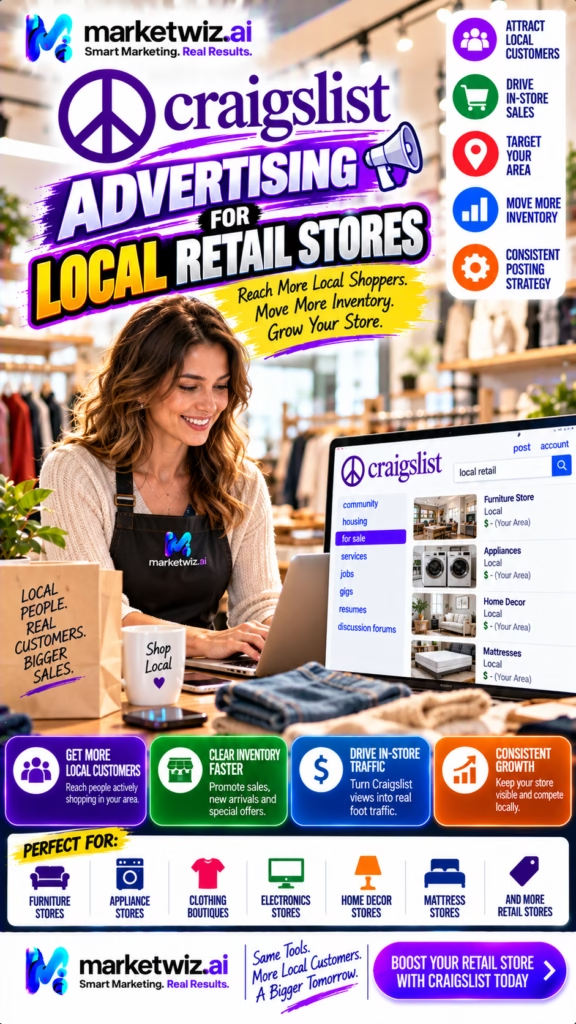
Craigslist Advertising for Local Retail Stores
Local retail stores can use Craigslist as part of a broader customer acquisition strategy to put relevant inventory in front of nearby shoppers, generate product inquiries, increase local discovery, support store traffic, and connect advertising activity to measurable sales.
Updated October 20261. Understand the Craigslist Opportunity for Local Retail Stores
Local retail marketing is increasingly fragmented. Customers can discover products through Google, social media, online marketplaces, search engines, retail websites, local directories, referrals, and traditional advertising.
Craigslist provides another potential discovery path because it organizes listings around local geographic markets and product-oriented categories.
For retailers with inventory that fits appropriate Craigslist categories, this creates an opportunity to put individual products and inventory categories in front of shoppers who may already be browsing for something specific.
The real opportunity is local product discovery. Instead of asking Craigslist to function like a traditional brand advertisement, retailers can use relevant product advertising to connect available inventory with nearby customer demand.
The objective should not be to create advertising volume for its own sake. The objective is to generate useful customer actions such as product inquiries, calls, store visits, pickups, appointments, orders, or purchases where appropriate.
2. Understand Retail Shopper Intent on Craigslist
Retailers should begin by understanding why a shopper may be browsing Craigslist. Unlike passive advertising environments, category-based browsing can reflect a relatively specific product interest.
A customer may be comparing sofas, searching for an appliance, looking for office furniture, researching equipment, browsing home improvement products, or trying to locate another item available nearby.
That customer intent should shape the advertisement.
Product Search
The shopper already knows the type of product they want and is evaluating local options.
Price Comparison
The customer is comparing prices, features, brands, sizes, or configurations.
Local Availability
The shopper wants to know whether a desired product is available nearby.
Discovery
The customer is browsing a category and may discover inventory they had not originally planned to purchase.
Retail ads should therefore communicate product relevance quickly and provide enough information for shoppers to decide whether they want to continue.
3. Choose the Right Retail Inventory to Advertise
A retailer may have hundreds or thousands of products, but that does not mean every item deserves the same Craigslist advertising priority.
Start by identifying inventory that matches relevant categories, local demand, and the retailer's business objectives.
Potential inventory priorities can include:
- Popular products
- High-demand categories
- High-margin inventory
- Products with strong local appeal
- Seasonal inventory
- New arrivals
- Distinctive products
- Products with strong visual appeal
- Inventory that needs additional exposure
- Products frequently requested by local customers
The retailer should also verify that each item is appropriate for the selected Craigslist category and that all customer-facing information is accurate.
4. Choose Craigslist Markets That Match the Retail Territory
Craigslist is geographically organized, making market selection a major component of the advertising strategy.
Retailers should compare Craigslist markets with their actual customer territory. For a physical store, this may center on the city and surrounding communities. Retailers offering delivery may have a larger legitimate customer radius.
Map the retail territory using:
- Store location
- Primary city
- Nearby communities
- Metro area
- Counties
- ZIP codes
- Pickup territory
- Delivery territory
- Additional store locations
Market Selection Should Reflect Real Operations
Focus on markets where the retailer can legitimately support customer purchases, pickups, deliveries, or other advertised transactions. Geographic expansion should follow actual business capacity.
5. Match Retail Products to Appropriate Craigslist Categories
Category selection influences who encounters the advertisement and the context in which the product appears.
A shopper browsing furniture is demonstrating a different type of intent from someone browsing appliances, automotive products, tools, equipment, or another category.
Retailers should review current Craigslist category structures in their target markets and select categories that accurately represent the advertised product.
Think from the shopper's perspective: if someone wanted this exact type of product, which appropriate category would they naturally browse?
Accurate category selection can improve relevance while helping the retailer avoid creating a confusing experience for potential customers.
6. Build Product-Focused Craigslist Retail Ads
Local retailers often have more advertising opportunities when they think in terms of individual products and product categories instead of publishing one broad advertisement about the entire store.
A furniture retailer, for example, may have distinct customer demand for sofas, sectionals, dining sets, mattresses, bedroom sets, desks, chairs, and storage furniture.
Each product type solves a different shopper need.
Product-focused advertising allows the title, imagery, specifications, price, and description to align with that specific intent.
Specificity Creates Relevance
A shopper searching for one particular product can evaluate a focused listing more quickly than an advertisement that tries to promote every department in the store at once.
7. Write Craigslist Retail Titles That Communicate Value Quickly
The title has to compete for attention while customers scan multiple listings. Strong retail titles make the product easy to identify.
Avoid relying only on vague promotional wording. Instead, prioritize details that help the shopper understand the item.
Depending on the product, a title might include:
- Product type
- Brand
- Model
- Size
- Material
- Style
- Color
- Configuration
- Condition
- Important distinguishing feature
The best combination depends on what shoppers in that category need to know first.
8. Write Retail Descriptions That Answer Buying Questions
Once the shopper opens the advertisement, the description should reduce uncertainty and make the product easier to evaluate.
Retailers can build descriptions around the questions customers regularly ask sales associates.
Useful product information may include:
- Product name
- Brand or manufacturer
- Model when applicable
- Dimensions
- Materials
- Color or finish
- Important features
- Condition
- Configuration
- Price when applicable
- Availability
- Pickup information
- Delivery information when applicable
- Store or geographic information
- Appropriate next step
Reduce the Information Gap
The more accurately the advertisement answers meaningful buying questions, the easier it becomes for a serious shopper to decide whether to contact the store.
9. Use High-Quality Product Images
Retail is highly visual. Images can determine whether a shopper understands the style, condition, proportions, features, or overall appeal of a product.
Use clear images that accurately represent the inventory being advertised whenever images are appropriate for the listing.
Useful retail imagery can show:
- Primary product view
- Alternate angles
- Important features
- Material details
- Controls or interfaces
- Interior storage
- Configuration options
- Scale or dimensions where useful
- Condition details
The primary image should make the product easy to understand without unnecessary visual clutter.
10. Make Retail Pricing Clear and Accurate
Price is one of the most important evaluation points for many retail shoppers. When pricing is displayed, it should accurately represent the product being advertised.
Misleading pricing may generate attention, but it can also create poor-quality inquiries and weaken customer trust.
If a product has legitimate options or configurations that affect the final price, the description should communicate relevant information clearly rather than creating an inaccurate impression.
Accuracy is more valuable than artificial attention. The goal is to attract shoppers who are genuinely interested in the actual product and purchase conditions.
11. Keep Craigslist Inventory Information Current
Retail inventory changes. Products sell, prices change, new models arrive, colors disappear, configurations change, and seasonal products move in and out of stock.
That creates an operational challenge for any inventory-based advertising system.
Retailers should regularly verify:
- Product availability
- Current price
- Brand
- Model
- Dimensions
- Features
- Condition
- Color
- Configuration
- Pickup options
- Delivery availability
Keeping advertising aligned with current inventory can improve the customer experience and reduce time spent answering inquiries about products that are no longer available.
12. Use Craigslist to Support Local Store Traffic
Not every Craigslist-generated customer journey needs to end entirely online. For brick-and-mortar retailers, an advertisement can create the initial product discovery that eventually leads to an in-store purchase.
A shopper might see a product, research the retailer, make contact, verify availability, and then visit the physical location to evaluate the item.
This means retailers should consider Craigslist within the broader store traffic funnel.
Connect Online Discovery to Offline Revenue
When possible, sales teams should record how customers discovered the store. This can reveal whether Craigslist is contributing to transactions that might otherwise be attributed only to walk-in traffic.
13. Build Local Trust Beyond the Craigslist Ad
A shopper may discover a product on Craigslist and then research the retailer elsewhere before making a purchase.
The business's broader online presence can therefore influence whether that Craigslist discovery turns into a customer.
Important trust assets can include:
- Professional retail website
- Accurate store information
- Google Business Profile
- Authentic customer reviews
- Real store photos
- Real product imagery
- Consistent phone information
- Accurate store hours
- Active social profiles
- Helpful product information
The goal is consistency. The retailer that shoppers find through Google or the company website should clearly match the business represented in the Craigslist advertisement.
14. Build a Reliable Response Process for Craigslist Shoppers
Advertising performance depends partly on what happens after the shopper makes contact.
Retail businesses should establish a clear internal process for handling Craigslist-generated questions.
Determine:
- Who receives inquiries
- Who checks product availability
- Who answers product questions
- Who handles pricing questions
- Who coordinates pickup
- Who discusses delivery when applicable
- Who records the lead source
- Who follows up on valuable opportunities
A clear process becomes increasingly important as advertising volume grows.
15. Qualify Retail Leads Without Creating Unnecessary Friction
Qualification does not have to turn a simple retail inquiry into a complicated interview.
The purpose is to collect enough information to help the shopper and route the opportunity correctly.
Useful information may include:
- Product of interest
- Preferred model or configuration
- Customer location
- Quantity
- Desired color or size
- Pickup or delivery preference
- Purchase timeline
- Relevant contact information when provided
Higher-value retail transactions may justify a more detailed qualification process than low-cost products.
16. Track Craigslist Retail Leads
A retailer cannot accurately evaluate advertising performance if the source of customer inquiries disappears once the sales conversation begins.
Build a simple tracking system that connects the original advertisement with the eventual business outcome.
Useful fields include:
- Inquiry date
- Customer name when available
- Contact information when provided
- Craigslist market
- Product advertised
- Product category
- Customer location
- Lead status
- Store visit when known
- Pickup when applicable
- Sale status
- Transaction value
- Follow-up status
17. Connect Valuable Craigslist Leads to the Retail CRM
A CRM can help retailers organize customer opportunities that require more than one interaction.
This can be particularly valuable for furniture, appliances, equipment, higher-ticket merchandise, wholesale products, custom orders, bulk purchases, and other transactions with a longer decision process.
A simple retail pipeline might include:
- New inquiry
- Product confirmed
- Qualified shopper
- Contact established
- Store visit planned
- Quote or order prepared
- Follow-up
- Purchase completed
- Future opportunity
- Closed or lost
Tracking creates accountability. It helps management understand whether advertising is generating actual customers instead of simply producing messages or calls.
18. Follow Up With High-Value Retail Opportunities
Not every shopper purchases during the first interaction.
Customers buying furniture, appliances, equipment, building products, specialty merchandise, or other higher-value items may compare multiple options before deciding.
An appropriate follow-up process can keep qualified opportunities organized.
Retail follow-up can be based on:
- Product interest
- Availability questions
- Requested specifications
- Store visit plans
- Delivery questions
- Quote status
- Expected purchase timeline
- Next agreed customer action
Follow-up should remain relevant to the shopper's request and any applicable communication requirements.
19. Test Retail Craigslist Ads Systematically
Retailers can improve campaigns by testing meaningful variables and measuring downstream results.
Avoid changing everything simultaneously. When possible, isolate meaningful differences so the business can learn from the results.
Retail advertising tests can include:
- Product selection
- Primary image
- Title structure
- Description format
- Feature emphasis
- Product category
- Market
- Seasonal positioning
- Price presentation where appropriate
- Different legitimate inventory configurations
The winning version should ultimately be determined by meaningful customer and sales outcomes rather than appearance alone.
20. Measure Craigslist Performance by Retail Product Category
Different product categories can produce dramatically different advertising results.
A retailer should therefore avoid combining all Craigslist activity into one performance number.
| Metric | What It Can Reveal |
|---|---|
| Inquiries | Initial customer interest in the product category |
| Qualified Shoppers | How many inquiries represent realistic purchase opportunities |
| Store Visits | How often online interest contributes to physical retail traffic |
| Orders | How often shoppers progress into transactions |
| Average Transaction | Financial quality of customers from the category |
| Sales | Number of completed purchases connected to the campaign |
| Revenue | Total sales value attributed to the product category |
Product-level reporting can help retailers identify where additional advertising effort has the greatest potential value.
21. Compare Retail Craigslist Performance by Market
Geographic reporting is especially useful for retailers serving multiple cities or operating multiple locations.
One market may generate many low-value inquiries while another generates fewer but stronger purchase opportunities.
Compare markets using qualified leads, store visits, purchases, average transaction value, delivery economics, and revenue.
Do Not Optimize for Inquiry Volume Alone
A smaller market can be more valuable if its shoppers convert more consistently or purchase higher-value products. Optimize around business outcomes rather than the largest response count.
22. Use AI to Scale Craigslist Retail Advertising
Retailers with large inventories face a major content challenge. Every product can have a different title, model, size, price, description, image set, and availability status.
AI can help organize and transform verified inventory information into customer-facing advertising drafts.
AI can assist with:
- Product title drafts
- Description drafts
- Feature summaries
- Specification organization
- Product categorization
- Local content variations
- Customer FAQ preparation
- Lead summaries
- Performance reporting
Retailers should verify important product facts before publication rather than allowing AI to invent missing inventory details.
23. Connect Advertising Workflows to Accurate Inventory Data
Retail advertising becomes more scalable when the marketing system can work from a structured source of truth.
That source might be an inventory management system, ecommerce catalog, spreadsheet, product database, CRM, or another verified business system.
Structured inventory data can include:
- SKU
- Product name
- Brand
- Model
- Category
- Price
- Quantity
- Availability
- Dimensions
- Features
- Store location
- Image references
Better Data Creates Better Automation
AI and marketing automation become significantly more useful when they operate from clean, current, structured product information instead of incomplete or outdated data.
24. Combine Craigslist Advertising With Google Maps
Google Maps can support the customer journey after a shopper discovers a retailer through Craigslist.
A shopper may search the store name, look for directions, read reviews, verify hours, view photos, or compare the business with other local retailers.
A strong Google Business Profile can reinforce:
- Store name
- Location
- Hours
- Phone information
- Website
- Business categories
- Customer reviews
- Store photos
- Product imagery
Craigslist can generate discovery while Google Maps helps customers verify and navigate to the business.
25. Support Craigslist With Local Retail SEO
Search engine optimization gives retailers another way to capture customers who are actively researching products and local stores.
The website can provide much deeper information than an individual classified advertisement.
Retail SEO opportunities can include:
- Product category pages
- Product pages
- Brand pages
- Local store pages
- City landing pages
- Buying guides
- Product comparison content
- Frequently asked questions
- Delivery information
- Store information
A strong organic search presence can help retailers capture additional customer demand beyond Craigslist.
26. Combine Craigslist With Facebook Marketplace Where Appropriate
Retail businesses with suitable inventory can evaluate both Craigslist and Facebook Marketplace as separate local discovery channels.
The two platforms should not automatically be treated as identical. Categories, customer behavior, listing formats, and platform requirements can differ.
Craigslist
Build around relevant geographic markets, product categories, clear titles, useful details, and accurate inventory.
Facebook Marketplace
Where appropriate, use visually strong and accurate product listings to create an additional local discovery opportunity.
Retailers can measure each channel independently and allocate resources according to actual customer and sales performance.
27. Build a Multi-Channel Local Retail Marketing Engine
The strongest retail strategy does not require every customer to discover the store through the same platform.
Different channels can capture different forms of customer intent.
A local retail marketing engine can include:
- Craigslist advertising
- Facebook Marketplace where appropriate
- Google Maps optimization
- Local SEO
- Retail website optimization
- Product pages
- Social media marketing
- Instagram content
- TikTok and short-form video
- Customer review generation
- Email marketing where appropriate
- Customer reactivation
- Referral marketing
- Paid advertising when appropriate
Each channel should have a purpose. Craigslist can create product discovery, Google Maps can support local store discovery, SEO can capture search demand, social media can build visibility, and the retailer's website can provide deeper product information.
28. Measure Craigslist Retail Advertising With Sales Metrics
The ultimate purpose of retail advertising is not simply to generate views or inquiries. It is to contribute to profitable customer relationships and sales.
Retailers should build reporting around the stages that matter to the business.
| Stage | Retail Metric |
|---|---|
| Advertising | Products, categories, and markets actively promoted |
| Interest | Customer inquiries connected to advertisements |
| Qualification | Relevant purchase opportunities |
| Store Activity | Visits, pickups, appointments, or other trackable actions |
| Conversion | Completed transactions |
| Financial | Average sale, revenue, margin, and return on marketing investment |
When retailers connect advertising to these outcomes, they can make better decisions about products, markets, creative, staffing, and future marketing investment.
29. Avoid Common Craigslist Retail Advertising Mistakes
Retailers can weaken campaign performance long before a customer reaches the store if the underlying advertising system is inaccurate or poorly organized.
Common mistakes include:
- Advertising unavailable inventory
- Using inaccurate prices
- Using vague product titles
- Choosing irrelevant categories
- Publishing incomplete descriptions
- Using weak or misleading imagery
- Failing to verify product specifications
- Ignoring local market relevance
- Failing to update changing inventory
- Responding slowly to shopper inquiries
- Failing to record lead sources
- Failing to connect inquiries with sales
- Measuring response volume instead of revenue
- Depending on one advertising channel
- Failing to review current platform requirements
A disciplined retail advertising system can eliminate many of these problems before the campaign is scaled.
30. Follow a 90-Day Craigslist Retail Growth Plan
Retailers can use a 90-day framework to build the advertising foundation, identify stronger products and markets, improve customer handling, and scale the parts of the system that create meaningful sales opportunities.
Days 1–30: Build the Retail Advertising Foundation
- Review current Craigslist requirements
- Define the retail customer territory
- Identify priority Craigslist markets
- Identify appropriate product categories
- Select initial inventory
- Verify product information
- Verify pricing
- Build an organized image library
- Create product-focused ad templates
- Establish inquiry tracking
- Record baseline performance
Days 31–60: Improve Customer and Sales Performance
- Compare product categories
- Compare Craigslist markets
- Improve titles
- Improve descriptions
- Improve primary product images
- Refine customer response workflows
- Track store visits where possible
- Track qualified shoppers
- Connect valuable leads to the CRM
- Improve follow-up
Days 61–90: Scale Stronger Retail Opportunities
- Expand stronger product categories
- Prioritize higher-value markets
- Reduce weak advertising activity
- Use AI to assist with repetitive content production
- Connect workflows to accurate inventory data
- Improve reporting by product
- Improve reporting by market
- Track completed transactions
- Measure average transaction value
- Measure revenue
- Expand Google Maps visibility
- Improve local retail SEO
- Develop a broader multi-channel marketing system
The retail Craigslist growth formula: accurate inventory + appropriate categories + strong local markets + product-focused titles + useful descriptions + quality imagery + accurate pricing + fast customer response + lead tracking + sales attribution + AI-assisted operations + multi-channel local visibility.
Turn Craigslist Into a Measurable Local Retail Growth Channel
Craigslist advertising can become more valuable for local retail stores when it is treated as part of a complete customer acquisition system rather than an isolated place to publish occasional advertisements.
The process begins with inventory.
Retailers need to know exactly what they are promoting. Product names, brands, models, dimensions, features, prices, availability, images, and other important details should come from accurate business information.
This is particularly important for retailers with rapidly changing inventory. Marketing becomes difficult to scale when the advertising system is disconnected from what is actually available for purchase.
The next layer is geographic strategy.
A physical retailer usually depends heavily on local customers. Even businesses offering delivery often have defined geographic limits where fulfillment remains practical.
Craigslist's local market structure can therefore align naturally with the way many retail businesses already operate.
Retailers can identify the cities, communities, counties, and metro areas that represent realistic customer opportunities and evaluate those markets independently.
Category selection adds another layer of relevance.
Customers often browse according to the type of product they want. A shopper searching for furniture has different needs from someone searching for appliances, tools, automotive products, equipment, or another retail category.
Accurate category selection can place the product in a more appropriate customer context.
From there, the advertisement needs to communicate clearly.
A strong title identifies the product quickly. A useful description answers important questions. Quality imagery helps the customer understand what is being sold. Accurate pricing reduces confusion. Current availability prevents the sales team from wasting time responding to shoppers interested in inventory that is no longer available.
Product-focused advertising can be especially powerful for retailers.
Instead of attempting to promote the entire store through one broad message, retailers can organize marketing around the specific products and categories customers are already interested in.
A furniture retailer might separately market sofas, sectionals, dining sets, bedroom furniture, mattresses, desks, chairs, and other appropriate inventory.
An appliance retailer might organize campaigns around refrigerators, washers, dryers, ranges, dishwashers, freezers, and other legitimate available products.
This structure allows each advertisement to speak directly to a specific shopper need.
Advertising, however, is only the beginning.
Retailers also need a process for handling the customer response.
Someone inside the business should know who receives Craigslist inquiries, how availability is checked, who answers product questions, how the source is recorded, and what happens when the shopper needs additional follow-up.
For higher-value products, this process becomes even more important.
Furniture, appliances, equipment, specialty products, custom orders, and large purchases may involve several interactions before a transaction is completed.
A structured CRM or lead-tracking system can prevent those opportunities from disappearing.
Tracking also allows management to understand the real value of Craigslist.
Inquiry counts provide only one piece of the picture.
A more useful system connects each inquiry to the product, market, customer journey, and eventual transaction.
Retailers can then measure qualified shoppers, store visits, orders, purchases, average transaction value, revenue, and potentially gross profit.
This information can reveal major differences between products.
One category may produce many inquiries but few purchases. Another may generate fewer inquiries but significantly larger transactions. A third may perform strongly only during a specific season.
Geographic performance can vary in the same way.
One market may create substantial interest but poor conversion. Another may consistently produce customers who visit the store or make higher-value purchases.
Businesses that track these differences can allocate future marketing effort more intelligently.
AI can make the operation more efficient.
When connected to verified product information, AI can assist with title drafts, descriptions, feature summaries, categorization, customer FAQs, lead summaries, reporting, and other repetitive marketing work.
The quality of that automation depends heavily on the quality of the source data.
Clean inventory information gives the business a stronger foundation for scaling advertising while reducing errors.
Human review should remain part of the process, particularly for prices, availability, product specifications, geographic information, customer-facing claims, and compliance with current platform requirements.
Craigslist also becomes more valuable when it works alongside other local marketing channels.
A shopper may discover a product on Craigslist and then search the store on Google. They may read customer reviews, look at photos, check hours, visit the website, browse additional inventory, and then travel to the store.
That makes Google Maps an important part of local retail visibility.
Local SEO provides another path for customers searching for products, brands, categories, and stores. Facebook Marketplace may provide additional product discovery where appropriate. Social media can showcase inventory and maintain visibility. Short-form video can demonstrate products in a more engaging format.
Together, these channels can create a broader retail customer acquisition engine.
The goal is not to maximize the number of advertisements.
The goal is to connect accurate inventory with real local customer demand, respond effectively when shoppers show interest, track what happens after the inquiry, and invest more heavily in the products and markets that contribute to profitable sales.
When Craigslist is managed this way, it can become one measurable component of a much larger local retail growth strategy.
Frequently Asked Questions About Craigslist Advertising for Local Retail Stores
1. Can local retail stores advertise on Craigslist?
Local retail stores can evaluate Craigslist categories and posting options that appropriately match their inventory and business while following current platform requirements.
2. Why can Craigslist be useful for local retailers?
Craigslist is organized around local markets, which can help retailers expose relevant inventory to shoppers browsing within their geographic area.
3. What retail products can be advertised on Craigslist?
Appropriate products depend on current Craigslist categories and rules, but retailers should focus on legitimate inventory that accurately matches the selected category.
4. How should retail stores choose Craigslist markets?
Retailers should prioritize markets that overlap with their real customer territory, store locations, delivery area, pickup area, or other legitimate geographic coverage.
5. What makes a good Craigslist retail ad title?
A strong title identifies the product clearly and can include important details such as brand, model, size, style, condition, or other relevant attributes.
6. Should Craigslist retail ads include prices?
When pricing is relevant and appropriate for the category, accurate pricing can help shoppers evaluate the product before making contact.
7. Should retail stores use product photos on Craigslist?
Clear and accurate product photos can help shoppers understand the inventory, condition, style, features, and overall offering.
8. How detailed should a Craigslist retail description be?
Descriptions should provide enough useful information to answer important shopper questions without adding unnecessary or repetitive content.
9. Can Craigslist help increase retail store traffic?
Relevant local ads can create product discovery and inquiries that may contribute to store visits, pickups, calls, or other appropriate customer actions.
10. Can Craigslist generate phone calls for retail stores?
Craigslist can generate customer inquiries when shoppers find an advertisement relevant and the business provides an appropriate contact path.
11. Should retailers advertise individual products or the entire store?
Product-focused advertising can often communicate shopper intent more clearly because each advertisement can focus on a specific legitimate item or inventory category.
12. How can retailers improve Craigslist ad quality?
Retailers can improve ad quality through accurate titles, useful descriptions, clear images, correct product details, relevant categories, accurate pricing, and updated availability.
13. How often should retail inventory ads be updated?
Retailers should keep advertising aligned with current inventory and follow Craigslist rules regarding posting frequency, renewal, and reposting.
14. What happens when an advertised retail product sells?
Businesses should keep customer-facing advertising accurate and update or remove listings when inventory is no longer available as appropriate.
15. Can furniture stores use Craigslist?
Furniture retailers can evaluate relevant Craigslist categories for legitimate inventory such as sofas, dining sets, bedroom furniture, office furniture, and other appropriate products.
16. Can appliance stores advertise on Craigslist?
Appliance retailers can evaluate appropriate local Craigslist categories for legitimate available inventory while keeping model, condition, pricing, and other details accurate.
17. Can AI help create Craigslist retail ads?
AI can help organize verified product data and draft titles and descriptions, while retailers should review final advertising for accuracy and compliance.
18. Can AI help manage retail inventory marketing?
AI can assist with content preparation, product categorization, lead summaries, reporting, and other repetitive marketing workflows when connected to accurate inventory data.
19. How should retailers track Craigslist leads?
Retailers can record the originating market, advertisement, product, customer inquiry, lead status, store visit or pickup when known, and resulting sale.
20. How can retailers measure Craigslist ROI?
Retailers can connect Craigslist-generated inquiries to transactions and compare resulting revenue or gross profit with advertising costs and operational effort.
21. Should retailers track Craigslist performance by product?
Product-level tracking can help identify which inventory categories create inquiries, store visits, and sales.
22. Should retailers track Craigslist performance by city?
Businesses serving multiple areas can compare results by market to understand where qualified customer demand and sales are strongest.
23. Can Craigslist work with Google Maps marketing?
Yes. Craigslist can support product discovery while Google Maps can help shoppers locate, research, and evaluate the retail business.
24. Can Craigslist work with retail SEO?
Yes. Craigslist and SEO can support separate discovery paths, while optimized product, category, and location pages can help retailers capture search demand.
25. Can Craigslist work with Facebook Marketplace?
Where appropriate for the inventory and each platform, Craigslist and Facebook Marketplace can provide separate channels for local product discovery.
26. Should retail stores depend only on Craigslist?
Retailers can reduce dependence on a single platform by combining Craigslist with Google Maps, SEO, social media, their website, customer reviews, and other relevant marketing channels.
27. What are common Craigslist mistakes for retailers?
Common mistakes include inaccurate inventory, vague titles, weak images, incorrect pricing, poor category selection, outdated availability, weak lead tracking, and slow customer response.
28. How can retailers improve Craigslist conversions?
Conversions can improve through clearer product information, stronger images, accurate pricing, better customer response, reliable inventory information, and organized sales follow-up.
29. Can multi-location retailers use Craigslist?
Multi-location retailers can evaluate relevant Craigslist markets individually when their stores or legitimate operating areas support those markets.
30. How should a retail store start advertising on Craigslist?
Start by reviewing current platform requirements, identifying relevant markets and categories, selecting accurate inventory, creating strong ads, establishing lead tracking, and measuring sales outcomes.
30 Additional SEO Keywords
These supporting keyword themes expand the article around Craigslist retail advertising, local store marketing, inventory promotion, customer acquisition, local SEO, Google Maps, marketplace advertising, AI automation, and retail growth.
Build a Stronger Local Retail Marketing Engine
Market Wiz AI helps local businesses build customer acquisition systems using Craigslist strategies, Facebook Marketplace marketing, Google Maps optimization, local SEO, AI automation, social marketing, lead tracking, and multi-channel local visibility.
Call MarketWiz.ai: (910) 601-2938












