
The Future of Demand Generation Explained
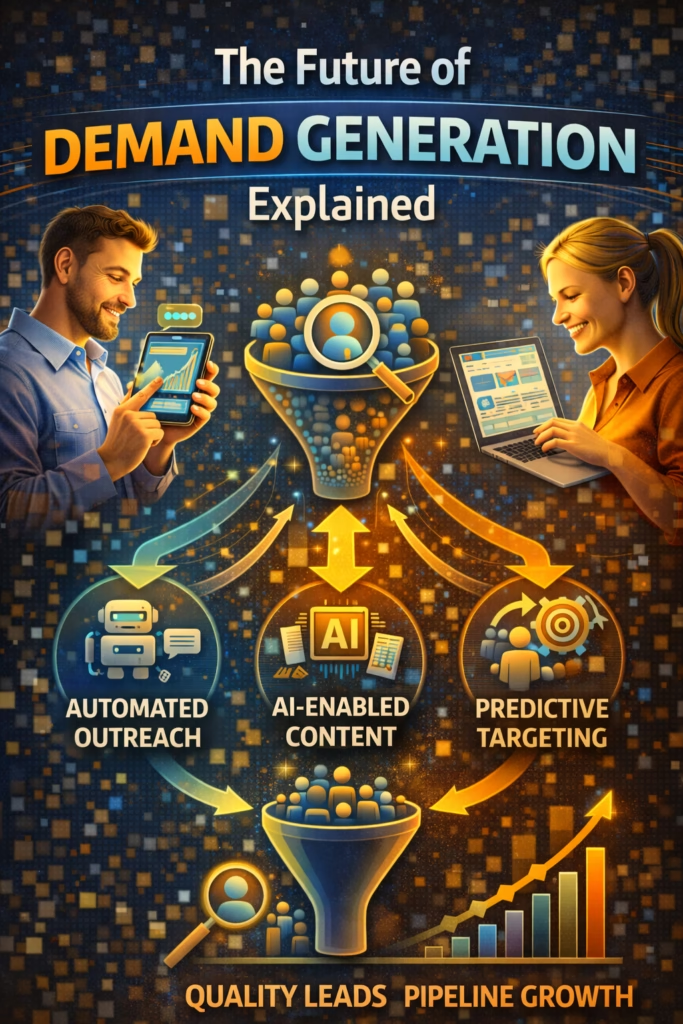
The Future of Demand Generation Explained is the modern demand stack—where always-on visibility meets demand capture systems that convert conversations into booked next steps.
Note: This is general guidance. Use compliance-first automation, avoid spam duplication, and keep claims accurate across platforms.
Introduction
The Future of Demand Generation Explained starts with a shift in reality: buyers no longer “enter a funnel” the way they used to. They discover you in feeds, listings, reviews, and short-form clips—then they message instantly.
That means demand generation isn’t just about running campaigns. It’s about building an always-on system that does two jobs:
- Create visibility in the places buyers naturally browse (search, social, marketplaces)
- Capture demand with speed-to-lead, qualification, follow-up, and pipeline conversion
Big idea: The future belongs to demand systems—not one-off campaigns.
Expanded Table of Contents
- 1) The buyer behavior shift changing demand gen
- 2) Demand generation vs demand capture (new model)
- 3) The modern demand generation stack
- 4) Why marketplaces are becoming demand engines
- 5) Why social discovery produces higher-intent conversations
- 6) Content engines: building visibility that compounds
- 7) Speed-to-lead: the conversion advantage nobody fixes
- 8) Follow-up systems: recovering lost demand
- 9) Measurement in the new era: what to track
- 10) AI workflows that scale demand gen responsibly
- 11) 30–60–90 day rollout plan
- 12) 25 Frequently Asked Questions
- 13) 25 Extra Keywords
1) The buyer behavior shift changing demand gen
Demand generation used to look like: ads → landing page → form → sales call. That still exists, but it’s no longer the dominant buyer path for many categories.
Today, buyers do this instead:
- Discover options in marketplaces, social feeds, review platforms, and search results
- Validate quickly by scanning photos, proof, and credibility signals
- Message instantly to ask availability, price, and timing
- Choose the fastest, clearest, most trustworthy responder
Pro insight: In the future, “messaging” is the new form-fill.
2) Demand generation vs demand capture (new model)
The future is not either/or. It’s both.
Demand generation
Creating awareness and interest through visibility: content, social, SEO, marketplaces, partnerships.
Demand capture
Converting existing intent into booked next steps: speed-to-lead, qualification, follow-up SOPs, pipeline stages.
Reality: Most businesses leak demand because they don’t have capture systems. They blame “marketing.”
3) The modern demand generation stack
Modern demand gen is a stack of systems that work together. You don’t need all of them on day one—but you need a plan.
| Layer | What it does | Examples |
|---|---|---|
| Visibility | Creates discovery | Marketplaces, social clips, SEO pages |
| Trust | Reduces skepticism | Proof photos, reviews, transparent offers |
| Speed | Wins the buyer race | Instant replies, routing |
| Qualification | Protects time | One-question filters, tags |
| Follow-up | Recovers revenue | 3-touch SOP, reminders |
| Pipeline | Prevents leakage | Stages, ownership, handoffs |
| Measurement | Enables optimization | Response time, booked rate, close rate |
Rule: Build the stack from the bottom up: capture systems first, then scale visibility.
4) Why marketplaces are becoming demand engines
Marketplaces are the new “local search” for many categories because they combine three things:
- High intent: people browse with purchase intent, not just entertainment
- Instant messaging: the barrier to inquiry is near zero
- Local relevance: location is built into discovery
How marketplaces create predictable demand
- More listings = more keyword coverage (visibility surface area)
- Consistent cadence = sustained freshness and distribution
- Proof photos + clear offers = higher message rates
Pro move: Marketplaces are a demand layer—your conversion systems determine how much you capture.
6) Content engines: building visibility that compounds
The future of demand generation is “always on.” Content engines do that by creating assets that keep working after you post them.
Compounding content principles
- Template-driven (so publishing is sustainable)
- Proof-led (so trust improves over time)
- Cadence-controlled (so visibility doesn’t disappear)
- Repurposed (one idea becomes multiple assets)
Repurpose map (simple)
| Core asset | Repurpose into | Why |
|---|---|---|
| 1 blog | 5–10 clips + 10 posts | More surface area |
| 1 product video | 3 hooks + 3 CTAs | More conversion tests |
| 1 offer | 5 angles (budget, urgency, premium) | Matches different intent |
Rule: Content engines create demand; capture systems convert it.
7) Speed-to-lead: the conversion advantage nobody fixes
In the future demand model, the fastest responder often wins—even if they are not the cheapest.
Instant reply (universal)
Yes — I can help ✅
Are you looking to do this today or this week?

What city/zip are you in? I’ll confirm the fastest next step.
Options-based close (books more)
Perfect ✅ I can do:
• Today: __:__ / __:__
• Tomorrow: __:__ / __:__

Which works best? And what city are you in?
Pro move: The first reply’s job is to qualify and book—don’t write an essay.
8) Follow-up systems: recovering lost demand
Ghosting is not rejection. It’s friction, distraction, or decision delay. Follow-up removes friction.
3-touch follow-up SOP
| Timing | Message | Goal |
|---|---|---|
| 20–40 min | Quick check-in + question | Re-engage |
| Same day | Availability + options | Create action |
| Next day | Alternate option | Save lead |
Quick check-in ✅
Did you still want to move forward?

Tell me your city and whether you want today or this week, and I’ll confirm options.
Rule: Every follow-up ends with a simple question to move the lead forward.
9) Measurement in the new era: what to track
Demand gen measurement is shifting from “clicks” to “conversations and bookings.”
| Metric | What it measures | Why it matters |
|---|---|---|
| Messages / inquiries | Demand capture volume | Shows real intent |
| Median response time | Speed-to-lead | Predicts conversion |
| Qualified rate | Lead quality | Protects capacity |
| Booked rate | Next steps scheduled | Predicts revenue |
| Close rate | Deals won | Profit signal |
Pro move: Track “booked next steps” weekly. It’s the clearest measure of demand capture performance.
10) AI workflows that scale demand gen responsibly
AI helps demand generation when it increases consistency and speed—without sacrificing accuracy or compliance.
High-impact AI workflows
- Template-driven content production (titles, descriptions, offers)
- Auto-variation rules (safe, structured changes)
- Instant reply scripts and routing
- Follow-up prompts and reminders
- Weekly KPI summaries and recommendations
Guardrails: Keep inventory/offers accurate, avoid spam duplication, and ensure any automated messaging is transparent and respectful.
11) 30–60–90 day rollout plan
Days 1–30 (Fix capture systems first)
- Deploy instant replies and lead routing
- Implement 3-touch follow-up SOP
- Define pipeline stages and ownership
- Start weekly tracking (messages, response time, booked rate)
Days 31–60 (Build always-on visibility)
- Launch cadence on marketplaces and social
- Standardize proof-based content templates
- Test 3 offer angles (budget/urgency/premium)
- Repurpose content into multiple assets
Days 61–90 (Scale and optimize)
- Increase surface area while maintaining variation
- Double down on top-performing angles and platforms
- Strengthen ops capacity (scheduling + SOPs)
- Optimize weekly using KPI trends
12) 25 Frequently Asked Questions
1) What is demand generation in 2026?
An always-on system combining visibility (marketplaces, social, SEO, content) with demand capture (speed-to-lead, qualification, follow-up, pipeline conversion).
2) How is demand gen different from lead gen?
Demand gen includes awareness and discovery; lead gen often focuses on capture. Modern systems require both.
3) Why are marketplaces important for demand gen?
They combine high intent, local discovery, and instant messaging.
4) Why are social platforms important?
Short-form content builds trust quickly and triggers direct messages.
5) What’s the biggest demand gen shift?
Messaging and conversation-based conversion replacing form-driven funnels in many categories.
6) What matters more: traffic or conversion?
Conversion first. Fix speed-to-lead and follow-up before scaling traffic.
7) What is demand capture?
Turning existing intent into booked next steps with speed, qualification, and follow-up.
8) What’s the fastest capture improvement?
Instant replies and a follow-up SOP.
9) How fast should I respond?
Under 5 minutes is good; under 1 minute is best.
10) What KPIs matter most?
Messages, response time, booked rate, close rate.
11) Do ads still work?
Yes, but the best outcomes come when ads are part of an always-on system.
12) What is an always-on system?
Cadence-driven visibility paired with consistent capture and follow-up.
13) Why do leads ghost?
They message multiple options. Slow response and no next step causes drop-off.
14) How do I reduce ghosting?
Fast replies, options-based scheduling, and follow-up SOPs.
15) What’s the best first reply script?
Confirm availability, ask timeline, ask city, offer the next step.
16) How do I qualify leads quickly?
Ask one question that reveals timeline and location (or budget/intent).
17) What is “surface area”?
How many assets you have live: listings, posts, pages, and keyword coverage.
18) What is cadence?
A consistent publishing/refresh schedule that maintains visibility.
19) How does content compound?
By staying searchable, shareable, and repurposable over time.
20) What role does AI play?
It increases consistency and speed through templates, variation, routing, and reporting.
21) What should AI not do?
Spam duplicate content or misrepresent offers/inventory.
22) How long until results?
Often weeks for conversion improvements; 60–90 days for compounding demand.
23) Can demand gen work without a website?
Yes, but a website can increase trust and conversions.
24) What’s the best next step today?
Deploy instant replies and a follow-up SOP.
25) What wins in the future?
Always-on visibility plus demand capture systems that book the next step.
13) 25 Extra Keywords
- The Future of Demand Generation Explained
- future of demand generation
- modern demand generation
- demand generation systems
- demand capture strategy
- always on demand generation
- marketplace demand generation
- social discovery demand gen
- short form content lead generation
- speed to lead demand capture
- instant reply scripts
- follow up SOP leads
- reduce lead leakage
- pipeline conversion system
- booked appointment rate
- close rate optimization
- visibility surface area strategy
- posting cadence system
- proof based marketing
- AI demand generation workflows
- conversation based selling
- messaging funnel strategy
- predictable inbound leads
- 30 60 90 day demand plan
- demand gen measurement KPIs









5) Why social discovery produces higher-intent conversations
Short-form social creates demand because it compresses trust faster than text. A buyer can see:
Social demand gen wins when you
Avoid: vague branding clips with no CTA and no proof. Entertainment without capture is expensive.