How Small Brands Compete Without Ad Budgets
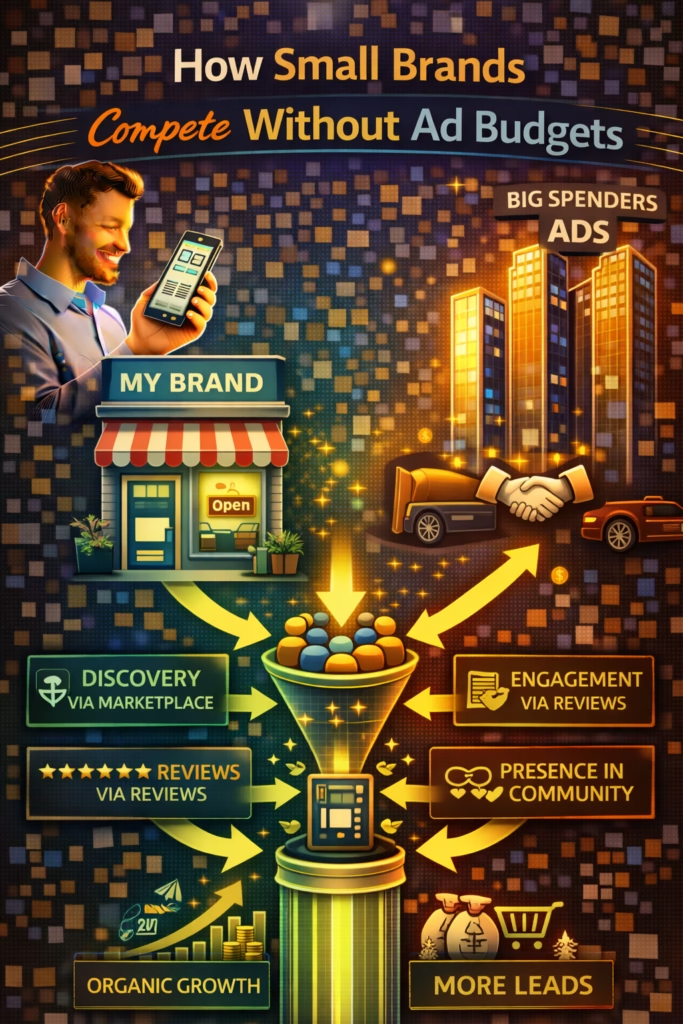
How Small Brands Compete Without Ad Budgets is the blueprint for building organic visibility and lead flow using consistency, intent-based channels, partnerships, and conversion systems—without relying on paid ads.
Note: This is general guidance. Follow platform rules, avoid misleading claims, and comply with local advertising/privacy requirements.
Introduction
How Small Brands Compete Without Ad Budgets starts with one uncomfortable truth:
Big brands win attention with money. Small brands win attention with systems.
When you don’t have a large ad budget, you can’t buy your way out of inconsistency. You can’t “turn on traffic” whenever you feel like it. But you can build something better:
- Channels that already have buyer intent
- Offers that convert fast
- Workflows that keep you visible every day
- Follow-up that protects every lead
Big idea: The advantage of a small brand is speed and focus. You can out-execute giants where they’re slow.
Expanded Table of Contents
- 1) The small-brand advantage (why you can win)
- 2) Demand capture vs demand creation
- 3) The best organic channels when you have no budget
- 4) Marketplaces as free “intent engines”
- 5) Local SEO as a compounding asset
- 6) The content-to-lead loop (without being a full-time creator)
- 7) Offer packaging that converts without discounts
- 8) Conversion messaging: what to say to win the click
- 9) Proof systems: how to build trust faster than big brands
- 10) Referral and partnership flywheels
- 11) Speed-to-lead and follow-up without a sales team
- 12) KPIs that matter when you’re growing organically
- 13) 30–60–90 day rollout plan
- 14) 25 Frequently Asked Questions
- 15) 25 Extra Keywords
1) The small-brand advantage (why you can win)
Small brands compete when they stop trying to “look big” and start trying to move better.
Focus
You can choose one niche, one region, and one offer and become the obvious choice.
Speed
You can test, change, and improve faster than a big brand’s approval process.
Proximity
You can win locally: faster response, faster delivery, better service, real relationships.
Authenticity
Real photos, real people, real proof. Buyers trust what feels real.
Rule: Competing without ads means competing with execution and consistency.
2) Demand capture vs demand creation
Big ad budgets are usually for demand creation (convincing people to want something). Small brands should start with demand capture (showing up when people already want it).
| Approach | What it means | Best for |
|---|---|---|
| Demand capture | Show up when buyers are already searching/browsing | Low budget, fast ROI |
| Demand creation | Create attention before buyers have intent | Big budgets, long runway |
Pro move: Build demand capture first. Then use content to expand demand over time.
3) The best organic channels when you have no budget
Not all “free channels” are equal. Prioritize channels where buyers already behave like buyers.
Best low-budget channel types
- Marketplaces: buyers browse with purchase intent
- Local SEO (Maps + reviews): buyers search with urgency
- Community distribution: groups, forums, neighborhood networks
- Partnerships: referrals from adjacent businesses
- Owned lists: email/SMS follow-up that you control
Rule: Organic growth is easiest when intent is already present.
4) Marketplaces as free “intent engines”
Marketplaces are modern search engines with pictures. People scroll them like they shop.
Why marketplaces work for small brands
- Exposure comes from freshness + engagement
- Listings act like micro landing pages
- Multiple listings create “surface area” (more chances to be found)
- Consistency compounds: daily activity builds reliable visibility
Marketplace visibility checklist
- Rotate first photo (thumbnail) regularly
- Write clear titles that match buyer keywords
- Use varied angles (value, premium, speed, trust)
- Answer messages fast (speed-to-lead)
- Avoid duplicates and spam patterns
Pro move: The small brand wins by posting consistently while giants rely on big campaigns.
5) Local SEO as a compounding asset
Local SEO is the closest thing to “free ads” that compounds over time.
Local SEO wins when you do 5 basics well
- Perfect listing info: category, services, hours, address, photos
- Reviews: ask consistently, respond professionally
- Content proof: posts, updates, Q&A, photos
- Service clarity: describe what you do in plain language
- Response speed: calls/messages get handled fast
Rule: If you can’t outspend, out-rank locally and out-respond on leads.
6) The content-to-lead loop (without being a full-time creator)
You don’t need to post “a lot.” You need to post useful content that matches buyer intent and earns trust.
The 3 content formats that convert for small brands
Proof
Before/after, demos, walk-throughs, customer stories, delivery/pickup wins.
Comparison
“Good vs better vs best,” “what to avoid,” “what to choose for X use case.”
FAQ answers
Short answers to top questions buyers ask before purchasing.
Simple weekly content system (30–60 minutes)
[ ] 1 proof post (real photo/video)
[ ] 1 comparison post
[ ] 1 FAQ answer post
[ ] Repurpose across platforms + link to your listing/offer
Pro move: Content is not “branding.” It’s sales enablement for organic channels.
7) Offer packaging that converts without discounts
Without ads, your offer has to do more work. It must be clear, safe, and easy to say yes to.
Offer elements that increase conversion
- Outcome: what the customer gets
- Proof: why they should believe it
- Friction remover: delivery, financing, setup, fast turnaround, warranty terms (truthful)
- Risk control: transparent pricing and next steps
- Urgency: availability windows (truthful, no fake scarcity)
Rule: Small brands win by removing friction, not by racing to the bottom on price.
8) Conversion messaging: what to say to win the click
Organic traffic is fragile—your first photo, title, and first two lines decide everything.
High-converting first-line formula
Real photos + clear details ✅
Best for: [use case] • Options: [delivery/financing/availability]
Question CTA: What city/zip are you in and are you looking for today or this week?
Angles that convert without hype
- Trust: transparent details, real photos, clear process
- Speed: same-day pickup/delivery (only if true)
- Value: “best overall value” framing instead of “cheapest”
- Fit: “perfect for” use-case targeting
Pro move: Ask a single question CTA. It increases replies and starts the conversion process.
9) Proof systems: how to build trust faster than big brands
Big brands have brand recognition. Small brands need proof.
Proof assets small brands can build quickly
- Real photos (consistent style)
- Short customer quotes (with permission)
- Before/after or setup/delivery videos
- FAQ screenshots (the questions buyers ask most)
- “What to expect” process card
Rule: Proof beats polish when budgets are tight.
10) Referral and partnership flywheels
Partnerships let small brands borrow trust and distribution.
Best partners are adjacent, not competing
- Service providers who touch your customers
- Installers, delivery partners, contractors, local pros
- Community orgs and local networks
- Complementary retailers
Simple partnership pitch
We serve the same customers.
If you send us a customer, we’ll take great care of them and send yours back.
Want to set up a simple referral exchange?
Pro move: A few strong partners can replace thousands in ad spend.
11) Speed-to-lead and follow-up without a sales team
When you win leads organically, you must protect them. Slow follow-up makes organic feel “weak.” It’s not weak—you just leaked it.
Instant reply (universal)
Yes — it’s available ✅
What city/zip are you in, and are you looking for today or this week?
I’ll confirm the best options and next step.
Follow-up ladder (non-spam)
- 0–2 minutes: instant reply + 1 question
- 2–24 hours: short helpful follow-up (“Want details or a quick call?”)
- 48–72 hours: final nudge with value (“Here are 2 options based on your budget.”)
Rule: When budgets are tight, response speed becomes your unfair advantage.
12) KPIs that matter when you’re growing organically
| KPI | What it measures | Target direction |
|---|---|---|
| Inbound leads/week | Overall demand capture | Up |
| Leads by channel | Which channels work | Clear distribution |
| Response time | Lead protection | Down |
| Appointments/quotes booked | Conversion health | Up |
| Close rate | Sales efficiency | Up |
| Reviews/week | Trust compounding | Up |
| Repeat/referral % | Flywheel strength | Up |
Pro move: Track “booked next steps” as your core KPI—organic wins when next steps are consistent.
13) 30–60–90 day rollout plan
Days 1–30 (Build your demand capture base)
- Pick 1–2 intent channels (marketplace + local SEO)
- Build a basic proof library (photos, FAQs, process)
- Standardize offers and messaging (titles, hooks, CTAs)
- Set response rules (instant reply + follow-up ladder)
- Track baseline KPIs (leads, response time, booked steps)
Days 31–60 (Increase consistency and surface area)
- Increase posting cadence with variation
- Collect reviews weekly and respond to them
- Launch partnerships (2–5 adjacent partners)
- Publish weekly content (proof + comparison + FAQ)
- Start testing (thumbnail, title, CTA question)
Days 61–90 (Compound and systemize)
- Double down on best channel(s)
- Document SOPs for content, listings, and follow-up
- Improve conversion points (landing page, scripts, checkout)
- Turn reviews and proof into repeatable assets
- Optimize weekly using KPIs and booked outcomes
Rule: Small brands win without ads by building consistency and trust systems that compound.
14) 25 Frequently Asked Questions
1) How can small brands compete without ad budgets?
By focusing on organic demand capture, consistent visibility, partnerships, referrals, and fast response systems.
2) What is the fastest organic channel for small brands?
Often marketplaces or local intent channels where buyers are already searching or browsing to buy.
3) Do you need social media to grow without ads?
No. Many small brands win with marketplaces, local SEO, referrals, and partnerships first.
4) What is demand capture?
Showing up when buyers already want what you sell (search, maps, marketplaces).
5) What is demand creation?
Creating awareness before buyers have intent (usually requires budget and time).
6) Why do marketplaces work without ads?
They contain built-in buyer intent and reward consistent, engaging listings.
7) How often should I post on marketplaces?
As often as you can sustain consistently with real variation and compliance.
8) What matters most in a marketplace listing?
The first photo, title clarity, and the first 1–2 lines of the description.
9) How do I avoid duplicate-content issues?
Rotate angles, thumbnails, titles, opening hooks, and feature emphasis.
10) How does local SEO help small brands?
It captures high-intent searches and compounds trust through reviews and activity.
11) What should I prioritize in local SEO?
Accurate business info, consistent reviews, photos, services, and response speed.
12) What kind of content works best without ads?
Proof, comparisons, and FAQ answers that match buyer intent.
13) How much content do I need to post?
Start small and consistent—3 useful posts per week can be enough.
14) How do small brands build trust quickly?
Real photos, transparent details, customer quotes, and clear process steps.
15) What is an offer “friction remover”?
Anything that makes the purchase easier: delivery, setup, fast turnaround, clear next steps (truthful).
16) Do I need discounts to compete?
No—many small brands win by removing friction and improving service and proof.
17) What is the best CTA to increase leads?
A single question: “What city/zip are you in and are you looking for today or this week?”
18) Why does response time matter so much?
Fast replies protect leads and increase conversions, especially in organic channels.
19) What response time should I aim for?
Under 5 minutes is strong; under 1 minute is best.
20) How do partnerships replace ad spend?
They let you borrow distribution and trust from adjacent businesses.
21) What is a referral flywheel?
Repeat customers + partner referrals that compound monthly without paid ads.
22) What KPIs matter most for organic growth?
Inbound leads, response time, booked next steps, reviews/week, and close rate.
23) How long does it take to see results without ads?
Often 2–4 weeks for early lift, with compounding gains over 60–90 days.
24) What is the biggest mistake small brands make?
Inconsistent activity and slow follow-up that leaks leads.
25) What should I do first if I’m starting from zero?
Choose one intent channel, create proof assets, standardize messaging, and respond fast.
15) 25 Extra Keywords
- How Small Brands Compete Without Ad Budgets
- compete without ad spend
- organic marketing for small brands
- small business lead generation without ads
- marketplace marketing without ads
- local SEO for small business growth
- free customer acquisition strategies
- organic demand capture strategy
- social commerce without paid ads
- how to get leads organically
- small brand growth system
- content to lead loop
- referral marketing for small business
- partnership marketing strategies
- community distribution strategy
- marketplace listing cadence
- increase organic visibility
- conversion messaging for small business
- offer packaging without discounts
- speed to lead best practices
- response time improves conversions
- organic sales pipeline for small brands
- 2026 organic marketing strategy
- small business marketing without budget
- organic lead flow blueprint













