

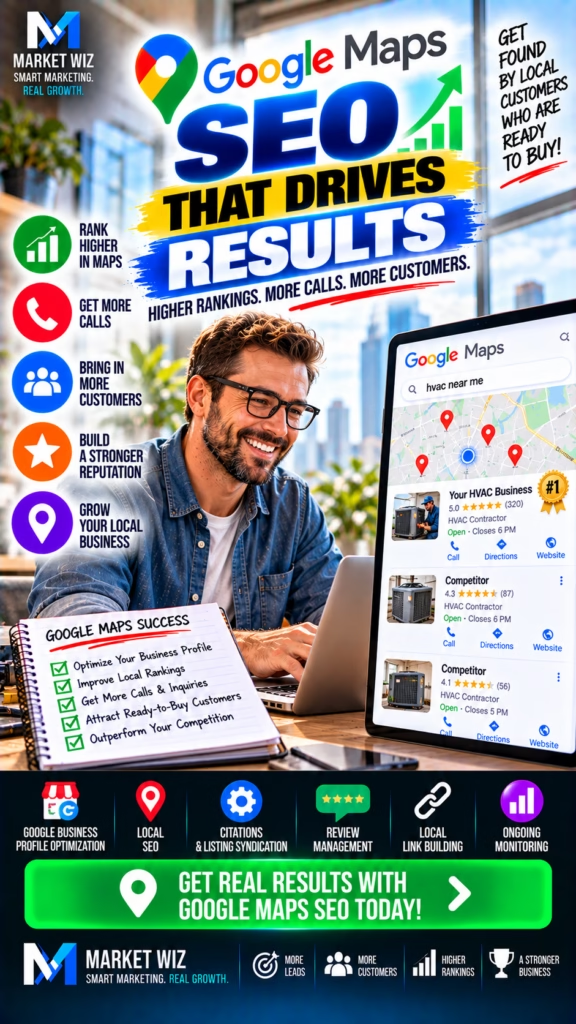
Google Maps SEO That Drives Results
Effective Google Maps SEO should do more than increase visibility. A results-focused local search strategy connects Google Business Profile optimization, website SEO, authentic reviews, local content, customer trust, rapid lead response, CRM tracking, AI automation, follow-up, and measurable sales performance to help businesses turn local searches into real customer opportunities.
What Does Google Maps SEO That Drives Results Actually Mean?
Google Maps SEO is often discussed as if the entire objective were achieving a particular map position. Rankings can matter because visibility creates opportunities for customers to discover a business, but ranking alone does not automatically create business growth.
A company can receive local visibility without converting that visibility into qualified customers. It can generate profile activity without answering incoming calls. It can attract website visitors without giving them a clear reason to contact the business.
Results-driven Google Maps SEO looks beyond visibility.
It examines the complete journey from local search to customer acquisition.
The real objective of Google Maps SEO is not simply to be seen. The stronger objective is to help relevant local customers discover the business, understand what it offers, trust the company enough to make contact, receive a professional response, and move toward a measurable business outcome.
Understand the Local Customer Journey
Local customers rarely experience marketing as separate channels. They experience a sequence of information.
Someone may first discover a company through Google Maps. That person may read reviews, inspect photos, visit the website, compare offerings, return to Google, look at competitors, visit social media, and eventually call.
Every part of this journey can influence whether the prospect moves forward.
Google Maps may be the beginning rather than the end
Businesses should therefore evaluate what happens after customers discover the profile.
Is the information accurate? Does the company look active? Does the website explain the business clearly? Are reviews authentic and recent? Can the customer quickly understand how to make contact?
Strong Google Maps SEO connects these pieces.
Build a Strong Google Business Profile Foundation
Google Business Profile can become one of the most visible digital representations of a local company.
Customers may encounter the profile before ever visiting the company's website.
That makes accuracy and professionalism important.
Start with accurate business information
The company should periodically review customer-facing information such as its business name, phone number, website, hours, categories, and other supported details.
Information should reflect the actual business rather than being altered simply to target additional keywords or locations.
Businesses should follow current Google Business Profile guidelines, eligibility requirements, and policies.
Choose Categories That Match the Real Business
Categories help communicate what a business actually does.
Selecting accurate categories can make the profile easier for both customers and search systems to understand.
Businesses should avoid adding unrelated categories simply because those categories appear attractive from a marketing perspective.
Relevance should guide optimization
A local SEO strategy becomes stronger when the Google Business Profile, website, customer reviews, photos, and marketing content all reflect the same legitimate business activities.
Optimize Around Real Local Search Intent
Customers search differently depending on what they need.
Some searches describe a business category. Others describe a product, project, problem, location, or desired outcome.
Understanding these differences helps businesses build more useful local marketing.
Business Category Searches
Customers may search directly for the type of company they want, such as a plumber, painter, furniture store, contractor, hotel, or other local business.
Problem-Based Searches
Customers may describe the problem they want solved rather than knowing the exact category or solution they need.
Product Searches
Retail and inventory-based businesses may be discovered when customers search for specific products, product categories, or nearby availability.
Location Searches
Customers may include a city, neighborhood, nearby landmark, or other geographic signal while looking for a relevant business.
Project Searches
Contractors and home improvement companies may attract customers researching a specific installation, renovation, repair, or project type.
Commercial Searches
Business buyers may search for local vendors, contractors, suppliers, properties, or professional providers that can support commercial needs.
Target Locations the Business Can Actually Serve
Geographic relevance is central to local marketing.
Businesses should focus their strategy on legitimate locations and service territories rather than creating misleading location signals.
Generating leads outside the company's practical operating territory can waste staff time and reduce conversion rates.
Match marketing geography to operational reality
The strongest target market is not necessarily the largest possible area.
It is the area where the business can provide a strong customer experience and convert demand profitably.
Connect Google Maps SEO to a High-Quality Website
Many customers who discover a business through Google Maps will visit its website before making contact.
The website should continue the trust and relevance established by the Google Business Profile.
Customers should quickly understand what the business offers, where it operates, why it may be relevant to their needs, and how to take the next step.
Make important information easy to find
Businesses should avoid forcing customers to navigate through vague marketing language to understand basic offerings.
Clear service, product, project, location, and contact information can create a stronger customer experience.
Create Dedicated Pages for Important Products and Services
Businesses with multiple important offerings may benefit from dedicated website pages that explain each one clearly.
A general homepage cannot always answer every question a prospective customer may have.
Dedicated pages allow the company to explain capabilities, customer needs, processes, project considerations, product information, and appropriate next steps in greater depth.
Build content around real customer demand
Website architecture should reflect the categories of business the company actually wants to generate.
This can create a stronger connection between search intent and the page customers reach.
Create Useful Local Landing Pages
Businesses serving multiple communities may benefit from location content when those pages provide genuine value.
Useful location pages can explain service coverage, available offerings, relevant local information, customer processes, projects, inventory, or other legitimate information associated with that market.
Avoid thin city-page duplication
Changing a city name across dozens or hundreds of nearly identical pages does not create a strong customer experience.
Local content should be useful enough that a customer in the target market gains something meaningful from visiting the page.
Build an Authentic Review Strategy
Customer reviews can strongly influence how prospective customers perceive a local business.
Reviews can provide information about communication, professionalism, products, projects, customer experience, responsiveness, and other aspects of the business.
Companies can create consistent processes for inviting eligible customers to provide honest feedback.
Build reputation naturally
Businesses should avoid fake reviews, deceptive review generation, review gating, or other prohibited manipulation.
A sustainable reputation strategy is built around real customer experiences and authentic feedback.
Use Review Responses to Strengthen Customer Trust
A review response is visible not only to the person who wrote the review but also to future customers researching the company.
Professional responses can show that the business pays attention to customer feedback.
Respond professionally to positive and critical feedback
Positive feedback can receive a concise expression of appreciation. Critical feedback should be addressed calmly, professionally, and without revealing private customer information.
The objective is to demonstrate responsible communication rather than win a public argument.
Use Authentic Photos to Strengthen Local Visibility and Trust
Customers often want to understand what a business looks like before making contact.
Real photos can help establish familiarity and provide useful context.
Depending on the business, appropriate media may include team members, storefronts, vehicles, equipment, products, installations, completed projects, commercial properties, offices, showrooms, and other legitimate business activity.
Create an organized visual content library
Approved photos can be organized by category and reused across Google Business Profile, website pages, social media, short-form video, advertisements, and sales materials.
Create Local Content That Answers Customer Questions
Strong SEO content should help customers make informed decisions.
Businesses can create articles, guides, FAQs, project pages, product information, comparison content, educational videos, and local landing pages around questions customers actually ask.
This creates useful website depth while supporting the company's broader search visibility.
Write for people first
Search optimization should not turn useful content into repetitive keyword blocks.
Keywords can guide topics, but the final content should provide real information that helps customers understand the business and their options.
Build a Local Keyword Strategy Around Customer Intent
Keyword research can help businesses understand how customers describe their needs.
The most useful keyword strategy typically includes multiple types of searches rather than relying on one broad phrase.
Useful keyword categories can include:
- Business category keywords
- Product keywords
- Service keywords
- Problem-based searches
- Project-based searches
- City and regional searches
- Commercial customer searches
- Residential customer searches
- High-intent purchase searches
- Educational and research searches
Turn Google Maps Visibility Into Qualified Leads
Visibility becomes valuable when relevant customers take action.
Depending on the business, this action may involve a phone call, website inquiry, appointment request, estimate request, store visit, product inquiry, booking, consultation, or other legitimate sales interaction.
Businesses should make the next step clear and easy to understand.
Do not separate SEO from conversion. If Google Maps generates customer interest but the business consistently misses calls, ignores inquiries, or provides a confusing next step, the marketing system is losing value after discovery has already occurred.
Improve Lead Response Speed
Customers searching locally can have strong buying intent.
They may contact multiple businesses during the same research session. This makes response speed an important part of the customer acquisition process.
Businesses should develop reliable workflows for handling calls, forms, messages, appointment requests, and other lead sources.
Build a clear ownership process
Every new lead should have an appropriate destination.
The business should know who receives it, who responds, what information is collected, how the opportunity is documented, and what happens if the customer does not immediately move forward.
Qualify Local Leads Before Moving Them Through the Sales Process
Not every inquiry is equally relevant.
Businesses can improve efficiency by collecting enough information to understand whether an opportunity matches their offerings, geography, availability, project requirements, inventory, or other important criteria.
Basic qualification may include:
- Customer name
- Phone number
- Email address when appropriate
- Customer location
- Product or service needed
- Project or purchase timeframe
- Relevant property or business information
- Appointment preference
- Other company-specific qualification information
Use AI Automation to Support Local Lead Response
Local businesses can receive customer inquiries while employees are already helping customers, working in the field, managing inventory, attending appointments, or handling other operational responsibilities.
AI automation can support repetitive parts of the lead management process.
AI workflows can support:
- Initial lead acknowledgment
- Basic information collection
- Lead notifications
- CRM record creation
- Lead routing
- Appointment workflows
- Follow-up reminders
- Internal task creation
- Customer re-engagement
- Lead status organization
Businesses should maintain appropriate human oversight for technical, financial, contractual, safety-sensitive, or other important customer decisions.
Track Google Maps Leads in a CRM
Businesses need visibility into what happens after a local lead is generated.
A CRM can create a structured record of customer acquisition activity.
Instead of relying on memory, scattered emails, paper notes, or disconnected spreadsheets, the company can track the lead through a defined process.
Useful CRM information can include:
- Lead date
- Customer name
- Phone number
- Email address
- Customer location
- Lead source
- Product or service interest
- Qualification status
- Appointment status
- Estimate or proposal status
- Follow-up status
- Sale status
- Revenue
- Lost opportunity reason when appropriate
Move Qualified Local Leads Toward the Right Next Step
Different businesses require different customer journeys.
A contractor may schedule an estimate. A retailer may encourage a customer to visit a showroom. A hotel may move the customer toward a reservation. A commercial real estate company may schedule a property tour. A professional business may schedule a consultation.
Google Maps SEO should ultimately support these real business actions.
Remove unnecessary conversion friction
Customers should understand what happens after they make contact.
Clear communication can improve the transition from online research to a real customer interaction.
Build Follow-Up Into the Local SEO Funnel
Not every qualified customer purchases during the first interaction.
Some customers are comparing companies. Others need approval from a spouse, manager, owner, purchasing department, or another decision-maker. Some projects simply have longer timelines.
Without structured follow-up, these opportunities can disappear.
Use lead stages to make follow-up relevant
New leads, scheduled appointments, completed estimates, pending proposals, past customers, and inactive opportunities should not necessarily receive the same communication.
CRM segmentation and automation can help businesses build more appropriate follow-up processes.
Build a Multi-Channel Local Customer Acquisition Strategy
Google Maps can become a powerful component of local marketing without needing to operate alone.
Businesses can combine local SEO with additional channels that fit their market, customer base, products, services, and sales process.
Google Maps
Capture customers researching local companies and nearby solutions.
Organic SEO
Build website visibility for product, service, problem, project, informational, and location-based searches.
Social Media
Maintain visibility and distribute useful content before customers begin actively searching.
Organic Advertising
Use relevant marketplace, classified, community, or listing channels where appropriate for the business.
AI Automation
Support rapid response, lead organization, scheduling, follow-up, and internal workflows.
CRM Follow-Up
Track customer opportunities beyond the first interaction and connect marketing to sales outcomes.
Measure Google Maps SEO Beyond Rankings
Rankings provide one perspective on local visibility, but businesses should avoid using rankings as the only measurement of success.
The stronger measurement framework follows the customer journey from discovery to revenue.
| Stage | Metric | Business Question |
|---|---|---|
| Visibility | Local search presence | Are relevant customers discovering the company? |
| Engagement | Profile and website activity | Are customers taking meaningful actions after discovery? |
| Contact | Calls and inquiries | Is visibility creating customer conversations? |
| Qualification | Qualified leads | Are the inquiries relevant to the business? |
| Conversion | Appointments, estimates, visits or opportunities | Are leads moving toward a purchase decision? |
| Sales | Customers and transactions | How many opportunities become paying customers? |
| Revenue | Attributed business value | What measurable revenue is connected to local marketing? |
Measure Lead Quality Instead of Chasing Raw Volume
More leads are not always better leads.
A campaign producing a large number of irrelevant inquiries may create more administrative work than business value.
A smaller number of well-matched prospects may produce more appointments, sales, revenue, and profit.
Evaluate what happens after the lead arrives
Businesses should monitor qualification rates, appointment rates, estimate rates, sales conversion, average transaction value, customer acquisition costs, and attributed revenue whenever practical.
Connect Local SEO to Revenue
One of the most important improvements a business can make is connecting marketing activity to financial outcomes.
This does not require perfect attribution for every customer journey. Local buying behavior can involve multiple interactions.
However, businesses can still build better measurement using CRM source tracking, analytics, appropriate call tracking, customer feedback, appointment records, and sales data.
Move from marketing reports to business reports
A useful report should help decision-makers understand whether local marketing is contributing to customer acquisition.
The conversation should eventually progress beyond visibility toward leads, opportunities, customers, and revenue.
Optimize Google Maps SEO Using Real Performance Data
Once local leads and revenue are tracked, businesses can make more informed decisions.
One location may produce stronger leads. Another product category may create higher-value customers. A particular website page may generate consistent inquiries. Another page may attract traffic but create little commercial value.
These differences can guide future optimization.
Use data to decide what deserves more attention
Businesses can strengthen high-performing content, improve weak conversion points, refine target markets, create new customer-focused pages, and improve lead workflows based on actual results.
Scale Google Maps SEO Across Multiple Markets
Businesses operating across multiple legitimate markets need a repeatable local SEO process.
Each market may have different customer behavior, competition, geography, products, demand, seasonality, and operational capacity.
A scalable strategy should preserve consistent brand standards while allowing local content and marketing to reflect real differences.
Standardize the process, not fake the location
Multi-market businesses can standardize website optimization, review workflows, content production, reporting, CRM tracking, lead response, and internal processes while maintaining accurate location information.
Common Google Maps SEO Mistakes That Reduce Results
Local SEO can underperform when businesses focus on shortcuts rather than customer experience and measurable outcomes.
Common mistakes include:
- Inaccurate business information
- Misleading or fake locations
- Duplicate or ineligible profiles
- Irrelevant business categories
- Weak or outdated websites
- Thin service or product content
- Mass-produced low-value location pages
- Fake or manipulated reviews
- Ignoring customer feedback
- Using generic stock content instead of authentic media
- Slow lead response
- Missing customer calls
- Failing to track lead sources
- Failing to follow up with qualified prospects
- Measuring rankings without measuring customers or revenue
Build a Google Maps SEO System That Drives Business Results
Sustainable local growth requires more than isolated optimization tactics.
Businesses can create a repeatable system that connects visibility, trust, customer contact, sales processes, and measurement.
Define the Business Outcome
Identify the products, services, projects, appointments, bookings, visits, or commercial opportunities the business wants local marketing to generate.
Define the Real Target Market
Focus on legitimate locations where the business can provide a strong customer experience and convert demand effectively.
Strengthen Google Business Profile
Maintain accurate information, appropriate categories, authentic media, current customer-facing details, and compliance with applicable platform policies.
Strengthen the Website
Create useful pages around important products, services, projects, customer questions, and legitimate locations.
Build an Authentic Reputation
Create a consistent process for earning genuine customer feedback and responding professionally.
Improve Lead Response
Make sure incoming calls, forms, messages, and other customer inquiries reach the correct person or workflow quickly.
Qualify and Convert
Collect appropriate customer information and move qualified opportunities toward appointments, estimates, purchases, visits, or another meaningful next step.
Track Leads in a CRM
Connect marketing sources with customer status, appointments, estimates, follow-up, sales, and revenue.
Optimize Using Business Data
Use customer acquisition and revenue information to continuously improve local marketing priorities.
Turn Google Maps SEO Into a Long-Term Growth Asset
Local SEO should evolve as the business evolves.
Companies introduce new products. Service areas change. Teams expand. Customer questions evolve. New competitors enter markets. Reviews accumulate. Websites become outdated. Search behavior changes.
The company's local presence should continue improving alongside these changes.
Businesses can regularly review profile accuracy, publish useful content, organize new photos, monitor customer feedback, improve website pages, strengthen lead response, refine CRM workflows, and measure business outcomes.
Google Maps SEO becomes significantly more valuable when it operates as part of a complete customer acquisition system. Visibility creates discovery. Trust creates contact. Fast response creates conversations. Qualification creates opportunities. Follow-up creates additional chances to convert. Tracking connects those outcomes back to marketing.
30 FAQs About Google Maps SEO That Drives Results
1. What is Google Maps SEO?
Google Maps SEO is the process of strengthening a business's local search presence through an accurate Google Business Profile, relevant business information, authentic reviews, useful photos, strong website content, local SEO, and other legitimate optimization activities.
2. How can Google Maps SEO drive business results?
Google Maps SEO can support business results by helping relevant local customers discover a company, evaluate its reputation, visit its website, call, request information, schedule appointments, and move through the sales process.
3. Why is Google Maps important for local businesses?
Google Maps can be important for local businesses because many customers search for nearby companies when they have an immediate or location-specific buying need.
4. What is Google Business Profile optimization?
Google Business Profile optimization involves maintaining accurate business information, selecting relevant categories, adding appropriate photos and supported details, managing reviews, and keeping the profile aligned with current Google guidelines.
5. Can Google Maps SEO generate more phone calls?
Improved local visibility can contribute to more customer calls when the business appears relevant to local searches and provides clear, accurate contact information.
6. Do Google reviews matter for local SEO?
Authentic customer reviews can help prospective customers evaluate a business and are an important part of a company's overall local online reputation.
7. Should businesses respond to Google reviews?
Professional review responses can demonstrate active customer communication and show prospective customers how the business engages with feedback.
8. Does a website help Google Maps SEO?
A useful and technically sound website with accurate business information, relevant service or product content, and strong local information can support the company's broader local search presence.
9. Should local businesses create service pages?
Dedicated pages for important legitimate offerings can help customers understand what the business provides and create stronger website organization around relevant customer needs.
10. Should businesses create location pages?
Useful location pages can support customers in real markets the company serves when the content is accurate, helpful, and not simply duplicated across many city names.
11. What business information should be consistent online?
Important business information such as the company name, contact information, website, hours, and other relevant details should accurately represent the business wherever customers encounter it.
12. Can photos improve a Google Business Profile?
Authentic photos can help customers understand the company, its work, products, team, location, equipment, and professionalism when the images accurately represent the business.
13. How important are local keywords?
Local keyword research can help businesses understand how customers describe products, services, problems, and locations when searching online.
14. Can Google Maps SEO help service businesses?
Service businesses can benefit from local visibility when customers search for companies that can provide work within a particular geographic area.
15. Can Google Maps SEO help retail businesses?
Retail businesses can use local search visibility to help nearby customers discover stores, products, business information, hours, reviews, and directions.
16. How quickly should businesses respond to Google leads?
Businesses should generally respond as promptly as practical because motivated customers may contact multiple companies during the buying process.
17. Can AI help manage local leads?
AI can support lead response, basic information collection, routing, CRM updates, scheduling workflows, reminders, follow-up, and other repetitive customer acquisition tasks.
18. Should Google Maps leads be tracked in a CRM?
CRM tracking can help businesses connect local marketing activity with qualified leads, appointments, estimates, sales opportunities, completed transactions, and revenue.
19. What metrics should businesses track for Google Maps SEO?
Useful metrics can include profile activity, website inquiries, calls, qualified leads, appointments, estimates, conversion rates, customer acquisition costs, sales, and attributed revenue.
20. Is ranking number one the only goal of Google Maps SEO?
No. Visibility can be useful, but businesses should also evaluate whether local search activity creates qualified customer conversations and measurable business outcomes.
21. Can social media support local SEO?
Social media can complement local search marketing by increasing brand visibility and distributing useful company, product, project, educational, and customer-facing content.
22. Can short-form video support local business marketing?
Short-form video can help businesses demonstrate expertise, showcase products or projects, answer common questions, and maintain visibility across multiple digital channels.
23. How can businesses improve lead quality from local search?
Businesses can improve lead quality by clearly describing what they offer, targeting legitimate service areas, creating relevant website content, and making customer qualification part of the lead response process.
24. Should businesses track revenue from Google Maps leads?
Tracking revenue where practical helps businesses evaluate local SEO using business outcomes rather than relying only on visibility or traffic metrics.
25. What are common Google Maps SEO mistakes?
Common mistakes include inaccurate business information, misleading locations, duplicate or ineligible profiles, weak websites, poor review management, thin content, slow lead response, and weak conversion tracking.
26. Can Google Maps SEO work in multiple markets?
Businesses operating in multiple legitimate markets can build localized strategies around their real locations, service territories, website content, customer needs, and eligible business profiles.
27. How does lead response affect local SEO results?
Lead response affects the business value of local SEO because visibility cannot produce revenue if incoming calls and inquiries are consistently missed or poorly handled.
28. How does follow-up improve local lead generation?
Follow-up helps businesses continue conversations with qualified prospects who may not purchase, schedule, or commit during the first interaction.
29. Can Google Maps SEO become part of a larger marketing system?
Google Maps SEO can work alongside website SEO, social media, content marketing, paid advertising, organic advertising channels, CRM automation, AI lead response, referrals, and other customer acquisition activities.
30. What is the goal of Google Maps SEO that drives results?
The goal is to turn relevant local search visibility into qualified customer conversations, calls, appointments, estimates, sales, repeat business, and measurable revenue.
30 Additional SEO Keywords
These keyword themes can support local business website content, Google Business Profile strategy, location pages, blog content, customer acquisition campaigns, and broader Google Maps marketing.
Build Google Maps SEO Around Real Business Results
Google Maps SEO becomes more valuable when businesses stop treating visibility as the final objective.
Visibility is the beginning of the customer acquisition process.
A local customer may search Google because they have an immediate problem, a future project, a product need, a purchasing decision, a commercial requirement, or another reason to find a nearby business.
Google Maps can introduce that customer to companies capable of helping.
What happens after discovery determines whether that visibility becomes useful to the business.
The customer may inspect the Google Business Profile.
They may look at the business name, category, hours, phone number, photos, customer reviews, website, and other available information.
Every one of those elements contributes to the customer's perception of the company.
Accuracy should therefore be the foundation of Google Maps optimization.
The profile should represent the actual business.
Categories should describe real business activities. Contact information should be current. Locations should be legitimate. Customer-facing information should remain accurate.
Authentic photos can strengthen that profile.
A contractor can showcase completed projects. A furniture company can show products and showroom environments. A hotel can display rooms and amenities. A commercial real estate company can show available properties. A local retailer can show inventory and the physical location.
Real images give customers additional information before they make contact.
Reviews provide another layer of customer research.
Prospective customers often want to understand what previous customers experienced.
Businesses can build a consistent process for requesting honest feedback from eligible customers while following applicable platform rules.
Review responses can also demonstrate professionalism.
Positive feedback can receive appreciation. Critical feedback can be handled calmly and appropriately without exposing private customer information.
The company's website should reinforce the same customer experience.
A customer who clicks from Google Maps should not arrive at a confusing website that provides little useful information.
The website should make important products, services, projects, locations, contact information, and customer next steps easy to understand.
Dedicated pages can help organize important offerings.
Instead of forcing every potential customer through one generic page, businesses can build useful destinations around major customer needs.
This creates stronger relevance for search engines and, more importantly, a more useful experience for people.
Local landing pages can provide additional geographic relevance when they are created for legitimate markets and contain useful information.
Businesses should avoid creating misleading location claims or hundreds of low-value pages that simply replace one city name with another.
Real local SEO is connected to real business operations.
The company should target places where it can actually provide its products or services effectively.
Customer intent should guide content development.
People search using category names, product names, project terms, problems, locations, questions, and commercial buying language.
Understanding these patterns can help businesses create a deeper website and more useful local marketing strategy.
Educational content can support customers who are still researching.
Product and service pages can support customers with stronger buying intent.
FAQs can answer common questions.
Project pages can demonstrate capabilities.
Location content can explain geographic coverage.
Videos can make complex topics easier to understand.
Together, these assets strengthen the business's digital footprint.
But even excellent visibility and content can fail to produce strong results if lead response is weak.
Local customers can be highly motivated.
A homeowner with an urgent repair may call multiple contractors. A business searching for commercial space may contact several property representatives. A shopper looking for furniture may compare several stores. A company searching for a vendor may contact multiple providers.
Businesses need a reliable process for handling these inquiries.
Calls should reach the appropriate person or workflow.
Website inquiries should not disappear into an unmonitored inbox.
Customer information should be documented.
Qualified opportunities should move toward the appropriate next step.
AI automation can support this process.
It can help acknowledge inquiries, organize information, update CRM records, route leads, trigger notifications, support scheduling, create follow-up tasks, and help maintain consistent communication.
Automation becomes especially useful when businesses receive inquiries outside normal office workflows or when employees are already occupied with customers and operational responsibilities.
Human oversight remains important.
Technical decisions, contractual commitments, complex pricing, regulated activities, safety issues, and other important matters should remain under appropriate qualified control.
CRM tracking connects marketing to sales.
When every lead has a source and status, businesses can begin understanding which marketing activities create real opportunities.
A lead can move from new inquiry to qualified prospect, appointment, estimate, proposal, purchase, completed job, or another meaningful business outcome.
Revenue can be associated with the customer journey whenever practical.
This creates a more useful definition of SEO performance.
Rankings can still be monitored.
Profile activity can still be monitored.
Website traffic can still be monitored.
But these metrics become more meaningful when businesses understand what happens afterward.
How many calls were generated?
How many inquiries were qualified?
How many appointments were scheduled?
How many estimates or sales opportunities were created?
How many customers purchased?
How much revenue resulted?
These questions connect local SEO with actual business growth.
Lead quality should also influence optimization.
Not every customer opportunity has the same value.
Businesses can analyze which products, services, markets, projects, and customer types create stronger economic outcomes.
This information can guide future content and marketing investments.
If one service category consistently creates profitable customers, the business may develop additional useful content around that category.
If one geographic market produces weak conversion, the company can investigate whether the problem involves targeting, competition, pricing, lead response, operational coverage, or another factor.
If a website page generates strong traffic but few inquiries, the business can evaluate whether the page matches customer intent and provides a clear next step.
This creates a continuous optimization cycle.
Google Maps SEO can also work alongside other customer acquisition channels.
Social media can keep the company visible before customers actively search.
Short-form video can demonstrate products, projects, expertise, and company activity.
Organic website SEO can capture additional searches beyond the map results.
Appropriate classified, marketplace, listing, or community channels can create additional discovery opportunities for certain business models.
Paid advertising can supplement organic visibility when it fits the company's strategy.
Referral programs can generate additional customers from existing relationships.
B2B outreach can create commercial opportunities.
CRM automation can help ensure leads from every channel receive consistent follow-up.
These channels become stronger when they connect to the same underlying customer acquisition infrastructure.
A customer may first see a business on social media.
Later, that customer may search Google.
They may recognize the business name, read reviews, visit the website, and make a phone call.
The call may enter a CRM, become an appointment, create an estimate, and eventually become a paying customer.
The customer's path may involve several channels, but the business experiences one customer journey.
Results-driven marketing should be built around that reality.
Long-term Google Maps SEO also requires maintenance.
Business information changes. Hours change. Teams change. Products and services evolve. Websites need updates. New reviews arrive. New photos become available. Customer questions change. New competitors enter the market.
The company's local presence should remain current.
Businesses can periodically review Google Business Profile information, website content, review activity, customer media, local pages, lead response, CRM tracking, and sales attribution.
This creates a local SEO system that improves alongside the business.
The strongest definition of Google Maps SEO that drives results is therefore much larger than a map ranking.
It is the connection between visibility and business outcomes.
Local customers discover the company.
Accurate information helps them understand it.
Authentic reviews and media help build confidence.
Useful website content answers questions.
Clear contact options make action easier.
Fast response creates conversations.
Qualification identifies relevant opportunities.
Scheduling and sales processes move customers forward.
Follow-up keeps opportunities alive.
CRM tracking connects those activities to sales.
Reporting identifies what is producing measurable value.
That is how Google Maps SEO can move beyond visibility and become a scalable component of a larger customer acquisition system.
Turn Local Search Visibility Into Measurable Business Growth
Market Wiz AI helps established businesses connect Google Maps optimization, local SEO, website visibility, social marketing, AI automation, rapid lead response, CRM workflows, customer follow-up, multi-channel marketing, and performance tracking into a more scalable customer acquisition system.
Get Started With Market Wiz AI© Market Wiz AI. Google, Google Maps, and Google Business Profile are trademarks of Google LLC. Market Wiz AI is not affiliated with or endorsed by Google unless expressly stated. Google Business Profile guidelines, eligibility requirements, ranking systems, features, and availability may change over time.














Combine Google Maps SEO With Social Media Marketing
Local search captures customers who are actively looking for information. Social media can build familiarity before that search occurs.
Businesses can use Facebook, Instagram, TikTok, YouTube Shorts, and other appropriate platforms to distribute useful content and showcase company activity.
Local social content can include: