
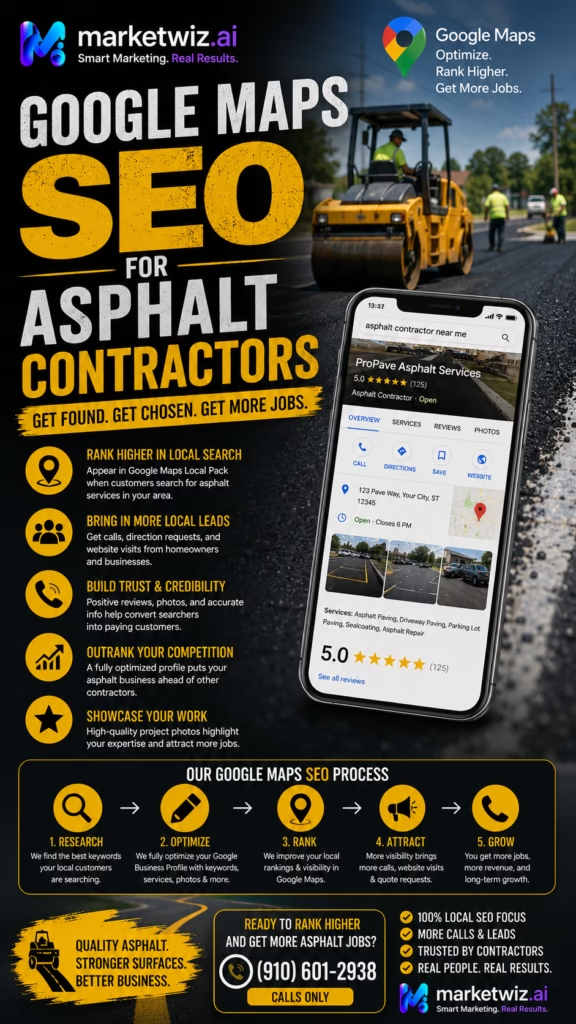
Google Maps SEO for Asphalt Contractors
Asphalt paving companies compete in highly local markets where homeowners, businesses, property managers, builders, and commercial property owners often search Google before requesting estimates. A strong Google Maps SEO strategy can help asphalt contractors increase local visibility, showcase completed paving projects, build customer trust, generate more calls, and turn search demand into qualified paving opportunities.
Asphalt contracting is a location-driven business. A homeowner searching for a new driveway, a property manager needing parking lot resurfacing, or a commercial owner planning a large paving project usually needs a contractor who can inspect the site, evaluate drainage and surface conditions, mobilize equipment, prepare an estimate, and complete the work within a practical geographic area.
That makes Google Maps one of the most strategically aligned customer acquisition channels for asphalt contractors.
When a customer searches phrases such as "asphalt contractor near me," "driveway paving company," "parking lot paving contractor," or "asphalt repair near me," Google may display local map-based results prominently in the search experience.
Those local results can become a critical first point of contact.
A strong profile can generate:
- phone calls,
- website visits,
- estimate requests,
- commercial inquiries,
- residential driveway opportunities,
- property management leads,
- repeat maintenance relationships.
However, Google Maps SEO is not simply a matter of setting up a Google Business Profile and adding the words "asphalt paving."
Effective local search marketing is supported by a broader system that includes accurate business data, strong service positioning, authentic project proof, genuine customer reviews, useful website content, local relevance, citations, lead tracking, and professional sales follow-up.
1. What Is Google Maps SEO for Asphalt Contractors?
Google Maps SEO is the process of strengthening the online signals and customer experience connected to an asphalt contractor's local Google presence.
The company's Google Business Profile is a central component, but it is only one part of the strategy.
Local visibility can also be supported by:
- website relevance,
- service pages,
- location content,
- reviews,
- project photos,
- accurate business information,
- citations,
- local authority,
- customer engagement,
- business prominence.
For asphalt contractors, the strategy should make several facts clear.
Potential customers should quickly understand:
- what types of paving services the company provides,
- whether it handles residential or commercial projects,
- which areas it serves,
- what completed projects look like,
- how customers can request an estimate,
- why the company may be a credible fit for the project.
Google Maps SEO should therefore be approached as part of a complete local marketing system rather than an isolated ranking tactic.
2. Why Google Maps Matters for Asphalt Paving Companies
Asphalt projects are inherently geographic.
Equipment, crews, materials, transportation, project logistics, and estimating all depend on location.
A customer searching for paving services is usually looking for a company that already operates within the region.
Google Maps can help connect that customer with nearby contractors.
Local Buying Intent
Paving customers generally need a company that can physically reach the property and complete the project locally.
High-Value Projects
Driveways, parking lots, commercial paving, resurfacing, and larger asphalt projects can represent meaningful contract values.
Visual Project Proof
Finished asphalt surfaces, parking lots, driveways, striping, repairs, and resurfacing can be demonstrated visually.
Estimate-Based Sales
Google Maps can become the first step in a sales process that moves from search to inquiry, site inspection, estimate, proposal, and booked job.
A contractor that becomes highly visible for relevant local searches can build a durable source of inbound opportunities.
3. Understand Asphalt Customer Search Intent
Customers search for asphalt contractors in different ways depending on their project.
Some use broad business-type searches:
- asphalt contractor near me,
- paving company near me,
- asphalt paving company,
- local paving contractor.
Others use service-specific searches:
- driveway paving,
- parking lot paving,
- asphalt resurfacing,
- asphalt repair,
- pothole repair,
- commercial paving.
Some customers search around a problem:
- cracked asphalt driveway,
- parking lot needs resurfacing,
- pothole repair company,
- replace old driveway,
- commercial lot paving contractor.
A strong local SEO strategy recognizes these different intents and builds relevant content around the services the contractor actually performs.
4. Build a Complete Google Business Profile
The Google Business Profile can become one of the asphalt company's most important digital assets.
The profile should be complete, accurate, and regularly maintained.
Important elements may include:
- business name,
- primary category,
- relevant secondary categories,
- phone number,
- website,
- business hours,
- service areas,
- services,
- business description,
- project photos,
- customer reviews.
Each element should represent the real business.
The profile should answer basic customer questions before the customer ever reaches the website.
5. Keep the Asphalt Company Name Accurate
The business name should reflect the real-world name of the company.
A contractor should not artificially load the profile name with extra search phrases merely to chase rankings.
For example, a legitimate business called:
Evergreen Paving LLC
should not turn its Google profile into:
Evergreen Paving LLC Asphalt Contractor Driveway Paving Parking Lot Paving Near Me
That is not a professional local SEO strategy.
Instead, the company should keep the legitimate business identity accurate and build relevance through:
- services,
- website content,
- project pages,
- reviews,
- local content,
- citations,
- project photos.
6. Choose the Right Google Business Profile Categories
Categories help Google and customers understand what kind of business the profile represents.
The primary category should closely match the contractor's main business activity.
Secondary categories can be used where they accurately represent additional legitimate services.
The objective is not to add every category that could potentially produce traffic.
The objective is to accurately describe the business.
An asphalt paving company should be positioned around its real commercial activity rather than unrelated contractor categories.
Keep Categories Relevant
The correct category strategy for an asphalt contractor may differ from:
- a concrete contractor,
- a general contractor,
- a landscaping company,
- a road construction company,
- a material supplier.
Use current available categories and select only those that genuinely apply.
7. Add Detailed Asphalt Services
The services section can help clarify the company's actual capabilities.
Depending on the business, legitimate services may include:
- asphalt paving,
- residential driveway paving,
- commercial parking lot paving,
- asphalt resurfacing,
- asphalt overlays,
- asphalt repair,
- pothole repair,
- parking lot repair,
- commercial paving,
- private road paving,
- asphalt replacement,
- sealcoating where offered,
- parking lot maintenance where offered.
Do not list services simply because they generate searches.
The business should only advertise work it can actually perform.
Service accuracy is important for both trust and lead quality.
8. Write a Strong Asphalt Contractor Business Description
The business description should communicate what the company does in natural language.
Useful information may include:
- residential or commercial specialization,
- types of paving projects,
- general service area,
- years of experience when accurate,
- property types served,
- general project capabilities.
Avoid transforming the description into a repetitive keyword block.
Customers should be able to read the description and understand the company quickly.
Clear communication is more useful than awkward search-engine language.
9. Use High-Quality Asphalt Project Photos
Asphalt paving is highly visual.
Project photos can help prospective customers evaluate the scale and quality of the work before making contact.
Useful photos may include:
- new asphalt driveways,
- large parking lots,
- commercial paving projects,
- private roads,
- resurfaced asphalt,
- before-and-after repairs,
- paving crews,
- rollers and paving equipment,
- finished surface details,
- completed commercial properties.
Photos should be authentic.
Do not use another paving company's projects and represent them as your own.
Real project proof is one of the strongest ways to differentiate a contractor.
10. Use Before-and-After Asphalt Content
Before-and-after imagery can be especially effective for paving because the transformation is immediately visible.
Examples include:
- a deteriorated driveway replaced with new asphalt,
- a cracked parking lot resurfaced,
- potholes repaired,
- a gravel drive upgraded to asphalt,
- an aging commercial lot restored,
- damaged asphalt replaced around a property.
These transformations can communicate value faster than a paragraph of sales copy.
They can also be reused across:
- Google Business Profile,
- service pages,
- project galleries,
- Facebook,
- Instagram,
- TikTok,
- YouTube Shorts.
11. Build a Genuine Google Review Strategy
Reviews can influence a customer's perception before the first conversation.
A paving contractor should create a consistent process for asking satisfied customers to share genuine feedback.
Reviews may naturally mention:
- communication,
- estimate experience,
- project scheduling,
- crew professionalism,
- finished driveway quality,
- parking lot results,
- cleanup,
- overall satisfaction.
The contractor should not fabricate reviews or manufacture false customer experiences.
A smaller number of authentic reviews is more credible than a reputation system built on fake feedback.
12. Respond Professionally to Customer Reviews
Review responses show prospective customers how the company communicates publicly.
A strong response can:
- thank the customer,
- reference the project naturally,
- reinforce professionalism,
- remain concise and genuine.
Negative reviews should be handled carefully.
Avoid emotional public arguments.
Respond professionally, address important points when appropriate, and move complicated service discussions into the appropriate customer-service process.
Future prospects may judge the company as much by the response as by the review itself.
13. Build an Asphalt Contractor Website That Supports Local SEO
The website should reinforce the same business identity that appears on Google Maps.
A strong asphalt contractor website can include:
- clear service descriptions,
- residential paving pages,
- commercial paving pages,
- project galleries,
- location pages,
- customer reviews,
- frequently asked questions,
- company information,
- estimate or contact options.
The site should be easy to navigate on mobile devices.
A customer may discover the company on Google Maps and immediately visit the website to evaluate project photos, services, reviews, and company credibility.
If the website feels outdated or difficult to use, that traffic may not convert.
14. Create Dedicated Asphalt Service Pages
A general services page often cannot fully address different customer needs.
Dedicated pages can create stronger relevance and better customer experiences.
Potential Asphalt Service Pages
- Asphalt Paving
- Residential Driveway Paving
- Commercial Parking Lot Paving
- Asphalt Resurfacing
- Asphalt Repair
- Pothole Repair
- Asphalt Overlays
- Commercial Asphalt Maintenance
- Sealcoating where offered
- Private Road Paving
Each page should provide real value.
A useful driveway paving page might discuss:
- property preparation,
- existing surface conditions,
- project planning,
- drainage considerations,
- project examples,
- estimate process.
A commercial paving page might focus on:
- parking lots,
- commercial traffic,
- scheduling,
- property access,
- phased work,
- larger equipment and crew capability.
15. Create Useful Local Service-Area Pages
Asphalt contractors often serve multiple cities, counties, or surrounding communities.
Location pages can support this strategy when the company genuinely serves those markets.
A quality location page may include:
- services available in the area,
- local project examples,
- common property types,
- residential paving information,
- commercial paving information,
- customer questions,
- nearby service coverage,
- estimate information.
Avoid creating dozens or hundreds of nearly identical pages where only the city name changes.
Those pages provide little value to customers.
Each location page should have a legitimate reason to exist.
16. Target Asphalt Keywords Based on Real Customer Intent
Keyword research can reveal how property owners search for paving companies.
Business-Type Keywords
- asphalt contractor,
- paving contractor,
- asphalt company,
- paving company.
Residential Keywords
- driveway paving,
- asphalt driveway contractor,
- new asphalt driveway,
- driveway replacement.
Commercial Keywords
- commercial asphalt paving,
- parking lot paving,
- parking lot resurfacing,
- commercial paving contractor.
Repair Keywords
- asphalt repair,
- pothole repair,
- asphalt resurfacing,
- parking lot repair.
Local modifiers can then be incorporated naturally when creating legitimate service-area content.
17. Build Accurate Local Citations
Citations are references to the business across third-party platforms.
Depending on the company and market, relevant citation sources may include:
- major business directories,
- mapping platforms,
- local chambers of commerce,
- construction directories,
- contractor directories,
- industry associations,
- regional business organizations.
The objective is not simply to create the largest possible number of directory listings.
Quality and accuracy matter.
A smaller portfolio of trustworthy, accurate citations can be more useful than hundreds of low-quality profiles.
18. Keep Asphalt Business Information Consistent
Businesses change over time.
An asphalt company may:
- move offices,
- change phone numbers,
- launch a new website,
- change operating hours,
- rebrand,
- expand into new service areas.
Old information can remain online.
This can create problems when customers find:
- wrong phone numbers,
- outdated addresses,
- old domains,
- duplicate business listings.
Periodic citation auditing helps keep important business information accurate.
19. Create Asphalt Content That Solves Customer Questions
Content marketing can support both organic SEO and customer conversion.
Asphalt contractors can publish educational content around real buying questions.
Examples include:
- when to replace an asphalt driveway,
- resurfacing vs replacement,
- how asphalt paving projects are planned,
- parking lot maintenance considerations,
- what causes potholes,
- how drainage affects pavement,
- commercial paving project planning,
- asphalt vs other driveway surfaces,
- how to prepare for a paving estimate,
- questions to ask a paving contractor.
Useful content helps customers understand the project before contacting the company.
Better educated prospects can become better qualified leads.
20. Use Google Business Profile Posts
Google Business Profile posts can help keep the local presence active and useful.
Asphalt contractors can publish updates about:
- recent driveway projects,
- commercial parking lots,
- resurfacing work,
- before-and-after projects,
- seasonal paving topics,
- repair projects,
- company updates,
- project education.
Posts should provide customer value.
Avoid turning every post into a repetitive string of city names and keywords.
A strong project post can explain what type of paving work was completed and why the project mattered.
21. Optimize Service-Area Asphalt Companies Correctly
Many asphalt contractors travel to customer properties and do not operate as traditional walk-in businesses.
These companies should follow Google's current requirements for service-area businesses and address visibility.
A contractor should not create fake office locations simply to appear in more markets.
Instead, a strong service-area strategy can focus on:
- one or more legitimate eligible profiles,
- accurate service areas,
- strong service pages,
- useful local content,
- customer reviews,
- authentic local project photos,
- citations,
- local authority.
Legitimate local marketing builds a more durable business presence.
22. Build Multi-Location Asphalt SEO Carefully
Larger asphalt companies may operate legitimate branches across several markets.
When each location is genuinely eligible, a multi-location strategy can include:
- accurate local profiles,
- unique location landing pages,
- market-specific project photos,
- local customer reviews,
- local citations,
- service-area tracking,
- market-specific lead reporting.
The purpose is to represent actual operations accurately.
Do not create fictional branch offices or misleading satellite locations.
23. Optimize Google Maps Traffic for Conversion
A strong ranking does not automatically create revenue.
Customers may compare multiple paving companies before requesting estimates.
The profile and website should provide enough trust to move the customer toward contact.
Important conversion elements include:
- authentic reviews,
- recent project photos,
- clear service descriptions,
- accurate contact information,
- a professional website,
- project galleries,
- easy estimate requests,
- fast response.
The marketing system should answer:
"Why should this property owner request an estimate from this asphalt company?"
24. Respond Quickly to Asphalt Leads
Paving prospects frequently request multiple estimates.
That makes response speed important.
A professional initial conversation can identify:
- project address,
- residential or commercial property,
- type of paving needed,
- approximate size,
- existing surface,
- repair or replacement needs,
- timeline,
- estimate requirements.
The goal is not to force the customer through an overly complicated questionnaire.
The goal is to determine whether the project is a good fit and schedule the next step.
For many paving jobs, that next step is an on-site evaluation.
25. Track Asphalt Leads in a CRM
A contractor should know where profitable projects originate.
A CRM can centralize lead data such as:
- customer name,
- phone number,
- email,
- lead source,
- service requested,
- project location,
- residential or commercial,
- estimated project size,
- appointment date,
- proposal value,
- sales stage,
- closed project value.
This allows the business to connect Google Maps visibility to actual financial outcomes.
Without that connection, marketing decisions are often based on assumptions.
26. Track More Than Google Maps Rankings
Local ranking reports can help measure visibility.
But rankings should not be the only performance indicator.
A contractor should monitor the entire funnel.
| Metric | What It Measures | Why It Matters |
|---|---|---|
| Local Visibility | Presence across target search areas | Shows whether the company is being discovered |
| Calls | Phone inquiries | Measures active customer interest |
| Website Leads | Forms and digital inquiries | Measures website conversion |
| Qualified Leads | Projects matching services and geography | Measures useful lead quality |
| Site Estimates | Projects reaching evaluation stage | Measures sales pipeline progression |
| Proposals | Active sales opportunities | Shows quoting activity |
| Closed Jobs | Projects won | Measures customer acquisition |
| Revenue | Sales generated | Connects marketing to business growth |
A contractor can rank well and still have weak marketing if leads are not converting.
The complete funnel matters.
27. Analyze Local Asphalt Competitors
Competitive analysis helps the company understand what customers see when comparing local paving businesses.
Review competitors for:
- Google Business Profile completeness,
- business categories,
- reviews,
- project photos,
- website quality,
- service pages,
- local content,
- commercial vs residential positioning,
- customer messaging.
The objective is not to copy competitors.
Instead, look for opportunities to create a stronger experience.
Potential Competitive Gaps
- Few competitors show commercial project galleries.
- Competitors have poor mobile websites.
- Competitors have outdated project photos.
- Commercial paving services are poorly explained.
- Competitors have weak review response systems.
- Location pages are thin or generic.
- Lead response appears slow.
Those gaps can become strategic opportunities.
28. Use AI to Support Asphalt Contractor Local SEO
AI can help asphalt companies manage repetitive marketing and lead-management workflows.
Potential applications include:
- keyword organization,
- content outlining,
- project post drafting,
- review response drafting,
- lead classification,
- conversation summaries,
- follow-up reminders,
- CRM workflows,
- local ranking reports,
- marketing performance analysis.
AI should be used with verified company data.
It should not invent:
- licenses,
- insurance claims,
- project locations,
- reviews,
- project pricing,
- warranties,
- service capabilities,
- availability.
29. Google Maps SEO Mistakes Asphalt Contractors Should Avoid
Keyword Stuffing the Business Name
Use the legitimate company name instead of loading the profile with search phrases.
Using Inaccurate Categories
Select categories that accurately represent real paving services.
Creating Fake Locations
Use legitimate eligible business locations and follow current Google guidelines.
Buying or Fabricating Reviews
Build reputation with authentic feedback from actual customers.
Ignoring Project Photos
Paving is highly visual. Real project imagery provides important proof.
Using Thin Service Pages
Each major paving service deserves useful information rather than repeated generic text.
Creating Thin Location Pages
Do not create hundreds of city pages where only the city name changes.
Ignoring Citation Accuracy
Wrong business information creates unnecessary customer confusion.
Ignoring Mobile Conversion
Customers frequently research local contractors from phones.
Responding Slowly
A customer requesting paving estimates may contact several businesses.
Tracking Rankings Instead of Revenue
Visibility matters, but estimates, jobs, revenue, and profitability matter more.
30. A 90-Day Google Maps SEO Plan for Asphalt Contractors
Days 1–30: Build the Foundation
Audit the Google Business Profile
Review the business name, categories, phone, website, business hours, services, service areas, description, project photos, and existing customer reviews.
Organize Asphalt Services
Create a verified list of services including driveway paving, parking lot paving, resurfacing, repairs, commercial paving, and other legitimate offerings.
Build a Project Media Library
Organize real photos and videos by project type, location, residential work, commercial work, before-and-after transformations, and equipment footage.
Audit the Website
Review mobile usability, service pages, project galleries, location pages, contact information, conversion paths, and local relevance.
Create Lead Tracking
Set up CRM fields so calls, website inquiries, estimate appointments, proposals, closed jobs, and revenue can be attributed to marketing sources.
Days 31–60: Strengthen Local Authority
- Publish authentic asphalt project photos.
- Develop a consistent customer review request process.
- Respond professionally to existing reviews.
- Improve driveway paving service content.
- Improve commercial parking lot paving pages.
- Create useful resurfacing and repair content.
- Build legitimate service-area pages.
- Audit important business citations.
- Correct outdated information.
- Publish useful Google Business Profile updates.
Days 61–90: Optimize for Leads and Revenue
- Measure local visibility across priority service areas.
- Track residential vs commercial lead quality.
- Track leads by service type.
- Improve response speed.
- Refine qualification questions.
- Track site visits and estimates.
- Measure proposal values.
- Connect closed jobs to marketing sources.
- Expand high-performing service content.
- Use AI and CRM workflows to reduce missed follow-up.
Final Thoughts: Turn Google Maps Visibility Into More Asphalt Projects
Google Maps SEO can be an especially powerful marketing strategy for asphalt contractors because paving is fundamentally local.
Customers need a contractor that can reach the property, inspect the site, understand the project, mobilize the appropriate crew and equipment, and complete the work efficiently.
That means local search visibility can connect the contractor with customers who may already have active buying intent.
But ranking alone is not enough.
A successful asphalt marketing system should connect:
- an accurate Google Business Profile,
- the correct categories,
- detailed paving services,
- authentic project photos,
- genuine customer reviews,
- a strong mobile website,
- service-specific pages,
- legitimate local pages,
- accurate citations,
- fast lead response,
- professional qualification,
- site estimates,
- CRM tracking,
- follow-up workflows,
- revenue measurement.
The strongest asphalt companies will also use Google Maps as part of a wider marketing ecosystem.
A prospect might first discover the company through Google Maps, then review the website, look through parking lot or driveway projects, read customer feedback, watch a paving video, and finally request an estimate.
Every touchpoint can strengthen or weaken confidence.
That is why local SEO should not be treated as a one-time profile setup.
It is an ongoing customer acquisition strategy.
Contractors that continuously strengthen their project proof, local relevance, reputation, website, lead response, tracking, and sales process can build a more defensible source of local demand.
Frequently Asked Questions About Google Maps SEO for Asphalt Contractors
1. What is Google Maps SEO for asphalt contractors?
Google Maps SEO is the process of improving an asphalt contractor's Google Business Profile, website, reviews, local relevance, services, project photos, citations, and other local search signals to increase visibility for relevant paving searches.
2. Why is Google Maps important for paving contractors?
Asphalt paving is geographically dependent, so Google Maps can connect contractors with nearby homeowners, commercial property owners, managers, builders, and businesses looking for paving services.
3. Can Google Maps generate asphalt paving leads?
Yes. Strong local visibility can generate calls, website visits, estimate requests, and other inquiries from people actively searching for asphalt services.
4. What category should an asphalt contractor use on Google Business Profile?
Use the most accurate primary category currently available for the company's actual main business activity and only relevant secondary categories.
5. Should asphalt companies use multiple categories?
Relevant secondary categories can be useful when they accurately reflect real services, but unrelated categories should not be added just to chase additional traffic.
6. What asphalt services should be added to Google Business Profile?
Legitimate services may include asphalt paving, driveway paving, parking lot paving, resurfacing, asphalt repair, pothole repair, commercial paving, overlays, and sealcoating where actually offered.
7. Do Google reviews help asphalt contractors?
Yes. Genuine customer reviews can strengthen reputation and provide useful information to prospective customers evaluating the contractor.
8. Should asphalt contractors respond to reviews?
Yes. Professional review responses demonstrate engagement and can help reinforce the company's customer-service approach.
9. Do paving project photos help Google Maps SEO?
Authentic project photos can strengthen the profile and help customers evaluate completed driveways, parking lots, resurfacing projects, repairs, and commercial work.
10. What photos should asphalt contractors upload?
Useful images include new driveways, commercial parking lots, before-and-after projects, resurfacing, pothole repairs, paving crews, equipment, and finished surfaces.
11. Does the asphalt contractor website affect local SEO?
A strong website can support local visibility and conversion by clearly communicating services, locations, project examples, business information, reviews, and contact options.
12. Should paving companies create separate service pages?
Yes. Dedicated pages for important legitimate services can help customers and search engines understand the company's capabilities more clearly.
13. Should asphalt contractors create city pages?
Useful location pages can support local SEO when the company genuinely serves the area and the content contains meaningful local information rather than duplicated city-name substitutions.
14. What are local citations for asphalt contractors?
Citations are references to the business across directories, maps, local organizations, contractor listings, and other relevant online platforms.
15. Does NAP consistency matter for paving companies?
Accurate business name, address information where applicable, phone number, website, and other details help create a clear local business footprint and reduce customer confusion.
16. What keywords should asphalt companies target?
Relevant terms may include asphalt contractor, paving company, driveway paving, parking lot paving, commercial asphalt, resurfacing, asphalt repair, pothole repair, and related local searches.
17. Should asphalt contractors use Google Business Profile posts?
Yes. Posts can highlight recent projects, before-and-after work, paving services, commercial projects, repairs, seasonal information, and company updates.
18. Can service-area asphalt businesses rank on Google Maps?
Yes. Service-area businesses can build local visibility while complying with Google's current eligibility and address-display requirements and strengthening legitimate local relevance.
19. Should asphalt companies create fake locations to rank in more cities?
No. Contractors should use legitimate eligible business locations and follow current Google guidelines rather than creating misleading profiles.
20. Can duplicate profiles hurt an asphalt contractor?
Unnecessary or ineligible duplicate profiles can create customer confusion and potential policy issues. Maintain accurate profiles for legitimate eligible locations.
21. How quickly can Google Maps SEO work for asphalt contractors?
Timelines vary based on competition, profile strength, website quality, reviews, service area, local authority, and the consistency of optimization.
22. How should paving companies track Google Maps results?
Track local visibility, calls, website inquiries, qualified leads, estimates, proposals, closed projects, average project value, and revenue.
23. Are rankings the most important asphalt SEO metric?
Rankings are useful, but qualified opportunities, estimate appointments, closed jobs, revenue, profit, and customer acquisition cost are more directly connected to business performance.
24. Can AI help asphalt contractors with Google Maps SEO?
AI can assist with keyword research organization, local content planning, review-response drafting, lead classification, reporting, follow-up, and CRM workflows when used with accurate business data.
25. Should asphalt contractors combine Google Maps with social media?
Yes. Paving projects create strong visual content that can be reused across Facebook, Instagram, TikTok, YouTube, and other social platforms.
26. Should paving companies combine Google Maps SEO with paid ads?
Paid advertising can complement local SEO by creating more immediate paid visibility while the company develops stronger long-term organic local search presence.
27. What Google Maps mistakes should asphalt contractors avoid?
Avoid inaccurate information, keyword-stuffed business names, fake locations, irrelevant categories, fake reviews, poor project photos, thin pages, inconsistent citations, slow lead response, and weak tracking.
28. How important is fast lead response for paving contractors?
It is important because property owners may request estimates from several contractors. Fast professional qualification can help turn local visibility into an active sales opportunity.
29. What asphalt topics are good for local SEO content?
Useful topics include driveway paving, parking lot paving, asphalt resurfacing, pothole repair, asphalt maintenance, drainage, commercial paving, sealcoating where offered, and project planning.
30. What is the best Google Maps SEO strategy for asphalt contractors?
Combine an accurate Google Business Profile, proper categories, detailed services, authentic project photos, genuine reviews, a strong website, useful service and location pages, accurate citations, fast lead response, CRM tracking, and continuous improvement based on real lead and revenue data.
30 Additional SEO Keywords
These additional keyword ideas can support asphalt contractor service pages, local SEO articles, Google Maps optimization resources, location content, project pages, internal linking, and broader topical authority.
Build a Stronger Local Lead Engine for Your Asphalt Business
MarketWiz.ai combines AI-powered Google Maps optimization, local SEO, lead generation, review workflows, CRM integration, marketing automation, and customer acquisition technology designed to help asphalt contractors improve local visibility, generate more qualified paving opportunities, and turn local search demand into measurable growth.
Call MarketWiz.ai: (910) 601-2938