

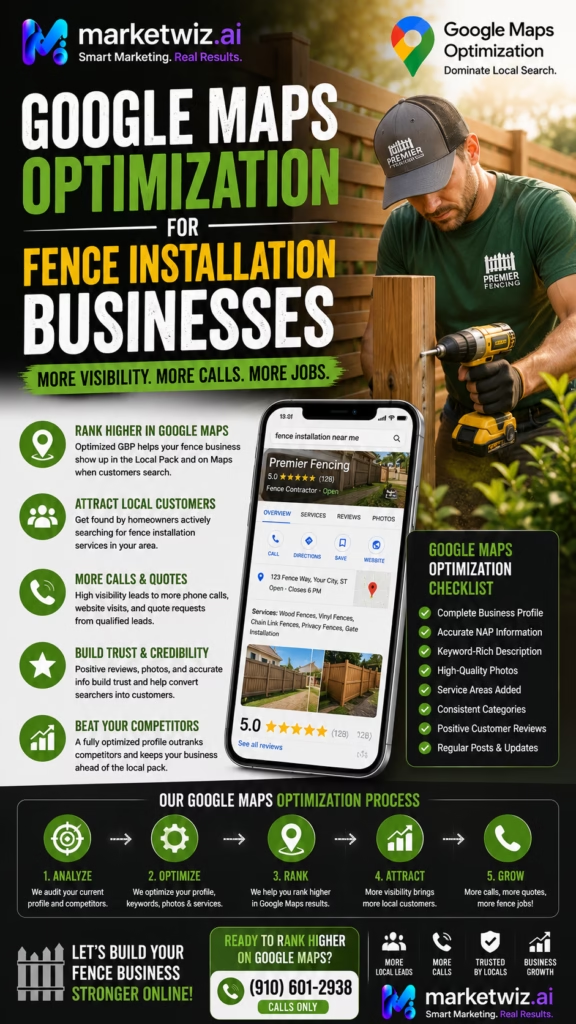
Google Maps Optimization for Fence Installation Businesses
Fence installation companies compete in highly local markets where customers often search Google for nearby contractors before requesting estimates. A properly optimized Google Maps presence can help a fence business increase local visibility, showcase completed projects, build customer trust, generate more calls, and turn local search demand into qualified installation opportunities.
Fence installation is one of the clearest examples of a location-driven service business. When a homeowner needs a privacy fence, a property manager needs chain-link fencing, or a business owner needs commercial fencing, the customer usually wants a contractor who serves the surrounding area and can inspect the property, prepare an estimate, and complete the installation locally.
That makes Google Maps an important marketing channel for fence installation businesses. Customers searching phrases such as "fence company near me," "privacy fence installer," "vinyl fence contractor," or "commercial fencing company" may encounter Google Maps and the local results before they ever reach traditional organic website listings.
For a fence company, appearing in those local results can create direct opportunities for phone calls, website visits, estimate requests, and project inquiries.
But Google Maps optimization is not simply a matter of creating a Google Business Profile and waiting.
A strong local search presence is supported by a complete ecosystem that can include:
- an accurate Google Business Profile,
- the correct business categories,
- detailed fence services,
- authentic project photos,
- genuine customer reviews,
- a strong local website,
- service pages,
- useful location content,
- accurate citations,
- local relevance,
- professional lead response,
- consistent performance tracking.
1. What Is Google Maps Optimization for Fence Installation Businesses?
Google Maps optimization is the process of improving the signals and customer experience connected to a fence company's local Google presence.
The center of that strategy is generally the company's Google Business Profile.
However, local visibility can also be influenced by the broader digital footprint surrounding the business.
That can include:
- website relevance,
- service content,
- business information consistency,
- customer reviews,
- local authority,
- project imagery,
- local content,
- business prominence.
For fence contractors, the strategy should clearly establish:
- what types of fencing the company installs,
- which areas it serves,
- what completed work looks like,
- why customers should trust the business,
- how a prospect can request the next step.
2. Why Google Maps Matters for Fence Contractors
Fence installation usually begins with a local need.
A homeowner may have purchased a property and need privacy.
A family may need a safer backyard for children or pets.
A business may need security fencing.
A pool owner may need appropriate fencing around the property.
A landlord may need damaged fencing repaired or replaced.
These are geographically specific projects.
Customers frequently search for nearby companies because the contractor must travel to the property, evaluate the site, determine measurements, discuss materials, prepare an estimate, and eventually complete the work.
That local buying behavior makes Google Maps especially relevant.
High Local Relevance
Fence customers usually need a contractor serving a defined local market rather than a national company located far away.
Strong Project Intent
Many fence searches come from property owners who already know they need installation, replacement, or repair.
Visual Service
Fence contractors can use project photos to demonstrate wood, vinyl, aluminum, chain-link, gate, and commercial installation work.
Estimate-Driven Sales
Google Maps can become an entry point into the contractor's estimate and sales process.
3. Understand Fence Customer Search Intent
Search intent matters because customers do not all search using the exact same words.
Some customers search by business type:
- fence company near me,
- fence contractor near me,
- local fence company,
- fence installers near me.
Others search by material:
- wood fence installer,
- vinyl fence company,
- chain-link fence contractor,
- aluminum fence installation.
Some search by customer problem or property need:
- privacy fence installation,
- backyard fence company,
- dog fence installation,
- commercial security fencing,
- fence repair near me.
A strong local SEO strategy considers these different forms of intent and builds the website, profile, services, and content around the actual services the company provides.
4. Build a Complete Google Business Profile
The Google Business Profile is one of the most important digital assets in a fence company's local marketing strategy.
The profile should contain accurate, current information.
Depending on what applies to the business, important elements may include:
- business name,
- primary category,
- secondary categories,
- phone number,
- website,
- business hours,
- service areas,
- services,
- business description,
- project photos,
- customer reviews.
Every field should reflect the real company.
The goal is clarity, not manipulation.
5. Keep the Fence Company Business Name Accurate
The business name on Google should represent the real-world name of the company.
One common local SEO mistake is attempting to force keywords into the business name for ranking purposes.
For example, a company whose legitimate name is:
Smith Fence Co.
should not arbitrarily change the profile name to something like:
Smith Fence Co. Best Privacy Fence Installation Vinyl Fence Contractor Near Me.
That creates a poor customer experience and may conflict with platform guidelines.
Use the legitimate business identity and optimize the surrounding profile, website, and content properly.
6. Choose the Right Google Business Profile Categories
Categories help communicate what type of business the profile represents.
Fence contractors should select the most accurate available primary category for the actual business.
Relevant secondary categories may be useful when they accurately represent real services, but a business should not add unrelated categories simply because they appear to have search volume.
The primary category should align closely with the company's main commercial activity.
That means a fence installation company should not position itself primarily as an unrelated type of contractor just to chase broader traffic.
Category Strategy Should Match the Business
A company specializing mainly in fence installation should present itself differently from:
- a general contractor that occasionally builds fences,
- a landscape company that also installs fencing,
- a gate automation specialist,
- a materials supplier.
Accuracy helps both customers and search engines understand the business.
7. Add Detailed Fence Installation Services
The services section provides an opportunity to clearly explain the company's offerings.
A fence business may legitimately provide services such as:
- wood fence installation,
- privacy fence installation,
- vinyl fence installation,
- chain-link fence installation,
- aluminum fence installation,
- ornamental fence installation,
- commercial fencing,
- residential fencing,
- gate installation,
- fence replacement,
- fence repair,
- pool fencing,
- farm fencing,
- security fencing.
Only list services the company actually provides.
If the company does not install a certain fence material, it should not add the service merely because competitors offer it.
8. Write a Strong Fence Company Business Description
The business description should explain the company naturally.
A useful description can communicate:
- what types of fencing the company installs,
- whether it serves residential or commercial properties,
- which general areas it serves,
- what differentiates the company,
- what kinds of projects customers commonly request.
The description should not become a block of repeated keywords.
Customers need useful information.
A strong description sounds like a professional fence contractor explaining the business to a real property owner.
9. Use High-Quality Fence Project Photos
Fence installation is an extremely visual service.
This gives fence companies an excellent opportunity to use Google Business Profile photos as proof of workmanship.
Useful image categories can include:
- finished wood privacy fences,
- vinyl fences,
- chain-link installations,
- aluminum fencing,
- decorative fences,
- commercial fencing,
- gates,
- corner details,
- completed backyard projects,
- large property installations,
- crews working on legitimate jobsites.
Photos should be clear and accurately represent the company's work.
Customers may compare several fence companies quickly, and professional project imagery can help one business stand out.
10. Publish Before-and-After Fence Projects
Before-and-after content can demonstrate the value of fence replacement particularly well.
Examples include:
- damaged wood fencing replaced with a new privacy fence,
- old chain-link fencing replaced with vinyl,
- an open yard transformed with perimeter fencing,
- damaged gate sections repaired or replaced,
- commercial property upgraded with security fencing.
The transformation is easy to understand visually.
That makes before-and-after photos useful not only for Google Maps, but also for the website, Facebook, Instagram, YouTube Shorts, and other marketing channels.
11. Build a Consistent Google Review Strategy
Fence installation projects can produce strong customer feedback because customers live with the finished result every day.
A review strategy should focus on genuine customers who actually completed projects with the company.
The contractor can create a consistent workflow for requesting feedback after successful installations.
A natural review may discuss:
- communication,
- professionalism,
- project quality,
- crew behavior,
- timeliness,
- finished appearance,
- overall customer experience.
Do not fabricate reviews or attempt to manufacture fake customer experiences.
12. Respond Professionally to Fence Company Reviews
Review responses give the company an opportunity to demonstrate professionalism publicly.
A useful response can:
- thank the customer,
- acknowledge the project,
- reinforce the company's commitment to service,
- remain professional and concise.
Negative reviews should also be handled carefully.
Avoid hostile public arguments.
Respond professionally, clarify important facts when appropriate, and attempt to move detailed dispute resolution into the appropriate private business process.
13. Build a Fence Contractor Website That Supports Google Maps
The website should reinforce the same business identity presented on Google.
A fence contractor website can include:
- clear company information,
- fence service pages,
- project galleries,
- service-area content,
- reviews,
- frequently asked questions,
- contact information,
- estimate information.
The website should also be mobile friendly.
Many local fence prospects search from phones while standing on their property, discussing a project with a spouse, checking pricing expectations, or comparing contractors.
A slow or confusing mobile website can weaken the conversion opportunity even if the Google Maps listing ranks well.
14. Create Dedicated Fence Service Pages
A single generic "Services" page may not fully explain the company's capabilities.
Dedicated service pages can create more useful experiences for customers looking for specific fence types.
Potential Service Pages
- Wood Fence Installation
- Privacy Fence Installation
- Vinyl Fence Installation
- Chain-Link Fence Installation
- Aluminum Fence Installation
- Commercial Fence Installation
- Fence Repair
- Gate Installation
- Pool Fence Installation
Each page should contain useful information rather than simply repeating the same generic text with different keywords.
Customers should learn:
- what the material is commonly used for,
- which property types it fits,
- what installation may involve,
- what project photos look like,
- how to request an estimate.
15. Build Useful Fence Contractor Location Pages
Fence companies often serve several nearby cities.
Location pages can support local visibility when the business genuinely serves those areas and the content is useful.
A strong location page may include:
- the fence services offered in that market,
- local project examples,
- property types common to the area,
- service information,
- frequently asked questions,
- customer reviews where appropriate,
- clear estimate information.
Avoid creating hundreds of thin pages where only the city name changes.
A page should provide enough unique local value to deserve its own URL.
16. Target Fence Keywords Based on Real Services
Keyword research helps fence contractors understand how customers describe their needs.
Important keyword families can include:
Business-Type Keywords
- fence company,
- fence contractor,
- fence installer,
- fencing company.
Service Keywords
- fence installation,
- fence replacement,
- fence repair,
- gate installation.
Material Keywords
- wood fence installation,
- vinyl fence installation,
- chain-link fence installation,
- aluminum fence installation.
Intent Keywords
- privacy fence company,
- backyard fence installer,
- commercial fencing contractor,
- pool fence installer.
Local modifiers can then be used naturally when creating legitimate location-focused content.
17. Build Accurate Local Citations
Citations are references to the business across relevant online platforms.
Depending on the business and market, these may include:
- major directories,
- local business listings,
- mapping platforms,
- industry directories,
- chambers of commerce,
- relevant trade organizations.
Quality and accuracy matter more than simply accumulating a huge number of listings.
Business information should remain consistent.
Incorrect phone numbers, outdated addresses, duplicate listings, or inconsistent business names can create customer confusion.
18. Maintain Accurate Business Information Across the Web
Fence companies sometimes change:
- phone numbers,
- office locations,
- websites,
- business names,
- hours.
Old information can remain online for years.
That makes periodic citation and business-information auditing useful.
The company should verify important profiles and listings so customers are not calling an old number or finding an outdated address.
19. Create Local Fence Content Customers Actually Need
Content can expand the website beyond basic sales pages.
Fence companies can create educational resources around real customer questions.
Examples include:
- wood vs vinyl fencing,
- privacy fence options,
- fence maintenance,
- how to choose a fence material,
- fencing for dogs,
- fencing for pools,
- commercial security fencing,
- gate options,
- fence replacement considerations,
- questions to ask before installing a fence.
This type of content can support both organic SEO and customer conversion.
A well-informed customer may become a better qualified lead.
20. Use Google Business Profile Posts Strategically
Google Business Profile posts can help keep the profile active and useful to customers.
Fence contractors can publish content around:
- recent projects,
- new fence installations,
- before-and-after transformations,
- wood fencing,
- vinyl fencing,
- commercial projects,
- gate projects,
- seasonal fence maintenance,
- business updates.
Posts should be written for customers, not simply stuffed with local keywords.
A useful post explains what happened, what service was completed, and why the project may be relevant to another property owner.
21. Optimize Service-Area Fence Businesses Correctly
Many fence contractors travel to customers rather than serving them from a retail showroom.
These businesses should follow Google's current rules regarding service-area businesses, addresses, and profile eligibility.
The business should not create fake offices or pretend to operate from locations where it does not maintain an eligible real-world presence.
Instead, focus on:
- a legitimate Google Business Profile,
- accurate service areas,
- strong local website content,
- reviews from real customers,
- project photos,
- legitimate business citations,
- local authority.
A service-area strategy can still build meaningful visibility without misleading locations.
22. Build a Multi-Location Strategy Carefully
Larger fence companies may operate legitimate offices or branches in multiple markets.
When each location meets current eligibility requirements, a multi-location strategy can include:
- accurate profiles for each eligible location,
- unique location information,
- local project photos,
- location-specific website pages,
- local review development,
- market-specific tracking.
The goal is to build genuine local authority around actual operations.
Fake satellite locations can create unnecessary risk.
23. Optimize Google Maps Visibility for Conversion
Ranking is only one part of local marketing.
If a fence company ranks prominently but the profile does not inspire confidence, leads may still choose competitors.
Conversion optimization should consider:
- review quality,
- review recency,
- project photos,
- website quality,
- clear service information,
- accurate hours,
- easy contact options,
- professional branding.
Customers commonly compare multiple fence companies.
The profile and website should help answer the question:
"Why should I contact this fence company?"
24. Respond Quickly to Fence Installation Leads
Local visibility becomes valuable only when the company handles leads effectively.
Fence customers may request estimates from several businesses.
A fast response can help move the conversation forward while the project is still active in the customer's mind.
Useful initial qualification information can include:
- property location,
- residential or commercial property,
- type of fence desired,
- approximate project size,
- whether an old fence needs removal,
- gate requirements,
- timeline,
- estimate needs.
The goal is to collect enough information to determine the appropriate next step.
25. Track Google Maps Fence Leads in a CRM
Without lead tracking, a contractor may know that Google generates calls but have no idea which interactions turn into actual projects.
A CRM can track:
- lead name,
- phone number,
- email where available,
- lead source,
- service requested,
- project address or service area,
- fence type,
- estimate appointment,
- proposal amount,
- sales stage,
- closed project value.
That information helps the company understand which marketing channels create profitable business.
26. Measure Google Maps Performance Beyond Rankings
Ranking reports can be useful, but rankings alone do not pay for fence materials, vehicles, crews, insurance, equipment, or payroll.
The business should connect local visibility to operational results.
| Metric | What It Measures | Why It Matters |
|---|---|---|
| Local Visibility | Where the business appears across target areas | Shows search presence |
| Calls | Phone inquiries | Measures customer interest |
| Website Leads | Forms and other website contacts | Shows digital conversion |
| Qualified Fence Leads | Projects that match the business | Separates quality from raw volume |
| Estimate Appointments | Opportunities progressing into sales | Measures pipeline creation |
| Closed Projects | Fence jobs won | Measures actual sales success |
| Revenue | Sales generated from marketing | Shows business impact |
A fence business should ultimately care about profitable projects, not vanity metrics.
27. Analyze Local Fence Competitors
Local competitive analysis can reveal what customers encounter before choosing a fence company.
Review competing businesses for:
- Google Business Profile completeness,
- review volume and quality,
- project photos,
- website strength,
- service pages,
- local content,
- business categories,
- customer messaging.
The purpose is not to copy competitors.
The purpose is to understand what standards exist in the market and where the company can create a stronger customer experience.
Look for Gaps
For example, competitors may have:
- weak commercial fencing pages,
- few vinyl project photos,
- outdated websites,
- slow customer response,
- poor location content.
Those gaps can help shape strategy.
28. Use AI to Support Fence Company Google Maps Marketing
AI can help reduce the workload involved in managing a comprehensive local marketing strategy.
Potential uses include:
- keyword organization,
- content outlining,
- review response drafting,
- Google Business Profile post drafting,
- lead classification,
- conversation summaries,
- follow-up reminders,
- marketing reporting,
- local content planning.
AI works best when it is connected to accurate business information.
It should not invent:
- project locations,
- customer reviews,
- pricing,
- service capabilities,
- licenses,
- warranties,
- availability.
29. Google Maps Optimization Mistakes Fence Companies Should Avoid
Keyword Stuffing the Business Name
Use the legitimate business name rather than attempting to force ranking terms into the profile.
Choosing Irrelevant Categories
Select categories that accurately reflect real fence services.
Creating Fake Locations
Use legitimate eligible locations and follow current service-area business requirements.
Buying or Fabricating Reviews
Build genuine feedback from actual customers.
Ignoring Reviews
A strong reputation system should include both review generation and professional responses.
Using Weak Photos
Fence installation is visual. Low-quality or irrelevant images reduce the opportunity to show workmanship.
Ignoring the Website
A weak website can limit both local SEO support and customer conversion.
Creating Thin City Pages
Location pages should contain useful local content rather than duplicated text with city names swapped.
Ignoring Business Information Consistency
Outdated contact details can confuse both customers and the local search ecosystem.
Measuring Only Rankings
Track qualified leads, estimates, projects, and revenue.
Responding Slowly to Leads
A highly visible profile cannot compensate for poor lead handling.
30. A 90-Day Google Maps Optimization Plan for Fence Businesses
Days 1–30: Build the Local SEO Foundation
Audit the Google Business Profile
Verify business information, categories, hours, phone number, website, services, service areas, and profile completeness.
Organize Fence Services
Create a clear list of legitimate services such as wood fencing, vinyl fencing, chain-link fencing, aluminum fencing, gates, repairs, and commercial installations.
Build a Project Photo Library
Collect high-quality photos from completed fence installations and organize them by material, project type, and location where useful.
Audit the Website
Review service pages, mobile performance, contact information, project galleries, location content, and conversion paths.
Build Lead Tracking
Create a system for identifying Google Maps inquiries, estimates, project values, closed jobs, and revenue.
Days 31–60: Build Local Authority
- Publish authentic project photos.
- Develop a consistent review request process.
- Respond professionally to existing reviews.
- Improve wood, vinyl, chain-link, aluminum, and commercial fence pages.
- Create useful location pages for legitimate service areas.
- Audit important citations.
- Correct outdated business information.
- Publish useful Google Business Profile updates.
- Create customer-focused local content.
- Improve mobile lead conversion.
Days 61–90: Optimize for Leads and Revenue
- Measure visibility across target service areas.
- Track lead quality by fence type.
- Improve response time.
- Refine qualification questions.
- Track estimate appointments.
- Connect closed projects to Google lead sources.
- Expand high-performing service content.
- Strengthen underperforming location pages.
- Compare performance with local competitors.
- Use CRM and AI workflows to reduce missed follow-up.
Final Thoughts: Turn Google Maps Visibility Into More Fence Projects
Google Maps optimization can be one of the most strategically aligned marketing channels for a fence installation business because fence buying is inherently local.
Customers need contractors who can physically visit their properties and complete projects within a defined geographic area.
When someone searches for a local fence company, that person may already be much closer to making a buying decision than someone casually browsing general home-improvement content.
That makes local search visibility valuable.
But visibility is only the beginning.
A complete fence contractor marketing system should connect:
- accurate Google Business Profile information,
- the correct categories,
- detailed fence services,
- professional project photos,
- genuine customer reviews,
- useful service pages,
- legitimate location content,
- accurate citations,
- fast lead response,
- professional qualification,
- estimate scheduling,
- CRM tracking,
- consistent follow-up,
- revenue measurement.
Fence businesses should also remember that Google Maps works best as part of a broader marketing ecosystem.
A customer may discover the company on Google Maps, visit the website, look at project photos, read reviews, view social media content, and then request an estimate.
Every touchpoint contributes to the customer's confidence.
That is why Google Maps optimization should not be treated as a one-time profile update.
It is an ongoing local customer acquisition strategy.
Companies that continuously improve their profiles, websites, project proof, reviews, local relevance, lead handling, and performance tracking can create a stronger foundation for long-term growth.
Frequently Asked Questions About Google Maps Optimization for Fence Installation Businesses
1. What is Google Maps optimization for fence installation businesses?
It is the process of improving a fence company's Google Business Profile, website, local relevance, reviews, project photos, service information, citations, and conversion systems to increase local search visibility and generate qualified opportunities.
2. Why is Google Maps important for fence contractors?
Fence projects are highly local, and Google Maps can place contractors in front of nearby homeowners and businesses actively looking for installation, replacement, repair, or other fencing services.
3. Can Google Maps generate fence installation leads?
Yes. Strong local visibility can produce calls, website visits, estimate requests, and other customer interactions from people searching for fence services.
4. What Google Business Profile category should a fence company use?
Choose the most accurate primary category currently available for the company's actual business activity and use secondary categories only when they genuinely apply.
5. Should fence companies add many Google Business Profile categories?
Only relevant categories should be used. Adding unrelated categories can create a less focused profile and does not replace a comprehensive local SEO strategy.
6. What services should fence contractors add to Google Business Profile?
List legitimate offerings such as wood fence installation, privacy fences, vinyl fencing, chain-link fences, aluminum fences, commercial fencing, fence repair, gates, and other services the company genuinely provides.
7. Do Google reviews help fence companies?
Yes. Genuine reviews can strengthen customer confidence and contribute to a stronger online reputation.
8. Should fence contractors respond to reviews?
Yes. Professional responses show engagement and give prospective customers another opportunity to evaluate the company's service approach.
9. Do fence project photos help Google Maps optimization?
Authentic project photos can strengthen the profile by showing real fence types, finished installations, gates, workmanship, and project variety.
10. What photos should a fence company upload?
Useful images include wood privacy fences, vinyl fences, chain-link installations, aluminum fences, commercial fencing, gates, completed properties, and real crews working on legitimate projects.
11. Does the fence company website affect Google Maps marketing?
A strong website can support local visibility and conversion by clearly presenting services, business information, local relevance, project photos, reviews, and contact options.
12. Should fence contractors create separate service pages?
Yes. Dedicated pages for major legitimate services can provide more useful information than a single generic page.
13. Should fence companies create city pages?
Useful location pages can support local marketing when the contractor genuinely serves the areas and the pages contain meaningful, differentiated information.
14. What are local citations for fence companies?
Citations are online references to a company's business identity and information across directories, maps, business listings, and other relevant platforms.
15. Does consistent business information matter?
Yes. Accurate name, address information where applicable, phone number, website, and other details reduce customer confusion and help create a clearer local business footprint.
16. What keywords should fence companies target?
Relevant terms can include fence company, fence contractor, fence installation, privacy fence, wood fence, vinyl fence, chain-link fence, aluminum fence, commercial fencing, and gate installation.
17. Should fence companies publish Google Business Profile posts?
Yes. Useful posts can highlight recent projects, fence materials, completed installations, seasonal information, customer education, and business updates.
18. Can service-area fence companies rank on Google Maps?
Yes. Service-area companies can build visibility while following Google's current eligibility and address rules and supporting the profile with legitimate local relevance.
19. Should fence companies create fake locations to rank in more cities?
No. Businesses should use legitimate eligible locations and follow current Google guidelines rather than creating misleading locations.
20. Can duplicate profiles hurt fence company marketing?
Unnecessary or ineligible duplicate profiles can create confusion and potential policy issues. Maintain accurate profiles for legitimate eligible locations.
21. How quickly can Google Maps SEO work for a fence company?
Results vary based on competition, existing profile strength, website quality, reviews, local authority, service areas, and the quality of optimization.
22. How should fence businesses track Google Maps performance?
Track local visibility, calls, website leads, qualified inquiries, estimates, closed projects, average project value, and revenue.
23. Are Google Maps rankings the most important metric?
Rankings are useful, but qualified leads, estimate appointments, closed projects, revenue, and customer acquisition cost are more directly tied to business results.
24. Can AI help fence companies with Google Maps marketing?
AI can assist with content planning, keyword organization, review-response drafting, lead classification, follow-up, reporting, and other repetitive marketing workflows.
25. Should fence companies combine Google Maps with social media?
Yes. Fence projects are visual, making social media useful for showcasing installations, before-and-after transformations, gates, materials, and completed properties.
26. Should fence contractors combine Google Maps with paid ads?
Paid ads can complement Google Maps optimization by creating immediate paid visibility while the company develops stronger long-term organic local visibility.
27. What Google Maps mistakes should fence companies avoid?
Avoid inaccurate business data, fake locations, keyword-stuffed names, irrelevant categories, fake reviews, poor photos, weak website content, inconsistent citations, and failure to track leads.
28. How important is fast lead response for fence contractors?
It is extremely important because customers may request several estimates. Fast, professional qualification can help turn visibility into an active sales opportunity.
29. What fence topics are useful for local SEO content?
Useful topics include privacy fencing, wood fencing, vinyl fencing, chain-link fencing, aluminum fencing, gates, commercial fencing, pool fencing, repairs, and local project education.
30. What is the best Google Maps optimization strategy for fence installation businesses?
Combine an accurate Google Business Profile, correct categories, detailed services, authentic project photos, genuine reviews, a strong website, useful service and location pages, accurate citations, fast lead response, CRM tracking, and continuous optimization.
30 Additional SEO Keywords
These additional keyword ideas can support future fence contractor marketing pages, local SEO articles, service-area content, project pages, internal linking, Google Maps optimization resources, and broader topical authority.
Build a Stronger Local Lead Engine for Your Fence Business
MarketWiz.ai combines AI-powered Google Maps optimization, local SEO, lead generation, review workflows, CRM integration, marketing automation, and customer acquisition technology designed to help fence installation businesses improve local visibility, generate more qualified opportunities, and turn local search demand into measurable growth.
Call MarketWiz.ai: (910) 601-2938












