

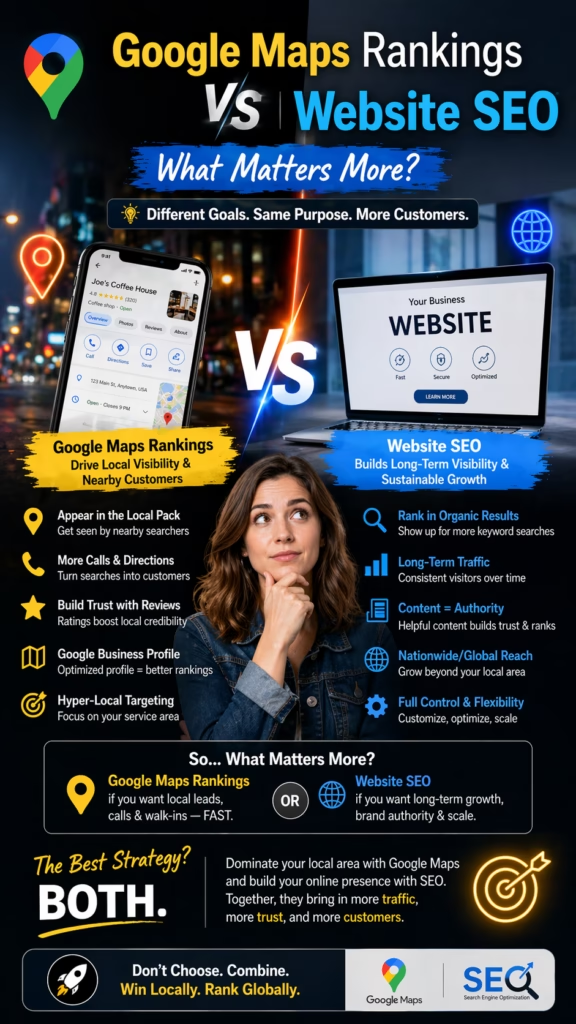
Google Maps Rankings vs Website SEO: What Matters More
Google Maps Rankings vs Website SEO: What Matters More explains how map visibility and traditional website SEO each influence local traffic, trust, lead generation, and customer action, and why the strongest local marketing results often come from understanding the role of both.
Introduction
Google Maps Rankings vs Website SEO: What Matters More is one of the most important questions local businesses can ask when deciding where to focus time, budget, and attention. Many business owners hear about local SEO, Google Business Profile optimization, content creation, backlinks, on-page SEO, reviews, and Maps visibility, but they are not always sure which area actually drives more results. That confusion is understandable because both channels influence lead flow in different ways.
At first glance, the question seems simple. If a business wants more visibility, should it focus on showing up in Google Maps or on ranking its website in organic search? The real answer is more nuanced. Google Maps rankings often matter most when the goal is immediate local visibility in front of nearby searchers ready to act. Website SEO often matters more when the goal is broader keyword reach, deeper information, stronger organic authority, and long-term search growth.
Google Maps Rankings vs Website SEO: What Matters More often depends on the type of business, the search intent involved, and whether the priority is immediate local action or broader long-term organic visibility.
For many local businesses, Maps visibility is incredibly powerful because it places the company directly in front of nearby people who are already searching with local intent. A person looking for a plumber, painter, mattress store, roofer, or chiropractor nearby may act quickly based on what appears in the local map pack. In those situations, Google Maps can directly influence calls, visits, and inquiries. The speed of local intent makes Maps especially valuable.
At the same time, website SEO supports a different but equally important part of growth. A well-optimized website can rank for many more topics, answer questions in depth, build authority, improve trust, support conversions, and attract organic traffic beyond the most immediate map-driven searches. A website also gives the business more control over messaging, structure, service detail, content strategy, and long-term brand presence.
Main idea: Google Maps rankings usually matter more for fast local visibility and immediate customer action, while website SEO usually matters more for broader organic reach, deeper trust-building, and long-term search growth.
Table of Contents
- 1) What Google Maps rankings really do
- 2) What website SEO really does
- 3) Why Google Maps often feels more immediate
- 4) Why website SEO often feels more expansive
- 5) Local intent and why it changes everything
- 6) When Google Maps matters more
- 7) When website SEO matters more
- 8) Trust, conversion, and the role of each channel
- 9) Lead quality differences between Maps and SEO
- 10) Why many businesses should not choose only one
- 11) Common mistakes when comparing Maps and SEO
- 12) A practical strategy for balancing both
- 13) Long-term growth implications
- 14) Which channel should a business prioritize first?
- 15) Final thoughts
- 16) FAQs
- 17) Extra keywords
1) What Google Maps Rankings Really Do
Google Maps rankings determine how visible a business is inside local map-based results. When people search for nearby products or services, the businesses that appear prominently in Maps often receive the first wave of attention. That is powerful because the local map pack is not just another ranking feature. It is often the first place people look when they want a nearby solution quickly.
Maps rankings matter because they compress decision-making. A local searcher often sees only a few businesses at the top, compares them quickly, and takes action. If a business appears there, it enters the conversation immediately. If it does not, it may lose the chance before the searcher ever explores the website.
Google Maps rankings often improve:
- Local visibility
- Profile impressions
- Call opportunities
- Direction requests
- Fast local inquiries
Google Maps rankings are powerful because they place the business into immediate local decisions where customer action often happens fast.
2) What Website SEO Really Does
Website SEO helps a business rank in traditional organic search results. It gives the company the ability to appear for a wider range of keywords, questions, services, problems, and informational queries. A strong website can educate searchers, build trust, show service depth, and create organic visibility far beyond the small set of keywords that trigger the local map pack.
This matters because not every customer journey begins with an immediate local search. Many people research before they act. They compare options, learn about services, explore pricing themes, read FAQs, and evaluate expertise. Website SEO supports this deeper part of the journey by giving the business content and structure that can capture attention earlier and nurture trust longer.
Maps = faster local visibility
Website SEO = broader search visibility
Maps = immediate local intent
Website SEO = deeper organic reach
A business that ignores website SEO often limits its ability to rank for broader questions, support trust with content, and grow organic authority over time.
3) Why Google Maps Often Feels More Immediate
Google Maps often feels more immediate because it captures searchers closer to action. Someone searching with local intent usually wants a nearby business now or soon. They may want to call, visit, compare hours, or find directions. That urgency makes map visibility extremely valuable. The business does not need the customer to explore ten pages of content first. It just needs to be visible and trustworthy in the moment of need.
This is why many local service businesses see Google Maps as the fastest path to leads. A person with a pressing need often uses location-driven search behavior. When the business appears strongly in Maps, it benefits from that urgency directly.
Google Maps often matters more when the customer is already close to making a decision and local relevance is the main factor shaping the search.
4) Why Website SEO Often Feels More Expansive
Website SEO feels more expansive because it supports more than one moment of intent. A strong site can rank for service pages, city pages, educational blog posts, question-based content, comparison content, and long-tail searches. That gives the business more entry points into organic discovery. Instead of appearing only when a user wants a nearby service immediately, the website can support earlier-stage research and a much wider variety of search paths.
That breadth matters for businesses that want to build authority, expand keyword coverage, and create durable organic momentum. Website SEO also allows the business to explain its value in detail, something a map listing cannot do by itself.
Website SEO matters more when a business needs more keyword coverage, more content depth, and more long-term organic search growth than a map listing alone can provide.
5) Local Intent and Why It Changes Everything
Local intent is the real reason this comparison matters. A search with high local intent often behaves differently than a broader organic search. When someone types a service plus a city, neighborhood, or nearby phrase, the search engine often emphasizes local results more strongly. That is where Google Maps can dominate attention.
But not every search has the same intent. Some searches are local and urgent. Others are educational and research-driven. Some are about comparing options. Some are about learning before contacting anyone. Understanding this difference is the key to understanding when Maps matters more and when website SEO matters more.
Google Maps Rankings vs Website SEO: What Matters More often comes down to the kind of intent the customer has at the moment of search.
6) When Google Maps Matters More
Google Maps usually matters more when the business depends heavily on fast local action. Service companies, local retailers, urgent-need providers, and businesses where customers choose quickly often benefit tremendously from strong Maps visibility. When people want a nearby solution, they frequently trust the local results they see first.
Maps may matter more in situations like:
- Emergency or urgent service needs
- High local intent searches
- Phone-call-driven lead generation
- Store visits and direction requests
- Fast comparison between nearby providers
For many local businesses, Google Maps matters more when customer action is fast, nearby, and tied directly to local intent.
7) When Website SEO Matters More
Website SEO usually matters more when the business needs search depth, educational reach, and stronger organic content coverage. Businesses that want to rank for many service variations, informational searches, city pages, blog topics, and long-tail queries often need website SEO to expand beyond what a Google Business Profile can do.
Website SEO may matter more in situations like:
- Longer research-driven customer journeys
- Competitive informational search spaces
- Businesses needing authority and content depth
- Ranking for many services, locations, or questions
- Long-term organic growth strategy
Website SEO matters more when the business needs to rank across a wider range of topics and support trust through stronger content and site structure.
8) Trust, Conversion, and the Role of Each Channel
Both Google Maps rankings and website SEO influence trust, but they do so differently. Maps builds trust through reviews, photos, categories, proximity, visibility, and listing strength. Website SEO builds trust through deeper explanation, stronger brand presentation, service detail, content quality, and overall site experience.
A business may get discovered in Maps and then confirmed by the website. Or it may get discovered through organic content and then reinforced by a strong Google Business Profile. In many cases, the two channels support each other rather than compete with each other.
Maps trust signals:
Reviews
Photos
Profile completeness
Proximity
Category relevance

Website trust signals:
Service detail
Helpful content
Professional design
Case studies
Brand clarity
Businesses often lose conversions when they invest in only one side of trust and ignore how customers validate businesses across multiple touchpoints.
9) Lead Quality Differences Between Maps and SEO
Lead quality can differ between Google Maps and website SEO depending on the query and the stage of intent. Maps leads are often more immediate. They may be closer to calling or visiting. Website SEO leads can be broader and sometimes earlier in the journey, but they may also be highly qualified when the content aligns tightly with the searcher’s exact needs.
This does not mean one is always better. It means the business should understand what kind of pipeline each channel supports. Maps often captures ready-now local attention. Website SEO often supports broader discovery and longer consideration cycles.
Google Maps often produces faster-action local leads, while website SEO often produces broader organic opportunities across more stages of the buying journey.
10) Why Many Businesses Should Not Choose Only One
One of the biggest mistakes businesses make is assuming they must choose between Google Maps and website SEO. In reality, both often support different parts of the same customer journey. A customer may first see the business in Maps, then visit the website to confirm trust. Another customer may first find a blog post or service page, then check the Maps profile to validate proximity and reviews.
Businesses that invest in both channels usually create stronger overall visibility. They appear in more places, support more types of intent, and build more complete trust across the decision process. That often creates a stronger local marketing system than relying on only one channel alone.
The strongest local search strategies usually combine Google Maps rankings and website SEO so the business can capture both immediate local intent and broader organic opportunity.
11) Common Mistakes When Comparing Maps and SEO
Many businesses frame the comparison the wrong way. They ask which matters more in the abstract without considering industry, intent, competition, urgency, and how customers actually buy. A better question is not just which channel matters more, but which channel matters more first, and how the other channel supports it.
Common mistakes include:
- Treating Maps and SEO as mutually exclusive
- Ignoring local intent when evaluating priority
- Assuming website traffic always converts better
- Assuming map visibility alone is enough for trust
- Neglecting content strategy because Maps is performing
- Neglecting Google Business Profile because the website ranks
- Thinking rankings matter without considering conversion quality
Big mistake: asking whether Google Maps or website SEO matters more without first asking how customers in that business actually search, compare, and take action.
12) A Practical Strategy for Balancing Both
If a business wants to apply Google Maps Rankings vs Website SEO: What Matters More in a practical way, it helps to build a strategy around both speed and depth.
Step 1: Strengthen Google Business Profile fundamentals
Step 2: Improve reviews, photos, categories, and profile completeness
Step 3: Build or optimize core service pages on the website
Step 4: Improve on-page SEO and local relevance signals
Step 5: Create supporting content for services, cities, and questions
Step 6: Use the website to deepen trust and explain value
Step 7: Use Maps to capture fast local intent
Step 8: Keep both channels improving together over time
This works because Maps and website SEO solve different visibility problems. One creates fast local discovery. The other creates wider organic reach and deeper search authority.
The best balance usually comes from letting Google Maps drive immediate local visibility while the website supports long-term authority, keyword depth, and conversion trust.
13) Long-Term Growth Implications
Long-term growth often depends more heavily on website SEO because the website gives the business an expandable asset. It can hold service pages, location pages, blogs, FAQs, proof elements, and more. That makes it easier to build organic momentum over time. A strong website also creates more resilience because it gives the business more ranking opportunities across many topics.
But this does not reduce the long-term value of Maps. A strong Google Business Profile remains a critical local asset. As long as local intent exists, map visibility will matter. The real growth advantage comes from building both a strong local listing and a strong site so the business is not fragile in either direction.
Website SEO often has greater long-term expansion potential, while Google Maps rankings remain essential for ongoing local visibility and local action.
14) Which Channel Should a Business Prioritize First?
The answer depends on the business model. If the company is highly local, phone-call-driven, and serving customers who make quick local decisions, Google Maps may deserve the first priority. If the company needs broader ranking coverage, content depth, city pages, and authority-building, website SEO may deserve more attention earlier. In most cases, the smartest path is not extreme. It is practical prioritization.
A business can start by strengthening the fastest local wins in Maps while building the website into a more powerful long-term asset. This creates momentum now without sacrificing future growth. That is often the most balanced approach.
Prioritize Google Maps first when:
- The business relies on local calls
- Customers search nearby and act quickly
- Visibility in the map pack drives real revenue
Prioritize website SEO first when:
- The business needs broader keyword reach
- Customers research more deeply before acting
- Content strategy is central to growth
For many local businesses, the smartest answer is to prioritize based on the fastest revenue path while still building both Maps strength and website strength together.
15) Final Thoughts
Google Maps Rankings vs Website SEO: What Matters More does not have one universal answer for every business. Google Maps often matters more when the goal is immediate local visibility, fast customer action, and strong presence in high-intent local search. Website SEO often matters more when the goal is broader keyword coverage, deeper organic reach, stronger authority, and long-term search growth.
The most important insight is that these channels are not enemies. They are partners in a stronger local search strategy. Maps helps the business appear when customers want nearby solutions quickly. Website SEO helps the business rank more broadly, build trust more deeply, and create a larger organic footprint over time. Businesses that understand both usually build stronger lead flow than businesses that force themselves into a false choice.
Final takeaway: Google Maps rankings often matter more for immediate local action, website SEO often matters more for broader long-term organic growth, and the strongest local businesses usually improve both instead of relying on just one.
16) FAQs
1) What is the difference between Google Maps rankings and website SEO?
Google Maps rankings affect visibility in local map results, while website SEO affects visibility in standard organic search results.
2) Which matters more for local businesses?
For many local businesses, Google Maps matters more for fast local action, while website SEO matters more for broader long-term growth.
3) Can a business grow with strong Maps rankings alone?
Yes, in some local categories, but weak website SEO can still limit broader visibility and trust support.
4) Can website SEO make up for weak Google Maps visibility?
Sometimes, but not always, especially when local map results dominate the search experience.
5) What is the biggest mistake businesses make?
They often treat Maps and website SEO like an either-or decision instead of seeing how both support different parts of growth.
6) Why does Google Maps feel faster?
Because it often captures people who are already ready to call, visit, or choose a nearby business quickly.
7) Why does website SEO feel broader?
Because it supports ranking for more keywords, questions, services, and informational content.
8) Does local intent matter in this comparison?
Yes. Local intent is one of the biggest reasons Google Maps can matter more in many service-based searches.
9) When does Google Maps usually matter more?
It usually matters more when customer decisions are fast, local, and tied to nearby search behavior.
10) When does website SEO usually matter more?
It usually matters more when a business needs broader reach, stronger content, and long-term organic authority.
11) Which channel drives more phone calls?
For many local businesses, Google Maps often drives more immediate phone calls because of local intent and fast action behavior.
12) Which channel builds more long-term authority?
Website SEO usually builds more long-term authority because the site can grow with content, service pages, and topical relevance.
13) Can both channels improve trust?
Yes. Maps improves trust with reviews and profile strength, while websites improve trust with content and brand depth.
14) Should small businesses invest in both?
Usually yes, especially if they want both immediate local visibility and durable long-term search growth.
15) Can a Google Business Profile replace a website?
No. A Google Business Profile is powerful, but it cannot replace the depth, control, and SEO reach of a strong website.
16) Can a website replace a Google Business Profile?
No. A website alone may still miss critical local visibility in map-driven searches.
17) Which one should a new business focus on first?
Often Google Maps first for local traction, while building the website for long-term growth at the same time.
18) Why do many businesses need both?
Because customers often discover businesses in one place and validate them in another.
19) Does website SEO help conversion too?
Yes. A strong website can deepen trust, answer questions, and improve conversion once the user visits.
20) Does Google Maps influence store visits?
Yes. Maps visibility often plays a major role in visits, calls, and direction requests.
21) Which channel is better for content marketing?
Website SEO is better for content marketing because the site can rank blogs, FAQs, guides, and service pages.
22) Which channel is better for urgent local searches?
Google Maps is often better for urgent local searches because nearby intent shapes the results strongly.
23) What weakens a business in this comparison?
Weakness usually comes from overinvesting in one side and neglecting the other completely.
24) Is one channel always more important than the other?
No. The answer depends on search intent, business type, and growth goals.
25) What is the core principle behind Google Maps Rankings vs Website SEO: What Matters More?
The core principle is that Google Maps usually captures immediate local intent while website SEO builds broader organic authority, and the best strategy often combines both.
17) Extra Keywords
- Google Maps Rankings vs Website SEO: What Matters More
- Google Maps rankings
- website SEO
- local SEO
- Google Business Profile
- Google Maps vs SEO
- local business marketing
- Google Maps local visibility
- website ranking strategy
- Google Maps lead generation
- organic search traffic
- local search intent
- Google Maps business growth
- website SEO for local business
- Google Maps call leads
- local map pack rankings
- organic SEO vs local SEO
- Google Maps optimization
- website authority building
- local search marketing strategy
- Google Business Profile optimization
- local organic traffic
- Google Maps customer calls
- website SEO long term growth
- local business search visibility













