
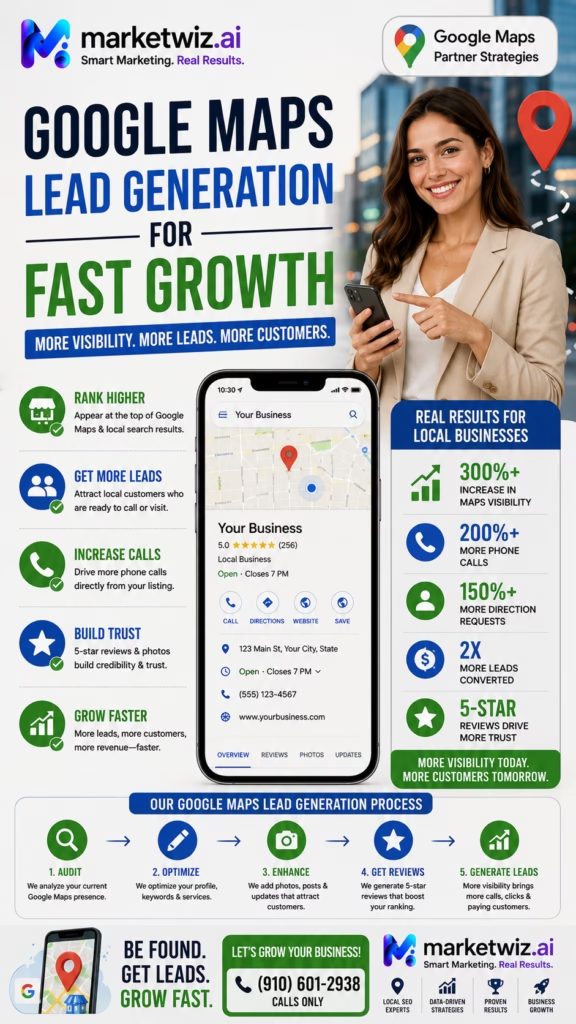
Google Maps Lead Generation for Fast Growth
Google Maps is more than a navigation platform. For local businesses, it can become one of the most powerful places to connect with people actively searching for products and services in their area. The right Google Maps lead generation strategy can transform local visibility into phone calls, appointments, website visits, qualified inquiries, and new customers.
Businesses looking for faster local growth often spend heavily on advertising while overlooking one of the highest-intent customer acquisition channels available: Google Maps lead generation. Every day, consumers search Google for contractors, home services, medical providers, restaurants, attorneys, auto services, stores, real estate companies, flooring businesses, HVAC companies, plumbers, electricians, and countless other local services.
Many of those consumers are not casually researching. They have immediate or near-term buying intent. They want a business that can solve a problem, provide a quote, schedule an appointment, deliver a product, or complete a service. When your company appears prominently at the right moment, Google Maps can become a direct bridge between search demand and revenue.
The key is understanding that Google Maps marketing is not simply about ranking. Ranking is only the first stage. A complete system must improve visibility, strengthen trust, generate customer actions, track those actions, and create a process for converting those opportunities into paying customers.
1. What Is Google Maps Lead Generation?
Google Maps lead generation is the process of positioning and optimizing a business within Google's local ecosystem so people searching for relevant products or services can discover the company and take a measurable action.
Those actions may include calling your business, visiting your website, requesting directions, viewing products, reviewing services, checking business hours, reading customer reviews, or beginning the process of scheduling an appointment.
A customer might search for terms such as:
- HVAC company near me
- flooring store in Dallas
- roof repair near me
- commercial warehouse space near Atlanta
- plumber open today
- best painting contractor nearby
- appliance repair company near me
- car dealership in my area
- local electrician
- moving company near me
Google can then display local businesses through Google Search, Google Maps, and the local pack. A well-positioned business has an opportunity to capture that demand before the customer chooses a competitor.
2. Why Google Maps Leads Can Convert So Well
One reason local search is attractive is the intent behind the search. A social media user might see an advertisement while watching videos or browsing a feed. A Google Maps user is frequently doing something very different: actively looking for a nearby business.
That difference matters.
Someone searching for “emergency plumber near me” has already identified a need. Someone searching for “flooring stores near Dallas” may already be comparing suppliers. Someone searching for “commercial HVAC repair” is likely much closer to becoming a customer than someone who simply saw an unrelated promotional post.
High Search Intent
Local searches often represent consumers who already know what they need and are now looking for the right company.
Geographic Relevance
Google attempts to connect searchers with businesses relevant to the geographic area associated with their search.
Immediate Contact Options
A properly configured profile gives customers convenient ways to call, visit a website, request directions, or learn more.
Trust Signals
Reviews, photos, business details, services, and profile activity can help potential customers evaluate a company before making contact.
3. Your Google Business Profile Is the Foundation
A strong Google Maps lead generation strategy begins with a legitimate and accurately configured Google Business Profile. The profile functions as a major source of information for how your company appears across Google's local results.
Business owners should carefully review core information including the company name, primary category, additional categories, phone number, website, operating hours, business description, services, products where appropriate, attributes, photos, and other available profile fields.
Accuracy matters because confusing or contradictory information can create friction for both customers and search engines.
Choose the Right Primary Category
The primary business category should accurately represent the principal nature of the business. Google offers numerous categories, and selecting the closest legitimate match helps clarify what the company actually does.
Additional categories can be useful when they accurately represent meaningful secondary areas of the business. The objective is not to select every remotely related category. The objective is to create an accurate representation of the company.
Complete Important Business Information
A customer should not have to guess whether your company serves their needs. Useful profiles make important information easy to understand.
Review your operating hours, contact information, service descriptions, website URL, location or service-area settings, photos, and other relevant fields regularly. Seasonal or holiday hours should also be maintained when necessary.
4. Build a Local Keyword Strategy Around Buyer Intent
Google Maps lead generation becomes more effective when your overall local marketing strategy reflects the language customers actually use.
Keyword research should consider services, products, problems, categories, geographic terms, and buying intent. Instead of focusing exclusively on a single broad phrase, businesses should understand the wider search ecosystem surrounding their services.
Service Keywords
These describe what a customer wants:
- AC repair
- roof replacement
- garage flooring
- house painting
- commercial cleaning
- appliance repair
Location Keywords
These connect services with relevant geographic markets:
- Dallas flooring company
- Charlotte HVAC contractor
- Raleigh warehouse space
- Wilmington roofing contractor
Problem-Based Keywords
Customers often search based on the problem they are experiencing instead of the exact industry terminology.
- AC not cooling
- water heater leaking
- roof leaking after storm
- hardwood floor damaged
- dryer not heating
Commercial-Intent Keywords
Search terms containing words such as “company,” “contractor,” “near me,” “services,” “repair,” “installation,” “quote,” and relevant product terms can signal stronger commercial intent depending on the industry.
5. Turn Reviews Into a Lead Generation Asset
Reviews affect more than reputation. They influence how prospects perceive your business when comparing nearby alternatives.
Imagine a potential customer sees several businesses offering similar services. One profile contains a healthy collection of detailed customer experiences, recent photos, clear business information, and professional responses. Another profile appears abandoned and has very little information.
Even before contacting either company, the customer may already have a preference.
Build a Consistent Review Process
Companies should create a sustainable process for requesting legitimate reviews from real customers rather than pursuing shortcuts. The strongest system is normally tied to actual customer interactions.
For example, a service business might request feedback after a completed project or successful customer interaction.
Respond Professionally
Review responses also become visible content for future prospects. Professional replies can reinforce a company's commitment to customer experience.
Negative reviews should be handled carefully. Avoid emotional arguments. A clear, professional response that attempts to resolve a legitimate concern often creates a better impression than an aggressive public confrontation.
6. Use Photos to Increase Trust Before the Call
Google Maps is highly visual. Photos can give prospects an immediate understanding of your business before they ever visit your website.
Depending on your industry, useful images might include:
- completed projects,
- before-and-after transformations,
- company vehicles,
- storefronts,
- product inventory,
- employees at work,
- equipment,
- office or retail interiors,
- commercial facilities,
- service examples.
A flooring company can show finished flooring projects. A roofing company can show completed roofs. A warehouse operator can show interior space, loading access, ceiling height, and building exteriors. An appliance company can display inventory and showroom images.
The goal is to reduce uncertainty.
When a customer can visually understand your company, products, services, and professionalism, making the next move becomes easier.
7. Support Google Maps With a Strong Local Website
Google Maps should not operate as an isolated marketing asset. Your website can support the broader local search strategy while also serving as a conversion destination for prospects who want more information.
A strong local website should explain what the business does, where it operates, why a customer should choose it, and how someone can take the next step.
Build Strong Service Pages
Instead of forcing every service onto one generic page, companies with several important service categories may benefit from dedicated pages that provide useful information about each major offering.
An HVAC company, for example, might have pages covering:
- AC repair,
- AC installation,
- heating repair,
- furnace replacement,
- commercial HVAC,
- maintenance plans.
Those pages should exist because they help customers, not merely because someone wants to create more URLs.
Create Useful Location Content
Businesses operating across multiple legitimate service markets may also benefit from quality location pages.
The strongest pages contain information relevant to the actual location instead of simply swapping one city name for another across dozens of duplicate pages.
8. Strengthen Local Business Data and Citations
Consistent business information across relevant online sources can strengthen the overall local presence of a business.
Important information can include:
- business name,
- address when applicable,
- phone number,
- website,
- business categories,
- operating information.
Businesses should focus on accurate, legitimate listings rather than blindly submitting information to hundreds of low-quality websites.
Consistency is especially important when a business has changed locations, phone numbers, names, or websites over time. Old information can remain online and create confusion.
9. Publish Local Content That Helps Customers
Local SEO content should answer real questions prospective customers have.
For example, a flooring company could publish content explaining how different flooring materials perform in a particular climate. An HVAC company could discuss common cooling problems during hot local summers. A roofing contractor might explain what homeowners should inspect after severe weather.
Useful local content can support organic search visibility, demonstrate expertise, and give Google Maps visitors a more informative website experience after they click through.
10. Keep the Profile Active With Relevant Updates
Businesses can use Google Business Profile features to communicate useful information about their operations. Depending on the business and available profile features, this may include updates, services, products, photos, offers, or other content.
Potential post topics include:
- new projects,
- seasonal services,
- service explanations,
- product highlights,
- customer education,
- business updates,
- before-and-after work,
- new inventory,
- frequently asked questions.
The purpose is not activity for activity's sake. Each update should provide useful information that reinforces what the business offers.
11. Optimize for Conversions, Not Just Rankings
One of the biggest mistakes businesses make is measuring Google Maps marketing only by rankings.
A ranking by itself does not pay the bills.
The real objective is business growth.
That means marketers should examine what happens after visibility occurs.
| Visibility Metric | Lead Metric | Business Metric |
|---|---|---|
| Local search visibility | Phone calls | Qualified opportunities |
| Google Maps impressions | Website visits | Appointments |
| Profile discovery | Contact actions | Quotes |
| Search presence | Direction requests | Store visits |
| Local rankings | Inbound inquiries | Revenue |
The best local marketing program connects all three layers.
12. Respond to Google Maps Leads Quickly
Generating the lead is only part of the job.
Local customers often contact multiple businesses during a short period. If your phone rings unanswered or a web inquiry sits untouched, a competitor may secure the customer first.
Businesses should create a clear lead response process that determines who receives new inquiries, how quickly the prospect is contacted, what qualifying questions should be asked, and what happens if the initial contact attempt fails.
Centralize Lead Management
When possible, leads from Google Maps, websites, advertising channels, social platforms, and other sources should flow into a centralized tracking environment.
This can be a CRM, lead management platform, call tracking system, or another structured database.
Without organized tracking, companies may confuse marketing problems with sales process problems.
13. Track What Actually Generates Customers
A professional Google Maps lead generation strategy requires measurement.
Tracking helps answer questions such as:
- How many prospects are finding the business?
- Which locations produce the strongest activity?
- Which services appear to generate demand?
- Are website visitors converting?
- How many phone inquiries become qualified prospects?
- How many leads become customers?
- What revenue can be attributed to local search?
Google Business Profile performance data can provide useful insights into how people discover and interact with the listing. Website analytics and CRM data can add deeper context.
When call tracking is used, it should be implemented carefully so business information remains accurate and attribution data remains useful.
14. How AI Can Improve Google Maps Lead Generation
Artificial intelligence can make local marketing operations more efficient, especially for businesses managing many services, markets, profiles, leads, or marketing channels.
AI should not be viewed as a substitute for legitimate local presence, customer service, or accurate business information. Its greatest value often comes from helping teams perform repetitive analysis and communication tasks more efficiently.
AI-Assisted Keyword Research
AI can help organize keyword ideas into categories such as service intent, customer problems, geographic terms, commercial queries, educational topics, and frequently asked questions.
AI-Assisted Content Planning
Local companies can use AI to generate topic ideas for website content, service pages, social posts, FAQs, Google Business Profile updates, and educational resources.
AI-Assisted Review Workflows
AI can help prepare professional response drafts for customer reviews, especially for businesses receiving significant review volume.
AI-Assisted Reporting
Marketing teams can use AI to analyze lead data, summarize performance, identify unusual changes, compare geographic markets, and highlight potential optimization opportunities.
AI-Assisted Lead Follow-Up
AI-powered systems can also support lead routing, qualification, CRM organization, and follow-up workflows when implemented responsibly and with appropriate human oversight.
15. Google Maps Lead Generation for Multi-Location Businesses
Companies operating multiple legitimate locations face a different challenge than a single-location business.
Each location may compete in a different local environment, have different review profiles, different competitors, different customer demographics, and different service demand.
A centralized local SEO strategy should therefore combine brand consistency with location-specific optimization.
Track Each Market Separately
Instead of looking only at total company-wide lead volume, multi-location companies should compare performance by location.
A company may discover that one city has strong visibility but weak conversion, another has excellent conversion but poor search visibility, and a third has aggressive local competition that requires additional investment.
Maintain Accurate Location Information
Business hours, phone routing, web pages, categories, photos, and other information should accurately represent the corresponding location.
Build Local Reputation
The customer experience should generate legitimate reputation signals at the location level whenever appropriate.
16. Google Maps for Service-Area Businesses
Many companies do not operate like traditional retail stores. Contractors, plumbers, roofers, HVAC companies, cleaners, mobile repair businesses, and other service providers typically travel to the customer's location.
Eligible service-area businesses can use Google Business Profile while following Google's applicable rules for business eligibility, service areas, and address display.
The marketing strategy should accurately reflect where the business genuinely operates. Creating misleading locations simply to appear in additional cities can expose a business to unnecessary platform risk.
17. Analyze Your Local Competition
Google Maps performance is relative. You are competing against other businesses seeking the same customer.
A useful competitive review may examine:
- primary and secondary business categories,
- review volume and review quality,
- review recency,
- profile completeness,
- photo quality,
- website quality,
- service-page coverage,
- local content depth,
- brand authority,
- business longevity,
- geographic positioning,
- overall prominence.
Competitive analysis should not become imitation. The goal is to understand what customers encounter when choosing among businesses and identify where your own marketing experience can become stronger.
18. The Fast-Growth Google Maps Framework
Businesses seeking faster growth should avoid random local SEO activities and instead build a repeatable system.
Audit the Existing Presence
Review the Google Business Profile, website, listings, reviews, photos, services, categories, business data, analytics, and existing lead handling process.
Map Customer Search Demand
Identify the services, products, customer problems, locations, and commercial-intent queries associated with actual buyers.
Optimize the Google Business Profile
Improve accurate business information, categories, service details, photos, and other relevant fields.
Strengthen the Website
Develop useful service, location, educational, and conversion-focused pages supporting your important local markets.
Build Reputation
Create an ongoing process for requesting legitimate customer feedback and professionally managing reviews.
Improve Local Authority
Maintain accurate citations, relevant local business information, useful content, and other legitimate signals reinforcing the company's presence.
Improve Lead Conversion
Make calling, visiting, and contacting the company easy. Reduce unnecessary friction between discovery and action.
Track Every Opportunity
Connect profile activity with website analytics, calls, CRM records, appointments, sales, and revenue whenever practical.
Automate Repetitive Workflows
Use AI and automation to assist with reporting, content operations, review management, lead routing, and appropriate follow-up processes.
Repeat What Produces Revenue
Use real performance data to identify the locations, services, keywords, pages, and processes creating the strongest business outcomes.
19. Google Maps Lead Generation Mistakes to Avoid
Poor local SEO strategies often focus on shortcuts rather than building a credible business presence.
Keyword Stuffing the Business Name
Your business information should accurately represent the real business. Artificially adding promotional terms to core identifying information can create compliance problems.
Creating Fake Locations
A business should not invent offices or locations simply to manipulate geographic visibility.
Using Fake Reviews
Fake or manipulated reviews can damage trust and create platform risk. Build a review strategy around legitimate customers.
Ignoring Negative Reviews
Not every negative review deserves the same response, but consistently ignoring customer concerns can weaken the perception of the business.
Using Thin Location Pages
Mass-producing nearly identical pages with only city names changed usually creates a poor user experience. Strong location pages should provide genuine local value.
Tracking Rankings Without Leads
A business can improve search visibility and still fail to grow if customers do not convert.
Generating Leads Without Following Up
Marketing cannot compensate indefinitely for unanswered phones, slow estimates, missed appointments, or inconsistent lead handling.
20. Industries That Can Benefit From Google Maps Leads
Google Maps lead generation applies to a wide range of local and regional businesses. The exact strategy varies based on buying cycle, geographic radius, competition, average transaction value, and customer behavior.
Home Services
HVAC, plumbing, roofing, electrical, painting, flooring, landscaping, remodeling, cleaning, pest control, garage doors, and similar companies.
Professional Services
Attorneys, accountants, financial professionals, real estate businesses, consultants, and other location-driven professional services.
Retail & Product Businesses
Furniture stores, appliance stores, flooring retailers, auto dealers, home improvement suppliers, and specialty retailers.
Commercial Businesses
Warehouses, commercial real estate, industrial services, commercial maintenance, business suppliers, and B2B service providers.
Healthcare & Wellness
Dental practices, medical offices, physical therapy, chiropractic practices, and other eligible healthcare providers.
Hospitality & Local Destinations
Hotels, restaurants, entertainment businesses, event venues, and businesses depending heavily on geographic discovery.
21. Google Maps Organic Leads vs. Paid Advertising
Organic Google Maps visibility and paid advertising should not necessarily be viewed as competitors. They can serve different roles within a broader lead generation system.
Paid advertising can generate immediate exposure while organic local search can create a longer-term visibility asset.
| Factor | Google Maps / Local SEO | Paid Advertising |
|---|---|---|
| Visibility | Earned through local optimization and relevance | Purchased through advertising |
| Speed | Can require sustained optimization | Can generate traffic quickly after launch |
| Long-Term Value | Can build ongoing organic visibility | Traffic typically depends on continued spend |
| Optimization | Profile, website, reputation, local authority | Audience, bidding, creative, landing pages |
| Best Use | Building durable local demand capture | Adding targeted and scalable exposure |
Many growth-oriented businesses use both.
22. Combine Google Maps With Social and Marketplace Marketing
A customer may encounter a company multiple times before converting.
For example, someone might first see a business on Facebook Marketplace, later search the company name on Google, read reviews, visit the website, and finally call.
That means Google Maps can become part of a much larger local customer acquisition ecosystem.
Businesses can combine Google Maps visibility with channels such as:
- Facebook Marketplace,
- Facebook Pages,
- Instagram,
- TikTok,
- YouTube,
- Craigslist,
- local organic search,
- paid search,
- CRM follow-up,
- email marketing.
The strongest systems allow these channels to reinforce one another rather than operate as completely disconnected campaigns.
23. Connect Google Maps Lead Generation to Your CRM
A local lead is far more valuable when the business knows what happens after the initial inquiry.
A CRM can help record:
- lead name,
- phone number,
- email address,
- lead source,
- service requested,
- geographic location,
- appointment status,
- estimate status,
- follow-up history,
- sales outcome,
- estimated or actual revenue.
Over time, that information can reveal which marketing sources are producing real customers rather than merely activity.
24. Build Local Authority Instead of Chasing Shortcuts
Strong Google Maps marketing is ultimately about making your company a credible, relevant, useful local result.
That means building a stronger business presence across multiple dimensions:
- a legitimate business identity,
- accurate profile information,
- strong customer experiences,
- helpful reviews,
- quality photos,
- useful website content,
- relevant services,
- consistent local information,
- professional customer response,
- measurable lead conversion.
Shortcuts may occasionally produce temporary changes, but sustainable growth is more likely to come from improving the underlying quality and authority of the business.
25. How to Scale Google Maps Lead Generation
Once a business has established a working local marketing system, it can begin looking for ways to scale.
Scaling does not necessarily mean creating hundreds of profiles or location pages. Instead, it means expanding proven systems carefully into legitimate markets, additional service categories, stronger content, better automation, and improved sales processes.
Scale Service Coverage
Identify profitable services where the business has operational capacity and customer demand.
Scale Geographic Coverage
Analyze markets where the company legitimately operates and determine whether additional local website content, marketing resources, or physical expansion makes business sense.
Scale Reputation
Make customer feedback a consistent part of operations instead of an occasional marketing project.
Scale Content
Create educational resources around recurring customer problems, services, products, locations, and decision-making questions.
Scale Lead Handling
As inquiry volume grows, automate routing and administrative tasks while preserving a high-quality customer experience.
26. A Better Measurement Framework
Google Maps reporting should move from visibility to revenue.
| Stage | Question | Possible KPI |
|---|---|---|
| Discovery | Are customers finding us? | Search and Maps visibility |
| Engagement | Are they interacting? | Calls, website visits, directions |
| Qualification | Are they good prospects? | Qualified lead rate |
| Sales | Are leads becoming opportunities? | Quotes and appointments |
| Revenue | Are opportunities becoming customers? | Closed sales and revenue |
| Efficiency | Is growth profitable? | Cost per lead and customer acquisition cost |
This approach prevents teams from celebrating ranking improvements that have no meaningful effect on business results.
27. The Future of Google Maps Lead Generation
Local discovery continues to evolve as Google integrates more AI-powered search experiences, richer business information, visual content, personalized results, and different ways for customers to evaluate local companies.
Businesses should therefore avoid treating Google Maps optimization as a one-time project.
The future belongs to businesses capable of maintaining structured, accurate, useful information across their profiles and websites while adapting to changes in customer search behavior.
AI may make it easier to analyze large amounts of data, generate useful marketing content, detect optimization opportunities, and automate parts of the lead management process. At the same time, authentic customer experiences, business reputation, and operational quality will remain difficult to replace.
28. A 90-Day Google Maps Growth Plan
Businesses beginning a serious local lead generation initiative can organize the first 90 days into three phases.
Days 1–30: Foundation
- Audit the Google Business Profile.
- Verify business information.
- Review categories.
- Evaluate services and profile content.
- Audit reviews and reputation.
- Analyze local competitors.
- Review the website.
- Audit citations and business data.
- Confirm tracking and analytics.
- Document the lead handling process.
Days 31–60: Expansion
- Improve important service pages.
- Develop useful location content where appropriate.
- Add quality business photos.
- Create educational local content.
- Improve review request processes.
- Publish useful business updates.
- Improve conversion paths.
- Connect lead activity to CRM tracking.
Days 61–90: Optimization
- Compare visibility by service and market.
- Review call and website lead quality.
- Analyze appointment rates.
- Identify content gaps.
- Identify weak conversion points.
- Analyze competitor movement.
- Improve high-opportunity pages.
- Automate repetitive reporting tasks.
- Expand strategies producing measurable results.
29. How MarketWiz.ai Approaches Local Lead Generation
Modern local businesses increasingly need more than a single marketing channel. Customers move between Google Search, Google Maps, social media, marketplaces, business websites, reviews, phone calls, and follow-up conversations.
MarketWiz.ai focuses on using AI, automation, local marketing, advertising, lead generation, and customer response systems to help businesses create a more connected growth engine.
A Google Maps strategy can become significantly more valuable when integrated into the larger customer acquisition process.
Instead of measuring only whether a profile appears for a keyword, the broader objective is to improve the complete path:
Search → Discovery → Trust → Contact → Qualification → Follow-Up → Sale.
That is where local SEO becomes a business system rather than simply a ranking project.
30. Final Thoughts: Turn Google Maps Visibility Into Growth
Google Maps lead generation can be one of the most valuable components of a local marketing strategy because it connects businesses with prospects already searching for nearby products and services.
But visibility alone is not enough.
Fast, sustainable growth requires a complete process that includes accurate Google Business Profile optimization, strong customer reviews, high-quality photos, useful website content, local relevance, consistent business information, conversion optimization, lead tracking, fast response, and ongoing improvement.
Businesses that treat Google Maps as a complete customer acquisition channel rather than a digital directory can create a major competitive advantage.
The goal should never be simply to appear on a map.
The goal is to appear when the right customer is searching, establish enough trust to earn the inquiry, and have a system capable of converting that inquiry into measurable business growth.
Frequently Asked Questions About Google Maps Lead Generation
1. What is Google Maps lead generation?
Google Maps lead generation is the process of increasing a business's visibility in Google Maps and local search so nearby consumers can discover the company and take actions such as calling, visiting its website, requesting directions, or scheduling an appointment.
2. Why is Google Maps important for local businesses?
Google Maps reaches consumers actively searching for businesses, services, or products associated with a specific geographic area. That makes it an important channel for businesses dependent on local customers.
3. How does Google Maps generate leads?
A consumer searches for a local service or business, discovers your Google Business Profile, reviews your information, and may then call, visit your website, request directions, or take another conversion action.
4. What is Google Business Profile?
Google Business Profile is Google's platform for managing how eligible businesses appear across local Google Search and Google Maps experiences.
5. Is Google Maps SEO different from regular SEO?
Yes. Traditional SEO primarily focuses on website visibility in organic search. Google Maps SEO focuses more specifically on local search visibility and includes Google Business Profile optimization, local relevance, reputation, website signals, business information, and geographic factors.
6. Can Google Maps help a business grow quickly?
It can become an important growth channel because local searchers may already have high purchase intent. The speed and scale of results depend on competition, geography, existing authority, profile quality, reputation, website strength, and other factors.
7. What businesses benefit most from Google Maps marketing?
Local service companies, retailers, contractors, professional services, medical practices, real estate companies, automotive businesses, restaurants, and many other businesses serving geographically defined markets may benefit.
8. How important are Google reviews?
Reviews can significantly influence consumer trust. Customers commonly examine ratings, review volume, recent customer experiences, and business responses before deciding whom to contact.
9. Should businesses respond to reviews?
Professional responses can show customers that the business is engaged and values feedback. Responses should remain factual, respectful, and appropriate for a public forum.
10. How important are Google Business Profile categories?
Categories help Google and customers understand the type of business and services offered. Businesses should choose categories that accurately represent their real operations.
11. Can photos improve lead generation?
Relevant photos can strengthen trust and help customers visualize the business, products, services, team, location, or completed work before contacting the company.
12. What are local citations?
Local citations are online references to a business's identifying information. Accurate information across legitimate directories and platforms can support a consistent local presence.
13. Does my website affect Google Maps marketing?
A strong website can provide additional relevance, service information, local content, customer education, and conversion opportunities that complement the Google Business Profile.
14. Should I create pages for every city I serve?
Create location pages when they genuinely help customers and represent legitimate service areas. Avoid creating large numbers of thin pages that simply replace one city name with another.
15. Do Google Business Profile posts help?
Profile updates can help keep business information fresh and provide prospects with additional information about services, projects, products, promotions, or company updates.
16. How frequently should I update my profile?
Essential business information should remain accurate at all times. Additional content such as photos, services, hours, and posts can be updated whenever new, useful information becomes available.
17. What does local search intent mean?
Local search intent means a consumer is searching for a product, service, organization, or destination associated with a geographic location.
18. What keywords should I target?
Focus on real customer searches related to your services, products, problems solved, business category, commercial intent, and legitimate geographic markets.
19. Can service-area businesses use Google Maps?
Eligible service-area businesses can use Google Business Profile as long as they follow Google's applicable eligibility and profile guidelines.
20. How can I track Google Maps leads?
Use Google Business Profile performance reporting, website analytics, CRM data, conversion tracking, and appropriately configured call attribution to understand how customers discover and contact the business.
21. What is the Google local pack?
The local pack is a prominent collection of local business results Google may display for searches that have local intent.
22. Can AI improve Google Maps marketing?
AI can assist with keyword research, reporting, content planning, review-response drafting, data analysis, lead organization, and appropriate follow-up automation.
23. Does customer proximity affect visibility?
Geographic distance can be one component of local search results because Google attempts to provide useful businesses associated with the searcher's query and location.
24. Can I rank in every nearby city?
No local marketing strategy can guarantee top visibility in every market. Rankings can vary based on location, competition, relevance, prominence, searcher context, and other factors.
25. Why might a business have poor Google Maps visibility?
Potential reasons include inaccurate information, inappropriate categories, weak local relevance, limited reputation, insufficient website support, strong competitors, geographic factors, or compliance problems.
26. Should I list all of my services?
Include legitimate services that accurately describe the work your business performs. Useful service information can help prospects determine whether your company meets their needs.
27. Why can Google Maps leads be valuable?
Many Google Maps leads originate from customers who are already actively searching for a provider, which can make them commercially valuable compared with more passive forms of exposure.
28. Should Google Maps leads go into a CRM?
Centralizing leads in a CRM can improve attribution, follow-up, sales tracking, and measurement of the customer journey from initial inquiry to closed sale.
29. How important is fast response time?
Response speed can matter because consumers often contact multiple companies during a single buying session. Businesses should have a reliable system for responding to qualified inquiries.
30. What is the best long-term Google Maps lead generation strategy?
The strongest approach combines accurate profile management, useful website content, local relevance, customer reputation, strong photos, consistent business information, lead tracking, conversion optimization, fast follow-up, and continuous analysis.
30 Additional SEO Keywords
The following related terms can support content expansion, internal linking, future blog topics, service pages, FAQs, and broader semantic coverage around Google Maps lead generation:
Turn Local Searches Into New Business
MarketWiz.ai combines AI-powered marketing, local visibility strategies, lead generation, automation, and customer acquisition systems designed to help local businesses create more opportunities and accelerate growth.
Call MarketWiz.ai: (910) 601-2938