

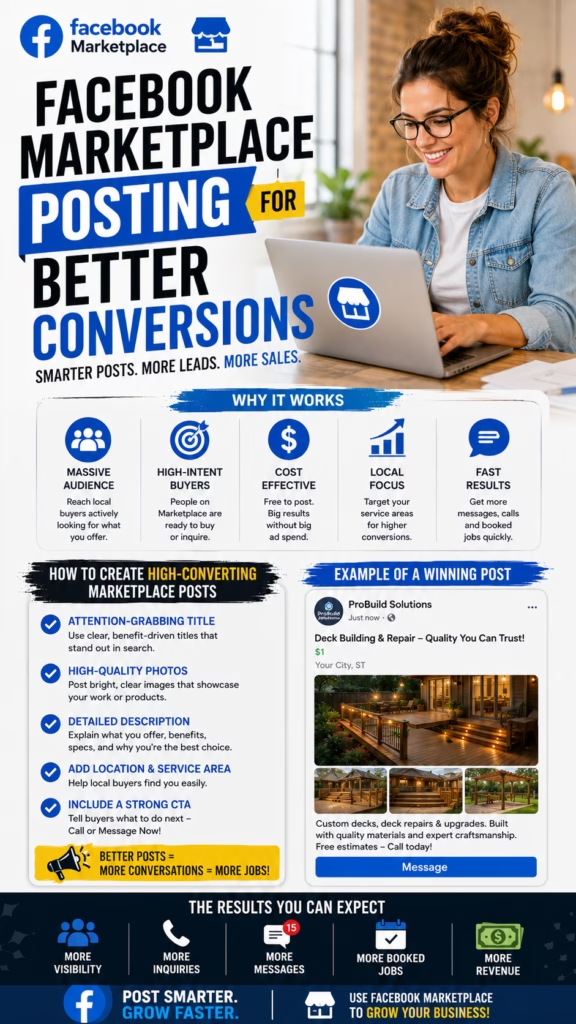
Facebook Marketplace Posting for Better Conversions
Facebook Marketplace posting for better conversions requires more than simply getting a listing in front of local shoppers. Visibility is useful, but visibility without buyer confidence, product clarity, accurate pricing, strong images, fast response, qualification, follow-up, and measurable sales outcomes can create activity without meaningful business growth. The strongest Marketplace strategy focuses on eligible physical products, specific listing titles, real or accurately represented inventory, useful descriptions, honest pricing, local relevance, prompt customer handling, CRM attribution, and continuous improvement based on the listings that actually generate purchases.
A Facebook Marketplace listing can get attention without generating meaningful business.
That distinction matters.
A listing may receive views.
Saves.
Messages.
Questions.
Yet none of those outcomes automatically create revenue.
A stronger Marketplace strategy asks a different question.
How many people who discover the listing become meaningful customer opportunities?
How many become qualified buyers?
How many call?
How many visit the business?
How many schedule the next step?
How many purchase?
How much revenue does the listing generate?
Those are conversion questions.
And conversion starts before the customer ever sends a message.
It starts with the listing.
The title determines whether the buyer understands the offer.
The main image determines whether the product earns attention.
The price affects whether expectations are realistic.
The description affects whether basic questions are answered.
The location affects whether the buyer is geographically relevant.
The product information affects whether the customer sees a fit.
Then the response process takes over.
How quickly does the business answer?
Does the response actually answer the question?
Does someone confirm the product?
Is availability accurate?
Is the price still correct?
Does the customer know what to do next?
All of those elements influence conversion.
That is why businesses should stop viewing Marketplace posting as simply a publishing task.
It is a customer acquisition workflow.
The listing creates attention.
The response creates conversation.
Qualification creates focus.
Follow-up creates additional opportunities.
CRM tracking creates accountability.
Revenue tracking shows whether the system works.
The Marketplace Conversion Formula
Right Product + Strong Title + Clear Main Image + Accurate Price + Useful Description + Local Relevance + Fast Response + Buyer Qualification + Clear Next Step + Follow-Up + CRM Tracking = Better Facebook Marketplace Conversions
What a Facebook Marketplace Conversion Actually Means
Conversion can mean different things depending on the business.
Qualified Inquiry
A serious local shopper contacts the business about a product that fits their need.
Phone Call
A Marketplace inquiry advances into a direct customer conversation.
Store Visit
A local buyer moves from digital discovery into a physical location.
Appointment
A qualified lead schedules a meaningful next step where appropriate.
Purchase
The buyer completes a transaction.
Revenue
Marketplace contributes measurable customer value to the business.
A business should define its preferred conversion before evaluating listing performance.
For a retailer, purchase may be the primary conversion.
For a high-ticket product seller, an appointment or store visit may be a useful intermediate conversion.
For a business selling products that require additional discussion, a qualified phone call may be meaningful.
The important point is to define something more valuable than a raw message.
Understand Marketplace Buyer Intent
Immediate Purchase Intent
Some buyers want to purchase today.
Comparison Intent
Some are comparing several products or sellers.
Price Research
Some shoppers are trying to understand market pricing.
Local Availability Intent
Some customers primarily want to know what they can buy nearby.
Feature Comparison
Buyers may be comparing size, color, material, style, model, condition, or specifications.
Future Purchase Intent
Some leads may be researching now but purchasing later.
Better Marketplace listings acknowledge those different buying stages by giving customers enough information to move forward without overwhelming them.
Use a Product-First Marketplace Strategy
One of the most important conversion principles is simple:
Sell the product first.
Make the Physical Item Obvious
Customers should understand the listing immediately.
Use Product-Specific Titles
Generic business advertising often creates weaker buyer intent.
Show the Product Clearly
The item should dominate the image.
Use Product-Specific Pricing
Avoid vague or misleading placeholder amounts.
Use Product-Specific Descriptions
Help the customer evaluate that exact item or category.
Keep Broader Business Messaging Secondary
Brand information can build trust, but the product should remain the primary reason for the listing.
Write Marketplace Titles That Attract Better Buyers
Start With What the Product Is
Do not force the buyer to interpret vague marketing language.
Add the Most Important Attribute
Size, material, style, model, color, condition, or brand can improve clarity.
Use Natural Buyer Language
Think about how a real customer describes the product.
Avoid Promotional Clutter
Excessive phrases such as “WOW,” “MUST SEE,” or repeated punctuation can make the title harder to scan.
Avoid Keyword Stuffing
More words do not automatically create more relevance.
Avoid Fake Scarcity
“Last one” should only be used when that statement is true.
Avoid Unsupported Claims
Do not use “best,” “cheapest,” or similar language unless there is a legitimate basis.
A Strong Title Filters Buyers Before They Contact You
Clear titles can reduce irrelevant messages because shoppers understand what the item is before opening the listing. Better clarity often means better lead quality.
Write Marketplace Descriptions That Improve Conversion
Start With the Product
The opening should immediately confirm what the buyer clicked.
Explain Important Features
Use factual product details that influence purchasing decisions.
Explain Size or Dimensions
Buyers often need to know whether the product fits their space or use case.
Explain Condition
New, used, floor model, open-box, or other conditions should be represented accurately.
Explain Price
Do not create a contradiction between the listing price and the description.
Explain Location
Help the customer determine whether buying locally makes sense.
Explain the Next Step
Make it easy for a serious buyer to move forward.
Avoid Unnecessary Filler
A long description should still be useful.
Use Better Marketplace Photos to Improve Buyer Confidence
Use Genuine Product Photography
Show the actual item or accurately represented inventory whenever possible.
Use Clear Lighting
Buyers should be able to see color, condition, texture, and details.
Use Multiple Angles
Different perspectives reduce uncertainty.
Show Important Details
Close-ups can help demonstrate finish, controls, packaging, materials, or other useful features.
Show Scale
For larger products, context can help customers understand dimensions.
Keep Backgrounds Clean
Visual clutter makes the item harder to evaluate.
Do Not Misrepresent Inventory
Stock or generated imagery should not be presented as the exact local item when it is not.
Improve the Main Marketplace Image
The first image carries disproportionate importance.
Make the Product Large
The customer should not have to search the frame.
Use Strong Contrast
The product should stand out naturally from the background.
Use a Useful Angle
Show the product from the perspective that best explains what it is.
Avoid Excessive Text
Graphics should not overwhelm the physical item.
Keep Mobile Viewing in Mind
Important details should still be understandable on a smaller screen.
Use Consistent Quality
Businesses with many listings can benefit from a repeatable image standard.
Your Main Image Is Your Marketplace Storefront
Buyers often make an extremely fast judgment while browsing. A clean, product-dominant first image gives the listing a better chance to earn the next action: opening, reading, asking, visiting, or buying.
Use Accurate Pricing to Improve Marketplace Conversion Quality
Price is one of the strongest conversion filters.
Use the Actual Product Price
Specific products should have specific pricing where appropriate.
Use Real Starting Prices
“Starting at” should correspond to a genuine item or approved offer.
Avoid Fake $1 Pricing
Low placeholders may create more clicks while producing worse customer expectations.
Avoid Fake $0 Pricing
Free-looking listings that are not free can reduce trust.
Keep Price and Description Consistent
Customers should not discover a completely different price after contacting the seller.
Update Pricing
Expired promotions and old prices create unnecessary friction.
More Messages Are Not Always Better
A fake low price may increase inquiries, but if most buyers disappear after learning the real cost, the listing has not improved conversion. Accurate pricing can produce fewer but more qualified prospects.
Strengthen Local Relevance
Use the Correct Market
Customers should understand where the item is located.
Use the Correct Business Location
Do not advertise under false geographic identities.
Consider Pickup Distance
Larger physical items may require realistic local travel.
Consider Delivery Area
Only state delivery availability when the business actually provides it.
Track Conversion by City
Some local markets may create stronger buyer intent than others.
Use Geographic Information to Qualify
Local accuracy can reduce unnecessary out-of-area inquiries.
Keep Marketplace Product Availability Accurate
Remove Sold Products
Customers should not continue contacting a business for unavailable items.
Update Changing Inventory
High-turnover products need regular review.
Avoid Absolute Availability Claims
If inventory changes quickly, use language that accurately reflects uncertainty.
Confirm Before Sending a Buyer
A customer should not drive to a location only to learn that the item is gone.
Track Frequently Sold-Out Listings
High demand may justify different inventory or listing strategies.
Describe Product Condition Clearly
New
Only describe an item as new when that is accurate.
Used
Show meaningful wear or limitations.
Floor Model
Explain whether the item has been displayed or handled.
Open Box
Clearly explain what that means for the product.
Damaged Packaging
Distinguish packaging damage from product damage.
Clearance
Clearance status should be genuine.
Include Product Attributes That Help Buyers Decide
Size
Essential for furniture, flooring, equipment, home products, and many physical goods.
Material
Material can influence quality, appearance, durability, and buyer preference.
Color
Use accurate names and photos.
Brand
Mention brands only when accurate.
Model
Model details can help buyers compare products.
Quantity
Make it clear whether pricing applies to one item, a set, a box, a pallet, or another unit.
Compatibility
Avoid claiming universal compatibility without a factual basis.
Build Trust Inside the Marketplace Listing
Use Accurate Business Information
Customers should know who they are dealing with when appropriate.
Use Genuine Photos
Visual accuracy increases confidence.
Use Accurate Product Details
Do not invent specifications.
Use Genuine Prices
Price surprises damage conversion.
Use Accurate Warranty Information
Warranty claims should match real terms.
Use Genuine Promotions
Do not create permanent fake discounts.
Keep the Listing Professional
Clear grammar, formatting, and product information can increase buyer confidence.
Create One Clear Customer Next Step
A buyer should not wonder what to do after reading.
Confirm the Item
The next action may be checking current availability.
Visit the Store
Local retailers may want qualified shoppers to visit.
Call About the Product
High-ticket products may benefit from a direct conversation.
Schedule an Appointment
Appropriate where a larger transaction requires an additional step.
Purchase Through the Approved Process
Keep the customer path simple.
Avoid Too Many Instructions
One primary action reduces friction.
Improve Marketplace Response Speed
Buyers often contact more than one seller.
A strong listing can still lose the sale if the customer waits too long for an answer.
Assign Responsibility
Someone should know who handles Marketplace inquiries.
Use Notifications
Avoid letting messages sit unnoticed.
Keep Product Information Accessible
Responders should not need to search for basic pricing and specifications.
Confirm Availability Quickly
Inventory questions are common.
Move Qualified Buyers Forward
Do not spend multiple messages repeating information already shown in the listing.
Write Better Marketplace Responses
Answer the Question First
If the customer asks about availability, answer availability.
Confirm the Product
Avoid confusion when multiple listings are active.
Use Accurate Pricing
Do not introduce unexpected fees or a completely different product.
Give Useful Details
Answer size, color, condition, location, or other relevant questions.
Guide the Buyer Forward
Create an appropriate next action.
Keep Responses Human and Clear
Overly robotic or irrelevant responses can reduce trust.
Qualify Marketplace Buyers Without Slowing Them Down
Confirm Product Fit
Make sure the buyer wants the correct item.
Confirm Location
Local geography may matter for pickup or store visits.
Confirm Quantity
Larger product orders may require additional coordination.
Confirm Timing
Is the customer buying now or researching?
Confirm Important Requirements
Size, color, material, model, or other factors may determine fit.
Do Not Over-Qualify
Simple purchases should not require an unnecessarily complex process.
Good Qualification Removes Friction
Qualification should help the customer reach the right product faster. It should not turn a simple Marketplace inquiry into a lengthy interrogation.
Turn Marketplace Inquiries Into Store Visits
Confirm Product Availability
Give the shopper confidence that the visit will be worthwhile.
Confirm the Correct Location
Multi-location businesses should avoid misrouting customers.
Keep Listing and Store Pricing Consistent
Unexpected differences can damage trust.
Track Walk-In Source
Ask whether the customer discovered the product through Marketplace.
Track Purchase Outcomes
A store visit is valuable, but a completed sale tells the stronger story.
Turn Marketplace Leads Into Appointments When Appropriate
Some products require more than a simple pickup.
High-Ticket Products
Customers may need an in-person consultation.
Large Product Categories
Buyers may want to compare samples, sizes, styles, or models.
Custom Orders
Additional product configuration may require an appointment.
Commercial Buyers
Larger quantity purchases can require more structured communication.
Track Appointment Completion
Do not stop measurement at the scheduled stage.
Turn Marketplace Interest Into Purchases
Maintain Product Consistency
The customer should encounter the same product they saw advertised.
Maintain Price Consistency
Unexpected pricing changes create friction.
Answer Final Questions
Reduce last-minute uncertainty.
Offer Appropriate Alternatives
If the exact item is not a fit, related genuine inventory may help the customer.
Track Purchase Value
Record the actual sale amount.
Track Additional Purchases
Some Marketplace customers buy more than the originally advertised product.
Follow Up With Qualified Marketplace Buyers
Not every buyer converts during the first conversation.
Follow Up on High-Ticket Products
Customers may need additional time to compare.
Follow Up After Store Visits
Buyers may leave without purchasing but remain interested.
Follow Up on Quantity Quotes
Larger orders may require approval.
Follow Up on Future Purchases
Some buyers may not be ready immediately.
Respect Customer Preferences
Follow-up should remain appropriate and stop when the customer indicates they no longer want contact.
Track Facebook Marketplace Leads in CRM
- Lead name
- Phone number where provided
- Email where provided
- Marketplace source
- Listing reference
- Product name
- Product category
- Advertised price
- Customer city or ZIP
- Quantity requested
- Purchase timing
- Qualification status
- Store visit status
- Appointment status where applicable
- Purchase status
- Final sale amount
- Repeat purchase opportunity
Suggested Marketplace Conversion Pipeline
- New Marketplace inquiry
- Responded
- Qualified
- Product confirmed
- Store visit / call / appointment
- Follow-up
- Purchased
- Lost
- Repeat opportunity
Measure Facebook Marketplace Conversion Rates
Inquiry Rate
How many people contact the business?
Qualified Lead Rate
How many inquiries represent realistic buyers?
Response-to-Visit Rate
How many conversations produce a store visit?
Response-to-Appointment Rate
How many qualified leads schedule the next step?
Lead-to-Purchase Rate
How many Marketplace leads actually buy?
Average Order Value
How much revenue does each customer generate?
Revenue per Listing
Which listings create the strongest economic return?
| Metric | What It Shows |
|---|---|
| Listing inquiries | Initial buyer interest |
| Qualified lead rate | Quality of listing traffic |
| Store visits | Online-to-offline conversion |
| Appointments | Progress on larger purchases |
| Purchases | Actual customer conversion |
| Average order value | Economic quality of buyers |
| Revenue per listing | Business value of Marketplace posting |
Track Marketplace Conversion by Product
High-Interest Products
Some listings generate many inquiries.
High-Conversion Products
Other products may produce fewer leads but more purchases.
High-Value Products
Some categories generate significantly higher customer revenue.
Low-Quality Products
Certain listings may attract many messages but poor buying intent.
Seasonal Products
Performance may vary throughout the year.
Clearance Products
Track whether Marketplace helps move aging inventory.
Track Marketplace Conversion by City and Local Market
Lead Volume
Which areas generate the most inquiries?
Lead Quality
Which cities generate serious buyers?
Purchase Rate
Which areas create actual sales?
Average Order Value
Buyer value may differ by market.
Pickup or Delivery Economics
Geography can influence profitability.
Store-Level Conversion
Multi-location businesses should compare local operations.
Test Marketplace Images for Better Conversion
Product-Only Image
Compare simple product-focused imagery.
Lifestyle Context
Show how the product looks in a realistic setting where appropriate.
Close-Up Detail
Highlight material or quality.
Wide Product View
Help buyers understand scale.
Minimal Text Overlay
Where appropriate, compare whether small amounts of truthful information improve clarity.
Track Downstream Conversion
Do not judge image performance only by clicks or messages.
Test Listing Titles Based on Customer Outcomes
Product + Size
Useful when size strongly affects buyer intent.
Product + Material
Useful for flooring, furniture, building materials, and similar categories.
Product + Brand
Useful when brand matters and the claim is accurate.
Product + Condition
Useful for floor models, open-box, or used products.
Product + Local Market
Accurate city wording may improve relevance.
Measure Purchases
The best title is the one that generates valuable buyers, not necessarily the most raw inquiries.
Evaluate Pricing Based on Conversion Quality
Conversion optimization does not always mean lowering price.
Higher Price, Better Buyer
Accurate premium pricing may attract fewer but more suitable customers.
Lower Price, More Volume
Lower pricing may create more inquiry volume but must remain economically viable.
Starting Price Strategy
Starting prices should remain genuine.
Bundle Pricing
Clearly explain what is included.
Clearance Pricing
Compare sale conversion against normal inventory.
Measure Revenue, Not Just Messages
Better pricing should create better economic outcomes.
Use Seasonal Marketplace Demand
Spring
Home improvement, outdoor, building, storage, and related categories may grow.
Summer
Outdoor products and project-related items may perform strongly in many markets.
Fall
Home preparation and seasonal inventory may shift buyer intent.
Winter
Indoor products may receive more attention in colder regions.
Holiday Periods
Genuine retail promotions can create stronger demand.
Local Climate Matters
Seasonal strategy should reflect the specific market.
Use Genuine Clearance Inventory to Create Conversion Opportunities
Floor Models
Describe condition accurately.
Discontinued Products
Genuine closeout pricing can attract local shoppers.
Open-Box Items
Explain exactly what the buyer is getting.
Overstock
Local inventory pressure can create real promotional opportunities.
Seasonal Closeout
Use clear pricing and availability.
Avoid Fake Clearance
False urgency may increase initial attention while reducing long-term trust.
Convert High-Ticket Marketplace Leads Differently
Expensive products often have longer sales cycles.
Provide More Product Detail
Buyers may need more information before visiting.
Use Better Visual Proof
Multiple clear photos can reduce uncertainty.
Expect More Questions
Higher-value purchases require confidence.
Move Toward a Conversation
A direct call or appointment may be appropriate.
Use Follow-Up
Buyers may take days or weeks to decide.
Track Full Customer Value
One high-ticket sale may justify significant marketing effort.
Facebook Marketplace Conversions for Local Retail Businesses
Promote Physical Inventory
Keep products central to the listing.
Use Genuine Store Pricing
Marketplace should match the local buying experience.
Use Real Store Inventory Photos
Customers appreciate seeing what is actually available.
Track Store Visits
Marketplace can influence offline shopping.
Track Final Purchases
Measure whether visitors actually buy.
Track Additional Sales
Customers may purchase related items after arriving.
Improve Marketplace Conversions for Multi-Location Businesses
Use Correct Local Inventory
Do not advertise products from another store without clear handling rules.
Use Correct Local Pricing
Pricing can differ by region or location.
Route Leads Correctly
Customers should reach the store responsible for the listing.
Track Location Conversion Rate
Some stores may respond and sell more effectively than others.
Standardize Listing Quality
Give each location approved title, image, and description frameworks.
Allow Accurate Local Variation
Consistency should not force stores to misrepresent price, inventory, or local information.
Use Automation Carefully to Support Marketplace Conversion
Automation is most useful behind the customer-facing listing.
Lead Routing
Send inquiries to the right person or location.
CRM Attribution
Tag Marketplace as the source.
Follow-Up Reminders
Prevent high-intent leads from being forgotten.
Performance Reporting
Compare products, cities, listings, and revenue.
Inventory Monitoring
Keep listings aligned with current products where operationally possible.
Content Organization
Maintain approved titles, images, descriptions, and product information.
Automation Should Not Replace Accuracy
Do not use automation to create fake products, misleading prices, false locations, fabricated availability, repetitive low-value spam, or activity designed to bypass platform restrictions. Useful automation improves response, routing, tracking, and reporting.
Connect Marketplace Conversion With Other Marketing Channels
Facebook Pages
Page content can build brand awareness and customer trust.
Product visuals can support broader discovery.
Google Maps
Customers may search for the business after discovering a Marketplace product.
Organic SEO
Product and local pages can capture additional demand.
Existing customers can be nurtured appropriately.
CRM
Centralized attribution helps compare channels.
Marketplace is strongest when it feeds into a complete local customer acquisition system rather than operating as an isolated source of messages.
Common Facebook Marketplace Conversion Mistakes
Vague Titles
Customers should immediately understand the product.
Poor Main Images
Weak visuals reduce buyer confidence.
Fake $1 Pricing
Misleading prices can attract the wrong audience.
Fake $0 Pricing
Customers should not believe an item is free when it is not.
Outdated Prices
Old pricing creates friction.
Unavailable Inventory
Listings should reflect current reality.
Misleading Product Photos
Do not present unrelated images as actual inventory.
Missing Dimensions
Buyers may need size information before contacting the seller.
Missing Condition Details
New, used, floor model, and open-box products should be distinguished.
Keyword-Stuffed Titles
Repetition can reduce readability.
Fake Urgency
Scarcity should be genuine.
Fake Discounts
Sale claims should have a factual basis.
False Locations
Geographic information should remain accurate.
Slow Responses
Buyers may choose another seller.
Generic Responses
Customers want answers relevant to the item.
No Qualification
Not every inquiry represents a serious buyer.
No Follow-Up
High-value buyers may need time.
No CRM Attribution
Businesses cannot measure sales without source tracking.
Measuring Messages Instead of Purchases
More conversations do not automatically mean more revenue.
Ignoring Platform Requirements
Listing formats, eligibility, categories, and policies can change.
A 30-Day Facebook Marketplace Conversion Optimization Plan
Week 1: Audit Current Listings
- Identify the highest-priority physical products
- Review listing titles
- Review product descriptions
- Review main images
- Review supporting photos
- Verify prices
- Verify inventory availability
- Verify local information
- Identify listings generating low-quality inquiries
- Define the primary conversion goal
Week 2: Rebuild Listing Quality
- Create clearer product-specific titles
- Create better product descriptions
- Improve main listing images
- Add useful detail photos
- Add accurate dimensions
- Add material and model details where appropriate
- Correct inaccurate pricing
- Remove unavailable products
- Add one clear customer next step
- Create genuine seasonal or clearance listings where relevant
Week 3: Improve Lead Conversion
- Assign responsibility for Marketplace responses
- Improve response speed
- Create product-specific response guidance
- Confirm availability quickly
- Qualify customer location
- Qualify product fit
- Move qualified buyers toward store visits or purchases
- Create follow-up reminders
- Track Marketplace as the lead source
- Record purchases and customer value
Week 4: Measure and Improve
- Compare inquiries by product
- Compare qualified lead rate
- Compare response speed
- Compare store visits
- Compare appointments
- Compare purchases
- Compare average order value
- Compare revenue by listing
- Compare conversion by city
- Identify poor-performing images
- Identify weak titles
- Improve future listings based on revenue rather than message volume
End-of-Month Outcome
After 30 days, the business should have clearer Marketplace listings, more accurate pricing, stronger product imagery, better-qualified customer conversations, faster response workflows, stronger lead follow-up, better CRM attribution, and a clearer understanding of which products and listings generate real customer revenue.
Final Takeaway: Better Marketplace Conversion Starts Before the First Message
Many businesses think Marketplace conversion begins after someone contacts them.
It begins much earlier.
It begins when the shopper sees the listing.
The title either creates clarity or confusion.
The image either builds interest or gets ignored.
The price either creates realistic expectations or creates friction later.
The description either answers questions or forces the buyer to work harder.
The location either makes sense or creates doubt.
The product either matches what the shopper wants or does not.
Every one of those decisions influences conversion.
That is why listing quality matters so much.
Product-first titles are clearer.
Strong photography is more convincing.
Accurate pricing attracts better-aligned buyers.
Useful descriptions reduce unnecessary questions.
Accurate local information reduces wasted inquiries.
Current inventory prevents customer disappointment.
The physical item should remain the center of the Marketplace experience.
A mattress listing should show the mattress.
A flooring listing should show the flooring.
A furniture listing should show the furniture.
An equipment listing should show the equipment.
A building-material listing should show the material.
A retail-product listing should show the product.
That sounds obvious.
Yet many listings bury the actual item under logos, giant promotional text, generic graphics, or unrelated marketing claims.
Buyers are browsing quickly.
Make the product obvious.
Then support it with useful information.
Size.
Material.
Condition.
Model.
Color.
Quantity.
Price.
Location.
Availability.
Those details help customers self-qualify.
A customer who knows the price before contacting you is more informed.
A customer who knows the dimensions is more informed.
A customer who knows the location is more informed.
A customer who has seen multiple product photos is more informed.
Better-informed buyers often create stronger sales conversations.
This is why fake low pricing can hurt conversion quality.
Imagine a product actually costs $700.
The listing says $1.
The business gets many messages.
But most people disappear when told the real price.
Did the listing perform well?
Not necessarily.
It generated activity.
But weak buying alignment.
Accurate pricing may generate fewer conversations.
Yet those conversations can be much more valuable.
Conversion optimization is not about maximizing every top-of-funnel number.
It is about improving the path toward revenue.
The same principle applies to images.
A flashy image may get attention.
But if the buyer cannot understand the product, attention does not help.
Strong product imagery reduces uncertainty.
Show the full item.
Show close details.
Show important angles.
Show scale.
Show actual condition.
Let the buyer understand what they would be purchasing.
Marketplace descriptions should continue that process.
Do not write descriptions only for algorithms.
Write for buyers.
What do they need to know?
What questions do they usually ask?
What would prevent them from buying?
What details determine whether the item fits?
Put those answers in the listing.
Then make the customer path simple.
A qualified buyer should know what happens next.
Visit the store.
Call about the product.
Confirm availability.
Schedule an appointment.
Move toward the approved purchase process.
The exact action depends on the business.
The principle remains the same.
Remove friction.
Response speed is another major part of the system.
A Marketplace shopper may contact several sellers in a few minutes.
They may ask everyone the same question.
“Is this available?”
The business that responds clearly has an opportunity.
But a strong response does more than say yes.
Confirm the item.
Answer the important question.
Confirm current information.
Give the customer a useful next step.
Do not overwhelm them with irrelevant sales language.
Do not make them repeat information unnecessarily.
Do not give robotic answers that ignore what they asked.
Customer experience influences conversion.
Qualification should improve that experience.
If the customer wants flooring, determine how much they need.
If they want furniture, confirm size.
If they want equipment, confirm model or application.
If they want multiple units, confirm quantity.
If location matters, confirm geography.
Ask only questions that help move the customer forward.
Then track what happens.
Did the buyer visit?
Did they call?
Did they schedule?
Did they buy?
How much did they spend?
Did they purchase additional products?
Did they become a repeat customer?
Those questions turn Marketplace from a posting activity into a measurable customer acquisition channel.
CRM tracking is critical.
Record Marketplace as the source.
Record the listing.
Record the product.
Record the price.
Record the location.
Record whether the lead qualified.
Record the final action.
Record the sale.
Record customer value.
Then compare.
Maybe one listing gets twenty messages and two sales.
Another gets six messages and five sales.
The second listing is likely far more valuable.
Maybe one product attracts many price shoppers.
Another attracts serious buyers.
Maybe one city produces more inquiries.
Another produces larger purchases.
Maybe one main image creates more messages.
Another creates fewer messages but better conversion.
Revenue data helps make those decisions.
That is why testing should focus on downstream outcomes.
Test titles.
Test main images.
Test product categories.
Test seasonal inventory.
Evaluate pricing.
Evaluate geographic performance.
But always ask what happens after the inquiry.
High-ticket products deserve special treatment.
Someone buying an expensive item may not convert immediately.
They may compare brands.
Compare stores.
Measure their space.
Talk with someone else.
Research financing where applicable.
Return days later.
That means follow-up matters.
A useful follow-up can answer remaining questions.
A reminder can restart the buying conversation.
A product update can create urgency when it is genuine.
But follow-up should remain respectful.
Marketplace inquiries are not permission for unlimited unwanted contact.
Better conversion comes from stronger customer experiences.
Not aggressive communication.
Businesses should also keep inventory current.
An unavailable product can generate frustration.
A customer sees the item.
Contacts the business.
Makes plans to buy.
Then learns it was sold days ago.
That is a poor conversion experience.
Remove old listings.
Update sold inventory.
Verify availability before sending customers to a store.
Keep product information aligned with reality.
Multi-location businesses need even stronger systems.
The correct product must be connected to the correct location.
The correct price must be shown.
The correct store must receive the lead.
The correct team must respond.
Then the conversion should be recorded against the correct location.
This creates accountability.
One store may respond in minutes.
Another may respond much later.
One may maintain accurate inventory.
Another may leave stale listings online.
One may track purchases.
Another may not.
Location-level reporting reveals those operational differences.
Automation can support the system.
Lead notifications.
CRM tagging.
Store routing.
Follow-up reminders.
Inventory synchronization.
Performance dashboards.
Approved listing libraries.
Those uses can improve efficiency.
But automation should not be used to create spam.
Do not flood categories with meaningless duplicate listings.
Do not create fake inventory.
Do not use false prices.
Do not create fake locations.
Do not claim products that are unavailable.
Do not attempt to bypass applicable platform restrictions.
Accuracy remains the foundation.
Marketplace should also connect with the broader local marketing system.
A customer discovers a product on Marketplace.
Then searches the company on Google.
Checks reviews.
Looks at the location.
Visits the website.
Checks Facebook.
Looks at Instagram.
Then decides whether to buy.
Customer journeys are not always single-channel.
Marketplace can create the first touch.
Google Maps can build confidence.
Social media can reinforce brand recognition.
CRM can manage follow-up.
The store can complete the sale.
That is why conversion should be evaluated across the whole customer path.
Avoid the common shortcuts.
Do not chase message volume with fake prices.
Do not use misleading images.
Do not hide basic product information.
Do not invent scarcity.
Do not create fake discounts.
Do not list products that do not exist.
Do not ignore customer questions.
Do not stop measuring after the first message.
Build stronger listings instead.
Better titles.
Better product images.
Better descriptions.
Better pricing.
Better local targeting.
Better inventory accuracy.
Better response.
Better qualification.
Better customer routing.
Better follow-up.
Better CRM tracking.
Better revenue attribution.
That is how Facebook Marketplace posting can create better conversions.
Frequently Asked Questions
1. How can Facebook Marketplace listings convert better?
Use clear product titles, accurate pricing, genuine photos, useful descriptions, local information, prompt responses, basic qualification, and an easy next step.
2. What counts as a Marketplace conversion?
A conversion can be a qualified inquiry, call, store visit, appointment, purchase, or other meaningful customer outcome depending on the business.
3. Do better Marketplace titles improve conversions?
Clear titles can attract more relevant buyers by identifying the product and its most important factual attributes.
4. Should Marketplace listings use real prices?
Yes. Accurate prices or genuine supported starting prices improve buyer expectations and qualification.
5. Should businesses use $0 or $1 placeholder prices?
Misleading placeholder pricing should be avoided because it can create poor customer expectations and low-quality inquiries.
6. How important are photos for Marketplace conversion?
Photos are highly important because buyers frequently evaluate the product visually before reading the full listing.
7. How many photos should a Marketplace listing include?
Use enough clear images to show the product, useful angles, details, and condition without unnecessary repetition.
8. Should the main image contain lots of promotional text?
The product should remain easy to identify. Any supporting text should remain truthful, useful, and visually secondary.
9. Should businesses use real inventory photos?
Genuine inventory photos can improve buyer confidence and reduce uncertainty about the advertised item.
10. How long should a Marketplace description be?
It should be long enough to answer important buyer questions while remaining easy to scan and focused on useful product information.
11. Should Marketplace listings include city information?
Accurate local information can help customers determine whether the product is convenient to buy or pick up.
12. Can product-specific listings convert better than generic listings?
Product-specific listings can improve clarity because the shopper immediately understands the physical item being offered.
13. Should major products have separate Marketplace listings?
Distinct products and categories can benefit from separate useful listings when they accurately represent genuine inventory.
14. Does response speed affect Marketplace conversion?
Prompt response can help businesses reach buyers while they are actively comparing local products and sellers.
15. How should businesses respond to Marketplace inquiries?
Confirm the product, answer the customer's question, verify availability, provide accurate information, and guide the buyer toward an appropriate next step.
16. Should Marketplace buyers be qualified?
Basic qualification can confirm product fit, location, quantity, timing, and whether the buyer is ready to move forward.
17. Can follow-up improve Marketplace conversions?
Appropriate follow-up can help qualified buyers who need additional time before making a purchase.
18. Should Marketplace leads be tracked in CRM?
Yes. CRM tracking connects Marketplace inquiries with visits, appointments, purchases, customer value, and revenue.
19. What Marketplace conversion metrics should businesses track?
Track inquiries, qualified leads, response time, store visits, appointments, purchases, average order value, revenue, and marketing return.
20. Should Marketplace performance be tracked by product?
Yes. Product-level reporting can identify which listings create the best combination of buyer quality and revenue.
21. Should Marketplace performance be tracked by city?
Yes. Local demand, buyer quality, order values, and conversion rates can vary across markets.
22. Can seasonal listings improve Marketplace conversion?
Seasonal listings can perform well when they match genuine local demand and current product availability.
23. Can clearance products convert well on Marketplace?
Genuine clearance inventory can attract strong buyer interest when condition, price, availability, and discount claims are accurate.
24. Should Marketplace listings use urgency?
Only when urgency is real. Fake scarcity or invented deadlines can reduce customer trust.
25. Should businesses use keywords in Marketplace titles?
Natural product terminology can improve clarity, while excessive keyword repetition should be avoided.
26. Can Marketplace complement Facebook Page marketing?
Yes. Marketplace can focus on product discovery while Page content can build broader brand visibility and trust.
27. Can Marketplace complement Google Maps?
Yes. Marketplace can introduce a product while Google Maps helps customers find and evaluate the local business.
28. What mistakes reduce Marketplace conversions?
Weak titles, poor images, fake prices, outdated inventory, inaccurate locations, slow response, weak qualification, no follow-up, and poor tracking can all reduce conversion.
29. Can automation improve Marketplace conversion?
Automation can improve internal lead routing, CRM attribution, reminders, reporting, and follow-up when used responsibly.
30. What is the main goal of Facebook Marketplace posting for better conversions?
The goal is to turn relevant product visibility into qualified buyer interest, meaningful customer actions, purchases, revenue, and measurable business growth.
30 Additional SEO Keywords
Use these supporting phrases naturally across Facebook Marketplace articles, local product marketing pages, conversion guides, FAQs, case studies, and relevant internal links.
Build a Stronger Facebook Marketplace Conversion System
MarketWiz.ai helps local businesses strengthen customer acquisition through automated advertising, local marketing, lead capture, follow-up, CRM integration, and measurable reporting designed to turn more local opportunities into real customers.
This article provides general information about Facebook Marketplace posting, product marketing, local advertising, lead generation, conversion optimization, CRM tracking, customer follow-up, retail marketing, and customer acquisition. It does not provide legal, tax, financial, advertising-law, intellectual-property, privacy, consumer-protection, financing, regulatory, compliance, or platform advice. Facebook Marketplace listing formats, available categories, account features, eligibility rules, geographic availability, prohibited-content policies, business-use rules, product restrictions, and other requirements can change. Businesses should review current Meta and Facebook Marketplace requirements before publishing listings. Product names, prices, starting prices, inventory, availability, quantities, locations, store information, brands, models, sizes, conditions, materials, warranties, discounts, promotions, specifications, product photographs, and other customer-facing information should remain accurate. Businesses should not fabricate products, inventory, reviews, locations, prices, availability, discounts, warranties, specifications, brands, conditions, or customer claims. Stock or generated imagery should not be presented as actual local inventory when it is not. Businesses should avoid misleading $0 or $1 placeholder pricing when it does not represent the genuine offer. Automation should not be used to fabricate identities, products, prices, inventory, or locations, flood Marketplace with deceptive low-value duplicate listings, or attempt to bypass applicable platform restrictions. Marketplace views, saves, inquiries, calls, store visits, appointments, purchases, revenue, conversion rates, and ROI cannot be guaranteed and may vary based on product category, local market demand, price, competition, listing quality, inventory, photography, customer response, seasonality, reputation, geographic market, follow-up, sales execution, product availability, store operations, and many other factors.













