
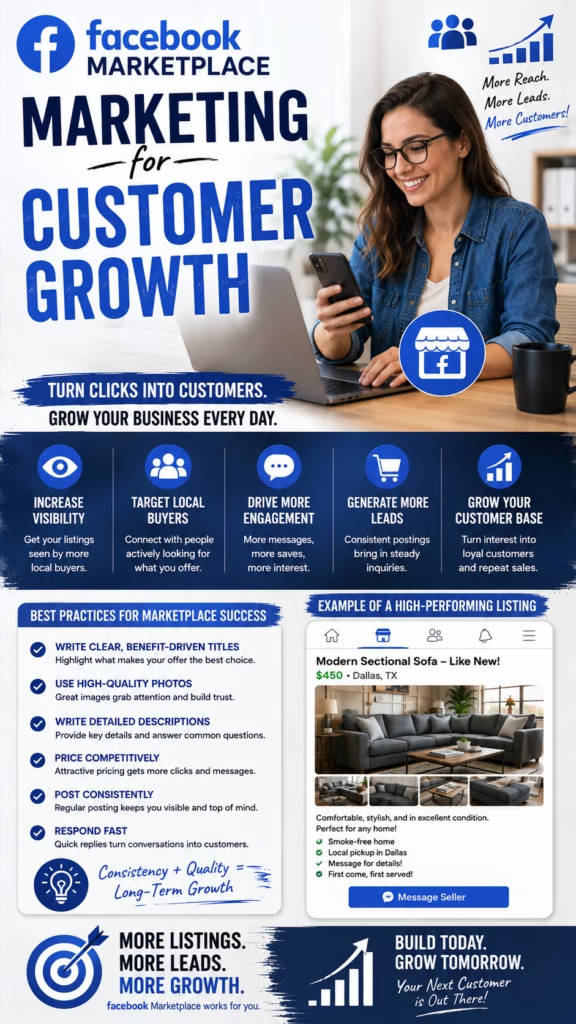
Facebook Marketplace Marketing for Customer Growth
Facebook Marketplace marketing for customer growth is most effective when businesses look beyond raw listing activity and build a complete customer-acquisition system around legitimate physical products, accurate pricing, strong images, useful specifications, real local information, fast buyer responses, lead qualification, CRM attribution, follow-up, purchase conversion, repeat-customer opportunities, and profitability measurement. The goal is not simply to generate more messages. The goal is to turn relevant Marketplace visibility into more qualified customers.
Facebook Marketplace can create visibility.
But visibility alone does not create customer growth.
A business can have many listings and still generate weak results.
It can receive hundreds of messages and still produce only a small number of real customers.
It can receive inquiries about products that are no longer available.
It can receive questions about prices that should have been explained in the listing.
It can receive messages from customers who live too far away to purchase or pick up the product.
It can receive low-intent questions that consume sales time without generating revenue.
Those problems happen when businesses think of Facebook Marketplace as a posting channel instead of a customer-acquisition channel.
Customer growth requires a broader system.
First, the business needs legitimate physical products people actually want.
The products need accurate prices.
They need strong photos.
They need useful descriptions.
They need specifications that help buyers understand what they are looking at.
The listing should accurately explain pickup, location, condition, quantity, and other relevant details.
When the buyer responds, the business needs a fast and useful response process.
That conversation should answer the buyer's immediate question.
It should confirm the correct product.
It should establish whether the product is still available.
It should determine whether the buyer is genuinely interested.
It should move the buyer toward the next appropriate step.
Then the business should track what happened.
Did the buyer purchase?
Did the buyer visit the store?
Did the buyer pick up the product?
Did the buyer purchase another product later?
Did the listing create a profitable customer?
Those answers determine whether Marketplace is supporting real customer growth.
The Facebook Marketplace Customer Growth Formula
Genuine Product + Accurate Price + Strong Images + Useful Specifications + Local Relevance + Fast Response + Buyer Qualification + CRM Attribution + Follow-Up + Purchase Conversion + Repeat Customer Tracking = Stronger Customer Growth
What Customer Growth Really Means on Facebook Marketplace
Customer growth is broader than generating more conversations.
More Qualified Buyers
The business attracts people who genuinely want the product being offered.
Better Conversion
A greater percentage of qualified Marketplace inquiries become actual customers.
Higher Customer Value
Buyers purchase larger quantities, higher-value products, or additional relevant items.
More Repeat Customers
A strong first purchase can create future business.
Better Local Market Penetration
The business becomes visible to more relevant local buyers.
Better Marketing Economics
Customer acquisition cost, gross profit, and ROI improve over time.
Start With Genuine Products Customers Actually Want
Product quality and product-market fit come before listing optimization.
Strong Demand
Products people already search for have a stronger foundation.
Clear Value
The customer should understand what makes the product worth considering.
Accurate Price
The listed price should reflect the real product and sales unit.
Current Availability
Do not build a campaign around products that are no longer available.
Useful Specifications
Buyers need enough information to determine whether the product fits.
Strong Visual Appeal
Product-focused photos can dramatically improve understanding.
Customer Growth Starts With Product-Market Fit
Better Marketplace marketing cannot permanently compensate for a weak product, unrealistic price, poor availability, or an offer buyers do not want.
Understand Facebook Marketplace Buyer Intent
Immediate Buyer
Some buyers are ready to purchase or pick up immediately.
Comparison Shopper
Others are comparing several similar listings.
Price Shopper
Some buyers primarily want the lowest price.
Specification Shopper
Others care about dimensions, material, model, color, condition, or quantity.
Future Buyer
Some prospects are researching before purchasing later.
Commercial Buyer
Businesses may need larger quantities or repeat purchases.
These buyer types should not all receive identical sales treatment.
Keep Facebook Marketplace Listings Appropriate for the Platform
Businesses should build customer growth around compliant, accurately represented listings.
List Genuine Physical Products
Where Marketplace is being used for physical goods, represent the actual item being sold.
Do Not Disguise Services as Products
A service-only offer should not be misrepresented as a physical item.
Use Accurate Pricing
Do not use misleading placeholder values simply to attract clicks.
Use Accurate Product Claims
Specifications, condition, quantity, brand, model, warranty, and other details should be factual.
Review Current Platform Rules
Facebook Marketplace rules, categories, interfaces, and eligible products can change.
Use Genuine Local Targeting to Support Customer Growth
Marketplace is highly influenced by geography.
Retail Stores
Focus on buyers who can realistically visit or pick up.
Warehouses
Product pickup areas should be explained accurately.
Delivery
Only claim delivery areas the business genuinely serves.
Multi-Location Businesses
Each location can be evaluated separately.
Commercial Buyers
Larger purchases may justify broader geographic reach where logistics make sense.
Local Relevance Improves More Than Visibility
When buyers are geographically realistic, sales conversations are more likely to progress toward pickup, store visits, delivery, or completed purchases.
Write Better Facebook Marketplace Titles
Lead With the Product
Tell the buyer exactly what is being sold.
Add an Important Specification
Size, material, model, style, finish, condition, quantity, or another real detail can improve relevance.
Add Price Context When Useful
If a price is per unit, square foot, piece, box, bundle, or another measure, clarify that accurately.
Use Local Context Carefully
Genuine city or regional terms can help establish pickup relevance.
Avoid Clickbait
The goal is buyer fit, not curiosity alone.
Marketplace Title Formula
[Real Product] + [Important Specification] + [Accurate Price or Local Context When Useful]
Write Product Descriptions That Help Customers Decide
Explain Exactly What Is Included
Clarify the physical item, quantity, package, or sales unit.
Explain Condition
New, used, open-box, refurbished, or other condition should be accurate.
Explain Dimensions
Buyers often need measurements before traveling.
Explain Material
Product composition may influence the purchase.
Explain Color or Finish
Especially important for furniture, flooring, cabinetry, décor, and home products.
Explain Pickup or Delivery
Only describe genuinely available options.
Explain the Next Step
Buyers should know how to continue the purchase conversation.
Use Accurate Marketplace Pricing to Improve Customer Growth
Pricing can improve both lead quality and conversion.
Use the Real Selling Price
Avoid fake $0 or $1 listings when they do not represent the product price.
Clarify Units
Per piece, per box, per square foot, per bundle, or per unit should be clear.
Clarify Quantity
A bulk price should not be confused with an individual-unit price.
Use Starting Prices Carefully
If a genuine product range begins at a specific amount, make clear what that amount actually applies to.
Avoid Unconfirmed Discounts
Do not invent sale percentages, clearance status, limited-time pricing, or other promotional claims.
Clear Pricing Helps Buyers Self-Qualify
Accurate pricing can reduce unnecessary messages while improving the percentage of inquiries from customers who understand the real cost.
Use Better Product Images to Improve Marketplace Conversion
Product images are one of the most important parts of Marketplace marketing.
Show the Entire Product
Buyers should understand what they are considering.
Show Important Details
Texture, hardware, controls, edges, grain, finish, packaging, or other product details can matter.
Show Scale
Furniture, equipment, flooring, cabinets, and larger products can benefit from visual context.
Show Condition Accurately
Used products should not be edited or photographed in a way that hides material defects.
Use Clean Backgrounds
Reduce distractions.
Keep Text Readable
If advertising graphics include price or product details, make sure the message is unambiguous.
Include Useful Specifications to Improve Marketplace Lead Quality
Specifications reduce uncertainty and unnecessary messaging.
Furniture
- Dimensions
- Material
- Color
- Condition
- Style
Flooring
- Product category
- Price per square foot
- Thickness
- Wear-layer or rating information where verified
- Finish or color
- Package quantity where relevant
Appliances
- Brand
- Model
- Dimensions
- Condition
- Major verified features
Equipment
- Model
- Capacity
- Power requirements
- Condition
- Attachments
Keep Facebook Marketplace Inventory Current
Remove Sold Products
Outdated listings generate frustration.
Update Quantities
Bulk sellers should know what is actually available.
Update Price Changes
The listing should match current selling terms.
Update Product Variants
Colors, finishes, sizes, or models should remain accurate.
Maintain a Source of Truth
Inventory data should come from a reliable internal system where possible.
Inventory Accuracy Is Part of Customer Experience
Customer growth becomes harder when buyers repeatedly respond to products that are unavailable or inaccurately described.
Respond Quickly to Facebook Marketplace Leads
Buyers often compare multiple listings at once.
Preserve Listing Context
Know exactly which product the customer contacted you about.
Answer the Buyer
Address the actual question.
Confirm Availability
Make sure the product remains available before advancing the conversation.
Clarify Price or Quantity
Prevent misunderstandings.
Give the Next Step
Pickup, store visit, approved delivery discussion, quantity confirmation, or another legitimate purchase step should be clear.
Use a Better Marketplace First-Response Formula
Answer
Respond directly to the buyer's question.
Confirm
Confirm product, price, availability, or important specifications.
Qualify
Ask one useful question about quantity, timing, location, or product needs.
Advance
Move the buyer toward the appropriate purchase step.
Marketplace First-Response Formula
Answer → Confirm → Qualify → Advance
Qualify Facebook Marketplace Buyers Efficiently
Product Fit
Does the product match what the buyer needs?
Quantity
Does the buyer need one unit or a larger amount?
Location
Can the buyer realistically pick up, visit, or receive the product?
Timing
Are they buying now or researching?
Specifications
Do dimensions, material, finish, model, or other requirements match?
Purchase Readiness
Is the buyer ready to move toward a real transaction?
Prioritize Marketplace Leads by Purchase Intent
High Intent
Buyers asking about pickup time, exact location, quantity, or payment may deserve faster attention.
Qualified Comparison Shopper
Prospects comparing specifications or prices may still be strong opportunities.
Future Buyer
Some prospects may need follow-up later.
Geographic Mismatch
Buyers outside practical geography may require less sales effort.
Product Mismatch
If the product does not meet their requirements, the conversation can be closed efficiently.
Commercial Opportunity
Larger quantity buyers may deserve more detailed qualification.
Use Internal Listing IDs for Better Marketplace Attribution
Listing-level tracking creates much better customer data.
Identify the Product
Every offer can have a unique internal reference.
Identify the Product Category
Furniture, flooring, appliances, equipment, and other categories can be compared.
Identify the Market
Local performance can be analyzed.
Identify the Lead
Each inquiry can retain the original listing reference.
Identify Revenue
Completed purchases can be connected to the listing that generated them.
Connect Facebook Marketplace Leads to CRM
Marketplace becomes more valuable when leads do not disappear inside separate conversations.
- Customer name
- Phone number where voluntarily provided
- Email where appropriate
- Marketplace source
- Listing ID
- Product category
- Specific product
- Quantity requested
- Customer location
- Qualification status
- Follow-up status
- Purchase status
- Order value
- Repeat-customer status
CRM Tracking Turns Marketplace Messages Into Customer Data
Once inquiries are connected with listings, products, markets, purchases, and repeat customers, businesses can make much better marketing decisions.
Route Facebook Marketplace Leads Efficiently
Product Specialist
Route technical questions to someone who understands the product.
Store Location
Multi-location retailers can route buyers to the closest appropriate store.
Inventory Manager
Quantity or availability questions may need internal confirmation.
Commercial Sales
Large quantity requests may need a specialized sales process.
Customer Support
Existing-customer issues should not be confused with new sales inquiries.
Build a Marketplace Follow-Up System
Not every qualified Marketplace buyer purchases immediately.
Product Follow-Up
Reconnect when a buyer asked serious questions but did not complete the purchase.
Quantity Follow-Up
Larger orders may require additional coordination.
Future Purchase Follow-Up
Buyers researching for a later project may become future customers.
Alternative Product Follow-Up
If the original item is unavailable, verified comparable products may be discussed when relevant.
Reasonable Frequency
Follow-up should be useful and respectful rather than excessive.
Turn Marketplace Buyers Into Repeat Customers
Customer growth becomes stronger when Marketplace produces more than one transaction per buyer.
Track the First Purchase
Know what product brought the customer in.
Track Future Purchases
Repeat business can reveal greater channel value.
Identify Related Products
Relevant complementary products can create additional value.
Support Good Customer Experience
Accurate listings and organized communication can improve trust.
Measure Lifetime Value
The first Marketplace sale may represent only part of the customer relationship.
Automate Administrative Work Around Marketplace Leads
Inventory Synchronization
Keep listing information aligned with actual inventory.
Lead Capture
Create structured records from qualified inquiries.
Lead Routing
Send inquiries to the correct location or representative.
CRM Entry
Preserve product and source context.
Follow-Up Reminders
Prevent good leads from being forgotten.
Reporting
Summarize leads, customers, revenue, acquisition cost, and ROI.
Use AI to Improve Marketplace Efficiency Without Inventing Details
Draft Product Listings
AI can organize verified product information into clear copy.
Create Title Options
AI can structure titles around real specifications.
Answer Repetitive Questions
Approved answers can reduce manual workload.
Collect Qualification Data
AI can ask about quantity, location, timing, or product requirements.
Summarize Buyer Conversations
Sales representatives can receive structured notes.
Create CRM Records
Lead details can be organized for attribution.
Do Not Let AI Invent Marketplace Claims
Never fabricate price, inventory, availability, discounts, clearance status, product condition, specifications, warranty, financing, brand, quantity, delivery, reviews, or other material facts.
Test Facebook Marketplace Listings Using Customer Outcomes
Test Product Selection
Compare genuine products with different demand profiles.
Test Title Structure
Determine which clear title formats generate stronger buyers.
Test Product Images
Compare accurate visual presentation.
Test Description Depth
More information may reduce repetitive questions.
Test Price Presentation
Make units and starting-price context clearer.
Judge by Customers
Do not select a winning listing only because it generated more messages.
A Better Listing Produces Better Customer Economics
The best-performing listing may be the one with fewer inquiries but stronger purchase conversion, larger orders, repeat customers, and gross profit.
Facebook Marketplace Customer Growth for Furniture Sellers
Show Dimensions
Buyers need to know whether furniture fits their space.
Show Material
Wood type, upholstery, metal, laminate, or other materials should be accurate.
Show Condition
New and used furniture require different buyer expectations.
Use Multiple Angles
Buyers should see the entire piece.
Explain Pickup
Large furniture may require a vehicle, loading help, or other logistics.
Track Category Performance
Sofas, tables, mattresses, bedroom furniture, and other categories can produce different conversion rates.
Facebook Marketplace Customer Growth for Flooring Sellers
List Physical Flooring Products
Make the material product the center of the offer.
Use Real Per-Square-Foot Prices
Buyers should understand the material price clearly.
Identify Flooring Category
Laminate, luxury vinyl, engineered hardwood, or another real product type should be clear.
Show Planks and Texture
Buyers need visual context for color and finish.
Use Verified Specifications
Thickness, wear layer, rating, construction, or other details should only be used when confirmed.
Keep Service Language Secondary
If separately available, installation or related services should not replace the physical product as the listing's primary offer.
Facebook Marketplace Customer Growth for Appliance Sellers
Use Brand and Model
Specific model information can improve buyer confidence.
Use Accurate Condition
New, scratch-and-dent, used, or refurbished should be represented truthfully.
Show Dimensions
Appliance fit is often critical.
Show Major Features
Only include verified features.
Explain Pickup or Delivery
Use only genuine logistics options.
Track Product-Level Sales
Refrigerators, washers, dryers, ranges, and other categories may produce different margins and customer values.
Facebook Marketplace Customer Growth for Home Improvement Products
Doors
Show dimensions, material, swing configuration where relevant, and condition.
Cabinets
Show style, dimensions, finish, and unit pricing accurately.
Windows
Dimensions and specifications matter.
Fencing Materials
Clarify panel, post, gate, or bundle pricing.
Building Materials
Explain quantity and pricing units clearly.
Avoid Service-Only Listings
Keep the physical material central where Marketplace rules require a physical product.
Facebook Marketplace Customer Growth for Equipment Sellers
Use Model Information
Buyers often search by exact equipment type.
Use Accurate Condition
Wear and operating condition should be represented truthfully.
Show Attachments
Clarify what is actually included.
Show Capacity or Ratings
Verified technical information can help buyers qualify.
Use Multiple Images
Controls, engine areas, tires, accessories, and overall condition can matter.
Qualify Commercial Buyers
Quantity, logistics, and operating requirements may matter for business customers.
Facebook Marketplace Customer Growth for High-Ticket Products
Provide More Information
Higher prices generally require greater confidence.
Use Better Photography
Buyers may want more detailed visual proof.
Use Accurate Pricing
Unrealistic teaser prices can damage lead quality.
Qualify Purchase Timing
Determine whether the buyer is actively shopping.
Use Structured Follow-Up
Higher-value purchases can require multiple conversations.
Track Gross Profit
Revenue alone does not determine customer-acquisition quality.
Facebook Marketplace Customer Growth for Multi-Location Businesses
Track Leads by Location
Know which store or warehouse generated the customer.
Track Inventory by Location
Do not send buyers to a location without the product.
Route Buyers Properly
Send leads to the closest relevant location.
Compare Customer Conversion
Some locations may have stronger buyer demand.
Compare Average Order Value
Customer value may differ between markets.
Compare Customer Acquisition Cost
Local economics should influence future Marketplace effort.
Build a Complete Facebook Marketplace Customer Journey
Customer growth becomes easier when the business understands each stage.
- Marketplace listing viewed
- Buyer sends inquiry
- Initial response sent
- Product and availability confirmed
- Buyer qualified
- Pickup, store visit, delivery discussion, or purchase step established
- Customer purchases
- Revenue recorded
- Customer added to CRM where appropriate
- Repeat-customer opportunity identified
- Future purchases tracked
Each stage gives the business another opportunity to improve conversion.
Track the Right Facebook Marketplace Customer Growth Metrics
Valid Inquiries
How many real buyers contacted the business?
Qualified Leads
How many buyers fit the product, geography, price, and purchasing requirements?
Purchase Conversion
How many qualified buyers became customers?
Average Order Value
How much revenue did the average Marketplace customer generate?
Repeat Customer Rate
How many buyers returned later?
Gross Profit
How much profit did Marketplace customers generate?
| Metric | Why It Matters |
|---|---|
| Valid Marketplace inquiries | Measures genuine customer interest |
| Qualified lead rate | Measures listing and targeting quality |
| Purchase conversion | Measures lead-to-customer effectiveness |
| Average order value | Measures customer revenue quality |
| Repeat customer rate | Measures long-term customer growth |
| CAC | Measures acquisition efficiency |
| Gross profit and ROI | Measures overall Marketplace economics |
Measure Facebook Marketplace Customer Acquisition Cost
Marketplace CAC = Total Attributable Marketplace Marketing and Lead-Handling Cost ÷ New Customers Attributed to Facebook Marketplace
Include Relevant Marketing Cost
Listing creation, management, creative production, software, and related campaign resources may be included where appropriate.
Include Relevant Lead-Handling Labor
Sales and administrative time can affect true acquisition cost.
Use Customers as the Denominator
Messages do not equal customers.
Compare by Product Category
Some categories may acquire customers more efficiently than others.
Compare by Market
Local customer economics can differ significantly.
Measure Facebook Marketplace ROI for Customer Growth
Qualified Lead Rate
Qualified Lead Rate = Qualified Marketplace Leads ÷ Valid Marketplace Inquiries × 100
Purchase Conversion Rate
Purchase Conversion = New Marketplace Customers ÷ Qualified Marketplace Leads × 100
Repeat Customer Rate
Repeat Customer Rate = Repeat Marketplace Customers ÷ Total Marketplace Customers × 100
Customer Acquisition Cost
Marketplace CAC = Marketplace Acquisition Cost ÷ New Marketplace Customers
Marketplace ROI
ROI = (Gross Profit From Marketplace Customers − Marketplace Marketing Cost) ÷ Marketplace Marketing Cost × 100
These metrics become more valuable when reviewed by product, category, location, listing, and time period.
Common Facebook Marketplace Marketing Mistakes That Limit Customer Growth
Using Fake Placeholder Prices
Misleading pricing can produce poor customer expectations.
Using Service-Only Listings as Products
Listings should accurately represent legitimate physical products where Marketplace requires them.
Using Weak Product Photos
Buyers may not understand the product clearly enough to inquire.
Using Thin Descriptions
Missing information creates repetitive questions.
Missing Specifications
Buyers cannot determine whether the product fits.
Leaving Sold Products Active
Outdated inventory wastes buyer time.
Slow Responses
Buyers may purchase from another seller.
Not Qualifying Buyers
Sales teams can waste time on low-probability conversations.
Not Tracking Listing Source
The business cannot determine which products generate customers.
Measuring Messages Instead of Purchases
High inquiry volume can hide weak conversion.
Ignoring Repeat Customers
Marketplace may generate more value than the initial order alone suggests.
Inventing Promotional Claims
Discounts, warranties, financing, availability, or reviews should not be fabricated.
A 30-Day Facebook Marketplace Customer Growth Plan
Week 1: Audit the Foundation
- List all genuine physical products being promoted
- Verify current prices
- Verify inventory availability
- Verify product specifications
- Review product categories
- Review local markets
- Review current titles
- Review descriptions
- Review product images
- Document current Marketplace customer results
Week 2: Improve Marketplace Listings
- Prioritize high-demand products
- Improve product-focused titles
- Add accurate prices
- Clarify pricing units
- Add useful product specifications
- Improve product photography
- Clarify pickup or genuine delivery options
- Remove outdated products
- Create internal listing IDs
- Create one reliable inventory source
Week 3: Improve Marketplace Lead Conversion
- Create first-response workflows
- Preserve listing context
- Confirm product availability
- Ask quantity where relevant
- Ask location where relevant
- Ask purchase timing
- Prioritize high-intent buyers
- Connect qualified leads to CRM
- Create lead-routing rules
- Create follow-up reminders
Week 4: Optimize for Customer Growth
- Track valid inquiries
- Track qualified lead rate
- Track response time
- Track purchase conversion
- Track average order value
- Track repeat customers
- Compare product categories
- Compare local markets
- Calculate Marketplace CAC
- Calculate gross profit
- Calculate Marketplace ROI
End-of-Month Outcome
After 30 days, the business should have stronger Marketplace product listings, clearer pricing, better images, improved local relevance, faster buyer responses, stronger qualification, better CRM attribution, improved purchase conversion, clearer repeat-customer tracking, and a much better understanding of which products and markets create profitable customer growth.
Final Takeaway: Facebook Marketplace Customer Growth Is About Customers, Not Listings
Effective Facebook Marketplace marketing for customer growth should not be evaluated by the number of listings a business publishes.
It should not be evaluated only by how many people click.
It should not be evaluated only by how many messages arrive.
Customer growth is the outcome that matters.
A real customer purchases.
A real customer creates revenue.
A good customer can create gross profit.
A strong customer relationship can lead to future purchases.
That is what Marketplace marketing should ultimately support.
The process begins with the product.
The business should promote legitimate physical products that people genuinely want.
The price should be real.
The quantity should be clear.
The specifications should be accurate.
The condition should be truthful.
The images should represent the actual product or an accurate representation of the product being offered.
The local information should be real.
The listing should give buyers enough information to decide whether the product fits.
That creates better self-qualification.
A shopper who knows the dimensions can decide whether furniture fits.
A flooring buyer who knows the per-square-foot price can compare budget.
An appliance buyer who knows the model can verify whether it meets their needs.
An equipment buyer who knows capacity can determine whether it fits the job.
Better listing information reduces unnecessary conversations.
Once a buyer sends a message, the response process becomes part of marketing.
Speed matters.
Relevance matters.
Context matters.
The business should know exactly which listing generated the inquiry.
The buyer should not have to explain the product again.
The response should answer the immediate question.
It should confirm availability.
It should clarify price or quantity if necessary.
Then it should move the buyer toward a real next step.
That could be a store visit.
It could be pickup.
It could be quantity confirmation.
It could be an approved delivery discussion.
It could be a larger commercial quote.
The next step depends on the product and business.
Qualification protects sales time.
A buyer asking whether the product is still available may only be at the beginning of the shopping process.
A buyer asking when they can pick it up may have stronger intent.
A buyer asking whether ten units are available may represent a larger commercial opportunity.
A buyer outside the practical pickup territory may be less likely to convert.
The business should recognize those differences.
High-intent opportunities deserve faster attention.
Qualified future buyers can be followed up with later.
Product mismatches can be handled efficiently.
Large opportunities can be routed to the appropriate representative.
CRM attribution makes all of this measurable.
Every qualified Marketplace lead can carry a listing ID.
It can carry the product.
It can carry the category.
It can carry the local market.
It can carry buyer qualification information.
It can carry purchase status.
It can carry order value.
It can carry repeat-customer status.
That information answers much better marketing questions.
Which products produce the most qualified buyers?
Which products produce the highest purchase conversion?
Which local markets produce stronger order values?
Which categories produce better gross profit?
Which listings create many messages but few purchases?
Which Marketplace customers purchase again?
Those insights can improve future customer growth.
Repeat customers are especially important.
A Marketplace customer may begin with one product.
A flooring customer may later need another room.
A furniture customer may later need another piece.
A commercial buyer may return for more quantity.
A landlord may need additional materials.
A contractor may become a repeat wholesale buyer.
Those future purchases increase the value of the original Marketplace lead.
That is why businesses should track customer lifetime value where practical.
AI and automation can improve the efficiency of the entire system.
AI can help organize product data.
It can help draft titles.
It can help structure descriptions.
It can answer approved repetitive questions.
It can ask how many units the buyer needs.
It can collect geographic information.
It can summarize conversations.
It can create CRM records.
It can route opportunities.
It can trigger follow-up workflows.
But automation should never reduce accuracy.
AI should not invent prices.
It should not invent stock availability.
It should not invent discounts.
It should not invent warranty coverage.
It should not invent financing.
It should not invent specifications.
It should not invent reviews.
It should not invent delivery options.
It should not invent clearance claims.
It should not make any other material customer-facing claim that is not verified.
Trust supports customer growth.
Accurate information supports trust.
The final step is measurement.
Track valid Marketplace inquiries.
Track qualified leads.
Track response time.
Track purchase conversion.
Track average order value.
Track repeat customers.
Track customer acquisition cost.
Track gross profit.
Track ROI.
Then compare those numbers by listing.
Compare them by product.
Compare them by category.
Compare them by location.
Compare them over time.
That is how Facebook Marketplace becomes a measurable part of a larger customer growth strategy.
The objective is not more posting for the sake of posting.
It is more qualified customers.
Better customers.
Higher-value customers.
More repeat customers.
And stronger economics from the local visibility the business is already creating.
Frequently Asked Questions
1. What is Facebook Marketplace marketing for customer growth?
It uses legitimate product listings, accurate local information, strong images, clear pricing, useful descriptions, fast responses, qualification, CRM attribution, follow-up, and conversion measurement to acquire more customers.
2. Can businesses use Facebook Marketplace to grow their customer base?
Businesses may use eligible Marketplace listings to reach local buyers when the listings accurately represent genuine products and comply with current platform requirements.
3. What kinds of products work well on Facebook Marketplace?
Eligible physical products with clear pricing, strong images, useful specifications, real local relevance, and genuine buyer demand can be good candidates.
4. Should service businesses list services as products?
Businesses should follow current Marketplace rules and should not misrepresent service-only offers as physical products.
5. How can Marketplace listings attract more qualified buyers?
Use clear product titles, accurate pricing, useful specifications, strong images, genuine local information, current availability, and fast response.
6. Should Marketplace listings include real prices?
Yes. Prices should accurately represent the product and selling unit rather than using misleading placeholders.
7. Do product photos matter on Facebook Marketplace?
Yes. Strong product images help customers evaluate appearance, condition, texture, scale, finish, and other important details.
8. What should a Facebook Marketplace title include?
A title can include the real product, an important specification, and accurate price or local context where useful.
9. How important are Marketplace descriptions?
Descriptions help answer buyer questions about dimensions, material, condition, price, quantity, pickup, and other important details.
10. Should businesses include product specifications?
Yes. Specifications help buyers determine whether the product fits their needs before contacting the seller.
11. Does local targeting matter on Facebook Marketplace?
Yes. Local relevance can improve the likelihood that an interested buyer can realistically visit, pick up, or receive the product.
12. How quickly should businesses respond to Marketplace leads?
As promptly as practical because buyers may be evaluating multiple competing listings.
13. What should the first response include?
Answer the buyer's question, confirm important product information, ask a useful qualification question, and give the next purchase step.
14. Should Facebook Marketplace leads be qualified?
Yes. Product fit, quantity, geography, timing, specifications, and purchase readiness can all matter.
15. Should Marketplace leads be tracked in a CRM?
Yes. CRM attribution can connect a Marketplace inquiry with its product, listing, market, purchase, revenue, and repeat-customer outcome.
16. Can businesses track Marketplace leads by listing?
Yes. Internal listing IDs can connect individual product listings with leads, purchases, and revenue.
17. Can AI help with Marketplace lead management?
AI can support approved intake, common questions, qualification, summaries, CRM organization, routing, and follow-up.
18. Can AI write Facebook Marketplace listings?
AI can organize verified product information into clearer titles and descriptions without inventing material facts.
19. Should AI invent discounts or availability claims?
No. Discounts, inventory, availability, warranty, financing, specifications, reviews, and other material claims should remain accurate.
20. Should businesses follow up with Marketplace leads?
Qualified buyers can benefit from reasonable follow-up when they have expressed genuine interest but have not yet completed the next step.
21. How can Marketplace marketing increase repeat customers?
Strong customer experiences, accurate information, CRM tracking, appropriate follow-up, and relevant future product offers can support repeat business.
22. Should businesses keep Marketplace inventory current?
Yes. Sold or unavailable items should be updated or removed to avoid wasting buyer time.
23. What Marketplace metrics should businesses track?
Track valid inquiries, qualified leads, response time, purchase conversion, average order value, repeat customers, CAC, gross profit, and ROI.
24. How should Marketplace lead quality be measured?
Measure product fit, geography, purchase intent, quantity, price alignment, timing, and progression toward a completed transaction.
25. Can Facebook Marketplace customer growth be guaranteed?
No. Results depend on buyer demand, competition, product quality, pricing, inventory, geography, listing quality, response speed, and sales execution.
26. Should Marketplace performance be tracked by product category?
Yes. Product and category tracking can reveal which offers create stronger customer conversion and profitability.
27. Should Marketplace marketing focus on messages or customers?
Customers. Message volume is useful, but completed purchases and profit are stronger indicators of marketing value.
28. What is Facebook Marketplace customer acquisition cost?
It is the attributable Marketplace marketing and lead-handling cost divided by the number of new customers attributed to Marketplace.
29. What is the biggest Marketplace marketing mistake businesses make?
Measuring success by posting or message volume instead of qualified buyers, purchases, customer value, acquisition cost, and profitability.
30. What is the goal of Facebook Marketplace marketing for customer growth?
The goal is to turn legitimate Marketplace product visibility into qualified buyer inquiries, completed purchases, repeat customers, revenue, and measurable customer acquisition.
30 Additional SEO Keywords
Use these supporting phrases naturally across Facebook Marketplace marketing guides, lead-generation pages, product marketing resources, case studies, FAQs, and internal links.
Turn Facebook Marketplace Into a Stronger Customer-Growth System
MarketWiz.ai helps businesses organize Facebook Marketplace campaigns, improve product-focused titles and descriptions, structure genuine product data, qualify buyer inquiries, connect CRM workflows, improve follow-up, and measure customers, repeat purchases, revenue, customer acquisition cost, gross profit, and return on investment.
This article provides general Facebook Marketplace marketing, product-listing, lead-generation, CRM, automation, customer-acquisition, conversion, and business information and does not provide legal, tax, financial, privacy, consumer-protection, licensing, regulatory, employment, housing, commerce, or platform advice. Facebook Marketplace eligibility, categories, interfaces, commerce requirements, listing limits, product rules, and policies can change. Businesses should review current Meta and Facebook Marketplace requirements and all applicable laws before implementing campaigns. Listings should represent legitimate eligible products and use accurate prices, locations, inventory, availability, quantities, specifications, condition, images, pickup information, genuine delivery options where offered, warranties, financing information, discounts, reviews, and other material customer-facing facts. Businesses should not disguise prohibited or service-only offers as physical products, use fake placeholder prices, fabricate inventory differences, misrepresent product condition, or invent promotional claims. Marketplace inquiry volume, qualified leads, purchases, repeat customers, revenue, customer acquisition cost, gross profit, and marketing results cannot be guaranteed and depend on buyer demand, competition, product quality, pricing, inventory, geography, listing quality, platform activity, response speed, qualification, follow-up, sales execution, operational capacity, and other business factors.