
Market Wiz AI

Market Wiz

With ingenious automation fused with human dedication 24/7, Market Wiz puts the local marketing competition on notice – they’ve created a new standard operating system for dominating every digital front.All-Platform Compatibility: Facebook, Craigslist, Google, you name it. This system plays well with all the big players, ensuring your ads are everywhere they need to be.The Cherry on Top: There's a ton more under the hood, each feature adding more muscle to your marketing efforts.Bottom line: Market Wiz.ai isn’t just another tool; it’s your 24/7 digital marketing powerhouse. In the world of local advertising, it's the smartest move you’ll make.Market Wiz automates your online ads.|

How Automation Boosts Test-Drive Requests

ChatGPT Image Mar 4 2026 01 36 29 PM
How Automation Boosts Test-Drive Requests

How Automation Boosts Test-Drive Requests

How Automation Boosts Test-Drive Requests is the modern playbook for turning visibility into booked appointments—by combining consistent inventory activity, instant replies, buyer qualification, follow-ups, and frictionless scheduling.

Automation Wins Because It Improves: Freshness Speed-to-Lead Follow-Up Scheduling Consistency Conversion

Note: This is general guidance. Follow platform rules and local laws, disclose vehicle details accurately, and avoid spammy duplication patterns. If you automate messaging, ensure your replies remain truthful and respectful.

Introduction

How Automation Boosts Test-Drive Requests comes down to one simple reality: buyers shop fast, and sellers lose leads when they can’t respond, follow up, and schedule quickly.

Automation doesn’t “replace” selling. It replaces delay.

Most dealers and independent sellers don’t struggle because their vehicles are bad. They struggle because their system is inconsistent:

  • Listings go stale and disappear from feeds
  • Photos and titles don’t win clicks
  • Replies arrive late (or not at all)
  • Follow-up doesn’t happen
  • Scheduling takes too many messages

Big idea: Test-drive requests increase when you remove friction at every step—visibility, response, qualification, and scheduling.

Expanded Table of Contents

1) What automation means for test-drive requests

Automation is any system that ensures the “important work” happens consistently—even when you’re busy. For test-drive requests, that means:

  • Listings remain fresh and active
  • Inquiries get an instant first response
  • Buyers are qualified with simple questions
  • Follow-ups happen on time
  • Scheduling is frictionless

Automation is not spam. Done correctly, it’s consistent service: fast, helpful, and accurate.

2) Why automation increases bookings

Test drives are won by momentum. Automation protects momentum.

Where leads dieWhat automation fixesResult
Listing goes staleFreshness + posting cadenceMore visibility
Slow first replyInstant responseMore conversations
No qualificationSimple questionsHigher lead quality
No follow-upTimed follow-upsMore recovered leads
Scheduling frictionCalendar links + optionsMore booked test drives

Rule: The easiest way to get more test drives is to remove delay and friction.

3) Visibility automation: keep inventory consistently live

If buyers don’t see you, they can’t book a test drive. Visibility automation ensures your inventory is always present across the discovery cycle.

Visibility automation includes

  • Consistent listing cadence (daily or near-daily)
  • Rotating hero photos and angles
  • Refreshing titles and first lines for clarity
  • Replacing underperformers with stronger variations

Pro move: Measure visibility by messages per listing, not views. Messages correlate with test drives.

4) Variation automation: avoid duplicates while staying fresh

High-volume posting fails when it looks like duplication. Variation automation solves that by rotating truthful angles.

Vehicle angle library (truthful and powerful)

Commuter
Fuel economy + reliability + low hassle.
Family
Space, safety, comfort, storage.
Work
Capability, towing, durability.
Winter/All-Weather
AWD, tires, traction confidence.
Value
Best deal in range + transparent details.
Premium
Options, trim highlights, upgraded feel.

Avoid: rapid posting of identical titles, photos, and descriptions. Space changes out and keep them meaningful.

5) Instant reply automation: win the first minute

Most buyers message multiple sellers. The first helpful reply often becomes the first test drive.

Instant reply template (high-converting)

Yes — it’s available ✅
What zip are you in, and are you looking for today or this week?

If you want, I can share the fastest times for a quick test drive.

Why this works

  • Confirms availability (reduces uncertainty)
  • Asks two qualification questions (zip + timeline)
  • Offers the next step (test drive times)

Rule: Instant replies don’t close the sale. They keep the lead alive long enough to book.

6) Qualification automation: filter tire-kickers politely

Qualification is not interrogation. It’s a friendly filter that protects your time and increases booked appointments.

Simple qualification questions

  • What zip are you in?
  • Are you looking to test drive today or this week?
  • Do you have a preferred day/time?
  • Is there anything specific you want me to confirm (mileage, features, condition)?

Pro move: Ask one question at a time to avoid overwhelming buyers.

7) Scheduling automation: reduce the “back-and-forth”

Most test drives are lost in scheduling friction. Automation wins by making scheduling easy.

Scheduling principles

  • Offer two time options (not an open-ended question)
  • Use a simple booking link when possible
  • Confirm location and what to bring (license, etc.)
  • Send a reminder before the appointment

Two-option booking message

Perfect — I can do a quick test drive.
Which works better: today at 5:30pm or tomorrow at 11:00am?

Rule: Less choice = faster booking.

8) Follow-up automation: reclaim lost leads

Many buyers don’t say “no.” They just go quiet. Follow-up automation brings them back without being pushy.

Follow-up cadence (simple and effective)

  • +2 hours: “Still interested or should I close this out?”
  • Next day: “I have a couple openings for a quick test drive.”
  • Day 3–5: “Anything specific you want me to confirm before you come by?”

Follow-up message that works

Quick check — are you still looking, or should I close this out?
If you want, I can hold a time for a quick test drive.

Avoid: excessive follow-ups. Keep it respectful and spaced out.

9) No-show reduction automation

No-shows are a hidden tax. Reduce them with confirmation and reminders.

No-show reduction checklist

  • Confirm time + location in one message
  • Send a reminder 2–4 hours before
  • Ask for a simple confirmation: “Reply YES to confirm”
  • Offer a quick reschedule option if needed

Reminder template

Reminder ✅
Test drive is set for [time] at [location].
Reply YES to confirm — if you need to reschedule, tell me what time works.

Rule: Confirmations reduce no-shows and increase completed test drives.

10) Message scripts that drive appointments

Script: buyer asks “Is it available?”

Yes — it’s available ✅
What zip are you in, and are you looking to test drive today or this week?

Script: buyer asks “Lowest price?”

I try to keep pricing fair and transparent.
If you’re ready to come see it, I can confirm the best option — what zip are you in and what day works?

Script: buyer asks “Any issues?”

I’ll be straightforward: [short honest note].
If you want, I can set a quick test drive — today at 5:30pm or tomorrow at 11:00am?

Pro move: Always transition to the next step: offer times.

11) Pipeline automation: tags, stages, and routing

Automation works best when your leads move through consistent stages.

Simple pipeline stages

  • New Inquiry
  • Qualified
  • Scheduling
  • Booked
  • Completed
  • No-Show
  • Closed

Rule: You can’t improve what you don’t track. Stages make improvement visible.

12) Testing plan: prove what boosts test drives

Automation increases consistency, but you still need testing to optimize conversion.

Test priority order

  1. Instant reply wording
  2. Qualification question order
  3. Two-option time offers
  4. Reminder timing
  5. Follow-up cadence

Simple test process

1) Choose one variable
2) Run for 7–14 days
3) Track booked test drives + completion rate
4) Keep the winner
5) Test the next variable

13) KPIs that predict booked test drives

KPIWhat it measuresTarget direction
Speed-to-first-replyLead captureDown
Messages per listingVisibility + intentUp
Qualified rateLead qualityUp
Booked test drivesAppointments createdUp
Show rateNo-show controlUp
Time-to-bookFriction levelDown

Pro move: Track “show rate” and “time-to-book.” Those two numbers reveal where friction lives.

14) 30–60–90 day rollout plan

Days 1–30 (Stop lead leakage)

  1. Deploy instant reply automation (zip + timeline)
  2. Use two-option scheduling prompts
  3. Add confirmation + reminder messages
  4. Track speed-to-lead and booked test drives
  5. Clean up listing titles and hero photos

Days 31–60 (Increase booked volume)

  1. Implement follow-up sequences
  2. Add qualification routing (serious vs browsing)
  3. Rotate inventory angles for freshness
  4. Test booking scripts weekly

Days 61–90 (Scale consistently)

  1. Document SOPs for photos, titles, and scripts
  2. Automate pipeline stages and reporting
  3. Optimize no-show reduction
  4. Scale what wins across more inventory

Rule: Automation boosts test drives by making the “right steps” happen every time.

15) 25 Frequently Asked Questions

1) What does automation mean for test-drive requests?

Using systems to keep listings active, reply instantly, qualify buyers, follow up, and schedule quickly.

2) Why does instant reply automation increase test-drive bookings?

It wins the first minute and keeps momentum before the buyer moves to another seller.

3) What is the quickest automation to implement?

An instant reply with zip + timeline and a two-option scheduling message.

4) Does automation increase lead quality?

Yes—simple qualification questions filter tire-kickers respectfully.

5) What questions should I automate first?

Zip code and timeline (today vs this week), then preferred day/time.

6) How do I avoid sounding robotic?

Use short, friendly messages and keep the language natural and helpful.

7) How many follow-ups are reasonable?

Typically 2–3 spaced-out follow-ups. Avoid excessive messaging.

8) What follow-up message works best?

A polite check-in asking if they’re still looking or want to schedule a time.

9) How do I reduce no-shows?

Confirm time/location and ask for a simple “YES” confirmation plus reminders.

10) Do reminders really matter?

Yes—reminders reduce no-shows and increase completed test drives.

11) What’s the best way to offer times?

Give two options. Too many choices slows decisions.

12) Should I use a booking link?

If it’s simple and reliable, yes—it reduces back-and-forth.

13) What KPIs matter most?

Speed-to-lead, booked test drives, show rate, and time-to-book.

14) How does automation help visibility?

By enabling consistent posting, freshness, and quicker engagement outcomes.

15) Does automation replace salespeople?

No—automation supports salespeople by handling repetitive steps consistently.

16) What’s the best first reply to “Is it available?”

Confirm availability and ask zip + timeline to move toward booking.

17) Should I automate price negotiations?

Use a polite script that encourages an in-person visit or test drive first.

18) How do I qualify without scaring buyers away?

Ask one question at a time and keep it helpful: “So I can give the best options…”

19) How long until I see more test drives?

Often within 1–2 weeks once response speed and scheduling improve.

20) What causes leads to ghost?

Slow replies, unclear next steps, and too much friction to schedule.

21) Can automation help with multiple locations?

Yes—automation routes leads by zip and offers localized scheduling options.

22) What’s the biggest automation mistake?

Over-messaging or using generic scripts that don’t move to the next step.

23) How do I keep automation compliant?

Use accurate vehicle details, respectful messaging, and follow platform rules.

24) What’s the best cadence for inventory activity?

Steady and sustainable—consistent activity outperforms burst posting.

25) What’s the biggest lever for more test drives?

Speed-to-lead plus frictionless scheduling.

16) 25 Extra Keywords

  1. How Automation Boosts Test-Drive Requests
  2. test drive request automation
  3. car dealership lead automation
  4. vehicle inquiry automation
  5. instant reply car leads
  6. speed to lead automotive
  7. automated appointment booking car sales
  8. marketplace automation for dealers
  9. Facebook Marketplace car leads
  10. vehicle listing cadence
  11. inventory rotation automation
  12. avoid duplicate vehicle listings
  13. car lead follow up automation
  14. automated SMS follow up car leads
  15. reduce no show test drive
  16. test drive scheduling scripts
  17. vehicle lead qualification flow
  18. book more test drives
  19. automotive CRM pipeline stages
  20. messages per listing KPI
  21. time to book test drive
  22. increase dealership appointments
  23. 2026 automotive marketing automation
  24. organic car lead generation
  25. high intent buyer conversion

© 2026 Your Brand. All Rights Reserved.
General information only—confirm compliance with platform policies, advertising rules, and applicable consumer protection/privacy requirements before posting, messaging, or automating follow-ups.

How Automation Boosts Test-Drive Requests Read More »

The New Rules of Vehicle Visibility

ChatGPT Image Mar 4 2026 01 36 37 PM
The New Rules of Vehicle Visibility

The New Rules of Vehicle Visibility

The New Rules of Vehicle Visibility is the modern blueprint for winning views and buyer messages—by mastering freshness, variation, engagement signals, trust proof, and speed-to-lead.

Visibility Drivers: First Photo Title Keywords Freshness Engagement Price Clarity Response Speed

Note: This is general guidance. Follow platform policies and local laws. Avoid misleading claims, inaccurate vehicle details, and spam-like duplicate posting patterns.

Introduction

The New Rules of Vehicle Visibility exist because the way buyers shop for vehicles has changed. Many buyers are no longer starting on traditional classified websites. They’re starting where attention already lives: marketplaces, social feeds, and local discovery platforms.

Vehicle visibility is no longer “post it once and wait.” Visibility is earned through consistent signals.

Two sellers can post the same make and model at the same price and get completely different results. That’s not luck. It’s the algorithm interpreting the signals your listing produces:

  • Click signals: does your first photo win the scroll?
  • Trust signals: do buyers feel safe and informed?
  • Engagement signals: do buyers save, click, and message?
  • Seller signals: do you reply fast and stay active?

Big idea: Visibility compounds. When you consistently earn clicks and messages, the platform learns to show you more.

Expanded Table of Contents

1) What “vehicle visibility” really means

Vehicle visibility is your probability of being shown—and chosen—when buyers search, browse feeds, and compare options.

Visibility has two layers

Distribution (reach)

How often your listing appears in search results and feeds.

Conversion (messages)

How often visibility turns into inquiries, calls, appointments, and sales.

Pro move: Measure visibility by messages per listing and booked next steps, not vanity views.

2) The visibility algorithm: signals that matter

Marketplaces optimize for buyer experience. They want listings that produce good outcomes: clicks, engagement, and successful transactions.

Signal typeExamplesImpact
Click signalsFirst photo, title clarityHigher CTR can increase exposure
Trust signalsAccurate details, condition notes, transparencyReduces buyer doubt, increases messages
Engagement signalsSaves, messages, time on listingBoosts distribution
Seller signalsFast replies, consistent activityImproves outcomes, supports reach

Rule: Visibility follows outcomes. Outcomes improve when your listing is click-worthy, trustworthy, and fast to respond.

3) The first photo rule: click-through decides reach

Most vehicle listings fail before buyers even read the price—because the first photo doesn’t win the scroll.

First-photo standards (simple but powerful)

  • Bright, clean lighting (no dark driveway shots)
  • 3/4 front angle (shows shape + stance)
  • Uncluttered background (avoid busy lots when possible)
  • Car fills the frame (no tiny vehicle in wide shot)
  • Remove visual distractions (trash cans, random people)

Photo sequence that converts

  1. Hero: 3/4 front exterior
  2. 3/4 rear exterior
  3. Interior driver view (dash + steering)
  4. Seats (front + rear)
  5. Odometer close-up
  6. Tires/tread
  7. Engine bay (optional)
  8. Any flaws (honest trust-builder)

Pro move: Test 3 different hero photos across time windows and track messages/day.

4) Title rules: keywords buyers actually use

Your title should match how buyers search. Most buyers type simple phrases: make, model, year, trim, mileage, and one key benefit.

High-performing title formula

[Year] [Make] [Model] [Trim] — [Mileage] mi — [Hook]

Hook examples (keep truthful)

  • “Clean & ready”
  • “Great commuter”
  • “Family SUV”
  • “Work truck”
  • “AWD winter-ready”

Avoid: keyword stuffing and misleading claims. Clarity wins long-term.

5) Freshness rules: cadence, rotation, and recency

Vehicle visibility is heavily influenced by freshness and consistent activity. New listings typically get a boost. Ongoing activity helps you sustain it.

What “freshness” can include (safe, meaningful)

  • Rotating the first photo (new hero shot)
  • Updating title clarity (trim, mileage, key hook)
  • Refreshing descriptions with new details
  • Updating availability honestly
  • Replacing underperformers with better variations

Rule: A steady rhythm beats big bursts. Consistency is a trust signal.

6) Trust proof rules: clarity beats hype

Vehicles are high-stakes purchases. Buyers want to reduce uncertainty fast.

Trust proof checklist

  • Accurate mileage and condition notes
  • Clear disclosure of known issues (if any)
  • Maintenance highlights (if known)
  • Clean interior photos (buyers notice)
  • Simple next step (showing / test drive / inspection)

Trust-first opening lines

Real photos + clear details ✅
If you tell me your zip and timeline, I’ll confirm the fastest next step.

Pro move: One honest flaw photo can increase trust and reduce wasted inquiries.

7) Pricing rules: clarity, competitiveness, and psychology

Price is a filter. It’s also a signal. Buyers quickly compare price against perceived condition and trust.

Pricing principles that improve messages

  • Be clear: avoid “$1” pricing if it creates distrust
  • Be competitive: align with your market reality
  • Use simple breaks: $9,995 feels different than $10,200
  • Match the story: if price is high, proof must be strong

Avoid: bait pricing or unclear totals. Short-term clicks can become long-term distrust.

8) Engagement rules: saves, clicks, messages

Engagement signals are the engine of marketplace distribution. When buyers click and message, the platform learns your listing is valuable.

Engagement ladder

  1. Impression
  2. Click
  3. Scroll photos
  4. Save
  5. Message
  6. Appointment/test drive

Simple CTA that increases messages

Yes — it’s available ✅
What zip are you in, and are you looking for today or this week?

Rule: Optimize for messages, not views. Messages are high-intent engagement.

9) Speed-to-lead rules: reply time is a weapon

Vehicle buyers shop fast. If they message 3 sellers, the first to reply often wins the conversation.

Response timeBuyer perceptionLikely outcome
Under 1 minuteProfessional, reliableConversation continues
5–30 minutesMaybe availableBuyer may move on
Hours+Not seriousLead often lost

Pro move: Use an instant reply + one question to hold attention while you prepare details.

10) Inventory rules: how to rotate without duplication risk

Rotation is how you stay fresh without looking spammy. The key is meaningful variety.

Rotation framework (truthful variety)

  • Angle: commuter vs family vs work vs winter-ready
  • Hero photo: new thumbnail changes click behavior
  • Hook line: clarity emphasis changes message rate
  • Feature emphasis: safety, fuel economy, space, reliability

Avoid: posting identical duplicates rapidly. Space out changes and keep them meaningful.

11) Geo rules: local targeting and buyer intent

Vehicles sell locally. Visibility improves when the listing aligns with buyer location intent.

Geo optimization basics

  • Use accurate location fields
  • Include nearby city references naturally (no stuffing)
  • Offer simple next steps (pickup/test drive windows)
  • Be clear about delivery options if available

Rule: Local clarity increases buyer confidence and reduces wasted messages.

12) Listing templates: the high-performing anatomy

Vehicle listing template (clean + conversion-focused)

Title: [Year] [Make] [Model] [Trim] — [Mileage] mi — [Hook]

Real photos + clear details ✅

Highlights:
• Mileage: [xx,xxx]
• Condition: [brief + honest]
• Key features: [3–6 bullets]
• Notes: [maintenance or disclosure if applicable]

Next step:
What zip are you in, and are you looking for today or this week?

Pro move: Treat the first 3 lines as your “ad.” Most buyers decide before scrolling.

13) Testing plan: prove what drives messages

Testing prevents guesswork. Vehicles are too competitive for assumptions.

Test priority order

  1. Hero photo
  2. Title format + hook
  3. First two lines
  4. CTA question
  5. Price bracket (within reason)

Simple test process

1) Change one variable
2) Run for 3–7 days
3) Track messages/day and messages per listing
4) Keep the winner
5) Test the next variable

14) KPIs that predict sales

KPIWhat it measuresTarget direction
Messages per listingListing qualityUp
Median response timeSpeed-to-leadDown
Qualified repliesBuyer seriousnessUp
Booked test drivesSales pipelineUp
No-show rateLead qualityDown
Flags/removalsCompliance riskDown

Pro move: “Booked next step” is the KPI that turns visibility into money.

15) 30–60–90 day rollout plan

Days 1–30 (Fix fundamentals)

  1. Upgrade hero photos and title structure
  2. Use a trust-first opening line
  3. Implement instant reply + zip/timeline question
  4. Track messages per listing + response time
  5. Remove or rewrite bottom performers

Days 31–60 (Build consistency)

  1. Set a sustainable posting/rotation cadence
  2. Rotate 3–5 angles per inventory category
  3. A/B test hero photos weekly
  4. Improve follow-up to reduce ghosting

Days 61–90 (Compound visibility)

  1. Document SOPs for photos, titles, and rotation
  2. Scale what wins by category and price tier
  3. Automate reporting and lead routing
  4. Optimize weekly using KPI trends

Rule: Vehicle visibility grows when you earn clicks, messages, and trust—consistently.

16) 25 Frequently Asked Questions

1) What does vehicle visibility mean on marketplaces?

How often your listings appear and how often that exposure turns into clicks and buyer messages.

2) Why do some car listings get no messages?

Usually weak photos, vague titles, unclear pricing, missing trust proof, inconsistent activity, or slow replies.

3) What is the #1 fastest way to improve vehicle visibility?

Upgrade your hero photo and title for click-through, then reply instantly to hold the lead.

4) Does the first photo really matter that much?

Yes. It drives click-through, which drives engagement, which supports distribution.

5) How many photos should I post?

Enough to remove doubt: exterior angles, interior, odometer, tires, and any notable imperfections.

6) Should I show flaws in photos?

Yes, when relevant. Honest disclosure builds trust and reduces wasted conversations.

7) What title format works best?

Year + make + model + trim + mileage + one truthful hook.

8) How important is mileage in the title?

Very. Mileage is a primary decision filter for many buyers.

9) What description length is best?

Clear and skimmable. Use bullets and keep the first lines strong.

10) What should I put in the first two lines?

Real photos + clear details, then a simple question CTA (zip + timeline).

11) Do saves help visibility?

Often, yes—saves indicate interest and can support distribution signals.

12) Do messages help visibility?

Yes—messages are one of the strongest intent signals you can earn.

13) How fast should I reply?

Under 5 minutes is strong; under 1 minute is ideal.

14) What’s the best first reply message?

Confirm availability and ask: “What zip and are you looking today or this week?”

15) Why does response speed matter?

Buyers message multiple sellers. Fast replies often win attention and bookings.

16) How often should I post or refresh listings?

Use a sustainable cadence. Consistency beats occasional bursts.

17) How do I stay fresh without duplicates?

Rotate hero photos, angles, hooks, and feature emphasis while staying truthful.

18) What causes listings to get flagged?

Spam patterns, misleading claims, inaccurate details, or excessive duplication.

19) Should I use “$1” pricing?

It can increase clicks but can also reduce trust. Use clear pricing when possible.

20) Should I include financing or trade-in info?

If applicable and truthful, yes—those offers can increase messages.

21) What KPI best predicts sales?

Booked next steps (test drives/appointments), not views.

22) How do I measure listing quality?

Messages per listing and qualified replies are strong indicators.

23) How long until visibility improves?

Often within 1–2 weeks, with compounding gains over 30–90 days.

24) Does posting time matter?

It can. Test windows and track which times produce higher message rates.

25) What’s the biggest mistake vehicle sellers make?

Weak hero photos and slow responses—both kill momentum and visibility.

17) 25 Extra Keywords

  1. The New Rules of Vehicle Visibility
  2. vehicle visibility strategy
  3. increase car listing reach
  4. sell cars on Facebook Marketplace
  5. marketplace car listing optimization
  6. vehicle listing engagement signals
  7. car listing photo sequence
  8. best first photo for car listing
  9. car listing title formula
  10. how to get more car buyer messages
  11. speed to lead for car sales
  12. vehicle listing freshness
  13. posting cadence for vehicle listings
  14. avoid duplicate car listings
  15. vehicle listing rotation framework
  16. marketplace auto buyer intent
  17. vehicle listing trust proof
  18. car pricing strategy marketplace
  19. vehicle listing conversion tips
  20. messages per listing KPI
  21. book more test drives
  22. local vehicle marketing
  23. organic vehicle lead generation
  24. 2026 auto marketplace strategy
  25. high-intent buyer capture

© 2026 Your Brand. All Rights Reserved.
General information only—confirm compliance with platform policies, advertising rules, and applicable consumer protection/privacy requirements before posting, messaging, or automating follow-ups.

The New Rules of Vehicle Visibility Read More »

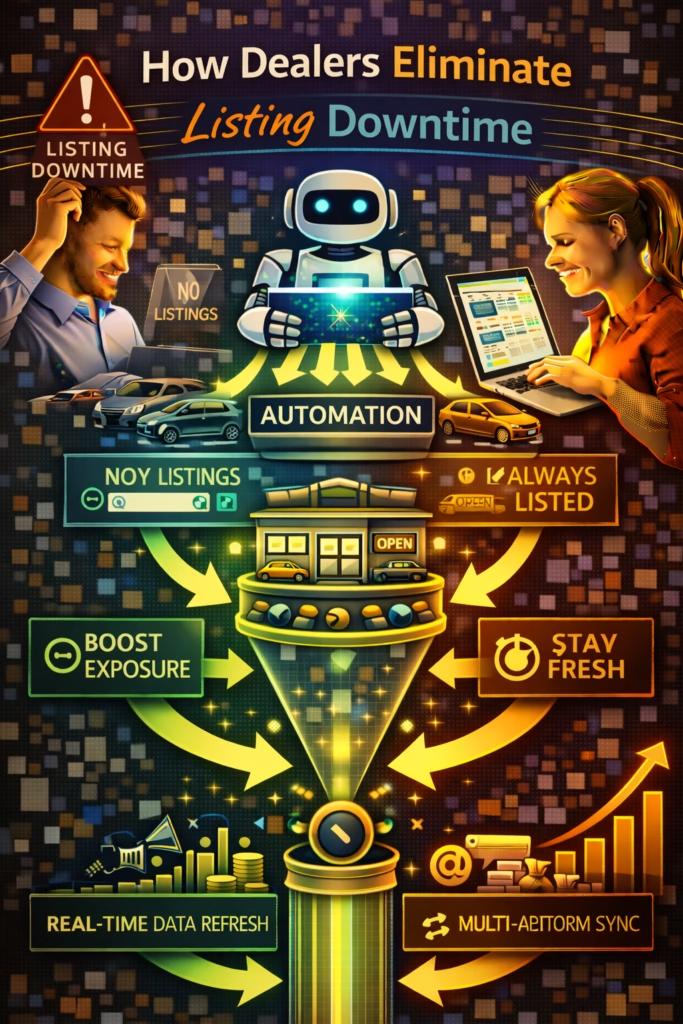
How Dealers Eliminate Listing Downtime

ChatGPT Image Mar 3 2026 01 39 52 PM
How Dealers Eliminate Listing Downtime

How Dealers Eliminate Listing Downtime

How Dealers Eliminate Listing Downtime is the blueprint for keeping inventory visible every day—by building a rotation-first, compliance-safe system that prevents removals, throttling, stale listings, and “dead zones.”

Downtime Killers: Rotation Cadence Account Health Variation Library Monitoring Fast Recovery

Note: This is general guidance. Follow platform rules and policies. Avoid misleading claims and spam patterns. Do not post identical duplicates.

Introduction

How Dealers Eliminate Listing Downtime starts with a truth every high-volume seller eventually hits:

Visibility is fragile when your system depends on “one listing staying live.”

Dealers lose leads when listings get removed, stall, stop showing in feeds, or go “quiet” after a short freshness burst. That’s downtime—and it’s expensive because it creates the worst kind of gap: a gap you don’t always notice until sales slow.

This guide shows you how to build a system where downtime becomes rare—and when it happens, recovery is immediate.

Big idea: You don’t eliminate downtime by posting harder. You eliminate downtime by building redundancy: cadence + rotation + monitoring + backup variations.

Expanded Table of Contents

1) What listing downtime really is

Listing downtime is any period when your inventory stops receiving normal exposure and lead flow. It can be obvious (a listing is removed) or silent (a listing is “live” but barely shown).

Downtime shows up as

  • Listings removed, hidden, or restricted
  • Impressions collapse even though listings are still live
  • Messages drop sharply with no inventory change
  • New listings don’t get the normal freshness spike
  • “Same effort, worse results” across multiple posts

Important: Downtime is often a system issue (patterns, cadence, duplication risk), not a “one bad listing” issue.

2) Why downtime happens to dealers

Dealers post at scale, and scale introduces patterns. Platforms tend to dislike patterns that resemble spam, duplication, or low-trust behavior.

Most common downtime causes

Duplicate patterns

Same photos, titles, and descriptions reused repeatedly—even if the inventory is different.

Inconsistent cadence

Bursts followed by silence can create unstable signals.

Stale creatives

Thumbnails and titles stop earning clicks, so exposure declines naturally.

Low engagement loop

Weak CTR + slow responses reduce outcomes, which reduces distribution.

Policy-sensitive phrasing

Overpromises, spammy language, or risky claims can trigger removals.

Operational gaps

No monitoring, no backups, no fast recovery process.

Rule: Dealers eliminate downtime by designing for predictable variation and fast recovery—not by hoping listings stay up forever.

3) The early warning signals of downtime

Downtime is easier to prevent when you detect it early.

SignalWhat it usually meansWhat to do
Messages drop 30–60% in 48 hoursVisibility decay or throttlingRotate thumbnails/titles; review duplication risk
New posts get no freshness liftAccount trust or pattern riskReduce repetition; slow down; increase variety
Removals cluster in one categoryWording/format riskRewrite templates; remove risky phrases
Same photos across many postsVisual duplication patternBuild photo sets; rotate first image
Response times increaseLead leakage beginsUse instant replies; assign follow-up owner

Pro move: Treat a message drop like a “check engine” light. Rotate and correct before it becomes downtime.

4) Rotation vs duplicates (the anti-flag foundation)

Rotation keeps you visible. Duplication gets you removed or throttled.

Rotation-first (good)

  • Different first photo
  • Different title intent (value vs speed vs trust)
  • Different hook line (first 1–2 lines)
  • Different feature emphasis
  • Meaningful spacing and scheduling

Duplicate-first (risky)

  • Same image set reused repeatedly
  • Near-identical titles and descriptions
  • Rapid repost loops
  • Minor punctuation swaps
  • Overly promotional/spammy tone

Rule: If you can’t explain what changed and why it helps the buyer, it’s probably not rotation.

5) Account health signals that protect visibility

Account health is the invisible foundation of consistent reach. Dealers who stay visible treat accounts like assets.

Health signals you can control

  • Consistency: steady activity beats random spikes
  • Responsiveness: fast replies reduce abandoned threads
  • Trust: real photos, clear details, transparent process
  • Low friction: simple next steps, no confusion
  • Low dispute risk: avoid misleading language

Pro move: “Account health” is often the difference between smooth scaling and recurring downtime.

6) Cadence frameworks that prevent “dead zones”

Dealers trigger downtime when their cadence becomes unpredictable or repetition-heavy. The goal is a sustainable schedule that produces stable signals.

Dealer cadence (baseline)

  • Daily: publish a steady batch with built-in variation
  • Weekly: rotate thumbnails and titles on top performers
  • Monthly: retire weak listings and replace with new angles

Staggering rule

Instead of posting the same category repeatedly in a short window, stagger categories across the day/week.

Rule: Predictable cadence + varied content prevents the algorithm from labeling your posting as a pattern risk.

7) The variation library: your downtime insurance policy

If you want zero downtime, you need backup variations ready to deploy instantly when a listing stalls or gets removed.

What to store in a variation library

  • 3–5 first-photo options per inventory type
  • 5 title angles (value, premium, speed, trust, fit)
  • 5 hook lines (clarity, trust, fit, speed, proof)
  • Feature emphasis blocks you can swap (truthful)
  • CTA question templates

Title angle examples (dealer-safe)

Value “Great value for [use case] • Real photos • Clear details”
Speed “Available now • Quick next steps • Message your zip”
Trust “Transparent details • Simple process • Ask any questions”
Fit “Perfect for [need] • Options available • Confirm availability”
Premium “Upgraded features • Clean presentation • For buyers who want quality”

Pro move: The variation library means downtime becomes a “swap and move on” event—not a crisis.

8) Photo-first refresh SOP (fastest recovery lever)

When a listing slows down, the fastest lever is the first photo. The first photo controls CTR, and CTR controls distribution.

Photo-first refresh SOP

[ ] Identify listings with message drop
[ ] Swap first photo to a new strong thumbnail
[ ] Keep the rest stable for 24–72 hours
[ ] Track messages/day and message quality
[ ] If still stalled, rotate title + hook next

Rule: Fix the scroll before you fix the story.

9) Inventory batching and surface area strategy

Downtime hurts most when your system depends on a few listings. Dealers win when they build surface area across inventory types and buyer intents.

Surface area checklist

  • Multiple intent angles per category
  • Multiple thumbnails per item type
  • Multiple listings across keywords buyers search
  • Category staggering to avoid repetition spikes

Pro move: A wider, varied inventory footprint means any single removal can’t kill your lead flow.

10) The 24-hour recovery playbook

When downtime hits, dealers lose money when they react slowly. This playbook is designed for speed without panic.

Hour 0–2: Stabilize

  1. Identify what changed (removals, drop in messages, category issues)
  2. Pause repetition: stop posting near-duplicates
  3. Deploy photo-first refresh on top listings

Hour 2–8: Restore

  1. Swap titles to new intent angles (from your library)
  2. Rewrite first 2 lines for clarity
  3. Remove risky phrases; keep details factual

Hour 8–24: Rebuild

  1. Post a smaller batch with stronger variation
  2. Track response time and keep it fast
  3. Log what was changed so you learn the pattern

Rule: Recovery is a process: reduce repetition, increase variety, restore engagement.

11) Testing plan: prove what prevents downtime

Downtime prevention isn’t guesswork if you track and test systematically.

What to test first

  1. First photo sets
  2. Title angles
  3. Hook lines
  4. Posting schedule (staggering)
  5. Response speed improvements

Simple test loop

1) Change one variable (e.g., first photo)
2) Run 3–7 days
3) Measure messages/day + removals
4) Keep the winner
5) Store it in the variation library

12) KPIs and dashboards to track downtime

KPIWhat it measuresTarget direction
Listings liveCoverage and surface areaStable/Up
Removals per weekCompliance riskDown
Messages per dayLead flowUp
Messages per listingListing qualityUp
Freshness actions/dayRotation cadenceStable
Median response timeLead protectionDown
Booked next stepsRevenue predictorUp

Pro move: Track “removals per week” as a leading indicator of future downtime.

13) 30–60–90 day rollout plan

Days 1–30 (Stop the bleeding)

  1. Build a variation library (photos, titles, hooks)
  2. Implement photo-first refresh SOP
  3. Stabilize cadence (avoid spikes)
  4. Track removals and message drops

Days 31–60 (Systemize prevention)

  1. Rotate thumbnails and titles weekly
  2. Batch and stagger categories
  3. Test intent-based title angles
  4. Improve response speed with instant replies

Days 61–90 (Compound visibility)

  1. Scale surface area with more varied listings
  2. Document SOPs for rotation and QA
  3. Double down on winners by category
  4. Maintain a recovery playbook and weekly dashboard review

Rule: Dealers eliminate downtime when visibility is built into the system—not tied to a single post.

14) 25 Frequently Asked Questions

1) What is listing downtime for dealers?

Any period where listings lose normal visibility or are removed, causing lead flow to drop.

2) What causes dealer listings to lose visibility?

Duplicate patterns, inconsistent cadence, low engagement, slow responses, or policy-sensitive wording.

3) What’s the fastest way to reduce listing downtime?

Use a rotation-first system with a variation library and a photo-first refresh SOP.

4) How do I know downtime is starting?

If messages drop sharply, new posts don’t lift, or removals increase.

5) Is downtime always caused by removals?

No—silent throttling and staleness can also create downtime.

6) What is the #1 downtime prevention lever?

Consistent cadence combined with real variation (photo/title/hook rotation).

7) Does rotating photos help?

Yes—thumbnail changes can improve CTR and recover visibility quickly.

8) What title changes help most?

Intent-based titles: value, speed, trust, fit, and premium angles.

9) What hook line works best?

Clarity + proof + one-question CTA usually increases messages.

10) What CTA question increases replies?

“What city/zip are you in and are you looking for today or this week?”

11) Should I repost the same listing repeatedly?

Avoid identical duplicates. Rotate meaningfully and follow platform rules.

12) Can posting in bursts cause downtime?

It can create spam-like patterns. Steady cadence is safer.

13) How does response speed impact downtime?

Slow responses reduce outcomes, which can reduce distribution and lead flow.

14) What response time should dealers aim for?

Under 5 minutes is strong; under 1 minute is best.

15) What is a variation library?

A saved collection of thumbnails, titles, hooks, and angles for fast rotation and recovery.

16) How many variations should I have?

At least 3–5 photo options and 5 title/hook angles per inventory type.

17) Does engagement affect visibility?

Yes—clicks and messages are strong interest signals.

18) What KPIs matter most for downtime?

Removals per week, messages/day, messages per listing, and response time.

19) How do I recover in 24 hours?

Reduce repetition, rotate thumbnails/titles, rewrite hooks, post a smaller varied batch, and track results.

20) Should I use real photos?

Yes—real photos typically build trust and improve CTR.

21) How do I prevent staleness?

Rotate first photos weekly and refresh titles/hooks on a schedule.

22) How do I scale without increasing downtime risk?

Scale variation, not repetition—batch inventory, stagger posting, and document SOPs.

23) Can I eliminate downtime completely?

You can reduce it dramatically by building redundancy and fast recovery.

24) How long until downtime prevention shows results?

Often within 1–2 weeks, with compounding gains over 30–90 days.

25) What’s the biggest dealer mistake?

Posting at scale without a variation library, monitoring, and recovery playbook.

15) 25 Extra Keywords

  1. How Dealers Eliminate Listing Downtime
  2. eliminate listing downtime
  3. dealership listing downtime
  4. marketplace listing downtime
  5. keep listings live
  6. inventory visibility strategy
  7. dealer marketplace visibility
  8. Facebook Marketplace dealer listings
  9. Craigslist dealer visibility
  10. OfferUp dealer listings strategy
  11. prevent listing removals
  12. avoid duplicate listing patterns
  13. rotation-first posting system
  14. photo-first refresh SOP
  15. dealer listing rotation
  16. intent-based title rotation
  17. marketplace account health
  18. cadence framework for dealers
  19. stagger posting schedule
  20. variation library for listings
  21. marketplace monitoring dashboard
  22. messages per listing KPI
  23. speed to lead for dealers
  24. 24-hour visibility recovery
  25. 2026 marketplace lead strategy

© 2026 Your Brand. All Rights Reserved.
General information only—confirm compliance with platform policies and applicable privacy/marketing rules before posting, messaging, or automating follow-ups.

How Dealers Eliminate Listing Downtime Read More »

How Listing Rotation Improves Marketplace Results

ChatGPT Image Mar 3 2026 01 39 54 PM
How Listing Rotation Improves Marketplace Results

How Listing Rotation Improves Marketplace Results

How Listing Rotation Improves Marketplace Results is the blueprint for keeping listings fresh, improving click-through and messages, and compounding visibility—without spam patterns or duplicate risks.

Rotation Levers: First Photo Title Hook Line Feature Emphasis Timing Inventory Batching

Note: This is general guidance. Follow platform rules, avoid misleading claims, and rotate content responsibly. Do not post identical duplicates.

Introduction

How Listing Rotation Improves Marketplace Results comes down to a simple reality: marketplace visibility decays over time.

Even great listings can stall when buyers have seen the same thumbnail, the same title, and the same pattern for weeks. Rotation fixes that—not by spamming, but by keeping your listings current, engaging, and varied.

Rotation is not duplication. Rotation is structured variety that protects reach and increases engagement.

Big idea: When you rotate correctly, you don’t just “refresh” listings—you rebuild momentum.

Expanded Table of Contents

1) What listing rotation actually means

Listing rotation is a set of intentional changes that keep your marketplace presence from going stale. The goal is to earn new engagement signals while staying truthful and compliant.

Rotation can include

  • Swapping the first photo (thumbnail)
  • Rewriting the title for a different buyer intent
  • Changing the opening hook (first 1–2 lines)
  • Reordering photos and bullets for clarity
  • Highlighting a different feature or offer angle
  • Refreshing availability timelines (truthfully)

Important: Rotation is a maintenance strategy that improves performance without relying on duplicates.

2) Why rotation improves results

Marketplaces reward what buyers engage with. Rotation improves engagement by giving buyers a new reason to click and message.

Rotation changeWhat it improvesWhy results increase
New first photoCTR (click-through rate)More clicks create more distribution opportunities
New title angleRelevanceMatches different buyer intent keywords
New hook lineMessagesBetter first impression increases inquiries
New feature emphasisFitDifferent buyers care about different features
Improved clarityTrustTransparent details reduce hesitation

Rule: Rotation improves results because it increases engagement signals without increasing spam signals.

3) Rotation vs duplication (anti-flag clarity)

If you want long-term marketplace wins, you must understand the line between healthy rotation and risky duplication.

Healthy rotation

  • Meaningful variation (new angle + new thumbnail + new hook)
  • Truthful updates (availability, details, options)
  • Spaced out changes (not frantic edit loops)
  • Better buyer experience (clarity and proof)

Risky duplication

  • Same title repeated with minor punctuation changes
  • Same photo set reused as “new” constantly
  • Rapid reposting patterns
  • Misleading claims or fake urgency

Pro move: Build a rotation library so you never “guess” what to change.

4) Photo-first rotation (fastest lever)

The first photo is the #1 control point. If your thumbnail doesn’t win the scroll, nothing else matters.

Photo rotation rules

  • Rotate the first image before changing the whole listing
  • Use real photos whenever possible
  • Show the product clearly; avoid clutter
  • Use different angles, lighting, and context

Photo-first rotation SOP

[ ] Choose 3 thumbnail candidates
[ ] Run each for 3–7 days
[ ] Track messages/day and messages per listing
[ ] Keep the winner
[ ] Repeat monthly

Rule: A better thumbnail can outperform more posting volume.

5) Title rotation that increases click-through

Titles are where buyer intent meets clarity. Rotate titles to capture different search phrases and different motivations.

Intent-based title framework

IntentTitle formulaExample pattern
Value[Product] + “Best Value” + [Size/Key Detail]“Sectional Sofa – Best Value for Small Spaces”
Speed[Product] + “Available Now” + [Pickup/Delivery]“Queen Mattress – Available Today (Pickup/Delivery)”
Premium[Product] + “Upgraded” + [Comfort/Quality]“Premium Recliner – Upgraded Comfort & Support”
Fit[Product] + “Perfect for” + [Use Case]“Dining Set – Perfect for Apartments”
Trust[Product] + “Real Photos” + “Clear Details”“Bed Frame – Real Photos + Clear Details”

Pro move: Rotate titles to target intent, not just keywords.

6) Hook rotation that increases messages

Your first two lines decide whether a buyer keeps reading. Rotate hooks to match what different buyers care about.

High-performing hook patterns

  • Clarity hook: “Real photos + clear details ✅”
  • Fit hook: “Best for: [use case] • Great for: [secondary use case]”
  • Trust hook: “Simple process, no surprises—ask any questions.”
  • Speed hook: “Fast pickup/delivery options—message your zip.”

Message-driving CTA (one-question rule)

What city/zip are you in, and are you looking for today or this week?

Rule: Hooks don’t need hype—just clarity that reduces hesitation.

7) Feature and offer emphasis rotation

Different buyers respond to different “reasons to buy.” Rotate feature emphasis while staying truthful.

Common feature angles to rotate

Comfort / Quality

Materials, build, support, durability.

Size / Fit

Apartment-friendly, room size match, layout.

Convenience

Pickup, delivery, setup timelines (if true).

Value

Best overall value, bundle options, included extras.

Trust

Transparent details, real photos, simple next steps.

Availability

What’s available now vs order lead time (truthful).

Pro move: Feature rotation prevents “buyer fatigue” without changing the product.

8) Rotation timing windows (what to rotate when)

Rotation works best when it’s scheduled. Random changes create noise. Planned changes create learning.

Time windowRotateWhy
Every 3–7 daysFirst photoFast feedback loop on CTR and messages
WeeklyTitle + hookCapture new intent and reduce fatigue
Bi-weeklyFeature emphasis + bulletsImprove clarity and fit messaging
MonthlyFull refresh planRetire low performers and create new angles

Rule: Rotate one variable at a time when testing. Rotate multiple variables only when “refreshing” a stale listing.

9) Inventory batching and “surface area”

Rotation isn’t just for a single listing. It’s also about managing your listing ecosystem.

Surface area strategy

  • Create multiple listings that represent different intents
  • Batch inventory by category (e.g., “value,” “premium,” “fast delivery”)
  • Rotate categories on different days so your presence stays active

Pro move: Your goal is not one perfect listing—it’s a portfolio of listings that catch different buyers.

10) Rotation SOPs (solo, team, multi-location)

Solo operator SOP

  • Daily: 2–5 rotation actions (photo swap, title update, clarity tweak)
  • Weekly: rotate top 5 listings (photo + title)
  • Monthly: replace bottom 20% performers

Small team SOP

  • Assign roles: posting, QA/compliance, response speed
  • Daily: rotate thumbnails across categories
  • Weekly: A/B test titles and hooks
  • Document a rotation library (photos, titles, hooks, angles)

Multi-location SOP

  • Localize: city keywords, availability, and photo context
  • Stagger rotation by market
  • Track KPIs per location and per rotation set

Rule: Rotation only works if response speed and follow-up are handled.

11) A/B testing plan for rotation winners

Rotation is most powerful when it produces winners you can reuse.

Test priority order

  1. First photo
  2. Title angle
  3. Hook line
  4. CTA question
  5. Feature emphasis

Simple test process

1) Choose one variable
2) Run for 3–7 days
3) Track messages/day + messages per listing
4) Keep the winner
5) Archive the loser for later rotation

Pro move: Build a “winner library” so your rotation improves month over month.

12) KPIs to prove rotation is working

KPIWhat it measuresTarget direction
Messages/dayOverall lead flowUp
Messages per listingListing performance qualityUp
CTR proxy (views-to-messages)Thumbnail/title strengthUp
Median response timeLead protectionDown
Flags/removalsCompliance riskDown
Booked next stepsRevenue predictorUp

Rule: Rotation is successful when it increases messages without increasing removals.

13) 30–60–90 day rollout plan

Days 1–30 (Build the rotation foundation)

  1. Create 3 thumbnails per listing (rotation candidates)
  2. Create 5 title angles per category (value, premium, speed, trust, fit)
  3. Write 5 hook variations + one-question CTA
  4. Set a weekly rotation schedule
  5. Track baseline KPIs (messages, response time, removals)

Days 31–60 (Test and standardize winners)

  1. Run thumbnail A/B tests on top listings
  2. Rotate titles weekly by intent
  3. Refresh top performers (photo + title + hook)
  4. Retire bottom performers and replace with new angles

Days 61–90 (Compound into a system)

  1. Build a winner library (photos, titles, hooks, angles)
  2. Document SOPs for rotation and QA
  3. Scale surface area by category and location
  4. Optimize weekly using KPIs and booked outcomes

Rule: Rotation wins when it’s planned, measured, and repeated.

14) 25 Frequently Asked Questions

1) What is listing rotation in marketplaces?

Rotating photos, titles, hooks, and emphasis to keep listings fresh and engaging over time.

2) Is listing rotation the same as reposting duplicates?

No—rotation uses meaningful variety and maintenance, not repeated duplicates.

3) What is the best rotation method for quick results?

Photo-first rotation: swap the first image to improve click-through.

4) How often should I rotate the first photo?

Typically every 3–7 days when testing, then monthly once you find winners.

5) What should I rotate besides photos?

Titles, the first 1–2 lines (hook), and feature emphasis.

6) Why do listings get “stale”?

Exposure and engagement decay as buyers see the same content repeatedly.

7) Does rotation increase exposure?

It often helps by improving engagement signals like clicks and messages.

8) What is a safe rotation change?

Meaningful photo swaps, clearer titles, updated details, and new hooks.

9) What rotation changes are risky?

Minor punctuation edits, rapid repost patterns, or identical duplicate content.

10) Should I change everything at once?

Only for full refreshes. For testing, rotate one variable at a time.

11) What title changes work best?

Intent-based titles: value, premium, speed, fit, and trust angles.

12) What hook line works best?

Clarity + proof + a single CTA question usually performs strongly.

13) What CTA question increases replies?

“What city/zip are you in and are you looking for today or this week?”

14) How does rotation reduce buyer fatigue?

New thumbnails and angles create a “new” reason to click and message.

15) Can rotation reduce flags?

It can help if it prevents duplicate patterns and improves compliance behavior.

16) What metrics show rotation is working?

Messages/day, messages per listing, and fewer removals/flags.

17) What matters more: views or messages?

Messages—messages signal stronger purchase intent.

18) How does response speed impact rotation success?

Rotation creates leads; slow replies waste the benefit.

19) What response time should I aim for?

Under 5 minutes is strong; under 1 minute is best.

20) How do I rotate in multiple locations?

Localize details and stagger rotation schedules by market.

21) What is a rotation library?

A saved set of thumbnails, titles, hooks, and angles you can reuse safely.

22) How many angles should I have per product?

At least 3–5: value, premium, speed, trust, and fit.

23) How long does it take to see improvement?

Often within 1–2 weeks, with compounding gains over 30–90 days.

24) Should I use stock photos?

Real photos typically perform better and build trust.

25) What’s the biggest rotation mistake?

Rotating without tracking results or rotating in spam-like patterns.

15) 25 Extra Keywords

  1. How Listing Rotation Improves Marketplace Results
  2. listing rotation strategy
  3. marketplace listing rotation
  4. rotate listings without getting flagged
  5. marketplace rotation best practices
  6. Facebook Marketplace listing rotation
  7. Craigslist listing rotation strategy
  8. OfferUp listing rotation tips
  9. photo-first rotation marketplace
  10. rotate first photo for more clicks
  11. increase messages with listing rotation
  12. marketplace visibility rotation system
  13. anti-flag posting rotation framework
  14. avoid duplicate listing patterns
  15. marketplace title rotation
  16. listing hook rotation
  17. feature emphasis rotation
  18. best time to rotate listings
  19. marketplace A/B testing thumbnails
  20. messages per listing KPI
  21. marketplace performance optimization
  22. organic marketplace growth 2026
  23. rotation SOP for sellers
  24. rotation schedule marketplace
  25. listing refresh strategy

© 2026 Your Brand. All Rights Reserved.
General information only—confirm compliance with platform policies and applicable privacy/marketing rules before posting, messaging, or automating follow-ups.

How Listing Rotation Improves Marketplace Results Read More »

Why AI Is Now Essential, Not Optional

ChatGPT Image Mar 3 2026 01 39 47 PM
Why AI Is Now Essential, Not Optional

Why AI Is Now Essential, Not Optional

Why AI Is Now Essential, Not Optional explains the new reality: speed, consistency, and automation are now the baseline—and AI is the lever that makes them possible.

AI Advantage Areas: Speed-to-Lead Follow-Up Content Operations Customer Support Reporting

Note: This is general guidance. Follow privacy laws, platform rules, and industry regulations. Avoid misleading claims and spam-like outreach.

Introduction

Why AI Is Now Essential, Not Optional is the conversation every small business eventually has—usually after watching a competitor move faster, respond quicker, and win more customers with the same (or less) effort.

AI isn’t a trend anymore. It’s the new standard for speed, consistency, and scale.

For years, small businesses competed with hustle: answering messages late at night, juggling marketing, dealing with follow-ups, and wearing ten hats. That approach still works—until it doesn’t. Because now your competitors can run a system that never sleeps:

  • Leads get answered instantly
  • Follow-ups happen automatically
  • Appointments get booked without staff chasing
  • Content gets produced daily
  • Performance gets tracked without spreadsheets

Big idea: AI doesn’t give you “one improvement.” It creates a compounding advantage loop that gets stronger over time.

Expanded Table of Contents

1) The shift: why “manual” is losing

Manual operations fail for one reason: humans are not built for endless repetition at infinite speed.

Manual loses where modern buyers care most

  • Speed: buyers want answers now
  • Consistency: buyers want predictable experiences
  • Availability: buyers shop nights and weekends
  • Clarity: buyers want simple next steps

Reality: The average small business doesn’t lose because it’s “bad.” It loses because it’s slower than the new standard.

2) The new baseline: speed and consistency

Buyers have more choices than ever. When they inquire, they often message multiple sellers.

What buyers doWhat they expectWhat happens when you’re slow
Message multiple sellersFast replyYou become option #3
Ask the same questionsClear answersThey move on
Browse after hoursAlways-on supportThey book elsewhere

Rule: AI isn’t “extra.” It’s how you keep up with the new baseline.

3) The AI advantage loop (compounding effect)

AI creates compounding advantage because it improves the same flywheel repeatedly:

Faster response

More conversations start. More leads stay engaged.

More follow-up

More “maybes” turn into “yes.” Less ghosting.

Better data

More clarity on what works. Better decisions.

More output

More listings, more content, more visibility.

Pro move: Don’t ask, “Will AI help?” Ask, “Which leak does AI fix first?”

4) The modern SMB AI stack

A practical stack for most SMBs includes:

  • Distribution: posting + listing rotation + multi-channel presence
  • Response: instant first reply + FAQ answers
  • Qualification: one-question intent capture (zip + timeline)
  • Booking: two-option close or scheduling link
  • Follow-up: polite sequences with stop rules
  • Routing: hot leads to humans, routine leads to automation
  • Reporting: response time, appointment rate, close rate

Rule: AI works best when it plugs into a simple process—not when it’s random tools everywhere.

5) AI for lead generation and distribution

AI improves lead generation in two ways:

  1. More surface area: more listings, more posts, more variations
  2. More consistency: steady cadence, fewer gaps, less burnout

What changes when you post consistently

  • You show up for more searches and buyer intents
  • Freshness increases exposure
  • More inbound inquiries arrive without paid media

Pro move: AI makes consistency affordable—because it reduces time cost, not ad cost.

6) AI for conversion: response, qualify, book

Most businesses think they need “more leads.” Often they need more conversion per lead.

The best first reply (universal)

Yes — available ✅

What city/zip are you in, and are you looking for today or this week?

Why this works

  • Confirms the buyer didn’t waste time
  • Captures two key qualification points
  • Moves toward a next step

Rule: If you reply fast but don’t ask a question, you still lose momentum.

7) AI follow-up: where most revenue is hiding

Follow-up is the most ignored revenue lever in small business, because it’s repetitive and time-consuming.

Simple follow-up sequence

Follow-up #1 (2–4 hours):
Just checking in ✅ Are you looking for today or this week?

Follow-up #2 (next day):
If you tell me your zip, I can confirm the fastest next step.

Follow-up #3 (48–72 hours):
No pressure—should I close this out or keep it open for you?

Avoid: endless chasing. Follow-up should be polite, finite, and helpful.

8) AI content: daily output without burnout

AI content is essential because visibility is earned through consistent output.

Where AI content helps most

  • Listing variations (titles, hooks, feature angles)
  • Short-form video scripts (20–30 seconds)
  • FAQ answers and product/service explainers
  • Local SEO pages and social captions

Pro move: Content doesn’t win because it’s perfect—it wins because it’s consistent and relevant.

9) AI operations: process, routing, and QA

AI is not just marketing. It’s operations support.

High-ROI operational wins

  • Auto-tag leads by intent
  • Route hot leads to calls
  • Standardize scripts for staff
  • Log conversation outcomes (booked, not interested, later)
  • Weekly KPI reporting

Rule: Once operations are consistent, marketing results become predictable.

10) AI customer support that doesn’t break trust

Support is often a bottleneck: questions pile up, replies get delayed, and customers feel ignored.

Best practices for AI support

  • Keep answers short and accurate
  • Offer escalation to a human when needed
  • Don’t make promises you can’t keep
  • Use consistent policy language

Clean escalation line

Got it ✅
I’m going to have a specialist confirm this for you.
What’s the best number to reach you?

11) The human role: what AI should not do

AI should not replace judgment. It should replace repetition.

Human-owned areas

  • Complex negotiations
  • Disputes and sensitive issues
  • High-ticket consultative sales
  • Brand voice and final approvals (where required)

Pro move: Use AI to handle 80% routine work, so humans can win the 20% that matters most.

12) Common objections (and honest answers)

“AI is expensive.”

Not adopting AI is often more expensive because it costs you missed leads, slower responses, and more labor hours.

“AI sounds robotic.”

Only if it’s written poorly. Good AI replies are short, helpful, and focused on next steps.

“We don’t need it.”

If competitors reply faster and follow up better, they will win more conversions from the same lead pool.

Rule: AI adoption is less about “tech” and more about eliminating conversion leaks.

13) KPIs to track AI impact

KPIWhat it measuresTarget direction
Median first response timeSpeed-to-leadDown
Conversation start rate% inquiries that reply backUp
Qualified lead rate% giving zip + timelineUp
Appointment rate% that book next stepUp
Show rateAppointment qualityUp
Close rateRevenue conversionUp
Cost per booked stepEfficiencyDown

Pro move: Track booked next steps weekly. That’s the earliest reliable revenue signal.

14) 30–60–90 day rollout plan

Days 1–30 (Foundation)

  1. Deploy instant first reply + one-question qualification
  2. Build FAQ library (top 20 questions)
  3. Implement a simple follow-up sequence
  4. Start tracking response time + appointment rate

Days 31–60 (Conversion)

  1. Add routing tiers (hot/warm/cold)
  2. Implement two-option booking close
  3. Improve objection scripts and escalation rules
  4. Review KPI dashboard weekly

Days 61–90 (Scale)

  1. Expand content output (listings, short-form scripts, local pages)
  2. Automate reporting and QA
  3. Optimize based on KPI trends
  4. Document SOPs for staff

Rule: AI becomes “essential” the moment it makes your business consistently faster than manual competitors.

15) 25 Frequently Asked Questions

1) Why is AI now essential for small businesses?

Because it enables faster replies, consistent follow-up, higher output, and better efficiency in competitive markets.

2) What business tasks should AI handle first?

First response, FAQ answers, qualification, follow-up, appointment booking, and simple reporting.

3) Does AI replace employees?

It usually replaces repetitive work and gaps first, making teams faster before replacing roles.

4) What is speed-to-lead?

How quickly you reply to a new inquiry, which strongly impacts conversion.

5) What response time should we aim for?

Under 5 minutes is strong; under 1 minute is ideal.

6) Can AI help with lead generation?

Yes—by enabling consistent posting, listing variations, and multi-channel presence.

7) Can AI help without paid ads?

Yes—AI helps maximize organic leads through consistency and conversion improvements.

8) What’s the biggest benefit of AI in sales?

Instant response and consistent follow-up that prevents lost leads.

9) How does AI reduce ghosting?

By replying instantly and following up politely with clear next steps.

10) Can AI book appointments?

Yes—using two-option closes or scheduling links, with routing rules.

11) Should AI negotiate price?

Light objections are fine; complex negotiations should escalate to a human.

12) Can AI improve customer support?

Yes—by answering FAQs quickly and escalating complex issues.

13) Is AI content useful?

Yes—consistent content output often drives more visibility and inbound inquiries.

14) How do we avoid robotic messaging?

Keep replies short, natural, and focused on one question plus a next step.

15) What’s the best AI first reply?

Confirm availability and ask: “What zip and are you looking today or this week?”

16) Does AI require a big tech team?

No—start with simple scripts and workflows, then improve over time.

17) How long until AI changes results?

Often within 1–2 weeks, with compounding gains over 30–90 days.

18) What industries benefit most?

Retail, services, real estate, vehicles—any business with inbound inquiries.

19) What is lead routing?

Assigning leads to the right workflow or person based on intent and fit.

20) What is a booked next step?

An appointment, quote, call, store visit, pickup, or delivery scheduled.

21) What KPIs show AI impact?

Response time, qualified rate, appointment rate, show rate, and close rate.

22) Is AI automation compliant?

It can be if you follow platform rules, privacy requirements, and respect opt-outs.

23) What’s the biggest AI mistake?

Using AI without a process—no qualification, no follow-up, no tracking.

24) Should AI be fully autonomous?

Not always. Use human handoff for complex and high-stakes situations.

25) Where should we start today?

Instant first reply + one-question qualification + follow-up sequence.

16) 25 Extra Keywords

  1. Why AI Is Now Essential, Not Optional
  2. AI for small business 2026
  3. AI marketing automation
  4. AI lead generation system
  5. AI customer responder
  6. speed to lead automation
  7. AI follow up sequences
  8. AI appointment booking
  9. AI sales assistant SMB
  10. local business AI stack
  11. AI for retail conversion
  12. AI for service businesses
  13. AI operations automation
  14. AI customer service automation
  15. AI content production
  16. organic lead generation with AI
  17. reduce lead leakage
  18. increase appointment rate
  19. improve close rate
  20. AI lead routing
  21. AI objection handling
  22. SMB automation strategy
  23. 2025 2026 AI marketing strategy
  24. competing with AI tools
  25. AI essential business workflow

© 2026 Your Brand. All Rights Reserved.
General information only—confirm compliance with platform policies and applicable privacy/marketing rules before posting, messaging, or automating follow-ups.

Why AI Is Now Essential, Not Optional Read More »

Turning Inquiries Into Revenue With AI

ChatGPT Image Mar 3 2026 01 39 49 PM
Turning Inquiries Into Revenue With AI

Turning Inquiries Into Revenue With AI

Turning Inquiries Into Revenue With AI is the modern conversion playbook: reply instantly, qualify cleanly, follow up consistently, and route every lead to a booked next step.

Revenue Drivers: Speed-to-Lead Qualification Follow-Up Scheduling Routing Reporting

Note: This is general guidance. Follow privacy/marketing rules and platform policies. Keep claims truthful and avoid spam-like outreach.

Introduction

Turning Inquiries Into Revenue With AI matters because most businesses don’t have a traffic problem—they have a conversion leak.

If you miss the first 5 minutes, you often miss the sale.

Every day, real buyers ask real questions… and never hear back fast enough. Or they get a slow, vague reply that doesn’t move the conversation forward. Or they get one message and then silence—no follow-up, no appointment, no close.

AI changes the game when it’s used correctly: not as a “robot” that talks at people, but as a system that ensures every inquiry gets:

  • A fast, clear first response
  • One-step qualification
  • A guided next step (appointment/quote/purchase)
  • Consistent follow-up until the buyer decides

Big idea: AI doesn’t replace selling. It removes the gaps that stop selling.

Expanded Table of Contents

1) The inquiry-to-revenue system (what AI actually does)

AI only “prints money” when it supports a real conversion system. The system looks like this:

Step 1: Instant response

AI replies fast to stop lead leakage and keeps buyers engaged while intent is hot.

Step 2: One-question qualification

AI asks a simple question that filters serious buyers without creating friction.

Step 3: Guided next step

AI offers two time options or a simple booking path to move the lead forward.

Step 4: Follow-up until decision

AI re-engages politely so “maybe later” becomes “yes” or “no” instead of ghosting.

Rule: Revenue comes from booked next steps—not from “more chatting.”

2) Speed-to-lead: why fast replies win

Most buyers message multiple sellers. The seller who responds first often controls the outcome.

What speed-to-lead affects

  • Conversation start rate
  • Appointment rate
  • Close rate
  • Buyer trust

Pro move: Treat the first reply like a “booking tool,” not customer support.

3) The perfect first reply (template + examples)

Your first reply should do three things:

  1. Confirm (availability / next step)
  2. Ask one qualifying question
  3. Move toward a booking

Universal first reply template

Yes — available ✅

What city/zip are you in, and are you looking for today or this week?

Retail (store pickup / delivery)

Yes — we have it ✅
What city/zip are you in, and do you want pickup today or delivery this week?

Service business (estimate / schedule)

Yes — we can help ✅
What city/zip are you in, and are you looking to get this done this week or next?

Rule: One question. Not a form. Not a paragraph.

4) Qualification in one question (without killing the vibe)

Qualification isn’t about interrogating. It’s about getting just enough info to route and book correctly.

The “two data points” that matter most

  • Location: city/zip (routing + feasibility)
  • Timeline: today/this week (intent signal)
Buyer answerMeaningBest next step
“Today” + zipHigh intentOffer two time slots
“This week” + zipStrong intentOffer booking window
“Not sure”Warm/uncertainAnswer 1 question + re-ask timeline
No answerGhost riskFollow-up sequence

5) Lead routing: who gets what lead and when

AI should route leads based on intent and fit, not “first come first served.”

Simple routing tiers

  • Hot: zip + today → immediate booking attempt
  • Warm: zip + this week → booking within 24 hours
  • Cold: vague answers → educate, then follow up
  • Unqualified: outside service area / wrong category → polite redirect

Pro move: Route “Hot” leads to the fastest closer (or call-first workflow).

6) Booking: how AI turns chats into appointments

The fastest booking method is the “two options” close.

Two-option close

Perfect ✅
I can do (A) today at 5:30 or (B) tomorrow at 11:00. Which works better?

When the buyer wants to “think about it”

No problem ✅
What would you like to confirm first—price, availability, or timing? I can help quickly.

Rule: Every conversation should end with a next step.

7) FAQ engine: answer instantly, stay consistent

Most inquiries are repeats: availability, location, price, delivery, financing, condition, warranty, hours, and “best offer.”

Best practice

  • Answer clearly in 1–3 lines
  • Then ask the booking/qualification question again
  • Never argue—redirect to next step

Pro move: A great FAQ answer ends with: “What zip and what timeframe?”

8) Objections: price, availability, trust, and “just browsing”

Price objection

I hear you ✅
It’s priced fairly for the condition/options.
If you’re serious, when could you come by—today or this week?

Availability doubt

Yes — it’s still available ✅
What city/zip are you in? I’ll confirm the fastest next step.

Trust objection

Totally fair ✅
We use real photos + clear details. If you’d like, I can set a quick time to see it in person.
Today or this week?

“Just browsing”

No worries ✅
What are you looking for most—price, quality, or fastest availability?

Rule: Objections are usually uncertainty. Reduce uncertainty, then book.

9) Follow-up: the revenue multiplier most sellers skip

Most revenue is lost after the first reply—not before it.

3-message follow-up sequence (polite)

Follow-up #1 (2–4 hours):
Just checking in ✅ Are you looking for today or this week?

Follow-up #2 (next day):
I can help you lock this in quickly. What zip are you in?

Follow-up #3 (48–72 hours):
No pressure—should I keep this open for you or close the message?

Avoid: aggressive or repetitive spam. Keep it helpful and finite.

10) Human handoff: when AI should escalate

AI should escalate when:

  • The buyer asks a complex question or negotiation starts
  • A complaint/refund/legal question appears
  • The lead is “Hot” and a call would close faster
  • The buyer requests a manager

Clean escalation message

Got it ✅
I’m going to have a specialist jump in to confirm the best option.
What’s the best number to reach you, and are you looking today or this week?

11) Multi-channel: Marketplace, SMS, calls, email

Different buyers prefer different channels. AI should keep the message consistent while adapting the format.

ChannelBest useAI focus
Marketplace DMFast discovery + quick questionsInstant reply + booking
SMSHighest response rateShort, appointment-driven
CallsFast closingRoute hot leads to call
EmailLonger decisionsProof + follow-up cadence

Pro move: Use SMS for follow-ups when the buyer opts in or provides a number.

12) Compliance-safe automation rules

  • Be transparent and truthful
  • Don’t spam duplicates or excessive follow-ups
  • Respect opt-outs immediately
  • Only message where you have a legitimate reason/context
  • Keep logs of lead sources and interactions

Note: If you operate in regulated industries, add extra review and legal compliance checks.

13) KPIs that prove revenue impact

KPIWhat it measuresTarget direction
Median first response timeSpeed-to-leadDown
Conversation start rate% inquiries that reply backUp
Qualified lead rate% giving zip + timelineUp
Appointment rate% that book next stepUp
Show rateAppointment qualityUp
Close rateRevenue conversionUp
Time-to-closeSales cycle speedDown

Rule: If response time improves but appointments don’t, upgrade scripts + qualification.

14) 30–60–90 rollout plan

Days 1–30 (Stop the leaks)

  1. Deploy instant first reply + one-question qualification
  2. Build FAQ library for top 20 questions
  3. Track response time and conversation start rate
  4. Implement two-option booking close

Days 31–60 (Increase bookings)

  1. Add follow-up sequence (2–4 hours, next day, 48–72)
  2. Route hot leads to call-first or fastest closer
  3. Measure qualified rate + appointment rate

Days 61–90 (Scale and optimize)

  1. Improve objection handling scripts
  2. Expand multi-channel workflows (SMS/email where appropriate)
  3. Review KPI dashboard weekly and refine templates
  4. Document SOPs for staff handoffs

Rule: AI wins when it standardizes speed, qualification, and follow-up—every day.

15) 25 Frequently Asked Questions

1) What does it mean to turn inquiries into revenue with AI?

It means using AI to respond fast, qualify leads, follow up, and guide buyers to a booked next step.

2) Does responding faster really increase sales?

Yes—fast replies reduce lead leakage and keep buyers engaged while intent is highest.

3) What should an AI first reply say?

Confirm availability, ask one qualifying question, and offer a next step.

4) What’s the best qualifying question?

“What city/zip are you in, and are you looking for today or this week?”

5) Why do leads ghost after asking a question?

They message multiple sellers, lose urgency, or don’t get a clear next step.

6) How does AI reduce ghosting?

By replying instantly and following up politely with a simple booking path.

7) What’s the fastest way to book appointments?

Use a two-option close with two time slots.

8) Should AI negotiate price?

It can handle light objections, but complex negotiations should escalate to a human.

9) How many follow-ups should we send?

Usually 2–3 polite follow-ups over 72 hours, then stop.

10) Can AI handle FAQ questions?

Yes—FAQ automation is one of the highest-ROI uses.

11) What if a buyer asks something complicated?

Escalate to a human and keep the buyer engaged while routing.

12) What is lead routing?

Assigning leads to the right person/workflow based on intent and fit.

13) How do I identify hot leads?

They answer location + timeline and ask next-step questions.

14) What response time should we target?

Under 5 minutes is strong; under 1 minute is ideal.

15) How do we measure AI conversion impact?

Track response time, appointment rate, show rate, and close rate.

16) What is a “booked next step”?

An appointment, visit, call, quote, or scheduled pickup/delivery.

17) Can AI increase revenue without more traffic?

Yes—by converting more of the inquiries you already get.

18) What’s the biggest conversion mistake?

Slow replies and no follow-up system.

19) Should AI message buyers on multiple platforms?

Only when appropriate and compliant, and when the buyer engages there.

20) Is SMS better than email for follow-up?

Often yes, but only if the buyer provides a number or opts in.

21) How do we avoid sounding robotic?

Use short, friendly replies and one-question guidance toward next steps.

22) Can AI improve lead quality?

Yes—by screening with simple questions and guiding serious buyers forward.

23) What if we get too many messages?

Use qualification, routing, and scheduling to keep volume manageable.

24) Is automation compliant?

It can be, if you respect platform rules, opt-outs, and truth-in-marketing.

25) Where should we start first?

Instant first reply + one-question qualification + two-option booking close.

16) 25 Extra Keywords

  1. Turning Inquiries Into Revenue With AI
  2. AI inquiry to revenue
  3. AI lead conversion system
  4. AI follow up automation
  5. speed to lead AI
  6. AI appointment booking
  7. lead qualification automation
  8. inbound lead automation
  9. AI sales assistant for SMB
  10. AI customer responder
  11. convert messages into sales
  12. reduce lead leakage
  13. automatic lead routing
  14. objection handling scripts
  15. follow up sequence automation
  16. booked next step KPI
  17. sales pipeline automation
  18. multi-channel lead follow up
  19. Marketplace lead conversion
  20. SMS follow up automation
  21. response time improvement
  22. appointment rate optimization
  23. close rate improvement
  24. 2026 AI marketing stack
  25. AI revenue conversion playbook

© 2026 Your Brand. All Rights Reserved.
General information only—confirm compliance with platform policies and applicable privacy/marketing rules before messaging, automating follow-ups, or collecting customer data.

Turning Inquiries Into Revenue With AI Read More »

How Small Brands Compete Without Ad Budgets

ChatGPT Image Mar 2 2026 02 28 49 PM
How Small Brands Compete Without Ad Budgets

How Small Brands Compete Without Ad Budgets

How Small Brands Compete Without Ad Budgets is the blueprint for building organic visibility and lead flow using consistency, intent-based channels, partnerships, and conversion systems—without relying on paid ads.

Organic Growth Drivers: Demand Capture Consistency Local SEO Marketplaces Partnerships Referrals

Note: This is general guidance. Follow platform rules, avoid misleading claims, and comply with local advertising/privacy requirements.

Introduction

How Small Brands Compete Without Ad Budgets starts with one uncomfortable truth:

Big brands win attention with money. Small brands win attention with systems.

When you don’t have a large ad budget, you can’t buy your way out of inconsistency. You can’t “turn on traffic” whenever you feel like it. But you can build something better:

  • Channels that already have buyer intent
  • Offers that convert fast
  • Workflows that keep you visible every day
  • Follow-up that protects every lead

Big idea: The advantage of a small brand is speed and focus. You can out-execute giants where they’re slow.

Expanded Table of Contents

1) The small-brand advantage (why you can win)

Small brands compete when they stop trying to “look big” and start trying to move better.

Focus

You can choose one niche, one region, and one offer and become the obvious choice.

Speed

You can test, change, and improve faster than a big brand’s approval process.

Proximity

You can win locally: faster response, faster delivery, better service, real relationships.

Authenticity

Real photos, real people, real proof. Buyers trust what feels real.

Rule: Competing without ads means competing with execution and consistency.

2) Demand capture vs demand creation

Big ad budgets are usually for demand creation (convincing people to want something). Small brands should start with demand capture (showing up when people already want it).

ApproachWhat it meansBest for
Demand captureShow up when buyers are already searching/browsingLow budget, fast ROI
Demand creationCreate attention before buyers have intentBig budgets, long runway

Pro move: Build demand capture first. Then use content to expand demand over time.

3) The best organic channels when you have no budget

Not all “free channels” are equal. Prioritize channels where buyers already behave like buyers.

Best low-budget channel types

  • Marketplaces: buyers browse with purchase intent
  • Local SEO (Maps + reviews): buyers search with urgency
  • Community distribution: groups, forums, neighborhood networks
  • Partnerships: referrals from adjacent businesses
  • Owned lists: email/SMS follow-up that you control

Rule: Organic growth is easiest when intent is already present.

4) Marketplaces as free “intent engines”

Marketplaces are modern search engines with pictures. People scroll them like they shop.

Why marketplaces work for small brands

  • Exposure comes from freshness + engagement
  • Listings act like micro landing pages
  • Multiple listings create “surface area” (more chances to be found)
  • Consistency compounds: daily activity builds reliable visibility

Marketplace visibility checklist

  • Rotate first photo (thumbnail) regularly
  • Write clear titles that match buyer keywords
  • Use varied angles (value, premium, speed, trust)
  • Answer messages fast (speed-to-lead)
  • Avoid duplicates and spam patterns

Pro move: The small brand wins by posting consistently while giants rely on big campaigns.

5) Local SEO as a compounding asset

Local SEO is the closest thing to “free ads” that compounds over time.

Local SEO wins when you do 5 basics well

  1. Perfect listing info: category, services, hours, address, photos
  2. Reviews: ask consistently, respond professionally
  3. Content proof: posts, updates, Q&A, photos
  4. Service clarity: describe what you do in plain language
  5. Response speed: calls/messages get handled fast

Rule: If you can’t outspend, out-rank locally and out-respond on leads.

6) The content-to-lead loop (without being a full-time creator)

You don’t need to post “a lot.” You need to post useful content that matches buyer intent and earns trust.

The 3 content formats that convert for small brands

Proof

Before/after, demos, walk-throughs, customer stories, delivery/pickup wins.

Comparison

“Good vs better vs best,” “what to avoid,” “what to choose for X use case.”

FAQ answers

Short answers to top questions buyers ask before purchasing.

Simple weekly content system (30–60 minutes)

[ ] 1 proof post (real photo/video)
[ ] 1 comparison post
[ ] 1 FAQ answer post
[ ] Repurpose across platforms + link to your listing/offer

Pro move: Content is not “branding.” It’s sales enablement for organic channels.

7) Offer packaging that converts without discounts

Without ads, your offer has to do more work. It must be clear, safe, and easy to say yes to.

Offer elements that increase conversion

  • Outcome: what the customer gets
  • Proof: why they should believe it
  • Friction remover: delivery, financing, setup, fast turnaround, warranty terms (truthful)
  • Risk control: transparent pricing and next steps
  • Urgency: availability windows (truthful, no fake scarcity)

Rule: Small brands win by removing friction, not by racing to the bottom on price.

8) Conversion messaging: what to say to win the click

Organic traffic is fragile—your first photo, title, and first two lines decide everything.

High-converting first-line formula

Real photos + clear details ✅
Best for: [use case] • Options: [delivery/financing/availability]
Question CTA: What city/zip are you in and are you looking for today or this week?

Angles that convert without hype

  • Trust: transparent details, real photos, clear process
  • Speed: same-day pickup/delivery (only if true)
  • Value: “best overall value” framing instead of “cheapest”
  • Fit: “perfect for” use-case targeting

Pro move: Ask a single question CTA. It increases replies and starts the conversion process.

9) Proof systems: how to build trust faster than big brands

Big brands have brand recognition. Small brands need proof.

Proof assets small brands can build quickly

  • Real photos (consistent style)
  • Short customer quotes (with permission)
  • Before/after or setup/delivery videos
  • FAQ screenshots (the questions buyers ask most)
  • “What to expect” process card

Rule: Proof beats polish when budgets are tight.

10) Referral and partnership flywheels

Partnerships let small brands borrow trust and distribution.

Best partners are adjacent, not competing

  • Service providers who touch your customers
  • Installers, delivery partners, contractors, local pros
  • Community orgs and local networks
  • Complementary retailers

Simple partnership pitch

We serve the same customers.
If you send us a customer, we’ll take great care of them and send yours back.
Want to set up a simple referral exchange?

Pro move: A few strong partners can replace thousands in ad spend.

11) Speed-to-lead and follow-up without a sales team

When you win leads organically, you must protect them. Slow follow-up makes organic feel “weak.” It’s not weak—you just leaked it.

Instant reply (universal)

Yes — it’s available ✅
What city/zip are you in, and are you looking for today or this week?
I’ll confirm the best options and next step.

Follow-up ladder (non-spam)

  • 0–2 minutes: instant reply + 1 question
  • 2–24 hours: short helpful follow-up (“Want details or a quick call?”)
  • 48–72 hours: final nudge with value (“Here are 2 options based on your budget.”)

Rule: When budgets are tight, response speed becomes your unfair advantage.

12) KPIs that matter when you’re growing organically

KPIWhat it measuresTarget direction
Inbound leads/weekOverall demand captureUp
Leads by channelWhich channels workClear distribution
Response timeLead protectionDown
Appointments/quotes bookedConversion healthUp
Close rateSales efficiencyUp
Reviews/weekTrust compoundingUp
Repeat/referral %Flywheel strengthUp

Pro move: Track “booked next steps” as your core KPI—organic wins when next steps are consistent.

13) 30–60–90 day rollout plan

Days 1–30 (Build your demand capture base)

  1. Pick 1–2 intent channels (marketplace + local SEO)
  2. Build a basic proof library (photos, FAQs, process)
  3. Standardize offers and messaging (titles, hooks, CTAs)
  4. Set response rules (instant reply + follow-up ladder)
  5. Track baseline KPIs (leads, response time, booked steps)

Days 31–60 (Increase consistency and surface area)

  1. Increase posting cadence with variation
  2. Collect reviews weekly and respond to them
  3. Launch partnerships (2–5 adjacent partners)
  4. Publish weekly content (proof + comparison + FAQ)
  5. Start testing (thumbnail, title, CTA question)

Days 61–90 (Compound and systemize)

  1. Double down on best channel(s)
  2. Document SOPs for content, listings, and follow-up
  3. Improve conversion points (landing page, scripts, checkout)
  4. Turn reviews and proof into repeatable assets
  5. Optimize weekly using KPIs and booked outcomes

Rule: Small brands win without ads by building consistency and trust systems that compound.

14) 25 Frequently Asked Questions

1) How can small brands compete without ad budgets?

By focusing on organic demand capture, consistent visibility, partnerships, referrals, and fast response systems.

2) What is the fastest organic channel for small brands?

Often marketplaces or local intent channels where buyers are already searching or browsing to buy.

3) Do you need social media to grow without ads?

No. Many small brands win with marketplaces, local SEO, referrals, and partnerships first.

4) What is demand capture?

Showing up when buyers already want what you sell (search, maps, marketplaces).

5) What is demand creation?

Creating awareness before buyers have intent (usually requires budget and time).

6) Why do marketplaces work without ads?

They contain built-in buyer intent and reward consistent, engaging listings.

7) How often should I post on marketplaces?

As often as you can sustain consistently with real variation and compliance.

8) What matters most in a marketplace listing?

The first photo, title clarity, and the first 1–2 lines of the description.

9) How do I avoid duplicate-content issues?

Rotate angles, thumbnails, titles, opening hooks, and feature emphasis.

10) How does local SEO help small brands?

It captures high-intent searches and compounds trust through reviews and activity.

11) What should I prioritize in local SEO?

Accurate business info, consistent reviews, photos, services, and response speed.

12) What kind of content works best without ads?

Proof, comparisons, and FAQ answers that match buyer intent.

13) How much content do I need to post?

Start small and consistent—3 useful posts per week can be enough.

14) How do small brands build trust quickly?

Real photos, transparent details, customer quotes, and clear process steps.

15) What is an offer “friction remover”?

Anything that makes the purchase easier: delivery, setup, fast turnaround, clear next steps (truthful).

16) Do I need discounts to compete?

No—many small brands win by removing friction and improving service and proof.

17) What is the best CTA to increase leads?

A single question: “What city/zip are you in and are you looking for today or this week?”

18) Why does response time matter so much?

Fast replies protect leads and increase conversions, especially in organic channels.

19) What response time should I aim for?

Under 5 minutes is strong; under 1 minute is best.

20) How do partnerships replace ad spend?

They let you borrow distribution and trust from adjacent businesses.

21) What is a referral flywheel?

Repeat customers + partner referrals that compound monthly without paid ads.

22) What KPIs matter most for organic growth?

Inbound leads, response time, booked next steps, reviews/week, and close rate.

23) How long does it take to see results without ads?

Often 2–4 weeks for early lift, with compounding gains over 60–90 days.

24) What is the biggest mistake small brands make?

Inconsistent activity and slow follow-up that leaks leads.

25) What should I do first if I’m starting from zero?

Choose one intent channel, create proof assets, standardize messaging, and respond fast.

15) 25 Extra Keywords

  1. How Small Brands Compete Without Ad Budgets
  2. compete without ad spend
  3. organic marketing for small brands
  4. small business lead generation without ads
  5. marketplace marketing without ads
  6. local SEO for small business growth
  7. free customer acquisition strategies
  8. organic demand capture strategy
  9. social commerce without paid ads
  10. how to get leads organically
  11. small brand growth system
  12. content to lead loop
  13. referral marketing for small business
  14. partnership marketing strategies
  15. community distribution strategy
  16. marketplace listing cadence
  17. increase organic visibility
  18. conversion messaging for small business
  19. offer packaging without discounts
  20. speed to lead best practices
  21. response time improves conversions
  22. organic sales pipeline for small brands
  23. 2026 organic marketing strategy
  24. small business marketing without budget
  25. organic lead flow blueprint

© 2026 Your Brand. All Rights Reserved.
General information only—confirm compliance with platform policies and applicable privacy/marketing rules before posting, messaging, or automating follow-ups.

How Small Brands Compete Without Ad Budgets Read More »

How Dealers Use Automation to Stay Fully Visible

ChatGPT Image Mar 2 2026 02 28 51 PM
How Dealers Use Automation to Stay Fully Visible

How Dealers Use Automation to Stay Fully Visible

How Dealers Use Automation to Stay Fully Visible is the blueprint for compounding exposure with steady cadence, compliant variation, inventory workflows, and fast response systems—without living inside posting apps.

Visibility Drivers: Cadence Freshness Variation Scheduling QA Speed-to-Lead

Note: This is general guidance. Follow platform rules and applicable advertising/privacy laws. Avoid spam, duplicates, and misleading claims.

Introduction

How Dealers Use Automation to Stay Fully Visible comes down to one reality most dealers discover after wasting months posting manually:

Visibility is not a campaign. It’s a system.

When you sell vehicles, RVs, power equipment, trailers, furniture, or any high-consideration inventory, buyers don’t convert on the first glance. They browse, compare, save, ask questions, and return later.

If you disappear for three days because your team is busy, your exposure collapses. If you post the same thing repeatedly, you raise flags and lose reach. Automation solves both problems—when it’s designed for steady cadence, real variety, and fast replies.

Big idea: Dealers win when they turn platforms into an always-on showroom that stays fresh every day.

Expanded Table of Contents

1) Visibility math: what “fully visible” actually means

“Fully visible” is not a feeling. It’s a measurable position across buyer intents and time windows.

Fully visible means you consistently have:

  • Freshness: new or updated listings appearing daily
  • Surface area: enough live listings to cover your inventory categories and price tiers
  • Variety: multiple angles and keywords for different buyers
  • Engagement: clicks, saves, and messages that reinforce distribution
  • Speed: fast responses that convert interest into appointments
Visibility leverWhat buyers seeWhat the platform “learns”
CadenceYou show up every dayActive, stable seller
VarietyDifferent reasons to buyBroader intent coverage
FreshnessCurrent inventoryHigher relevance
EngagementListings worth clickingMore distribution
Speed-to-leadQuick answersBetter outcomes

Rule: Visibility is the compounding result of consistent, varied activity plus fast follow-up.

2) Why automation is the dealer advantage

Dealers have more inventory churn than most sellers. That makes manual posting a treadmill.

Automation wins because it solves dealer reality

Inventory changes daily

Automation keeps listings updated without a human remembering every edit.

Buyers browse at all hours

Automation maintains a steady drip of freshness and fast replies.

Teams are busy on the lot

Automation removes the “posting tax” from your sales staff.

Competitors flood platforms

Automation helps you stay consistently present without spam patterns.

Pro move: Dealers don’t need “more posts.” They need a system that produces daily freshness and lead capture.

3) The dealer automation stack (what to automate first)

Not all automation is equal. Dealers should automate the steps that create steady visibility and protect conversion.

Priority order

  1. Inventory intake: normalize data (year/make/model/trim/price/location/condition)
  2. Photo pipeline: standardized shots + naming
  3. Listing templates: angle library and title frameworks
  4. Scheduling cadence: publish in natural windows
  5. Response automation: instant replies + routing + booking next steps
  6. QA safeguards: duplication checks, claim checks, and timing limits

Rule: Automate inputs and cadence first; automate “replies” second; automate everything else last.

4) Inventory-to-listing pipeline (the engine of consistency)

The best dealer automation starts with a clean pipeline that turns inventory into listings predictably.

Pipeline stages

  1. Normalize: enforce consistent fields (SKU/stock #, price, location, key features)
  2. Package: standardized photo set per unit
  3. Generate: choose an angle + title framework + bullet set
  4. Publish: schedule across time windows and platforms (where allowed)
  5. Maintain: update availability, price changes, and “sold” status

Standard dealer photo set (vehicle/RV/equipment)

  • Hero angle (best front/3-quarter shot)
  • Side profile
  • Rear angle
  • Interior cabin (or operator area)
  • Dash/controls / key features
  • Tires/undercarriage or wear points (trust)
  • VIN/stock label (where appropriate) or tag reference

Pro move: Standardized photos reduce writing time and increase buyer trust—two wins for scale.

5) Compliant variation library (how to scale without flags)

Dealers lose visibility when automation creates duplicates. The fix is a variation library designed around buyer intent.

The 8 dealer angles (rotate responsibly)

Value

Best overall value in its class; price clarity and transparency.

Monthly/Payments

Budget framing (only if truthful and compliant for your area).

Reliability

Condition, inspection, and trust-building details.

Performance

Capability: towing, horsepower, payload, features (where applicable).

Family/Comfort

Space, seating, ride comfort, interior highlights.

Work/Utility

For contractors or jobsite needs; practical benefits.

Availability

“Ready now” urgency without hype or misleading claims.

Trade-In Friendly

Trade-in welcome messaging (truthful, no bait claims).

Title frameworks (rotate)

Framework A: [Year Make Model] + [Key Feature] + [Availability]
Framework B: [Make Model] + [Benefit Hook] + [Condition/Options]
Framework C: [Category] + [Use Case] + [Location/Area]

Important: Keep all details truthful. Avoid repeating identical titles/descriptions across multiple posts.

6) Cadence frameworks for dealers (single lot, multi-lot, multi-city)

Cadence is what turns automation into “always visible.” The best cadence is steady and sustainable.

Single-lot dealer cadence

  • Publish: 5–20 listings/day (varied angles + photos)
  • Maintenance: refresh top performers weekly
  • Lead handling: respond continuously or at fixed intervals

Multi-lot dealer cadence

  • Stagger by location: each lot gets its own time windows
  • Localize keywords: city/area terms + pickup/delivery rules
  • Track KPIs per lot: messages, booked steps, response time

Multi-city dealer cadence

  • Use localized variation (photos, hooks, availability)
  • Stagger schedules to avoid bursts
  • Rotate category focus by day (trucks, SUVs, RVs, trailers)

Pro move: Consistent cadence beats “posting sprints” followed by silence.

7) Scheduling rules: publish like a stable seller

Automation should publish in a way that looks natural and stable.

Scheduling rules dealers should follow

  • Use 2–4 daily windows instead of one burst
  • Mix categories and angles within each window
  • Rotate first photos (thumbnails) deliberately
  • Limit repetitive edits and avoid “gaming” refresh patterns
  • Keep listings accurate with inventory updates and sold removals

Rule: The safest automation looks like an organized human team—not a copy machine.

8) Speed-to-lead automation (the visibility multiplier)

Dealers win leads when they respond fast. Fast response improves conversion and often supports platform trust signals.

Instant reply (universal)

Yes — it’s available ✅
What city/zip are you in, and are you looking to buy this week or later?
I’ll confirm the fastest next step (details, appointment, or pickup).

Qualify + book next step

Got it — are you looking for:
1) Best price/value, or
2) Best monthly payment?

If you share your zip, I can confirm availability and a time to see it.

Lead routing (simple)

  • New lead → instant reply + 1–2 qualifying questions
  • Warm lead → schedule appointment / call
  • No-response lead → polite follow-up later (no spam)

Pro move: Automation isn’t just posting—it’s protecting the lead the moment it arrives.

9) QA + anti-flag safeguards dealers should use

Automation should include guardrails that prevent the most common dealer mistakes.

Dealer QA checklist

  • Price is consistent and accurate
  • Year/make/model fields match photos and stock records
  • First photo is strong and unique (no repeated thumbnails)
  • Angle/hook/title not duplicated across recent posts
  • No exaggerated claims (“guaranteed approval,” “lowest price ever,” etc.)
  • Posting schedule avoids unnatural bursts
  • Sold units removed or marked correctly

Avoid: Duplicate content across multiple posts, misleading finance claims, and aggressive follow-up spam.

10) Testing plan: prove what increases lead flow

Automation scales what you teach it. Testing ensures you teach it the right patterns.

Test priority order

  1. First photo (thumbnail CTR)
  2. Title framework
  3. Angle/hook line
  4. CTA question
  5. Publishing time windows

Simple test process

1) Choose one variable
2) Run for 3–7 days
3) Track messages/day + booked next steps
4) Keep the winner
5) Repeat

Rule: Dealers who test systematically build “visibility engines” that competitors can’t copy quickly.

11) KPIs and dashboards for dealer visibility

KPIWhat it measuresTarget direction
Listings/day (published)Cadence consistencyStable
Active listingsSurface areaUp
Messages/dayLead flowUp
Messages per listingQuality per unitUp
Median response timeSpeed-to-leadDown
Booked appointmentsRevenue predictorUp
Flags/removalsCompliance riskDown

Pro move: Track booked appointments per category (trucks vs SUVs vs RVs) to see where visibility is converting.

12) 30–60–90 day rollout plan

Days 1–30 (Build the foundation)

  1. Standardize inventory fields and photo sets
  2. Create an angle library and 3 title frameworks
  3. Set scheduling windows (2–4 per day)
  4. Deploy instant replies and lead routing
  5. Track baseline KPIs (messages, response time, booked steps)

Days 31–60 (Scale visibility safely)

  1. Increase daily publish volume gradually
  2. Rotate thumbnails and angles systematically
  3. Add QA safeguards for duplication and pricing errors
  4. Run weekly tests (thumbnail, title, hook)

Days 61–90 (Compound into a machine)

  1. Document SOPs for listing creation, QA, and responses
  2. Automate maintenance updates (availability, sold)
  3. Double down on best-performing categories and angles
  4. Optimize weekly using KPIs and booked outcomes

Rule: Dealers stay fully visible by combining cadence, variety, QA safeguards, and speed-to-lead.

13) 25 Frequently Asked Questions

1) How do dealers use automation to stay fully visible?

They automate cadence, scheduling, inventory updates, compliant variation, and fast responses.

2) Does automation hurt marketplace reach?

Not if it produces quality, variety, and natural timing. It hurts when it creates duplicates and spam patterns.

3) What is the safest way to automate dealer listings?

Automate workflows and scheduling, keep listings truthful, rotate angles/photos/titles, and run QA safeguards.

4) What does “fully visible” actually mean?

Steady daily freshness, broad surface area, varied intent coverage, and consistent engagement.

5) What should dealers automate first?

Inventory normalization, photo pipeline, template library, and scheduling cadence.

6) How important are photos for visibility?

Extremely—first photo drives CTR, which drives engagement and distribution.

7) What is an angle library?

A set of buyer-intent frameworks used to produce varied listings without duplication.

8) How many angles should dealers rotate?

At least 6–8 core angles rotated responsibly across inventory categories.

9) Should dealers post in one big burst?

Usually no—multiple natural windows is safer and more stable.

10) How do you avoid duplicate listing patterns?

Rotate first photos, titles, hooks, features, and posting windows.

11) Do edits and refreshes help visibility?

Meaningful edits (photo/title clarity) can revive engagement without duplication.

12) How often should dealers refresh top performers?

Weekly is a strong starting point, based on performance and engagement decline.

13) What response time should dealers aim for?

Under 5 minutes is strong; under 1 minute is ideal.

14) Why does response speed matter for visibility?

It improves outcomes and reduces lead leakage, reinforcing engagement loops.

15) What is the best CTA for dealer listings?

“What city/zip are you in, and are you looking to buy this week or later?”

16) What KPIs matter most for dealers?

Messages/day, messages per listing, response time, and booked appointments.

17) What KPI predicts revenue best?

Booked next steps—appointments, test drives, or lot visits.

18) How do dealers handle multi-location posting?

Stagger schedules per lot, localize variations, and track KPIs per location.

19) How do inventory updates affect automation?

Automation should update availability and remove sold units to protect trust.

20) Can automation help without paid ads?

Yes—organic visibility compounds with steady cadence and engagement.

21) What causes flags/removals most often?

Duplicate content, spam bursts, misleading claims, and inconsistent details.

22) How do dealers test what works?

A/B test thumbnails, title frameworks, hooks, and posting windows weekly.

23) How fast do results change after improving cadence?

Often within 1–2 weeks, with compounding gains over 30–90 days.

24) What’s the biggest automation mistake dealers make?

Automating volume without variation, QA safeguards, and response speed.

25) What’s the simplest starting step?

Standardize photos and build 6–8 angle templates, then schedule consistent windows.

14) 25 Extra Keywords

  1. How Dealers Use Automation to Stay Fully Visible
  2. dealer automation visibility
  3. automate dealer listings
  4. dealer marketplace posting system
  5. inventory listing automation
  6. dealer listing cadence
  7. dealer listing templates
  8. dealer photo pipeline
  9. compliant variation for listings
  10. avoid duplicate listing flags
  11. anti-flag posting framework
  12. dealer lead flow automation
  13. speed to lead for dealers
  14. instant reply scripts dealer
  15. dealer appointment booking leads
  16. messages per listing KPI
  17. dealer listing QA checklist
  18. multi-location dealer posting
  19. best time windows to post
  20. organic dealer visibility
  21. 2026 dealer marketing strategy
  22. marketplace exposure for dealers
  23. dealer inventory marketing system
  24. dealer listing scheduling automation
  25. dealer showroom on marketplace

© 2026 Your Brand. All Rights Reserved.
General information only—confirm compliance with platform policies and applicable privacy/marketing rules before posting, messaging, or automating follow-ups.

How Dealers Use Automation to Stay Fully Visible Read More »

Why Marketplace Is Replacing Classified Auto Sites

ChatGPT Image Mar 2 2026 02 28 45 PM
Why Marketplace Is Replacing Classified Auto Sites

Why Marketplace Is Replacing Classified Auto Sites

Why Marketplace Is Replacing Classified Auto Sites explains the shift in buyer behavior—from “searching listings” to “discovering inventory”—and how sellers can win in a social-first world.

Shift Drivers: Mobile Discovery Built-in Messaging Engagement Distribution Freshness Trust Signals Faster Decisions

Note: This is general guidance. Follow platform rules, keep details truthful, and avoid spam/duplicate patterns.

Introduction

Why Marketplace Is Replacing Classified Auto Sites starts with a simple reality:

Buyers didn’t stop wanting vehicles. They stopped wanting friction.

Traditional classified auto sites were built for a web era: filters, search forms, email leads, and long decision cycles. But the modern buyer is mobile-first, message-first, and speed-first.

Marketplaces changed the game because they combine inventory browsing, social trust, and instant communication in one place—without forcing the buyer into a slow, multi-step funnel.

Big idea: In 2025–2026, distribution matters as much as listing quality—and social marketplaces are distribution machines.

Expanded Table of Contents

1) Why the shift is happening now

Marketplace isn’t “new.” The change is that it’s now where attention lives—and attention is the beginning of every sale.

Three forces accelerated the shift:

Mobile-first shopping

Buyers browse vehicles like they browse everything else: short sessions, frequent checks, quick comparisons.

Message-first decisions

Instead of filling forms and waiting, buyers want instant replies and immediate next steps.

Algorithmic distribution

Classifieds rely heavily on static search. Social marketplaces rely on distribution fueled by engagement and freshness.

Lower friction = more action

When asking a question is effortless, more buyers take the first step.

Rule: Wherever buyers spend the most attention, that’s where inventory sells fastest.

2) Buyer behavior: search vs discovery

Classified auto sites are “search-first.” Marketplace is “discovery-first.” That difference changes everything.

BehaviorClassified Auto SitesMarketplace
Starting pointIntent-driven searchFeed-driven discovery
Session styleLonger sessions, deeper filtersShort, frequent check-ins
Lead actionForm/email/call laterInstant message now
Decision speedSlower, more stepsFaster, conversational

Pro move: On Marketplace, your listing must win the “trust check” quickly—because buyers are comparing at scroll speed.

3) Distribution mechanics: why social wins

Classified sites tend to rank listings by category placement, paid boosts, and static relevance. Social marketplaces rank by performance signals.

Common performance signals

  • Click-through: thumbnail/title wins the scroll
  • Dwell time: buyers open and scroll photos
  • Saves/shares: strong intent
  • Messages: highest local intent signal
  • Seller response speed: improves buyer experience
  • Freshness: recent activity implies availability

Rule: On Marketplace, good listings earn more distribution because they create better outcomes.

4) The messaging loop: speed creates outcomes

Marketplace wins because it closes the gap between “interest” and “action.”

The loop

  1. Buyer discovers listing
  2. Buyer messages instantly
  3. Seller replies quickly
  4. Conversation stays warm
  5. Appointment/test drive gets booked
  6. Outcome improves → listing earns more distribution

Pro move: Your speed-to-lead is a growth lever. Fast responses don’t just convert— they create more exposure.

5) Trust signals: why buyers feel safer faster

Trust isn’t only “reviews.” It’s the full sense that the seller is real, responsive, and transparent.

Trust signals that matter on Marketplace

  • Real photos (not generic, not repetitive)
  • Clear condition disclosure
  • Simple, consistent details (miles, location, title status if relevant)
  • Fast, polite replies
  • Clear next steps (two time options)

Rule: The faster you reduce uncertainty, the faster serious buyers commit.

6) Freshness: the hidden advantage of Marketplace

Classified auto listings can feel stale: the buyer doesn’t know if it’s still available, and the seller may not respond for hours or days.

Marketplace is built around the idea that listings are alive.

Freshness actions (safe, meaningful)

  • Rotate the first photo (thumbnail testing)
  • Update the opening hook line
  • Clarify availability
  • Respond quickly to messages

Avoid: spam duplication patterns. Keep changes meaningful and spaced out.

7) Lead quality: why sellers get “more” but need systems

Marketplace often produces more messages than classifieds. That’s both a benefit and a responsibility.

Why volume increases

  • Messaging is effortless
  • Browsing is frequent
  • Discovery surfaces listings to casual shoppers

How to improve lead quality

  • Use a proof-first listing (photos + clarity)
  • Add a screening CTA: zip + timeline
  • Reply with appointment-setting structure
  • Follow up politely within 24–72 hours

Rule: Marketplace rewards sellers who can handle speed and volume with structure.

8) Dealer migration plan: keep classifieds, lead with Marketplace

For many dealers, the best approach is not “either/or.” It’s stacking channels while prioritizing the channel that drives daily conversations.

Simple channel strategy

  • Marketplace: primary conversation engine (daily buyer messaging)
  • Classified sites: secondary high-intent search channel
  • Website/GBP: trust + local capture + follow-through

Pro move: Treat classifieds like “search capture” and Marketplace like “demand creation.”

9) Independent seller plan: proof stack + screening CTA

Independent sellers win on Marketplace by removing uncertainty and making next steps easy.

Minimum viable system

  1. 15–25 real photos
  2. Clear title (year/make/model + hook)
  3. Clean, structured description
  4. Screening CTA: zip + today/this week
  5. Instant reply script
  6. Two time-slot close

Rule: You don’t need fancy tech. You need consistent execution.

10) The listing framework that wins on Marketplace

High-performing listing structure

Real photos + clear details ✅

Basics:
• Year/Make/Model:
• Miles:
• Location:
• Availability:

Highlights:
• [2–5 true highlights]

Condition (truthful):
• Runs/drives:
• Known issues (if any):

Next step:
What city/zip are you in, and are you looking to see it today or this week?

Pro move: The “Next step” question is what upgrades your leads.

11) Response scripts that convert marketplace leads

Instant reply (universal)

Yes — it’s available ✅
What city/zip are you in, and are you looking to see it today or this week?

Appointment close

Perfect ✅
I can do [Time Option A] or [Time Option B]. Which works better?

“Lowest?” reply (without dragging the chat)

I priced it fairly for the condition ✅
If you’re serious, when could you come see it—today or this week?

Rule: The goal is booking, not chatting.

12) Variety vs duplicates: anti-flag activity framework

Marketplace rewards consistent activity, but punishes spam patterns. Variety is your stability lever.

Variety checklist

  • Rotate first photo
  • Rotate title angle (reliability vs utility vs economy)
  • Rotate opening hook line
  • Rotate feature emphasis
  • Stagger posting windows

Important: Avoid posting identical duplicates. Keep everything truthful and consistent with the vehicle.

13) KPIs that prove where sales really come from

KPIWhat it measuresTarget direction
Messages/dayDemand + distributionUp
High-intent ratio% answering zip + timelineUp
Median response timeLead leakage riskDown
Appointments bookedConversion momentumUp
Show rateLead qualityUp
Flags/removalsCompliance riskDown

Pro move: If your message volume is high but appointments are low, improve proof stack + CTA screening.

14) 30–60–90 day rollout plan

Days 1–30 (Stabilize performance)

  1. Standardize listing structure (photos + template)
  2. Add screening CTA to every listing
  3. Deploy instant reply scripts
  4. Track messages/day + response time
  5. Rotate thumbnails weekly

Days 31–60 (Increase lead quality)

  1. Improve proof stack (clarity + disclosures)
  2. Test title angles and hooks
  3. Add follow-up SOP for non-responders
  4. Track high-intent ratio

Days 61–90 (Systemize multi-channel)

  1. Keep classifieds as secondary capture (optional)
  2. Scale Marketplace variety without duplicates
  3. Measure appointments and show rate weekly
  4. Double down on winning templates

Rule: Marketplace replaces classifieds when sellers run it like a system—proof, speed, and next steps.

15) 25 Frequently Asked Questions

1) Why is Marketplace replacing classified auto sites?

Because it offers faster discovery, built-in messaging, and distribution driven by engagement and freshness.

2) Are classified auto sites still worth using?

Sometimes—especially for search-driven buyers—but Marketplace often produces faster daily conversations.

3) What makes Marketplace leads different from classified leads?

Marketplace leads are more conversational and faster; classified leads can be slower but sometimes more search-intent.

4) Why do Marketplace listings get more views?

Because they can be distributed in feeds and boosted by engagement signals.

5) Does messaging speed matter?

Yes—fast replies keep buyers warm and increase booked appointments.

6) How do I improve lead quality on Marketplace?

Use proof-first listings and a screening CTA (zip + today/this week).

7) Do better photos reduce tire-kickers?

Yes—trust reduces “fishing” questions and increases serious inquiries.

8) What’s the best listing title format?

Year + make/model + key benefit + miles + availability/fit.

9) Should I disclose issues?

Yes—truthful disclosure builds trust and filters out unrealistic buyers.

10) Why do buyers prefer social listings?

Because they can browse quickly and message instantly without forms.

11) Is Marketplace only for cheap cars?

No—serious buyers shop all price points, especially when listings build trust.

12) How often should I update a listing?

Only with meaningful changes like better photos, clearer hooks, and availability updates.

13) Do classifieds provide higher intent leads?

Sometimes, but volume and speed can be lower than Marketplace.

14) What’s the biggest reason classifieds feel slower?

Lead capture is often form-based and response cycles are longer.

15) How do I convert Marketplace messages into showings?

Confirm availability, ask zip + timeline, then offer two time slots.

16) What’s the best CTA question?

“What city/zip are you in, and are you looking to see it today or this week?”

17) How do I handle “lowest price?” messages?

Re-anchor to fair pricing and pivot to scheduling a viewing.

18) How many follow-ups should I do?

2–3 polite follow-ups over 72 hours is usually enough.

19) What’s a good response time target?

Under 5 minutes is strong; under 1 minute is ideal.

20) Do algorithms favor active sellers?

Consistent, compliant activity that generates engagement often performs better.

21) What causes listings to get flagged?

Spammy duplication patterns, misleading claims, and policy-risk behavior.

22) How do I post consistently without duplicates?

Rotate photos, angles, hooks, and posting windows while staying truthful.

23) What KPI matters most?

Appointments booked and show rate—not just views or messages.

24) Can Marketplace replace paid promotions?

Often it can reduce reliance on paid boosts if listings are optimized and responses are fast.

25) What’s the biggest mistake sellers make?

Vague listings and slow response times that cause buyers to move on.

16) 25 Extra Keywords

  1. Why Marketplace Is Replacing Classified Auto Sites
  2. Marketplace replacing auto classifieds
  3. Facebook Marketplace vs auto classified sites
  4. social marketplace vehicle sales
  5. classified auto sites alternative
  6. why classifieds are declining
  7. vehicle lead generation marketplace
  8. car buyer messages marketplace
  9. sell cars faster on marketplace
  10. marketplace engagement signals
  11. freshness strategy vehicle listings
  12. mobile-first vehicle shopping
  13. messaging loop vehicle sales
  14. speed to lead auto sales
  15. vehicle listing optimization
  16. proof stack car listings
  17. screening CTA for car buyers
  18. appointment setting marketplace leads
  19. reduce tire kicker messages
  20. best time to post car listings
  21. avoid duplicate listing flags
  22. multi-channel auto marketing stack
  23. dealership marketplace strategy
  24. organic auto lead flow
  25. 2026 marketplace vehicle strategy

© 2026 Your Brand. All Rights Reserved.
General information only—confirm compliance with platform policies and applicable privacy/marketing rules before posting, messaging, or automating follow-ups.

Why Marketplace Is Replacing Classified Auto Sites Read More »

How Vehicle Sellers Capture High-Intent Buyers

ChatGPT Image Mar 2 2026 02 28 47 PM
How Vehicle Sellers Capture High-Intent Buyers

How Vehicle Sellers Capture High-Intent Buyers

How Vehicle Sellers Capture High-Intent Buyers is the blueprint for turning marketplace views into serious inquiries—by using proof-first listings, built-in screening, and fast appointment-setting responses.

High-Intent Drivers: Proof Stack Clear Price Photo Quality Screening CTA Speed-to-Lead Next-Step Booking

Note: This is general guidance. Keep details truthful, follow platform rules, and avoid spam/duplicate patterns.

Introduction

How Vehicle Sellers Capture High-Intent Buyers comes down to one simple truth:

High-intent buyers are not “found.” They are created—by the signals your listing sends.

Most vehicle sellers focus on “getting more messages.” But that’s the wrong goal. You want more serious messages.

High-intent buyers behave differently than tire-kickers:

  • They ask fewer questions, but their questions are specific.
  • They want confirmation, not persuasion.
  • They move quickly if trust is high and next steps are clear.

Big idea: Your listing should do pre-qualification for you—before the first message arrives.

Expanded Table of Contents

1) What “high-intent” means in vehicle sales

A high-intent vehicle buyer is actively moving toward purchase and is messaging to confirm:

  • Availability
  • Condition details that affect trust
  • Price expectations
  • Timing for viewing/test drive
  • Financing/trade options (if applicable)

High-intent is “ready to act,” not “curious to browse.”

Message typeIntent levelHow you handle it
“Is this available?”MediumConfirm + ask time/location
“Can I see it today after 5?”HighOffer 2 time slots
“What’s your lowest?”Low–MediumRe-anchor value + ask timeline
“Any issues? Clean title? Miles?”HighAnswer directly + book viewing

Rule: High-intent buyers want certainty, not a long conversation.

2) Why most vehicle inquiries are low-intent

Vehicle marketplaces produce a lot of messages because the barrier to ask is low. Low-intent messages happen when:

  • Listings are vague, creating “information fishing”
  • Photos don’t build trust, causing more probing questions
  • Price feels unrealistic, attracting bargain hunters only
  • Next steps aren’t clear, so buyers poke instead of book

Pro move: You reduce low-intent messages by adding clarity and proof—so only serious buyers bother to message.

3) The modern vehicle buyer journey (2025–2026)

Buyers don’t “start at dealerships” anymore. They start in feeds and local search.

What buyers do in order

  1. Scan thumbnails (fast elimination)
  2. Open listings (trust check)
  3. Compare 3–10 options (price/condition)
  4. Message top 2–3 (availability + next step)
  5. Choose the fastest path to certainty (appointment/test drive)

Rule: Your listing is competing with a grid of alternatives. Win the trust check quickly.

4) The proof stack that filters tire-kickers

Proof stack = the bundle of trust signals that makes serious buyers comfortable and discourages low-intent poking.

Proof stack checklist (use what applies)

  • Clear, consistent photos of key areas (interior/exterior)
  • Odometer photo (if appropriate)
  • VIN visible (or “VIN available on request”)
  • Clean title status / lien status (truthful)
  • Known issues disclosed (short and direct)
  • Maintenance highlights (if true)
  • Availability statement (“Available now / appointment required”)

Important: Do not claim inspections, warranties, “certified,” or mechanical guarantees unless you truly provide them.

Pro move: The best proof stack doesn’t “sell.” It reduces uncertainty.

5) Photo system: the 20-shot set that converts

High-intent leads start with trust. Trust starts with photos.

The 20-shot set (simple, repeatable)

  1. Front 3/4 exterior
  2. Rear 3/4 exterior
  3. Driver side
  4. Passenger side
  5. Front close-up (grille/headlights)
  6. Rear close-up (taillights)
  7. Wheels/tires
  8. Windshield + hood
  9. Driver seat + dash
  10. Passenger seat
  11. Rear seats
  12. Steering wheel close-up
  13. Center console / infotainment
  14. Instrument cluster / odometer
  15. Trunk/cargo area
  16. Engine bay
  17. VIN plate (or keep ready to send)
  18. Any notable feature (sunroof, 3rd row, etc.)
  19. Any honest flaw (if present)
  20. Bonus “context” photo (parking lot, lot sign, or neutral background)

Rule: Show enough that serious buyers don’t need to “investigate” in DMs.

6) Title framework that attracts serious buyers

Your title should answer: “What is it, why should I click, and what makes it a fit?”

High-intent title formula

[Year] [Make] [Model] — [Trim/Key Feature] | [Miles] mi | [Clean Title / Title Status if true]

Examples (generic)

  • 2016 Toyota Camry — Reliable Daily Driver | 92k mi | Ready Now
  • 2018 Ford F-150 — 4x4 Crew Cab | 110k mi | Strong Runner
  • 2020 Honda CR-V — Great on Gas | 58k mi | Available Today

Pro move: Use buyer language: “reliable,” “ready now,” “great on gas,” “family space,” “4x4,” “tow.”

7) Pricing strategy to increase serious messages

Price affects lead quality as much as volume.

Three pricing positions (choose intentionally)

PositionWhat it attractsBest for
Below marketHigh volume, mixed qualityFast move / urgent sale
At marketBalanced, more seriousHealthy daily lead flow
Above marketLower volume, more “proof required”Exceptional condition / upgrades

How to reduce “lowest price?” messages

  • Anchor value with proof and clarity
  • State “priced fairly for condition” (if true)
  • Offer next step instead of arguing price

Rule: Clarity reduces negotiation spam.

8) Description structure that screens buyers

Your description should do three jobs: build trust, answer objections, and move to the next step.

High-intent description template

Real photos + clear details ✅

Basics:
• Year/Make/Model:
• Miles:
• Title status:
• Location:

Highlights:
• [2–5 true highlights]
• [1–2 comfort/utility highlights]

Condition (truthful):
• Runs/drives:
• Known issues (if any):
• Maintenance notes (if known):

Next step:
Message your city/zip + the best time today/this week to see it.

Pro move: Put “known issues” in plain language. Serious buyers respect honesty.

9) The screening CTA that upgrades lead quality

A screening CTA filters low intent and pulls high intent forward.

Best screening CTA (simple)

What city/zip are you in, and are you looking to see it today or this week?

Optional add-ons (use if relevant)

  • “Do you prefer morning or evening?”
  • “Are you paying cash or exploring financing?”
  • “Do you have a trade-in?”

Rule: High-intent buyers answer questions. Low-intent buyers disappear.

10) Response scripts that book appointments

Response speed is critical, but structure matters too. Your goal is booking.

Instant reply (universal)

Yes — it’s available ✅
What city/zip are you in, and are you looking to see it today or this week?

Appointment-setting reply

Perfect ✅
I can do [Time Option A] or [Time Option B]. Which works better?
(If you share your zip, I’ll confirm the best meeting spot.)

“Lowest price?” reply (quality-preserving)

I priced it fairly for the condition and what’s included ✅
If you’re serious, when could you come see it—today or this week?

Avoid: Long back-and-forth debates. Offer two time slots and move forward.

11) Follow-up SOP for non-responders

Most serious buyers message multiple sellers. Follow-up brings them back—without being pushy.

Follow-up cadence

  • +15–60 minutes: short nudge
  • Next day: availability + time windows
  • 48–72 hours: final check-in

Follow-up templates

Quick check — still interested? I can do a quick viewing today or tomorrow.
Still available ✅ If you share your zip, I’ll confirm the easiest time window.

Rule: Follow-up should reduce friction, not increase pressure.

12) Variety vs duplicates: anti-flag posting system

If you’re posting regularly, variety keeps your activity compliant and your reach stable.

Variety checklist

  • Rotate first photo (thumbnail test)
  • Change title angle (reliability vs utility vs economy)
  • Change first 2 lines (trust hook vs availability hook)
  • Change feature emphasis (safety vs space vs mpg)
  • Change posting windows (morning vs evening)

Important: Avoid posting identical duplicates. Keep everything truthful and consistent with the actual vehicle.

13) KPIs for high-intent lead flow

KPIWhat it measuresTarget direction
Messages/dayDemandUp
High-intent ratio% of messages that answer your CTAUp
Median response timeLead leakageDown
Appointments bookedConversion momentumUp
Show rateAppointment qualityUp
Flags/removalsCompliance riskDown

Pro move: Track “high-intent ratio” by counting how many leads answer time + zip.

14) 30–60–90 day rollout plan

Days 1–30 (Build proof + stability)

  1. Adopt the 20-shot photo system
  2. Standardize title + description template
  3. Deploy screening CTA in every listing
  4. Use instant reply scripts
  5. Track response time + appointments booked

Days 31–60 (Improve lead quality)

  1. Test 3 thumbnail options
  2. Test 3 title angles (economy, reliability, utility)
  3. Refine pricing position (below/at/above market)
  4. Build follow-up cadence for no-replies

Days 61–90 (Systemize and scale)

  1. Document SOPs for listing creation + messaging
  2. Build a dashboard for high-intent ratio
  3. Double down on the best photo + title winners
  4. Reduce low-quality messages by improving proof stack

Rule: High-intent buyers show up when your listing reduces uncertainty and makes next steps effortless.

15) 25 Frequently Asked Questions

1) What is a high-intent vehicle buyer?

Someone ready to purchase soon who messages to confirm key details and schedule next steps.

2) How do I attract serious buyers on marketplaces?

Use proof-first listings, clear titles/prices, screening CTA questions, and fast appointment-setting replies.

3) Do better photos increase high-intent messages?

Yes—photos raise trust and reduce low-quality “fishing” questions.

4) What photo matters most?

The first photo (thumbnail) because it drives clicks.

5) How many photos should I include?

Enough to remove doubt—typically 15–25 quality images.

6) Should I show flaws?

Yes, if present—honest disclosure builds trust with serious buyers.

7) What title structure works best?

Year + make/model + key benefit + miles + availability/fit.

8) How do I reduce “What’s your lowest?” messages?

Add proof and clarity, then pivot to a viewing time question.

9) What’s the best CTA question?

“What city/zip are you in, and are you looking to see it today or this week?”

10) Why does location/zip matter?

It signals seriousness and helps you coordinate a real appointment.

11) How fast should I reply?

Under 5 minutes is strong; under 1 minute is ideal.

12) What should I say first?

Confirm availability, then ask the CTA question.

13) How do I book more appointments?

Offer two time windows and ask which works.

14) Do I need financing language?

Only if relevant—keep it truthful and simple.

15) Should I mention trade-ins?

If you accept trades, yes—this can increase serious inquiries.

16) How do I handle no-shows?

Confirm the day-of and offer a specific meetup plan.

17) How many follow-ups should I send?

Usually 2–3 polite follow-ups over 72 hours.

18) What if a buyer asks for a report or inspection?

Only provide what you can verify and offer a viewing next.

19) How do I avoid duplicate listing issues?

Rotate photos, angles, hooks, and posting windows while staying truthful.

20) Does posting more always help?

No—quality and variety matter more than volume.

21) What KPI matters most?

Appointments booked and show rate, not just messages.

22) What is “high-intent ratio”?

The percentage of leads who answer your screening CTA (zip + timeline).

23) How long until results improve?

Often within 1–2 weeks, with compounding gains over 30–90 days.

24) Can I do this without paid ads?

Yes—organic performance improves with proof, clarity, and fast replies.

25) What’s the biggest mistake sellers make?

Vague listings and slow response times.

16) 25 Extra Keywords

  1. How Vehicle Sellers Capture High-Intent Buyers
  2. vehicle sellers high intent buyers
  3. high intent car leads
  4. Facebook Marketplace vehicle leads
  5. used car buyer messages
  6. car listing optimization
  7. best photos for selling a car
  8. vehicle listing proof stack
  9. screening CTA for car buyers
  10. how to get serious buyers
  11. reduce tire kicker messages
  12. appointment setting for car sales
  13. speed to lead vehicle sales
  14. vehicle marketplace response scripts
  15. pricing strategy for car listings
  16. best title for selling a car
  17. vehicle description template
  18. increase vehicle inquiries
  19. high quality car buyer leads
  20. avoid duplicate listing flags
  21. marketplace posting variety system
  22. vehicle sales follow up SOP
  23. organic car lead generation
  24. 2026 vehicle marketplace strategy
  25. turn messages into test drives

© 2026 Your Brand. All Rights Reserved.
General information only—confirm compliance with platform policies and applicable privacy/marketing rules before posting, messaging, or automating follow-ups.

How Vehicle Sellers Capture High-Intent Buyers Read More »

Scroll to Top