
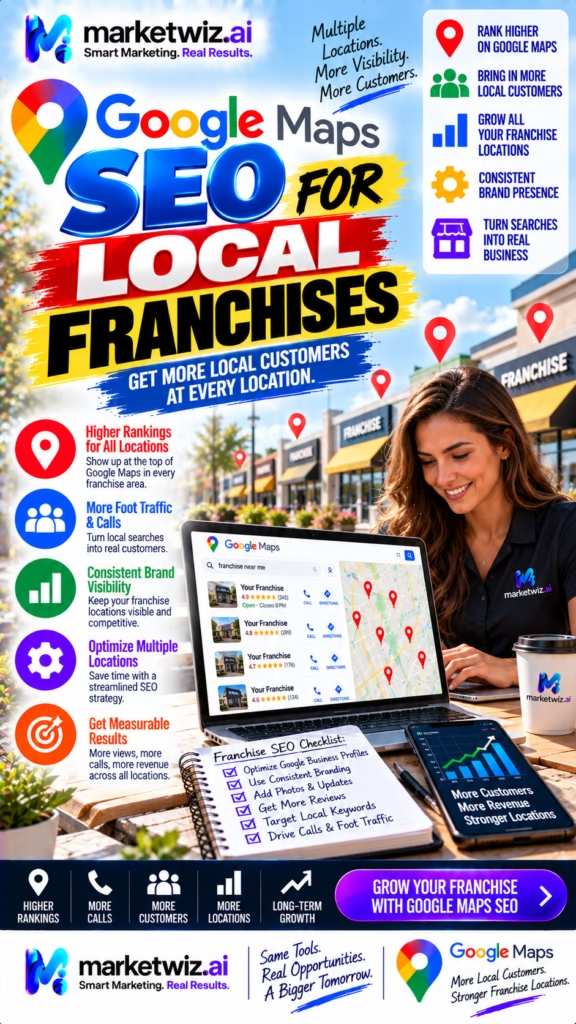
Google Maps SEO for Local Franchises
Franchise brands can have national recognition while still competing for customers one neighborhood at a time. Google Maps SEO helps individual franchise locations strengthen their local visibility, build location-specific trust, generate more calls and customer actions, and create a scalable local marketing system that can support growth across multiple markets.
Updated September 20261. Why Google Maps SEO Matters for Local Franchises
A franchise may operate under a recognizable brand, but the customer making a local search usually needs a specific nearby location. They want to know which franchise is closest, whether it is open, what it offers, what local customers think about it, how to contact it, and whether that particular location can solve their immediate need.
This creates an important distinction between national brand marketing and local franchise marketing. Corporate campaigns can build awareness across a large region, but Google Maps can connect individual franchise locations with customers searching inside their actual local markets.
Franchise growth happens locally. Even when the brand is national, many buying decisions are made at the city, neighborhood, ZIP code, and individual location level.
A strong franchise SEO strategy therefore needs to protect the consistency of the overall brand while creating enough local relevance for each eligible location to compete in its own market.
2. Separate Franchise Brand Authority From Local Location Authority
Franchise organizations often begin with an advantage that independent local businesses may not have: established brand recognition. Customers may already know the company name, logo, products, reputation, or national advertising.
But brand recognition does not eliminate the need for location-specific optimization. A customer searching in one city is evaluating a local branch, store, office, restaurant, contractor, clinic, dealer, or other franchise location.
Brand-Level Authority
National website strength, established brand awareness, major media coverage, corporate marketing, and overall brand reputation.
Location-Level Authority
Local reviews, accurate location data, local photographs, location pages, community relevance, customer engagement, and geographic visibility.
The strongest franchise strategies connect these two layers instead of assuming one can completely replace the other.
3. Build Accurate Google Business Profiles for Eligible Locations
Individual franchise locations that qualify for Google Business Profiles should be represented accurately and consistently. The profile can become one of the most important digital assets for the local operator because customers may encounter it before visiting the main franchise website.
Every location should be reviewed carefully instead of assuming information imported from an old database is still correct.
Important location information can include:
- Accurate franchise business name
- Correct street address or eligible service-area setup
- Local phone number where appropriate
- Correct location page
- Current business hours
- Holiday and special hours
- Appropriate business categories
- Relevant products or services
- Authentic location photographs
- Accurate customer-facing information
Franchise operators should also follow applicable Google Business Profile requirements and their own franchise brand standards when managing location information.
4. Standardize Franchise Categories Without Losing Local Accuracy
Business categories help communicate what a location actually is. Franchise organizations with many locations can benefit from having a clear category strategy rather than allowing every location to select unrelated options.
At the same time, standardization should not create inaccurate information. If certain locations genuinely offer different products or operate under different business models, those differences may need to be reflected appropriately.
Build a Category Governance System
Define the appropriate primary category for the core franchise model, identify legitimate secondary categories, document exceptions, and review location profiles periodically for accuracy.
This approach helps the franchise maintain brand consistency while avoiding random profile changes that can weaken the overall local marketing system.
5. Give Every Important Franchise Location a Strong Local Landing Page
One of the most important website assets for a multi-location franchise is a useful page for each legitimate location.
The location page should do more than display a city name and phone number. It should help customers understand the specific location they are considering.
A premium franchise location page can include:
- Location name
- Accurate address
- Local phone number
- Business hours
- Directions and geographic context
- Products or services available
- Local team information where appropriate
- Authentic location photographs
- Customer testimonials or reviews
- Local frequently asked questions
- Nearby communities served
- Clear conversion options
A strong location page becomes a bridge between the franchise's national brand authority and the local customer's immediate need.
6. Avoid Building Hundreds of Thin Duplicate Franchise Pages
One of the easiest franchise website strategies to automate is also one of the easiest to execute poorly: creating hundreds of nearly identical location pages with only the city and state changed.
Templates are useful for maintaining brand consistency, but the information inside the template should provide meaningful value for the location.
Use a standardized design, not standardized emptiness. Franchise location pages can share layouts and brand elements while still containing useful information that is genuinely specific to each market.
Local photographs, customer questions, neighborhood references, team information, location-specific offerings, directions, testimonials, and legitimate market information can make individual pages significantly more useful.
7. Build Franchise Keyword Strategies Around Local Search Intent
Franchise keyword research should identify how customers combine the brand, product, service, and geographic intent when searching.
Some customers search directly for the franchise brand. Others may have no brand preference and search for the broader category instead.
Important search themes can include:
- Brand + city
- Brand + near me
- Product + city
- Service + city
- Business category + city
- Product + near me
- Service + near me
- Location-specific problem searches
- Neighborhood searches
- Appointment or booking searches
- Store or office searches
- Hours and directions searches
The best keyword strategy depends on what the franchise actually sells and how its customers make purchasing decisions.
8. Define the Real Geographic Market for Each Franchise Location
Franchise territories may be defined contractually, operationally, or by practical customer behavior. Local SEO should reflect the actual markets a location can legitimately serve.
A franchise location may draw customers primarily from a small radius, while another may serve several cities. Home-service franchises can have much larger operational territories than retail locations where customers need to physically visit the store.
Understanding the real service territory helps determine which geographic searches matter and where the franchise should invest in local content, reputation, advertising, and rank tracking.
9. Build a Location-Level Franchise Review Strategy
National reputation matters, but customers frequently want to know what people experienced at the specific location they are considering.
This makes authentic local reviews extremely valuable to franchise operators. A franchise location should develop a consistent process for requesting feedback from real customers without creating artificial or misleading reviews.
Location-level reviews can help customers evaluate:
- Customer experience
- Professionalism
- Communication
- Product or service quality
- Staff interactions
- Scheduling
- Location experience
- Overall satisfaction
Franchise organizations can establish a consistent review request framework while allowing legitimate customer experiences to remain authentic.
10. Respond to Reviews Without Losing the Franchise Brand Voice
Review responses create an interesting challenge for franchises. Responses should feel local and human while still reflecting the standards of the broader brand.
Overly generic responses copied across hundreds of locations can feel automated. Completely uncontrolled responses can create brand inconsistencies.
Create Flexible Response Guidelines
Give local teams clear tone and escalation guidelines while allowing enough flexibility to acknowledge the actual customer experience. This can produce more natural responses without sacrificing brand consistency.
11. Use Authentic Local Franchise Photography
Corporate photography is useful for maintaining a polished brand, but local photographs can give customers something different: proof that the location is real, active, and relevant to their market.
Depending on the franchise, useful photographs may include:
- Exterior location photos
- Storefront or office signage
- Interior environment
- Local team members
- Products
- Completed customer projects
- Company vehicles
- Equipment
- Local events
- Community involvement
The specific image strategy should match the franchise model. A home-service franchise may emphasize completed work and technicians, while a retail franchise may emphasize its physical location and products.
12. Keep Franchise Hours and Customer Information Current
Inaccurate business hours create immediate friction. A customer who drives to a location and discovers it is closed may lose trust quickly.
Franchise organizations should have a reliable process for maintaining standard hours, seasonal hours, holiday schedules, temporary closures, and other important changes.
This becomes increasingly important as the number of franchise locations grows. What is manageable for five locations can become difficult for fifty, five hundred, or several thousand without clear data ownership and operating procedures.
13. Maintain Consistent Franchise Location Data Across the Web
Franchise location information can appear across corporate websites, Google, social platforms, directories, mapping systems, industry websites, local listings, review platforms, and other sources.
Old addresses, disconnected phone numbers, duplicate location records, and inconsistent business information can confuse customers.
Build one reliable source of location truth. Large franchise systems benefit from maintaining a clean master database for important location information and using that data to keep customer-facing platforms accurate.
14. Create Local Content That Goes Beyond City Names
Local franchise content should help customers, not merely insert geographic keywords into otherwise generic copy.
Useful local content varies by franchise model. A contractor franchise can discuss local property needs. A restaurant franchise can highlight the location experience. A fitness franchise can explain local membership options. A retail franchise can showcase locally available products or location-specific information.
Potential local content themes include:
- Frequently asked local questions
- Local project examples
- Community involvement
- Location announcements
- Seasonal market information
- Local customer stories
- Area-specific educational content
- Location-specific products or offerings
15. Build a Strong Franchise Website Architecture
Large franchise websites can become complicated. Hundreds of location pages, product pages, service pages, regional pages, corporate content, blogs, and franchise development pages need a logical structure.
Customers should be able to move naturally from the main brand website to the correct local location. Search engines should also be able to discover and understand those location pages.
A franchise website architecture may connect:
- National homepage
- Location finder
- State or regional pages where useful
- Individual location pages
- Product or service pages
- Educational resources
- Local supporting content
Internal links should serve customers first while creating a logical relationship between national and local content.
16. Make the Franchise Location Finder Easy to Use
A location finder is often one of the most important tools on a franchise website. Customers who already know the brand may go directly to the website and need a fast way to find the nearest location.
The location finder should work well on mobile devices, provide accurate information, and lead customers to useful individual location pages.
Make Discovery Fast
Help customers identify nearby legitimate locations without unnecessary steps.
Make Location Pages Useful
Once a location is selected, provide enough information for the customer to evaluate and contact it.
17. Build Legitimate Local Authority for Individual Franchise Locations
A national franchise website may already have strong authority, but local locations can still benefit from legitimate local references and relationships.
Opportunities vary by business but may include chambers of commerce, professional organizations, local sponsorships, community partnerships, business associations, suppliers, charities, events, local media, and industry organizations.
The objective is not to manufacture links at scale. It is to create a real local business footprint around each franchise location.
18. Track Google Maps Rankings Geographically
Local rankings are not necessarily uniform throughout a franchise territory. A location can have excellent visibility near its physical address and weaker visibility several miles away.
Geographic tracking can help franchise marketers understand this variation.
One Search Is Not a Local Ranking Report
Checking a keyword once from one computer provides only a narrow snapshot. Franchise organizations can gain more useful insight by evaluating visibility across multiple points within legitimate target markets.
For multi-location brands, this data can also reveal which franchise locations may need additional optimization.
19. Analyze Competitors at the Local Market Level
A franchise's national competitors may not be the same businesses competing against each individual location in Google Maps.
One franchise location may compete primarily against other national brands. Another may face several strong independent businesses. A third may operate in a market with limited competition.
Local competitive analysis can review:
- Google Maps visibility
- Review profiles
- Website quality
- Local landing pages
- Business categories
- Local content depth
- Photographs
- Conversion experience
- Local authority signals
This prevents corporate marketing teams from assuming that every franchise location operates in an identical search environment.
20. Create a Local SEO Launch Process for New Franchise Locations
New franchise openings create an opportunity to build local search foundations correctly from the beginning.
Instead of waiting months after opening to think about local SEO, the franchise can make digital location setup part of the launch workflow.
21. Turn Franchise Google Maps Visibility Into Customer Actions
Visibility alone does not guarantee revenue. Once customers discover the franchise location, they need a clear path to the next action.
That action depends on the franchise model. It could be calling, booking an appointment, requesting an estimate, placing an order, visiting a store, scheduling a consultation, reserving a table, or submitting a form.
The Google Business Profile and location page should make the appropriate next action obvious.
Local SEO should end in a business outcome. The objective is not simply to produce ranking reports. It is to help the right local customers discover the right franchise location and move toward a valuable customer action.
22. Route Franchise Leads to the Correct Location
Multi-location organizations can lose opportunities when leads are generated successfully but routed incorrectly.
A customer searching for one franchise location should not be forced through unnecessary steps before reaching the appropriate team.
A strong lead-routing system can consider:
- Customer location
- Franchise territory
- Selected location
- Product or service needed
- Lead source
- Business hours
- Appointment availability
- Internal ownership rules
Clear routing protects both customer experience and franchisee lead ownership.
23. Use AI to Manage Franchise Local SEO at Scale
The challenge of franchise SEO increases rapidly with the number of locations. A process that is easy for ten locations can become difficult at one hundred or one thousand.
AI can help organize and analyze large amounts of location-level information while human oversight protects brand accuracy.
AI can assist with:
- Local keyword research
- Location data auditing
- Content planning
- Review sentiment analysis
- Competitor research organization
- Location-level reporting
- Lead classification
- Performance anomaly detection
- Local market comparisons
- CRM follow-up workflows
AI is most valuable when it helps the franchise operate a stronger system, not when it is used to generate inaccurate location information at scale.
24. Build Location-Level Franchise SEO Reporting
Corporate marketing teams need portfolio-level visibility, while franchise owners often care about the performance of their individual location. Reporting should serve both needs.
| Metric | Location-Level Question |
|---|---|
| Local Visibility | Where is this franchise location being discovered? |
| Calls | How many customer calls are associated with local discovery? |
| Website Activity | Are customers visiting the local franchise page? |
| Conversions | Are visitors booking, buying, calling, or requesting information? |
| Reviews | How is local reputation developing? |
| Revenue | What business outcomes are connected to local marketing? |
Franchise-wide dashboards can then aggregate location data while still allowing teams to identify individual markets that require attention.
25. Benchmark Franchise Locations Without Oversimplifying Performance
Comparing locations can reveal useful patterns, but franchises should avoid assuming every market has identical potential.
Population, competition, market maturity, customer demographics, franchise age, physical location, service territory, demand, seasonality, and other factors can influence results.
Compare Context, Not Just Numbers
A location with fewer leads may still perform strongly relative to the size of its market. Another location with more traffic may have a serious conversion problem. Good franchise reporting combines performance data with local context.
26. Connect Google Maps With the Entire Franchise Marketing System
Google Maps should not operate in isolation. Customers frequently interact with several marketing channels before making a decision.
Someone may see a social advertisement, hear about the franchise from a friend, receive direct mail, encounter a Marketplace listing, see a local sponsorship, or click a paid ad before searching the franchise name on Google.
A franchise customer acquisition system may include:
- Google Maps SEO
- Organic website SEO
- Paid search
- Social media
- Facebook Marketplace where appropriate
- Craigslist where appropriate
- Email marketing
- Local partnerships
- Referral programs
- CRM automation
- Review generation
- Local community marketing
A strong Google presence can reinforce trust even when the original customer discovery happened through another channel.
27. Create Clear Corporate and Franchisee SEO Responsibilities
Franchise local SEO can become disorganized when nobody knows who owns which task. Corporate teams may assume franchisees are managing profiles while franchisees assume corporate is handling everything.
Clear governance reduces these gaps.
| Responsibility | Possible Ownership Model |
|---|---|
| Brand Standards | Corporate marketing |
| Website Infrastructure | Corporate or centralized digital team |
| Location Data | Shared process with verified local input |
| Local Photography | Local location with brand guidelines |
| Review Responses | Local or centralized team using approved standards |
| Performance Reporting | Centralized dashboard with location access |
The exact ownership structure can vary, but it should be documented and repeatable.
28. Measure Franchise Local SEO by Business Outcomes
Franchise organizations can collect enormous amounts of marketing data, but more data does not automatically create better decisions.
Local SEO reporting should eventually connect visibility with meaningful customer and revenue outcomes.
Depending on the franchise model, track:
- Calls
- Website visits
- Direction requests
- Forms
- Appointments
- Bookings
- Estimate requests
- Qualified leads
- Store visits where measurable
- Orders
- Sales
- Revenue
The most useful metrics depend on the customer journey of the specific franchise.
29. Avoid Common Google Maps SEO Mistakes for Franchises
Franchise systems have unique advantages, but their scale can also multiply mistakes. An inaccurate process applied to one location is a small problem. The same inaccurate process deployed across hundreds of locations becomes a major problem.
Common franchise local SEO mistakes include:
- Incorrect location information
- Outdated operating hours
- Weak location pages
- Mass-produced thin local content
- Inconsistent business naming
- Wrong phone numbers
- Old franchise locations remaining online
- Duplicate or confusing location records
- Neglected customer reviews
- Generic review responses
- Few authentic local photographs
- Poor location finder experiences
- Weak mobile website performance
- No geographic rank tracking
- No location-level lead tracking
- No clear corporate/local ownership
- Ignoring local competitors
- Focusing on rankings without conversions
- Failing to update closed or relocated locations
- Scaling automation without quality control
30. Build a 90-Day Google Maps SEO Plan for Local Franchises
Franchise organizations can turn local SEO into a repeatable operating system by dividing optimization into clear phases.
Days 1–30: Audit the Franchise Local Search Foundation
- Inventory every active franchise location
- Verify core location information
- Audit eligible Google Business Profiles
- Review primary and secondary categories
- Check operating hours
- Audit location page URLs
- Identify duplicate or outdated records
- Review location photographs
- Audit customer reviews
- Establish local ranking and lead baselines
Days 31–60: Strengthen Local Franchise Relevance
- Improve weak location pages
- Add useful location-specific content
- Upload authentic local photographs
- Improve review request workflows
- Respond to reviews professionally
- Correct important directory inconsistencies
- Improve website internal linking
- Improve location finder usability
- Strengthen conversion paths
- Develop local authority opportunities
Days 61–90: Measure, Compare, and Scale
- Track visibility geographically
- Measure calls and website activity
- Measure appointments, bookings, or leads
- Compare location-level performance
- Identify underperforming markets
- Analyze local competitors
- Connect leads to CRM outcomes
- Measure location-level conversions
- Document successful optimization workflows
- Roll proven systems into additional locations
The franchise Google Maps growth formula: accurate location data + eligible optimized profiles + strong local landing pages + authentic reviews + local photography + useful geographic content + consistent business information + local authority + geographic rank tracking + clear lead routing + location-level reporting + continuous optimization.
Turn Google Maps Into a Scalable Local Franchise Growth Engine
Franchises occupy a unique position in local marketing. They can benefit from the authority, recognition, systems, and resources of an established brand while still operating in local markets where customers compare nearby businesses before making decisions.
Google Maps SEO connects those two worlds.
A strong national website can create brand authority, but each franchise location still needs accurate information, a useful local presence, authentic reviews, relevant photographs, and a clear customer journey.
The Google Business Profile can become the front door to that local journey. Customers may use it to check hours, call the location, visit the website, review photographs, read customer experiences, get directions, and determine whether the franchise can meet their needs.
The individual location page then gives the franchise an opportunity to go deeper. It can explain the specific location, products or services, local team, geographic market, customer questions, hours, directions, reviews, and appropriate next steps.
This is why franchise location pages should not be treated as disposable duplicates. A standardized template can maintain brand consistency, but the content should still provide meaningful local information.
Reviews add another layer of local trust. A nationally recognized franchise can have a strong overall reputation while customers still want to know what the experience is like at the location nearest them.
Authentic photographs can create the same local reassurance. Customers can see the actual storefront, office, team, vehicles, completed projects, products, or environment instead of relying entirely on corporate stock imagery.
Data consistency becomes increasingly important as the franchise grows. Maintaining five locations manually may be manageable. Maintaining hundreds requires clear systems, data ownership, documented processes, and regular quality control.
Geographic rank tracking is equally important because local visibility can change throughout a market. A location may be highly visible near its physical address while becoming less visible farther away. Understanding that pattern gives franchise marketers better information than a single ranking check.
AI can help franchise organizations manage this complexity. Keyword research, location audits, review analysis, content planning, reporting, lead classification, and market comparisons can all become more scalable when automation is combined with human oversight.
Lead routing must also be part of the strategy. Generating a local customer opportunity has limited value if the prospect reaches the wrong franchise location, receives no response, or disappears inside an unorganized lead process.
Franchise organizations should therefore connect local SEO with CRM systems, location ownership rules, call handling, appointment processes, and conversion reporting.
The final measurement should extend beyond rankings. Calls, appointments, bookings, estimates, qualified leads, transactions, closed customers, and revenue reveal whether local search visibility is contributing to actual franchise growth.
When all of these pieces work together, Google Maps SEO becomes more than a collection of location profiles. It becomes a repeatable local growth framework that can help individual franchisees compete in their own markets while giving the larger franchise organization a scalable system for customer acquisition across many locations.
Frequently Asked Questions About Google Maps SEO for Local Franchises
1. What is Google Maps SEO for local franchises?
Google Maps SEO for local franchises is the process of improving the local search presence of eligible franchise locations so nearby customers can more easily discover, evaluate, and contact the appropriate location.
2. Why is Google Maps important for franchise locations?
Google Maps can connect individual franchise locations with nearby customers who are actively searching for the products or services the franchise provides.
3. Should every franchise location have its own Google Business Profile?
Eligible franchise locations should follow Google's applicable Business Profile requirements. When separate locations qualify for profiles, each should accurately represent the real local business.
4. Should every franchise location have its own website page?
Dedicated location pages can help customers and search engines understand individual franchise locations when those pages contain accurate and useful local information.
5. Can franchises use the same content for every location page?
Franchise websites are generally more useful when location pages include meaningful location-specific information rather than relying entirely on duplicated text with only city names changed.
6. Do reviews matter for franchise Google Maps SEO?
Authentic reviews can help prospective customers evaluate individual franchise locations and understand previous customer experiences.
7. Should franchise locations respond to Google reviews?
Professional responses can demonstrate customer attention and give prospective customers additional context about how a local franchise location communicates.
8. Can local franchise owners improve their own Google Maps visibility?
Local franchise operators can contribute to stronger visibility through accurate location information, authentic reviews, useful local content, photographs, website improvements, and other legitimate local marketing efforts that align with franchise requirements.
9. What information should a franchise location page include?
Useful information can include the location's address or service area, phone number, hours, products or services, local photographs, customer information, directions, frequently asked questions, and clear contact options.
10. How can franchises target city-based searches?
Franchises can build accurate location pages, useful local content, consistent business information, authentic reviews, and relevant location-specific website signals around markets they legitimately serve.
11. Does proximity affect franchise Google Maps rankings?
Local search results can vary based on the searcher's location, so the visibility of a franchise location can differ across neighborhoods and surrounding areas.
12. Should franchises track rankings from multiple geographic points?
Geographic rank tracking can provide a more complete picture of local visibility than checking one search from one location.
13. How important is business information consistency for franchises?
Accurate and consistent location information helps customers identify the correct franchise location and reduces confusion across websites, directories, profiles, and other sources.
14. Can franchise brand authority help local SEO?
A recognized brand can support customer trust, but individual franchise locations still benefit from strong local information, reviews, content, and conversion experiences.
15. Should franchise SEO be managed nationally or locally?
Many franchise systems benefit from a coordinated approach where brand standards and technical systems are managed centrally while accurate local information, local reputation, and location-specific marketing receive appropriate local attention.
16. Can local franchises create city-specific content?
Useful city-specific content can support local relevance when it accurately represents the franchise location and provides meaningful information rather than simply repeating keywords.
17. Do local photos help franchise Google Business Profiles?
Authentic local photographs can help customers recognize a location, understand the business environment, view products or work, and feel more confident about contacting or visiting the franchise.
18. Can franchises use AI for local SEO?
AI can assist with keyword research, location data organization, content planning, review analysis, reporting, lead analysis, and identifying optimization opportunities across multiple franchise locations.
19. How should franchises track Google Maps leads?
Franchises can track meaningful actions such as calls, website visits, forms, appointments, qualified leads, purchases, bookings, estimates, and revenue while separating performance by location where practical.
20. Can a franchise compare Google Maps performance by location?
Location-level reporting can help franchise organizations compare visibility, customer actions, reviews, leads, and business outcomes while accounting for differences between markets.
21. What are common franchise local SEO mistakes?
Common mistakes include inaccurate location information, weak location pages, duplicated low-value content, neglected reviews, outdated hours, poor local photographs, inconsistent listings, and failing to measure location-level leads.
22. How can a new franchise location build local visibility?
A new location can build its local presence through accurate business information, a strong location page, authentic photographs, legitimate reviews, useful local content, relevant business listings, and consistent marketing.
23. Should franchises optimize for near me searches?
Rather than excessively repeating near me phrases, franchises can focus on accurate location information, strong local relevance, useful website content, and a complete local presence that helps search engines connect the business with nearby customers.
24. Can franchises rank in multiple cities?
Visibility can vary by location, competition, proximity, relevance, business presence, and other factors. Franchises with legitimate locations or service coverage across multiple markets can build appropriate local assets for those markets.
25. Do local backlinks help franchise SEO?
Legitimate local references and links from relevant organizations, partnerships, media, associations, and community sources can strengthen a location's broader online presence.
26. How long does Google Maps SEO take for a franchise?
There is no universal timeline because performance depends on market competition, location history, website quality, reputation, existing visibility, optimization needs, and other factors.
27. Can Google Maps SEO work with paid advertising for franchises?
Local SEO and paid advertising can support different parts of customer acquisition. Strong local organic visibility can complement paid campaigns and provide customers with additional opportunities to research the franchise.
28. Can Google Maps SEO support franchise expansion?
A repeatable local SEO framework can help franchise organizations establish stronger digital foundations as legitimate new locations open in additional markets.
29. What should franchises measure from local SEO?
Useful measurements can include local visibility, calls, website visits, forms, appointments, bookings, qualified leads, reviews, conversions, sales, and revenue by location.
30. Is Google Maps SEO worth it for local franchises?
For franchise locations that depend on customers within specific geographic markets, a strong local search presence can be an important component of a diversified customer acquisition strategy.
30 Additional SEO Keywords
These supporting keyword themes expand the article around franchise Google Maps SEO, multi-location optimization, Google Business Profiles, franchise location pages, local customer acquisition, review management, geographic visibility, and scalable local marketing.
Build a Stronger Local Growth Engine Across Your Franchise Locations
Market Wiz AI helps local and multi-location businesses strengthen customer acquisition through Google Maps optimization, local SEO, AI-powered lead generation, Facebook Marketplace marketing, Craigslist marketing, social marketing, CRM workflows, and conversion-focused automation.
Call MarketWiz.ai: (910) 601-2938












