Why Speed-to-Lead Is Now an AI Problem
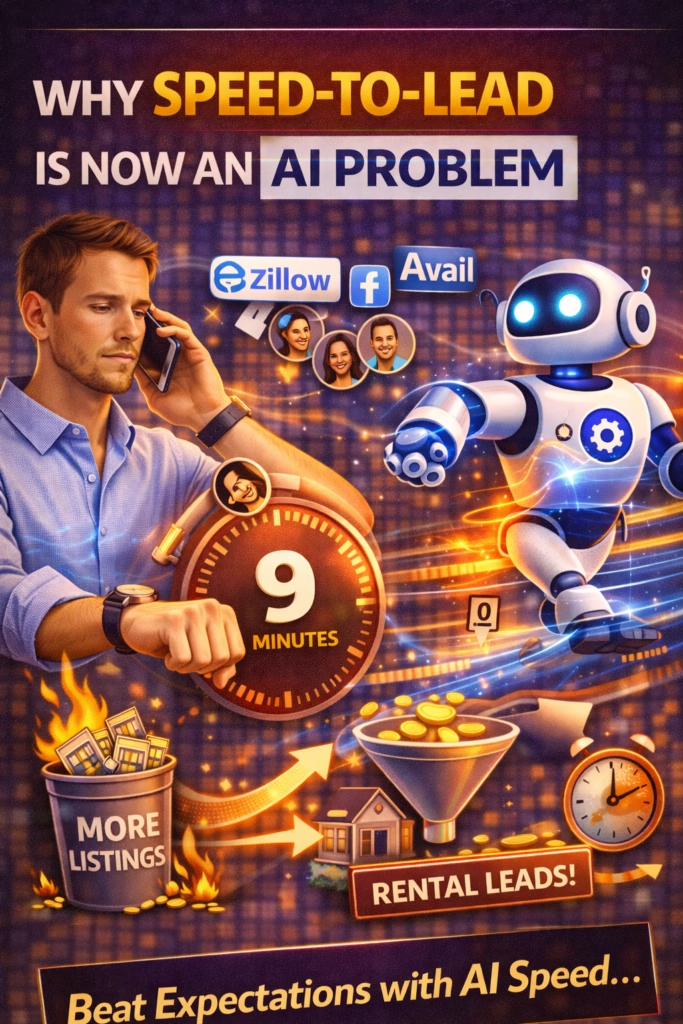
Why Speed-to-Lead Is Now an AI Problem explains why modern inbound conversion is won in minutes—not hours—and how AI becomes the only scalable way to reply instantly, qualify consistently, and follow up without dropping leads.
Note: This is general guidance. Keep messaging accurate, follow platform rules, and comply with applicable privacy and marketing laws. Avoid spam and misleading claims.
Introduction
Why Speed-to-Lead Is Now an AI Problem comes down to a brutal reality: your leads are not waiting. They’re shopping. They’re messaging multiple businesses. They’re choosing the fastest path to a clear next step.
In older marketing eras, being “good” at follow-up meant replying same day. In 2025–2026, that’s often too slow—especially in messaging-first channels like Marketplace, Instagram DMs, website chat, and SMS.
Big idea: Speed isn’t a nice-to-have. It’s the conversion gate.
Expanded Table of Contents
- 1) What speed-to-lead really means
- 2) Why speed-to-lead matters more now
- 3) The economics: speed multiplies the same leads
- 4) Modern buyer behavior (how they actually shop)
- 5) Why humans can’t win speed at scale
- 6) What AI does better (and where humans stay essential)
- 7) The conversation funnel: from message to booked next step
- 8) Copy/paste scripts that convert fast
- 9) Routing and triage: catch high intent instantly
- 10) Follow-up automation: where hidden revenue lives
- 11) Human handoff: when the closer steps in
- 12) KPIs to track weekly
- 13) 30–60–90 day rollout plan
- 14) 25 Frequently Asked Questions
- 15) 25 Extra Keywords
1) What speed-to-lead really means
Speed-to-lead is the time between when a lead takes an action (DMs you, texts you, fills a form, calls, clicks a button) and when you respond with a helpful next step.
Speed-to-lead includes two clocks
Clock #1: First response
How quickly you acknowledge and engage the lead.
Clock #2: Time to next step
How quickly you book the appointment, showing, demo, pickup, or quote call.
Pro move: “Instant response” without “booked next step” is just fast small talk.
2) Why speed-to-lead matters more now
Most markets are more competitive. Most buyers are more impatient. And the channels that produce leads are increasingly tap-to-message environments where the easiest reply wins.
What changed
- Buyers message multiple options at once
- Decision windows shrink to minutes
- After-hours inbound is normal
- Messaging platforms reward speed and consistency
Reality check: A 2-hour response time can feel like “no response” in DM-first channels.
3) The economics: speed multiplies the same leads
Speed doesn’t just “help.” Speed changes your unit economics because it converts more of the leads you already paid for (or earned organically).
| Scenario | What happens | Business impact |
|---|---|---|
| Slow replies | More ghosting, fewer booked next steps | Lower close rate; need more traffic |
| Fast replies | More conversations reach scheduling | Higher close rate; traffic becomes optional fuel |
| Fast + follow-up | Recovered leads you would have lost | Best ROI channel: your own pipeline |
Rule: Before you buy more leads, convert more of the leads you already get.
4) Modern buyer behavior (how they actually shop)
Most buyers don’t research one business at a time. They multi-thread.
The “multi-thread buyer” pattern
- They browse and short-list 3–10 options
- They message 3–5 at once
- They choose the one that replies fast and makes the next step easy
- They stop responding to the rest
Translation: Ghosting is often not rejection. It’s selection—of the faster competitor.
5) Why humans can’t win speed at scale
Humans are great closers. Humans are not great at 24/7 instant response—especially across multiple channels.
The four bottlenecks
- Sleep and schedules: leads don’t arrive only when you’re available
- Context switching: replying across platforms kills focus
- Consistency: different reps ask different questions
- Follow-up fatigue: humans stop after the first message
Truth: Even the best team drops leads when volume spikes.
6) What AI does better (and where humans stay essential)
AI is not replacing closers. AI is replacing delay and inconsistency.
AI should handle
- Instant first reply
- Qualification questions
- Capturing key fields (city, timeline, budget, needs)
- Routing and triage
- Follow-up SOP
- Scheduling options and confirmations
Humans should handle
- Complex objections
- Negotiation and closing
- Edge cases and exceptions
- High-trust relationship building
- High-ticket consultative calls
Rule: AI creates momentum. Humans close momentum.
7) The conversation funnel: from message to booked next step
A speed-to-lead system is not “reply fast.” It’s a funnel with stages.
Conversation funnel stages
- Engage: confirm + acknowledge instantly
- Qualify: ask 1–2 questions that move the lead forward
- Offer options: give next-step choices (A/B/C)
- Book: schedule appointment/showing/demo
- Confirm: send confirmation and reduce no-shows
- Follow-up: recover non-responders
Pro move: Don’t optimize “message count.” Optimize “booked next steps.”
8) Copy/paste scripts that convert fast
Instant reply (universal)
Yes — I can help ✅
Quick question so I send the right options:

Are you looking to do this today or this week?
Second question (capture location / routing)
Got it ✅ What city/zip are you in?Offer options (book next step)
Perfect ✅ I can get you set up:
A) Today 4–6
B) Tomorrow 11–1
C) Saturday 10–12

Which one works best?
If they’re “just browsing” (nurture)
No worries ✅
What’s your ideal budget range and your timeline?
I’ll point you to the best next step when you’re ready.
Rule: One message = one job. Don’t overload the first reply.
9) Routing and triage: catch high intent instantly
Not all leads deserve the same attention. AI is excellent at sorting.
Simple triage buckets
| Bucket | Signal | Action |
|---|---|---|
| High intent | Ready now / asks price / wants availability | Escalate + book now |
| Medium intent | Timeline soon, needs info | Qualify + offer options |
| Low intent | Browsing, vague | Nurture + collect basics |
Pro move: Route “ready now” leads to a human in real time, with the AI summary included.
10) Follow-up automation: where hidden revenue lives
Most businesses answer once and stop. That’s where the money leaks. Follow-up recovers leads you already earned.
3-touch follow-up SOP (baseline)
| Timing | Message | Goal |
|---|---|---|
| 20–40 min | Quick check-in + question | Restart |
| Same day | Options + urgency (truthful) | Book |
| Next day | Alternate option / plan | Save |
Follow-up #1
Quick check-in ✅
Did you still want to move forward?
What city are you in, and are you looking for today or this week?
Follow-up #2
Just a heads up ✅
If you want the fastest option, reply with your city and I’ll confirm the next step.
Follow-up #3
Still shopping? ✅
If this isn’t perfect, tell me your budget + must-haves and I’ll point you to the best match.
Rule: Follow-up should add clarity, not pressure.
11) Human handoff: when the closer steps in
The best AI systems don’t replace humans—they tee them up with context.
What the AI should pass to the closer
- Lead name (if available)
- Channel (Marketplace/DM/form)
- City/zip
- Timeline (today/this week/this month)
- Budget range / needs
- Objections asked
- Best next-step recommendation
Pro move: Your closer should open with: “I saw you’re in ___ and looking for ___ this week—want the fastest option?”
12) KPIs to track weekly
| KPI | What it means | Target |
|---|---|---|
| Median response time | Speed-to-lead | < 5 min good; < 1 min best |
| Qualified rate | Info captured | Up with better scripts |
| Booked rate | Appointments/showings/demos | Up with options |
| Show rate | No-shows vs attended | Improve with confirmations |
| Close rate | Revenue conversion | Improves with speed + follow-up |
Truth: “Leads” are not the metric. “Booked next steps” is the metric.
13) 30–60–90 day rollout plan
Days 1–30 (Install speed)
- Define your 1–2 qualification questions
- Deploy instant reply scripts across channels
- Implement 3-touch follow-up SOP
- Track response time + booked rate weekly
Days 31–60 (Install consistency)
- Add routing and triage (high intent → human)
- Standardize handoff summaries
- Add scheduling options and confirmations
- Refine scripts based on ghosting points
Days 61–90 (Install scale)
- Expand to all inbound channels
- Improve nurture flows for longer timelines
- Optimize weekly on booked rate and show rate
- Retire weak scripts and double down on winners
14) 25 Frequently Asked Questions
1) What does speed-to-lead mean?
How quickly you respond after a lead messages, calls, or submits a form.
2) Why is speed-to-lead now an AI problem?
Because inbound happens 24/7 and buyers choose whoever responds fastest and books the next step.
3) What response time is good?
Under 5 minutes is strong; under 1 minute is best.
4) Does instant response increase conversions?
Yes—especially in messaging-first channels.
5) Why do leads ghost?
They pick the fastest competitor or lose momentum if no next step is offered.
6) What is a conversation funnel?
A DM-to-appointment system: confirm, qualify, offer options, book, follow up.
7) What should the first reply say?
Confirm, ask a question, offer a next step.
8) Best qualification question?
Location + timeline (or budget + timeline) depending on your offer.
9) Can AI qualify leads?
Yes—consistently and instantly.
10) Can AI book appointments?
Yes if integrated with scheduling tools.
11) What is routing and triage?
Sorting leads by intent and sending the right ones to a human quickly.
12) How does AI reduce workload?
AI handles repetitive replies, captures info, and follows up automatically.
13) Do I still need humans?
Yes—humans close, handle exceptions, and build relationships.
14) Which channels benefit most?
Marketplace, DMs, web chat, SMS, inbound forms.
15) What’s the risk of slow replies?
Lost leads, more ghosting, lower booked rate.
16) What is a follow-up SOP?
A consistent sequence that re-engages non-responders.
17) How many follow-ups?
Three touches is a strong baseline.
18) What should follow-ups include?
Check-in, clear next step, alternate option.
19) How do I make AI sound human?
Short sentences, one question at a time, clear options, consistent tone.
20) Best KPI for conversion?
Booked next steps.
21) What should I track weekly?
Inbound volume, response time, qualified rate, booked rate, close rate.
22) Can AI reduce ad spend?
Often yes—by converting more of the same leads.
23) Is AI only for big companies?
No—small businesses benefit heavily from after-hours coverage.
24) How fast can results show?
Within days, because you’re improving conversion immediately.
25) Fastest improvement today?
Instant reply + 3-touch follow-up SOP that always asks a question and offers options.
15) 25 Extra Keywords
- Why Speed-to-Lead Is Now an AI Problem
- speed-to-lead
- AI speed-to-lead
- lead response time automation
- instant lead response
- AI auto reply system
- follow up automation
- inbound lead conversion
- conversation funnel
- appointment booking automation
- lead routing and triage
- reduce lead ghosting
- instant reply scripts
- DM to appointment system
- speed to lead strategy 2026
- automated lead qualification
- AI sales assistant for inbound leads
- 24/7 lead response
- after hours lead coverage
- booked next steps KPI
- reduce marketing waste
- lead nurturing automation
- AI customer response system
- sales follow up SOP
- modern lead generation economics













