
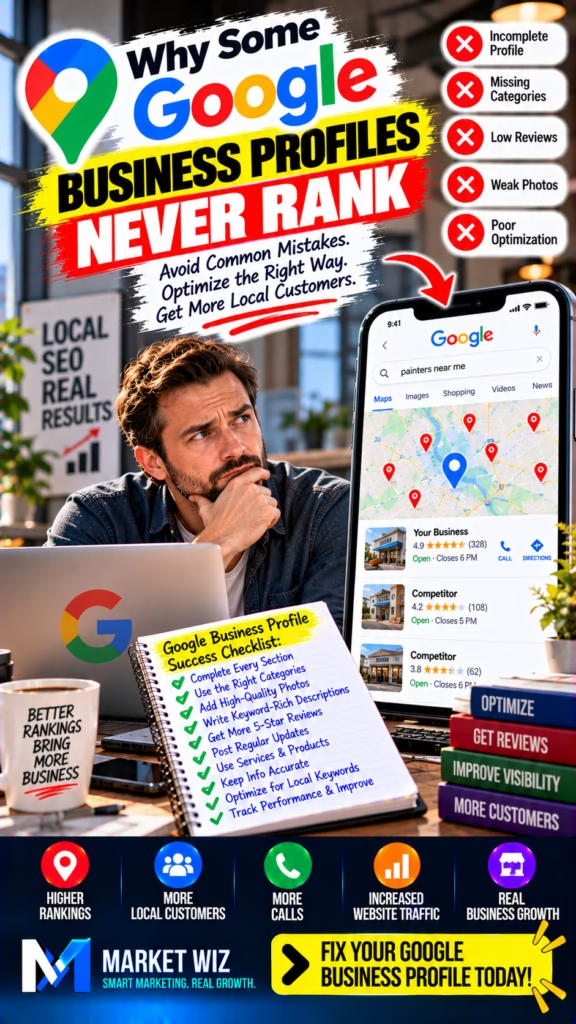
Why Some Google Business Profiles Never Rank
Some businesses invest time in Google Business Profile optimization yet remain almost invisible for valuable local searches. The problem is not always missing keywords or too few posts. It may involve relevance, distance, prominence, inaccurate information, eligibility problems, weak customer trust, or unrealistic expectations. This complete guide explains the reasons Google Business Profiles struggle to rank and what businesses can do to build a stronger, more sustainable local search presence.
1. Why Some Google Business Profiles Stay Invisible
A Google Business Profile can be an important source of local discovery. Customers use Google Search and Google Maps to find nearby contractors, restaurants, retailers, automotive companies, home improvement providers, and many other types of businesses.
Yet creating a profile does not automatically produce strong visibility. Some businesses appear prominently for relevant searches, while others struggle to appear outside searches for their own company names.
The reasons are often more complicated than a missing description or an incomplete photo gallery. Google uses multiple systems to determine which businesses are most relevant to a particular local search.
Location matters. Business categories matter. Online prominence matters. The searcher's wording and location also matter. Two customers searching for the same service from different neighborhoods may see noticeably different local results.
Important distinction: A business that does not appear in the top three local results is not necessarily completely unranked. It may appear lower, appear for different queries, or appear more prominently from another search location.
Before attempting to fix a Google Maps ranking problem, business owners should understand whether the issue involves profile eligibility, search relevance, local competition, or the way ranking performance is being measured.
2. Understanding Google's Three Main Local Ranking Factors
Google publicly identifies three primary considerations behind local search results: relevance, distance, and prominence.
These factors provide the foundation for understanding why some Google Business Profiles appear prominently while others receive limited exposure.
Relevance
How closely the business matches the customer's search. Accurate categories and business information help Google understand what the business offers.
Distance
How far the business is from the location associated with the search. Distance can affect results even when a business serves a much larger geographic area.
Prominence
How well-known the business is based on signals Google can evaluate, including information from across the web.
Search Context
The specific query and search location influence how relevance, distance, and prominence apply to the results a customer sees.
Businesses sometimes focus entirely on one factor. They may attempt to increase review volume, publish more posts, or add more service areas while ignoring fundamental relevance problems.
A better approach considers the complete picture. No legitimate optimization provider can directly control Google's organic local ranking decisions.
3. Profile Verification and Eligibility Problems
Google Business Profiles are intended for eligible businesses that meet Google's representation requirements. Businesses generally need to have in-person customer contact during their stated hours, subject to the applicable business-type guidelines and exceptions.
Verification is an important step in establishing and managing a business's presence. Google may require particular verification methods depending on the business and circumstances.
A business that has not completed required verification may have limited ability to manage its profile or may face additional restrictions.
What businesses should review
- Whether the business is eligible for a Google Business Profile.
- Whether the profile has completed the required verification process.
- Whether any verification action remains pending.
- Whether the business information matches real-world operations.
- Whether the profile has any restrictions or policy notices.
Verification alone does not guarantee strong rankings. It establishes an important management foundation, but local visibility still depends on other factors.
4. Choosing the Wrong Primary Business Category
The primary category is one of the most important pieces of information used to describe a business. It should reflect the business's actual primary activity.
For example, a business specializing in a specific trade should select the most accurate available category rather than an unrelated broad category chosen only to pursue additional search traffic.
Secondary categories can describe additional genuine activities, but they should not be used as a collection of every possible search phrase.
Optimization principle: Choose categories that accurately represent the business's real activities. Do not select unrelated categories simply because they appear competitive or popular.
Businesses should review available category options periodically, especially when their genuine offerings change.
5. Why Distance Can Prevent Strong Google Maps Rankings
Distance is one of the most misunderstood aspects of Google Maps SEO.
A business may provide services throughout an entire county or metropolitan area, but that does not mean it will rank equally well in every neighborhood.
Google considers the distance between a business and the location associated with a customer's search. This can create substantial differences between search results in nearby communities.
For example, a contractor operating from one city may legitimately serve customers in several surrounding cities. However, businesses physically closer to a particular searcher may have a distance advantage for some queries.
The correct response is not to invent addresses or create fictitious offices. Businesses should represent their locations accurately and work on relevance, prominence, and useful local website information.
6. Why Adding More Service Areas Does Not Guarantee Rankings
Some business owners believe that adding dozens of cities to a Google Business Profile automatically expands their Google Maps ranking coverage.
That is not how Google's published local ranking guidance works. Service-area settings describe where an eligible business actually serves customers. They are not a guaranteed ranking multiplier.
Businesses should configure genuine service areas according to Google's current guidelines.
A company should not claim cities it does not serve or create additional locations solely to manipulate results.
Better approach: Use accurate service-area settings, maintain a helpful website, and explain genuine local coverage through useful content and customer information.
7. Business Name Keyword Stuffing and Policy Violations
Some businesses attempt to influence Google Maps rankings by adding extra keywords, services, or city names to their Google Business Profile names.
Google requires businesses to use names that accurately reflect how they are known and represented in the real world.
A profile name should not become a list of search phrases.
Misleading names may create policy problems and can undermine customer trust.
Businesses should maintain a consistent, legitimate business identity instead of attempting to gain an advantage through unauthorized keyword additions.
8. Weak Business Descriptions and Unclear Offerings
A business description should help customers understand the company's actual work.
Descriptions that are vague, inaccurate, or filled with repetitive promotional phrases provide limited value.
A useful description explains the business's primary offerings, genuine specialties, and relevant customer information.
For example, a contractor may explain the types of projects it performs and the customers it serves.
A retailer may describe its product categories and the shopping experience it provides.
A description is not a guaranteed ranking lever, but accurate information helps create a clearer business presence.
9. Incomplete and Inaccurate Google Business Profile Information
A business profile should contain current, accurate information that customers can rely on.
Missing contact details, incorrect hours, outdated website links, and misleading descriptions can create unnecessary friction.
Profile information checklist
- Correct real-world business name.
- Accurate primary category.
- Relevant secondary categories.
- Eligible address or service-area configuration.
- Working business telephone number.
- Current website URL.
- Regular and special operating hours.
- Accurate description.
- Relevant offerings where supported.
- Authentic business photographs.
Complete information does not guarantee a particular ranking position. However, it helps customers understand and contact the business successfully.
10. Strong Local Competition Can Limit Visibility
Some businesses operate in highly competitive markets where many established providers target similar customer searches.
A newer business may compete with companies that have operated in the area for years, developed recognizable brands, earned authentic reviews, and built substantial online presences.
Competition can also vary dramatically between industries and neighborhoods.
Instead of comparing only review counts, businesses should evaluate the overall quality of their local presence.
Relevant offerings, accurate information, customer experience, and legitimate prominence are more sustainable areas of improvement than attempts to manipulate competitors.
11. Insufficient Authentic Customer Reviews
Google states that review count and positive ratings can contribute to local prominence.
However, reviews are not the only ranking factor. A business with fewer reviews may still appear above another company because of relevance, distance, or other considerations.
A responsible review strategy encourages real customers to share honest experiences.
Businesses should not buy reviews, create fake customer accounts, or offer prohibited incentives in exchange for feedback.
Authentic customer reviews can support both local prominence and informed customer decisions.
12. Ignoring Customer Reviews and Reputation Management
Customer reviews can reveal how people experience a business.
A company that never responds may miss opportunities to clarify information, thank customers, or address legitimate concerns.
Review responses should remain professional, accurate, and respectful.
Businesses should avoid publishing private customer details or arguing publicly with reviewers.
While responding to reviews does not guarantee higher rankings, responsible reputation management supports a better customer experience.
13. Weak Website Content and Poor Local SEO Foundations
A Google Business Profile does not exist in complete isolation from the rest of a company's online presence.
Google can consider information from across the web when evaluating prominence and understanding a business.
A useful business website helps customers learn about actual offerings, operating areas, contact methods, and relevant business details.
Pages should be clear, accessible, mobile-friendly, and genuinely useful.
Avoid producing large quantities of thin or repetitive content solely to target search engines.
A website is not a guaranteed Maps ranking solution, but it can strengthen the overall local marketing foundation.
14. Poorly Designed Local Landing Pages
Businesses serving multiple genuine markets sometimes create separate website pages for different locations.
This can be useful when each page contains meaningful, distinctive information about the business's actual work in that area.
Problems arise when location pages simply repeat identical text while replacing one city name with another.
Useful location pages may explain real service coverage, customer requirements, verified local experience, and appropriate contact details.
The goal is to help local customers, not manufacture the appearance of physical locations that do not exist.
15. Limited Online Prominence and Relevant Backlinks
Google identifies prominence as a major local ranking consideration.
Prominence can reflect information about a business from sources beyond its own Google Business Profile.
Google's guidance notes that links can contribute to local prominence.
Businesses may earn legitimate references through relevant industry relationships, community involvement, useful resources, and authentic coverage.
Manipulative link purchases, irrelevant link networks, and artificial authority schemes should be avoided.
Practical principle: Build a business that customers and relevant organizations have genuine reasons to reference. Artificial links are not a substitute for a credible local presence.
16. Inconsistent Business Information Across the Web
Customers may encounter a business through its website, Google Business Profile, industry directories, and other legitimate online platforms.
Conflicting information can make it difficult for customers to determine which details are current.
For example, an outdated telephone number on a major directory may send customers to the wrong contact.
Businesses should maintain accurate information on relevant platforms they control and correct important outdated records when practical.
Directory consistency is useful, but mass directory submissions do not guarantee stronger Google Maps rankings.
17. Missing or Misleading Business Photographs
Photographs help customers understand a business before making contact.
A contractor may show authentic completed projects. A restaurant may show genuine menu items. A retailer may show actual products or its physical shopping environment.
Photographs should accurately represent the business and comply with Google's content policies.
Uploading a large number of images does not guarantee better rankings.
The more meaningful objective is helping customers form realistic expectations.
18. Misunderstanding Google Business Profile Posts
Business Profile posts can be useful for sharing relevant updates, events, and offers where supported.
However, some marketers present posting frequency as a guaranteed ranking formula.
Google does not promise that publishing a certain number of posts each week will produce a particular Maps position.
Posts should be accurate, relevant to customers, and compliant with current platform requirements.
Businesses should prioritize overall profile quality rather than treating post volume as the sole measure of optimization.
19. Incorrect Business Hours and Availability
Accurate operating hours are fundamental to a useful local profile.
A customer searching for a business may need assistance immediately or may be planning a visit.
If a business displays incorrect hours, customers may call or travel when nobody is available.
Review regular hours, holiday hours, and temporary operating changes.
Do not claim 24-hour availability unless that accurately reflects the business's operations.
Reliable information improves customer experience even when it does not independently guarantee higher rankings.
20. Duplicate Listings and Ineligible Business Locations
Duplicate Google Business Profiles can create management problems and may violate platform rules.
Businesses should not create multiple profiles for the same operation merely to target additional keywords or surrounding cities.
Google also maintains eligibility rules for physical locations, service-area businesses, and certain other business models.
Virtual offices and coworking arrangements must satisfy applicable requirements rather than simply functioning as mailing addresses.
When a legitimate duplicate or ownership issue exists, businesses should use Google's official procedures to resolve it.
21. Suspended or Restricted Google Business Profiles
A suspended or restricted profile can affect a business's ability to manage its Google presence and may affect visibility.
Businesses should review any notifications or policy explanations provided through their profile management tools.
Common areas requiring review may include eligibility, business representation, location information, or other policy requirements.
A business should correct genuine problems and follow Google's official appeal or reinstatement procedures when appropriate.
Creating replacement profiles to bypass enforcement is not a responsible solution.
22. Ranking for Your Business Name but Not Your Services
A business may appear prominently when someone searches for its exact name but struggle to appear for broader service-related searches.
These searches involve different relevance and competitive conditions.
A branded search identifies a particular company. A broader service search may involve many competing businesses.
Businesses should review their genuine categories, offerings, website content, and local prominence.
They should also assess whether the searcher's location creates a meaningful distance disadvantage.
23. Why Google Maps Rankings Change Across Neighborhoods
Google Maps rankings are not one universal number.
A company may appear prominently near its actual location and much lower several miles away.
The same business may also rank differently for closely related search phrases.
Search results can vary with location, query interpretation, competition, and other relevant context.
For this reason, a single manual search is not a complete ranking analysis.
Businesses should evaluate a representative set of relevant queries and locations rather than rely on one screenshot or position.
24. Measuring Rankings Without Understanding Search Context
Poor measurement can make a business believe it is performing better or worse than it actually is.
For example, checking one keyword from one location does not reveal how customers throughout an operating area experience local search results.
Google Business Profile performance information can provide useful interaction data, while website analytics and customer records can add further context.
| Metric | What It Helps Explain | Important Limitation |
|---|---|---|
| Local search position | Visibility for a particular query and location | Not a universal ranking |
| Profile interactions | Available customer engagement signals | Not identical to completed sales |
| Website visits | Visitors reaching the business website | Not all visits are qualified leads |
| Qualified inquiries | Relevant customer opportunities | Requires consistent definitions |
| Completed sales | Actual business outcomes | May involve several marketing channels |
Better measurement helps businesses identify meaningful improvements instead of chasing isolated ranking fluctuations.
25. Unrealistic Ranking Expectations and SEO Guarantees
One of the most common problems in local SEO marketing is the expectation that every business can reach the first position for every keyword and every city.
Google's local ranking systems do not work that way.
Relevance, distance, and prominence vary by search. Competition also differs between markets and industries.
No legitimate provider can guarantee a permanent number-one organic Google Maps position.
Businesses should evaluate optimization based on realistic goals, transparent reporting, and meaningful customer outcomes.
26. How AI Can Help Diagnose Google Business Profile Problems
AI-assisted tools can support local SEO workflows when used responsibly.
For example, AI may help organize profile audits, identify missing business information, prepare content drafts, and summarize performance records.
AI can also assist with customer communication workflows and administrative follow-up.
However, AI cannot directly control Google's organic rankings.
Businesses should verify all generated information, protect customer data, and follow applicable platform policies.
Useful AI application: Automate repetitive analysis and administrative work while keeping real business information, human review, and platform compliance at the center of the strategy.
27. Build a Stronger Local SEO Strategy Beyond Your Profile
A sustainable Google Maps strategy should support the business's complete local presence.
This may include an accurate website, useful service information, authentic customer reviews, relevant local references, and consistent customer communication.
Businesses should prioritize the channels that genuinely help their customers discover and evaluate their offerings.
For example, a home improvement company may benefit from informative project pages, while a retailer may need clear product and location details.
The strategy should reflect actual customer needs rather than generic SEO checklists alone.
28. Analyze Competitors Without Copying Their Mistakes
Publicly visible competitor information can help businesses understand their local search environment.
However, competitor research should focus on legitimate insights, not manipulation.
Useful areas to examine
- Which genuine business categories competitors use.
- How clearly they explain their offerings.
- Whether they provide helpful website content.
- How they present real business information.
- What customer questions appear in authentic reviews.
- Which local search queries are relevant to the market.
- How distance affects results across neighborhoods.
Avoid assuming that every visible competitor tactic is compliant or effective.
A competitor's ranking does not prove that every aspect of its marketing caused that position.
29. The Most Common Google Business Profile Ranking Mistakes
Businesses struggling with Google Maps visibility should review several recurring problems.
- Using an inaccurate primary category.
- Ignoring important verification requirements.
- Publishing incorrect business information.
- Claiming service areas that do not reflect real operations.
- Adding unauthorized keywords to the business name.
- Creating duplicate or ineligible profiles.
- Using fictitious offices or misleading addresses.
- Failing to explain genuine products or services.
- Maintaining outdated hours or contact details.
- Buying fake reviews or using prohibited incentives.
- Publishing misleading photographs.
- Relying entirely on posting frequency.
- Ignoring useful website content.
- Using thin duplicate city pages.
- Participating in manipulative link schemes.
- Measuring rankings from only one search location.
- Assuming every service-area city should rank equally.
- Confusing profile views with qualified leads.
- Expecting guaranteed first-place rankings.
- Ignoring actual customer experience.
Not every issue applies to every business. A careful audit should identify the problems supported by actual evidence rather than make assumptions.
30. A 90-Day Plan to Improve Google Business Profile Visibility
A structured improvement plan helps businesses address fundamental problems before investing in additional marketing activity.
Days 1–30: Audit and Correct
Review Eligibility and Verification
Confirm that the business qualifies for a profile, complete required verification, and review any policy or management restrictions.
Correct Business Information
Review the real-world name, categories, contact information, hours, address settings, and genuine service areas.
Establish a Measurement Baseline
Record relevant local searches, available performance metrics, and customer inquiry outcomes using consistent definitions.
Days 31–60: Strengthen Relevance and Trust
Improve Genuine Offering Details
Clarify the products, services, and business specialties that accurately represent the company.
Improve Supporting Website Content
Develop useful pages that answer customer questions and explain actual operating coverage.
Strengthen Authentic Customer Trust
Maintain accurate photographs, encourage honest customer reviews, and respond professionally to feedback.
Days 61–90: Evaluate and Refine
Review Local Visibility Patterns
Compare relevant queries and search locations to understand where visibility is stronger or weaker.
Measure Qualified Customer Opportunities
Use available analytics and CRM information to distinguish profile interactions from meaningful inquiries and sales.
Prioritize Evidence-Based Improvements
Address remaining information gaps, customer communication problems, and genuine local SEO opportunities without relying on ranking shortcuts.
Long-term takeaway: Google Maps visibility is built through accurate business representation, relevance to real customer searches, legitimate prominence, and consistent operational quality. The objective is sustainable discovery, not temporary ranking manipulation.
30 Frequently Asked Questions About Google Business Profiles That Never Rank
1. Why is my Google Business Profile not ranking?
A Google Business Profile may struggle to appear prominently because of relevance, distance, prominence, incomplete or inaccurate information, eligibility issues, or strong local competition. Rankings vary by search and location.
2. What are the main Google Maps ranking factors?
Google identifies relevance, distance, and prominence as the primary factors influencing local search results. No single optimization tactic guarantees a particular ranking.
3. Can an unverified Google Business Profile rank?
Verification is important for managing and establishing an eligible profile. A business should complete Google's required verification steps, but verification alone does not guarantee prominent rankings.
4. Does choosing the wrong Google Business Profile category hurt rankings?
An inaccurate category can make it harder for Google and customers to understand what a business actually offers. Choose the most accurate primary category and relevant secondary categories.
5. Can I rank in cities outside my physical location?
A business may appear for searches outside its immediate location, but distance remains an important factor. Adding service areas or city names does not guarantee rankings in those markets.
6. Does adding more service areas improve Google Maps rankings?
No guaranteed ranking improvement comes from adding service areas. Businesses should list only genuine areas they serve and follow Google's current service-area guidelines.
7. Can keyword stuffing hurt my Google Business Profile?
Adding unnecessary keywords to a business name or using misleading content can violate Google's guidelines. Use the real business name and accurate descriptions instead.
8. Do Google reviews affect local rankings?
Google says review count and positive ratings can contribute to local prominence. Reviews are one consideration among several, and no number of reviews guarantees a specific position.
9. Why does a competitor with fewer reviews rank above me?
Google considers multiple factors, including relevance, distance, and prominence. A competitor with fewer reviews may be more relevant or closer to a particular searcher.
10. Do Google Business Profile posts directly improve rankings?
Google does not promise ranking improvements from a particular posting frequency. Useful posts can inform customers, but they should not be treated as a guaranteed ranking tactic.
11. Can outdated business hours affect my local visibility?
Accurate hours are important for customer experience and profile quality. Businesses should keep regular and special hours current rather than rely on outdated information.
12. Why is my Google Business Profile visible for my business name but not my services?
Branded searches and broader service searches involve different competition and relevance considerations. Accurate categories, offerings, website content, and genuine prominence can help establish relevance.
13. Can duplicate Google Business Profiles cause problems?
Duplicate or ineligible profiles can create management and policy issues. Businesses should maintain profiles that accurately represent eligible real-world operations.
14. Can a virtual office be used to rank on Google Maps?
A virtual office generally does not qualify merely because a business receives mail there. Businesses must follow Google's eligibility and location rules, including any applicable staffing and signage requirements.
15. Does a website help Google Maps rankings?
A useful website can support local search relevance and business credibility. Google also considers information from across the web, but having a website does not guarantee a particular Maps ranking.
16. Do local backlinks matter for Google Maps SEO?
Google indicates that links can contribute to prominence. Relevant, editorially earned links may support a business's broader online presence, but buying manipulative links is not a reliable strategy.
17. Do business directory listings help Google Business Profiles?
Accurate business information on legitimate directories can help customers find consistent details. Directory submissions alone do not guarantee higher Google Maps rankings.
18. Can changing my business name improve rankings?
Businesses should use their genuine real-world names. Adding keywords or locations that are not part of the actual business name can violate Google's guidelines.
19. Does hiding my address hurt Google Maps rankings?
Eligible service-area businesses should follow Google's address visibility requirements. Hiding an address when required is not a reason to misrepresent the business's operating model.
20. Can Google Business Profile suspensions prevent rankings?
A suspended or restricted profile can affect visibility and management. Businesses should review the stated issue and use Google's official appeal or reinstatement processes when appropriate.
21. Why do my Google Maps rankings change by neighborhood?
Local results vary with the searcher's location, query, and competitive environment. Distance and relevance can make the same business appear differently across neighborhoods.
22. How long does Google Business Profile optimization take?
Results vary according to business eligibility, competition, location, existing online presence, and the changes made. No legitimate provider can guarantee a fixed timeline for reaching a specific position.
23. Can AI automatically make my Google Business Profile rank first?
No. AI can assist with audits, content preparation, data organization, and workflow management, but it cannot guarantee or directly control Google's organic ranking decisions.
24. Should I create separate Google Business Profiles for every city?
Only create profiles for locations that independently meet Google's eligibility requirements. Creating fictional locations or duplicate profiles to target more cities violates the intent of Google's guidelines.
25. Can inaccurate contact information reduce customer leads?
Yes. Incorrect phone numbers, website links, or hours can prevent interested customers from contacting the business successfully, regardless of its search visibility.
26. Does adding more photos guarantee higher rankings?
No. Authentic photos can help customers understand a business, but uploading a particular number of images does not guarantee improved Google Maps rankings.
27. How can I check whether my Google Business Profile is improving?
Review available Business Profile performance data, monitor relevant local searches from appropriate locations, and track qualified customer inquiries and completed business outcomes over time.
28. Can paying Google improve my organic Maps ranking?
No. Google states that businesses cannot request or pay for a better organic local ranking. Paid advertising is separate from organic local ranking.
29. What is the biggest Google Business Profile ranking mistake?
There is no universal single biggest mistake. Common problems include inaccurate information, wrong categories, ineligible locations, weak relevance, policy violations, and unrealistic expectations about distance.
30. What is the best long-term strategy to improve Google Maps visibility?
Maintain an eligible and accurate profile, explain genuine offerings clearly, earn authentic customer trust, build a useful website and online presence, and evaluate results using meaningful local business outcomes.
30 Additional SEO Keywords for Google Business Profile Rankings
These keyword themes can support future local SEO research, educational articles, service pages, and content planning. Use relevant phrases naturally rather than repeating keywords without providing useful information.
Conclusion: Google Maps Visibility Requires More Than a Completed Profile
Some Google Business Profiles struggle to rank because the business is poorly matched to relevant searches, too far from certain searchers, or less prominent than competing providers.
Other profiles face more direct problems, including inaccurate categories, incomplete information, eligibility issues, duplicate listings, or policy restrictions.
The most effective response is not to chase secret ranking tricks.
Businesses should first establish an accurate, eligible Google Business Profile that clearly reflects their real operations.
They should then strengthen supporting website information, authentic customer trust, relevant local visibility, and reliable customer communication.
Most importantly, they should evaluate marketing success using qualified inquiries, appointments, customer relationships, and completed business outcomes.
Market Wiz AI helps businesses coordinate local SEO, Google Maps optimization, organic marketing strategies, and AI-assisted customer engagement to create a more organized approach to local business growth.
Sustainable Google Maps performance depends on relevance, legitimate prominence, accurate information, and consistent improvement.
Improve Your Google Maps Visibility With Market Wiz AI
Discover how Market Wiz AI can help your business identify local SEO opportunities, improve Google Business Profile information, strengthen organic marketing, support customer engagement, and build a more measurable local growth strategy.
Strengthen Your Local Google Presence →