

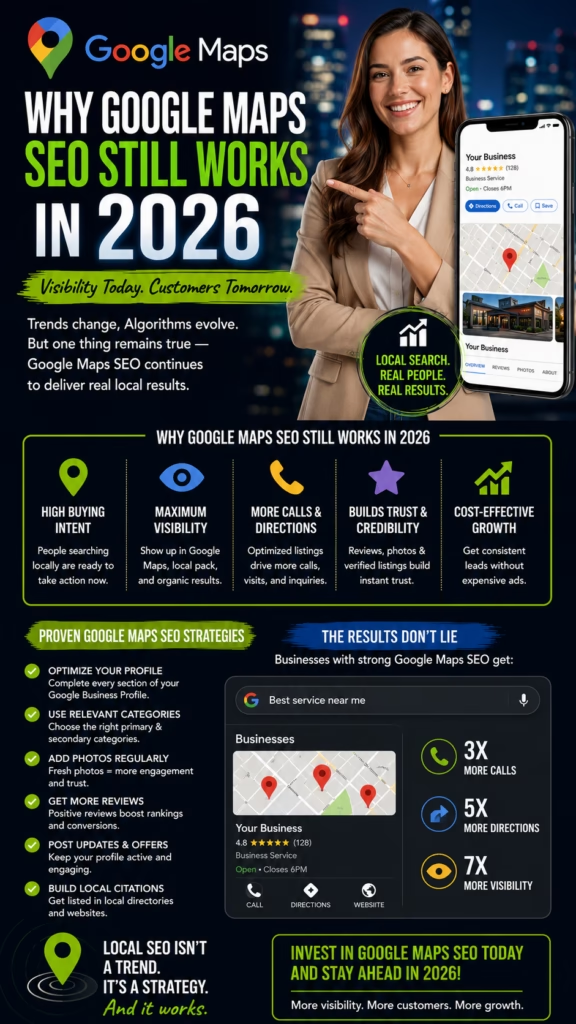
Why Google Maps SEO Still Works in 2026
Why Google Maps SEO Still Works in 2026 explains why local businesses still depend on Google Maps visibility to generate calls, appointments, direction requests, website visits, and real customers.
Introduction
Why Google Maps SEO Still Works in 2026 comes down to one simple fact: local buyers still use Google when they need something nearby. Whether someone needs a plumber, dentist, moving company, pest control service, HVAC contractor, med spa, attorney, roofing company, restaurant, auto repair shop, flooring company, or local store, Google Maps is often where the decision starts.
Even with social media, AI search tools, paid ads, short-form video, and marketplace platforms growing fast, Google Maps remains powerful because it captures local intent. People do not search Maps just for entertainment. They search because they need a service, want directions, compare reviews, check hours, request a quote, or choose who to call.
Google Maps SEO still works in 2026 because customers still search locally, compare trusted businesses, read reviews, view photos, check distance, and take action directly from the map results.
For local businesses, Google Maps SEO is not just about ranking. It is about being visible at the exact moment a customer is ready to decide. A strong Google Business Profile, steady review growth, local website relevance, service-area pages, citations, photos, posts, and tracking can turn search visibility into calls, bookings, and revenue.
Main idea: Why Google Maps SEO Still Works in 2026 is about local buyer intent, trust signals, profile quality, business prominence, and the ability to turn nearby searches into customers.
Table of Contents
- 1) Why Google Maps SEO still matters
- 2) Local intent is still powerful in 2026
- 3) Google Maps connects searchers with nearby businesses
- 4) Reviews still influence local decisions
- 5) Google Business Profile optimization still matters
- 6) Categories and services still shape relevance
- 7) Photos and posts still build trust
- 8) Website relevance still supports Maps visibility
- 9) City pages and service pages still help
- 10) Citations and NAP consistency still support trust
- 11) Proximity still matters, but it is not everything
- 12) Prominence still separates strong businesses
- 13) Google Maps SEO versus paid ads
- 14) Google Maps SEO versus social media
- 15) Why service businesses still need Maps SEO
- 16) Why retail and local storefronts still need Maps SEO
- 17) How AI search makes local trust even more important
- 18) Tracking Google Maps leads in 2026
- 19) Common Google Maps SEO mistakes
- 20) Final thoughts
- 21) FAQs
- 22) Extra keywords
1) Why Google Maps SEO Still Matters
Google Maps SEO still matters because customers use local search when they are close to taking action. A business can have a great website, strong social media, and paid ads, but if it does not appear well on Google Maps, it may miss high-intent local customers.
Maps visibility helps customers find the business, compare reviews, check photos, see hours, click to call, visit the website, request directions, and decide whether the company feels trustworthy.
Google Maps SEO can still help businesses generate:
- More local phone calls
- More website clicks
- More direction requests
- More appointment requests
- More quote requests
- More walk-in visits
- More review-driven leads
- More service-area visibility
- More branded searches
- More long-term local growth
Google Maps SEO still matters because it helps businesses appear when local customers are ready to choose.
2) Local Intent Is Still Powerful in 2026
Local intent means the customer is looking for a nearby solution. This is why Google Maps SEO remains valuable. A person searching for “emergency plumber near me,” “best dentist near me,” “roof repair in my city,” or “moving company near me” is often much closer to buying than someone casually scrolling social media.
Local intent is powerful because the searcher usually has a real need, a location, and a reason to act soon.
High-intent local searches often include:
near me
open now
best
top rated
emergency
same day
local
city name
service area
free estimate
appointment
directions
Google Maps SEO works because it captures customers who are actively looking for local solutions.
3) Google Maps Connects Searchers With Nearby Businesses
Google Maps is powerful because it connects searchers with nearby businesses in a simple decision format. Customers can compare the business name, rating, reviews, distance, photos, hours, service options, and contact buttons in one place.
This makes Google Maps different from a normal webpage. It is a local decision engine. The customer can go from search to call in seconds.
Google Maps helps customers quickly compare:
- Business name
- Distance
- Reviews
- Ratings
- Photos
- Hours
- Services
- Website link
- Call button
- Directions
Maps visibility gives local businesses a direct path from search exposure to customer action.
4) Reviews Still Influence Local Decisions
Reviews remain one of the biggest reasons Google Maps SEO still works in 2026. Customers use reviews to judge trust, quality, reliability, professionalism, speed, and customer experience.
A business with strong, recent, detailed reviews can often earn more clicks and calls than a competitor with weaker trust signals. Reviews do not just help rankings. They help conversion.
Strong review signals include:
Review quantity
Review quality
Review recency
Review detail
Review keywords
Review responses
Customer photos
Service-specific mentions
Location mentions
Consistent review growth
Reviews help Google Maps SEO work because customers trust other local customers.
5) Google Business Profile Optimization Still Matters
Google Business Profile optimization is still the foundation of Google Maps SEO. An incomplete profile gives customers less information and gives Google fewer signals about what the business does.
A fully optimized profile should include accurate business information, categories, services, business description, hours, website link, phone number, photos, posts, and review responses.
Google Business Profile optimization checklist:
- Correct business name
- Accurate address or service area
- Local phone number
- Website link
- Primary category
- Secondary categories
- Business hours
- Services and products
- Business description
- Photos and posts
Google Business Profile optimization still works because profile quality affects both visibility and customer trust.
6) Categories and Services Still Shape Relevance
Categories and services help Google understand what your business should rank for. The primary category is one of the most important relevance signals on a Google Business Profile.
Businesses should choose the most accurate primary category and add relevant secondary categories. They should also fill out service details that match real customer searches and real business offerings.
Category and service optimization tips:
Choose the most accurate primary category
Add relevant secondary categories
Avoid unrelated categories
Add real services
Use clear service names
Keep services updated
Match services to website pages
Add service descriptions where useful
Review competitor categories
Align profile with local content
Google Maps SEO weakens when the business profile does not clearly match what customers search for.
7) Photos and Posts Still Build Trust
Photos and posts help make a Google Business Profile feel active and real. Customers want to see the business, team, products, service results, project examples, vehicles, office, store, or finished work before they call.
Google Business Profile posts also help businesses share updates, offers, seasonal messages, new services, events, and helpful reminders.
Photo and post ideas:
- Before-and-after photos
- Team photos
- Work vehicle photos
- Interior and exterior location photos
- Product photos
- Completed project photos
- Seasonal service posts
- Offer posts
- FAQ-style posts
- Review highlight posts
Photos and posts help Google Maps SEO work by improving customer confidence and profile engagement.
8) Website Relevance Still Supports Maps Visibility
Your website still supports Google Maps SEO because it helps reinforce what your business does and where it serves. A weak website can limit your local relevance. A strong local website can support your Google Business Profile with service pages, city pages, reviews, schema, internal links, and clear contact options.
The website should match the profile. If your profile says you offer roofing, pest control, painting, flooring, HVAC, dental services, or legal services, your website should clearly support those services.
Website elements that support Google Maps SEO:
Local homepage content
Service pages
City pages
Contact page
Consistent NAP information
Reviews and testimonials
Schema markup
Internal links
Fast mobile loading
Clear calls to action
Google Maps SEO still works better when your website confirms your services, location, and trust signals.
9) City Pages and Service Pages Still Help
City pages and service pages still help because they build local relevance beyond the Google Business Profile. A business that wants to rank for multiple services and multiple cities needs content that clearly supports those services and areas.
The key is quality. Thin duplicate pages are weak. Useful pages that explain the service, local context, customer problems, FAQs, proof, and next steps can support both local SEO and conversions.
Strong local page structure:
- Service or city-focused headline
- Local introduction
- Service details
- Common customer problems
- Areas served
- Reviews or proof
- Photos if available
- FAQs
- Internal links
- Clear call to action
City and service pages still work because they help Google and customers understand where you serve and what you offer.
10) Citations and NAP Consistency Still Support Trust
Citations and NAP consistency still matter because they help confirm that your business information is accurate across the web. NAP stands for name, address, and phone number.
When your business information is consistent on your website, Google profile, directories, maps platforms, review sites, and local listings, it creates less confusion for search engines and customers.
Places to check business information:
Google Business Profile
Website
Facebook
Apple Maps
Bing Places
Yelp
Industry directories
Local chamber pages
Review platforms
Local business directories
Google Maps SEO still benefits from accurate and consistent business information across trusted platforms.
11) Proximity Still Matters, But It Is Not Everything
Proximity still matters in Google Maps because customers often want nearby businesses. A company close to the searcher may have an advantage for certain searches.
However, proximity is not the only factor. Relevance, reviews, prominence, website strength, profile quality, and trust signals can all influence performance. Service-area businesses can still improve visibility by strengthening the areas they legitimately serve.
Ways to support service-area visibility:
- Set accurate service areas
- Create city pages
- Earn local reviews
- Use local project photos
- Build local citations
- Add service-area details on the website
- Use local internal links
- Keep NAP information consistent
You cannot fake proximity, but you can strengthen relevance and prominence in the areas you truly serve.
12) Prominence Still Separates Strong Businesses
Prominence is one reason Google Maps SEO still works. Prominence is about how established, trusted, and recognized a business appears online. Reviews, mentions, backlinks, citations, content, and brand searches can all support prominence.
Two businesses may offer the same service in the same city, but the one with stronger trust and stronger online presence often has an advantage.
Prominence signals can include:
Review strength
Local citations
Quality backlinks
Brand mentions
Local content
Website authority
Business history
Customer engagement
Directory consistency
Community presence
Prominence helps Google Maps SEO work because trusted businesses are easier for customers to choose.
13) Google Maps SEO Versus Paid Ads
Paid ads can work, but they require ongoing spend. Google Maps SEO can create long-term visibility that continues to support the business over time. The best strategy often uses both, but Maps SEO can reduce total dependence on paid traffic.
Paid ads can drive immediate visibility. Maps SEO builds local authority, reviews, trust, and organic discovery. Together, they can create stronger local lead flow.
Google Maps SEO advantages:
- Captures local intent
- Builds long-term visibility
- Uses reviews as trust signals
- Supports calls and directions
- Improves local credibility
- Can lower dependence on paid ads
- Creates profile-based conversions
- Supports brand searches
Google Maps SEO still works because it creates trust-based visibility that paid ads alone cannot replace.
14) Google Maps SEO Versus Social Media
Social media is powerful for awareness, content, and engagement. But Google Maps is different because it captures people searching with local intent. A person scrolling social media may not need a service right now. A person searching Google Maps often does.
That is why local businesses should not choose only one channel. Social media can build familiarity, while Google Maps captures demand.
Social media is useful for:
Brand awareness
Community content
Before-and-after posts
Short videos
Promotions
Audience engagement

Google Maps is useful for:
Local search intent
Calls
Directions
Website clicks
Reviews
Nearby customer decisions
Social media builds attention, but Google Maps often captures customers when they are ready to act.
15) Why Service Businesses Still Need Maps SEO
Service businesses still need Maps SEO because customers often search locally before booking. Plumbers, electricians, movers, roofers, HVAC companies, pest control businesses, painters, flooring companies, med spas, dentists, attorneys, cleaning companies, and contractors all benefit from local visibility.
Service customers compare reviews, distance, availability, services, photos, and websites before calling. Google Maps puts those decision points in one place.
Service businesses that benefit from Maps SEO:
- HVAC companies
- Plumbers
- Roofers
- Electricians
- Moving companies
- Pest control companies
- Flooring companies
- Painting companies
- Med spas
- Dental offices
Google Maps SEO still works for service businesses because local customers want nearby providers they can trust.
16) Why Retail and Local Storefronts Still Need Maps SEO
Retail stores and storefront businesses still need Maps SEO because customers use Google Maps to check hours, directions, photos, products, reviews, and proximity. Even if someone discovers a business elsewhere, they may still check Maps before visiting.
Restaurants, auto shops, gyms, salons, boutiques, medical offices, furniture stores, mattress stores, and local shops can all benefit from stronger Maps visibility.
Storefront businesses can improve Maps results with:
Accurate hours
Fresh photos
Product posts
Review responses
Popular products
Directions tracking
Local promotions
Interior and exterior photos
Business attributes
Customer Q&A
Google Maps SEO still matters for storefronts because customers use Maps to decide where to go.
17) How AI Search Makes Local Trust Even More Important
AI search tools are changing how people find information, but local trust still matters. When customers need a real business nearby, they still want accurate hours, reviews, photos, service details, directions, and contact information.
This means businesses should make their local signals stronger, not weaker. Clear profiles, useful website content, consistent business information, real reviews, and trusted local mentions can help businesses remain visible across changing search behavior.
AI-era local trust signals:
- Complete business profiles
- Consistent NAP information
- Real customer reviews
- Detailed service pages
- Local authority content
- Structured data
- Quality citations
- Helpful FAQs
- Accurate hours and services
- Strong brand mentions
Google Maps SEO still works in 2026 because accurate local trust signals are becoming more important, not less.
18) Tracking Google Maps Leads in 2026
Tracking is what turns Google Maps SEO from a ranking project into a business growth system. Rankings matter, but calls, website clicks, direction requests, bookings, and revenue matter more.
Businesses should track Maps activity and connect it to real outcomes whenever possible. This helps identify which services, cities, reviews, and profile updates are generating value.
Track these Google Maps SEO metrics:
Profile views
Search terms
Phone calls
Website clicks
Direction requests
Messages
Booking requests
Form submissions
Review growth
Photo views
Top service searches
Closed leads
Revenue from Maps leads
Google Maps SEO still works best when visibility is tied to calls, leads, bookings, and revenue.
19) Common Google Maps SEO Mistakes
Many businesses think Google Maps SEO does not work because they only set up a profile once and then ignore it. Maps SEO requires profile quality, reviews, local content, citations, photos, posts, and consistent updates.
Most visibility problems come from weak relevance, weak trust, weak consistency, or no lead tracking.
Common mistakes include:
- Incomplete Google Business Profile
- Wrong primary category
- No review strategy
- No review responses
- Outdated business hours
- Weak service descriptions
- No fresh photos
- No Google posts
- Inconsistent NAP information
- No lead tracking
Google Maps SEO usually fails when businesses treat it like a one-time setup instead of an ongoing local growth system.
20) Final Thoughts
Why Google Maps SEO Still Works in 2026 comes down to local intent, trust, and action. Customers still use Google Maps to find nearby businesses, compare reviews, view photos, check hours, get directions, call, and book services.
The strongest Google Maps SEO strategy includes a complete Google Business Profile, accurate categories, detailed services, real reviews, review responses, fresh photos, regular posts, local website content, city pages, citations, NAP consistency, service-area signals, and performance tracking.
Final takeaway: Google Maps SEO still works in 2026 because local customers still need nearby businesses they can find, trust, and contact quickly.
21) FAQs
1) Why does Google Maps SEO still work in 2026?
Google Maps SEO still works because customers continue to search locally, compare reviews, check distance, view photos, and contact businesses directly from Maps results.
2) Is Google Maps SEO still worth it?
Yes. For local businesses, Google Maps SEO can still generate calls, website visits, direction requests, appointments, and quote requests.
3) What is Google Maps SEO?
Google Maps SEO is the process of improving your Google Business Profile, local relevance, reviews, website support, and online trust signals so your business appears more often in local Maps searches.
4) What makes Google Maps SEO different from regular SEO?
Google Maps SEO focuses on local rankings, proximity, Google Business Profile optimization, reviews, citations, and local trust signals.
5) Do reviews still matter for Google Maps SEO?
Yes. Reviews still influence customer trust, clicks, calls, and local conversion rates.
6) Does Google Business Profile optimization still matter?
Yes. A complete and accurate Google Business Profile remains one of the most important foundations for Maps visibility.
7) Are categories important for Google Maps SEO?
Yes. Categories help Google understand what your business does and which searches your profile should match.
8) Do photos help Google Maps SEO?
Photos help build trust and engagement by showing your business, team, products, services, and results.
9) Do Google posts still help?
Google posts can help keep your profile active and provide customers with current offers, updates, seasonal messages, and service information.
10) Does my website affect Google Maps visibility?
Yes. Your website can support Maps visibility by reinforcing your services, location, service areas, reviews, and local relevance.
11) Do city pages still work for local SEO?
City pages can still work when they are useful, unique, location-specific, and written for real customers.
12) Do citations still matter?
Quality citations and consistent business information can support local trust and business prominence.
13) What is NAP consistency?
NAP consistency means your business name, address, and phone number are accurate and consistent across your Google profile, website, directories, and listings.
14) Can service-area businesses still use Google Maps SEO?
Yes. Service-area businesses can improve visibility with accurate service areas, reviews, local pages, citations, and strong website relevance.
15) Does proximity still matter?
Yes. Proximity still matters, especially for near-me searches, but relevance and prominence also influence visibility.
16) Can Google Maps SEO reduce paid ad costs?
Yes. Strong Maps visibility can reduce dependence on paid ads by generating organic local leads over time.
17) Is Google Maps SEO better than social media?
They serve different purposes. Social media builds awareness, while Google Maps often captures customers who are already searching for a local business.
18) Does AI search replace Google Maps SEO?
No. AI search changes discovery behavior, but local trust signals, reviews, accurate business data, and Maps visibility still matter for real-world customer decisions.
19) How often should I update my Google Business Profile?
Update it regularly with fresh photos, posts, services, hours, offers, and review responses.
20) What should I track for Google Maps SEO?
Track calls, website clicks, direction requests, messages, bookings, review growth, search terms, leads, and revenue.
21) What is the biggest Google Maps SEO mistake?
The biggest mistake is treating Google Maps SEO as a one-time setup instead of an ongoing local optimization system.
22) Should I buy fake reviews?
No. Fake reviews are risky, unethical, and can damage customer trust. Focus on real reviews from real customers.
23) How long does Google Maps SEO take?
Results vary based on competition, location, profile quality, reviews, website strength, and consistency. It usually requires ongoing effort.
24) What businesses benefit most from Google Maps SEO?
Local service businesses, storefronts, medical offices, contractors, restaurants, attorneys, auto shops, and home service companies can benefit strongly.
25) What is the main goal of Google Maps SEO in 2026?
The main goal is to turn local search visibility into calls, visits, bookings, quote requests, and paying customers.
22) Extra Keywords
- Why Google Maps SEO Still Works in 2026
- Google Maps SEO
- Google Business Profile SEO
- local SEO 2026
- Google Maps rankings
- local business SEO
- Maps visibility
- Google Maps optimization
- Google Business Profile optimization
- Google Maps lead generation
- local search rankings
- Google local pack SEO
- Google Maps review strategy
- Google Maps photos
- Google Business Profile posts
- local citations
- NAP consistency
- service-area SEO
- local business rankings
- Google Maps calls
- Google Maps website clicks
- Google Maps conversion tracking
- AI search and local SEO
- local SEO strategy 2026
- Google Maps growth strategy













