
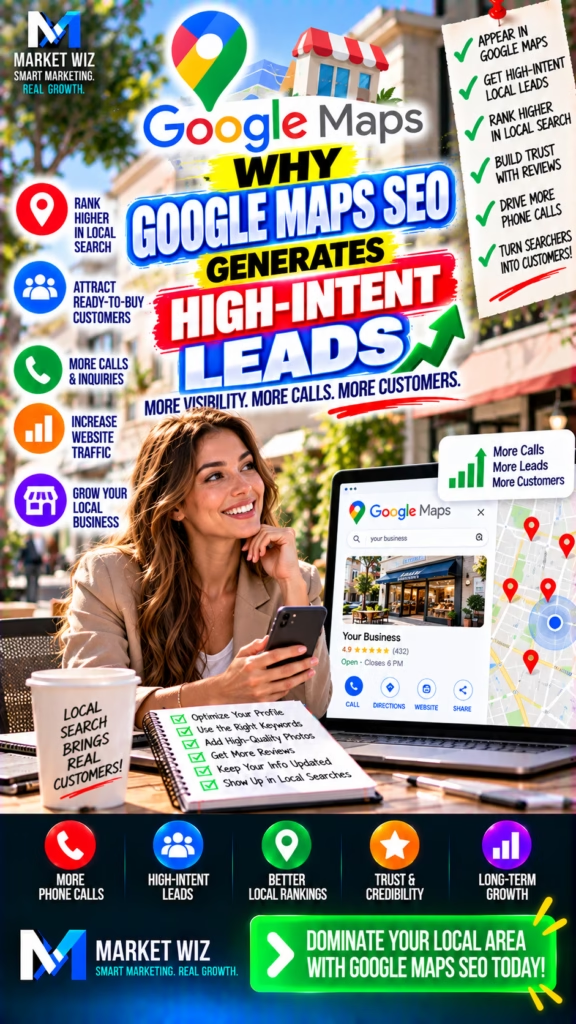
Why Google Maps SEO Generates High-Intent Leads
Google Maps SEO can connect businesses with customers at one of the most valuable moments in the buying journey: when they are actively searching for a nearby company, product, professional, or solution. Instead of interrupting people who may or may not be interested, local search can capture existing demand. This guide explains why Google Maps visibility can generate high-intent leads and how businesses can turn local search activity into calls, website visits, appointments, directions, qualified opportunities, and measurable revenue.
Why Google Maps Leads Can Have Strong Commercial Intent
Not every marketing lead begins at the same stage of the customer journey.
Some marketing channels introduce a business to people who were not actively searching for it.
That can be valuable for awareness and demand generation.
Google Maps frequently operates differently.
Many people encounter local businesses on Google because they have already decided to search for something.
They may need an HVAC contractor because the air conditioner stopped working.
They may need a painter because they are preparing a home for sale.
They may need a furniture store because they recently moved.
They may need an apartment because their lease is ending.
They may need a commercial property because their business is expanding.
They may need a local retailer because they want a product today instead of waiting for shipping.
In each situation, the search itself reveals useful information.
The prospect has identified a need.
They have taken an action to solve it.
They are evaluating available businesses.
That combination is what makes local search intent commercially valuable.
Google Maps SEO can be powerful because it captures demand that already exists. Instead of asking whether someone might eventually need the business, local search can connect the company with people who are actively looking for a relevant solution in a relevant geographic area.
1. Google Maps Captures Active Search Intent
Search intent describes what a person is trying to accomplish when they enter a query.
Some searches are informational.
A person may want to learn how something works.
Other searches are navigational.
A person may be trying to locate a specific company or website.
Commercial searches often indicate that someone is comparing products or businesses.
Transactional and local searches can indicate that someone is moving closer to taking action.
Google Maps frequently appears in searches with a strong geographic component.
Examples might include searches for a roofing company nearby, a mattress store in a particular city, an HVAC company, an apartment, a warehouse, a restaurant, or another local business category.
These searchers are not merely consuming content.
Many are evaluating businesses they may contact or visit.
2. Local Search Adds Geographic Intent to Buyer Intent
A prospect can be interested in a product without being a realistic customer for a particular business.
Geography changes that.
A customer searching for a local business is often communicating two important things simultaneously.
First, they need a relevant product or solution.
Second, they need it within a useful geographic area.
That geographic filter can improve lead relevance.
A local contractor does not need leads from every state.
A furniture showroom may care most about customers who can reasonably visit the store or receive local delivery.
An apartment community needs prospects interested in the surrounding market.
Google Maps can help connect demand with location.
3. Google Maps Often Reaches Customers Later in the Buying Journey
Marketing effectiveness can depend heavily on when the business reaches the customer.
A person watching an entertaining social video may have no immediate buying need.
A person searching for a specific type of nearby business has already progressed further.
They may have recognized the problem.
They may understand the category of solution they need.
They may be comparing providers.
They may be preparing to call.
They may be deciding where to drive.
They may be checking reviews before making a final decision.
This later-stage behavior can make local search visibility especially important for businesses that depend on calls, appointments, visits, estimates, consultations, or local transactions.
4. Google Maps Gives High-Intent Prospects Multiple Ways to Take Action
Local search is valuable because visibility can connect directly with customer actions.
Depending on the business, profile configuration, device, query, and available Google features, a prospect may be able to call the business, visit its website, request directions, view hours, examine photos, read reviews, explore products, or access other useful information.
This reduces the distance between discovery and action.
A customer does not necessarily need to remember the business and search for it again later.
They can evaluate important information while their need is active.
5. Phone Calls Can Signal Strong Local Purchase Intent
For many businesses, phone calls are among the most commercially useful local actions.
A customer who calls may have specific questions.
They may want pricing.
They may want to confirm availability.
They may need an appointment.
They may have an urgent problem.
They may want directions or store information.
They may already be comparing a short list of businesses.
That does not mean every call becomes a sale.
But a call can represent significantly more commercial intent than a passive impression.
6. Direction Requests Can Indicate Real-World Buying Intent
For businesses with customer-facing locations, direction requests can be especially meaningful.
A shopper researching furniture from home may still be early in the process.
A shopper requesting directions to the furniture store may be much closer to visiting.
The same concept can apply to showrooms, retailers, apartment communities, offices, medical practices, dealerships, restaurants, and many other location-based businesses.
Local SEO therefore has the potential to influence both digital and physical customer journeys.
7. Google Maps Can Send High-Intent Prospects to the Website
Some customers need more information before contacting a business.
They may want to review products.
They may want to understand pricing.
They may want to see previous work.
They may want to read about the company.
They may want to understand financing.
They may want to submit a form or schedule an appointment.
This makes the website an important extension of Google Maps visibility.
A strong local presence may earn the click, but the website still needs to convert the visitor.
8. Reviews Can Help High-Intent Searchers Make Faster Decisions
High intent does not eliminate uncertainty.
A customer can be ready to purchase and still be unsure which business deserves the opportunity.
Reviews can help reduce that uncertainty.
Customers may evaluate overall reputation.
They may read recent feedback.
They may look for comments related to the specific product or solution they need.
They may evaluate how the business responds to feedback.
Reputation therefore plays both an SEO and conversion role within the broader local marketing system.
9. Complete Business Information Reduces Conversion Friction
A high-intent prospect can still abandon a business if basic information is difficult to find or appears unreliable.
Is the business open?
Is the phone number correct?
Is the website working?
Is the address accurate?
Does the business appear to offer what the customer needs?
Does the profile contain useful photos?
Is important business information consistent?
Accurate information makes it easier for the prospect to move from search to action.
10. Relevance Helps Connect Businesses With Better-Matched Searches
High-intent lead generation is not simply about appearing for as many searches as possible.
The business needs visibility for searches related to what it actually offers.
A roofing contractor wants roofing-related demand.
A painting company wants painting-related demand.
A furniture store wants furniture shoppers.
A warehouse operator wants businesses looking for relevant commercial space.
Accurate categories, website content, business information, and broader local relevance can help align the company with appropriate search intent.
The goal of Google Maps SEO is not maximum visibility at any cost. The stronger objective is relevant visibility: appearing when people in realistic service areas are searching for products, companies, or solutions the business can actually provide.
11. Proximity Can Make Local Leads More Actionable
Distance is one of the realities that separates local SEO from national marketing.
Customers often prefer nearby businesses because local options can offer convenience.
Travel may be shorter.
Appointments may be easier.
Delivery may be more practical.
Store visits may require less effort.
Local companies may understand the market better.
Google has long described local results using concepts including relevance, distance, and prominence.
Businesses cannot control where every searcher is located, but they can strengthen the other parts of their local search presence.
12. Local Authority Can Influence Which Businesses Earn Attention
Customers often encounter several businesses during a local search.
Visibility alone may not be enough.
The business also needs to appear credible.
A strong website can help.
Accurate directory information can help.
Reviews can help.
Useful content can help.
Local mentions and legitimate authority can help.
Brand recognition can help.
Together, these signals create a broader digital footprint that can support both visibility and customer confidence.
13. Website SEO Strengthens the Google Maps Lead Generation System
Google Maps SEO should not be separated completely from website SEO.
The website gives the business space to explain its products, expertise, markets, locations, and customer value in greater depth.
Product pages can target commercial demand.
Location pages can support geographic relevance.
Educational content can answer customer questions.
Project pages can demonstrate experience.
Conversion pages can turn visitors into leads.
A strong website and a strong local presence can therefore reinforce one another.
14. Local Landing Pages Can Capture More Geographic Search Demand
Businesses serving multiple legitimate markets may need website content that explains those geographic relationships.
A generic homepage cannot always communicate every relevant market, product, or solution effectively.
Useful local pages can explain what the business offers in specific areas.
These pages should not be thin duplicates created only to repeat city names.
They should provide meaningful information.
Relevant products.
Local context.
Appropriate customer questions.
Service or delivery information where applicable.
Useful proof.
Clear conversion paths.
15. Consistent Business Information Supports Local Trust
Businesses frequently appear across many online platforms.
Directories.
Social networks.
Industry websites.
Local organizations.
Maps.
Review platforms.
Maintaining accurate core information across important sources helps customers find consistent information about the business.
Incorrect phone numbers, old addresses, broken website links, or outdated business names can create unnecessary friction.
16. Strong Photos Can Improve Conversion From Local Search
Search visibility gets the business considered.
Visual credibility can help move the prospect forward.
Customers may want to see the storefront.
They may want to see completed work.
They may want to see inventory.
They may want to see the team.
They may want to understand the environment before visiting.
Accurate, professional, current images can answer some of those questions before the customer ever calls.
17. High-Intent Google Maps Leads Can Improve Sales Efficiency
Lead generation should not be judged only by volume.
Sales teams have limited time.
A hundred weak inquiries can consume more resources than twenty qualified opportunities.
High-intent local search leads may enter the process with several qualification factors already present.
They know what category they need.
They are searching in a relevant area.
They are comparing businesses.
They may be ready to call, schedule, visit, or request information.
This can reduce the distance between marketing activity and a sales conversation.
18. Fast Response Is Critical After Google Generates the Lead
High-intent leads can also be highly competitive.
A customer searching Google may contact several businesses in a short period.
The business that responds effectively while the customer's need is active can have an advantage.
This is particularly important for urgent or time-sensitive categories.
Lead notifications should be reliable.
Calls should be handled appropriately.
Forms should route correctly.
Appointment requests should not disappear into an unmonitored inbox.
Marketing creates the opportunity.
Operations must capture it.
19. Put Qualified Google Maps Leads Into a CRM
Local SEO performance becomes more valuable when businesses can trace what happens after the initial interaction.
Qualified leads can be moved into a CRM or structured lead-management system.
Useful information may include source, customer name, phone number, email, location, requested product or solution, appointment date, salesperson, qualification status, follow-up date, sales outcome, and revenue.
This allows management to evaluate lead quality instead of stopping at surface-level search metrics.
20. AI Can Help Businesses Handle High-Intent Local Leads Faster
Lead generation can fail when operational systems cannot keep up with demand.
AI-supported workflows can help businesses manage repetitive steps after a local lead arrives.
Leads can be organized.
Notifications can be routed.
Qualification information can be captured.
Follow-up tasks can be created.
CRM records can be supported.
Appointments can be coordinated where appropriate.
Performance data can be summarized.
The objective is not automation for its own sake.
The objective is reducing the delay between customer intent and business response.
21. Google Maps SEO Can Capture Demand Without Paying for Every Click
Paid advertising can be useful because it can create immediate visibility and provide businesses with significant targeting and campaign controls.
Organic local SEO operates differently.
Businesses invest in building visibility rather than purchasing each individual click through an advertising auction.
This can make local SEO strategically valuable over time.
A strong organic local presence can continue generating discovery, calls, website visits, and other customer actions without attaching a direct advertising charge to every individual interaction.
That does not make local SEO free.
It requires strategy, optimization, content, reputation management, technical work, monitoring, and ongoing improvement.
22. Google Maps and Social Media Capture Different Types of Intent
Google Maps and social media should not necessarily be treated as competing channels.
They can perform different roles.
| Channel | Typical Customer Behavior | Potential Marketing Role |
|---|---|---|
| Google Maps | Actively searching for a relevant nearby business or solution | Capture existing local demand |
| Organic Search | Researching products, businesses, questions, and solutions | Capture informational and commercial search demand |
| Social Media | Browsing content, brands, entertainment, products, and recommendations | Create awareness, familiarity, and demand |
| Marketplace Platforms | Browsing products, inventory, deals, and local opportunities | Generate product-level discovery and conversations |
Strong businesses can use these channels together rather than expecting one platform to handle the entire customer journey.
23. Track Revenue, Not Just Google Maps Visibility
Ranking reports can be useful.
Visibility data can be useful.
Profile interactions can be useful.
But businesses ultimately need commercial outcomes.
A local SEO program should attempt to connect marketing activity with qualified customer actions whenever possible.
Calls
Measure relevant phone opportunities and determine how many become qualified conversations.
Website Leads
Track forms, appointments, calls, purchases, or other meaningful website conversions.
Appointments & Visits
Connect local search activity with scheduled opportunities and real-world customer actions where measurable.
Sales & Revenue
Evaluate whether local SEO is contributing to customers, revenue, profit, and business growth.
24. Ranking Higher Has Limited Value Without Conversion
Businesses can become overly focused on rankings.
Rankings matter because customers cannot choose a business they never discover.
But ranking is only the beginning.
Once the customer finds the business, they still evaluate it.
Are the reviews convincing?
Are the photos useful?
Is the business information complete?
Does the website look credible?
Is the offer relevant?
Is contacting the company easy?
Does anyone answer?
The complete conversion system determines whether visibility becomes revenue.
25. Competitive Markets Require More Than Basic Profile Setup
Creating a Google Business Profile is not the same as building a competitive local SEO strategy.
In low-competition markets, basic optimization may produce meaningful improvements.
Competitive markets can require significantly more work.
The business may need stronger website content.
Better local authority.
A healthier review profile.
Better conversion assets.
Stronger local pages.
More consistent business information.
Better technical SEO.
More complete performance tracking.
Local SEO is competitive because other businesses want access to the same high-intent searches.
26. Avoid Google Maps SEO Mistakes That Can Waste High-Intent Demand
- Using inaccurate business information
- Selecting categories that do not accurately represent the business
- Ignoring customer reviews
- Allowing incorrect hours to remain published
- Using a weak or outdated website
- Failing to create useful local website content
- Ignoring mobile conversion experience
- Using low-quality or irrelevant photos
- Failing to track calls and website leads
- Responding too slowly to high-intent inquiries
- Leaving qualified leads outside the CRM
- Measuring only rankings instead of business outcomes
- Creating thin, duplicated city pages
- Allowing inconsistent business information across important sources
- Trying to manipulate local rankings instead of building legitimate relevance
- Expecting immediate guaranteed ranking improvements
- Ignoring the sales process after the lead is generated
27. A Practical Google Maps SEO Workflow for High-Intent Leads
Define the Most Valuable Local Searches
Identify the products, categories, problems, and geographic markets associated with realistic customer demand.
Build an Accurate Google Business Profile
Maintain accurate business information, categories, hours, website links, contact information, and other applicable profile details.
Strengthen the Website
Build useful product, category, solution, and location content that supports customer needs and broader local relevance.
Improve Local Authority
Strengthen legitimate citations, links, mentions, reputation, and other signals that support the business's real-world prominence.
Improve Customer Trust
Maintain useful photos, accurate information, professional review management, and strong conversion assets.
Track High-Intent Actions
Measure calls, website conversions, appointments, qualified leads, sales, and other meaningful outcomes.
Respond Quickly
Build reliable lead-routing processes so high-intent prospects do not disappear because of operational delays.
Move Qualified Leads Into the CRM
Preserve customer information, follow-up tasks, appointments, outcomes, and revenue attribution.
Measure Sales Performance
Determine which local searches, locations, pages, and customer actions contribute to actual business growth.
Continuously Improve
Strengthen weak areas based on search visibility, customer behavior, lead quality, competition, conversion, and sales data.
28. Scale Google Maps SEO Around the Markets That Produce Customers
Businesses serving multiple areas should avoid treating every market as identical.
Demand varies.
Competition varies.
Customer value varies.
Search behavior varies.
Operational capacity varies.
Businesses can use performance data to identify where local SEO investment has the strongest commercial potential.
The objective should not be creating the largest possible geographic footprint on paper.
It should be building strong visibility in markets the business can actually serve profitably.
29. Combine Google Maps SEO With a Multi-Channel Lead Generation Strategy
High-intent local search can be powerful, but businesses should not assume every customer begins with Google Maps.
Some discover companies through social media.
Some browse Facebook Marketplace.
Some search Craigslist.
Some receive referrals.
Some encounter paid ads.
Some read articles.
Some see a business repeatedly across several channels before taking action.
Google Maps can become the high-intent conversion layer inside a larger marketing ecosystem.
30. Build a Local Customer Acquisition System, Not Just a Google Maps Ranking
The strongest local SEO strategy extends beyond ranking reports.
It begins with visibility.
Then it builds trust.
Then it creates an action.
Then the business responds.
Then the prospect is qualified.
Then the opportunity is tracked.
Then follow-up happens.
Then the sale is measured.
This is what turns Google Maps SEO from a ranking project into a customer acquisition system.
30 FAQs About Google Maps SEO and High-Intent Leads
1. Why does Google Maps SEO generate high-intent leads?
Google Maps often appears during local searches where users are actively looking for a nearby business, product, professional, or solution. That immediate local need can make many Maps interactions commercially valuable.
2. What is Google Maps SEO?
Google Maps SEO is the process of improving a business's local search presence through accurate business information, Google Business Profile optimization, website relevance, reviews, local authority, content, and other legitimate local SEO practices.
3. What is a high-intent local lead?
A high-intent local lead is a prospect whose search behavior indicates a meaningful likelihood of contacting, visiting, comparing, scheduling with, or purchasing from a nearby business.
4. Can Google Maps generate phone calls?
Google Business Profiles can provide eligible users with direct ways to call businesses, making phone calls an important local conversion action for many companies.
5. Can Google Maps generate website leads?
Google Maps and Business Profile visibility can send potential customers to a business website where they may call, submit forms, schedule appointments, request information, or take other conversion actions.
6. Can Google Maps generate store visits?
Google Maps can help customers find business locations and request directions, which can support in-person visits for businesses that serve customers at a physical location.
7. Are Google Maps leads better than social media leads?
Lead quality depends on the business and campaign. Google Maps often captures active local search intent, while social media can create awareness and demand before a customer actively searches.
8. Does Google Business Profile optimization help local SEO?
A complete and accurate Google Business Profile is an important component of a broader local SEO strategy and helps customers understand key information about a business.
9. Do Google reviews help local customers choose businesses?
Reviews can influence customer confidence and purchasing decisions by providing social proof and information about previous customer experiences.
10. Does proximity affect Google Maps results?
Distance is one factor associated with local search results, along with relevance and prominence. Results can vary based on the searcher, query, location, and other signals.
11. Can a business rank in multiple cities on Google Maps?
Visibility can vary across locations. Businesses can strengthen broader local relevance through legitimate local SEO, website content, authority, reputation, and accurate business information, but rankings are not guaranteed.
12. How important are Google Business Profile categories?
Accurate categories help communicate what a business does and are an important part of representing the business correctly within Google Business Profile.
13. Does a business website affect Google Maps SEO?
A relevant, authoritative, technically sound website can support a broader local SEO strategy by providing Google and customers with additional information about products, services, locations, expertise, and business relevance.
14. Do local landing pages help Google Maps SEO?
Useful location-focused pages can support local organic relevance when they provide genuine value and accurately describe the areas, products, or services associated with the business.
15. Do citations help local SEO?
Accurate business information across reputable directories and platforms can support local visibility and help customers find consistent information about a business.
16. Can photos improve a Google Business Profile?
Useful, accurate photos can improve the customer experience by helping prospects understand the business, location, products, team, work, or facilities.
17. Should businesses respond to Google reviews?
Professional review responses can demonstrate customer engagement and give businesses an opportunity to acknowledge feedback appropriately.
18. How long does Google Maps SEO take?
Timelines vary based on competition, market, existing authority, profile quality, website strength, reputation, location, and the scope of optimization. No legitimate SEO strategy can guarantee an exact ranking timeline.
19. Can Google Maps SEO work without paid ads?
Yes. Organic local visibility is distinct from paid advertising, although businesses may use both organic and paid strategies as part of a diversified marketing plan.
20. Can Google Maps SEO help contractors?
Local SEO can be valuable for eligible contractors because customers frequently search for nearby companies when they need repairs, improvements, installations, estimates, or other local work.
21. Can Google Maps SEO help retail businesses?
Retail businesses can benefit when customers use local search to find stores, products, hours, directions, reviews, websites, and nearby purchasing options.
22. Can Google Maps SEO help professional businesses?
Many professional businesses can benefit from local search visibility when prospective customers search for relevant providers within a specific geographic area.
23. Should Google Maps leads be tracked?
Businesses should track meaningful conversion actions such as calls, website leads, appointments, qualified opportunities, store visits where measurable, sales, revenue, and customer acquisition outcomes.
24. Can a CRM help manage Google Maps leads?
A CRM can help businesses organize qualified local leads, assign follow-up, track appointments, record outcomes, and measure which marketing sources contribute to sales.
25. Can AI help manage Google Maps leads?
AI-supported systems can assist with lead routing, notifications, qualification support, appointment workflows, CRM updates, follow-up reminders, reporting, and other repetitive lead-management tasks.
26. Does response speed matter for Google Maps leads?
Response speed can matter significantly because local searchers may contact multiple businesses and may have an immediate need.
27. What should businesses measure for Google Maps SEO?
Businesses should evaluate visibility and engagement alongside qualified leads, calls, website conversions, appointments, sales, revenue, profit, and customer acquisition performance.
28. Is ranking number one on Google Maps the only goal?
No. Visibility matters, but businesses ultimately need qualified customer actions and profitable outcomes. Ranking without conversion has limited commercial value.
29. Should Google Maps SEO be combined with other marketing channels?
A diversified strategy can combine local SEO with website SEO, social media, marketplaces, email, referrals, paid advertising, and other channels appropriate to the business.
30. What is the best Google Maps SEO strategy for high-intent leads?
A strong strategy combines an accurate Google Business Profile, relevant website content, legitimate reputation building, consistent business information, local authority, strong customer experience, conversion tracking, rapid lead response, and continuous improvement.
30 Additional SEO Keywords
These related keyword themes can support future articles, local landing pages, educational content, industry pages, Google Maps resources, and supporting SEO content around high-intent local lead generation.
Why Google Maps SEO Can Become One of the Strongest Sources of High-Intent Local Leads
The commercial value of Google Maps SEO begins with intent.
A person can see a billboard without needing the company.
They can watch a social media video without planning to buy.
They can receive an email without currently needing the offer.
Search is different because the customer initiates the interaction.
They decide they need information.
They decide they need a product.
They decide they need a company.
They decide they need a nearby solution.
Then they search.
That action creates a valuable opportunity for businesses that are visible at the right moment.
Local search adds another layer of qualification.
The customer is not merely interested in the category.
They are often interested in finding that category within a useful geographic area.
This matters enormously for local companies.
A contractor needs customers within the territory the company can realistically serve.
A retail store needs customers who can visit or receive the product.
An apartment community needs prospects interested in that market.
A commercial real estate company needs businesses interested in the available region.
A local professional needs customers who can realistically become clients.
Google Maps can help combine category relevance with geographic relevance.
But visibility alone is not enough.
A business still needs to earn the customer's trust.
The profile needs accurate information.
The business category needs to make sense.
Hours should be correct.
Phone information should be current.
Website links should work.
Photos should help the customer understand the business.
Reviews can help reduce uncertainty.
The broader web presence should reinforce credibility.
Every one of these elements can influence what happens after the customer discovers the business.
Website quality becomes especially important at this stage.
Some customers will not call immediately.
They want more information.
They want to see products.
They want to understand pricing.
They want to review previous work.
They want to understand the company.
They want to compare alternatives.
They may want to schedule online.
They may want to submit a request.
This is why local SEO and website SEO should work together.
Google Maps can create discovery.
The website can deepen trust.
Strong landing pages can explain the offer.
Conversion elements can make the next step easy.
Local content can reinforce relevance.
Educational content can answer questions.
The complete ecosystem helps turn search visibility into customer action.
Reputation is another major part of that ecosystem.
A high-intent prospect may be ready to hire someone today.
That does not mean they will hire the first business they see.
They may compare several companies.
Reviews help them evaluate those alternatives.
Recent feedback can demonstrate current customer experiences.
Review responses can show that the company pays attention.
Photos can reinforce what customers say.
The website can provide deeper evidence.
Together, these assets help convert intent into trust.
Once the customer takes action, response speed becomes critical.
A high-intent customer is valuable partly because they are closer to making a decision.
But that also means the opportunity can disappear quickly.
The customer may call another business.
They may submit several forms.
They may request multiple estimates.
They may visit another store.
They may choose the first company that answers clearly.
Businesses therefore need systems capable of matching the speed of customer intent.
Calls should be handled.
Form submissions should be visible.
Appointment requests should be routed.
Qualified prospects should not disappear into an inbox.
Follow-up should not depend entirely on memory.
This is where CRM systems and AI-supported workflows can strengthen local SEO performance.
The marketing channel generates demand.
The CRM preserves the opportunity.
Automation can reduce repetitive administrative delays.
Salespeople can focus on meaningful customer conversations.
Managers can track outcomes.
Marketing teams can understand which sources are creating value.
Measurement should continue all the way to revenue whenever possible.
A ranking improvement is useful.
More visibility is useful.
More profile interactions can be useful.
But none of those metrics automatically mean the business is making more money.
The business needs to understand whether visibility generates qualified leads.
Whether qualified leads become appointments.
Whether appointments become customers.
Whether customers generate profitable revenue.
This is the difference between SEO reporting and customer acquisition reporting.
Businesses should also recognize that Google Maps SEO compounds.
Website improvements can strengthen the digital foundation.
Useful content can continue attracting searchers.
Legitimate local authority can strengthen the brand.
Customer reviews can build a deeper reputation over time.
Stronger conversion processes can increase the value of future traffic.
Better tracking can improve future marketing decisions.
Unlike a temporary campaign that disappears the moment activity stops, many local SEO assets can continue supporting the business over time, although rankings and traffic are never guaranteed and competitive conditions continue changing.
Local SEO should also be integrated with other marketing channels.
Social media can create awareness before a customer searches.
Facebook Marketplace can introduce inventory.
Craigslist can create another discovery channel.
Email can maintain relationships.
Paid advertising can create immediate targeted visibility.
Organic website SEO can capture broader search demand.
Google Maps can capture high-intent local searches when the customer moves closer to action.
These channels can reinforce one another.
A customer may first see the business on social media.
Weeks later, they develop a need.
They search Google.
They recognize the brand.
They read the reviews.
They visit the website.
They call.
That customer journey demonstrates why marketing attribution can be complex.
It also demonstrates why strong brands build multiple paths to discovery.
Google Maps SEO becomes particularly valuable because it can meet the customer during the decision process.
The need exists.
The search begins.
The customer evaluates options.
The business appears.
Trust determines whether the prospect investigates further.
Conversion determines whether they take action.
Response speed determines whether the opportunity receives attention.
Sales execution determines whether the opportunity becomes revenue.
Tracking determines whether the business learns from the result.
That is why the strongest Google Maps SEO strategy is not simply about ranking higher.
It is about creating an end-to-end local customer acquisition system.
Search visibility should connect to trust.
Trust should connect to action.
Action should connect to fast response.
Response should connect to qualification.
Qualification should connect to sales.
Sales should connect to reporting.
Reporting should connect back to optimization.
When those pieces work together, Google Maps can become much more than a digital listing.
It can become a consistent point of connection between local demand and the business prepared to capture it.
Turn Google Maps Visibility Into More High-Intent Customer Opportunities
Market Wiz AI helps established businesses connect Google Maps optimization, local SEO, website SEO, Facebook Marketplace, Craigslist, social media, AI automation, rapid lead response, CRM workflows, qualification, follow-up, and performance tracking into a more scalable customer acquisition system.
Get Started With Market Wiz AI© Market Wiz AI. Google, Google Maps, and Google Business Profile are trademarks of Google LLC. Market Wiz AI is not affiliated with or endorsed by Google LLC unless expressly stated. Google Business Profile eligibility, local ranking systems, profile features, categories, verification requirements, search interfaces, analytics, policies, and other platform functionality may change over time. Businesses should review current Google requirements and guidelines before implementing local search strategies. Search rankings and marketing results are not guaranteed and vary based on relevance, distance, competition, prominence, market demand, business location, website quality, reputation, content, authority, customer behavior, operational capacity, sales execution, and other factors.