
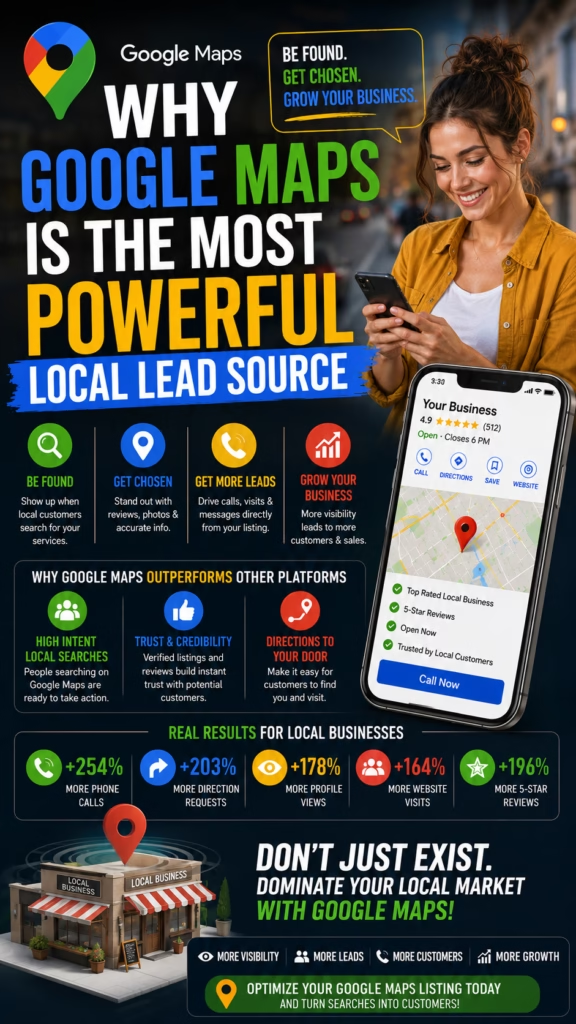
Why Google Maps Is the Most Powerful Local Lead Source
Google Maps sits directly between local customer intent and nearby businesses. When optimized correctly, it can generate calls, website visits, appointments, quote requests, store visits, and customers at the exact moment people are searching for a local solution.
Local businesses spend enormous amounts of money trying to reach people who might need their services. They run Facebook ads, Google Ads, direct mail, email campaigns, social media promotions, sponsorships, cold outreach, and countless other marketing strategies. Google Maps is different because it often places a business directly in front of people who are already searching for the exact type of company they need.
That difference explains why Google Maps is one of the most powerful local lead sources available to businesses.
Someone searching “plumber near me,” “roofing company,” “used car dealer near me,” “flooring store,” “pressure washing company,” “dentist near me,” “commercial warehouse,” or “HVAC repair” is not simply browsing the internet. That customer may already have a specific problem, purchase need, project, or deadline.
Google Maps can connect that demand with nearby businesses in a format that immediately displays information customers care about: reviews, ratings, business hours, location, service areas, photos, website links, phone numbers, directions, and other business details.
Why Google Maps Is Such a Powerful Local Lead Source
Google Maps has several qualities that make it fundamentally different from many traditional marketing channels.
High Intent
Many searches begin with an existing need, problem, project, or purchase decision.
Geographic Relevance
Local search naturally considers proximity and geographic context, helping connect customers with nearby businesses.
Immediate Trust Signals
Reviews, photos, ratings, business information, and websites help customers compare companies quickly.
Direct Conversion
Customers can often move from search to call, website visit, directions, appointment, or inquiry within moments.
Google Maps solves the targeting problem naturally
Traditional advertising often begins with the question: who should we target?
Marketers attempt to identify demographics, interests, income levels, behaviors, locations, job titles, or audiences that might be interested in an offer.
Local search reverses the equation.
The customer reveals intent through the search itself.
A search for “emergency plumber near me” provides a very different signal than a user simply fitting the demographic profile of a homeowner.
A search for “commercial flooring company” identifies a potentially valuable business need more clearly than broad audience targeting.
This makes Google Maps particularly powerful because the platform can align intent with geography at the same time.
The Power of Local Search Intent
Search intent refers to what the customer is trying to accomplish.
Local search intent is especially valuable because the customer is not merely researching a subject. The customer is often trying to identify a business that can satisfy a real-world need.
Transactional intent
Transactional searches can indicate that someone is actively looking to purchase something.
Examples include:
- mattress store near me;
- used trucks for sale;
- flooring store near me;
- appliance store;
- shipping containers for sale;
- office furniture near me.
Service intent
Service searches indicate that the customer needs someone to perform work.
- HVAC repair near me;
- pressure washing company;
- house painter near me;
- plumber near me;
- roofing contractor;
- flooring installer;
- electrician near me.
Urgent intent
Some local searches occur because the customer has an immediate problem.
- emergency plumber;
- AC repair near me;
- towing company;
- locksmith near me;
- water damage restoration;
- 24 hour electrician.
These searches can be particularly valuable because the customer may have little desire to delay the purchase decision.
Commercial intent
Local search is not limited to homeowners. Business buyers frequently use Google to find:
- commercial contractors;
- warehouse space;
- office equipment;
- commercial cleaners;
- fleet services;
- business insurance;
- commercial HVAC;
- property management vendors;
- industrial suppliers.
One commercial search can therefore represent a substantially higher lifetime customer value than a typical residential inquiry.
Where Google Maps Fits in the Local Customer Journey
Google Maps can influence several stages of the buying process.
Stage 1: Need recognition
The customer realizes something needs to happen. The air conditioner stops working. The driveway needs cleaning. A family needs a new mattress. A business needs warehouse space. A homeowner wants the house painted.
Stage 2: Local search
The customer searches Google using a service, product, or business category.
Stage 3: Maps comparison
Several local businesses may appear. The customer compares:
- ratings;
- review counts;
- review recency;
- photos;
- business names;
- locations;
- services;
- hours;
- websites.
Stage 4: Trust validation
The customer may open a profile, read reviews, browse photos, visit the website, and evaluate the company.
Stage 5: Contact
The customer calls, visits the website, requests directions, schedules an appointment, or initiates another available conversion action.
Stage 6: Sales process
The company now has an opportunity to respond, qualify the lead, provide pricing or an estimate, and close the sale.
Stage 7: Reputation flywheel
After a successful customer experience, the business can appropriately request genuine feedback. That new review may help persuade the next customer.
Google Maps vs. Other Local Lead Sources
Google Maps should not necessarily replace every other marketing channel. Its strength becomes clearer when compared with how other channels create demand.
| Channel | Primary Strength | Main Limitation |
|---|---|---|
| Google Maps | Captures high-intent local demand | Visibility must be earned and varies by geography |
| Google Ads | Immediate paid search visibility | Traffic depends on continued ad spend |
| Facebook Ads | Audience targeting and demand creation | Users may not currently be searching for the service |
| Social Media | Brand awareness and engagement | Buyer intent can be inconsistent |
| Direct Mail | Geographic household reach | Timing may not match immediate need |
| Cold Outreach | Proactive prospecting | Business must create interest from an interruption |
| Referrals | High trust | Difficult to scale predictably by itself |
Google Maps captures demand instead of interrupting customers
This distinction is critical.
A Facebook ad interrupts someone while they browse. A cold call interrupts someone during their day. Direct mail arrives whether the homeowner needs the service or not.
Google Maps often responds to a request the customer initiated.
That customer-driven interaction can result in substantially stronger lead intent.
Understanding Google Maps Ranking Factors
Strong Google Maps visibility does not come from one secret trick.
Google explains local results around three major concepts:
Relevance
Relevance refers to how closely the business matches the customer's search.
Signals that can reinforce relevance include:
- accurate categories;
- services;
- business information;
- website content;
- service pages;
- product pages;
- local content;
- customer feedback.
Distance
Distance reflects the geographic relationship between the business and the search.
This is why a company may rank first in one neighborhood but much lower ten miles away.
Prominence
Prominence broadly reflects how established and well-known the business appears.
Signals may include:
- reviews;
- links;
- citations;
- website authority;
- brand mentions;
- online reputation.
Google Business Profile Optimization
The Google Business Profile is the core business entity presented to local searchers.
Use the correct business name
The company should use its legitimate real-world name rather than adding service and city keywords solely for ranking purposes.
Choose the most accurate primary category
Categories help Google understand what the business is.
The primary category should reflect the main business activity. Additional categories should only describe real parts of the company.
Add genuine services
Service businesses should accurately describe the services customers can purchase.
Maintain accurate contact information
Important information may include:
- phone number;
- website;
- hours;
- address when applicable;
- service-area information;
- business description.
Keep the profile current
Businesses change. Phone numbers, hours, locations, websites, services, and operational details should be updated when necessary.
Reviews Make Google Maps a Trust Engine
One reason Google Maps can outperform many lead sources is that discovery and reputation appear in the same environment.
A customer can find the business and immediately see what previous customers say about it.
Reviews reduce uncertainty
Customers frequently wonder:
- Will this company show up?
- Do they perform good work?
- Are they professional?
- Do they communicate?
- Do customers recommend them?
- Is the company legitimate?
Genuine reviews can answer those questions before the first phone call.
Review quantity matters differently by market
A review profile should be evaluated against legitimate local competitors. Twenty reviews may look strong in one rural market and extremely weak in a major metropolitan area.
Review recency influences customer perception
A company with hundreds of old reviews but no recent feedback can appear less active than a business continuously serving customers.
Respond to reviews
Professional responses show that the company pays attention to customer feedback.
Never manufacture reputation
Fake reviews, purchased reviews, manipulated feedback, and fabricated customer experiences can create significant policy and reputation risk.
Photos Turn Google Maps Into a Visual Sales Tool
Many businesses underestimate how persuasive Google Business Profile photos can be.
Photos can help customers visualize the company before ever contacting it.
Contractors can show completed projects
Painters, roofers, remodelers, flooring companies, pressure washers, landscapers, concrete contractors, and other service businesses can demonstrate real work.
Retailers can show inventory
Furniture stores, mattress retailers, appliance stores, flooring showrooms, dealerships, and specialty shops can display products and locations.
Restaurants can show food and atmosphere
Visual proof can heavily influence a customer's decision to visit.
Professional services can show trust
Office environments, teams, signage, and facilities can make the company feel more established.
Authentic photos outperform generic credibility
A large library of real business imagery can demonstrate years of genuine activity better than generic stock photography.
Why the Website Matters for Google Maps Lead Generation
Google Maps optimization should not stop at the Business Profile.
The website can reinforce who the company is, what it offers, where it operates, and why customers should choose it.
Build a clear homepage
A strong homepage should quickly communicate:
- business category;
- core services or products;
- primary geographic area;
- trust signals;
- customer value proposition;
- clear conversion options.
Create deep service content
If an HVAC company offers AC repair, furnace repair, installation, and maintenance, each major service can deserve substantial content.
If a painter offers interior painting, exterior painting, cabinet painting, deck staining, and drywall repair, those topics should be clearly represented.
Improve mobile usability
Local searches frequently occur on smartphones. A slow or difficult mobile website can waste valuable Maps traffic.
Connect website content logically
Internal links can help customers and search engines navigate from the homepage into relevant services, products, locations, case studies, and supporting information.
Service Pages Build Local Search Relevance
Service pages are especially important for businesses offering several different solutions.
A generic page that says “we do everything” often communicates less relevance than detailed pages focused on individual customer needs.
Home service examples
- AC repair;
- furnace installation;
- water heater replacement;
- interior painting;
- roof replacement;
- driveway pressure washing;
- hardwood flooring;
- electrical panel replacement.
Retail examples
- mattresses;
- sectional sofas;
- refrigerators;
- washers and dryers;
- luxury vinyl plank flooring;
- used trucks;
- commercial furniture.
Detailed pages allow the website to support a broader range of local search intent.
City and Service-Area SEO
Many local businesses operate beyond one city.
A contractor may serve an entire metro region. A dealer may attract customers from 100 miles away. A warehouse company may serve multiple industrial markets.
Create geographic content when it is genuinely useful
Strong city pages can include:
- services offered in that market;
- local projects;
- market-specific customer needs;
- local testimonials;
- photos;
- service details;
- internal links;
- relevant business information.
Avoid mass-generated doorway pages
Hundreds of pages with identical text and only a city name changed provide little value.
Prioritize the most profitable markets
Geographic SEO should follow business economics.
Consider:
- population;
- customer value;
- competition;
- travel cost;
- operational capacity;
- existing customers;
- market demand;
- commercial opportunities.
Citations and Local Authority
Citations are references to the business across directories, mapping platforms, business databases, industry sites, and other online sources.
Accuracy matters
Customers should not encounter:
- old phone numbers;
- incorrect addresses;
- duplicate listings;
- dead websites;
- outdated business names.
Focus on legitimate sources
Local SEO is not strengthened simply by creating hundreds of low-quality directory profiles.
Businesses should prioritize relevant, trustworthy, and legitimate sources.
Build real local authority
Strong local businesses may develop relationships with:
- chambers of commerce;
- industry associations;
- local media;
- community organizations;
- vendors;
- business partners;
- property managers;
- real estate professionals;
- local organizations.
Genuine local relationships can produce referrals, mentions, links, and broader brand recognition.
Turning Google Maps Visibility Into Leads
Ranking does not create revenue automatically.
A business can rank prominently and still lose customers if its profile looks weak or its response process is poor.
Build a strong first impression
Customers may compare several businesses in seconds.
Important conversion elements include:
- strong review rating;
- recent reviews;
- professional photos;
- clear service information;
- accurate hours;
- working website;
- professional branding;
- clear contact information.
Answer the phone
One of the simplest ways to increase Maps ROI is improving the percentage of incoming calls that receive a timely response.
Respond quickly to website leads
Customers may submit forms to several businesses in the same session.
Qualify without creating friction
Gather enough information to understand the customer's need while keeping the conversation easy.
Follow up consistently
Not every lead converts immediately. Appropriate follow-up can recover opportunities competitors forget.
Why Lead Response Automation Makes Google Maps More Powerful
Google Maps can generate valuable demand, but many businesses lose leads after the search.
Common problems include:
- missed calls;
- slow form responses;
- leads sitting in inboxes;
- salespeople forgetting follow-up;
- poor lead routing;
- no CRM tracking.
Automated lead notifications
Systems can alert the appropriate employee when a new inquiry arrives.
Lead qualification
Structured workflows can collect useful information such as service, location, timeline, budget, product interest, or project type.
CRM routing
Qualified leads can be assigned to the correct salesperson, location, department, or manager.
Follow-up systems
Businesses can create appropriate follow-up sequences for leads that do not purchase immediately.
Revenue attribution
When lead sources are organized correctly, businesses can measure how much revenue Google Maps actually produces.
Tracking Google Maps Performance Correctly
Businesses frequently make the mistake of evaluating Google Maps using one keyword checked from one location.
Local rankings change across geography
A business may rank strongly close to its location and much lower farther away.
Geographic rank tracking can reveal the company's true visibility across the market.
Track multiple keyword groups
A contractor may need to monitor:
- general business category terms;
- individual services;
- commercial terms;
- residential terms;
- high-value specialty services;
- city-specific searches.
Track conversions, not rankings alone
Important metrics can include:
- calls;
- website visits;
- form submissions;
- appointments;
- quote requests;
- store visits where measurable;
- qualified leads;
- sales;
- revenue.
Measure lead quality
Ten high-value leads may be more important than fifty low-quality inquiries.
Businesses should connect local SEO performance with actual customer value.
Industries That Can Benefit Most From Google Maps
Google Maps is especially powerful when customers need a nearby provider.
HVAC Companies
Air conditioning failures and heating problems can create urgent local searches with strong buying intent.
Plumbers
Plumbing issues can move customers quickly from search to call.
Roofing Companies
Roof repair and replacement are high-value decisions where local reviews and reputation can heavily influence the customer.
Painting Contractors
Local search can connect painters with homeowners seeking interior, exterior, cabinet, deck, and other painting services.
Pressure Washing Companies
Before-and-after photography makes Maps especially effective for visual exterior cleaning services.
Flooring Companies
Flooring combines local product shopping with installation and remodeling intent.
Appliance Stores
Customers frequently need appliances quickly, making local inventory and proximity valuable.
Furniture and Mattress Stores
Consumers often search locally because they want to see, test, purchase, or receive products quickly.
Car and Truck Dealerships
Local dealership searches can represent very strong commercial intent.
Real Estate Professionals
Agents, brokerages, property managers, and commercial real estate companies can benefit when searchers need locally relevant expertise.
Dentists and Healthcare Practices
Location, reputation, reviews, office photos, and convenience can strongly influence patient selection.
Restaurants
Maps can directly influence dining decisions through reviews, photos, proximity, hours, and directions.
Commercial Contractors
Local B2B buyers frequently search Google for nearby companies capable of handling specialized commercial work.
Why Google Maps Leads Can Be More Valuable Than Broad Awareness Leads
Lead value is not simply about volume.
A channel that produces fewer but higher-intent prospects can outperform a channel generating large numbers of weak inquiries.
Searchers self-identify their need
The keyword often explains what the customer wants.
Geography filters relevance
Local results naturally emphasize businesses in the surrounding market.
Reviews pre-qualify trust
By the time the customer calls, the person may have already read reviews and decided the company appears credible.
Website visits provide deeper qualification
Customers who open the website may review services, products, projects, and company information before making contact.
This means the lead can enter the sales process with more context than a prospect reached through interruption advertising.
Why Google Maps Can Lower Dependence on Paid Advertising
Paid ads are extremely useful, but they generally require continuous media spending.
Organic Google Maps visibility can create another stream of demand that does not charge the business for every organic click or call.
Paid traffic stops when spending stops
Google Ads can deliver immediate visibility, but campaigns generally stop producing paid traffic when budgets are paused.
Organic assets can continue creating value
Reviews, service pages, project photos, citations, content, website authority, and local reputation can remain useful over time.
Use both channels strategically
Businesses do not necessarily need to choose between SEO and paid ads.
A strong strategy can use:
- paid advertising for immediate scale;
- Google Maps SEO for organic local visibility;
- social media for awareness;
- CRM systems for follow-up;
- reviews for trust;
- content for long-term authority.
Why Google Maps Becomes More Valuable as Reviews Grow
Local SEO can create a compounding reputation advantage.
Imagine two companies initially competing with similar profiles.
Company A consistently asks satisfied customers for genuine reviews, responds professionally, adds real project photos, updates the website, and improves customer service.
Company B ignores its profile.
After several years, Company A may have built:
- hundreds of customer reviews;
- years of project photography;
- strong local brand recognition;
- deep service content;
- local backlinks;
- better conversion rates;
- more repeat customers;
- more referral activity.
That accumulated digital history can become difficult for a new competitor to replicate quickly.
Google Maps for Multi-Location Businesses
Multi-location organizations can use local search as a decentralized lead generation system.
Each legitimate location can build local authority
Properly operated locations can maintain their own local reputation, reviews, photos, and market presence.
Compare markets
Businesses can measure:
- rankings;
- calls;
- leads;
- appointments;
- sales;
- revenue;
- review growth;
- conversion rates.
Identify underperforming locations
One location may have strong reviews but weak website relevance. Another may have great rankings but poor phone response.
Location-level data makes optimization more precise.
Google Maps for Service-Area Businesses
Contractors and home-service companies frequently travel to customers rather than serving them at a storefront.
Eligible businesses can configure profiles as service-area businesses according to Google's requirements.
Do not create fake locations
Businesses should not manufacture offices or addresses simply to expand ranking coverage.
Build genuine geographic relevance
Strong local expansion can come from:
- real projects in the area;
- local content;
- customer reviews;
- service-area pages;
- local relationships;
- brand recognition;
- website relevance.
Why Google Maps Can Generate B2B Leads
Google Maps is often discussed as a consumer lead channel, but business buyers use local search constantly.
Property managers
Property managers may search for:
- commercial painting;
- pressure washing;
- HVAC contractors;
- roofing companies;
- flooring contractors;
- landscapers;
- maintenance vendors.
Business owners
Companies may search for:
- office furniture;
- warehouses;
- commercial insurance;
- fleet services;
- commercial equipment;
- IT companies;
- marketing agencies.
Commercial opportunities can have high lifetime value
One Google Maps lead might become a recurring vendor relationship across multiple properties or locations.
Why Google Maps Is a Reputation Channel and a Lead Channel
One of the strongest advantages of Maps is that the platform combines discovery with social proof.
A customer does not need to search one website for a company and another site for reviews. Much of the initial evaluation can occur within the same local search experience.
This can shorten the distance between:
- need;
- discovery;
- trust;
- contact;
- purchase.
The shorter that path becomes, the easier it can be for the right business to win the customer.
Why Local Rank Tracking Matters
Search rankings are not static across an entire city.
A business might rank:
- #1 two miles away;
- #3 five miles away;
- #8 ten miles away;
- outside prominent results farther away.
That geographic variation is why local rank grids and location-based measurement can provide a more complete view than one search from the business owner's phone.
Track priority keywords
Focus on terms that reflect real revenue opportunities rather than vanity keywords.
Track changes over time
Ranking trends become more useful when compared over weeks and months.
Connect rankings to business results
If rankings improve but calls do not, investigate conversion issues.
Why Speed-to-Lead Can Decide Who Wins a Maps Customer
A customer who finds a business through Google Maps can often see several competitors at once.
That means the first company to respond professionally can gain a major advantage.
Answer calls whenever possible
Missed calls may become competitor sales.
Return missed calls quickly
A callback hours later may occur after the customer has already booked another company.
Respond to forms promptly
Leads often contact multiple providers.
Use automation carefully
Automation can help notify teams, route leads, capture data, and manage follow-up while maintaining a professional customer experience.
How Google Maps Supports Brand Searches
As the business becomes more visible, customers may begin searching the company by name.
Branded search can reinforce:
- company legitimacy;
- review reputation;
- business location;
- photos;
- contact information;
- website discovery.
This means Google Maps can support not only generic category searches but also the company's broader brand presence.
Common Google Maps Marketing Mistakes
1. Keyword stuffing the business name
Businesses should use their genuine business name rather than artificially inserting cities and services.
2. Creating fake business locations
Fabricated offices and addresses can create serious profile problems.
3. Buying fake reviews
Artificial reputation can damage customer trust and create policy risk.
4. Ignoring the website
The Google Business Profile and website should reinforce each other.
5. Using poor photos
Low-quality imagery can weaken customer confidence even when rankings are strong.
6. Allowing outdated business information
Incorrect hours, numbers, locations, or websites create customer friction.
7. Ignoring reviews
Review quality and customer feedback should be treated as core marketing assets.
8. Tracking only one ranking position
Local visibility varies geographically.
9. Responding slowly to leads
Strong rankings cannot compensate for poor sales operations.
10. Measuring visibility instead of revenue
The goal is profitable customer acquisition, not simply appearing on a ranking report.
How to Scale Google Maps Lead Generation
Once a business begins generating consistent local leads, the system can be expanded carefully.
Step 1: Identify the highest-value keywords
Determine which services, products, and categories generate the best customers.
Step 2: Strengthen weak geographic areas
Use ranking data to identify parts of the legitimate service territory where visibility is weaker.
Step 3: Build more service depth
Expand useful website content around profitable offerings.
Step 4: Increase authentic project content
More jobs can produce more photos, case studies, social content, and customer proof.
Step 5: Strengthen review acquisition
Build a consistent process for requesting feedback from satisfied customers.
Step 6: Improve lead handling
Increase phone coverage, CRM organization, lead routing, and follow-up.
Step 7: Expand into additional legitimate markets
Growth should follow actual operational capacity rather than fake location creation.
Building a Complete Google Maps Local Lead Generation System
The strongest businesses treat local search as a complete growth system.
Layer 1: Business foundation
- accurate business information;
- legitimate Google Business Profile;
- appropriate categories;
- real services;
- correct location or service-area setup.
Layer 2: Reputation
- genuine reviews;
- review responses;
- customer satisfaction;
- professional branding.
Layer 3: Website relevance
- optimized homepage;
- service pages;
- product pages;
- city pages where appropriate;
- internal links;
- case studies;
- customer-focused content.
Layer 4: Local authority
- citations;
- local links;
- industry references;
- business partnerships;
- community presence.
Layer 5: Visual credibility
- project photos;
- products;
- team photos;
- vehicles;
- storefront or office;
- real customer-facing business imagery.
Layer 6: Conversion
- phone response;
- fast form response;
- lead qualification;
- appointment scheduling;
- quote follow-up;
- sales process.
Layer 7: Measurement
- local rankings;
- calls;
- website traffic;
- leads;
- appointments;
- sales;
- revenue.
When all seven layers improve together, Google Maps can become much more than a profile. It can become a central component of the company's local customer acquisition engine.
Why Google Maps Can Compound Over Time
The most powerful aspect of local SEO may be the way legitimate business activity creates new marketing assets.
- A customer discovers the business on Google Maps.
- The customer calls and purchases.
- The business completes excellent work.
- The project creates photos or content.
- The customer may provide a genuine review.
- The review improves customer trust.
- The project strengthens the company's online proof.
- The stronger profile converts future customers more effectively.
- Additional customers create additional proof.
This cycle can continue for years.
A business that consistently invests in its local presence can eventually accumulate a digital reputation that competitors cannot reproduce overnight.
Google Maps Optimization Checklist
- Use the correct real-world business name.
- Verify Google Business Profile information.
- Select the most accurate primary category.
- Add legitimate secondary categories.
- Add real services or products.
- Maintain accurate business hours.
- Use the correct website.
- Use the correct phone number.
- Configure the address properly.
- Configure service areas correctly when applicable.
- Write a useful business description.
- Add authentic business photos.
- Add project photos.
- Build a genuine review request process.
- Respond to reviews professionally.
- Optimize the website homepage.
- Create detailed service pages.
- Create product pages when applicable.
- Build useful city or service-area pages.
- Improve internal linking.
- Improve mobile website performance.
- Maintain accurate citations.
- Build legitimate local authority.
- Publish useful local content.
- Track geographic rankings.
- Track calls.
- Track website leads.
- Track appointments and quotes.
- Track closed sales.
- Measure Google Maps revenue.
Final Thoughts: Why Google Maps Is the Most Powerful Local Lead Source
Google Maps is powerful because it sits at the intersection of customer intent, geography, reputation, trust, and conversion.
A customer can recognize a need, search for a nearby provider, compare multiple companies, read reviews, inspect photos, visit a website, and contact a business within minutes.
Few marketing environments connect all of those steps so closely.
Google Maps can therefore become one of the strongest lead generation channels for businesses that consistently build:
- accurate business information;
- strong service relevance;
- genuine reviews;
- authentic photos;
- useful website content;
- local authority;
- geographic visibility;
- fast lead response;
- effective follow-up;
- revenue measurement.
Unlike pure interruption marketing, Google Maps often begins after the customer has already decided to search for a solution.
That is the central reason Google Maps is such a powerful local lead source. The business does not always need to convince someone to want the category. It needs to become the most credible, relevant, and compelling choice when local demand appears.
When Google Maps SEO is combined with a strong website, reputation management, local content, CRM integration, fast response, and AI-powered lead follow-up, the result can become a complete local customer acquisition system capable of producing measurable growth over the long term.
Frequently Asked Questions About Google Maps Lead Generation
1. Why is Google Maps such a powerful local lead source?
Google Maps can connect businesses with nearby customers who are actively searching for a product, service, or business category. That combination of search intent, geography, reviews, and direct contact options can create highly valuable leads.
2. What is Google Maps lead generation?
Google Maps lead generation involves improving local search visibility so potential customers discover a business and take actions such as calling, visiting the website, requesting a quote, booking an appointment, or visiting the location.
3. Why are Google Maps leads often high intent?
Many people use local search after identifying a specific need and are actively comparing nearby providers, which can place them relatively close to a purchasing decision.
4. Is Google Maps better than social media for local leads?
Google Maps often captures existing demand, while social media can be stronger for awareness and discovery. The strongest local marketing strategies often use both channels for different purposes.
5. Is Google Maps SEO free?
Businesses do not pay Google for each organic Maps click, but effective local SEO can require ongoing investment in profile management, reputation, content, website optimization, citations, tracking, and strategy.
6. Which businesses benefit most from Google Maps?
Contractors, home service companies, retailers, restaurants, healthcare providers, professional services, dealerships, real estate businesses, and many other companies serving a defined geographic market can benefit.
7. How does Google Maps generate calls?
Customers can discover the business through local search, review profile information and, where available, use direct contact options to call the company.
8. Can Google Maps generate website traffic?
Yes. Customers can visit the business website from local search to learn more about services, products, pricing, projects, and contact options.
9. Do Google reviews improve lead generation?
Genuine reviews can increase trust and help potential customers compare businesses before deciding who to contact.
10. Are Google Business Profile photos important?
Yes. Authentic photos can demonstrate products, projects, teams, locations, facilities, and business professionalism, which can help customers make decisions.
11. Can Google Maps generate leads without paid advertising?
Organic Google Maps visibility can generate calls and inquiries without requiring a payment for each organic click, although building strong visibility typically requires ongoing optimization.
12. What are the main Google Maps ranking factors?
Google describes local search using relevance, distance, and prominence, while actual visibility can also vary based on query, competition, business information, reputation, and other local signals.
13. What is Google Business Profile optimization?
It involves maintaining an accurate, complete, and useful business profile with appropriate categories, services, hours, contact information, descriptions, photos, and reputation signals.
14. Does the website influence Google Maps SEO?
A strong website can reinforce the company's services, geography, topical expertise, business identity, authority, and customer experience.
15. Can service-area businesses use Google Maps?
Eligible service-area businesses can use Google Business Profile when configured according to Google's requirements and can compete for local visibility in markets they genuinely serve.
16. Can a business rank in multiple cities?
A business may gain visibility across several legitimate markets, but rankings can vary significantly based on proximity, relevance, prominence, search location, and competition.
17. Why does proximity matter on Google Maps?
Local search is geographic, so Google may consider the relationship between the business location, the searcher's location, and the geographic intent of the search.
18. How long does Google Maps SEO take?
Timelines vary depending on the business's starting position, competition, reviews, website quality, profile strength, local authority, geographic market, and ongoing optimization.
19. What Google Maps metrics should businesses track?
Track geographic rankings, calls, website visits, inquiries, appointments, quote requests, qualified leads, sales, and revenue where possible.
20. Can Google Maps lower customer acquisition costs?
Strong organic local visibility can add leads without paying for each organic click, which may improve the company's blended customer acquisition economics.
21. Is Google Maps better than Google Ads?
They serve different purposes. Google Ads can provide immediate paid visibility while Google Maps SEO can develop organic local visibility that compounds over time.
22. Why are “near me” searches valuable?
“Near me” searches often signal that the customer wants a nearby provider and is actively evaluating local options.
23. Do citations help Google Maps rankings?
Accurate citations across reputable online sources can reinforce core business information and contribute to a cleaner local search presence.
24. Should businesses respond to Google reviews?
Yes. Professional review responses demonstrate customer engagement and can help future prospects evaluate how the business communicates.
25. Can Google Maps generate B2B leads?
Yes. Commercial buyers frequently use Google to find nearby contractors, professional services, vendors, facilities, equipment suppliers, and other businesses.
26. Why should businesses track rankings geographically?
Local ranking visibility can vary block by block or ZIP code by ZIP code, so geographic tracking provides a more complete picture of search coverage.
27. What Google Maps mistakes should businesses avoid?
Avoid fake reviews, fake locations, inaccurate business information, keyword-stuffed business names, irrelevant categories, and other tactics that misrepresent the business.
28. How can businesses convert more Google Maps leads?
Improve reviews, photography, profile completeness, website quality, response speed, lead qualification, appointment handling, and follow-up.
29. Can Google Maps become a long-term lead source?
Yes. Businesses can build long-term organic local visibility by strengthening their reputation, website, content, profile, customer experience, local authority, and conversion systems.
30. What is the best Google Maps lead generation strategy?
Build an accurate Google Business Profile, earn genuine reviews, create strong service and local website content, publish authentic photos, maintain citations, build local authority, track geographic rankings, respond quickly to leads, and measure actual sales and revenue.
30 Additional SEO Keywords
Turn Google Maps Into a Local Lead Generation Engine
Build stronger Google Maps rankings, improve local visibility, strengthen your Google Business Profile, track geographic rankings, automate lead response, and turn more local searches into calls, appointments, customers, and measurable revenue.
Schedule a MarketWiz.ai Demo












