
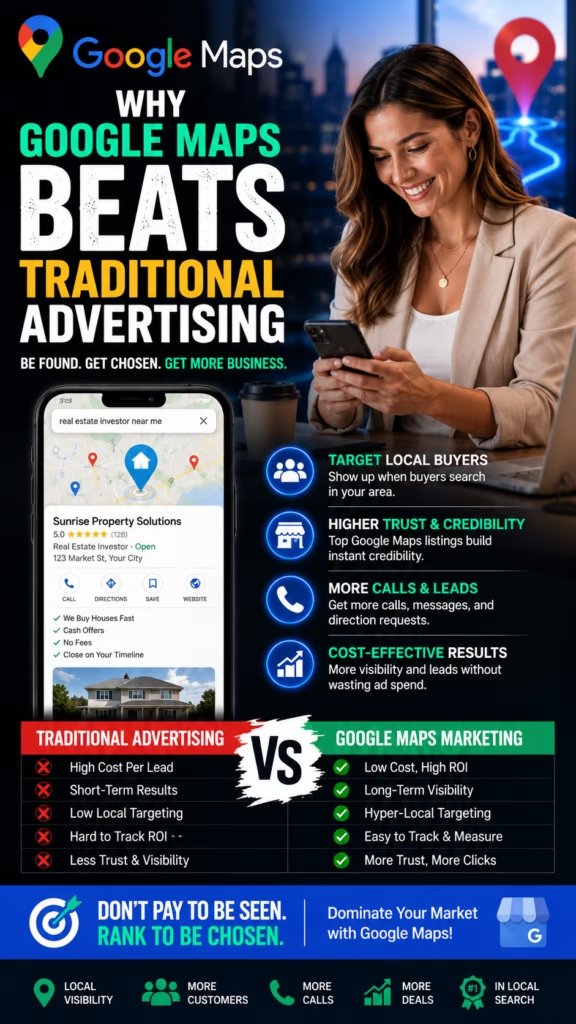
Why Google Maps Beats Traditional Advertising
Why Google Maps Beats Traditional Advertising explains how local businesses can reach customers with stronger purchase intent, build trust through reviews and photos, reduce wasted exposure, track meaningful actions, and convert nearby searches into phone calls, appointments, visits, estimates, and sales.
Introduction
Why Google Maps Beats Traditional Advertising begins with one major difference: traditional advertising interrupts people, while Google Maps often appears when people are already looking for help.
A billboard may be seen by thousands of drivers who have no immediate need for the business. A radio commercial may reach listeners outside the service area. A newspaper advertisement may be viewed by people who are not ready to buy. A direct-mail piece may be discarded before the homeowner understands the offer.
Google Maps operates closer to the moment of decision. A customer searches for a plumber, dentist, auto repair shop, real estate investor, pressure washing company, furniture store, restaurant, attorney, contractor, medical spa, or another local provider. Google then displays nearby businesses with reviews, photos, contact options, hours, websites, and directions.
Traditional advertising attempts to create attention. Google Maps captures demand that already exists.
This does not mean every traditional channel is ineffective. Billboards, direct mail, print, television, radio, sponsorships, and community advertising can build awareness and reinforce a brand. However, they frequently struggle to match the timing, local relevance, customer intent, trust signals, and direct conversion options available through Google Maps.
Google Maps marketing is also not completely free. Businesses still need profile optimization, professional photos, customer reviews, website content, local pages, accurate citations, reporting, lead handling, and ongoing activity. The difference is that the business can build a local digital asset that continues attracting searchers without paying for every individual view.
The strongest local marketing strategy combines an accurate Google Business Profile, complete services, relevant categories, genuine reviews, current photos, local website content, useful posts, citations, fast response, call tracking, and conversion measurement.
Main idea: Google Maps often beats traditional advertising because it connects a nearby customer’s immediate need with a trusted local business and a direct path to action.
Table of Contents
- 1) Traditional advertising pushes while Google Maps pulls
- 2) Google Maps reaches stronger customer intent
- 3) Local relevance reduces wasted exposure
- 4) Google Maps creates measurable customer actions
- 5) Reviews create visible social proof
- 6) Photos create immediate business credibility
- 7) Google Maps supports mobile decisions
- 8) Business information appears instantly
- 9) Google Maps can produce long-term visibility
- 10) Traditional ads disappear when spending stops
- 11) Google Maps supports service-specific discovery
- 12) Google Maps improves local customer convenience
- 13) Google Maps creates multiple conversion paths
- 14) Google Maps can lower customer acquisition costs
- 15) Local SEO builds a compounding marketing asset
- 16) Google Maps supports reputation management
- 17) Google Maps improves competitive visibility
- 18) Google Maps helps businesses target service areas
- 19) Lead response determines final performance
- 20) Comparing Google Maps with common traditional channels
- 21) When traditional advertising still makes sense
- 22) Tracking Google Maps marketing results
- 23) Common Google Maps marketing mistakes
- 24) Final thoughts
- 25) FAQs
- 26) Extra keywords
1) Traditional Advertising Pushes While Google Maps Pulls
Traditional advertising is usually interruption based. A business places its message in front of a large audience and hopes that some of those people need the product or service.
Traditional advertising examples:
Billboards
Radio commercials
Television advertisements
Newspaper ads
Magazine ads
Direct mail
Door hangers
Event sponsorships
Printed flyers
Local coupon books
These channels can create awareness, but they often reach customers before a need exists. Someone driving past a roofing billboard may not need a roof for several years. A homeowner receiving a plumbing flyer may throw it away because nothing is currently leaking.
Google Maps is demand driven. The customer searches because a need already exists. The person may be dealing with a broken air conditioner, tooth pain, vehicle trouble, a home sale, a renovation project, a restaurant decision, or another immediate local need.
Google Maps often appears when customers are:
- Comparing nearby businesses
- Looking for immediate availability
- Checking reviews
- Searching for directions
- Trying to call a company
- Looking for business hours
- Requesting an estimate
- Planning a store visit
- Evaluating service options
- Ready to make a decision
Google Maps attracts customers who are actively pulling information rather than passively receiving an advertisement.
2) Google Maps Reaches Stronger Customer Intent
Customer intent refers to how likely a person is to take action. A person casually hearing an advertisement may have weak intent. A person searching for emergency HVAC repair near me has much stronger intent.
Low-intent exposure:
Seeing a billboard while driving
Hearing a radio ad
Receiving a generic postcard
Watching a television commercial
Passing a printed sign

High-intent behavior:
Searching for a service near me
Reading business reviews
Checking store hours
Calling from Google Maps
Requesting directions
Visiting a service website
Comparing nearby providers
High-intent customers are usually closer to scheduling, buying, visiting, calling, or requesting an estimate.
Google Maps can also match the search to the business category. A person searching for an auto repair shop does not need to filter through unrelated advertisers. The local results are built around businesses that appear relevant to the request.
This relevance can improve lead quality. The customer already understands the basic service category and is often comparing specific local providers.
Google Maps does not need to convince customers that they have a problem. It helps them choose who will solve it.
3) Local Relevance Reduces Wasted Exposure
Traditional advertising often reaches people outside the ideal customer profile. A radio station may cover several counties. A newspaper may circulate far beyond the service area. A billboard may be seen by travelers who will never become customers.
Google Maps is strongly connected to location. It can show businesses based on the searcher’s position, the searched city, service relevance, prominence, and other local factors.
Local relevance can help businesses attract:
- Nearby homeowners
- Customers within delivery zones
- Patients near a practice
- Drivers near an auto shop
- Property owners in acquisition markets
- Retail shoppers near a store
- Commercial customers in service territories
- Customers searching within specific cities
- People needing same-day service
- Customers ready to visit in person
This does not guarantee that every Google Maps lead is qualified. Businesses still need accurate service areas, pricing expectations, service information, and lead qualification.
However, the starting point is often stronger because the search already includes local context.
Google Maps reduces wasted exposure by connecting the business with customers who are geographically capable of buying.
4) Google Maps Creates Measurable Customer Actions
Traditional advertising can be difficult to measure. A business may know how many flyers were delivered or how many people pass a billboard, but it may not know which customers acted because of the campaign.
Google Maps creates direct actions that can be tracked more clearly.
Google Maps actions may include:
- Phone calls
- Website visits
- Direction requests
- Messages
- Appointment requests
- Menu views
- Product views
- Form submissions
- Store visits
- Booked services
Call tracking, website analytics, CRM records, booking systems, and lead-source questions can help connect Google Maps interactions to revenue.
Example tracking flow:
Google profile view
Phone call
Lead qualified
Appointment scheduled
Estimate completed
Sale booked
Revenue recorded
Traditional channels can also be tracked with dedicated phone numbers, QR codes, landing pages, coupons, and promo codes. However, many businesses fail to implement those systems consistently.
Google Maps makes it easier to connect visibility with customer behavior and business outcomes.
5) Reviews Create Visible Social Proof
A traditional advertisement tells the audience what the business claims about itself. Google reviews show what customers say about the experience.
This creates visible social proof before the customer calls or visits.
Customers may evaluate:
- Overall rating
- Number of reviews
- Review recency
- Customer service comments
- Specific service experiences
- Photos uploaded by customers
- Business responses
- Complaint handling
- Scheduling reliability
- Product or service quality
A billboard cannot display hundreds of detailed customer experiences. A radio commercial cannot allow listeners to compare recent feedback. A direct-mail piece may include testimonials, but customers know those comments were selected by the advertiser.
Google reviews provide a broader public record of customer experiences. Genuine reviews can make the business feel safer and more established.
Businesses should never buy fake reviews, pressure customers, or fabricate experiences. Long-term trust depends on genuine feedback.
Reviews allow customers to verify the business before taking the next step.
6) Photos Create Immediate Business Credibility
Google Business Profile photos can show the actual business, products, projects, team, location, equipment, storefront, vehicles, treatment rooms, properties, and completed work.
Strong profile photo categories include:
- Business exterior
- Business interior
- Team members
- Products
- Before-and-after projects
- Completed installations
- Branded vehicles
- Equipment
- Commercial projects
- Customer-facing spaces
Traditional advertisements usually have limited space. One postcard may include one or two images. A billboard must communicate in seconds. A radio commercial has no visual proof.
Google Maps allows businesses to build an ongoing visual library. Customers can review multiple examples before calling.
Photos also help confirm that the company is active. Recent project images can feel more credible than a profile with only an old logo.
Real photos let customers see the business rather than relying only on advertising claims.
7) Google Maps Supports Mobile Decisions
Many local searches happen on mobile devices. Customers may be in a car, at home, at work, or standing near the business when they search.
Google Maps is designed to support immediate mobile actions.
Mobile customers can quickly:
- Tap to call
- Request directions
- Visit the website
- Read reviews
- View photos
- Check hours
- Send a message
- Book an appointment
- Compare nearby businesses
- Save the location
A customer does not need to remember a radio phone number, write down a billboard URL, or carry a printed flyer.
The business information remains available on the customer’s phone at the moment of need.
This convenience can improve conversion, especially for urgent services, restaurants, healthcare, automotive services, retail stores, and appointment-based companies.
Google Maps removes friction by placing the next action directly inside the customer’s mobile search experience.
8) Business Information Appears Instantly
Traditional advertising must decide which information to include. Space and time are limited. Google Maps can display multiple business details in one profile.
A complete Google Business Profile may show:
- Business name
- Primary category
- Phone number
- Website
- Address or service area
- Business hours
- Reviews
- Photos
- Services
- Products
- Posts
- Appointment options
This allows the customer to answer several questions before contacting the business.
Does the company provide the service? Is it open? Does it serve the location? What do customers say? What does the work look like? How can the customer call?
Accurate information is essential. Outdated hours, disconnected phone numbers, incorrect addresses, and old website links can quickly waste local visibility.
Google Maps compresses the customer’s research process into one local business profile.
9) Google Maps Can Produce Long-Term Visibility
A well-optimized Google Business Profile can continue appearing in local searches over time. Reviews, photos, website content, citations, and local authority can strengthen the business presence as they accumulate.
This creates a compounding effect.
Local visibility assets that can grow:
Customer reviews
Project photos
Service pages
Location pages
Local citations
Business mentions
Website authority
Customer engagement
Brand searches
Community recognition
A direct-mail campaign is usually temporary. Once the postcard is delivered, the exposure ends. A radio commercial stops airing when the schedule ends. A billboard disappears when the contract expires.
Google Maps visibility can continue after the original optimization work, although businesses still need ongoing maintenance and activity.
Profiles should be updated as services, hours, phone numbers, locations, photos, products, and business operations change.
Google Maps can become a long-term local marketing asset rather than a one-time advertising placement.
10) Traditional Ads Disappear When Spending Stops
Most traditional advertising is rented exposure. The business pays for a period of time, placement, circulation, audience size, or number of impressions.
Traditional advertising lifecycle:
Campaign purchased
Advertisement published
Audience exposed
Campaign ends
Exposure stops
New campaign required
Google Maps optimization is different because many of the underlying assets remain connected to the business.
Reviews remain visible. Photos remain available. Service pages remain on the website. Citations continue referencing the company. Local content can keep attracting search traffic.
This does not guarantee permanent rankings. Competitors improve, algorithms change, customer behavior changes, and businesses must continue maintaining their profiles.
However, the company is building owned and earned digital assets rather than paying only for temporary placement.
Traditional ads often rent attention. Google Maps marketing helps build lasting local visibility.
11) Google Maps Supports Service-Specific Discovery
Customers do not always search for a business category alone. They often search for a specific service, problem, product, or situation.
Service-specific searches:
emergency plumber near me
driveway cleaning company
queen mattress store
commercial warehouse space
roof repair estimate
inherited property buyer
med spa Botox appointment
auto brake repair
garage builder near me
same-day HVAC service
A complete profile and website can support these detailed searches through services, categories, posts, reviews, photos, and relevant pages.
Traditional advertising often uses one broad message because space is limited. Google Maps marketing can support many service categories at once.
A contractor can create separate website pages for roofing, siding, painting, flooring, remodeling, and decks. A medical practice can explain individual treatments. A retailer can highlight different product categories.
Google Maps helps businesses appear for the specific need behind the customer’s search—not only the general industry.
12) Google Maps Improves Local Customer Convenience
Convenience affects conversion. Customers are more likely to contact a business when the process is simple.
Google Maps reduces customer effort by providing:
- One-tap phone calls
- Automatic directions
- Current business hours
- Website access
- Review comparison
- Photo galleries
- Appointment links
- Location information
- Service details
- Mobile compatibility
Traditional advertisements often require an extra step. The customer must remember the business, type the website, save the flyer, write down the phone number, or search for the company later.
Each additional step creates an opportunity for the lead to disappear.
Google Maps keeps the business information connected to the customer’s original search.
Convenience turns local visibility into action by reducing the number of steps between interest and contact.
13) Google Maps Creates Multiple Conversion Paths
Different customers prefer different actions. Some want to call. Others prefer to visit the website, request directions, send a message, or schedule online.
Google Maps conversion paths may include:
- Phone call
- Website form
- Online booking
- Direct message
- Store visit
- Direction request
- Product inquiry
- Menu review
- Quote request
- Appointment scheduling
A traditional ad may support only one call to action. Call now. Visit the website. Bring this coupon. Google Maps can support several actions at once.
This flexibility can improve conversion because customers can choose the method that feels most convenient.
Businesses should ensure every path works. Phone numbers should be answered. Website forms should send correctly. Booking links should be current. Directions should lead to the right place.
Google Maps allows one local business profile to serve customers with different communication preferences.
14) Google Maps Can Lower Customer Acquisition Costs
Customer acquisition cost is the total cost required to generate a new customer. Traditional campaigns may include media spending, design, printing, distribution, agency fees, tracking, and staff time.
Traditional acquisition costs may include:
Ad placement
Printing
Mailing
Design
Production
Media buying
Agency management
Tracking numbers
Landing pages
Sales follow-up
Google Maps marketing also requires investment. Businesses may need profile management, local SEO, website content, photography, review systems, citation work, reporting, and lead response.
The potential advantage is that these investments can generate ongoing visibility rather than one temporary campaign.
A business should compare total costs with qualified leads, booked appointments, completed sales, and customer lifetime value.
Customer acquisition cost formula:
Total marketing and sales cost
÷
Number of new customers acquired
=
Customer acquisition cost
Google Maps is valuable when it produces qualified local customers at a lower total acquisition cost—not merely because profile views are free.
15) Local SEO Builds a Compounding Marketing Asset
Local SEO supports Google Maps through website content, location pages, service pages, citations, links, reviews, and business authority.
Compounding local SEO assets include:
- Service pages
- City landing pages
- Customer reviews
- Project galleries
- Frequently asked questions
- Local citations
- Community links
- Case studies
- Educational blog content
- Brand recognition
Each asset can support future discovery. A location page may rank for months or years. A review can influence many customers. A project photo can continue building trust.
Traditional advertising usually must be purchased repeatedly. Local SEO content can continue working after publication, although updates and improvements may still be needed.
The strongest businesses build both profile-level and website-level relevance.
Local SEO turns marketing work into a growing library of visibility, trust, and conversion assets.
16) Google Maps Supports Reputation Management
Traditional advertising gives businesses control over the message. Google Maps gives customers a public place to respond.
This may feel uncomfortable, but it creates an opportunity to demonstrate professionalism.
Reputation management includes:
- Monitoring reviews
- Responding to positive feedback
- Addressing negative experiences calmly
- Protecting customer privacy
- Correcting inaccurate business information
- Improving customer service
- Requesting genuine feedback
- Identifying recurring complaints
- Highlighting customer strengths
- Building review consistency
A professional response to criticism may increase trust because future customers can see how the company communicates.
Businesses should avoid emotional arguments, private customer details, threats, or repetitive generic responses.
Reviews also provide operational feedback. Repeated comments about communication, scheduling, cleanliness, pricing, or service quality can reveal areas for improvement.
Google Maps transforms reputation from a private business concern into a visible customer trust system.
17) Google Maps Improves Competitive Visibility
Customers frequently compare several businesses inside the same local result set. This gives smaller companies an opportunity to compete through relevance, reviews, photos, service clarity, and customer experience.
Customers may compare competitors based on:
- Distance
- Rating
- Review count
- Recent feedback
- Photos
- Business hours
- Services
- Website quality
- Response speed
- Overall professionalism
A large company does not automatically win every local search. A smaller business with stronger local relevance and a better profile may attract more attention.
Traditional advertising often rewards the company with the largest budget. Google Maps can reward businesses that build a stronger local presence and customer experience.
Competition remains significant. Businesses should continually improve reviews, photos, services, website content, and lead response.
Google Maps gives local businesses a visible way to compete on trust and relevance—not only advertising budget.
18) Google Maps Helps Businesses Target Service Areas
Service-area businesses need leads from locations they can serve profitably. Google Maps can support visibility across selected markets when the profile, website, reviews, citations, and local content align.
Service-area planning questions:
Which cities are profitable?
How far will crews travel?
Where is customer demand strongest?
Which areas fit delivery zones?
Where are appointments available?
Which markets have existing reviews?
What locations create excessive travel costs?
Which services are available in each area?
Businesses should avoid claiming unrealistic coverage. Listing every city in a large region does not guarantee strong rankings or qualified leads.
Location pages can explain services, project examples, common customer needs, market-specific information, and contact options for real service areas.
Performance should be measured by city. One market may produce more calls but lower average job value. Another may produce fewer leads but stronger customers.
Google Maps allows service-area businesses to build local relevance where operations and customer demand overlap.
19) Lead Response Determines Final Performance
Google Maps can generate visibility, but it cannot force the business to answer the phone, return messages, qualify leads, or follow up.
Strong local lead handling includes:
- Fast phone response
- Quick missed-call follow-up
- Professional messaging
- Service-area confirmation
- Customer need qualification
- Appointment scheduling
- Estimate follow-up
- CRM tracking
- Clear next actions
- Outcome measurement
Simple local lead response:
Thank you for contacting us. What city are you located in, what service do you need, and what timeline are you considering? We can review the details and explain the best next step.
A company can rank well and still lose business if calls go unanswered, messages receive generic replies, or estimates are never followed up.
Traditional advertising faces the same problem, but Google Maps customers may be especially ready to contact competitors immediately.
Google Maps creates the opportunity. The business response process creates the customer.
20) Comparing Google Maps with Common Traditional Channels
Each advertising channel has different strengths. The following comparison explains why Google Maps often performs better for direct local customer acquisition.
Google Maps vs Billboards

Billboards:
Broad exposure
Limited information
Difficult attribution
Short viewing time
High location dependence

Google Maps:
Intent-based searches
Reviews and photos
Direct calls
Website access
Trackable actions
Google Maps vs Radio
Radio:
Broad audience
Repeated exposure
Limited visual proof
Difficult lead attribution
Message disappears quickly
Google Maps:
Local search intent
Visual business proof
Customer reviews
Persistent business information
Immediate contact optionsGoogle Maps vs Direct Mail
Direct mail:
Physical household reach
Can target selected areas
Printing and delivery costs
Often discarded
Limited ongoing visibility
Google Maps:
Ongoing digital visibility
Customer-controlled discovery
Reviews and photos
Easy updates
Multiple conversion pathsGoogle Maps vs Newspaper Advertising
Newspaper:
Established local audience
Limited circulation
Temporary placement
Reduced tracking
Restricted space
Google Maps:
Search-based audience
Mobile accessibility
Continuous profile presence
Measurable interactions
Detailed business informationTraditional channels can still strengthen awareness, but Google Maps often performs better when the immediate goal is to generate calls, appointments, visits, and local leads.
Google Maps combines local intent, trust, information, convenience, and measurement inside one customer experience.
21) When Traditional Advertising Still Makes Sense
Traditional advertising is not useless. It may support goals that Google Maps cannot fully replace.
Traditional advertising may remain valuable for:
- Broad brand awareness
- Major local events
- New business launches
- Community sponsorships
- Reaching offline audiences
- Seasonal promotions
- Large service-area campaigns
- Brand repetition
- Direct neighborhood targeting
- Supporting local reputation
A billboard can strengthen name recognition. Direct mail can target selected neighborhoods. Radio can create repeated local awareness. Sponsorships can build community relationships.
The strongest approach may combine traditional awareness with Google Maps conversion.
Integrated strategy:
Traditional ad creates awareness
Customer later searches the brand
Google Maps profile appears
Customer reads reviews
Customer views photos
Customer calls or visits
Sale is tracked
In this situation, traditional advertising creates the initial recognition while Google Maps validates the business and captures the action.
Traditional advertising can support Google Maps when awareness campaigns lead customers into a trusted local search experience.
22) Tracking Google Maps Marketing Results
Tracking is essential because profile views alone do not prove business growth.
Useful Google Maps marketing metrics:
- Profile views
- Search appearances
- Phone calls
- Website visits
- Direction requests
- Messages
- Appointment requests
- Form submissions
- Qualified leads
- Estimates scheduled
- Store visits
- Sales completed
- Average transaction value
- Revenue by location
- Customer acquisition cost
Example Google Maps performance:
4,000 profile views
180 phone calls and website leads
95 qualified opportunities
52 appointments or estimates
24 completed sales

View-to-contact rate:
180 ÷ 4,000 = 4.5%

Qualification rate:
95 ÷ 180 = 52.8%

Appointment rate:
52 ÷ 95 = 54.7%

Qualified lead-to-sale rate:
24 ÷ 95 = 25.3%
The business should compare these results with traditional advertising.
Comparison questions:
How much did each channel cost?
How many qualified leads did it produce?
How many sales were completed?
What was the average sale value?
What was the customer acquisition cost?
Did the channel create repeat customers?
Can the results be tracked accurately?
Does visibility continue after spending ends?
The strongest marketing channel is the one that produces profitable customers—not the one that creates the most impressions.
23) Common Google Maps Marketing Mistakes
Google Maps can outperform traditional advertising only when the profile and customer experience are managed properly.
Common Google Maps mistakes include:
- Using an inaccurate business name
- Selecting the wrong category
- Using an ineligible address
- Creating duplicate profiles
- Leaving hours outdated
- Using stock photos only
- Ignoring reviews
- Buying fake reviews
- Providing incomplete services
- Using inconsistent contact information
- Publishing duplicate location pages
- Responding slowly to leads
- Failing to track revenue
- Focusing only on rankings
- Making unsupported claims
Another mistake is assuming that a profile requires no ongoing work. Competitors add reviews, upload photos, improve websites, publish content, and strengthen local authority.
Businesses should also avoid measuring success only through keyword rankings. Rankings vary by customer location, device, search phrase, competition, and other factors.
The real goal is qualified customer action.
Google Maps marketing fails when visibility improves but the profile, website, reputation, or lead response creates distrust.
24) Final Thoughts
Why Google Maps Beats Traditional Advertising comes down to intent, relevance, trust, convenience, measurement, and long-term value.
Traditional advertising often pays to place a message in front of people who may or may not need the business. Google Maps appears when nearby customers are actively searching for a solution.
A strong Google Business Profile gives customers immediate access to reviews, photos, hours, services, directions, phone calls, websites, and appointment options. This reduces the distance between discovery and action.
Google Maps also supports long-term visibility through reviews, project photos, local content, citations, service pages, location pages, and website authority. These assets can continue generating leads after the original work is completed.
Traditional advertising can still play an important role in awareness, community presence, promotions, and offline reach. However, local businesses should ensure that their Google Maps presence is strong before spending heavily on campaigns that may cause customers to search the company and find an incomplete profile.
The strongest strategy combines profile accuracy, local SEO, genuine reviews, professional photos, complete services, customer-focused content, rapid response, lead qualification, follow-up, and revenue tracking.
Turn Google Maps into a Local Customer Acquisition System
Market Wiz AI helps local businesses improve Google Business Profile optimization, Google Maps visibility, local SEO, review growth, service-area content, posting consistency, lead response, multi-location marketing, and performance tracking.
Schedule a Market Wiz AI DemoFinal takeaway: Google Maps beats traditional advertising when a nearby customer’s active search is matched with a complete, trusted, and conversion-ready local business profile.
25) FAQs
1) Why does Google Maps beat traditional advertising?
Google Maps often reaches nearby customers who are already searching for a product or service, while traditional advertising frequently reaches broad audiences with weaker immediate intent.
2) Is Google Maps marketing free?
A Google Business Profile may create organic visibility, but strong results still require profile management, content, reviews, photos, website optimization, tracking, and lead response.
3) Is Google Maps cheaper than billboards?
Google Maps can produce a lower long-term acquisition cost because it creates intent-based local visibility, while billboards usually require ongoing placement payments for broad exposure.
4) Is Google Maps better than radio advertising?
Google Maps often produces stronger direct-response performance because customers can read reviews, view photos, visit the website, request directions, and call immediately.
5) Is Google Maps better than direct mail?
Google Maps can provide ongoing visibility and measurable actions, while direct mail is usually a temporary campaign that may be discarded without response.
6) Can Google Maps replace traditional advertising?
For some local businesses, Google Maps can replace a significant portion of traditional advertising. Other businesses may benefit from combining both strategies.
7) What businesses benefit most from Google Maps?
Contractors, medical practices, retailers, restaurants, professional services, home service companies, automotive businesses, property companies, and other local businesses can benefit.
8) Why is customer intent important?
Customers with stronger intent are closer to calling, visiting, scheduling, requesting an estimate, or making a purchase.
9) How does Google Maps reduce wasted advertising?
It connects businesses with customers searching within relevant locations rather than exposing the message to large numbers of people outside the service area.
10) Are Google reviews more valuable than testimonials in ads?
Google reviews can feel more credible because customers can view a broader public record of recent experiences rather than only testimonials selected by the advertiser.
11) Why are Google Business Profile photos important?
Real photos show the business, products, team, location, projects, vehicles, equipment, and customer-facing environment before the customer makes contact.
12) Can customers call directly from Google Maps?
Yes. Customers can often tap the phone number, visit the website, request directions, send a message, or book through the profile.
13) Does Google Maps produce long-term visibility?
It can. Reviews, photos, website content, citations, and local authority can continue supporting visibility over time when the profile remains active and accurate.
14) What happens when traditional advertising spending stops?
Billboards, radio, print, television, and direct-mail exposure usually stop when the campaign or placement ends.
15) How can Google Maps lower acquisition costs?
It can generate ongoing local visibility and high-intent customer actions without requiring payment for every organic profile view.
16) What should a complete Google Business Profile include?
It should include the accurate business name, category, phone number, website, hours, address or service area, description, services, photos, reviews, and contact options.
17) Do businesses need a website for Google Maps?
A professional website can strengthen relevance, trust, service information, local content, conversion, and performance tracking.
18) Can traditional advertising support Google Maps?
Yes. Traditional advertising can build awareness, causing customers to search the brand and use the Google Maps profile to verify and contact the business.
19) Should businesses stop all traditional advertising?
Not necessarily. The best mix depends on customer acquisition cost, market, audience, brand goals, local competition, and measurable results.
20) How quickly should businesses answer Google Maps leads?
Businesses should respond as quickly as reasonably possible because high-intent customers may contact several local competitors.
21) What Google Maps metrics should businesses track?
Track calls, website visits, direction requests, messages, forms, appointments, qualified leads, completed sales, revenue, and customer acquisition cost.
22) Why does a profile get views but few calls?
The profile may have weak reviews, poor photos, unclear services, inaccurate information, an unprofessional website, or no strong next step.
23) What is the biggest Google Maps marketing mistake?
One of the biggest mistakes is focusing only on rankings while ignoring profile quality, reputation, website conversion, response speed, and revenue tracking.
24) Is Google Maps useful for service-area businesses?
Yes. Contractors, mobile services, property companies, delivery businesses, and other service-area companies can build visibility in markets they genuinely serve.
25) What is the best Google Maps marketing strategy?
Build a complete profile, earn genuine reviews, publish real photos, create useful local content, maintain accurate information, respond quickly, and track customers through completed sales.
25) Extra Keywords
- Why Google Maps Beats Traditional Advertising
- Google Maps marketing
- local SEO vs traditional advertising
- Google Business Profile marketing
- local lead generation
- Google Maps advertising alternative
- local business SEO
- Google Maps customer acquisition
- Google Maps vs billboards
- Google Maps vs radio advertising
- Google Maps vs direct mail
- Google Maps vs newspaper ads
- local search marketing
- Google Maps lead generation
- traditional advertising alternatives
- Google Maps business growth
- local business customer acquisition
- Google Maps conversion strategy
- Google Maps review marketing
- Google Maps local visibility
- Google Maps marketing ROI
- local SEO customer acquisition
- Google Business Profile lead generation
- Google Maps marketing strategy
- Google Maps advertising benefits