

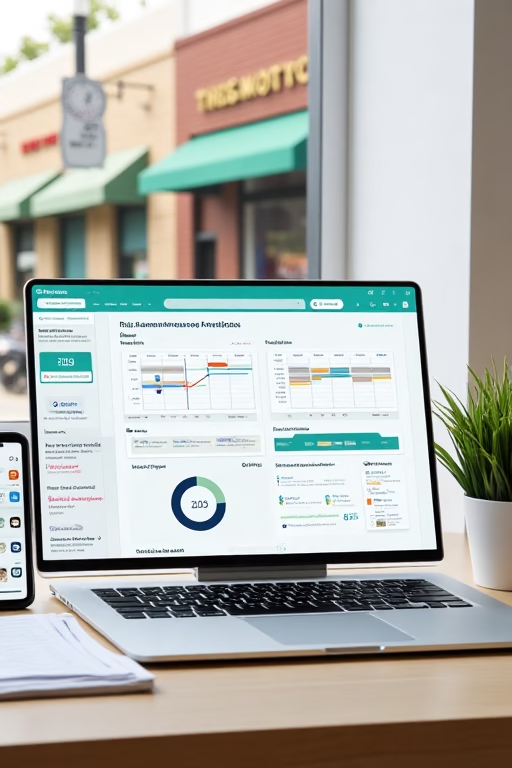
Why Every Local Business Needs Ad Automation in 2025
Your Automated Growth Blueprint by Market Wiz
Table of Contents
- Introduction: The Marketing Shift
- 1. The Rise of Ad Automation
- 1.1 Programmatic Buying
- 1.2 AI‑Powered Bidding
- 2. Core Benefits for Local Businesses
- 2.1 Time & Resource Savings
- 2.2 Precise Audience Targeting
- 2.3 Budget Optimization
- 2.4 Consistent Campaign Management
- 3. Key Automation Platforms
- 3.1 Google Ads Automated Bidding
- 3.2 Facebook Campaign Budget Optimization
- 3.3 Local DSPs & Programmatic
- 4. Implementation Steps
- 4.1 Audit Your Current Ads
- 4.2 Select Tools & Integrations
- 4.3 Define Automation Rules
- 4.4 Launch & Monitor
- 5. Best Practices & Pitfalls
- 6. Measuring Success & ROI
- 7. Future Outlook
- Conclusion & Next Steps
- 25 Frequently Asked Questions
- 25 Extra Keywords
Introduction: The Marketing Shift
By 2025, local businesses face tighter margins and fiercer competition. Manual ad management—setting bids, adjusting budgets, A/B testing—can no longer keep pace. Ad automation harnesses AI and programmatic buying to run campaigns that optimize themselves in real time, freeing you to focus on serving customers.
1. The Rise of Ad Automation
1.1 Programmatic Buying
Programmatic platforms purchase impressions in milliseconds via real‑time auctions, placing your ads where they matter most without manual insertion orders.
1.2 AI‑Powered Bidding
Machine‑learning models analyze performance signals—time of day, device, location—to set optimal bids that maximize conversions at target cost‑per‑acquisition.
2. Core Benefits for Local Businesses
2.1 Time & Resource Savings
Automated rules handle routine tasks—budget pacing, bid adjustments, pausing underperformers—saving hours each week.
2.2 Precise Audience Targeting
Geo‑fencing, demographic layers, and lookalike models ensure your message reaches nearby prospects most likely to convert.
2.3 Budget Optimization
Dynamic budget allocation shifts spend toward high‑ROI segments automatically, eliminating guesswork and waste.
2.4 Consistent Campaign Management
Automations enforce brand and compliance rules across channels, preventing ad fatigue and policy violations.
3. Key Automation Platforms
3.1 Google Ads Automated Bidding
Strategies like Maximize Conversions and Target CPA use machine learning to bid on every auction for the best possible outcome.
3.2 Facebook Campaign Budget Optimization
CBO distributes budget across ad sets in real‑time, scaling top performers without manual shifts.
3.3 Local DSPs & Programmatic
Demand‑Side Platforms such as The Trade Desk offer local publishers and data segments to reach nearby audiences programmatically.
4. Implementation Steps
4.1 Audit Your Current Ads
Identify top‑performing campaigns and manual pain points—bidding, schedule changes, audience tweaks.
4.2 Select Tools & Integrations
Choose platforms with native API integrations to your Google, Facebook, or third‑party ad accounts.
4.3 Define Automation Rules
Set thresholds for cost, click‑through, and conversion rates. Configure actions—raise budget, pause ad sets, shift audiences.
4.4 Launch & Monitor
Start small: automate one campaign category, monitor performance daily, then expand as confidence grows.
5. Best Practices & Pitfalls
- Keep human oversight: review automated decisions weekly.
- Avoid over‑automation: critical changes (creative, messaging) still require manual input.
- Watch for overfitting: too‑aggressive rules can starve emerging opportunities.
6. Measuring Success & ROI
- Time Saved: Hours freed from manual bid management.
- Cost Per Acquisition: Compare before/after automation.
- Return on Ad Spend: Track revenue generated per dollar spent.
- Campaign Uptime: Fewer pauses or budget exhaustions.
7. Future Outlook
Looking ahead, hyper‑local ad variants—dynamic store inventory feeds, real‑time foot traffic signals—will further enhance local ad performance, making automation the baseline for competitiveness.
Conclusion & Next Steps
Ad automation is no longer a luxury; it’s a necessity for local businesses aiming to work smarter and scale faster. Start by automating one campaign type, refine your rules, and expand across channels to stay ahead in 2025’s competitive landscape.
25 Frequently Asked Questions
1. What is ad automation?
Using software and AI to manage bids, budgets, and targeting without manual intervention.
2. Is ad automation expensive?
Costs vary; many platforms include automation in existing ad spend with no extra fees.
3. Do I lose control with automation?
No—rules you define guide automated actions; you can always override them.
4. Which campaigns to automate first?
Start with search or retargeting campaigns that have clear conversion metrics.
5. How often to review automated rules?
Weekly—to catch anomalies and refine thresholds.
6. Can automation manage creative tests?
No—creative iterations require manual updates, though performance data informs tests.
7. Does automation work for small budgets?
Yes—rules can be scaled to any budget level.
8. What about platform updates?
Choose vendors with robust support to adapt automation to platform changes.
9. How to integrate with existing tools?
Most platforms offer APIs or native connectors for Google, Facebook, and DSPs.
10. Can I automate local inventory ads?
Yes—dynamic local inventory ads automatically show in‑stock items to nearby shoppers.
11. What KPIs improve most?
CPA, ROAS, and budget utilization typically see the biggest gains.
12. Is automation GDPR compliant?
Yes—ensure your data sources and tools adhere to privacy regulations.
13. How to avoid overspending?
Set daily budgets and bid caps within your automation rules.
14. What are AI bidding strategies?
Algorithms that adjust bids in real time based on conversion likelihood and cost targets.
15. Can I pause automation?
Yes—disable rules or switch to manual mode at any time.
16. How do I train the AI?
Provide sufficient historical data and refine through performance feedback loops.
17. Does automation handle seasonality?
Advanced rules can adjust budgets or bids based on date ranges or real‑time signals.
18. Are programmatic ads the same?
Programmatic is a subset of automation focused on real‑time media buying across exchanges.
19. Can automation detect fraud?
Some platforms include fraud detection; always monitor unusual activity.
20. What team roles change?
Teams shift from manual optimizers to strategic planners and analysts.
21. How to budget for automation?
Allocate a portion of your monthly ad spend; track the lift to justify expansion.
22. Can I A/B test rules?
Yes—run two sets of rules simultaneously to compare performance.
23. What metrics to watch daily?
Spend pacing, conversion volume, and early signs of audience saturation.
24. Are there industry benchmarks?
Vendors publish vertical benchmarks for CPA and ROAS to guide your setup.
25. What’s the first step?
Identify a mature campaign, enable one automated bidding strategy, and monitor results for one week.
25 Extra Keywords
- local ad automation
- programmatic advertising SMB
- automated bidding strategies
- Google Ads CPA automation
- Facebook CBO tutorial
- real-time ad optimization
- AI campaign management
- smart budget allocation
- dynamic audience targeting
- hyperlocal programmatic ads
- automated ad rules
- ad performance dashboard
- ROI tracking automation
- automation fraud detection
- GDPR ad compliance
- A/B test automated rules
- campaign scheduling AI
- bid cap vs target CPA
- seasonality automation
- DSP for local ads
- lead gen automation
- ad spend optimization
- conversion lift automation
- market wiz ad guide
- future of ad tech













