
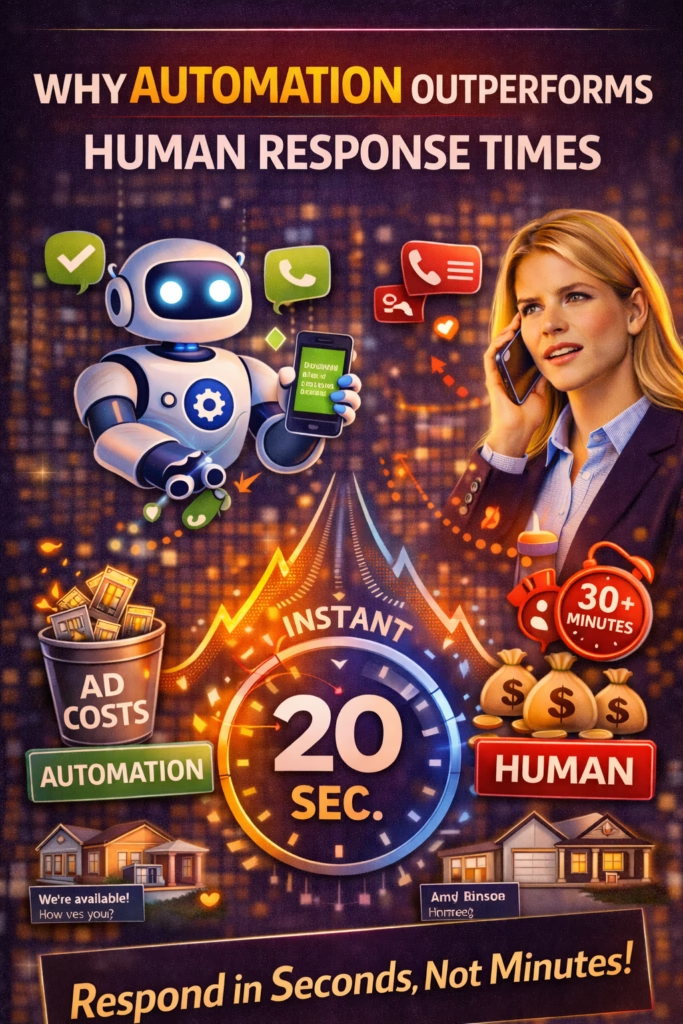
Why Automation Outperforms Human Response Times
Why Automation Outperforms Human Response Times explains the real economics of speed-to-lead—and how instant replies, routing, and follow-up automation convert more inquiries into booked appointments and revenue.
Note: This is general guidance. Keep messages truthful, respect privacy and consent rules, and follow platform policies. Avoid spammy repetition and provide opt-outs where required.
Introduction
Why Automation Outperforms Human Response Times isn’t a “robots are better than people” argument. It’s a reality check about physics, attention, and time.
Humans are amazing at empathy, judgment, negotiation, and closing. But humans are also constrained by:
- Business hours
- Context switching
- High inbox volume
- Meetings, tours, installs, deliveries
- Simple fatigue
Automation outperforms on one critical dimension: instant, consistent action—the moment a lead raises their hand.
Big idea: The fastest responder doesn’t “win the lead.” They win the next step—and next steps win revenue.
Expanded Table of Contents
- 1) The economics of response time
- 2) Why human-only response breaks at scale
- 3) What automation does better (and what it shouldn’t do)
- 4) Channel-by-channel response-time benchmarks
- 5) The perfect instant reply formula
- 6) Qualification flows that raise lead quality
- 7) Routing rules that prevent bottlenecks
- 8) Follow-up automation: where hidden revenue lives
- 9) Booking next steps automatically
- 10) Compliance and brand guardrails
- 11) KPIs that prove it’s working
- 12) 30–60–90 day rollout plan
- 13) 25 Frequently Asked Questions
- 14) 25 Extra Keywords
1) The economics of response time
Response time is a multiplier, not a tactic. When a lead inquires, they’re at peak intent. Every minute you wait is a minute competitors can:
- Reply first
- Offer options
- Book a call/tour
- Lock in the next step
Why speed wins in plain language
Most buyers don’t keep searching because they love searching. They keep searching because nobody made it easy to finish.
Pro move: The goal of a first response isn’t to “explain everything.” It’s to create momentum.
A simple conversion math framework
| Metric | Meaning | Why it matters |
|---|---|---|
| Inquiries | People raising hands | Top-of-funnel demand |
| Booked next steps | Calls/tours/demos scheduled | Predicts revenue |
| Show rate | People who show up | Quality + reminders |
| Close rate | Deals won | Outcome metric |
Rule: Automation increases revenue by increasing booked next steps—not by “sending more messages.”
2) Why human-only response breaks at scale
Even great teams fall behind when:
- Volume spikes (weekends, promotions, seasonality)
- Staff are on tours/calls
- Inquiries come after hours
- Multiple channels fragment the inbox (Marketplace, SMS, email, forms)
The hidden killer: context switching
Humans don’t just “reply.” They read, interpret, check details, decide what to say, then write it. That’s expensive time.
Truth: A human-only system is usually “fast sometimes.” Automation is “fast always.”
3) What automation does better (and what it shouldn’t do)
Automation wins at
- Instant replies (seconds)
- Consistency (same SOP every time)
- After-hours coverage
- Qualification questions
- Follow-up sequences
- Routing + tagging
Humans should own
- Complex negotiations
- Exception handling
- High-empathy situations
- Custom proposals
- Final closing
- Edge-case compliance calls
Pro move: Use automation to get to the moment where humans are strongest: the live conversation.
4) Channel-by-channel response-time benchmarks
| Channel | Buyer behavior | Best response target | Why |
|---|---|---|---|
| Facebook Marketplace / DMs | Fast shopping | < 1 minute | High competition, multi-message behavior |
| Website chat | Research + intent | < 1 minute | They’re live on the page right now |
| SMS | High immediacy | < 1 minute | Text is conversational and time-sensitive |
| Contact forms | Mixed intent | < 5 minutes | Fast improves show/booking rates |
| Slower channel | < 60 minutes | Still benefits from speed, but less urgent |
Rule: Automate the fastest channels first. That’s where response-time advantage is most profitable.
5) The perfect instant reply formula
The best instant replies do three things:
- Confirm the inquiry
- Ask one simple qualifying question
- Offer a next step
Universal instant reply (copy/paste)
Yes — I can help ✅
Quick question so I can point you to the right option:

What city/zip are you in, and are you looking to do this today or this week?
Instant reply + scheduling option (copy/paste)
Got it ✅
If you want to lock this in, which works better?

A) Today: 4–6
B) Tomorrow: 11–1
C) Saturday: 10–12
Avoid: Long paragraphs, multiple links, or “call us” without context. Make it easy to reply.
6) Qualification flows that raise lead quality
Automation doesn’t just respond faster—it can qualify better by asking the same essential questions every time.
Qualification checklist (general)
- Location
- Timeline
- Budget range (if relevant)
- Service/product type
- Preferred next step (call/appointment/quote)
3-question flow (copy/paste)
Perfect ✅
1) What city/zip are you in?
2) Are you looking for today or this week?
3) What’s your budget range (roughly)?
Pro move: The goal is not interrogation. The goal is routing + next step.
7) Routing rules that prevent bottlenecks
Most teams don’t lose deals because they “didn’t try.” They lose deals because leads hit the wrong inbox.
Routing rules that work
| Rule type | Example | Outcome |
|---|---|---|
| Location | Zip → closest rep/store | Faster fulfillment |
| Service type | Install vs repair | Correct expert |
| Urgency | “Today” → priority queue | Higher close rate |
| Budget | High-ticket → senior closer | Better conversion |
Rule: Routing turns speed into certainty. Fast replies without correct handoff still lose deals.
8) Follow-up automation: where hidden revenue lives
Most leads don’t say “no.” They just go quiet. Follow-up automation recovers those leads without staff time.
3-touch follow-up sequence (universal)
| Timing | Message | Goal |
|---|---|---|
| 20–40 min | Quick check-in + question | Restart conversation |
| Same day | Offer options | Book next step |
| Next day | Alternate option | Save the lead |
Follow-up #1
Quick check-in ✅
Do you still want to do this?

What city are you in, and are you looking for today or this week?
Follow-up #2
I can get you scheduled ✅
Which works better: A) today, B) tomorrow, or C) Saturday?
Follow-up #3
Still shopping? ✅
If this isn’t the right fit, tell me your budget + what you need and I’ll point you to the best option.
Pro move: Follow-up should feel like service, not pressure.
9) Booking next steps automatically
Automation wins when it converts messages into scheduled actions. The fastest path to revenue is a booked next step.
Booking script (copy/paste)
Let’s lock it in ✅
What’s the best phone number (or email) for the confirmation?

And which time window works best:
A) 4–6
B) 11–1
C) 10–12
Rule: If you don’t ask for a next step, you’re hoping. Systems don’t hope.
10) Compliance and brand guardrails
High-performing automation is safe automation. Keep these guardrails:
- Truth: no misleading claims
- Consent: follow applicable SMS/email rules
- Opt-out: include where required
- Frequency caps: avoid spam patterns
- Human handoff: easy escalation path
Note: Policies vary by platform and region. When in doubt, use simpler messaging and fewer touches.
11) KPIs that prove it’s working
| KPI | What it measures | Target direction |
|---|---|---|
| Time-to-first-response | Speed-to-lead | Down |
| Booked next steps | Sales momentum | Up |
| Qualification rate | Lead quality capture | Up |
| Follow-up completion | SOP adherence | Up |
| Close rate | Revenue outcome | Up |
Pro move: Track “booked” as your North Star. Leads are noise; booked is signal.
12) 30–60–90 day rollout plan
Days 1–30 (Win response time)
- Unify inboxes (DMs/SMS/forms/email) into one view
- Deploy universal instant reply + 1-question qualification
- Set routing rules (location/service/urgency)
- Implement 3-touch follow-up SOP
- Track response time + booked next steps weekly
Days 31–60 (Win booking rate)
- Add scheduling prompts (A/B/C windows)
- Refine qualification flow (2–3 questions max)
- Improve handoff to humans (alerts + summaries)
- Cut message length; increase clarity
Days 61–90 (Scale responsibly)
- Add knowledge base updates and accuracy checks
- Implement frequency caps and safety guardrails
- Optimize by channel (Marketplace vs web vs SMS)
- Expand to more offers/locations after KPIs stabilize
13) 25 Frequently Asked Questions
1) What does it mean that automation outperforms human response times?
Automation replies instantly and consistently, while human teams naturally delay due to workload and hours.
2) Why does response time matter?
Because buyers contact multiple providers and choose whoever makes the next step easiest first.
3) What is speed-to-lead?
The time between a lead’s inquiry and your first response.
4) What response time should I target?
Under 5 minutes is strong; under 1 minute is best-in-class.
5) Does automation replace humans?
Usually no—automation handles first response and follow-up; humans close.
6) What inquiries should be automated first?
High-volume FAQs: availability, pricing ranges, scheduling, and basic qualification.
7) What is lead leakage?
Lost revenue from missed responses, weak follow-up, and no next-step booking.
8) How does automation reduce leakage?
It guarantees immediate responses and consistent timed follow-ups.
9) Are instant replies the same as follow-up?
No—instant replies start the conversation; follow-up recovers stalled leads.
10) Can automation feel spammy?
Yes—if it’s long, repetitive, or pushy. Keep it short and helpful.
11) Best first message structure?
Confirm + ask one question + offer next step.
12) Simplest qualification question?
City/zip + timeline (today vs this week).
13) How do you route leads automatically?
Rules based on location, service type, urgency, and budget.
14) Does after-hours automation help?
Yes—after-hours is where many teams lose leads to faster responders.
15) How do you keep answers accurate?
Maintain a small, updated knowledge base and refresh it routinely.
16) What compliance risks exist?
Consent, privacy, and platform rules—avoid misleading claims and spam patterns.
17) Which KPIs improve most?
Response time and booked next steps, then show and close rate.
18) How do you measure ROI?
Compare booked next steps and closed revenue before and after automation.
19) What is a booked next step?
A scheduled call/tour/demo/appointment that predicts revenue.
20) Can automation qualify out bad leads?
Yes—by asking consistent questions and routing accordingly.
21) Which channels benefit most?
Fast channels like Marketplace, web chat, and SMS.
22) Biggest automation mistake?
Long generic messages with no question and no next step.
23) Does it work for high-ticket services?
Yes—high-ticket buyers still want fast answers and scheduling.
24) How fast do results appear?
Immediately for response time; 1–3 weeks for booking improvements.
25) Fastest win to implement?
Universal instant reply + 3-touch follow-up sequence.
14) 25 Extra Keywords
- Why Automation Outperforms Human Response Times
- speed to lead automation
- instant reply system
- response time conversion
- lead response automation
- AI auto reply
- follow up automation
- sales response time strategy
- after hours lead capture
- appointment booking automation
- inbound lead automation
- lead routing rules
- lead qualification automation
- reduce lead leakage
- speed-to-lead KPI
- booked next steps metric
- Marketplace instant reply
- website chat automation
- SMS follow up sequences
- increase booking rate
- automated sales assistant
- customer response automation
- conversion rate improvement system
- sales automation 2026
- lead management automation













