

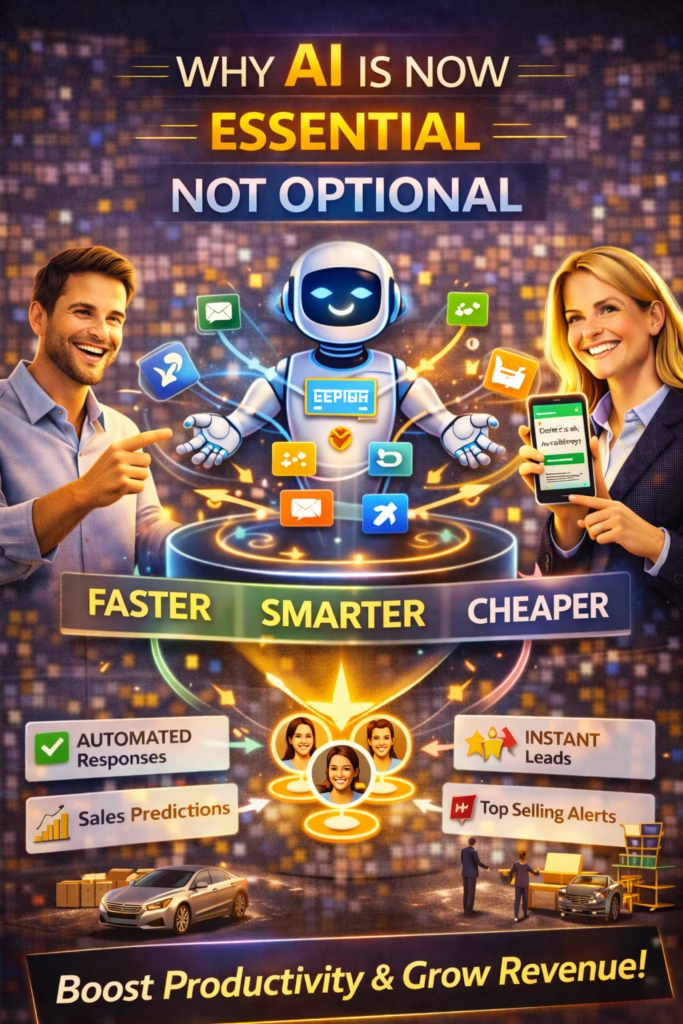
Why AI Is Now Essential, Not Optional
Why AI Is Now Essential, Not Optional explains the new reality: speed, consistency, and automation are now the baseline—and AI is the lever that makes them possible.
Note: This is general guidance. Follow privacy laws, platform rules, and industry regulations. Avoid misleading claims and spam-like outreach.
Introduction
Why AI Is Now Essential, Not Optional is the conversation every small business eventually has—usually after watching a competitor move faster, respond quicker, and win more customers with the same (or less) effort.
AI isn’t a trend anymore. It’s the new standard for speed, consistency, and scale.
For years, small businesses competed with hustle: answering messages late at night, juggling marketing, dealing with follow-ups, and wearing ten hats. That approach still works—until it doesn’t. Because now your competitors can run a system that never sleeps:
- Leads get answered instantly
- Follow-ups happen automatically
- Appointments get booked without staff chasing
- Content gets produced daily
- Performance gets tracked without spreadsheets
Big idea: AI doesn’t give you “one improvement.” It creates a compounding advantage loop that gets stronger over time.
Expanded Table of Contents
- 1) The shift: why “manual” is losing
- 2) The new baseline: speed and consistency
- 3) The AI advantage loop (compounding effect)
- 4) The modern SMB AI stack
- 5) AI for lead generation and distribution
- 6) AI for conversion: response, qualify, book
- 7) AI follow-up: where most revenue is hiding
- 8) AI content: daily output without burnout
- 9) AI operations: process, routing, and QA
- 10) AI customer support that doesn’t break trust
- 11) The human role: what AI should not do
- 12) Common objections (and honest answers)
- 13) KPIs to track AI impact
- 14) 30–60–90 day rollout plan
- 15) 25 Frequently Asked Questions
- 16) 25 Extra Keywords
1) The shift: why “manual” is losing
Manual operations fail for one reason: humans are not built for endless repetition at infinite speed.
Manual loses where modern buyers care most
- Speed: buyers want answers now
- Consistency: buyers want predictable experiences
- Availability: buyers shop nights and weekends
- Clarity: buyers want simple next steps
Reality: The average small business doesn’t lose because it’s “bad.” It loses because it’s slower than the new standard.
2) The new baseline: speed and consistency
Buyers have more choices than ever. When they inquire, they often message multiple sellers.
| What buyers do | What they expect | What happens when you’re slow |
|---|---|---|
| Message multiple sellers | Fast reply | You become option #3 |
| Ask the same questions | Clear answers | They move on |
| Browse after hours | Always-on support | They book elsewhere |
Rule: AI isn’t “extra.” It’s how you keep up with the new baseline.
3) The AI advantage loop (compounding effect)
AI creates compounding advantage because it improves the same flywheel repeatedly:
Faster response
More conversations start. More leads stay engaged.
More follow-up
More “maybes” turn into “yes.” Less ghosting.
Better data
More clarity on what works. Better decisions.
More output
More listings, more content, more visibility.
Pro move: Don’t ask, “Will AI help?” Ask, “Which leak does AI fix first?”
4) The modern SMB AI stack
A practical stack for most SMBs includes:
- Distribution: posting + listing rotation + multi-channel presence
- Response: instant first reply + FAQ answers
- Qualification: one-question intent capture (zip + timeline)
- Booking: two-option close or scheduling link
- Follow-up: polite sequences with stop rules
- Routing: hot leads to humans, routine leads to automation
- Reporting: response time, appointment rate, close rate
Rule: AI works best when it plugs into a simple process—not when it’s random tools everywhere.
5) AI for lead generation and distribution
AI improves lead generation in two ways:
- More surface area: more listings, more posts, more variations
- More consistency: steady cadence, fewer gaps, less burnout
What changes when you post consistently
- You show up for more searches and buyer intents
- Freshness increases exposure
- More inbound inquiries arrive without paid media
Pro move: AI makes consistency affordable—because it reduces time cost, not ad cost.
6) AI for conversion: response, qualify, book
Most businesses think they need “more leads.” Often they need more conversion per lead.
The best first reply (universal)
Yes — available ✅

What city/zip are you in, and are you looking for today or this week?
Why this works
- Confirms the buyer didn’t waste time
- Captures two key qualification points
- Moves toward a next step
Rule: If you reply fast but don’t ask a question, you still lose momentum.
7) AI follow-up: where most revenue is hiding
Follow-up is the most ignored revenue lever in small business, because it’s repetitive and time-consuming.
Simple follow-up sequence
Follow-up #1 (2–4 hours):
Just checking in ✅ Are you looking for today or this week?

Follow-up #2 (next day):
If you tell me your zip, I can confirm the fastest next step.

Follow-up #3 (48–72 hours):
No pressure—should I close this out or keep it open for you?
Avoid: endless chasing. Follow-up should be polite, finite, and helpful.
8) AI content: daily output without burnout
AI content is essential because visibility is earned through consistent output.
Where AI content helps most
- Listing variations (titles, hooks, feature angles)
- Short-form video scripts (20–30 seconds)
- FAQ answers and product/service explainers
- Local SEO pages and social captions
Pro move: Content doesn’t win because it’s perfect—it wins because it’s consistent and relevant.
9) AI operations: process, routing, and QA
AI is not just marketing. It’s operations support.
High-ROI operational wins
- Auto-tag leads by intent
- Route hot leads to calls
- Standardize scripts for staff
- Log conversation outcomes (booked, not interested, later)
- Weekly KPI reporting
Rule: Once operations are consistent, marketing results become predictable.
10) AI customer support that doesn’t break trust
Support is often a bottleneck: questions pile up, replies get delayed, and customers feel ignored.
Best practices for AI support
- Keep answers short and accurate
- Offer escalation to a human when needed
- Don’t make promises you can’t keep
- Use consistent policy language
Clean escalation line
Got it ✅
I’m going to have a specialist confirm this for you.
What’s the best number to reach you?
11) The human role: what AI should not do
AI should not replace judgment. It should replace repetition.
Human-owned areas
- Complex negotiations
- Disputes and sensitive issues
- High-ticket consultative sales
- Brand voice and final approvals (where required)
Pro move: Use AI to handle 80% routine work, so humans can win the 20% that matters most.
12) Common objections (and honest answers)
“AI is expensive.”
Not adopting AI is often more expensive because it costs you missed leads, slower responses, and more labor hours.
“AI sounds robotic.”
Only if it’s written poorly. Good AI replies are short, helpful, and focused on next steps.
“We don’t need it.”
If competitors reply faster and follow up better, they will win more conversions from the same lead pool.
Rule: AI adoption is less about “tech” and more about eliminating conversion leaks.
13) KPIs to track AI impact
| KPI | What it measures | Target direction |
|---|---|---|
| Median first response time | Speed-to-lead | Down |
| Conversation start rate | % inquiries that reply back | Up |
| Qualified lead rate | % giving zip + timeline | Up |
| Appointment rate | % that book next step | Up |
| Show rate | Appointment quality | Up |
| Close rate | Revenue conversion | Up |
| Cost per booked step | Efficiency | Down |
Pro move: Track booked next steps weekly. That’s the earliest reliable revenue signal.
14) 30–60–90 day rollout plan
Days 1–30 (Foundation)
- Deploy instant first reply + one-question qualification
- Build FAQ library (top 20 questions)
- Implement a simple follow-up sequence
- Start tracking response time + appointment rate
Days 31–60 (Conversion)
- Add routing tiers (hot/warm/cold)
- Implement two-option booking close
- Improve objection scripts and escalation rules
- Review KPI dashboard weekly
Days 61–90 (Scale)
- Expand content output (listings, short-form scripts, local pages)
- Automate reporting and QA
- Optimize based on KPI trends
- Document SOPs for staff
Rule: AI becomes “essential” the moment it makes your business consistently faster than manual competitors.
15) 25 Frequently Asked Questions
1) Why is AI now essential for small businesses?
Because it enables faster replies, consistent follow-up, higher output, and better efficiency in competitive markets.
2) What business tasks should AI handle first?
First response, FAQ answers, qualification, follow-up, appointment booking, and simple reporting.
3) Does AI replace employees?
It usually replaces repetitive work and gaps first, making teams faster before replacing roles.
4) What is speed-to-lead?
How quickly you reply to a new inquiry, which strongly impacts conversion.
5) What response time should we aim for?
Under 5 minutes is strong; under 1 minute is ideal.
6) Can AI help with lead generation?
Yes—by enabling consistent posting, listing variations, and multi-channel presence.
7) Can AI help without paid ads?
Yes—AI helps maximize organic leads through consistency and conversion improvements.
8) What’s the biggest benefit of AI in sales?
Instant response and consistent follow-up that prevents lost leads.
9) How does AI reduce ghosting?
By replying instantly and following up politely with clear next steps.
10) Can AI book appointments?
Yes—using two-option closes or scheduling links, with routing rules.
11) Should AI negotiate price?
Light objections are fine; complex negotiations should escalate to a human.
12) Can AI improve customer support?
Yes—by answering FAQs quickly and escalating complex issues.
13) Is AI content useful?
Yes—consistent content output often drives more visibility and inbound inquiries.
14) How do we avoid robotic messaging?
Keep replies short, natural, and focused on one question plus a next step.
15) What’s the best AI first reply?
Confirm availability and ask: “What zip and are you looking today or this week?”
16) Does AI require a big tech team?
No—start with simple scripts and workflows, then improve over time.
17) How long until AI changes results?
Often within 1–2 weeks, with compounding gains over 30–90 days.
18) What industries benefit most?
Retail, services, real estate, vehicles—any business with inbound inquiries.
19) What is lead routing?
Assigning leads to the right workflow or person based on intent and fit.
20) What is a booked next step?
An appointment, quote, call, store visit, pickup, or delivery scheduled.
21) What KPIs show AI impact?
Response time, qualified rate, appointment rate, show rate, and close rate.
22) Is AI automation compliant?
It can be if you follow platform rules, privacy requirements, and respect opt-outs.
23) What’s the biggest AI mistake?
Using AI without a process—no qualification, no follow-up, no tracking.
24) Should AI be fully autonomous?
Not always. Use human handoff for complex and high-stakes situations.
25) Where should we start today?
Instant first reply + one-question qualification + follow-up sequence.
16) 25 Extra Keywords
- Why AI Is Now Essential, Not Optional
- AI for small business 2026
- AI marketing automation
- AI lead generation system
- AI customer responder
- speed to lead automation
- AI follow up sequences
- AI appointment booking
- AI sales assistant SMB
- local business AI stack
- AI for retail conversion
- AI for service businesses
- AI operations automation
- AI customer service automation
- AI content production
- organic lead generation with AI
- reduce lead leakage
- increase appointment rate
- improve close rate
- AI lead routing
- AI objection handling
- SMB automation strategy
- 2025 2026 AI marketing strategy
- competing with AI tools
- AI essential business workflow













