
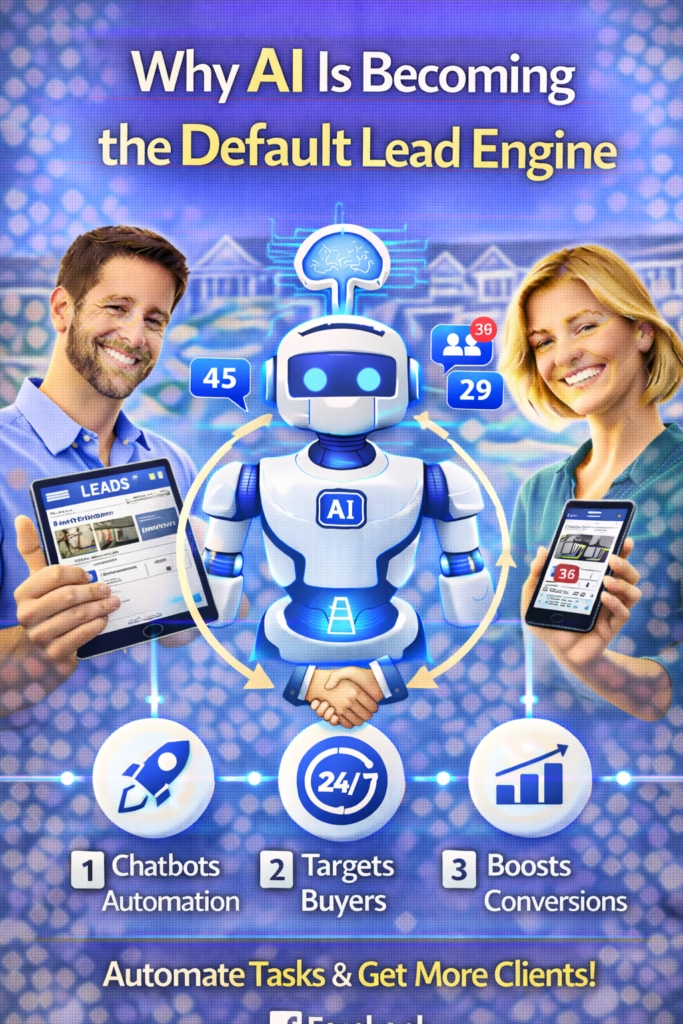
Why AI Is Becoming the Default Lead Engine
Why AI Is Becoming the Default Lead Engine comes down to one thing: businesses are shifting from “manual follow-up” to always-on, instant, consistent conversion across every channel.
Note: This is general marketing guidance. Follow relevant privacy laws, consent requirements (SMS/calls), and platform policies for each channel.
Introduction
Why AI Is Becoming the Default Lead Engine is not hype—it’s economics. Buyers expect instant answers, teams can’t respond 24/7, and ad costs punish slow follow-up. AI fixes the single biggest leak in most funnels: time.
When a lead comes in, there are only two outcomes: you respond fast and direct them to a next step, or the lead keeps shopping and disappears. AI is becoming “default” because it makes the winning outcome automatic.
Big idea: AI doesn’t replace marketing. It replaces the delay between interest and action.
Expanded Table of Contents
- 1) The market shift: from campaigns to conversion engines
- 2) The 7 reasons AI is becoming the default lead engine
- 3) The AI lead engine architecture (simple)
- 4) Where AI wins most: website, calls, SMS, DMs, local listings
- 5) AI qualification that feels helpful (not interrogating)
- 6) Appointment booking automation that actually sticks
- 7) Follow-up SOP: how AI recovers “ghost” leads
- 8) Content engines + local SEO: AI as your distribution layer
- 9) KPIs that prove ROI (without guessing)
- 10) Risks, compliance, and how to stay safe
- 11) 30–60–90 day rollout plan
- 12) 25 Frequently Asked Questions
- 13) 25 Extra Keywords
1) The market shift: from campaigns to conversion engines
For years, “lead generation” meant launching campaigns and hoping a team handled the rest. Now, the competitive edge is not the campaign—it’s the system that converts.
Old model
Run ads → wait for leads → humans follow up when they can.
New model
Always-on engine → instant response → qualification → booking → follow-up.
AI is becoming default because it turns conversion into infrastructure—like having lights and internet. Not optional.
2) The 7 reasons AI is becoming the default lead engine
Reason 1: Speed-to-lead is the #1 conversion lever
Most leads are won or lost in the first few minutes. AI responds instantly—every time.
Reason 2: Leads arrive outside business hours
When teams sleep, AI works. That’s not a “nice-to-have.” It’s recovered revenue.
Reason 3: Consistency beats talent in volume funnels
Humans vary. AI can ask the right questions every time and follow the same SOP.
Reason 4: Personalization at scale is now affordable
AI can reference the source, intent, service, city, and availability—without adding headcount.
Reason 5: Follow-up is boring, but it’s where money is
AI doesn’t get tired. It can follow up intelligently and politely until the lead books or opts out.
Reason 6: Ad costs punish slow conversion
If your close rate is weak, the cost per acquisition skyrockets. AI improves conversion without spending more.
Reason 7: Multi-channel is mandatory now
Leads come from search, maps, DMs, forms, calls, and marketplaces. AI can unify the experience and hand off cleanly.
Simple truth: AI is becoming “default” because it systematically removes the three killers: delay, inconsistency, and missed follow-up.
3) The AI lead engine architecture (simple)
You don’t need a complicated stack. You need a repeatable flow.
| Layer | Purpose | Output |
|---|---|---|
| Capture | Catch intent across channels | Lead record + source |
| Instant Reply | Stop the leak immediately | Conversation started |
| Qualification | Collect what matters | Fit + urgency |
| Routing / Booking | Move to next step | Appointment or escalation |
| Follow-Up | Recover ghosts | Booked or closed-lost |
| Reporting | Measure what’s working | KPIs + ROI |
Pro move: Build one “universal conversation SOP” and apply it everywhere (web, SMS, DM, calls).
4) Where AI wins most: website, calls, SMS, DMs, local listings
AI becomes a default lead engine when it covers the channels where humans lose speed.
Website forms & chat
Instant replies + booking increase conversion without more traffic.
SMS
Fast, simple, and ideal for scheduling and confirmations.
Phone calls
AI can answer, qualify, and route—even when staff is busy.
Social DMs
Messenger/IG leads go cold fast. AI keeps them moving.
Local listings / Maps
AI helps convert “high-intent” calls/messages into booked appointments.
Marketplace-style inquiries
“Is it available?” becomes a qualification + booking flow.
Important: Each channel has its own consent rules and platform policies—build compliance into your workflow.
5) AI qualification that feels helpful (not interrogating)
Qualification is not about asking 20 questions. It’s about asking the right questions in a friendly sequence.
3-question universal qualifier
Quick question so I point you the right way ✅
1) What are you looking for help with?
2) What city/area are you in?
3) How soon are you looking to start?
Service businesses (example qualifier)
Perfect — I can help ✅
1) What service do you need?
2) What’s the address or city?
3) Best time for a quick call or estimate?
Rule: Qualification should feel like concierge help, not a form.
6) Appointment booking automation that actually sticks
AI becomes the default lead engine when it closes the loop: not just chatting, but booking.
Booking message (copy/paste)
Awesome ✅ I can get you on the schedule.

Would you prefer:
A) Today / Tomorrow
B) This week
C) Next week

Reply A/B/C and your best time window (morning/afternoon/evening).
Confirmation message (reduces no-shows)
You’re booked ✅ for __ on ___.
Reply YES to confirm.

If you need to reschedule, reply RESCHEDULE and I’ll send options.
Pro move: Confirmation + reminders often improve show rate more than adding more leads.
7) Follow-up SOP: how AI recovers “ghost” leads
Most businesses lose money in the quiet part of the funnel: follow-up. AI turns follow-up into a process.
4-touch follow-up sequence
| Timing | Message | Goal |
|---|---|---|
| 15–45 min | Short check-in + next step | Restart conversation |
| Same day | Answer a common objection | Reduce friction |
| Next day | Offer a specific time window | Book |
| Day 3–5 | Alternate option / “still need help?” | Save lead |
Follow-up #1
Quick check-in ✅
Do you still want to get this scheduled?

Reply with your city + preferred day and I’ll lock it in.
Rule: Follow-up should always present a next step, not a vague “just checking.”
8) Content engines + local SEO: AI as your distribution layer
AI is also becoming the default lead engine because it can publish at scale: location pages, FAQs, service pages, and helpful posts that rank in search and convert on Maps.
What AI can publish consistently
- Service pages (each service, each city)
- FAQ clusters that match real queries
- Before/after case studies
- Local posts and Google Business content
- Short-form scripts for social that drive inbound inquiries
Pro move: Combine AI content + AI follow-up. Most competitors only do one side.
9) KPIs that prove ROI (without guessing)
| KPI | What it measures | Why it matters |
|---|---|---|
| Median response time | Speed-to-lead | Directly impacts conversion |
| Lead-to-booked rate | Booking efficiency | Measures real outcomes |
| Show rate | No-shows vs shows | Protects revenue |
| Cost per booked appointment | True acquisition cost | Better than CPL |
| Close rate | Booked → customer | Profit lever |
| Time saved | Ops efficiency | Headcount leverage |
Truth: If your response time drops and your booked rate rises, AI is paying for itself—regardless of channel.
10) Risks, compliance, and how to stay safe
AI becomes “default” only when it’s trusted. That means guardrails.
Practical guardrails
- Consent: Use opt-in for SMS/calls where required and offer opt-out language.
- Accuracy: Don’t invent pricing or availability—pull from a source of truth.
- Escalation: Route edge cases to a human fast (complaints, refunds, legal questions).
- Privacy: Don’t request unnecessary sensitive data.
- Consistency: Use approved scripts and keep logs.
Reminder: This is general guidance. For legal compliance (especially housing, lending, healthcare, and telecom), consult qualified counsel in your jurisdiction.
11) 30–60–90 day rollout plan
Days 1–30 (Stop the bleeding)
- Install instant replies across top channels
- Deploy the 3-question qualifier
- Implement booking + confirmation templates
- Create a follow-up sequence
- Track response time + booked rate weekly
Days 31–60 (Increase conversion)
- Tighten scripts based on real objections
- Add escalation rules and human handoff
- Reduce no-shows with reminders
- Standardize lead routing and tagging
Days 61–90 (Scale the engine)
- Expand coverage to every lead source
- Launch content engine for local SEO
- Build KPI dashboard by channel
- Optimize cost per booked appointment
12) 25 Frequently Asked Questions
1) Why is AI becoming the default lead engine?
Why AI Is Becoming the Default Lead Engine comes down to speed, consistency, and 24/7 coverage—AI turns more inquiries into booked appointments without needing more headcount.
2) What is an AI lead engine?
An AI lead engine is a system that captures inquiries, replies instantly, qualifies intent, books or routes appointments, and follows up automatically.
3) Is AI better than paid ads?
They do different jobs. Ads create demand; AI converts demand. If conversion is weak, AI often delivers higher ROI than increasing ad spend.
4) What’s the biggest advantage of AI lead gen?
Speed-to-lead and consistent follow-up.
5) Does AI replace sales teams?
Usually it supports them by handling first response, qualification, and scheduling—then handing off qualified leads.
6) Where should I deploy AI first?
Where leads go cold fastest: DMs, SMS, incoming calls, and web chat/forms.
7) How fast should AI reply?
Instantly—under 1 minute is ideal.
8) Can AI qualify leads?
Yes, with short question sequences that confirm fit and urgency.
9) Can AI book appointments?
Yes—especially when the booking flow is simple and the next step is clear.
10) How does AI reduce no-shows?
Confirmations, reminders, and easy rescheduling.
11) Can AI work across multiple channels?
Yes—web, SMS, calls, DMs, and marketplace-style inquiries.
12) Is AI lead gen expensive?
It can be cheaper than additional staff or higher ad spend, depending on volume.
13) What KPIs should I track?
Response time, lead-to-booked rate, show rate, close rate, and cost per booked appointment.
14) Does AI improve local SEO?
AI can help produce consistent content and FAQs that support ranking and conversion.
15) How do I keep AI from saying the wrong thing?
Use guardrails: approved scripts, source-of-truth data, and escalation rules.
16) Is AI compliant for SMS and calls?
It can be if you follow consent rules and provide opt-out options where required.
17) Can AI handle objections?
Yes, especially common objections like price, availability, scheduling, and scope.
18) What industries benefit most?
Any business with inbound inquiries: real estate, home services, rentals, retail, medical marketing (with compliance), and more.
19) Does AI work if my lead volume is low?
Yes—speed and follow-up still matter, and AI ensures you don’t miss opportunities.
20) Can AI personalize messages?
Yes—using the lead’s service, city, timeframe, and source.
21) How do I avoid sounding robotic?
Keep messages short, friendly, and question-based—like a helpful concierge.
22) Can AI improve close rate?
Indirectly—by increasing the number of qualified leads that reach your team and keeping them engaged.
23) What’s the best first question to ask?
“What city are you in?” or “How soon are you looking to start?” depending on your business.
24) How long does it take to see results?
Many businesses see improvements immediately in response time and booking rate once instant replies are live.
25) What’s the fastest win?
Instant replies + a 3-question qualifier + a direct booking prompt.
13) 25 Extra Keywords
- Why AI Is Becoming the Default Lead Engine
- AI lead engine for small business
- AI lead generation system 2026
- automated lead capture and follow up
- AI appointment booking automation
- instant response lead conversion
- AI sales assistant for inbound leads
- AI customer acquisition engine
- AI marketing automation platform
- AI follow up sequence for leads
- speed to lead automation
- multi channel lead routing AI
- AI for Facebook Messenger leads
- AI for Instagram DM leads
- AI for website chat lead gen
- AI for inbound call qualification
- AI lead scoring and qualification
- reduce cost per booked appointment
- AI local SEO content engine
- AI lead nurturing automation
- automated scheduling and reminders
- AI conversion optimization
- AI pipeline automation
- AI lead gen compliance guardrails
- always on lead generation engine













