

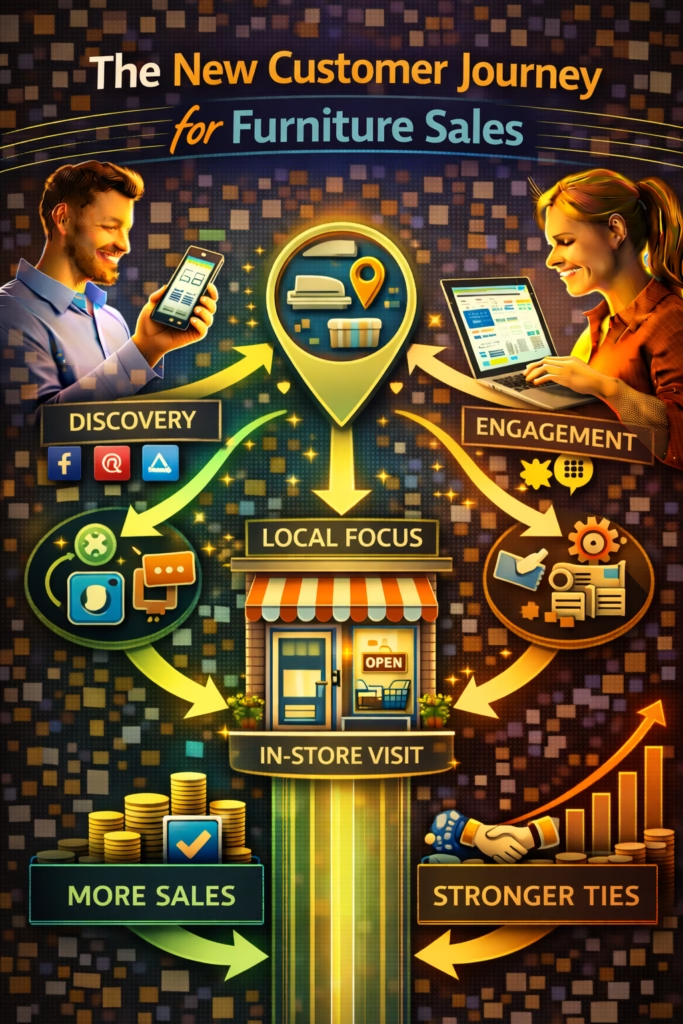
The New Customer Journey for Furniture Sales
The New Customer Journey for Furniture Sales is the blueprint for how buyers really shop now—browse, compare, message, and buy locally with speed, trust, and convenience.
Note: This is general guidance. Follow platform rules, keep details truthful, and avoid duplication or misleading claims in listings and messages.
Introduction
The New Customer Journey for Furniture Sales is not the old showroom path.
Furniture buyers don’t “start in the store” anymore. They start in a feed.
They scroll, screenshot, compare, and message multiple sellers at once. They want quick answers, real photos, fast delivery options, and a clear next step. The retailer who understands this journey—and builds a system around it—wins.
What changed isn’t just marketing. It’s buyer behavior:
- Discovery moved from malls to marketplaces, short-form video, and local search.
- Comparison happens instantly across multiple stores and sellers.
- Messaging became the new “first conversation.”
- Speed-to-lead and convenience often beat brand loyalty.
Big idea: Modern furniture sales are won by retailers who treat platforms like a showroom entrance—not a side channel.
Expanded Table of Contents
- 1) The new journey map (2025–2026)
- 2) Discovery: where furniture buyers start now
- 3) Comparison: how buyers shortlist in minutes
- 4) Messaging: the new first sales conversation
- 5) Showroom visits: turning interest into commitment
- 6) Delivery, setup, and convenience as differentiators
- 7) Financing and payment options in the modern journey
- 8) Trust signals that replace “brand familiarity”
- 9) Listing system that matches the journey
- 10) Response + follow-up system that converts
- 11) KPIs and dashboards for the new journey
- 12) 30–60–90 day rollout plan
- 13) 25 Frequently Asked Questions
- 14) 25 Extra Keywords
1) The new journey map (2025–2026)
Today’s furniture customer journey is a fast loop that repeats across platforms:
| Stage | What the buyer is doing | What the retailer must do |
|---|---|---|
| Discover | Scrolling and saving | Win attention with strong thumbnails and clear titles |
| Compare | Shortlisting 3–7 options | Make your offer and proof easy to see |
| Message | Asking “available?” “price?” “delivery?” | Respond fast with options and a next step |
| Visit/Commit | Deciding to come in or buy now | Book a time window + confirm inventory and location |
| Deliver | Choosing convenience | Clear delivery, setup, and timeline expectations |
| Review/Repeat | Sharing outcome | Ask for a review and re-market later |
Pro move: Your job is to remove friction at each stage. Less friction = more conversions.
2) Discovery: where furniture buyers start now
Furniture buyers discover products in three main places:
- Marketplaces: fast browsing, local convenience, message-first.
- Short-form video: “show me what it looks like” content drives curiosity.
- Local search: “mattress store near me,” “sectional delivery today,” etc.
Rule: If you don’t show up where discovery happens, your showroom traffic becomes unpredictable.
Discovery assets that outperform
Real product photos
Clear, bright, consistent angles. Make the thumbnail obvious and scroll-stopping.
Single-idea titles
Say what it is, then add one hook: availability, delivery, value, or premium.
Proof blocks
Condition clarity, specs, and simple “what’s included” language reduces hesitation.
Convenience offers
Delivery windows, pickup options, financing language (only if true).
3) Comparison: how buyers shortlist in minutes
Buyers compare fast. They don’t read essays. They scan for:
- Fit: size, material, comfort, color, dimensions.
- Trust: real photos, transparent details, clear policies.
- Convenience: delivery, availability, timeline.
- Value: price relative to perceived quality.
The “scan structure” that converts
✅ Real photos + clear details
• What it is + key features
• Size / dimensions
• Condition and what’s included
• Availability + delivery options
👉 Question CTA: What city/zip + today or this week?
Pro move: Your first 2 lines should answer “Is this legit?” and “What’s the next step?”
4) Messaging: the new first sales conversation
Messaging is the modern “walk-in.” If you treat it like a nuisance, you lose the buyer to someone who treats it like the sale.
Why buyers message first
- It’s lower pressure than calling.
- They’re comparing multiple options at once.
- They want fast confirmation: availability, delivery, timeline.
Instant reply that moves the journey forward
Yes — it’s available ✅
What city/zip are you in, and are you looking for today or this week?
I’ll confirm the fastest pickup/delivery options.
Rule: Speed wins. The first clear reply often wins the visit.
5) Showroom visits: turning interest into commitment
The showroom still matters—but its job changed. It’s not where discovery starts. It’s where confidence is sealed.
How to convert a message into a visit
- Offer a time window (not “come whenever”).
- Confirm the item is available (truthfully).
- Give a simple address + expectation (who to ask for, what to bring).
- Reduce anxiety with clarity: “We’ll have it ready to show.”
Visit booking script
We can have it ready to show ✅
Do you want to stop in today or tomorrow?
If you send your city/zip, I’ll confirm the best time window and delivery options.
Pro move: Every conversation should end in a scheduled next step.
6) Delivery, setup, and convenience as differentiators
Convenience is now a competitive weapon. Buyers will pay more for speed, clarity, and zero hassle.
Convenience offers that win
- Same-day or next-day delivery (if true)
- Clear delivery window ranges
- Stairs/setup options explained simply
- Pickup instructions that reduce confusion
Rule: A buyer doesn’t just buy the furniture—they buy the experience of getting it.
7) Financing and payment options in the modern journey
Financing has moved earlier in the journey. Buyers ask about affordability before they commit to visiting.
How to mention financing without sounding pushy
- Keep it factual and simple.
- Use “options available” language (only if true).
- Move to a next step: quote, visit, or eligibility check.
Financing reply (neutral)
Yes — options are available ✅
If you tell me your city/zip and whether you want it today or this week,
I’ll confirm the fastest options and what the payment choices look like.
Important: Only claim financing if you truly offer it. Keep details compliant.
8) Trust signals that replace “brand familiarity”
Online giants have brand trust. Local stores win by creating proof and clarity.
Trust signals that increase conversion
- Real photos (not a single stock image)
- Consistent posting cadence (shows you’re active)
- Clear condition and included items
- Fast replies (signals reliability)
- Transparent delivery and timeline
Pro move: Put “Real photos + clear details ✅” in the first line. It removes doubt instantly.
9) Listing system that matches the journey
Your listings should be designed for the journey stages: discovery, comparison, and messaging.
High-performing listing architecture
| Listing component | Job | Best practice |
|---|---|---|
| First photo | Win clicks | Bright, clear, close, obvious |
| Title | Clarify fast | What it is + hook + option |
| First 2 lines | Build trust + move to message | Real photos + offer + CTA question |
| Bullets | Help comparison | Size, condition, included, delivery |
| CTA | Start conversation | City/zip + today/this week |
Title framework (furniture)
[Product] + [Hook] + [Option]
Examples:
• Sectional Sofa + Like-New Comfort + Delivery Options
• Queen Mattress Set + Great Value + Available Today
• Dining Set + Solid Wood Look + Pickup or Delivery
Rule: Don’t post more. Post more variety across buyer intents.
10) Response + follow-up system that converts
The new journey is message-first, which means your response system is your sales floor.
3-message conversion system
Message 1: Confirm + CTA
Yes — it’s available ✅
What city/zip are you in, and are you looking for today or this week?
Message 2: Options + next step
Perfect — we can do pickup or delivery.
Do you want to stop in today, or should I quote delivery to your zip?
Message 3: Book the step
Let’s lock it in ✅
What time window works best (2–4 or 4–6)?
Follow-up (24 hours)
Quick check—did you still want to set up a time?
If yes, what city/zip and what day works best?
Pro move: Treat every message as a micro-appointment booking.
11) KPIs and dashboards for the new journey
| KPI | What it measures | Target direction |
|---|---|---|
| Messages/day | Lead flow | Up |
| Messages per listing | Listing quality | Up |
| Median response time | Speed-to-lead | Down |
| Booked visits/deliveries | Sales pipeline health | Up |
| Show rate | Visit commitment | Up |
| Delivery conversion | Convenience win-rate | Up |
| Reviews/week | Trust compounding | Up |
Rule: “Booked next steps” is the KPI that turns activity into revenue.
12) 30–60–90 day rollout plan
Days 1–30 (Fix discovery + messaging)
- Upgrade first photos + titles on top listings
- Deploy instant reply + CTA question
- Standardize listing scan structure (bullets + proof line)
- Track messages/day and response time
- Publish 3–5 buyer-intent angles (value/speed/trust/premium/fit)
Days 31–60 (Build conversion)
- Implement visit booking scripts and time windows
- Clarify delivery and setup options in listings
- Start weekly A/B tests (first photo, title)
- Improve follow-up system for inactive leads
Days 61–90 (Compound trust)
- Build review request loop after delivery/purchase
- Retire low performers and replace with better angles
- Create SOPs for posting, QA, and response speed
- Track booked steps weekly and optimize the bottleneck
Pro move: The new journey is a system. Once built, it compounds.
13) 25 Frequently Asked Questions
1) What is the new customer journey for furniture sales?
Buyers discover in feeds, compare quickly, message for details, then decide based on speed, trust, and convenience.
2) Why do furniture buyers message instead of calling?
Messaging is faster and lower pressure, and buyers can compare multiple sellers at once.
3) What is the fastest way to increase furniture lead flow?
Improve first photo/title for click-to-message performance and respond faster with clear options.
4) Where do furniture buyers discover products now?
Marketplaces, short-form video, and local search.
5) Do showrooms still matter?
Yes—showrooms are where confidence is sealed, not where discovery starts.
6) What do buyers compare first?
Fit, trust, convenience, and value.
7) What listing element matters most?
The first photo—because it drives CTR.
8) What makes a strong furniture title?
What it is + one hook + one option (delivery/availability/pickup).
9) What should the first line of a listing say?
Something that reduces doubt: “Real photos + clear details ✅”
10) What is the best CTA question?
“What city/zip are you in, and are you looking for today or this week?”
11) How fast should I reply?
Under 5 minutes is strong; under 1 minute is best.
12) What is a booked next step?
A scheduled visit, pickup, or delivery window.
13) Why do leads ghost?
Slow replies, unclear next steps, or too much friction in the conversation.
14) How do I reduce ghosting?
Offer options and ask one simple question to move forward.
15) What role does delivery play now?
Convenience often determines the winner—even at a higher price.
16) Should I mention financing in listings?
Yes, if you offer it—keep it factual and simple.
17) What trust signals convert best?
Real photos, transparent details, and fast replies.
18) Are stock photos okay?
Real photos typically convert better and build trust.
19) How many listings should I have active?
Enough to cover your inventory and buyer intents—quality and variety matter more than volume.
20) Is posting more always better?
No—consistent cadence and varied angles beat bursts and duplicates.
21) What is the best KPI to track?
Booked next steps, plus messages/day and response time.
22) How long until improvements show results?
Often within 1–2 weeks, compounding across 30–90 days.
23) How do I turn messages into visits?
Offer time windows and confirm availability, then ask for a day/time choice.
24) How do I get more reviews?
Ask after a successful delivery/purchase with a simple link and short request.
25) What’s the biggest mistake furniture stores make?
Treating marketplaces and messages like “side tasks” instead of the main journey.
14) 25 Extra Keywords
- The New Customer Journey for Furniture Sales
- furniture customer journey 2026
- modern furniture buyer behavior
- furniture sales lead flow
- marketplace furniture leads
- Facebook Marketplace furniture buyers
- local furniture marketing strategy
- furniture showroom conversion
- message based selling furniture
- speed to lead furniture sales
- click to message optimization
- furniture listing title examples
- furniture photo strategy marketplace
- increase furniture messages per day
- book more showroom visits
- same day delivery furniture marketing
- furniture financing conversation
- trust signals for local stores
- marketplace listing cadence
- anti-flag listing variety
- furniture sales follow up scripts
- local retail customer journey
- convert browsers into buyers
- furniture lead generation system
- marketplace retail showroom strategy













