

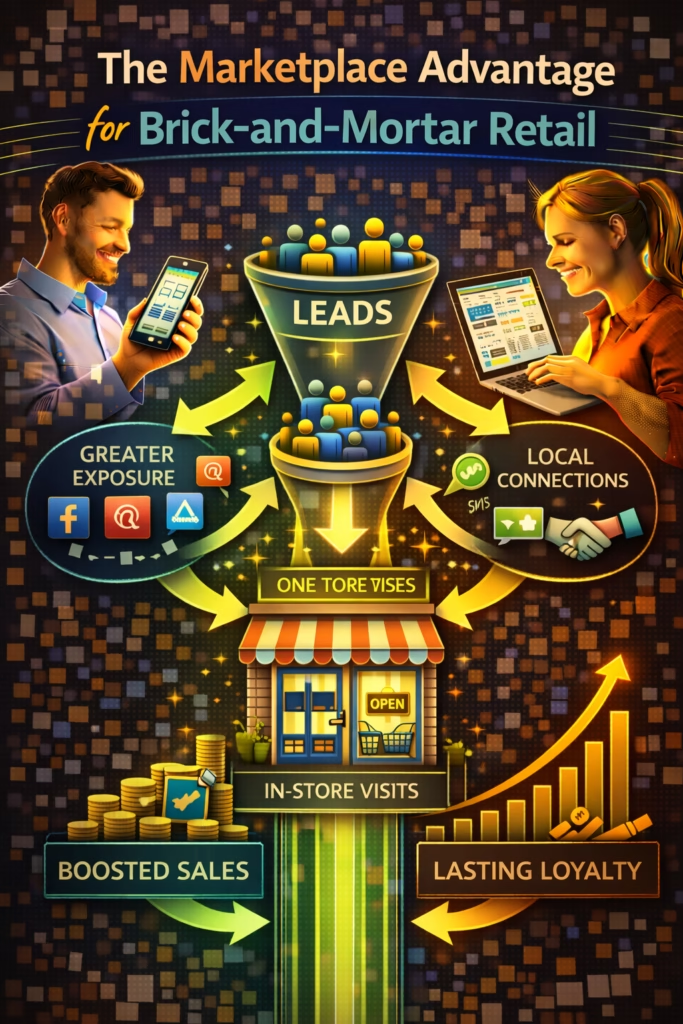
The Marketplace Advantage for Brick-and-Mortar Retail
The Marketplace Advantage for Brick-and-Mortar Retail is the blueprint for using Marketplace like a digital showroom—driving local messages, calls, store visits, pickups, and deliveries with consistent, compliant activity.
Note: This is general guidance. Follow platform rules, keep claims truthful, and confirm compliance with privacy/marketing rules before posting or automating follow-ups.
Introduction
The Marketplace Advantage for Brick-and-Mortar Retail comes down to one shift that changed local buying forever:
Your showroom is no longer only a physical space. It’s also a feed.
Buyers don’t start in a store anymore. They start on a phone—scrolling, comparing, saving, and messaging. Platforms like Facebook Marketplace have become the new “walk-in traffic,” except the customer is already pre-qualified: they’re local, interested, and ready to ask a question.
If you run a retail store and you want more local sales, Marketplace is not a “nice extra.” It’s a demand channel—when you treat it like a system.
Big idea: Marketplace turns your inventory into daily exposure. Your process turns that exposure into revenue.
Expanded Table of Contents
- 1) Why Marketplace is a retail channel (not a side project)
- 2) The digital showroom model for brick-and-mortar stores
- 3) Turning inventory into leads: the surface area principle
- 4) Offer stacks that beat online shopping friction
- 5) The listing system: cadence + variety + compliance
- 6) The anti-flag framework: variety without duplication
- 7) Response speed: the Marketplace conversion multiplier
- 8) Message-to-visit scripts that book store traffic
- 9) Follow-up loops that recover “lost” buyers
- 10) Pairing Marketplace with Google Maps for full-funnel capture
- 11) Testing plan: improve conversion weekly
- 12) KPIs for Marketplace retail success
- 13) 30–60–90 day rollout plan
- 14) 25 Frequently Asked Questions
- 15) 25 Extra Keywords
1) Why Marketplace is a retail channel (not a side project)
Retailers often treat Marketplace like a classifieds page: post a few items, hope for messages, move on.
But the reality is simple:
Marketplace is a discovery feed where local buyers browse before they decide where to buy.
What makes Marketplace different from traditional ads?
- Buyers browse with intent (they’re actively shopping)
- Messaging is frictionless (low barrier to inquire)
- Local proximity is built-in (you’re competing locally, not globally)
- Inventory creates exposure (each listing can be a mini billboard)
Rule: Treat Marketplace like a daily showroom, not an occasional posting platform.
2) The digital showroom model for brick-and-mortar stores
A physical showroom works because buyers can:
- See real options
- Compare easily
- Ask questions instantly
- Leave with confidence
Marketplace can do the same—if you design it to.
The digital showroom stack
Consistent listings create daily impressions.
Real photos, clear pricing, clear details.
Fast reply + fast next step.
Local delivery/setup options and accountability.
Scripts that book visits, pickups, deliveries.
Follow-up and repeat buyer loops.
Pro move: Every listing should make a buyer feel: “This is real, local, and easy.”
3) Turning inventory into leads: the surface area principle
Marketplace rewards one thing that brick-and-mortar stores already have: inventory variety.
Each listing is a surface area opportunity—another way to appear for another buyer intent.
Surface area comes from
- Different product types (or categories)
- Different price tiers (value, mid, premium)
- Different use cases (guest room, primary, kids, small space)
- Different offers (delivery, setup, financing, bundle)
- Different thumbnails (first photo tests)
Rule: Exposure grows when you list variety—not when you repost duplicates.
4) Offer stacks that beat online shopping friction
Online giants compete on convenience. Local stores win on certainty and speed—when they package it.
Offer stack examples (mix-and-match)
| Offer element | What it signals | Why it wins |
|---|---|---|
| Real local inventory | Certainty | Buyers hate “maybe available” |
| Same-day pickup/delivery | Speed | Beats shipping delays |
| Help choosing the right option | Guidance | Reduces returns and regret |
| Local accountability | Trust | A real store stands behind the sale |
| Bundles / add-ons | Value | Shifts focus away from price-only comparison |
Offer copy template
Real photos ✅ Local store ✅
In-stock options ✅ Fast pickup/delivery ✅
Tell me your zip + timeline (today/this week) and I’ll recommend the best fit.
Pro move: Don’t sell “the item.” Sell “the easiest decision.”
5) The listing system: cadence + variety + compliance
The biggest Marketplace mistake retailers make is inconsistency: big bursts of posting, then silence.
A sustainable listing cadence
Solo operator
- 2–5 listing actions/day
- Weekly photo + title upgrades
- Monthly winner rotation (replace weak listings)
Small team
- 10–30 listing actions/day (distributed)
- Daily QA for duplication risk
- Weekly A/B tests (thumbnail + hook)
Multi-location
- Local variations per city
- Stagger posting windows per market
- KPIs tracked per location
Retail rule
- Steady beats spiky
- Variety beats duplication
- Messages beat views
Rule: Cadence is the engine. Variety is the fuel.
6) The anti-flag framework: variety without duplication
Marketplace platforms reduce exposure when listings look duplicated or spam-like. The solution is structured variety that stays truthful.
Variety checklist
- Different intent angle (value vs speed vs premium vs trust)
- Different first photo (thumbnail)
- Different opening hook line
- Different feature emphasis
- Different posting time windows
Intent-angle matrix (example)
| Angle | Who it attracts | Hook example |
|---|---|---|
| Value | Budget-conscious buyers | “Great value if you want quality without overspending.” |
| Speed | Urgent buyers | “Available now—fast pickup/delivery options.” |
| Premium | Comfort/quality buyers | “For buyers who want the best experience.” |
| Trust | Skeptical buyers | “Real photos + clear details from a local store.” |
| Fit | Confused buyers | “Tell me your needs—I'll point you to the best match.” |
Important: Avoid posting identical duplicates. Rotate responsibly and follow platform rules.
7) Response speed: the Marketplace conversion multiplier
Marketplace creates messages. Your response speed determines whether those messages become revenue.
Why speed matters
- Buyers message multiple sellers (fast reply wins)
- Intent decays quickly (minutes, not days)
- Momentum is fragile (one delay can lose the sale)
Speed-to-lead benchmarks
| Reply time | Impact | Interpretation |
|---|---|---|
| < 1 minute | Excellent | You capture peak intent |
| < 5 minutes | Strong | Competitive with most local sellers |
| 1–3 hours | Weak | Buyer likely moved on |
| Next day | Very weak | Almost always lost |
Rule: Fast response is not a “nice-to-have.” It’s the conversion gate.
8) Message-to-visit scripts that book store traffic
Your goal is not to chat. Your goal is to book a next step.
Instant reply (universal)
Yes — I can help ✅
What city/zip are you in, and are you looking for today or this week?
I’ll confirm the best options.
Availability + booking
Yes — available ✅
Quickest next step is a short visit or pickup.
Which works best: today, tomorrow, or this weekend?
Delivery quote prompt
I can quote delivery/setup.
Send your zip + preferred day (today/this week) and I’ll confirm the fastest options.
When they ask “best price?”
I can help you get the best value.
If you tell me your zip + budget range, I’ll recommend the best option that fits what you need.
Pro move: One question + three options books more visits than long descriptions.
9) Follow-up loops that recover “lost” buyers
Most buyers don’t say “no.” They disappear. Follow-up brings them back.
Simple follow-up cadence
| When | Message | Goal |
|---|---|---|
| +2 hours | “Do you want the fastest option today or this week?” | Recover momentum |
| +24 hours | “Want me to recommend the best options for your budget?” | Offer help |
| +72 hours | “If you send your zip, I can confirm delivery/pickup options.” | Reduce friction |
| +7 days | “Should I keep this open for you?” | Reactivation |
Rule: Follow-up turns “ghosts” into sales—if it’s helpful, not pushy.
10) Pairing Marketplace with Google Maps for full-funnel capture
Marketplace captures browsing demand. Google Maps captures “ready to buy nearby” demand.
Why pairing works
- Marketplace feeds you messages (top-of-funnel)
- Maps feeds you calls, directions, and visits (bottom-of-funnel)
- Each channel reinforces trust for the other
Maps basics that matter most
- Accurate hours and category
- Consistent new photos (weekly is better than monthly)
- Review cadence (steady beats bursts)
- Clear services and product language
- Fast call handling and follow-up
Pro move: When someone messages on Marketplace, they often check your Maps listing next. Make it strong.
11) Testing plan: improve conversion weekly
Most retailers don’t need more leads. They need higher conversion.
Test priority order
- First photo (thumbnail)
- Title clarity
- First 2 lines of description
- CTA question
- Booking script (today/tomorrow/weekend)
Simple test process
1) Pick one variable
2) Run 3–7 days
3) Track messages/day + booked next steps
4) Keep the winner
5) Repeat weekly
Rule: One small improvement per week compounds into domination.
12) KPIs for Marketplace retail success
| KPI | What it measures | Target direction |
|---|---|---|
| Listings active | Surface area | Up |
| Views → messages | Listing quality | Up |
| Median reply time | Speed-to-lead | Down |
| Messages → booked steps | Booking script effectiveness | Up |
| Booked steps → sales | Close rate | Up |
| Follow-up recovery | Saved leads | Up |
| Flags/removals | Compliance risk | Down |
Pro move: Track “booked next steps” weekly—it’s the closest KPI to revenue.
13) 30–60–90 day rollout plan
Days 1–30 (Build the digital showroom)
- Standardize listing templates (real photos, clear titles, clear offers)
- Set a sustainable daily cadence (steady beats bursts)
- Implement instant reply + booking question
- Start tracking reply time and booked next steps
- Create 5 intent angles to rotate (value/speed/premium/trust/fit)
Days 31–60 (Increase demand capture)
- Expand listing surface area with compliant variety
- Run weekly thumbnail + hook A/B tests
- Deploy follow-up cadence
- Improve Maps listing strength (photos + reviews cadence)
Days 61–90 (Systemize and scale)
- Document SOPs for posting, QA, messaging, follow-up
- Train staff on booking scripts (today/tomorrow/weekend)
- Optimize weekly based on KPIs
- Scale to more categories, more offers, or more locations
Rule: Marketplace becomes a predictable lead asset when it’s consistent, varied, and fast.
14) 25 Frequently Asked Questions
1) What is the marketplace advantage for brick-and-mortar retail?
Using Marketplace as a digital showroom to generate local messages and convert them into visits, pickups, and deliveries.
2) Does Facebook Marketplace work for retail stores?
Yes—especially when you post consistently, use real photos, and respond fast.
3) What’s the fastest way to get more Marketplace leads?
Upgrade your first photo and title, increase consistent cadence, and reply faster.
4) What makes Marketplace different from ads?
It’s a discovery feed where buyers browse and message with low friction.
5) What is a digital showroom?
Your inventory represented in a feed with real photos, clear offers, and easy next steps.
6) How do I turn Marketplace messages into store visits?
Confirm availability, ask zip + timeline, and offer a simple next step (today/tomorrow/weekend).
7) What response time should I aim for?
Under 5 minutes is strong; under 1 minute is best.
8) How often should I post listings?
As often as you can sustain consistently—steady beats bursts.
9) What causes listings to get flagged or lose exposure?
Duplicate patterns, spam-like behavior, and policy-risk content.
10) How do I post more without duplicating?
Rotate intent angles, thumbnails, hooks, and feature emphasis while staying truthful.
11) Should I use stock photos?
Real photos typically build more trust and convert better.
12) What should the first line of my listing say?
Something that signals trust and clarity: “Real photos + clear details ✅”
13) What is the best CTA question?
“What city/zip are you in, and are you looking for today or this week?”
14) How do I quote delivery quickly?
Ask for zip + preferred day, then confirm options.
15) Do Marketplace leads buy same-day?
Many do—especially when availability and next steps are simple.
16) What’s the best offer to beat online shopping?
Speed, certainty, and local accountability—often with pickup/delivery options.
17) How do I measure Marketplace success?
Views-to-messages, reply time, and booked next steps.
18) What KPI predicts revenue best?
Booked next steps (visits/pickups/deliveries), not just views.
19) How do I recover leads that stopped replying?
Use a helpful follow-up cadence at 2 hours, 24 hours, 72 hours, and 7 days.
20) Can Marketplace help my Google Maps performance?
Indirectly—Marketplace attention can drive searches, calls, and visits if your Maps listing is strong.
21) Why should I pair Marketplace with Google Maps?
Marketplace captures browsing demand; Maps captures high-intent local search.
22) How long until results improve?
Often within 1–2 weeks, compounding over 30–90 days.
23) Should my staff handle messages?
Yes if trained—speed and booking scripts matter more than long chats.
24) Can automation help?
Automation can help with response speed and follow-up when used compliantly.
25) What’s the biggest mistake retailers make on Marketplace?
Posting inconsistently and replying too slowly.
15) 25 Extra Keywords
- The Marketplace Advantage for Brick-and-Mortar Retail
- marketplace advantage for retail
- Facebook Marketplace for brick and mortar
- brick and mortar marketplace strategy
- local retail leads marketplace
- digital showroom strategy
- marketplace listing system for retailers
- convert marketplace leads in store
- marketplace messaging scripts
- book store visits from marketplace
- marketplace response speed retail
- speed to lead marketplace
- anti-flag listing framework
- avoid duplicate marketplace listings
- retail offer stack marketplace
- local inventory marketing
- same-day pickup delivery retail
- marketplace follow up cadence
- marketplace lead conversion KPI
- marketplace retail marketing 2026
- brick and mortar demand capture
- marketplace + Google Maps strategy
- local store digital marketing blueprint
- organic local leads for retailers
- turn marketplace into lead asset













