
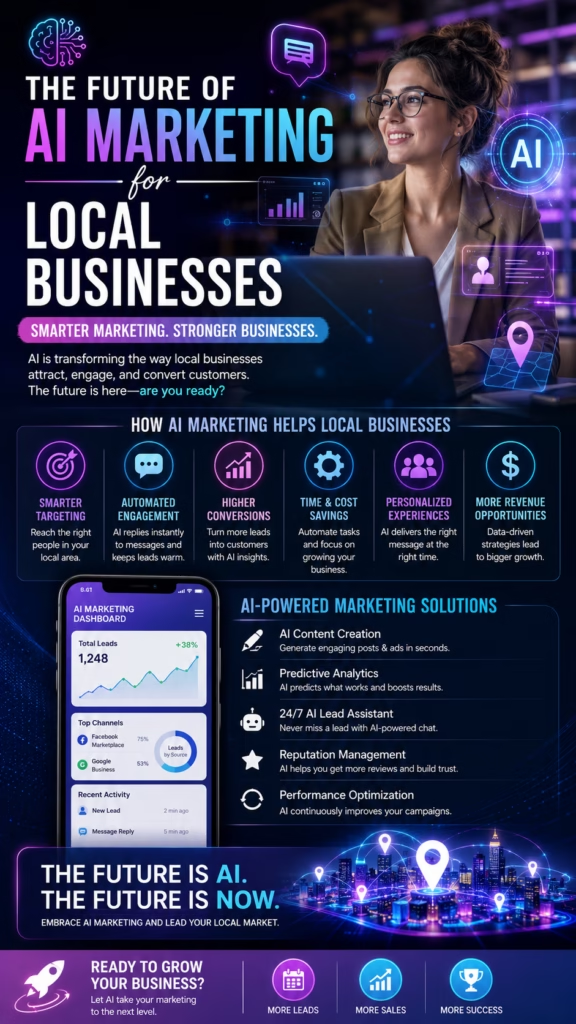
The Future of AI Marketing for Local Businesses
The Future of AI Marketing for Local Businesses explains how small companies can use AI to improve local SEO, social posting, marketplace advertising, lead response, reviews, reporting, and customer growth.
Introduction
The Future of AI Marketing for Local Businesses is about more than faster content creation. It is about smarter visibility, better customer response, stronger local search presence, automated posting, cleaner reporting, and more consistent lead generation across the channels where local customers already spend time.
Local businesses are under more pressure than ever. They need to show up on Google, Facebook, Instagram, TikTok, Nextdoor, Craigslist, OfferUp, Facebook Marketplace, review platforms, maps results, directory listings, and their own websites. Most small teams do not have enough time to manually post, optimize, reply, track, and improve every day.
The future of AI marketing for local businesses is not replacing human trust. It is helping local businesses become faster, more visible, more consistent, and more responsive.
AI can help local businesses create better content, answer leads faster, find keyword opportunities, write local landing pages, improve Google Business Profile activity, generate marketplace ads, respond to reviews, organize reporting, and understand which campaigns are producing revenue.
Main idea: The Future of AI Marketing for Local Businesses is about using automation and intelligence to turn local visibility into leads, appointments, customers, reviews, and growth.
Table of Contents
- 1) Why AI marketing matters for local businesses
- 2) Local marketing is becoming more automated
- 3) AI and local SEO
- 4) AI for Google Business Profile growth
- 5) AI for marketplace advertising
- 6) AI for social media posting
- 7) AI for lead response
- 8) AI for reputation and reviews
- 9) AI for local landing pages
- 10) AI for content personalization
- 11) AI for ad testing and optimization
- 12) AI for customer follow-up
- 13) AI for reporting and analytics
- 14) AI for service businesses
- 15) AI for retailers and product sellers
- 16) AI for contractors and home services
- 17) Human trust still matters
- 18) Risks of using AI the wrong way
- 19) How local businesses should prepare
- 20) Final thoughts
- 21) FAQs
- 22) Extra keywords
1) Why AI Marketing Matters for Local Businesses
AI marketing matters for local businesses because small companies need to compete with bigger brands while working with smaller teams, tighter budgets, and less time. AI can help local businesses do more without adding unnecessary workload.
A local business may need daily social posts, marketplace listings, Google Business Profile updates, SEO pages, review responses, ad testing, lead follow-up, and reporting. Without AI, that workload can become overwhelming. With AI, the business can create a system that is more consistent and easier to manage.
AI marketing can help local businesses improve:
- Local SEO visibility
- Google Maps activity
- Social media consistency
- Marketplace posting
- Lead response speed
- Review management
- Customer follow-up
- Content creation
- Campaign reporting
- Revenue tracking
AI matters because local businesses win when they are visible, fast, consistent, and trustworthy.
2) Local Marketing Is Becoming More Automated
Local marketing is moving toward automation because customers expect faster answers and more consistent visibility. A customer may search for a service on Google, check reviews, browse Facebook Marketplace, message through social media, compare options on Craigslist, and expect a quick reply.
AI helps businesses keep up with that behavior. Instead of manually managing every channel, local companies can use AI-assisted systems to publish, respond, track, and improve campaigns across multiple platforms.
Local marketing automation can include:
Scheduled social posts
Marketplace ad creation
Google Business Profile content
Review response drafts
Lead response workflows
Follow-up messages
SEO page generation
Keyword research
Ad testing
Performance reporting
The businesses that automate intelligently will usually move faster than businesses relying only on manual marketing.
3) AI and Local SEO
AI is changing local SEO by making it easier to create service pages, location pages, FAQs, blog content, schema, internal links, meta descriptions, and keyword-focused content. Local businesses can use AI to build stronger search visibility around cities, services, neighborhoods, and customer problems.
The future of local SEO will not be about publishing random AI content. It will be about useful, specific, locally relevant pages that help customers choose the right business.
AI can support local SEO with:
- City landing pages
- Service-area pages
- Local blog posts
- FAQ sections
- Schema markup
- Meta titles and descriptions
- Internal linking ideas
- Keyword clusters
- Competitor content gaps
- Search-intent mapping
AI local SEO works best when content is accurate, useful, local, and built for real customers.
4) AI for Google Business Profile Growth
Google Business Profile is one of the most important local visibility assets. AI can help businesses create posts, service descriptions, product updates, review replies, Q&A content, photo captions, and reporting summaries.
AI can also help identify which services, cities, categories, and customer questions should be emphasized more often. This helps a local business stay active and relevant in its local market.
AI can help Google Business Profile with:
Weekly post ideas
Service descriptions
Product descriptions
Review response drafts
Q&A content
Photo caption ideas
Local keyword planning
Offer updates
Seasonal reminders
Performance summaries
The future of Google Business Profile marketing is consistent local activity supported by smarter automation.
5) AI for Marketplace Advertising
Marketplace advertising is a major opportunity for local businesses because many customers browse platforms like Facebook Marketplace, Craigslist, OfferUp, and Nextdoor with local intent. AI can help businesses create better titles, descriptions, keywords, image prompts, offer angles, and follow-up scripts.
AI can also rotate listings intelligently so the business does not rely on one stale ad. Different offers can be written for different customer needs, cities, services, products, or seasons.
AI can improve marketplace advertising by creating:
- Listing titles
- Product descriptions
- Service ads
- Local keyword variations
- Offer angles
- FAQ-style listings
- Lead qualification questions
- Reply scripts
- Posting calendars
- Performance summaries
AI marketplace advertising helps local businesses stay visible where nearby buyers are already browsing.
6) AI for Social Media Posting
Social media requires consistency, but most local businesses struggle to post regularly. AI can help create captions, short-form video scripts, image ideas, local promotions, customer education posts, review highlights, and platform-specific content.
The future of social media for local businesses will be less about random posting and more about structured content systems. AI can help create posts for awareness, trust, offers, proof, education, and lead generation.
AI social media content can include:
Facebook posts
Instagram captions
TikTok scripts
YouTube Shorts scripts
LinkedIn updates
Google Business Profile posts
Review highlight posts
Before-and-after captions
Seasonal reminders
Local offer posts
AI helps local businesses post more consistently without making every post sound the same.
7) AI for Lead Response
Lead response speed can determine whether a business wins or loses a customer. AI can help local businesses reply faster to messages from websites, social media, marketplace listings, Google Business Profile, email, and chat forms.
A good AI response system should not feel robotic. It should ask useful questions, gather details, qualify the lead, and guide the customer toward a call, quote, appointment, or purchase.
AI lead response can help ask for:
- Customer location
- Service needed
- Timeline
- Photos if useful
- Budget range if relevant
- Product preference
- Appointment availability
- Pickup or delivery details
- Project size
- Best contact method
The future of lead response is fast, helpful, personalized, and available beyond normal business hours.
8) AI for Reputation and Reviews
Reviews are critical for local businesses. AI can help draft professional review responses, identify common customer themes, summarize reputation trends, and create follow-up reminders for satisfied customers.
AI should never create fake reviews. The future of AI reputation management is about helping real customer feedback become easier to manage, understand, and respond to.
AI can support reputation management with:
Review response drafts
Positive review summaries
Negative review response support
Common complaint analysis
Customer feedback themes
Review request reminders
Reputation reporting
Service improvement insights
Local trust content
Customer appreciation posts
AI can help manage reviews, but real customer trust still has to be earned.
9) AI for Local Landing Pages
Local landing pages help businesses rank for city, service, and neighborhood searches. AI can help create landing pages for different locations and services while keeping the content structured and SEO-friendly.
The future will reward pages that are useful and specific. Thin pages with swapped city names will not be enough. AI should help create better pages with service details, FAQs, proof, local language, calls to action, and schema.
Strong AI-assisted landing pages can include:
- City-specific headlines
- Service descriptions
- Local customer problems
- Proof points
- FAQs
- Internal links
- Meta tags
- Schema markup
- Calls to action
- Trust signals
AI local landing pages work best when they are built for customers first and search engines second.
10) AI for Content Personalization
AI will make local marketing more personalized. Instead of sending every customer the same message, businesses can create content based on service type, location, customer stage, season, product interest, or previous inquiry.
A moving company can speak differently to an apartment mover than a full-house mover. A flooring company can speak differently to a landlord than a homeowner. A mattress store can speak differently to someone looking for a guest room bed than someone looking for a king mattress and adjustable base.
AI personalization can adjust:
Service angle
Customer location
Offer type
Follow-up timing
Product recommendations
Content tone
CTA
FAQ suggestions
Pricing guidance
Appointment next steps
The future of AI marketing is more relevant messaging for each local customer.
11) AI for Ad Testing and Optimization
AI can help local businesses test different versions of ads, titles, descriptions, CTAs, offers, landing pages, and follow-up scripts. This helps businesses learn which messages create the best response.
Instead of guessing, local businesses can test multiple angles and use performance data to improve campaigns over time.
AI can help test:
- Ad headlines
- Opening lines
- Offer angles
- Local keywords
- Image concepts
- CTA wording
- Follow-up scripts
- Landing page sections
- Email messages
- Review request language
AI optimization helps local businesses improve based on real response instead of opinions.
12) AI for Customer Follow-Up
Many local businesses lose leads because follow-up is inconsistent. AI can help create follow-up sequences for missed calls, quote requests, estimates, abandoned forms, marketplace messages, appointment reminders, and post-service review requests.
Good follow-up should be helpful, not annoying. The best AI systems help customers move forward while respecting timing and context.
AI follow-up can support:
Missed call replies
Quote request follow-ups
Appointment reminders
Estimate follow-ups
Review requests
Customer check-ins
Product availability messages
Service reminders
Seasonal reactivation
Referral prompts
The future of local follow-up is timely, helpful, and harder to forget.
13) AI for Reporting and Analytics
Local businesses need simple reporting. Many owners do not want overwhelming dashboards. They want to know what worked, what did not, where leads came from, which campaigns created calls, and what should be improved next.
AI can turn raw marketing data into useful summaries. It can identify trends across ads, marketplace posts, SEO pages, reviews, calls, forms, and revenue.
AI reporting can summarize:
- Lead sources
- Top-performing posts
- Best local keywords
- Customer message trends
- Review themes
- Call volume
- Appointment rates
- Sales outcomes
- Revenue by campaign
- Next recommended actions
AI reporting helps local businesses make faster marketing decisions.
14) AI for Service Businesses
Service businesses can benefit heavily from AI marketing because they need steady local visibility and fast response. Movers, cleaners, pest control companies, restoration businesses, junk removal companies, landscapers, tree services, HVAC companies, roofers, painters, and handyman businesses can all use AI to generate more consistent demand.
AI can help create service ads, city pages, seasonal reminders, review responses, quote scripts, and lead qualification workflows.
AI can help service businesses with:
Local service pages
Google Business Profile posts
Marketplace service listings
Quote request scripts
Lead qualification questions
Before-and-after captions
Review replies
Seasonal campaigns
Follow-up reminders
Performance reports
AI helps service businesses stay visible when local customers suddenly need help.
15) AI for Retailers and Product Sellers
Retailers and product sellers can use AI to create better product descriptions, marketplace listings, social posts, inventory updates, promotional campaigns, delivery language, and customer follow-up.
This is especially valuable for mattress stores, furniture stores, appliance sellers, car dealers, local shops, equipment sellers, and specialty retailers that rely on local discovery.
AI can help product sellers with:
- Product descriptions
- Marketplace listings
- Inventory promotion
- Clearance ads
- Delivery messaging
- Social posts
- Customer reply scripts
- Review highlights
- Category pages
- Sales reporting
AI helps local retailers turn inventory into more consistent local visibility.
16) AI for Contractors and Home Services
Contractors and home service companies can use AI to create project-specific content, local estimate ads, before-and-after captions, service pages, follow-up workflows, and seasonal campaigns.
Flooring, remodeling, roofing, fencing, garage building, painting, drywall, concrete, decks, and restoration companies can use AI to explain services more clearly and respond to customers faster.
AI can help contractors with:
Project landing pages
City service pages
Before-and-after posts
Estimate request forms
Craigslist ads
Facebook Marketplace listings
OfferUp posts
Follow-up scripts
Review response drafts
Lead tracking summaries
AI helps contractors turn project expertise into better local marketing assets.
17) Human Trust Still Matters
AI can make marketing faster, but human trust still matters. Local customers want real businesses, real reviews, real photos, real service, and honest communication. AI should support those things, not replace them.
The strongest local businesses will use AI to become more consistent while still sounding human, proving quality, and delivering real customer value.
Human trust still comes from:
- Real customer service
- Honest offers
- Accurate pricing language
- Real reviews
- Professional work
- Clear communication
- On-time appointments
- Local reputation
- Quality results
- Follow-through
AI can create attention, but trust is earned through real business performance.
18) Risks of Using AI the Wrong Way
AI can hurt marketing when it is used carelessly. Generic content, fake claims, duplicate pages, robotic replies, inaccurate service details, misleading offers, and low-quality automation can damage trust.
Local businesses should review AI content, keep it accurate, use real proof, and make sure every message matches the actual service or product being offered.
AI marketing mistakes to avoid:
Publishing generic content
Inventing reviews
Making false guarantees
Using inaccurate service details
Over-automating replies
Ignoring customer context
Posting duplicate content everywhere
Using fake urgency
Skipping human review
Tracking vanity metrics only
AI should make marketing smarter, not sloppier.
19) How Local Businesses Should Prepare
Local businesses should prepare for AI marketing by organizing their services, offers, locations, reviews, photos, FAQs, customer questions, lead sources, and reporting. AI performs better when it has better business information to work with.
The future belongs to businesses that build systems. A local business should not just ask AI for random posts. It should create repeatable workflows for content, posting, response, reviews, reporting, and optimization.
Local businesses should prepare by organizing:
- Service list
- Product list
- Service areas
- Customer FAQs
- Real reviews
- Project photos
- Brand voice
- Pricing guidance
- Lead follow-up process
- Campaign tracking
The better the business information, the better the AI marketing output.
20) Final Thoughts
The Future of AI Marketing for Local Businesses is about building smarter, faster, more consistent local growth systems. AI can help businesses improve SEO, social media, marketplace posting, lead response, reviews, reporting, follow-up, and customer personalization.
The winning businesses will not use AI as a shortcut for low-quality marketing. They will use it as a system for better visibility, better response, better tracking, and better customer experience.
Final takeaway: The future of AI marketing for local businesses belongs to companies that combine automation with real trust, local relevance, strong offers, fast follow-up, and measurable results.
21) FAQs
1) What is The Future of AI Marketing for Local Businesses?
The Future of AI Marketing for Local Businesses is the shift toward smarter automation for local SEO, social media, marketplace ads, lead response, reviews, reporting, and customer follow-up.
2) How can AI help local businesses?
AI can help with content creation, SEO, ad writing, social posting, customer replies, review responses, reporting, lead tracking, and follow-up.
3) Can AI improve local SEO?
Yes. AI can help create service pages, city pages, FAQs, meta tags, internal links, schema, and local keyword strategies.
4) Can AI help with Google Business Profile?
Yes. AI can help create posts, service descriptions, review replies, Q&A content, photo captions, and reporting summaries.
5) Can AI create marketplace ads?
Yes. AI can help write Craigslist, Facebook Marketplace, OfferUp, and Nextdoor listings with better titles, descriptions, local keywords, and CTAs.
6) Can AI respond to leads?
Yes. AI can help respond quickly, ask qualifying questions, and guide customers toward quotes, appointments, or purchases.
7) Will AI replace local marketers?
AI will not replace trust, strategy, or real customer service. It will help marketers and business owners work faster and more consistently.
8) Is AI content good for local businesses?
AI content can be valuable when it is accurate, local, helpful, reviewed by humans, and connected to real services or products.
9) What businesses benefit most from AI marketing?
Service businesses, contractors, retailers, product sellers, car dealers, home service companies, restaurants, and local shops can benefit.
10) Can AI help with reviews?
Yes. AI can draft review responses, summarize feedback, identify customer themes, and support review request workflows.
11) Can AI personalize marketing?
Yes. AI can adjust messaging by location, service type, customer stage, product interest, season, and follow-up need.
12) Can AI help with social media?
Yes. AI can create captions, video scripts, post calendars, promotional posts, review highlights, and local content ideas.
13) Can AI help reduce missed leads?
Yes. AI can help with instant replies, missed call follow-up, appointment reminders, quote follow-ups, and customer reactivation.
14) What is the biggest AI marketing risk?
The biggest risk is using AI to publish generic, inaccurate, misleading, or robotic content without human review.
15) Should local businesses use AI for paid ads?
Yes, AI can help test headlines, offers, audience angles, landing page copy, and performance summaries.
16) Can AI help contractors get more leads?
Yes. AI can help contractors create project pages, local ads, before-and-after captions, marketplace listings, and follow-up scripts.
17) Can AI help retailers sell more products?
Yes. AI can help retailers create product listings, inventory posts, delivery messaging, promotions, and customer reply scripts.
18) Can AI help service businesses book appointments?
Yes. AI can improve lead response, quote collection, appointment reminders, and follow-up timing.
19) Should AI marketing sound human?
Yes. AI marketing should sound clear, helpful, local, and natural, not robotic or generic.
20) How can businesses prepare for AI marketing?
They should organize services, products, locations, reviews, photos, FAQs, pricing guidance, brand voice, and lead follow-up steps.
21) Can AI help with reporting?
Yes. AI can summarize lead sources, campaign performance, review trends, top ads, revenue impact, and next steps.
22) Is AI marketing affordable for small businesses?
AI marketing can be cost-effective because it helps reduce manual work, improve consistency, and increase output without always adding staff.
23) What should AI not do?
AI should not invent reviews, make false claims, mislead customers, publish inaccurate details, or replace real customer care.
24) How does AI fit into a local marketing system?
AI should support SEO, Google Business Profile, social media, marketplace ads, reviews, website pages, lead response, follow-up, and reporting.
25) What is the main goal of AI marketing for local businesses?
The main goal is to turn local visibility into more leads, faster responses, stronger trust, better customer experiences, and measurable revenue growth.
25) Extra Keywords
- The Future of AI Marketing for Local Businesses
- AI marketing for local businesses
- local AI marketing
- AI local SEO
- AI lead generation
- AI social media marketing
- small business AI marketing
- AI marketing automation
- AI for Google Business Profile
- AI marketplace advertising
- AI Craigslist posting
- AI Facebook Marketplace ads
- AI OfferUp marketing
- AI Nextdoor marketing
- AI review management
- AI customer follow-up
- AI lead response
- AI marketing reporting
- AI content personalization
- AI landing pages
- AI contractor marketing
- AI service business marketing
- AI retail marketing
- AI local advertising
- AI small business growth strategy













