
Rental Demand Generation Without Advertising Spend
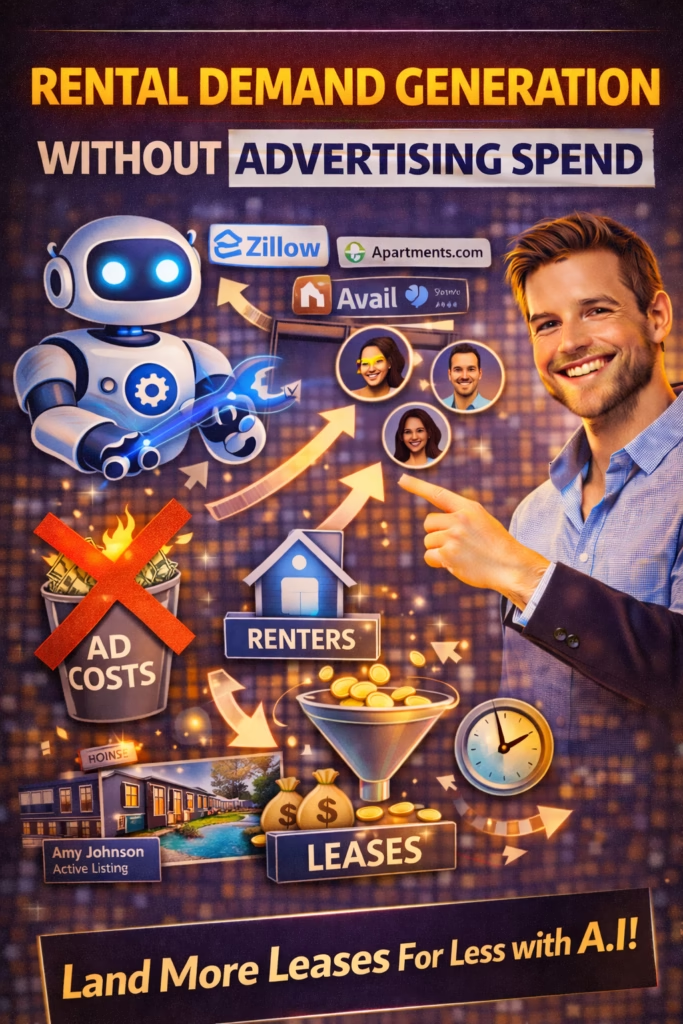
Rental Demand Generation Without Advertising Spend is the blueprint for leasing faster without paid ads—using intent channels (Marketplace + local search), proof-heavy listings, consistent cadence, and speed-to-lead systems that convert.
Note: This is general guidance. Follow Fair Housing laws, local advertising rules, and your screening compliance process. Keep all claims accurate and avoid discriminatory language or policies.
Introduction
Rental Demand Generation Without Advertising Spend is not about “doing nothing” and hoping renters magically appear. It’s about building an organic system that makes demand show up because you’re visible where renters already shop—and you respond faster than anyone else.
Most property teams default to paid ILS placement or ad budgets when vacancies rise. But in many markets, there’s a cheaper lever that produces faster results:
Fix the conversion system first: listings + proof + cadence + speed-to-lead + follow-up.
When you do that, the same market demand produces more tours, more applications, and fewer vacant days—even without paid ads.
Expanded Table of Contents
- 1) What rental demand generation without ad spend really is
- 2) Intent channels: where renters actually start
- 3) Marketplace-first: why Facebook Marketplace converts
- 4) Local SEO: “free demand” from Google
- 5) Surface area: more entry points without spamming
- 6) Proof photo framework that increases inquiries
- 7) Offer clarity: what renters need to see immediately
- 8) Cadence that compounds visibility
- 9) Speed-to-lead: the conversion multiplier
- 10) Follow-up SOP: where hidden leases come from
- 11) Tour booking system without staff overload
- 12) Application acceleration without pressure
- 13) Pipeline + tracking: stop lead leakage
- 14) KPIs that prove demand is improving
- 15) 30–60–90 day rollout plan
- 16) 25 Frequently Asked Questions
- 17) 25 Extra Keywords
1) What rental demand generation without ad spend really is
Rental demand generation without advertising spend is a repeatable organic system that produces consistent renter inquiries by combining:
1) Visibility (surface area)
More entry points across renter search behavior—without duplicates and spam.
2) Trust (proof)
Clear photos, accurate details, transparent requirements, and consistency.
3) Conversion (speed)
Fast responses, quick tour options, and minimal back-and-forth.
4) Recovery (follow-up)
A short SOP to re-engage prospects who pause or ghost.
Pro move: Organic demand isn’t “free.” You pay with discipline: cadence + response speed.
2) Intent channels: where renters actually start
To generate rental demand without ad spend, you must show up where renters already look—when they’re ready to move.
| Channel | Renter mindset | Strength | How you win |
|---|---|---|---|
| Facebook Marketplace | Shopping | Fast inbound messages | Proof + speed + tour slots |
| Google (Local) | Need-driven | High-intent calls | GBP + consistency + reviews |
| ILS organic placement | Comparing | Stable demand | Great photos + responsiveness |
| Referrals | Trust-based | High quality | Simple referral CTA |
Rule: Demand is already there. Your job is to capture it faster and convert it cleaner.
3) Marketplace-first: why Facebook Marketplace converts
Marketplace is powerful because it turns browsing intent into instant messaging. There’s no form friction. That creates more conversations—if your listing is clear and your responses are fast.
Marketplace advantages (no-ad-spend)
- Built-in renter traffic
- Tap-to-message contact flow
- Local visibility
- Fast feedback loop (you see what works quickly)
Important: Marketplace is time-sensitive. If you respond late, renters book elsewhere.
4) Local SEO: “free demand” from Google
When renters search “apartments near me” or “rentals in [city],” local visibility can generate calls and form leads without paid ads.
Local SEO essentials
- Optimized Google Business Profile (complete categories, photos, description)
- Consistent NAP (name, address, phone) everywhere
- Weekly photo updates and posts (light cadence)
- Fast review responses and ongoing review generation
- Simple, clear landing page (even one page helps)
Pro move: Treat local SEO as a “demand savings account.” It compounds over time.
5) Surface area: more entry points without spamming
Surface area means you show up for different renter intents: budget, pets, move-in timing, features, and location cues.
Surface area map (examples)
| Renter intent | Listing angle | Hook example |
|---|---|---|
| Move-in ASAP | Availability | “Available this week — tour slots open” |
| Budget-driven | Value | “Best value option near [landmark]” |
| Pet owners | Pet-friendly | “Pet-friendly options — ask about policy” |
| Amenities | Feature-led | “Washer/dryer + parking — see details” |
| Trust | Proof-first | “Real photos + transparent requirements” |
Rule: The goal is variety and relevance, not duplication.
6) Proof photo framework that increases inquiries
Proof photos reduce skepticism and increase inquiry-to-tour conversion. Renters are wary of scams and outdated listings—proof wins.
Proof photo checklist
- Bright hero shot (best room or exterior)
- Kitchen + bathroom clarity
- Bedrooms with scale reference
- Close-ups of condition details
- Floor plan (if available)
- Neighborhood cue (entrance, parking, nearby landmark)
Pro move: Add one “trust line” in every listing: “Real photos. Happy to confirm availability—tell me your move-in date.”
7) Offer clarity: what renters need to see immediately
Confusion kills demand. The fastest way to increase renter messages is to make the offer obvious.
Offer clarity rules
- Price: show it (or a truthful range)
- Availability date: be specific
- Location cue: neighborhood/landmark
- Requirements: basic screening notes (policy-based)
- Next step: tour booking question
Rental listing offer block (copy/paste)
✅ Rent: $____ / month
✅ Available: (date / this week)
✅ Beds/Baths: __ / __
✅ Key features: ________
✅ Next step: Tours available — reply with your move-in date + city/zip
Compliance note: Keep requirements consistent and policy-based. Avoid any language that could violate Fair Housing.
8) Cadence that compounds visibility
No-ad demand requires presence. Cadence keeps your listings fresh and keeps you visible in renter browsing patterns.
Cadence model (safe and sustainable)
- Daily/near-daily: refresh or rotate a small set of listings (varied)
- Weekly: update top performers (new first photo + title)
- Monthly: retire stale listings and replace with new angles
Rule: Consistency beats intensity. Don’t batch-post and disappear.
9) Speed-to-lead: the conversion multiplier
Speed is the biggest reason no-ad demand strategies work. Renters message multiple options. If you respond first and book a tour, you win.
Instant reply (copy/paste)
Yes — it’s available ✅
Quick question so I can confirm the best option:
What move-in date are you targeting, and what city/zip are you in?

If you share your preferred tour day/time window, I’ll send available slots.
Pro move: Always ask 1–2 questions. If you don’t ask, the conversation stalls.
10) Follow-up SOP: where hidden leases come from
Many prospects pause because they got busy or they’re comparing. Follow-up recovers demand your competitors lose.
3-touch follow-up sequence
| Timing | Message | Goal |
|---|---|---|
| 20–40 min | Quick check-in + question | Re-engage |
| Same day | Tour options | Book a step |
| Next day | Alternate unit/option | Save the lead |
Follow-up #1
Quick check-in ✅
Did you still want to take a look?

Reply with your move-in date + city/zip and I’ll confirm tour options.
Follow-up #2
Tours are available ✅
Which works better?

A) Today: 4–6
B) Tomorrow: 11–1
C) Saturday: 10–12
Follow-up #3
Still searching? ✅
If this unit isn’t perfect, tell me your budget + must-haves and I’ll share the closest match.
11) Tour booking system without staff overload
A no-ad demand engine breaks if tours are slow to schedule. Use simple, repeatable scheduling that reduces back-and-forth.
Tour booking framework
- Offer 2–3 windows instantly (A/B/C)
- Confirm address + instructions
- Send reminders (24h + 2h)
- Offer reschedule options
Rule: Don’t ask “When can you tour?” Offer options. Options book faster.
12) Application acceleration without pressure
Applications stall when prospects feel uncertain. Make the next step clear and easy.
Application message (copy/paste)
Awesome ✅ Here’s the fastest next step:
Apply here: [link]

To make it quick, have these ready:
• ID
• Proof of income
• Basic rental history info

If you tell me your move-in date, I’ll confirm availability while you apply.
Pro move: “Confirm availability while you apply” creates urgency without pressure.
13) Pipeline + tracking: stop lead leakage
Demand is wasted when leads sit untracked in inboxes. Use a simple pipeline so every lead moves forward.
Pipeline stages
- New → inquiry received
- Qualified → budget + move-in date captured
- Tour Scheduled → time booked
- Toured → completed
- Application Sent → link delivered
- Submitted → received
- Approved → ready to sign
- Leased → complete
- Lost → no response after SOP
Weekly tracking checklist
[ ] active listings (by channel)
[ ] inbound messages/week
[ ] time-to-first-response
[ ] tour bookings
[ ] show rate
[ ] application completion rate
[ ] time-to-lease trend
Rule: If demand is there, pipeline discipline turns it into leases.
14) KPIs that prove demand is improving
| KPI | What it means | Target direction |
|---|---|---|
| Inbound messages/week | Demand capture | Up |
| Time-to-first-response | Speed-to-lead | Down |
| Tour booking rate | Inquiry → tour | Up |
| Show rate | Tour completion | Up |
| Application completion rate | Tour → submitted | Up |
| Time-to-lease | Vacancy time | Down |
Pro move: Measure “booked next steps” (tours) to predict leases earlier.
15) 30–60–90 day rollout plan
Days 1–30 (Build demand capture + speed)
- Standardize listing templates + proof photos
- Deploy Marketplace-first posting cadence (varied angles)
- Optimize Google Business Profile + basic local SEO hygiene
- Implement instant replies and qualification questions
- Track response time and tour bookings weekly
Days 31–60 (Convert more of the same demand)
- Identify top listing angles and replicate variations
- Implement follow-up SOP across all leads
- Improve tour booking flow (A/B/C slots + reminders)
- Reduce application friction with checklists and nudges
Days 61–90 (Scale responsibly)
- Increase surface area with new angles and updated photos
- Retire weak listings and double down on winners
- Standardize pipeline for team use
- Measure time-to-lease and optimize weekly
16) 25 Frequently Asked Questions
1) What is rental demand generation without ad spend?
A repeatable organic system that produces renter inquiries using intent channels, proof, speed, and follow-up.
2) Can you lease fast without paid ads?
Yes—especially with Marketplace + local SEO + strong response systems.
3) Biggest lever for organic demand?
Speed-to-lead and consistent follow-up.
4) Best channels for no-ad rental leads?
Marketplace, Google local SEO/GBP, organic ILS, and referrals.
5) Do proof photos matter?
Yes—proof increases trust and conversion.
6) How often should I post/refresh?
Consistently—several times per week or daily, depending on capacity.
7) How do I avoid duplicate issues?
Use real variations and avoid identical repeats.
8) What is a marketplace-first strategy?
Prioritizing intent platforms that produce messages quickly.
9) What should listings include?
Price, availability, key features, location cues, and a tour CTA question.
10) Target response time?
Under 5 minutes good; under 1 minute best.
11) Why do renters ghost?
They’re comparing. Slow response and unclear next steps lose them.
12) How many follow-ups?
Three touches is a strong baseline.
13) How do I increase tour bookings?
Offer immediate options and reduce back-and-forth.
14) How does local SEO help?
Captures renters searching on Google in need-driven moments.
15) Do I need a website?
Not required, but it improves trust and reduces repetitive questions.
16) What is application acceleration?
Moving prospects from interest to submitted faster.
17) Can automation help without ads?
Yes—automation boosts speed and follow-up consistency.
18) What KPIs matter?
Messages/week, response time, tours booked, show rate, application completion, time-to-lease.
19) How long to see results?
Signals in 1–3 weeks; compounding over 60–90 days.
20) Will it work in slow markets?
It helps, but pricing/condition/offer clarity matter more.
21) How to improve lead quality?
Clear requirements, stronger proof, and consistent qualification.
22) Simplest qualification question?
Move-in date + monthly budget.
23) Biggest mistake?
Inconsistent posting and slow responses.
24) Is it risky to rely on organic only?
Only if you stop being consistent. Systems reduce that risk.
25) Fastest improvement today?
Instant replies + 3-touch follow-up SOP + immediate tour options.
17) 25 Extra Keywords
- Rental Demand Generation Without Advertising Spend
- rental demand without ads
- generate renter leads organically
- no ad spend rental marketing
- organic rental leads
- property demand generation
- leasing without paid ads
- Facebook Marketplace rental leads
- local SEO for rentals
- Google Business Profile rentals
- proof photos rental listing
- rental listing cadence strategy
- speed to lead leasing
- rental follow up SOP
- tour booking scripts rentals
- reduce vacancy time organically
- application acceleration rentals
- increase tour bookings without ads
- organic renter inquiries
- lease faster without advertising
- rental marketing system 2026
- multi platform rental listings
- reduce rental lead leakage
- property manager organic marketing
- no paid ads leasing strategy