
Nextdoor Marketing Systems That Grow Local Businesses
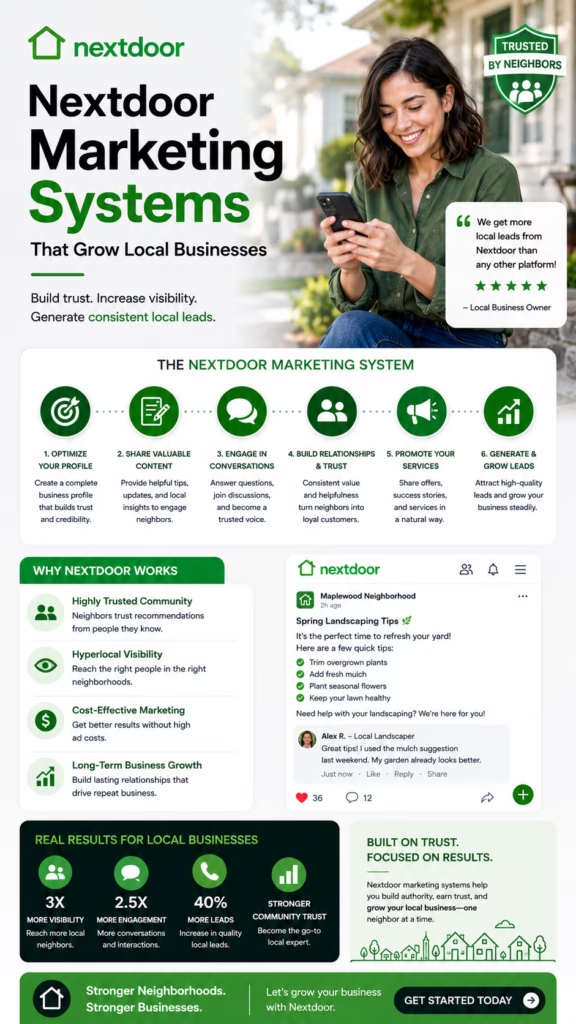
Nextdoor Marketing Systems That Grow Local Businesses explains how companies can use neighborhood trust, helpful content, recommendations, offers, engagement, and follow-up workflows to turn nearby residents into real leads and customers.
Introduction
Nextdoor Marketing Systems That Grow Local Businesses are important because local customers often choose companies they recognize, trust, and see recommended by nearby residents. When someone needs a painter, plumber, HVAC company, cleaner, landscaper, roofer, restaurant, mattress store, pet service, wellness provider, real estate professional, or local shop, neighborhood credibility can influence who they contact first.
Nextdoor gives local businesses a way to become visible inside neighborhood conversations. Residents use the platform to ask questions, recommend providers, discover nearby offers, and learn about local companies. A business that shows up consistently and professionally can become a trusted local option.
Nextdoor marketing systems grow local businesses by turning neighborhood visibility into trust, and trust into calls, messages, quote requests, visits, bookings, and customers.
The key word is system. Posting once or twice is not enough. A strong Nextdoor system includes a complete business profile, helpful posts, recommendation requests, local offers, visual proof, service-area clarity, fast replies, and lead tracking. Each part supports the next.
When these pieces work together, Nextdoor becomes more than a posting platform. It becomes a local growth engine that helps businesses build awareness, earn credibility, capture inquiries, and follow up with interested residents before competitors do.
Main idea: Nextdoor marketing systems help local businesses grow by creating repeatable neighborhood visibility, trust, engagement, and lead conversion.
Table of Contents
- 1) Why local businesses need a Nextdoor system
- 2) How Nextdoor supports neighborhood growth
- 3) Profile optimization as the foundation
- 4) Recommendations that build trust
- 5) Helpful posts that create visibility
- 6) Local offers that drive inquiries
- 7) Service-area clarity and lead quality
- 8) Visual proof and authority
- 9) Engagement workflows that build relationships
- 10) Fast response and follow-up systems
- 11) Nextdoor systems for service businesses
- 12) Nextdoor systems for storefronts
- 13) Tracking results and improving performance
- 14) Common mistakes that limit growth
- 15) Final thoughts
- 16) FAQs
- 17) Extra keywords
1) Why Local Businesses Need a Nextdoor System
Local businesses need a Nextdoor system because random posting creates random results. A business may get some attention from one post, but long-term growth requires a repeatable process. The system should help the business get seen, build trust, generate inquiries, and follow up quickly.
A Nextdoor marketing system gives structure to local visibility. It helps the business know what to post, when to post, how to ask for recommendations, how to promote offers, and how to respond when residents reach out.
A Nextdoor marketing system can help increase:
- Neighborhood visibility
- Customer recommendations
- Direct messages
- Phone calls
- Quote requests
- Store visits
- Appointment bookings
- Service inquiries
- Local trust
- Booked customers
Nextdoor Marketing Systems That Grow Local Businesses work because they replace random posting with a structured local lead process.
2) How Nextdoor Supports Neighborhood Growth
Nextdoor supports neighborhood growth by helping businesses appear in front of people who live nearby. This matters because local businesses do not need attention from everyone. They need attention from residents in their service areas, neighborhoods, and nearby communities.
When a business becomes visible inside local conversations, residents may start to recognize it. Recognition can lead to trust. Trust can lead to inquiries. Inquiries can lead to appointments, visits, bookings, and customers.
Neighborhood visibility
Helpful local content
Recommendations and proof
Resident trust
Customer inquiry
Fast follow-up
Booked job, visit, or sale
Nextdoor supports local growth by helping businesses become familiar and trusted within the neighborhoods they serve.
3) Profile Optimization as the Foundation
A complete business profile is the foundation of a strong Nextdoor marketing system. When residents see a post or recommendation, they may click the profile before contacting the business. The profile should quickly explain who the business helps, what it offers, where it serves, and how to take the next step.
An incomplete profile can stop a lead before it starts. A complete profile can turn curiosity into confidence.
A strong Nextdoor profile should include:
- Clear business name
- Accurate contact information
- Website link
- Service areas
- Business category
- Service or product description
- Photos or proof
- Customer recommendations
- Simple call to action
Profile optimization helps Nextdoor marketing systems grow local businesses by making the business easier to trust and contact.
4) Recommendations That Build Trust
Recommendations are one of the strongest growth signals on Nextdoor. When local customers recommend a business, that recommendation can influence nearby residents who need the same service or product.
Businesses should create a simple recommendation process. After a positive service, sale, appointment, or visit, the business can ask satisfied customers to recommend them. This turns good customer experiences into future lead opportunities.
Customer has a positive experience
Business asks for a recommendation
Recommendation appears locally
Nearby residents see proof
More inquiries are created
Recommendations help Nextdoor systems grow local businesses because they turn customer satisfaction into neighborhood proof.
5) Helpful Posts That Create Visibility
Helpful posts create visibility without making the business feel overly promotional. A local business can share tips, seasonal reminders, project examples, product updates, service availability, customer stories, or neighborhood-specific advice.
Helpful content gives residents a reason to notice the business before they need to buy. Over time, this builds familiarity and trust.
Helpful Nextdoor post ideas include:
- Seasonal maintenance tips
- Before-and-after project examples
- Common problem warnings
- Local service reminders
- Product arrival updates
- Customer success stories
- Neighborhood-specific advice
- Appointment availability updates
Helpful posts grow local businesses by creating repeated neighborhood visibility and positioning the business as useful.
6) Local Offers That Drive Inquiries
Offers help turn visibility into action. A resident may recognize the business and trust it, but a clear offer can give them a reason to reach out now. Strong offers are simple, local, and easy to respond to.
Examples include free estimates, same-week appointments, neighborhood specials, seasonal promotions, delivery offers, consultation openings, or limited service availability.
Offer structure:
Clear service or product
Local relevance
Simple benefit
Timing or availability
Call/message CTA
Local offers help Nextdoor marketing systems grow local businesses by creating a clear reason for residents to call, message, visit, or book.
7) Service-Area Clarity and Lead Quality
Service-area clarity improves lead quality because residents need to know whether the business serves their location. Specific neighborhoods, cities, ZIP codes, or nearby communities can make posts and profiles feel more relevant.
Clear service-area messaging also reduces wasted inquiries. It helps attract residents who are actually within the business’s target area.
Nextdoor marketing systems grow better when businesses clearly explain where they work and who they serve.
8) Visual Proof and Authority
Visual proof helps businesses build authority. Photos and videos can show completed work, products, storefronts, team members, service vehicles, before-and-after examples, local projects, and customer experiences.
Residents often trust what they can see. Strong visuals make the business feel more real, active, and reliable.
Useful visual proof includes:
- Before-and-after photos
- Completed project images
- Team photos
- Storefront photos
- Product images
- Service vehicle photos
- Local work examples
- Offer graphics
Visual proof helps local businesses grow by increasing trust before residents contact them.
9) Engagement Workflows That Build Relationships
Engagement is a key part of a Nextdoor marketing system. Businesses should respond to comments, answer questions, thank customers, clarify service details, and participate professionally when relevant.
Engagement should feel helpful and local. A business that responds consistently can build stronger neighborhood relationships and create more lead opportunities.
Engagement workflows should include:
- Replying to comments
- Answering questions
- Thanking customers
- Responding to recommendations
- Clarifying offers
- Providing helpful advice
- Guiding residents to the next step
Nextdoor marketing systems grow local businesses when engagement turns local attention into relationships and inquiries.
10) Fast Response and Follow-Up Systems
Fast response is essential because interested residents may contact multiple businesses. If a lead waits too long, the opportunity may be lost. A strong Nextdoor system should include clear response workflows.
Businesses can use saved replies, CRM tracking, appointment links, missed-message follow-up, phone scripts, and reminder messages. Every lead should move toward a quote, appointment, visit, booking, or sale.
Inquiry received
Fast reply sent
Question answered
Next step offered
Lead tracked
Appointment, quote, visit, or sale completed
Follow-up systems turn Nextdoor inquiries into real business growth.
11) Nextdoor Systems for Service Businesses
Service businesses can use Nextdoor systems to generate quote requests, estimate appointments, and booked jobs. Painters, plumbers, HVAC companies, cleaners, landscapers, roofers, pest control providers, electricians, movers, and handymen can all benefit from neighborhood trust.
Service businesses should focus on proof, helpful posts, recommendation requests, service-area clarity, and fast replies.
Service business system ideas:
- Weekly helpful tip post
- Monthly recommendation request
- Before-and-after project post
- Seasonal service offer
- Fast quote response workflow
- CRM lead tracking
- Google Maps profile connection
Nextdoor systems help service businesses grow by turning neighborhood trust into quote requests and booked jobs.
12) Nextdoor Systems for Storefronts
Storefronts can use Nextdoor systems to generate calls, product questions, store visits, and repeat local awareness. Restaurants, mattress stores, furniture shops, boutiques, wellness centers, pet stores, and retailers can all benefit from consistent local visibility.
Storefronts should post product updates, local specials, events, delivery options, customer favorites, and reasons to visit.
Storefront system ideas:
- Weekly product highlight
- Local special post
- Event announcement
- Customer favorite feature
- Delivery or pickup update
- Review and recommendation request
- Store visit CTA
Nextdoor systems help storefronts grow by turning nearby awareness into visits, calls, and repeat customers.
13) Tracking Results and Improving Performance
Tracking helps businesses understand whether their Nextdoor system is working. Views and engagement are useful, but the real goal is leads, appointments, visits, bookings, and sales.
Businesses can track performance with CRM tags, dedicated phone numbers, website landing pages, lead source questions, appointment notes, and closed-sale reports.
Important Nextdoor system metrics include:
- Profile views
- Post engagement
- Recommendations
- Direct messages
- Phone calls
- Website clicks
- Quote requests
- Appointments booked
- Store visits
- Closed customers
Tracking helps Nextdoor marketing systems improve over time and produce more consistent local business growth.
14) Common Mistakes That Limit Growth
Many businesses fail to grow on Nextdoor because they do not use a system. They post occasionally, ignore recommendations, fail to complete their profile, or respond too slowly to inquiries. These gaps reduce trust and conversion.
- Incomplete business profile
- No recommendation strategy
- Posting only promotions
- No helpful content
- No service-area clarity
- Poor or missing visuals
- No clear call to action
- Slow response to messages
- No CRM or lead tracking
- No offer strategy
- Inconsistent posting
- No connection to website or Google Maps
Big mistake: treating Nextdoor like a random posting platform instead of a complete neighborhood growth system.
15) Final Thoughts
Nextdoor Marketing Systems That Grow Local Businesses work because neighborhood trust can become a major advantage. Businesses that show up consistently, provide value, earn recommendations, and respond quickly are more likely to become trusted local choices.
The strongest systems include profile optimization, helpful posts, recommendation requests, local offers, service-area clarity, visual proof, engagement workflows, fast response, lead tracking, and connections to Google Maps and the website.
Final takeaway: Nextdoor marketing systems grow local businesses by turning neighborhood visibility into trust, and trust into measurable customer action.
16) FAQs
1) What are Nextdoor marketing systems that grow local businesses?
They are structured systems for using Nextdoor to build visibility, trust, recommendations, inquiries, and customer growth.
2) Can Nextdoor help local businesses grow?
Yes. Nextdoor can help local businesses grow by increasing neighborhood awareness, trust, calls, messages, visits, and leads.
3) What businesses benefit from Nextdoor?
Home services, contractors, restaurants, retailers, wellness providers, pet services, real estate professionals, and storefronts can benefit.
4) Why do recommendations matter?
Recommendations create local proof and help nearby residents feel more comfortable contacting the business.
5) What should a Nextdoor profile include?
It should include contact information, service areas, description, photos, website link, recommendations, and a CTA.
6) What kind of posts work best?
Helpful tips, project examples, service reminders, customer stories, offers, and local updates can work well.
7) Should businesses post offers?
Yes. Offers can turn awareness into calls, messages, visits, and bookings.
8) Why is service-area clarity important?
It helps residents know whether the business serves their location and improves lead quality.
9) Do photos help?
Yes. Photos build trust by showing real work, products, teams, storefronts, or proof.
10) How important is response speed?
Response speed is very important because interested residents may contact competitors too.
11) Can Nextdoor help service businesses?
Yes. Service businesses can use Nextdoor to generate quote requests and booked jobs.
12) Can Nextdoor help storefronts?
Yes. Storefronts can use Nextdoor to increase local awareness, product questions, calls, and visits.
13) Should Nextdoor connect to a website?
Yes. A website helps residents learn more, request quotes, book appointments, and verify the business.
14) Should Nextdoor connect to Google Maps?
Yes. Google Maps helps residents confirm reviews, photos, hours, location, and directions.
15) How should businesses track results?
They should track messages, calls, clicks, quote requests, appointments, visits, and closed customers.
16) What is the biggest Nextdoor mistake?
The biggest mistake is posting randomly without a complete profile, recommendations, offers, follow-up, or tracking.
17) Can new businesses use Nextdoor?
Yes. New businesses can use Nextdoor to build local awareness and collect early recommendations.
18) How often should businesses post?
Businesses should post consistently without spamming. Weekly or seasonal posts can work well.
19) Should posts be helpful or promotional?
The strongest posts are usually helpful first, with a natural CTA or offer included.
20) Can Nextdoor support referrals?
Yes. Recommendations and neighborhood conversations can support referral-style growth.
21) Should businesses use a CRM?
Yes. A CRM or tracking sheet helps manage inquiries, follow-up, appointments, and sales outcomes.
22) Can Nextdoor support local SEO?
Yes. Nextdoor can support local awareness alongside Google Maps, website SEO, reviews, and social media.
23) What makes a Nextdoor system work?
Consistency, helpful content, recommendations, offers, fast replies, and lead tracking make the system work.
24) Is Nextdoor a one-time marketing task?
No. It works best as an ongoing neighborhood visibility and lead-generation system.
25) What is the main goal of a Nextdoor marketing system?
The main goal is to turn neighborhood trust into calls, messages, visits, bookings, and paying customers.
17) Extra Keywords
- Nextdoor Marketing Systems That Grow Local Businesses
- Nextdoor marketing systems
- Nextdoor marketing
- Nextdoor lead generation
- local business growth
- neighborhood marketing
- Nextdoor for business
- local customer acquisition
- local service leads
- neighborhood leads
- Nextdoor recommendations
- local trust marketing
- community-based marketing
- neighborhood customer leads
- Nextdoor customer inquiries
- home service marketing
- storefront marketing
- service-area marketing
- local recommendation marketing
- word-of-mouth marketing
- Nextdoor profile optimization
- neighborhood visibility strategy
- local business visibility
- Nextdoor customer acquisition
- neighborhood business growth