
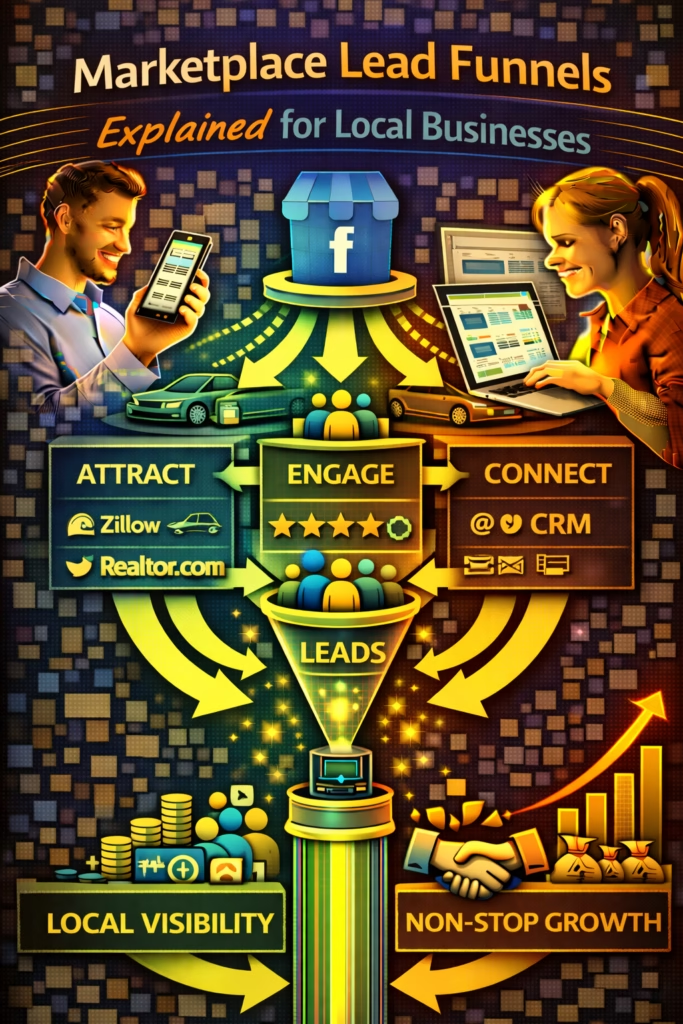
Marketplace Lead Funnels Explained for Local Businesses
Marketplace Lead Funnels Explained for Local Businesses is the blueprint for turning listing visibility into messages, qualification, appointments, and sales through a practical local marketplace funnel.
Note: This is general guidance. Follow platform policies, avoid misleading claims, and keep all listings and follow-up truthful, useful, and compliant.
Introduction
Marketplace Lead Funnels Explained for Local Businesses begins with one important shift in mindset:
A marketplace listing is not just a post. It is the top of a funnel.
Most local businesses think about marketplace platforms in a shallow way. They post listings, wait for messages, and judge results based on whether a lead appears. But strong results do not come from random listing activity. They come from understanding the full funnel: how buyers see a listing, what makes them click, what makes them message, how they get qualified, and how they become a booked next step or sale.
When a local business understands that funnel, it stops guessing. It starts optimizing.
Big idea: Marketplace lead generation becomes predictable when every stage of the buyer journey is designed on purpose.
Expanded Table of Contents
- 1) What a marketplace lead funnel actually is
- 2) Why local businesses need a funnel, not just listings
- 3) Stage 1: visibility and buyer discovery
- 4) Stage 2: click-through and first-impression drivers
- 5) Stage 3: turning views into real inquiries
- 6) Stage 4: qualifying inquiries without killing momentum
- 7) Stage 5: booked next steps and sales intent
- 8) Stage 6: follow-up and funnel recovery
- 9) Listing structure that supports the full funnel
- 10) Cadence and rotation: keeping the funnel active
- 11) Speed-to-lead and why it affects every stage
- 12) KPI dashboard for marketplace lead funnels
- 13) 30–60–90 day rollout plan
- 14) 25 Frequently Asked Questions
- 15) 25 Extra Keywords
1) What a marketplace lead funnel actually is
A marketplace lead funnel is the sequence of steps that turns a local buyer from browser to customer.
| Funnel stage | Buyer action | Business goal |
|---|---|---|
| Visibility | Sees the listing | Earn attention |
| Click-through | Opens the listing | Earn curiosity and trust |
| Inquiry | Messages | Start the conversation |
| Qualification | Answers questions | Clarify fit and intent |
| Booked next step | Schedules / commits | Move toward revenue |
| Follow-up | Re-engages or decides later | Recover missed opportunities |
Rule: If one stage is weak, the whole funnel underperforms—even if your listings are getting traffic.
2) Why local businesses need a funnel, not just listings
Listings alone do not create predictability. Funnels do. A funnel lets a local business understand where results are being lost and where improvements create the biggest gains.
Without a funnel mindset, businesses usually ask
- “Why are my listings not working?”
- “Why am I getting views but no messages?”
- “Why do people message and disappear?”
With a funnel mindset, businesses ask
- “Which stage is leaking?”
- “Is the click-through weak or the inquiry rate weak?”
- “Is the issue qualification, speed, or follow-up?”
Pro move: A funnel turns vague frustration into specific optimization.
3) Stage 1: visibility and buyer discovery
The funnel starts before the buyer clicks. Visibility is the first stage, and it depends on factors like freshness, relevance, and listing activity.
Visibility drivers
- Consistent listing cadence
- Relevant titles and categories
- Freshness signals from rotation and updates
- Strong engagement history
Rule: If the buyer never sees the listing, the rest of the funnel never starts.
4) Stage 2: click-through and first-impression drivers
Once the listing appears, the buyer decides whether to open it. This stage depends mostly on the first photo and the title.
Click-through drivers
- Clear, relevant first photo
- Title clarity and usefulness
- Local or timing relevance
- Strong visual contrast against competing listings
Title formula
[What it is] + [Benefit/Hook] + [Local or Timing Angle]Pro move: Click-through is not just about attention. It is about attracting the right attention.
5) Stage 3: turning views into real inquiries
After the click, the listing must convert interest into action. This stage is where many businesses lose momentum.
What increases inquiry rate
- Trust-building first two lines
- Clear details without clutter
- Real photos
- One easy CTA question
Opening-line example
Real photos + clear details ✅
What city/zip are you in and are you looking for today or this week?
Rule: A good listing makes messaging feel easier than leaving.
6) Stage 4: qualifying inquiries without killing momentum
Not every inquiry is a strong lead. But qualification must be done carefully. If you add too much friction too early, good leads go cold.
Best qualification approach
- Ask one question at a time
- Start with timing or location
- Move into budget, fit, or specifics only after response
- Keep it conversational and useful
Qualification template
Perfect — thanks.
What city/zip are you in, and are you looking for today or this week?
Pro move: Good qualification protects the funnel. Bad qualification clogs it.
7) Stage 5: booked next steps and sales intent
A booked next step is the moment the lead becomes real pipeline instead of casual conversation.
Common booked next steps
- Appointment
- Estimate or quote request
- Store visit
- Pickup time
- Delivery window
- Property tour
- Call slot
Booking template
Perfect — I can help with that ✅
What works best for you next:
A) Quick call
B) Visit / pickup / tour time
C) Just send details first
Rule: The funnel becomes revenue-focused at the booked-next-step stage.
8) Stage 6: follow-up and funnel recovery
Many marketplace buyers do not act immediately. Follow-up is how businesses recover leads that would otherwise disappear.
Simple follow-up sequence
Day 0: Instant reply + one question
Day 1: “Still looking for this week?”
Day 3: “Want me to send the best options for your area?”
Day 5: “Would a quick call, visit, or details first work best?”
Day 7: “No worries if timing changed — want me to keep an eye out?”
Rule: A strong funnel includes recovery, not just first-touch conversion.
9) Listing structure that supports the full funnel
The strongest marketplace lead funnels start with listings that are built for conversion at multiple stages—not just visibility.
Recommended structure
Title: [What it is] + [Hook] + [Local/Option]
Line 1: Real photos + clear details ✅
Line 2: Why buyers choose this / what problem it solves
Bullets: key facts, features, timing, proof, next-step clarity
CTA: What city/zip are you in and are you looking for today or this week?
Pro move: A listing should support the entire funnel from click to message, not just look good in search.
10) Cadence and rotation: keeping the funnel active
Funnels do not stay healthy on stale content. Consistent cadence and responsible rotation keep the top of the funnel moving.
What to rotate
- First photo
- Title angle
- Opening lines
- Feature emphasis
- Posting windows
Cadence examples
Solo operator
- 2–5 actions per day
- Weekly refresh of top listings
- Monthly cleanup of weak performers
Small team
- 10–20 actions per day
- Daily QA checks
- Weekly testing and rotation
Avoid: copy-paste duplication, meaningless reposting, and rotation so random that it removes recognition.
11) Speed-to-lead and why it affects every stage
Speed-to-lead does not just affect closing. It affects the health of the entire funnel by protecting buyer momentum.
Instant reply template
Yes — I can help ✅

Quick question so I send the best option:
Are you looking for today or this week?

What city/zip are you in?
Why speed matters
- It prevents inquiry drop-off
- It increases trust
- It raises booked-next-step rates
- It makes the business more memorable
Pro move: In local marketplace funnels, speed often wins even before price does.
12) KPI dashboard for marketplace lead funnels
| KPI | What it measures | Target direction |
|---|---|---|
| Views / impressions | Top-of-funnel visibility | Up |
| Click-through rate | Photo + title strength | Up |
| Inquiry rate | Listing conversion | Up |
| Qualified rate | Lead quality | Up |
| Median response time | Speed-to-lead | Down |
| Booked next steps | Revenue predictor | Up |
| Follow-up recovery rate | Recovered funnel leakage | Up |
Rule: A funnel is only as strong as the stage you are measuring honestly.
13) 30–60–90 day rollout plan
Days 1–30 (Map the funnel)
- Clarify the offer and CTA
- Improve first photos and titles
- Install instant replies and simple qualification
- Start tracking funnel KPIs
- Identify the first major leak
Days 31–60 (Strengthen conversion)
- Improve opening lines and inquiry rate
- Build rotation patterns for top listings
- Install follow-up templates
- Measure booked-next-step rate by listing angle
Days 61–90 (Scale the working funnel)
- Document SOPs for listing, qualification, and follow-up
- Expand winning patterns across categories or areas
- Review the KPI dashboard weekly
- Double down on the funnel stages producing the best booked outcomes
Rule: Marketplace lead funnels become powerful when they are measured, improved, and repeated.
14) 25 Frequently Asked Questions
1) What is a marketplace lead funnel for a local business?
It is the path from listing visibility to inquiry, qualification, booked next step, and sale.
2) Why do marketplace lead funnels work well for local businesses?
Because local buyers often browse with intent and can message quickly without much friction.
3) What is the fastest way to improve a marketplace lead funnel?
Improve the first photo, title, opening lines, response speed, and next-step question.
4) What is the first stage of the funnel?
Visibility—getting the listing seen by the right buyers.
5) What controls click-through most?
The first photo and the title.
6) What controls inquiry rate most?
Trust-building opening lines, clear details, and an easy CTA question.
7) What is a good CTA?
“What city/zip are you in and are you looking for today or this week?”
8) How should I qualify leads?
One question at a time, starting with timing or location.
9) What is a booked next step?
An appointment, estimate, visit, pickup, delivery slot, call, or tour.
10) Why track booked next steps?
Because they predict revenue better than messages alone.
11) Why does speed-to-lead matter so much?
Because buyers often compare multiple options and the fastest useful reply usually wins.
12) What response time should I target?
Under 5 minutes is strong; under 1 minute is ideal when possible.
13) Why do leads disappear after messaging?
Usually because qualification created friction, the reply was slow, or there was no clear next step.
14) What role does follow-up play?
It recovers leads that did not act on the first interaction.
15) How often should I rotate listings?
Regularly enough to stay fresh, but with meaningful variation instead of duplication.
16) What should I rotate?
Photos, title angles, opening lines, feature emphasis, and posting windows.
17) Can one person run a marketplace lead funnel?
Yes, if the process is simple, realistic, and documented.
18) What is the biggest funnel mistake?
Treating listings as one-off posts instead of entry points into a system.
19) What should I test first?
First photo, then title, then opening lines, then CTA.
20) How long until funnel improvements show results?
Often within 1–2 weeks, with stronger gains over 30–90 days.
21) Do small businesses need complex CRMs for this?
Not necessarily. Even simple tracking can improve funnel clarity dramatically.
22) What KPI matters most?
Booked next steps, because that is where conversation becomes pipeline.
23) Can marketplace funnels replace websites?
No. They are powerful lead-entry systems, but websites still help with proof, authority, and depth.
24) What is the best mindset for local businesses?
Treat every listing as the top of a practical, measurable funnel.
25) What is the simplest starting point?
Upgrade the first photo, rewrite the title, and install a fast reply and follow-up system.
15) 25 Extra Keywords
- Marketplace Lead Funnels Explained for Local Businesses
- marketplace lead funnel
- local business lead funnel
- Facebook Marketplace lead funnel
- marketplace inquiry funnel
- local lead generation funnel
- marketplace listing strategy
- speed to lead
- booked next steps
- marketplace conversion funnel
- marketplace views to inquiries
- listing qualification process
- local inquiry conversion
- marketplace follow-up funnel
- messages per listing KPI
- booked next steps KPI
- marketplace response speed
- listing rotation strategy
- anti-flag marketplace framework
- marketplace pipeline stages
- local service lead funnel
- organic marketplace lead system
- 2026 marketplace funnel strategy
- local buyer journey marketplace
- marketplace sales funnel for local business