
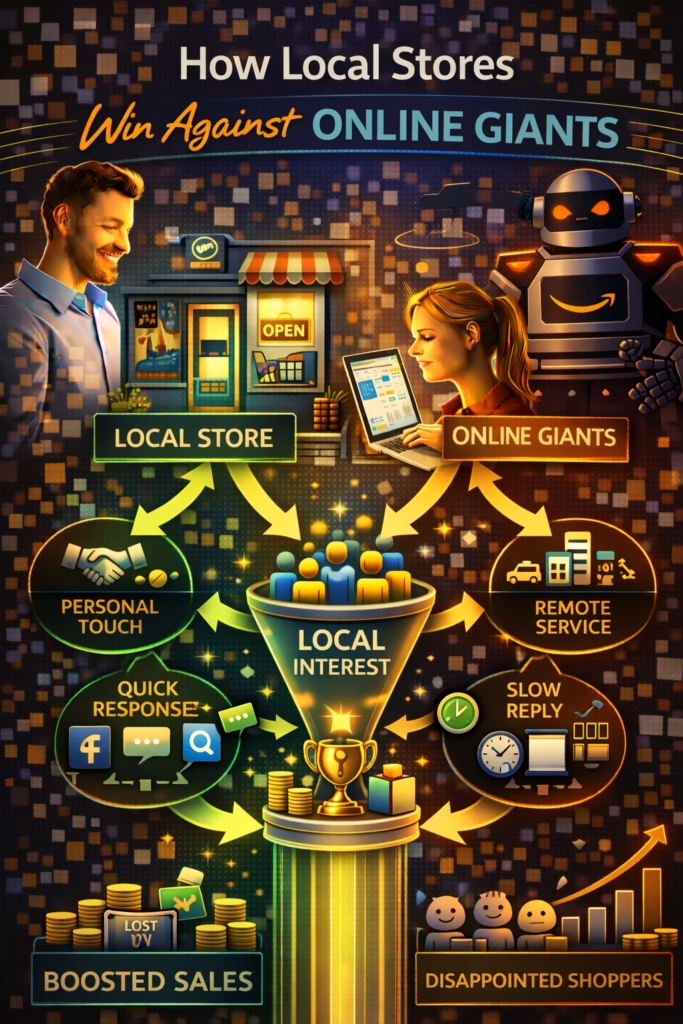
How Local Stores Win Against Online Giants
How Local Stores Win Against Online Giants is the blueprint for beating e-commerce with a local advantage stack—speed, trust, service, and demand capture through Marketplace + Google Maps.
Note: This is general guidance. Keep claims truthful and comply with platform rules, consumer protection laws, and privacy/marketing rules before posting or automating follow-ups.
Introduction
How Local Stores Win Against Online Giants starts with a simple truth:
You don’t beat online giants by copying them. You beat them by stacking what they can’t do.
Online giants are great at search scale, endless inventory, and shipping logistics. But local stores have something more valuable: proximity, certainty, real human support, and the ability to deliver an experience that reduces risk.
In 2025–2026, local retailers win when they turn these advantages into a system—capturing demand where it starts (feeds and maps), responding fast, booking a next step, and closing with confidence in-store.
Big idea: Local retail is not dead. It’s just moved upstream—into Marketplace browsing and Google Maps intent.
Expanded Table of Contents
- 1) What online giants do best (and what they don’t)
- 2) The local advantage stack
- 3) The “certainty advantage”: see it, trust it, get it
- 4) Speed wins: same-day availability and fast answers
- 5) Experience wins: showroom and human guidance
- 6) Demand capture: Marketplace + Google Maps
- 7) Offer frameworks that beat online comparison
- 8) Messaging scripts that book visits and pickups
- 9) Follow-up and retention loops that giants can’t replicate
- 10) Testing plan: improve conversion weekly
- 11) KPIs that predict local revenue
- 12) 30–60–90 day rollout plan
- 13) 25 Frequently Asked Questions
- 14) 25 Extra Keywords
1) What online giants do best (and what they don’t)
To win, you have to stop fighting on their battlefield.
Online giants are great at
- Endless selection
- Fast shipping (sometimes)
- Price comparison at scale
- Mass review volume
Online giants struggle with
- Certainty: “Will this actually fit me / work for my space?”
- Timing: same-day needs and last-minute decisions
- Human guidance: real help during confusion
- Local accountability: “Who do I talk to if there’s an issue?”
- Experience: feel, comfort, demonstration, setup confidence
Pro move: Your marketing should make the buyer feel: “This is easier and safer than ordering online.”
2) The local advantage stack
Local stores win when they combine multiple small advantages into one big, obvious reason to buy locally.
Same-day pickup/delivery and fast responses.
Real photos, real inventory, real answers.
Guidance, recommendations, and clarity.
Showroom validation and confidence.
A local place and person to stand behind the sale.
Marketplace browsing + Maps intent.
Rule: One advantage is “nice.” Five advantages is a no-brainer.
3) The “certainty advantage”: see it, trust it, get it
Online shopping creates uncertainty. Local stores eliminate it.
Certainty builders
- Real photos of your inventory (not just stock images)
- Clear pricing and clear options
- Availability language that’s honest
- Simple next step: visit/pickup/delivery
Certainty copy template
Real photos ✅
In-stock options ✅
Clear pricing ✅
Local pickup/delivery ✅
What zip are you in and are you looking for today or this week?
Rule: The more certainty you provide, the fewer “price shoppers” you attract.
4) Speed wins: same-day availability and fast answers
Speed is where local stores can dominate—if they operationalize it.
Speed-to-lead targets
| Metric | Target | Why it matters |
|---|---|---|
| Reply time | < 5 minutes | Captures peak intent |
| Booking prompt | 1 message | Momentum is fragile |
| Same-day option | Whenever possible | Beats shipping delays |
Pro move: Your fastest reply should be one question that books the next step.
5) Experience wins: showroom and human guidance
Online giants cannot replicate the confidence created by a real demonstration and a helpful person.
Showroom advantages to highlight
- Try/see/feel before buying
- Expert recommendations for needs and budgets
- Better fit, fewer returns, less regret
- Local delivery/setup support
Rule: Don’t sell “products.” Sell “confidence.”
6) Demand capture: Marketplace + Google Maps
Local stores win when they show up in two places:
- Marketplace feeds: where buyers browse and compare
- Google Maps: where buyers search with purchase intent
Why the combo works
| Channel | Buyer mindset | Your goal |
|---|---|---|
| Marketplace | Browsing, comparing | Earn messages + attention |
| Google Maps | High intent, local | Earn calls/visits now |
Pro move: Marketplace fills your top-of-funnel. Maps converts the bottom-of-funnel.
7) Offer frameworks that beat online comparison
You can’t always win on sticker price. But you can win on total value and speed.
Value stack offer examples
- Same-day pickup/delivery options
- Setup assistance (or simple add-on)
- Guided selection to avoid wrong buys
- Local accountability if something goes wrong
- Financing/payment options where applicable
Offer line template
Local, real inventory + real photos.
Fast pickup/delivery options.
Tell me your zip and timeline (today/this week) and I’ll recommend the best fit.
Rule: Online sells “cheap.” Local sells “easy and certain.”
8) Messaging scripts that book visits and pickups
Instant reply
Yes — I can help ✅
What city/zip are you in, and are you looking for today or this week?
I’ll confirm the best options.
3-option booking prompt
Quickest next step is a short visit or pickup.

Which works best?
1) Today
2) Tomorrow
3) This weekend

Send your option + your zip and I’ll lock it in.
When they say “I’m just looking”
No worries at all — totally normal.
If you tell me your zip + budget range, I’ll point you to the best options so you don’t waste time.
Pro move: Every message should reduce friction and move toward a booked step.
9) Follow-up and retention loops that giants can’t replicate
Local stores win long-term when they treat every lead as a relationship, not a transaction.
Simple follow-up cadence
| When | Message | Goal |
|---|---|---|
| +2 hours | “Do you want the fastest option today or this week?” | Recover momentum |
| +24 hours | “Want me to recommend the best option for your budget?” | Offer help |
| +72 hours | “If you send zip + timeline, I’ll line it up.” | Reduce friction |
| +7 days | “Should I keep this open for you?” | Reactivation |
Retention loop ideas
- Post-purchase check-in (simple and helpful)
- Accessory add-ons or upgrade path
- Seasonal promos for past buyers
- Referral ask after a positive outcome
Rule: The easiest customer to win is the one who already trusts you.
10) Testing plan: improve conversion weekly
Most local stores don’t need a new channel. They need better conversion.
Test priority order
- First photo (thumbnail)
- Title clarity
- First 2 lines of the description
- CTA question
- Booking script
Simple test process
1) Pick one variable
2) Run 3–7 days
3) Track messages/day + booked next steps
4) Keep the winner
5) Repeat weekly
Pro move: One small win per week compounds into a dominant local system.
11) KPIs that predict local revenue
| KPI | What it measures | Target direction |
|---|---|---|
| Views → messages | Listing clarity + offer strength | Up |
| Median reply time | Speed-to-lead | Down |
| Messages → booked steps | Script effectiveness | Up |
| Booked steps → sales | Close rate | Up |
| Follow-up recovery | Saved leads | Up |
| Repeat/referral rate | Retention strength | Up |
Rule: Track “booked next steps” weekly. It’s the closest KPI to revenue.
12) 30–60–90 day rollout plan
Days 1–30 (Build the local advantage stack)
- Upgrade photos, titles, and first lines for clarity
- Deploy instant reply + one-question CTA
- Implement 3-option booking script
- Start posting varied inventory angles (no duplicates)
- Track booked next steps weekly
Days 31–60 (Capture more demand)
- Expand Marketplace surface area with intent-based variations
- Improve Maps presence (hours, photos, reviews cadence)
- Run weekly A/B tests on thumbnails and hooks
- Implement follow-up cadence
Days 61–90 (Systemize and scale)
- Document SOPs for posting, messaging, follow-up
- Automate safe parts (routing, reminders, instant replies)
- Optimize by KPI trends weekly
- Expand to a second local market (or second channel)
Pro move: Once your system works in one city, it can work in many.
13) 25 Frequently Asked Questions
1) Can local stores really compete with online giants?
Yes—by stacking speed, certainty, human help, and local accountability into a system.
2) What’s the biggest local advantage?
Speed and certainty: buyers can confirm and get it today.
3) Do local stores need to match online prices?
Not always. Win on total value: speed, setup, support, and trust.
4) What channels matter most in 2026?
Google Maps for high-intent searches and Marketplace for browsing demand.
5) Why does Marketplace work for retailers?
It’s where buyers browse first—like a digital showroom.
6) What makes a Marketplace listing convert?
Real photos, clear pricing, clear availability, and a strong next step.
7) What response time should local stores aim for?
Under 5 minutes is strong; under 1 minute is best.
8) What’s the best CTA question?
“What city/zip are you in, and are you looking for today or this week?”
9) How do I book store visits from messages?
Use a 3-option booking prompt (today/tomorrow/weekend).
10) How do I avoid duplicate listing flags?
Rotate photos, hooks, and intent angles while staying truthful.
11) Do stock photos hurt conversion?
Usually—real photos tend to build more trust.
12) What’s the biggest reason leads go cold?
Slow replies and no follow-up cadence.
13) How often should I follow up?
2 hours, 24 hours, 72 hours, and 7 days is a solid baseline.
14) What does “certainty” mean in retail marketing?
Reducing risk: real proof, clear details, and easy next steps.
15) How do I win buyers who are “just comparing”?
Offer guidance and reduce effort: recommend the best fit quickly.
16) How do local stores beat shipping speed?
Same-day pickup/delivery and fast confirmation.
17) How do reviews affect local competition?
They are a trust amplifier—especially on Maps.
18) What if I don’t have many reviews?
Start a consistent request process after positive outcomes.
19) What KPI predicts revenue best?
Booked next steps (visits, pickups, deliveries).
20) How do I measure Marketplace performance?
Views-to-messages, reply time, and messages-to-booked steps.
21) How long does it take to see results?
Often 1–2 weeks, compounding over 30–90 days.
22) Can service beat price?
Yes—buyers pay for certainty, speed, and reduced hassle.
23) Should local stores use automation?
Automation can help with response speed and follow-up when used compliantly.
24) What should I avoid automating?
Spam-like posting and aggressive bulk messaging that violates rules.
25) What’s the simplest change to win more sales?
Reply faster and guide every lead toward a booked next step.
14) 25 Extra Keywords
- How Local Stores Win Against Online Giants
- local stores vs online giants
- compete with Amazon locally
- local retail marketing strategy 2026
- Facebook Marketplace for retailers
- Google Maps SEO for local stores
- local showroom advantage
- digital showroom strategy
- same-day retail delivery advantage
- speed to lead retail
- marketplace lead conversion system
- local trust signals marketing
- booked next steps KPI
- retail messaging scripts
- how to book store visits from marketplace
- local buyer intent capture
- marketplace vs ecommerce conversion
- local retail demand capture
- reduce returns with showroom confidence
- local store customer service advantage
- organic local leads marketplace
- maps marketing for retailers
- retail follow up cadence
- local retail competitive strategy
- turn browsers into local buyers













