

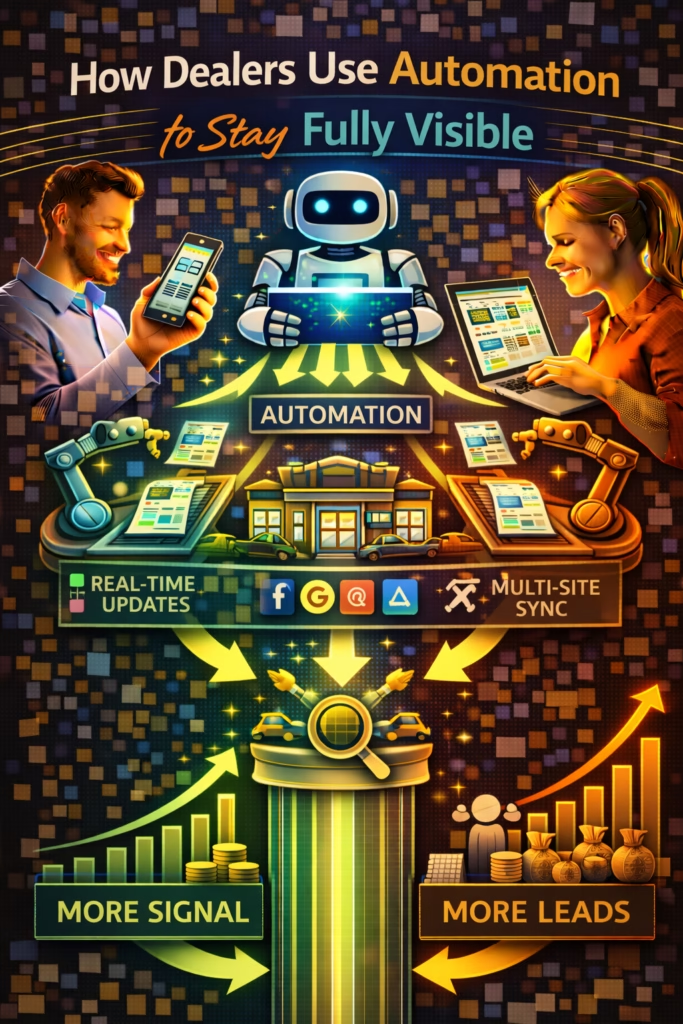
How Dealers Use Automation to Stay Fully Visible
How Dealers Use Automation to Stay Fully Visible is the blueprint for compounding exposure with steady cadence, compliant variation, inventory workflows, and fast response systems—without living inside posting apps.
Note: This is general guidance. Follow platform rules and applicable advertising/privacy laws. Avoid spam, duplicates, and misleading claims.
Introduction
How Dealers Use Automation to Stay Fully Visible comes down to one reality most dealers discover after wasting months posting manually:
Visibility is not a campaign. It’s a system.
When you sell vehicles, RVs, power equipment, trailers, furniture, or any high-consideration inventory, buyers don’t convert on the first glance. They browse, compare, save, ask questions, and return later.
If you disappear for three days because your team is busy, your exposure collapses. If you post the same thing repeatedly, you raise flags and lose reach. Automation solves both problems—when it’s designed for steady cadence, real variety, and fast replies.
Big idea: Dealers win when they turn platforms into an always-on showroom that stays fresh every day.
Expanded Table of Contents
- 1) Visibility math: what “fully visible” actually means
- 2) Why automation is the dealer advantage
- 3) The dealer automation stack (what to automate first)
- 4) Inventory-to-listing pipeline (the engine of consistency)
- 5) Compliant variation library (how to scale without flags)
- 6) Cadence frameworks for dealers (single lot, multi-lot, multi-city)
- 7) Scheduling rules: publish like a stable seller
- 8) Speed-to-lead automation (the visibility multiplier)
- 9) QA + anti-flag safeguards dealers should use
- 10) Testing plan: prove what increases lead flow
- 11) KPIs and dashboards for dealer visibility
- 12) 30–60–90 day rollout plan
- 13) 25 Frequently Asked Questions
- 14) 25 Extra Keywords
1) Visibility math: what “fully visible” actually means
“Fully visible” is not a feeling. It’s a measurable position across buyer intents and time windows.
Fully visible means you consistently have:
- Freshness: new or updated listings appearing daily
- Surface area: enough live listings to cover your inventory categories and price tiers
- Variety: multiple angles and keywords for different buyers
- Engagement: clicks, saves, and messages that reinforce distribution
- Speed: fast responses that convert interest into appointments
| Visibility lever | What buyers see | What the platform “learns” |
|---|---|---|
| Cadence | You show up every day | Active, stable seller |
| Variety | Different reasons to buy | Broader intent coverage |
| Freshness | Current inventory | Higher relevance |
| Engagement | Listings worth clicking | More distribution |
| Speed-to-lead | Quick answers | Better outcomes |
Rule: Visibility is the compounding result of consistent, varied activity plus fast follow-up.
2) Why automation is the dealer advantage
Dealers have more inventory churn than most sellers. That makes manual posting a treadmill.
Automation wins because it solves dealer reality
Inventory changes daily
Automation keeps listings updated without a human remembering every edit.
Buyers browse at all hours
Automation maintains a steady drip of freshness and fast replies.
Teams are busy on the lot
Automation removes the “posting tax” from your sales staff.
Competitors flood platforms
Automation helps you stay consistently present without spam patterns.
Pro move: Dealers don’t need “more posts.” They need a system that produces daily freshness and lead capture.
3) The dealer automation stack (what to automate first)
Not all automation is equal. Dealers should automate the steps that create steady visibility and protect conversion.
Priority order
- Inventory intake: normalize data (year/make/model/trim/price/location/condition)
- Photo pipeline: standardized shots + naming
- Listing templates: angle library and title frameworks
- Scheduling cadence: publish in natural windows
- Response automation: instant replies + routing + booking next steps
- QA safeguards: duplication checks, claim checks, and timing limits
Rule: Automate inputs and cadence first; automate “replies” second; automate everything else last.
4) Inventory-to-listing pipeline (the engine of consistency)
The best dealer automation starts with a clean pipeline that turns inventory into listings predictably.
Pipeline stages
- Normalize: enforce consistent fields (SKU/stock #, price, location, key features)
- Package: standardized photo set per unit
- Generate: choose an angle + title framework + bullet set
- Publish: schedule across time windows and platforms (where allowed)
- Maintain: update availability, price changes, and “sold” status
Standard dealer photo set (vehicle/RV/equipment)
- Hero angle (best front/3-quarter shot)
- Side profile
- Rear angle
- Interior cabin (or operator area)
- Dash/controls / key features
- Tires/undercarriage or wear points (trust)
- VIN/stock label (where appropriate) or tag reference
Pro move: Standardized photos reduce writing time and increase buyer trust—two wins for scale.
5) Compliant variation library (how to scale without flags)
Dealers lose visibility when automation creates duplicates. The fix is a variation library designed around buyer intent.
The 8 dealer angles (rotate responsibly)
Value
Best overall value in its class; price clarity and transparency.
Monthly/Payments
Budget framing (only if truthful and compliant for your area).
Reliability
Condition, inspection, and trust-building details.
Performance
Capability: towing, horsepower, payload, features (where applicable).
Family/Comfort
Space, seating, ride comfort, interior highlights.
Work/Utility
For contractors or jobsite needs; practical benefits.
Availability
“Ready now” urgency without hype or misleading claims.
Trade-In Friendly
Trade-in welcome messaging (truthful, no bait claims).
Title frameworks (rotate)
Framework A: [Year Make Model] + [Key Feature] + [Availability]
Framework B: [Make Model] + [Benefit Hook] + [Condition/Options]
Framework C: [Category] + [Use Case] + [Location/Area]
Important: Keep all details truthful. Avoid repeating identical titles/descriptions across multiple posts.
6) Cadence frameworks for dealers (single lot, multi-lot, multi-city)
Cadence is what turns automation into “always visible.” The best cadence is steady and sustainable.
Single-lot dealer cadence
- Publish: 5–20 listings/day (varied angles + photos)
- Maintenance: refresh top performers weekly
- Lead handling: respond continuously or at fixed intervals
Multi-lot dealer cadence
- Stagger by location: each lot gets its own time windows
- Localize keywords: city/area terms + pickup/delivery rules
- Track KPIs per lot: messages, booked steps, response time
Multi-city dealer cadence
- Use localized variation (photos, hooks, availability)
- Stagger schedules to avoid bursts
- Rotate category focus by day (trucks, SUVs, RVs, trailers)
Pro move: Consistent cadence beats “posting sprints” followed by silence.
7) Scheduling rules: publish like a stable seller
Automation should publish in a way that looks natural and stable.
Scheduling rules dealers should follow
- Use 2–4 daily windows instead of one burst
- Mix categories and angles within each window
- Rotate first photos (thumbnails) deliberately
- Limit repetitive edits and avoid “gaming” refresh patterns
- Keep listings accurate with inventory updates and sold removals
Rule: The safest automation looks like an organized human team—not a copy machine.
8) Speed-to-lead automation (the visibility multiplier)
Dealers win leads when they respond fast. Fast response improves conversion and often supports platform trust signals.
Instant reply (universal)
Yes — it’s available ✅
What city/zip are you in, and are you looking to buy this week or later?
I’ll confirm the fastest next step (details, appointment, or pickup).
Qualify + book next step
Got it — are you looking for:
1) Best price/value, or
2) Best monthly payment?

If you share your zip, I can confirm availability and a time to see it.
Lead routing (simple)
- New lead → instant reply + 1–2 qualifying questions
- Warm lead → schedule appointment / call
- No-response lead → polite follow-up later (no spam)
Pro move: Automation isn’t just posting—it’s protecting the lead the moment it arrives.
9) QA + anti-flag safeguards dealers should use
Automation should include guardrails that prevent the most common dealer mistakes.
Dealer QA checklist
- Price is consistent and accurate
- Year/make/model fields match photos and stock records
- First photo is strong and unique (no repeated thumbnails)
- Angle/hook/title not duplicated across recent posts
- No exaggerated claims (“guaranteed approval,” “lowest price ever,” etc.)
- Posting schedule avoids unnatural bursts
- Sold units removed or marked correctly
Avoid: Duplicate content across multiple posts, misleading finance claims, and aggressive follow-up spam.
10) Testing plan: prove what increases lead flow
Automation scales what you teach it. Testing ensures you teach it the right patterns.
Test priority order
- First photo (thumbnail CTR)
- Title framework
- Angle/hook line
- CTA question
- Publishing time windows
Simple test process
1) Choose one variable
2) Run for 3–7 days
3) Track messages/day + booked next steps
4) Keep the winner
5) Repeat
Rule: Dealers who test systematically build “visibility engines” that competitors can’t copy quickly.
11) KPIs and dashboards for dealer visibility
| KPI | What it measures | Target direction |
|---|---|---|
| Listings/day (published) | Cadence consistency | Stable |
| Active listings | Surface area | Up |
| Messages/day | Lead flow | Up |
| Messages per listing | Quality per unit | Up |
| Median response time | Speed-to-lead | Down |
| Booked appointments | Revenue predictor | Up |
| Flags/removals | Compliance risk | Down |
Pro move: Track booked appointments per category (trucks vs SUVs vs RVs) to see where visibility is converting.
12) 30–60–90 day rollout plan
Days 1–30 (Build the foundation)
- Standardize inventory fields and photo sets
- Create an angle library and 3 title frameworks
- Set scheduling windows (2–4 per day)
- Deploy instant replies and lead routing
- Track baseline KPIs (messages, response time, booked steps)
Days 31–60 (Scale visibility safely)
- Increase daily publish volume gradually
- Rotate thumbnails and angles systematically
- Add QA safeguards for duplication and pricing errors
- Run weekly tests (thumbnail, title, hook)
Days 61–90 (Compound into a machine)
- Document SOPs for listing creation, QA, and responses
- Automate maintenance updates (availability, sold)
- Double down on best-performing categories and angles
- Optimize weekly using KPIs and booked outcomes
Rule: Dealers stay fully visible by combining cadence, variety, QA safeguards, and speed-to-lead.
13) 25 Frequently Asked Questions
1) How do dealers use automation to stay fully visible?
They automate cadence, scheduling, inventory updates, compliant variation, and fast responses.
2) Does automation hurt marketplace reach?
Not if it produces quality, variety, and natural timing. It hurts when it creates duplicates and spam patterns.
3) What is the safest way to automate dealer listings?
Automate workflows and scheduling, keep listings truthful, rotate angles/photos/titles, and run QA safeguards.
4) What does “fully visible” actually mean?
Steady daily freshness, broad surface area, varied intent coverage, and consistent engagement.
5) What should dealers automate first?
Inventory normalization, photo pipeline, template library, and scheduling cadence.
6) How important are photos for visibility?
Extremely—first photo drives CTR, which drives engagement and distribution.
7) What is an angle library?
A set of buyer-intent frameworks used to produce varied listings without duplication.
8) How many angles should dealers rotate?
At least 6–8 core angles rotated responsibly across inventory categories.
9) Should dealers post in one big burst?
Usually no—multiple natural windows is safer and more stable.
10) How do you avoid duplicate listing patterns?
Rotate first photos, titles, hooks, features, and posting windows.
11) Do edits and refreshes help visibility?
Meaningful edits (photo/title clarity) can revive engagement without duplication.
12) How often should dealers refresh top performers?
Weekly is a strong starting point, based on performance and engagement decline.
13) What response time should dealers aim for?
Under 5 minutes is strong; under 1 minute is ideal.
14) Why does response speed matter for visibility?
It improves outcomes and reduces lead leakage, reinforcing engagement loops.
15) What is the best CTA for dealer listings?
“What city/zip are you in, and are you looking to buy this week or later?”
16) What KPIs matter most for dealers?
Messages/day, messages per listing, response time, and booked appointments.
17) What KPI predicts revenue best?
Booked next steps—appointments, test drives, or lot visits.
18) How do dealers handle multi-location posting?
Stagger schedules per lot, localize variations, and track KPIs per location.
19) How do inventory updates affect automation?
Automation should update availability and remove sold units to protect trust.
20) Can automation help without paid ads?
Yes—organic visibility compounds with steady cadence and engagement.
21) What causes flags/removals most often?
Duplicate content, spam bursts, misleading claims, and inconsistent details.
22) How do dealers test what works?
A/B test thumbnails, title frameworks, hooks, and posting windows weekly.
23) How fast do results change after improving cadence?
Often within 1–2 weeks, with compounding gains over 30–90 days.
24) What’s the biggest automation mistake dealers make?
Automating volume without variation, QA safeguards, and response speed.
25) What’s the simplest starting step?
Standardize photos and build 6–8 angle templates, then schedule consistent windows.
14) 25 Extra Keywords
- How Dealers Use Automation to Stay Fully Visible
- dealer automation visibility
- automate dealer listings
- dealer marketplace posting system
- inventory listing automation
- dealer listing cadence
- dealer listing templates
- dealer photo pipeline
- compliant variation for listings
- avoid duplicate listing flags
- anti-flag posting framework
- dealer lead flow automation
- speed to lead for dealers
- instant reply scripts dealer
- dealer appointment booking leads
- messages per listing KPI
- dealer listing QA checklist
- multi-location dealer posting
- best time windows to post
- organic dealer visibility
- 2026 dealer marketing strategy
- marketplace exposure for dealers
- dealer inventory marketing system
- dealer listing scheduling automation
- dealer showroom on marketplace













