
How Automation Redefines Customer Acquisition
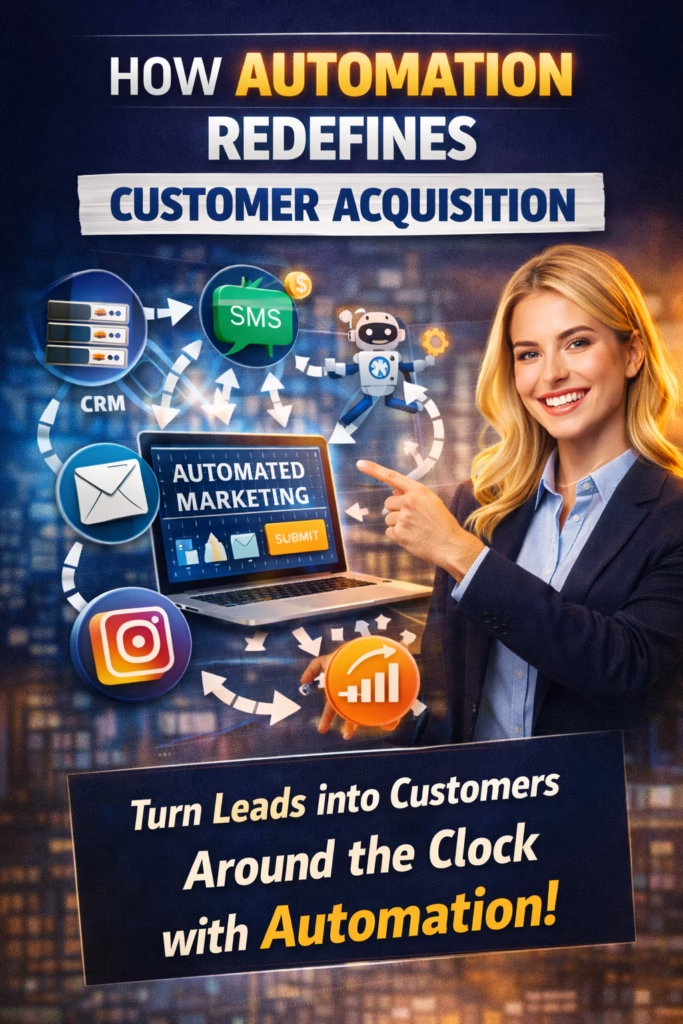
How Automation Redefines Customer Acquisition is a practical playbook for replacing manual outreach with an always-on acquisition engine—built on visibility, speed-to-lead, consistent qualification, and automated follow-up.
Note: This is general marketing guidance. Follow platform rules and confirm privacy/consent requirements before automating messages.
Introduction
How Automation Redefines Customer Acquisition starts with a simple observation: the companies winning today are not “better marketers.” They’re faster, more consistent, and less dependent on humans doing repetitive tasks perfectly.
Manual acquisition breaks at scale. It depends on someone being available, noticing messages, following up on time, remembering details, and never dropping the ball. That’s not a system—that’s stress.
Big idea: Automation doesn’t replace sales. It replaces leakage.
Expanded Table of Contents
- 1) The automation shift: why acquisition is changing
- 2) The hidden tax of manual customer acquisition
- 3) The acquisition stack: layers that scale
- 4) Visibility without ads: compounding surfaces
- 5) Offer engineering: make responses inevitable
- 6) Proof systems: trust at first glance
- 7) Lead capture: how to reduce friction
- 8) Routing automation: who gets the lead and when
- 9) Speed-to-lead: automation’s biggest ROI
- 10) Qualification automation: turn inquiries into opportunities
- 11) Follow-up automation: stop losing “ghost” revenue
- 12) Pipeline automation: stages, SLAs, and handoffs
- 13) KPIs that predict acquisition growth
- 14) 30–60–90 day rollout plan
- 15) 25 Frequently Asked Questions
- 16) 25 Extra Keywords
1) The automation shift: why acquisition is changing
Modern buyers expect immediate answers. They shop at weird hours, compare options faster, and bounce the moment a response feels slow or confusing.
Automation wins because it is:
- Instant (speed-to-lead)
- Consistent (same quality every time)
- Trackable (data reveals bottlenecks)
- Scalable (volume doesn’t cause chaos)
Rule: In competitive markets, speed and follow-up beat “more ad spend.”
2) The hidden tax of manual customer acquisition
Manual acquisition looks cheap until you measure the hidden costs.
| Manual Problem | What it causes | What automation fixes |
|---|---|---|
| Slow replies | Lost leads | Instant response + routing |
| Inconsistent messaging | Lower trust | Scripts + templates |
| Missed follow-ups | Revenue leakage | Follow-up sequences |
| No ownership | Leads fall through | Assignments + escalation |
| No tracking | No improvement | KPIs + dashboards |
Truth: The most expensive leads are the ones you already paid for—but never converted.
3) The acquisition stack: layers that scale
To understand How Automation Redefines Customer Acquisition, think in layers. Each layer removes a bottleneck.
Visibility
Where people discover you: listings, local search, social, referrals.
Offer
Why they respond: clarity, pricing, urgency, next step.
Proof
Why they trust: real photos, reviews, case wins, process.
Capture
How they raise their hand: calls, forms, SMS, DMs, chat.
Routing
Who gets the lead: ownership, backup coverage, SLAs.
Speed-to-lead
How fast they hear back: instant replies, after-hours coverage.
Qualification
Turning messages into real opportunities: the right questions.
Follow-up
Recovering ghost leads: sequences that feel helpful.
Pipeline + KPIs
Enforcing next steps and measuring what improves conversion.
Rule: You don’t “automate marketing.” You automate the journey from attention to conversion.
4) Visibility without ads: compounding surfaces
Automation works best when paired with surfaces where buyers already have intent.
High-intent surfaces to systemize
- Local search: Google Business Profile, reviews, map presence
- Listing marketplaces: inventory-style platforms where people browse to buy
- Short-form content: proof clips, FAQs, “how it works” videos
- Reactivation: email/SMS lists, past inquiries, past customers
Pro move: Build a cadence calendar so visibility is consistent even when your team is busy.
5) Offer engineering: make responses inevitable
Offers fail when they require too much thinking. Automation is most powerful when your offer is simple and your next step is obvious.
Offer blueprint
✅ Outcome (what they get)
✅ Proof (why trust)
✅ Clarity (price/terms/options)
✅ Next step (one easy action)
Examples of “easy-to-reply” CTAs
Reply YES + your zip Text “INFO” for options Send your city for availability Pick: Today / This Week / Later
Rule: If a lead can’t reply in 3 seconds, your CTA is too complicated.
6) Proof systems: trust at first glance
Automation speeds up the conversation. Proof speeds up belief.
Proof assets that scale
- Real photos of inventory/service/team
- Review screenshots and recent testimonials
- Before/after outcomes and short case summaries
- Transparent process: “here’s what happens next”
Avoid: over-polished claims. Proof beats hype every time.
7) Lead capture: how to reduce friction
Customer acquisition scales when capture feels effortless. The best capture systems accept the lead wherever they are.
Capture channels to support
| Channel | Best for | Automation advantage |
|---|---|---|
| Phone | High intent | Call routing + missed call text-back |
| SMS | Fast responses | Instant replies + follow-up sequences |
| Forms | Structured info | Auto-tagging + assignment |
| DMs | Marketplace/social | Instant qualification prompts |
| Chat | After-hours | Capture + schedule next step |
Rule: Capture first, qualify second. Don’t block leads with long forms.
8) Routing automation: who gets the lead and when
Routing is the backbone. If you don’t automate routing, every improvement upstream becomes wasted.
Routing rules (simple but strict)
- Assign an owner instantly
- Set an SLA (response time requirement)
- Escalate if SLA is missed
- Log source + timestamp + stage
Routing template
IF lead source = DM → assign to Responder
IF lead source = Form → assign to Inside Sales
IF lead source = Call → assign to On-Duty Agent
IF no response within 5 minutes → alert backup
Common failure: “Team inbox” ownership. If everyone owns it, no one owns it.
9) Speed-to-lead: automation’s biggest ROI
Speed-to-lead is the difference between “inquiry” and “customer.” Automation makes speed consistent.
Instant reply formula
Confirm ✅ + Ask 1 question + Offer next stepInstant reply examples
Yes ✅ I can help.
What city/zip are you in, and is this for today/this week or later?
Got it ✅
Quick question: what’s your timeline—urgent or planning ahead?Rule: Every first reply ends with one clear question.
10) Qualification automation: turn inquiries into opportunities
Qualification automation prevents back-and-forth and makes your team’s time more valuable.
Minimum qualification fields
- Location
- Need (what they want)
- Timeline
- Budget range (if needed)
Qualification script (copy/paste)
Perfect ✅
1) What city/zip?
2) What are you looking for?
3) Is this urgent (today/this week) or later?
Pro move: Use “choices” instead of open-ended questions to get faster replies.
11) Follow-up automation: stop losing “ghost” revenue
Most acquisition systems don’t fail at “getting leads.” They fail at converting leads who needed one extra touch.
3-touch follow-up sequence
| Timing | Message | Goal |
|---|---|---|
| 20–60 min | Quick check-in + question | Re-engage |
| Same day | Offer next step | Book |
| Next day | Alternate option | Save lead |
Follow-up templates
Quick check-in ✅
What city/zip are you in? I’ll confirm the best next step.
Still want help? ✅
Do you prefer a quick call or text to confirm details?Still shopping? ✅
If this isn’t the right fit, tell me what you want + your timeline and I’ll send better options.12) Pipeline automation: stages, SLAs, and handoffs
Pipeline stages prevent chaos and make performance measurable.
Pipeline stages (universal)
- New
- Contacted
- Qualified
- Options Sent
- Booked
- Closed
- Lost
SLAs (example)
• New → Contacted: under 5 minutes
• Contacted → Qualified: same day
• Qualified → Booked: 24–48 hours (lead dependent)
Rule: No stage = no next step = lost revenue.
13) KPIs that predict acquisition growth
| KPI | What it means | Target |
|---|---|---|
| Leads/week | Demand volume | Trending up |
| Median response time | Speed-to-lead strength | < 5 min (good), < 1 min (best) |
| Qualified rate | Conversation quality | Improve weekly |
| Booked rate | Conversion health | Improve weekly |
| Close rate | Sales performance | Optimize offers |
Pro move: Fix response time and follow-up before you buy more traffic.
14) 30–60–90 day rollout plan
Days 1–30 (Stop leakage)
- Implement instant reply + one-question qualification
- Set routing ownership + backup escalation
- Launch 3-touch follow-up SOP
- Define pipeline stages + SLAs
- Start weekly KPI tracking
Days 31–60 (Increase conversion)
- Build proof library and reuse it everywhere
- Refine offers and CTAs (make replies easier)
- Standardize “options sent” templates
- Improve qualification scripts using data
Days 61–90 (Scale acquisition)
- Increase visibility cadence (listings/content)
- Add after-hours capture coverage
- Expand best-performing surfaces
- Optimize booked and close rates using KPI feedback
Outcome: A customer acquisition engine that grows without adding stress or headcount.
15) 25 Frequently Asked Questions
1) How does automation redefine customer acquisition?
It shifts growth from manual effort to systems that respond, route, qualify, and follow up consistently—so more leads convert.
2) What should we automate first?
Speed-to-lead: instant replies and lead routing with clear ownership.
3) Will automation replace salespeople?
No. It removes repetitive tasks so sales can focus on closing.
4) Does automation reduce customer experience?
Not if it’s used for speed and clarity. Customers prefer fast, helpful responses.
5) What makes automation feel spammy?
Repetitive messages, fake personalization, and ignoring context.
6) What is speed-to-lead?
The time between a lead reaching out and receiving a response.
7) What’s a good response time target?
Under 5 minutes is good. Under 1 minute is best.
8) What is lead routing?
Assigning leads instantly to a responsible owner, with escalation if unanswered.
9) Why do leads get lost?
No ownership, slow responses, and missing follow-up.
10) How many follow-ups should we send?
At least three touches across 24–48 hours.
11) What should an instant reply include?
Confirmation, one qualification question, and a next step.
12) What’s the best first qualification question?
City/zip plus timeline (today/this week/later) is a strong default.
13) Do we need a CRM?
Yes if volume is meaningful. Stages and SLAs prevent leakage.
14) What are pipeline stages?
Defined steps like New → Contacted → Qualified → Booked → Closed.
15) What is an SLA?
A response requirement, such as “respond within 5 minutes.”
16) What’s the proof layer?
Assets that create trust fast: real photos, reviews, case examples.
17) How do we build a proof library?
Collect repeatable photo sets, testimonials, and short outcomes—then reuse them.
18) What’s the role of visibility cadence?
Consistent posting/listing keeps you present and compounding.
19) Can automation reduce ad spend?
Often, yes—by converting more of the leads you already generate.
20) How do we measure success?
Track response time, qualified rate, booked rate, and close rate weekly.
21) What’s the biggest mistake?
Buying more traffic without fixing routing and follow-up.
22) How do we avoid automation mistakes?
Use automation for speed and structure, and keep the language human and helpful.
23) How long does implementation take?
Core systems can be built in 30 days and improved over 60–90 days.
24) What businesses benefit the most?
Any business with inbound inquiries: local services, real estate, rentals, retail, medical, and B2B.
25) What’s the fastest win today?
Turn on instant replies with a city/zip + timeline question and add a 3-touch follow-up SOP.
16) 25 Extra Keywords
- How Automation Redefines Customer Acquisition
- customer acquisition automation
- automated customer acquisition system
- lead automation strategy
- speed to lead automation
- instant reply system
- automated follow up sequence
- lead routing workflow
- lead qualification automation
- pipeline stages for leads
- CRM SLA response time
- reduce lead leakage
- convert more inbound leads
- after hours lead capture
- automated appointment booking
- customer acquisition funnel automation
- marketing operations automation
- sales ops automation system
- proof assets for conversion
- visibility cadence strategy
- listing velocity strategy
- KPIs for customer acquisition
- booked rate optimization
- 30 60 90 day acquisition plan
- scalable acquisition engine













