
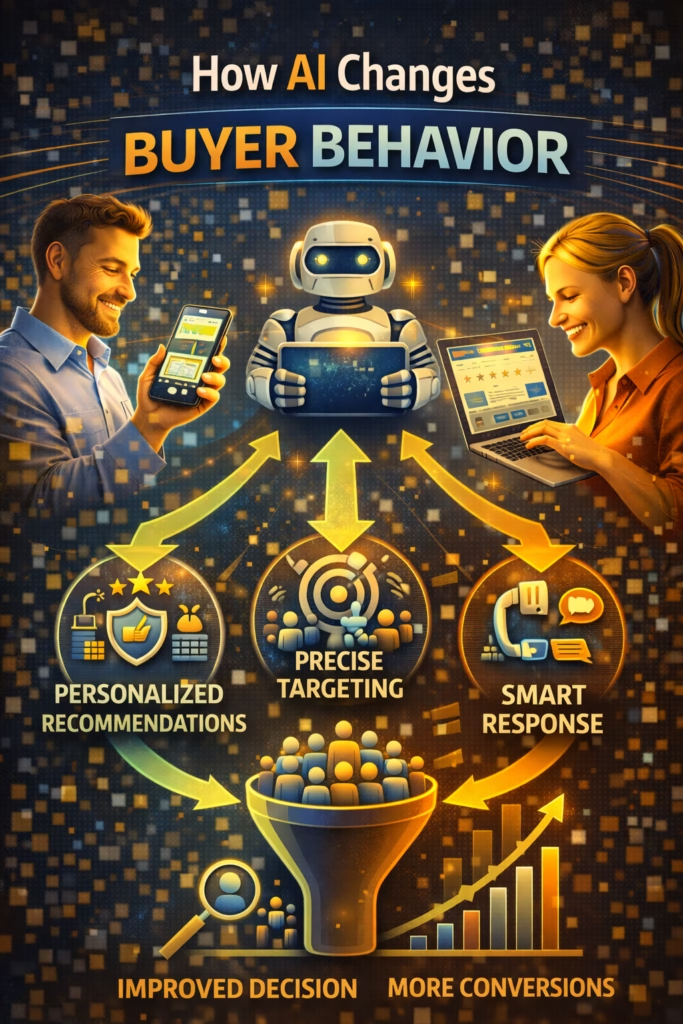
How AI Changes Buyer Behavior
How AI Changes Buyer Behavior is the new reality of buying—faster discovery, more comparison, higher expectations, and messaging-based decisions.
Note: This is general guidance. Use AI responsibly, keep offers accurate, and stay compliant with platform policies when automating any messaging or posting.
Introduction
How AI Changes Buyer Behavior can be summed up in one sentence: buyers now move faster than your old process.
AI didn’t just add a new marketing channel. It changed how people decide. Buyers can now discover options, compare prices, read opinions, and draft questions instantly—often without ever visiting a website.
That means the “real funnel” happens in the first 30 seconds of discovery, not after a form fill.
Big idea: AI reduces friction for buyers, which raises expectations for sellers.
Expanded Table of Contents
- 1) The new AI-driven buyer journey
- 2) AI accelerates discovery (where buyers start now)
- 3) AI increases comparison (why buyers shop harder)
- 4) AI changes trust signals (what buyers believe)
- 5) AI raises speed expectations (instant is the baseline)
- 6) Chat-based buying (the new conversion pathway)
- 7) Personalization and the “option menu” effect
- 8) Price transparency and the new negotiation behavior
- 9) Content that wins in the AI era
- 10) The demand capture systems businesses need now
- 11) KPIs that reveal AI-driven buyer behavior
- 12) 30–60–90 day rollout plan
- 13) 25 Frequently Asked Questions
- 14) 25 Extra Keywords
1) The new AI-driven buyer journey
In many industries, the classic journey was linear: ad → website → form → call → close. AI made the journey non-linear and faster.
What the AI buyer journey looks like now
- Instant discovery: buyers find options via AI-assisted search, marketplaces, short-form social, and reviews.
- Rapid validation: they scan proof signals (photos, specifics, credibility, transparency).
- Fast messaging: they send multiple inquiries to compare speed, clarity, and availability.
- Decision by response: whoever responds fastest with the clearest next step often wins.
Translation: Buyers are testing your operational competence in the first message.
2) AI accelerates discovery (where buyers start now)
AI changes discovery by reducing the work required to explore options. Buyers can ask AI to:
- Summarize choices by budget, features, or location
- Generate comparison questions to ask sellers
- Identify “best value” options
- Find alternatives instantly
What this means for businesses
- Visibility must be everywhere buyers look (marketplaces, social, search)
- Listings and pages must be specific and structured
- Proof content must be obvious at a glance
Rule: In the AI era, vague marketing disappears. Specificity wins.
3) AI increases comparison (why buyers shop harder)
AI doesn’t make buyers less serious—it makes them more informed. That increases comparison behavior:
- More vendors get contacted
- Buyers ask smarter questions
- They expect clear answers and fast confirmation
The new comparison battleground
| What buyers compare | What they infer | How to win |
|---|---|---|
| Response time | Reliability | Instant replies + routing |
| Clarity of offer | Trust | Simple price + next step |
| Proof signals | Legitimacy | Real photos, specifics |
| Availability | Convenience | Options-based scheduling |
Avoid: long explanations before asking the next-step question. Buyers will move on.
4) AI changes trust signals (what buyers believe)
AI didn’t eliminate scams—it made buyers more suspicious. That means trust signals matter more than ever.
New trust signals buyers look for
- Real photos that show context (not just stock images)
- Specific details (dimensions, condition, availability windows)
- Transparent pricing and terms
- Consistent branding (same name, same messaging, same proof)
- Professional communication and fast replies
Rule: Proof beats persuasion.
5) AI raises speed expectations (instant is the baseline)
When AI gives buyers instant answers, they expect sellers to respond quickly too. Slow response feels like:
- “They’re not serious.”
- “They’re unreliable.”
- “This isn’t real.”
Instant reply (universal)
Yes — I can help ✅
Are you looking to do this today or this week?

What city/zip are you in? I’ll confirm the fastest next step.
Pro move: Your first message should ask one question that qualifies timeline + location.
6) Chat-based buying (the new conversion pathway)
AI is pushing conversion into messaging. Buyers prefer fast, low-friction chats over forms and calls.
Why messaging converts in the AI era
- Instant back-and-forth
- Easy to compare sellers
- Easy to ask “one last question”
- Feels lower commitment than a call
The messaging funnel (simple)
Message → Qualify → Offer Options → Book Next Step → Confirm → CloseRule: If you don’t have a messaging funnel, you don’t have a funnel.
7) Personalization and the “option menu” effect
AI makes buyers expect “options.” They don’t want one pitch—they want the best match for their context.
How to personalize without overworking
- Create 3 option categories: Budget, Best Value, Premium
- Ask one qualifier question
- Respond with a simple option menu
Option menu reply (copy/paste)
Got it ✅ Based on what you said, here are 3 options:
A) Budget: $___ (fastest availability)
B) Best Value: $___ (most popular)
C) Premium: $___ (best upgrade)

Which one fits best—and what city are you in?
Pro move: Options reduce decision friction and increase bookings.
8) Price transparency and new negotiation behavior
AI makes pricing easier to compare. Buyers will ask:
- “Is this the best price?”
- “What’s included?”
- “Can you do it sooner?”
How to handle “lowest price?”
I can help ✅
Is your priority the lowest price, or the best overall value/quality?

Tell me your city and timeline (today/this week) and I’ll send the best match.
Avoid: negotiating in circles. Move to options and next steps.
9) Content that wins in the AI era
AI-driven buyers respond to content that is:
- Specific (details, numbers, real photos)
- Structured (easy to scan, easy to understand)
- Proof-led (trust signals are obvious)
- Next-step focused (clear CTA)
High-performing content structure
Hook → Proof → Price/Offer → Availability → CTA (city + timeline)Rule: If a buyer can’t understand the offer in 10 seconds, they keep scrolling.
10) The demand capture systems businesses need now
To adapt to AI-driven buyer behavior, you need systems that keep up with speed and volume.
Core systems
- Speed-to-lead: instant replies + routing
- Qualification: one-question filter + tags
- Follow-up SOP: 3-touch sequence
- Pipeline: stages + ownership
- Tracking: response time, booked rate, close rate
Pro move: Most “marketing improvements” fail because the capture system is weak. Fix capture first.
11) KPIs that reveal AI-driven buyer behavior
| KPI | What it reveals | Target |
|---|---|---|
| Median response time | Speed expectations | < 5 min good, < 1 min best |
| Messages/week | Demand capture volume | Track trend weekly |
| Qualified rate | Lead quality | Improve with scripts |
| Booked rate | Conversion power | Improve with options |
| Close rate | Revenue impact | Optimize offer + follow-up |
Rule: Buyers may change behavior—KPIs tell you what’s real in your market.
12) 30–60–90 day rollout plan
Days 1–30 (Fix speed and follow-up)
- Deploy instant reply scripts and routing
- Implement 3-touch follow-up SOP
- Define pipeline stages and ownership
- Track response time and booked rate weekly
Days 31–60 (Build proof and option menus)
- Standardize proof photos and structured offers
- Create 3-tier option menus (budget/value/premium)
- Improve titles/descriptions for fast scanning
- Increase visibility cadence responsibly
Days 61–90 (Scale visibility + optimize)
- Expand surface area (more angles, not duplicates)
- Double down on best-performing offers and CTAs
- Optimize weekly using KPI trends
- Strengthen ops capacity as volume increases
13) 25 Frequently Asked Questions
1) How does AI change buyer behavior?
AI accelerates discovery, increases comparison, raises expectations for instant responses, and shifts more decisions into messaging-based conversations.
2) Are buyers more price-sensitive because of AI?
Often yes, because comparison is faster. But buyers also value speed, clarity, and trust.
3) What do buyers expect now?
Fast replies, clear offers, and proof signals that reduce uncertainty.
4) What is AI-assisted search?
Search behavior where buyers use AI tools to summarize options, compare features, and generate questions.
5) Does AI reduce the need for a website?
Not always, but many decisions happen before a website visit. Proof and messaging matter more.
6) Why is messaging more important now?
Because it’s the lowest-friction way for buyers to compare and move forward.
7) What’s the best first reply?
Confirm availability, ask timeline, ask city, and offer next steps.
8) How fast should I respond?
Under 5 minutes is good; under 1 minute is best.
9) What is “speed-to-lead”?
How quickly you respond to an inquiry.
10) Why does speed-to-lead matter?
Buyers message multiple options. The fastest responder often wins.
11) How do I reduce ghosting?
Use options-based replies and a follow-up SOP.
12) What is a follow-up SOP?
A simple sequence of messages sent at set times to re-engage leads.
13) How many follow-ups should I send?
Three touches is a strong baseline.
14) What is an option menu?
A 3-tier set of choices (budget/value/premium) that reduces decision friction.
15) Does personalization matter more now?
Yes. Buyers expect relevance, not generic pitches.
16) What proof signals matter most?
Real photos, specific details, transparent pricing, and consistent branding.
17) Should I use AI in customer messaging?
It can help with consistency, but keep responses accurate and compliant.
18) What should AI not do?
Spam duplicates, misrepresent offers, or invent details.
19) What’s the biggest mistake businesses make?
Trying to increase traffic without fixing conversion systems.
20) What KPIs matter in the AI era?
Response time, messages, qualified rate, booked rate, close rate.
21) How do I qualify leads faster?
Ask one question that reveals timeline and location.
22) Can AI make buyers more skeptical?
Yes—buyers are more aware of scams and demand more proof.
23) How long until systems show results?
Often weeks for conversion improvements; 60–90 days for compounding outcomes.
24) Does this apply to local services?
Yes—local buyers now discover and message faster than ever.
25) What’s the best next step today?
Deploy instant replies and a 3-touch follow-up SOP.
14) 25 Extra Keywords
- How AI Changes Buyer Behavior
- AI buyer behavior
- AI changes purchasing decisions
- AI search behavior
- AI assisted search
- chat based buying
- conversation based selling
- AI demand generation
- AI demand capture
- speed to lead expectations
- instant reply scripts
- follow up SOP leads
- reduce lead ghosting
- proof signals marketing
- trust signals in listings
- personalized offers system
- option menu sales script
- price transparency behavior
- marketplace buyer behavior
- social discovery buyer journey
- short form content conversion
- modern buyer journey 2026
- messaging funnel strategy
- KPI tracking for conversion
- 30 60 90 day rollout plan













