

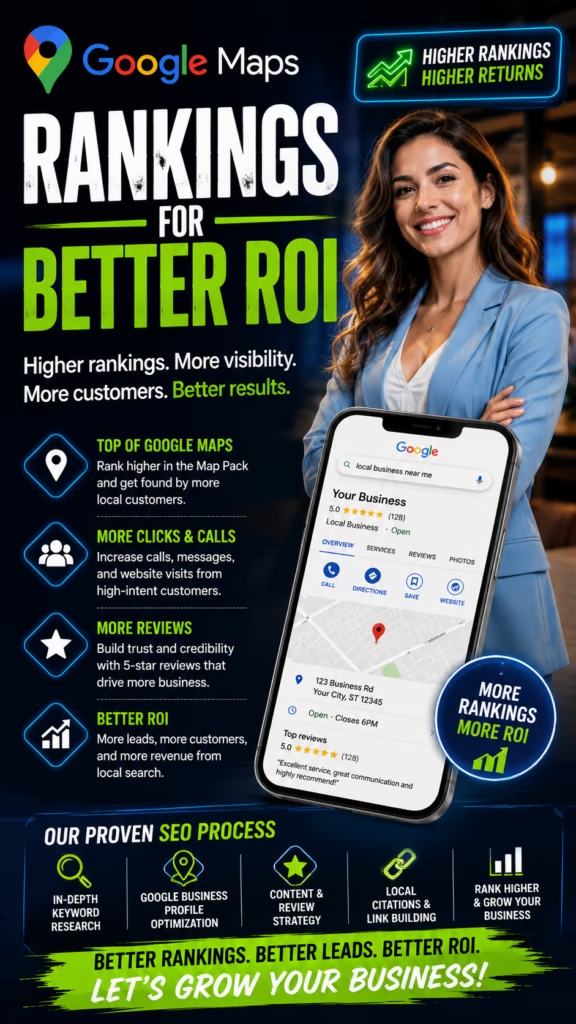
Google Maps Rankings for Better ROI
Google Maps Rankings for Better ROI explains how local businesses can turn stronger map visibility into more qualified calls, website clicks, appointments, reviews, booked jobs, and measurable revenue.
Introduction
Google Maps Rankings for Better ROI is about more than appearing higher in local search. The real goal is not just ranking. The real goal is generating profitable local visibility that turns into calls, messages, website visits, quote requests, appointments, sales, booked jobs, and revenue.
Many local businesses spend money on ads, SEO, social media, directories, and lead platforms without knowing which channels actually create return. Google Maps can become one of the highest-value local marketing assets because people searching there often have strong intent. They are looking for a nearby business, comparing options, checking reviews, and deciding who to contact.
Google Maps rankings create better ROI when they produce qualified local actions that can be tracked from search visibility to revenue.
A strong Google Maps strategy includes Google Business Profile optimization, correct categories, clear services, strong photos, consistent reviews, local keywords, Google Posts, Q&A, citations, website support, call tracking, lead qualification, and revenue attribution.
Main idea: Google Maps Rankings for Better ROI is about turning local search visibility into measurable business growth, not vanity rankings.
Table of Contents
- 1) Why Google Maps rankings affect ROI
- 2) Ranking is only valuable when it creates action
- 3) Understanding Google Maps ROI
- 4) Optimizing Google Business Profile for return
- 5) Categories and services that improve lead quality
- 6) Reviews that increase conversion rates
- 7) Photos that turn visibility into trust
- 8) Local keywords that attract better buyers
- 9) Google Posts for active local visibility
- 10) Website support for better Maps ROI
- 11) Calls, clicks, directions, and messages
- 12) Tracking cost per lead from Google Maps
- 13) Tracking booked jobs and revenue
- 14) Improving lead quality from Google Maps
- 15) Reducing wasted local marketing spend
- 16) Industries that benefit from Google Maps ROI
- 17) Monthly optimization checklist
- 18) Common ROI mistakes
- 19) Advanced ROI improvement tips
- 20) Final thoughts
- 21) FAQs
- 22) Extra keywords
1) Why Google Maps Rankings Affect ROI
Google Maps rankings affect ROI because local search visibility can place a business in front of people who are already looking for a nearby solution. These users may need a contractor, roofer, plumber, dentist, HVAC company, concrete contractor, landscaper, mover, pest control company, auto dealer, retailer, restaurant, or local service provider.
When a business appears higher and looks more trustworthy, it can receive more calls, website clicks, direction requests, messages, and appointment opportunities. Better rankings can reduce dependence on expensive paid ads and third-party lead platforms when the profile converts well.
Google Maps rankings can improve ROI by creating:
- More high-intent local visibility
- More qualified phone calls
- More website clicks
- More direction requests
- More estimate requests
- More appointment bookings
- More review-driven trust
- More repeat local discovery
- Lower cost per lead over time
- More trackable revenue opportunities
Google Maps ROI improves when visibility turns into real customer action.
2) Ranking Is Only Valuable When It Creates Action
A top ranking is not valuable if it does not generate calls, clicks, appointments, or sales. Ranking should be measured by business outcomes, not only position. A profile that ranks well but has weak reviews, poor photos, confusing services, or no tracking may not produce strong ROI.
The goal is to rank, convert, and track. Each part matters.
Google Maps visibility path:
Ranking
Profile view
Trust evaluation
Call or click
Lead qualification
Appointment or sale
Revenue
ROI measurement
Better ROI comes from improving both ranking and conversion.
3) Understanding Google Maps ROI
Google Maps ROI measures the return from the time, money, and effort invested into Google Business Profile optimization and local SEO. The simplest version compares what the business spends to what it earns from Google Maps leads.
To understand ROI, businesses should track leads by source, close rate, average job value, customer lifetime value, and total revenue generated from map visibility.
Simple ROI formula:
ROI = Revenue from Google Maps leads - Marketing cost / Marketing cost

Example:
$20,000 revenue - $2,000 cost = $18,000 gain
$18,000 / $2,000 = 9x ROI
Google Maps ROI becomes clearer when lead source and revenue are tracked together.
4) Optimizing Google Business Profile for Return
Google Business Profile should be optimized for both search visibility and customer action. The profile should clearly explain what the business does, where it serves, why it is trustworthy, and how customers can contact it.
ROI-focused Google Business Profile elements:
- Accurate business name
- Correct primary category
- Relevant secondary categories
- Complete services
- Strong business description
- Real photos
- Consistent reviews
- Review responses
- Website link
- Trackable phone and lead process
A complete profile gives customers more confidence and creates more measurable lead opportunities.
5) Categories and Services That Improve Lead Quality
Categories and services help Google understand what searches the business should appear for. They also help customers understand whether the business matches their need. Better category and service alignment can improve lead quality.
A business should choose categories that match real services and add detailed service offerings that reflect profitable work.
Examples of service optimization:
Roofer: roof repair, roof replacement, storm damage, inspections
Concrete contractor: driveways, patios, slabs, stamped concrete
HVAC company: AC repair, furnace repair, maintenance, installation
Mover: local moving, apartment moves, furniture delivery
Pest control: ants, roaches, rodents, mosquitoes, termites
Contractor: remodeling, kitchen updates, bathrooms, additions
Better services can attract customers who are closer to buying.
6) Reviews That Increase Conversion Rates
Reviews influence ROI because they affect whether people choose to call. A business with stronger reviews may convert more profile views into leads. Review quantity, quality, recency, and relevance all matter.
Businesses should ask real customers for honest reviews after successful work and respond professionally to every review.
Review signals that can improve ROI:
- Higher review count
- Strong average rating
- Recent reviews
- Service-specific review language
- Location-specific review language
- Professional owner responses
- Real customer detail
- Consistent review growth
Reviews help turn map visibility into trust, and trust turns into leads.
7) Photos That Turn Visibility Into Trust
Photos can improve ROI because they help customers believe the business is real, active, and capable. For service businesses, photos show proof of work. For retailers, photos show inventory. For restaurants, photos show food and atmosphere. For contractors, photos show completed projects.
ROI-focused photo ideas:
Completed projects
Before-and-after results
Team photos
Branded vehicle photos
Storefront photos
Showroom photos
Product photos
Service equipment
Job-site photos
Customer result photos
Strong photos can increase the percentage of profile visitors who call or click.
8) Local Keywords That Attract Better Buyers
Local keywords help connect the business to the searches most likely to generate revenue. Use service, city, neighborhood, problem, and buyer-intent keywords naturally across the profile, website, posts, services, and Q&A.
High-intent local keyword examples:
- service near me
- local service provider
- emergency service near me
- same-day service if accurate
- free estimate if offered
- service company in city
- best local contractor
- nearby repair company
- local appointment availability
- service area near me
Better local keywords help attract customers with stronger intent and clearer needs.
9) Google Posts for Active Local Visibility
Google Posts help keep the profile active and can support ROI by highlighting offers, service availability, completed projects, seasonal reminders, events, updates, and customer education.
Google Post ideas for ROI:
Recent project completed
Seasonal service reminder
Appointment openings
Limited availability update if accurate
New product arrival
Customer review highlight
Service-area announcement
Before-and-after result
Helpful customer tip
Estimate availability reminder
Google Posts help customers see that the business is active and ready to help.
10) Website Support for Better Maps ROI
The website connected to the Google Business Profile should support the same services and locations the business wants to rank for. A weak website can reduce conversions after customers click from Maps.
The website should have strong landing pages, clear CTAs, service pages, location pages, reviews, photos, fast loading speed, and simple contact options.
Website elements that support Google Maps ROI:
- Service pages
- City pages
- Project galleries
- Review sections
- Clear phone number
- Contact forms
- Fast page speed
- Mobile-friendly design
- Trust badges if accurate
- Strong calls to action
Google Maps rankings perform better when the website converts clicks into leads.
11) Calls, Clicks, Directions, and Messages
Google Maps actions are key ROI signals. Calls, website clicks, direction requests, and messages show customer interest. Each action should be tracked and connected to real business outcomes when possible.
Google Maps action signals:
Phone calls
Website clicks
Direction requests
Messages if enabled
Bookings if available
Menu or product views if relevant
Appointment clicks
Quote requests
Form submissions
Review interactions
Actions are more important than impressions because they show customer intent.
12) Tracking Cost Per Lead From Google Maps
Cost per lead helps businesses understand whether Google Maps optimization is efficient. To calculate cost per lead, divide the monthly investment by the number of qualified leads generated from Google Maps.
Cost per lead formula:
Monthly Google Maps marketing cost / Qualified Google Maps leads = Cost per lead

Example:
$1,000 cost / 40 qualified leads = $25 cost per lead
Lower cost per lead can improve ROI, but lead quality and close rate also matter.
13) Tracking Booked Jobs and Revenue
Lead tracking is useful, but revenue tracking is better. A business should know how many Google Maps leads became appointments, sales, booked jobs, signed contracts, or repeat customers.
Revenue tracking should include:
- Lead source
- Customer name
- Service requested
- City or service area
- Appointment status
- Quote amount
- Closed sale amount
- Profit margin if tracked
- Repeat purchase potential
- Referral value
Revenue attribution shows whether Google Maps is creating profit, not just leads.
14) Improving Lead Quality From Google Maps
Better rankings can bring more leads, but better profile clarity can bring better leads. A profile should communicate what services are offered, what areas are served, what type of customers are a good fit, and how the process works.
Ways to improve lead quality:
List accurate services
Use clear service-area details
Show real project photos
Explain pricing or estimate process
Add FAQs in Q&A
Use website landing pages
Respond to reviews
Track bad-fit leads
Update profile based on lead patterns
Use stronger CTAs
Better lead quality improves ROI even if total lead volume stays the same.
15) Reducing Wasted Local Marketing Spend
Google Maps rankings can reduce wasted spend by creating more organic visibility from people already searching locally. This can help businesses rely less on low-quality lead sellers, expensive broad ads, or channels that do not produce measurable revenue.
Google Maps can reduce waste by improving:
- Organic local visibility
- High-intent traffic
- Trust before contact
- Lead source clarity
- Lower cost per lead
- Better close rate
- Review-driven conversion
- Long-term visibility
Better Maps ROI often comes from replacing random marketing with trackable local intent.
16) Industries That Benefit From Google Maps ROI
Many local industries can benefit from Google Maps rankings because customers use maps to compare nearby options. The best results usually come from businesses with strong local intent, clear service areas, and measurable leads.
Industries that benefit:
Contractors
Roofers
Concrete businesses
HVAC companies
Plumbers
Electricians
Pest control companies
Landscapers
Movers
Cleaning companies
Auto dealers
Dentists
Med spas
Restaurants
Retailers
Google Maps ROI is strongest when customers search locally before choosing a provider.
17) Monthly Optimization Checklist
Google Maps rankings improve through consistent work. Businesses should update the profile monthly and track whether those updates are helping lead generation and ROI.
Monthly Google Maps ROI checklist:
- Check business information accuracy
- Add new photos
- Publish Google Posts
- Request reviews from real customers
- Respond to all reviews
- Update services if needed
- Review search terms
- Track calls and clicks
- Review booked jobs
- Calculate cost per lead and revenue
Monthly optimization keeps the profile active and keeps ROI measurement accurate.
18) Common ROI Mistakes
Many businesses track rankings but fail to track revenue. Others generate visibility but lose leads because their profile looks weak, their reviews are outdated, their website is confusing, or their follow-up is slow.
Common Google Maps ROI mistakes:
- Tracking rankings only
- No call tracking
- No lead source tracking
- No revenue attribution
- Weak review strategy
- Poor profile photos
- Incomplete services
- Slow follow-up
- Weak website conversion
- No monthly optimization
Google Maps ROI fails when businesses rank but do not track or convert the traffic.
19) Advanced ROI Improvement Tips
Advanced Google Maps ROI comes from improving every stage of the local search funnel. This includes visibility, profile conversion, website conversion, lead qualification, follow-up, close rate, and revenue tracking.
Advanced ROI tips:
Track calls by source
Use dedicated landing pages
Improve review velocity
Add service-specific photos
Build city-specific pages
Use Q&A for buyer objections
Update Google Posts weekly
Monitor competitor profiles
Track close rate by keyword
Calculate revenue by lead source
Improve speed to lead
Retarget website visitors if applicable
Advanced ROI optimization means improving the full path from search to sale.
20) Final Thoughts
Google Maps Rankings for Better ROI is about making local visibility profitable. Ranking higher is helpful, but the real goal is turning that visibility into qualified calls, website clicks, appointments, sales, booked jobs, and measurable revenue.
The strongest strategy includes complete Google Business Profile optimization, accurate categories, strong services, review growth, real photos, local keywords, Google Posts, website support, call tracking, lead tracking, and revenue attribution.
Final takeaway: Better Google Maps rankings create better ROI when they attract high-intent local customers and the business tracks every step from visibility to revenue.
21) FAQs
1) What are Google Maps Rankings for Better ROI?
Google Maps Rankings for Better ROI means improving local map visibility in a way that generates more qualified leads, appointments, sales, and measurable revenue.
2) Do Google Maps rankings improve ROI?
Yes. Strong Google Maps rankings can improve ROI when they produce qualified calls, website clicks, appointments, and sales.
3) Is ranking alone enough?
No. Ranking only matters when the profile converts visibility into real customer action.
4) How do you measure Google Maps ROI?
Measure Google Maps ROI by tracking marketing cost, qualified leads, booked jobs, closed sales, revenue, and profit.
5) What is a good Google Maps ROI metric?
Useful metrics include cost per lead, cost per booked job, close rate, revenue per lead, and total revenue from Google Maps.
6) What profile elements affect ROI?
Categories, services, photos, reviews, review responses, business description website link, posts, Q&A, and contact options can affect ROI.
7) Do reviews improve Google Maps ROI?
Yes. Strong reviews can increase trust and improve the percentage of searchers who call or click.
8) Do photos improve ROI?
Yes. Real photos can help customers trust the business and take action.
9) Should businesses use Google Posts?
Yes. Google Posts can highlight services, offers, projects, updates, seasonal reminders, and appointment availability.
10) How do local keywords affect ROI?
Local keywords help attract customers searching for specific services in specific areas, which can improve lead quality.
11) Does the website affect Google Maps ROI?
Yes. A strong website can convert Google Maps clicks into calls, forms, appointments, and sales.
12) Should businesses track Google Maps calls?
Yes. Call tracking helps connect Google Maps visibility to real leads and revenue.
13) Should businesses track website clicks from Google Maps?
Yes. Website clicks should be tracked through analytics, forms, call tracking, and lead source fields.
14) What is cost per lead from Google Maps?
Cost per lead is the monthly Maps marketing cost divided by the number of qualified Google Maps leads.
15) What is revenue attribution?
Revenue attribution means connecting closed sales or booked jobs back to the original lead source, such as Google Maps.
16) How can businesses improve lead quality from Google Maps?
Use accurate services, clear service areas, real photos, FAQs, strong CTAs, review responses, and better landing pages.
17) Can Google Maps reduce paid ad spend?
Google Maps can reduce part of paid ad spend for some businesses by generating more organic local leads.
18) What businesses benefit most from Google Maps ROI?
Contractors, roofers, concrete companies, HVAC businesses, plumbers, electricians, pest control companies, movers, dentists, retailers, restaurants, and local service providers can benefit.
19) How often should Google Business Profile be updated?
Businesses should update the profile regularly with photos, posts, reviews, service changes, accurate hours, and new information.
20) What mistakes hurt Google Maps ROI?
Tracking rankings only, ignoring reviews, weak photos, incomplete services, no lead tracking, no revenue attribution, and slow follow-up can hurt ROI.
21) How long does Google Maps ROI take?
Timing varies by competition, profile strength, reviews, website support, service area, and consistency of optimization.
22) Is Google Maps better than paid ads?
Google Maps and paid ads can both work. Google Maps often provides long-term local visibility, while paid ads can create faster paid exposure.
23) Should businesses track booked jobs, not just leads?
Yes. Booked jobs and revenue are stronger ROI indicators than raw lead count.
24) How does Google Maps fit into local marketing?
Google Maps should support a larger local system that includes local SEO, reviews, website pages, social media, paid ads, and follow-up automation.
25) What is the main goal of Google Maps rankings for better ROI?
The main goal is to turn local search visibility into qualified leads, booked appointments, sales, revenue, and profitable growth.
25) Extra Keywords
- Google Maps Rankings for Better ROI
- Google Maps ROI
- local SEO ROI
- Google Business Profile ROI
- Google Maps ranking
- local lead generation
- Google Maps lead tracking
- Google Maps cost per lead
- Google Maps revenue tracking
- Google Maps conversion optimization
- Google Maps local leads
- Google Business Profile optimization
- local search ROI
- Google Maps calls
- Google Maps website clicks
- Google Maps review strategy
- Google Maps photos
- Google Posts ROI
- local SEO lead tracking
- local marketing ROI
- Google Maps appointment generation
- Google Maps service-area SEO
- Google Maps business growth
- Google Maps sales tracking
- Google Maps ROI strategy













