

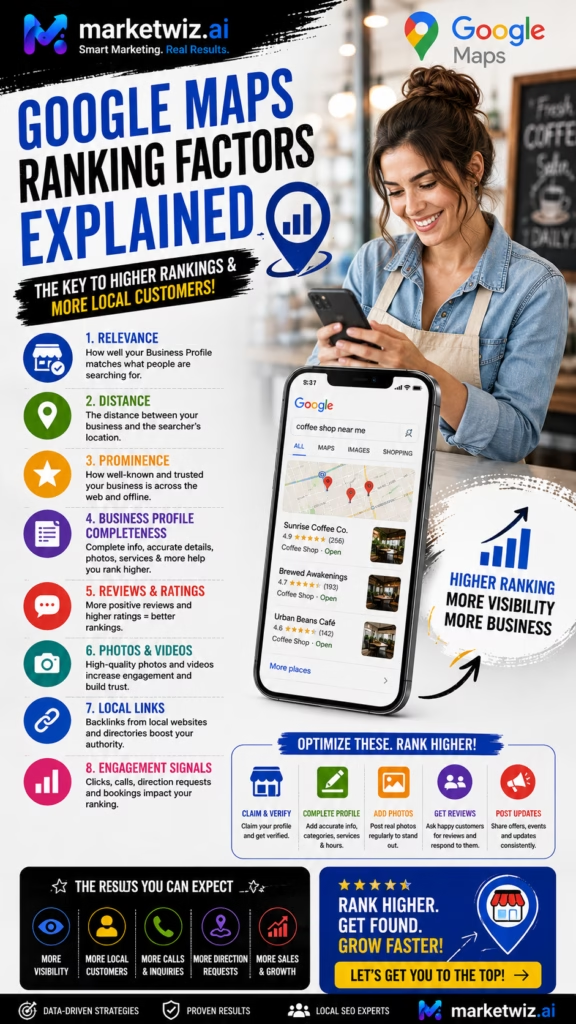
Google Maps Ranking Factors Explained
Google Maps ranking factors explained properly means separating what matters most from local SEO myths. Google describes local results around three major concepts: relevance, distance, and prominence. Those broad factors are supported by business information, categories, reviews, website authority, links, profile completeness, photos, services, reputation, local content, citations, and other signals that help Google and customers understand a business. The strongest local SEO strategy therefore does not depend on one trick. It builds a complete local authority system designed to increase visibility, trust, qualified leads, and measurable revenue.
Google Maps rankings are often discussed as though there is one secret signal that determines which businesses appear first.
That is the wrong way to think about local search.
Local visibility is produced by multiple factors working together.
Google summarizes the core system using three major concepts: relevance, distance, and prominence.
Relevance asks whether the business matches what the customer wants.
Distance considers the relationship between the business and the location associated with the search.
Prominence considers how established, recognized, and authoritative the business appears.
Underneath those three concepts are many practical SEO activities.
Accurate Business Profile information can improve understanding.
Correct categories can strengthen service relevance.
Genuine reviews can strengthen reputation and prominence.
Website SEO can reinforce services, products, geographic coverage, and authority.
Citations can reinforce business identity.
Backlinks and legitimate mentions can strengthen broader web prominence.
Project pages, product pages, service pages, and local content can demonstrate expertise and geographic experience.
None of these factors operates completely independently.
Strong local SEO is therefore best treated as a complete ecosystem.
The Google Maps Ranking Framework
Relevance + Distance + Prominence + Accurate Business Information + Strong Website Authority + Genuine Reputation + Local Trust + Consistent Optimization = Stronger Organic Local Visibility
The Three Core Google Maps Ranking Factors
Relevance
How closely the business matches what the customer appears to be searching for.
Distance
How far the business is from the location associated with the customer's search.
Prominence
How established and well known the business appears online and offline.
Business Information
Accurate profile information helps search systems understand what the company does.
Website Authority
Strong organic SEO can reinforce services, geography, credibility, and prominence.
Customer Reputation
Genuine reviews and broader reputation can influence prominence and customer choice.
Ranking Factor #1: Relevance
Relevance is the relationship between what the customer searches for and what Google understands about the business.
Business Category
Categories help communicate what type of company the profile represents.
Services
Accurate service information can provide additional context around what the company offers.
Products
Product-based businesses can use genuine product information where supported.
Business Description
A useful description can help customers understand the company and its core offerings.
Website Content
Detailed service and product pages can reinforce the topics associated with the business.
Local Content
Useful geographic content can reinforce where services are genuinely offered.
Relevance Is About Clarity
The clearer and more accurately a business communicates what it does, the easier it is for customers and search engines to understand when that business may be relevant.
Ranking Factor #2: Distance
Distance makes local SEO fundamentally different from many traditional organic searches.
Two customers searching for the same service from different neighborhoods may see different local results.
Searcher Location
The physical location associated with the search can affect which businesses appear.
Business Location
A business naturally has stronger geographic proximity to some customers than others.
Search Geography
Searches that include a specific city or neighborhood can provide additional geographic context.
Service Areas
Service-area information should represent where the business genuinely operates.
Distance Cannot Be Fully Optimized Away
A business cannot manipulate physical geography through normal SEO.
This means a company should focus heavily on the ranking variables it can control.
Ranking Factor #3: Prominence
Prominence is broader than the Google Business Profile itself.
It involves the overall reputation and authority of the business.
Reviews
Review quantity and customer ratings can contribute to local prominence.
Links
Reputable websites linking to the company can contribute to broader web authority.
Directories and Citations
Legitimate references across the web can reinforce business identity.
Website SEO
Strong organic visibility can reinforce broader search prominence.
Brand Recognition
Well-known businesses can have naturally stronger prominence.
Local Reputation
Community presence, associations, local partnerships, projects, and genuine customer relationships can help strengthen the overall brand.
Google Business Profile Completeness Supports Local Relevance
Businesses should complete relevant profile information accurately rather than leaving important fields empty.
- Business name
- Primary category
- Relevant secondary categories
- Address or service-area information
- Phone number
- Website
- Business hours
- Services
- Products where appropriate
- Business description
- Photos
- Supported profile attributes
More information is not automatically better if the information is inaccurate.
Accuracy comes first.
Business Name Accuracy Matters More Than Keyword Stuffing
Some businesses attempt to manipulate local rankings by adding unnecessary service and city keywords to their profile name.
Use the Real-World Business Name
The profile should represent the company as customers actually know it.
Avoid Artificial Keywords
Do not change the profile name simply to target additional searches.
Build Relevance Through Legitimate Fields
Categories, services, website pages, products, and content provide legitimate places to explain the business.
Business Categories Are a Major Relevance Signal
Primary Category
Choose the most accurate category available for the company's primary business.
Secondary Categories
Use relevant secondary categories for significant genuine offerings.
Avoid Irrelevant Categories
Selecting categories unrelated to the actual company can create confusion.
Review Category Options Periodically
Available Google Business Profile categories can change over time.
Category Strategy Should Reflect Reality
Choose enough categories to describe the core business accurately rather than treating every available category as another keyword target.
Products and Services Reinforce Business Relevance
Use Real Services
List services the company genuinely performs.
Use Clear Customer Language
Customers should understand each service without needing internal company terminology.
Keep Services Updated
Remove discontinued offerings.
Use Products Where Appropriate
Retail and product-driven businesses can describe genuine product categories where supported.
Accurate Address and Service-Area Information Matter
Local SEO should represent real-world business operations.
Physical Locations
Use legitimate customer-facing locations when eligible.
Service-Area Businesses
Businesses that travel to customers should represent their operation according to the applicable Business Profile requirements.
Avoid Fake Offices
Artificial locations created simply for rankings can create serious problems.
Maintain Accurate Geographic Information
Customers should never be directed to a location where the business does not actually operate.
Accurate Business Hours Improve Customer Experience
Regular Hours
Keep everyday hours current.
Holiday Hours
Update special schedules when necessary.
Appointment-Based Businesses
Represent customer availability accurately.
Consistency
Major public-facing sources should not display conflicting hours unnecessarily.
Google Reviews Influence Prominence and Customer Decisions
Reviews are one of the most visible elements in local search.
Earn Genuine Reviews
Invite real customers to share honest experiences.
Build Reviews Consistently
Review generation should be an ongoing customer-experience process.
Make Review Requests Easy
Provide customers with a straightforward path to provide feedback.
Avoid Review Manipulation
Fake, purchased, or deceptive reviews create unnecessary risk.
Review Volume and Positive Ratings Can Matter
A strong review profile can support both local prominence and customer trust.
Review Count
More genuine feedback can demonstrate that the business has served more customers.
Review Score
Higher customer satisfaction can influence how shoppers evaluate competing businesses.
Review Recency
Recent authentic customer feedback can help potential buyers understand the current customer experience.
Review Quality
Detailed authentic reviews can provide valuable context to future customers.
Reviews Have Two Jobs
They can contribute to broader local prominence while also helping real customers decide whether they trust the business enough to call, visit, or purchase.
Review Responses Support Reputation Management
Respond Naturally
Avoid copying exactly the same response to every customer.
Thank Positive Customers
Show genuine appreciation.
Handle Negative Feedback Professionally
Avoid public arguments and emotional responses.
Protect Privacy
Do not expose customer details unnecessarily.
Business Photos Improve Profile Quality and Customer Confidence
Photos help customers understand the business before making contact.
Exterior Photos
Help customers recognize physical locations.
Interior Photos
Show offices, stores, showrooms, restaurants, gyms, clinics, or customer spaces.
Team Photos
Introduce the people behind the company.
Project Photos
Contractors and service businesses can show real completed work.
Product Photos
Retail businesses can highlight legitimate inventory.
Keep Photos Current
A profile should continue to represent the business as it operates today.
The Website Can Reinforce Google Maps Prominence and Relevance
The website is one of the strongest assets a local business controls.
Service Relevance
Detailed pages explain what the company offers.
Geographic Relevance
Location and service-area content explains where the business operates.
Authority
Useful content, links, case studies, credentials, and project history can strengthen website trust.
Conversion
Strong pages can turn Google Maps visitors into leads and customers.
Dedicated Service Pages Can Strengthen Topical Relevance
One Major Service Per Page
Give important offerings enough depth to stand on their own.
Explain the Customer Need
Describe the problem that causes someone to search for the service.
Explain the Process
Help customers understand what happens after they make contact.
Answer FAQs
Address common purchasing questions.
Add Real Examples
Case studies and projects can reinforce expertise.
Useful Location Pages Can Reinforce Geographic Relevance
Local pages should exist because they help customers—not because someone wants to replace one city name with another hundreds of times.
Explain Local Service Availability
Clarify what the business genuinely offers in the area.
Add Local Projects
Real work creates geographic proof.
Add Local Testimonials
Genuine customer experiences can reinforce market relevance.
Add Local FAQs
Different communities may have different customer questions.
Avoid Thin Duplicate Content
Every priority location page should provide useful information.
Local Citations Can Reinforce Business Identity
Major Business Directories
Keep profiles accurate on reputable platforms.
Industry Directories
Relevant professional and trade sources can strengthen business context.
Local Organizations
Chambers, associations, organizations, and community groups may provide legitimate local references.
Quality Over Volume
Thousands of low-quality directory submissions are not automatically better than credible accurate citations.
Business Information Consistency Supports Local Trust
Name
Use the legitimate business identity.
Address
Keep legitimate location information accurate.
Phone
Remove outdated contact numbers.
Website
Point customers toward the correct website.
Hours
Avoid obvious contradictions across important local sources.
Backlinks Can Contribute to Broader Prominence
Not every backlink carries equal value.
Industry Links
Associations, suppliers, manufacturers, professional organizations, and industry publications can create relevant authority.
Local Links
Local publications, chambers, organizations, and community resources can reinforce geographic context.
Partner Links
Legitimate business partnerships may naturally create references.
Editorial Links
Useful guides, research, case studies, and resources may attract natural citations.
Avoid Manipulative Link Schemes
Bulk low-quality links can create SEO risk rather than sustainable authority.
Local Links and Mentions Can Strengthen Geographic Authority
- Local chambers of commerce
- Community organizations
- Neighborhood publications
- Local sponsorships
- Industry associations
- Business partnerships
- Local event websites
- Supplier or manufacturer directories
- Professional organizations
- Local project features
The strongest references usually come from legitimate real-world business relationships.
Local Content Can Build Relevance Beyond the Business Profile
Buying Guides
Help customers understand products and services before they purchase.
Cost Guides
Explain legitimate pricing variables.
Comparison Guides
Help customers compare options.
Local Advice
Address geography, weather, housing, regulations, seasonal needs, or other genuinely relevant local factors.
Customer FAQs
Build content around real questions.
Projects and Case Studies Can Demonstrate Local Experience
Explain the Problem
Describe what the customer needed.
Explain the Solution
Describe the work or product provided.
Add Photos
Use genuine project or product visuals.
Add Geographic Context
Mention the city or general market without revealing private information.
Link to Relevant Services
Help customers continue exploring.
Structured Data Helps Search Engines Understand Website Information
LocalBusiness structured data can provide machine-readable information about business entities and attributes.
Use Accurate Information
Schema should reflect visible website content.
Use Appropriate Business Types
Select structured-data types that accurately represent the entity.
Use Breadcrumb Structured Data
Breadcrumb markup can reinforce website hierarchy.
Do Not Treat Schema as a Ranking Shortcut
Structured data should improve clarity rather than be treated as a guaranteed Maps ranking boost.
Mobile Experience Influences Whether Local Traffic Converts
Many local customers search from smartphones.
Clickable Phone Numbers
Calling should require minimal effort.
Short Forms
Avoid unnecessary friction.
Readable Content
Customers should not need to zoom constantly.
Fast Pages
Large photos and unnecessary scripts should not make key pages difficult to use.
Visible Calls to Action
Phone, booking, quote, directions, store visit, and purchase actions should be easy to find.
Google Maps Rankings Can Change Across a Geographic Grid
A business does not necessarily have one universal Maps position.
Neighborhood Variation
Rankings may change dramatically within the same city.
Suburban Variation
A company may be highly visible near its core market and less visible farther away.
Keyword Variation
Geographic visibility can also differ by service.
Competitive Variation
Different competitors may become stronger as the search location changes.
One Ranking Check Is Not Enough
Because distance influences local results, businesses should evaluate visibility across the geographic areas and services that matter instead of assuming one manual search represents the entire market.
Competition Changes the Difficulty of Google Maps SEO
Business Density
Markets with many similar companies create stronger competition.
Competitor Reviews
Established competitors may have large amounts of authentic customer feedback.
Competitor Website Authority
Strong websites can reinforce established competitors.
Competitor Age and Brand Recognition
Long-established companies may have significant prominence.
Different Keywords Have Different Difficulty
A business may compete strongly for one service and weakly for another.
Ranking Is Only Valuable When Customers Take Action
Local SEO often becomes too focused on position tracking.
But the purpose of ranking is customer acquisition.
Phone Calls
Are relevant customers contacting the business?
Website Visits
Are people moving from local search to owned web properties?
Appointments
Are leads scheduling?
Store Visits
Are local shoppers visiting physical locations?
Purchases
Are local-search leads becoming customers?
Phone Response Can Determine the Business Value of Google Maps Rankings
A business can rank extremely well and still waste the opportunity by failing to answer calls.
Answer Promptly
Local customers may call multiple businesses.
Use Good Intake
Determine service, product need, location, timing, and next step.
Schedule Qualified Customers
Move high-intent leads forward immediately.
Track the Source
Record whether customers originated through local search.
Website Conversion Determines How Valuable Maps Traffic Becomes
Clear Landing Pages
Match the service or product the customer wants.
Strong Trust Signals
Genuine reviews, photos, projects, credentials, staff information, product details, and business history can help customers evaluate the company.
Strong Calls to Action
Give customers a clear next step.
Fast Response
Forms should not disappear into an unattended inbox.
Connect Google Maps Leads With CRM Attribution
Ranking data becomes much more meaningful when connected to sales outcomes.
- Customer name
- Phone number
- Email when appropriate
- Service or product interest
- Customer location
- Lead source
- Appointment status
- Quote status
- Proposal status
- Store visit status
- Sale status
- Revenue
Suggested Pipeline
- New organic local lead
- Responded
- Qualified
- Appointment or visit scheduled
- Quote or consultation completed
- Decision pending
- Customer acquired
- Completed
- Future follow-up
- Lost
Track Google Maps Rankings Without Losing Sight of Revenue
Geographic Visibility
Measure visibility across important parts of the service area.
Keyword Visibility
Track important service and product searches.
Business Profile Activity
Monitor customer interactions available through Business Profile performance reporting.
Website Traffic
Measure local organic website activity.
Qualified Leads
Track which visibility actually produces realistic opportunities.
Customers
Connect marketing activity with real business outcomes.
Measure Google Maps SEO Through Business ROI
Qualified Lead Rate
Qualified Lead Rate = Qualified Organic Local Leads ÷ Total Valid Organic Local Leads × 100
Appointment Rate
Appointment Rate = Local Search Appointments ÷ Qualified Local Leads × 100
Customer Conversion Rate
Customer Conversion Rate = New Local Search Customers ÷ Qualified Local Leads × 100
Organic Local Customer Acquisition Cost
Organic Local CAC = Total Local SEO Cost ÷ New Customers Attributed to Organic Local Search
Local SEO ROI
ROI = (Gross Profit From Organic Local Customers − Local SEO Cost) ÷ Local SEO Cost × 100
| Ranking / Marketing Metric | Business Meaning |
|---|---|
| Geographic ranking visibility | Where the business is discoverable across the local market |
| Business Profile interactions | Whether visibility creates customer action |
| Qualified calls and forms | Whether Maps exposure attracts realistic prospects |
| Appointments or visits | Whether prospects move forward |
| Customers | Whether rankings translate into sales |
| Gross profit and ROI | Whether the local SEO investment contributes profitable growth |
Common Google Maps Ranking Mistakes
Searching for One Secret Ranking Factor
Local visibility depends on multiple signals working together.
Keyword Stuffing the Business Name
Use the real company name.
Choosing Too Many Irrelevant Categories
Categories should represent genuine business operations.
Using Fake Locations
Geographic information should reflect real-world operations.
Buying Fake Reviews
Focus on real customer experience.
Ignoring Website SEO
The website can reinforce relevance and prominence.
Ignoring Local Authority
Links, citations, partnerships, and legitimate mentions matter to the broader online presence.
Using Thin City Pages
Location pages need genuine value.
Checking Rankings From One Location
Distance means ranking visibility can change significantly across a market.
Ignoring Lead Conversion
Rankings without customers provide limited business value.
A 30-Day Google Maps Ranking Optimization Plan
Week 1: Audit Relevance
- Verify Google Business Profile information
- Review business-name accuracy
- Review primary category
- Review secondary categories
- Review services
- Review products where relevant
- Verify phone number
- Verify website
- Verify address or service area
- Verify hours
Week 2: Strengthen Prominence
- Audit review quantity and quality
- Create a genuine review-request workflow
- Respond to existing reviews
- Add current business photos
- Audit major citations
- Correct inaccurate business information
- Identify relevant local link opportunities
- Identify industry authority opportunities
Week 3: Improve Website Support
- Improve core service pages
- Improve product pages where relevant
- Improve priority location pages
- Add project or case-study content
- Improve internal linking
- Improve mobile experience
- Improve conversion paths
- Review LocalBusiness structured data where appropriate
Week 4: Measure Geographic Visibility and Revenue
- Track priority keywords geographically
- Track Business Profile interactions
- Track website visits
- Track phone calls
- Track forms
- Track appointments
- Track qualified lead rate
- Track customers acquired
- Calculate organic local CAC
- Calculate local SEO ROI
End-of-Month Outcome
After 30 days, the business should have stronger Business Profile accuracy, clearer service relevance, cleaner categories, stronger reputation management, improved photos, better website support, cleaner citations, stronger local authority, better geographic ranking measurement, and clearer visibility into whether local SEO is producing qualified customers and revenue.
Final Takeaway: Google Maps Ranking Factors Work Together
Understanding Google Maps ranking factors explained correctly means abandoning the idea that one optimization controls the entire outcome.
Google describes local rankings primarily through relevance, distance, and prominence.
Relevance determines how closely the business matches what the customer wants.
Distance introduces geography into the ranking equation.
Prominence considers how established and authoritative the business appears.
Those broad factors connect to many practical marketing activities.
Accurate categories strengthen clarity.
Complete Business Profile information helps customers and search systems understand the company.
Genuine reviews strengthen reputation.
Positive ratings can influence customer choice.
Strong photos make the profile more useful.
Service and product information reinforces what the business offers.
Accurate geographic information explains where the company operates.
Website service pages reinforce topical relevance.
Useful location pages reinforce genuine geographic experience.
Local projects and case studies demonstrate real work.
Citations help establish business identity across the web.
Backlinks and legitimate mentions can strengthen broader prominence.
Local organizations and partnerships can build real community authority.
Structured data can help search engines understand website information.
Mobile usability and strong conversion paths help turn search visibility into actual customer activity.
Geography remains one of the most important realities of local SEO.
A company can rank differently from block to block, neighborhood to neighborhood, and city to city.
That means one manual search is never a complete measure of local visibility.
Businesses should evaluate priority services across the geographic areas that matter.
More importantly, they should connect ranking performance to business outcomes.
A ranking should create phone calls.
Calls should become qualified leads.
Qualified leads should become appointments, visits, estimates, consultations, or purchases.
Those opportunities should become customers.
CRM attribution should connect those customers back to their original local search source whenever practical.
The business can then evaluate local SEO through customer acquisition cost, average customer value, gross profit, and ROI.
That is the difference between ranking for vanity and ranking for growth.
The strongest Google Maps strategy is not built around manipulating one factor.
It is built around creating a legitimate, relevant, authoritative, useful, and trustworthy local business presence.
When relevance, prominence, reputation, website quality, accurate information, local authority, geographic understanding, customer response, and revenue tracking all work together, Google Maps can become a durable source of local customer acquisition.
Frequently Asked Questions
1. What are the main Google Maps ranking factors?
Google describes local results primarily through relevance, distance, and prominence.
2. What does relevance mean in Google Maps rankings?
Relevance describes how closely a Business Profile matches what someone is searching for.
3. What does distance mean in Google Maps rankings?
Distance considers how far a business is from the location associated with the search.
4. What does prominence mean in Google Maps rankings?
Prominence relates to how established or well known the business appears, including signals such as reviews, links, and broader web information.
5. Can a business pay Google for better organic Maps rankings?
Organic local rankings are separate from paid Google advertising.
6. Does Google Business Profile completeness matter?
Complete and accurate information can help Google understand the business and match it with relevant searches.
7. Do Google Business Profile categories affect local relevance?
Yes. Categories help explain what kind of business the profile represents.
8. Does the business name affect Google Maps rankings?
The profile should use the genuine real-world business name rather than artificial keyword additions.
9. Do Google reviews affect local rankings?
Genuine review count and ratings can contribute to local prominence and influence customer decisions.
10. Do positive ratings help Google Maps visibility?
Positive genuine ratings can contribute to reputation and may support local ranking performance.
11. Should businesses buy Google reviews?
No. Businesses should build authentic customer feedback.
12. Do Google Business Profile photos affect customer engagement?
Current accurate photos can make the profile more useful and attractive to customers.
13. Does the website influence Google Maps performance?
Website SEO can reinforce services, geography, authority, prominence, and customer conversion.
14. Do backlinks matter for local SEO?
Relevant legitimate links can contribute to broader website authority and prominence.
15. Do local citations matter?
Accurate citations can reinforce business identity and local consistency.
16. What is NAP consistency?
NAP generally means business name, address, and phone number.
17. Do services inside Google Business Profile matter?
Accurate service information helps customers and search systems understand what the business offers.
18. Do local service pages help Google Maps SEO?
Useful service pages can strengthen topical relevance and provide customers with deeper information.
19. Do city pages help local SEO?
Useful unique location pages can reinforce geographic relevance when the business genuinely serves those markets.
20. Does proximity mean a business will rank everywhere in its service area?
No. Rankings may change significantly as the searcher's location changes.
21. Can service-area businesses rank in Google Maps?
Eligible service-area businesses can appear in local search when their profile complies with Google requirements.
22. Should a business create fake locations to improve rankings?
No. Locations and service areas should represent genuine business operations.
23. Does LocalBusiness structured data directly guarantee better Maps rankings?
No. Structured data helps communicate machine-readable business information but should not be treated as a guaranteed ranking shortcut.
24. Does website speed affect Google Maps rankings?
Website speed is better treated as part of broader website quality and customer experience rather than a guaranteed standalone Maps ranking factor.
25. Can Google Maps rankings be guaranteed?
No. Rankings depend on many factors and can vary by geography and search intent.
26. How long does Google Maps SEO take?
Timing varies according to competition, profile history, website authority, reviews, location, citations, and other conditions.
27. Should businesses monitor Maps rankings from several locations?
Yes. Because distance matters, geographic ranking analysis can provide a more complete picture than one search location.
28. What Google Maps ranking factors can a business control?
Businesses can improve accuracy, categories, services, reputation, reviews, website content, citations, authority, photos, and customer experience. Physical distance is much less controllable.
29. What is the biggest Google Maps SEO mistake?
Searching for one ranking trick instead of building a strong overall local presence.
30. What is the goal of understanding Google Maps ranking factors?
The goal is to prioritize legitimate improvements that turn stronger local visibility into qualified calls, leads, appointments, customers, revenue, and measurable growth.
30 Additional SEO Keywords
Use these supporting phrases naturally across Google Maps guides, Google Business Profile pages, local SEO resources, service pages, FAQs, case studies, and internal links.
Turn Google Maps Ranking Factors Into a Complete Local Growth Strategy
MarketWiz.ai helps local businesses strengthen Google Business Profile optimization, improve service and location relevance, organize genuine review workflows, strengthen citations, improve local website SEO, build service and location content, track geographic visibility, connect calls and website leads with CRM workflows, and measure appointments, customers, revenue, gross profit, customer acquisition cost, and return on investment.
This article provides general Google Maps SEO, Google Business Profile, local-search, website, reputation-management, lead-generation, CRM, and business information and does not provide legal, tax, financial, privacy, advertising, consumer-protection, intellectual-property, licensing, platform, or regulatory advice. Google Business Profile features, categories, verification requirements, policies, interfaces, eligibility requirements, and local-ranking systems can change. Businesses should provide accurate information and follow current Google requirements and applicable laws. Google Maps rankings, impressions, calls, website visits, appointments, leads, customers, revenue, and SEO results cannot be guaranteed and depend on relevance, distance, prominence, competition, reviews, website quality, citations, links, reputation, search context, customer behavior, lead response, sales execution, and Google's systems.













