
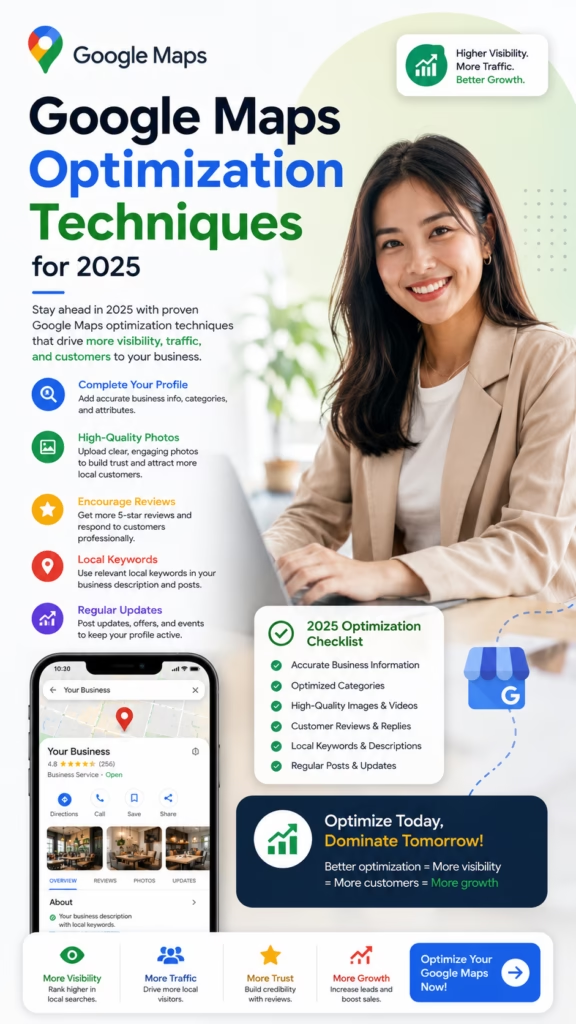
Google Maps Optimization Techniques for 2025
Google Maps Optimization Techniques for 2025 explains how local businesses can improve Maps visibility, strengthen trust, optimize Google Business Profiles, and turn nearby searches into calls, direction requests, website visits, bookings, and leads.
Introduction
Google Maps Optimization Techniques for 2025 are essential for local businesses that want to be found when nearby customers search for products, services, directions, appointments, quotes, or trusted local providers. Whether a company is a contractor, plumber, painter, HVAC business, mattress store, restaurant, landscaper, dentist, retailer, med spa, or local marketing agency, Google Maps visibility can directly affect customer calls and leads.
Google Maps has become one of the most important local discovery tools because customers often use it when they are close to action. They may be ready to call, visit, get directions, compare reviews, check hours, view photos, or request service. A business that appears with a complete profile, strong reviews, clear services, and fresh photos has a better chance of being chosen.
Google Maps optimization techniques for 2025 focus on relevance, trust, profile quality, customer engagement, local SEO, and conversion.
Many businesses create a Google Business Profile but never fully optimize it. They may have missing services, outdated hours, weak photos, few reviews, poor categories, inconsistent business information, or no tracking system. These gaps can cause valuable local traffic to go to competitors.
The strongest Google Maps optimization strategy is ongoing. Businesses should improve their Google Business Profile, build reviews, upload photos, publish posts, update services, strengthen website SEO, clean up citations, and track calls and leads. When these pieces work together, Maps visibility becomes a real local growth channel.
Main idea: Google Maps optimization techniques for 2025 help businesses become easier to find, easier to trust, and easier to contact when nearby customers are ready to act.
Table of Contents
- 1) Why Google Maps optimization matters in 2025
- 2) How local customers use Google Maps
- 3) Google Business Profile completeness
- 4) Categories and search relevance
- 5) Services, products, and customer intent
- 6) Reviews and reputation growth
- 7) Photos and videos that build trust
- 8) Local keywords and location signals
- 9) Website SEO that supports Maps rankings
- 10) Citations and business information consistency
- 11) Posts, offers, and profile activity
- 12) Conversion-focused profile improvements
- 13) Tracking calls, clicks, and leads
- 14) Common Google Maps optimization mistakes
- 15) Final thoughts
- 16) FAQs
- 17) Extra keywords
1) Why Google Maps Optimization Matters in 2025
Google Maps optimization matters in 2025 because customers increasingly use Maps to make fast local decisions. They do not always browse multiple websites first. They may compare ratings, read reviews, check photos, confirm hours, and tap the call or directions button directly from the Maps result.
This makes Google Maps a high-intent channel. A customer searching for a nearby service is often much closer to taking action than someone casually scrolling social media. Strong Maps visibility can turn that intent into measurable results.
Google Maps optimization can help increase:
- Phone calls
- Website clicks
- Direction requests
- Store visits
- Quote requests
- Appointment bookings
- Local brand awareness
- Customer trust
- Review visibility
- Lead generation
Google Maps Optimization Techniques for 2025 matter because local visibility can directly influence customer action.
2) How Local Customers Use Google Maps
Local customers use Google Maps to discover, compare, and contact businesses. They may search by service, category, city, neighborhood, brand, urgency, or “near me” phrase. Then they compare businesses based on reviews, distance, photos, hours, services, and trust signals.
A strong profile can win attention quickly. A weak profile can lose the customer even if the business provides excellent service. The profile must answer the customer’s key questions before they move on.
Customer searches locally
Google Maps shows nearby businesses
Customer compares reviews, photos, services, hours, and distance
Customer chooses a trusted option
Customer calls, clicks, visits, books, or requests directions
Google Maps optimization works best when the profile helps customers decide quickly and confidently.
3) Google Business Profile Completeness
Google Business Profile completeness is the foundation of Google Maps optimization. A complete profile helps customers understand the business and helps search systems better match it to relevant local searches.
Businesses should complete every relevant field, including name, address or service area, phone number, website, hours, categories, services, products, business description, attributes, photos, posts, and review responses.
A complete Google Business Profile should include:
- Accurate business name
- Correct address or service area
- Current phone number
- Website link
- Accurate business hours
- Primary category
- Secondary categories
- Services and products
- Business description
- Photos and videos
- Review responses
A complete profile helps improve Google Maps optimization by strengthening clarity, trust, and local relevance.
4) Categories and Search Relevance
Categories are one of the most important Google Maps optimization elements. The primary category tells Google and customers what the business mainly does. Secondary categories can support additional offerings when they are accurate and relevant.
A wrong category can reduce visibility for important searches. A precise category helps the business appear for customers looking for that exact service or product. Businesses should choose categories based on their main revenue-driving service, not vague or unrelated options.
Accurate categories improve Google Maps optimization by helping the business match relevant local searches.
5) Services, Products, and Customer Intent
Services and products help connect a business to customer intent. A customer may search for a specific service like “cabinet painting,” “AC repair,” “same-day mattress delivery,” or “roof inspection.” If the profile clearly lists those services, the business becomes easier to understand and compare.
Businesses should write service and product details in language customers actually use. The wording should be clear, specific, and helpful.
Service optimization example:
Main service: Emergency AC repair
Supporting services: HVAC maintenance, heating repair, system inspection
Local relevance: Serving nearby homeowners
CTA: Call to check availability
Google Maps optimization techniques for 2025 should include clear service and product details that match customer search intent.
6) Reviews and Reputation Growth
Reviews are one of the strongest trust signals on Google Maps. Customers often compare star ratings, review quantity, review recency, written feedback, and business responses before choosing who to contact.
A strong review strategy should be consistent and ethical. Businesses should ask satisfied customers for honest feedback, make the review process easy, and respond professionally to both positive and negative reviews.
Review strategy should focus on:
- Consistent review requests
- Recent customer feedback
- Detailed customer experiences
- Professional review responses
- Service-specific review language
- Reputation monitoring
- Customer experience improvement
Reviews improve Google Maps optimization by increasing trust, engagement, and customer confidence.
7) Photos and Videos That Build Trust
Photos and videos help customers see what the business offers before they contact it. A profile with fresh, real visuals often feels more active and trustworthy than a profile with no images or outdated photos.
Businesses should upload real photos of their storefront, team, projects, products, service vehicles, interiors, before-and-after results, displays, and customer-facing experiences. Visual proof can increase profile engagement and confidence.
Useful Google Maps visuals include:
- Storefront photos
- Interior photos
- Team photos
- Before-and-after project photos
- Product displays
- Service vehicles
- Short videos
- Branded graphics
- Customer experience photos
Fresh visuals help Google Maps optimization by making the business look real, active, and trustworthy.
8) Local Keywords and Location Signals
Local keywords help connect the profile and website to customer searches. These keywords should appear naturally in services, descriptions, posts, website pages, FAQs, and city or service-area content. The goal is relevance, not repetition.
Businesses should include service terms, city names, neighborhood references, product terms, problem-based searches, and customer-friendly language where appropriate.
Local keyword examples:
AC repair near me
Mattress store in Rochester NY
House painter in Fort Worth TX
Emergency plumber open now
Google Maps SEO for local businesses
Restaurant near me
Local keywords support Google Maps optimization by aligning business content with how nearby customers search.
9) Website SEO That Supports Maps Rankings
A strong local website can support Google Maps optimization by reinforcing services, locations, trust, and authority. The website should match the information on the Google Business Profile and give customers deeper details.
Businesses should build service pages, location pages, FAQ sections, review sections, schema markup, contact pages, and fast mobile experiences. The website should make calling, booking, or requesting a quote easy.
Website elements that support Google Maps SEO:
- Local service pages
- City or area landing pages
- Consistent name, address, and phone number
- Embedded map or location details
- Customer reviews
- FAQ sections
- Local schema markup
- Fast mobile speed
- Clickable phone numbers
Google Maps optimization becomes stronger when the website and Google Business Profile support the same local signals.
10) Citations and Business Information Consistency
Citations are mentions of a business’s name, address, phone number, and website across online directories, social profiles, review platforms, and local listing sites. Consistent information helps reduce confusion and builds trust.
If a business has different phone numbers, old addresses, or inconsistent names across the web, customers may hesitate. Keeping business information consistent supports a stronger local presence.
Business information consistency supports Google Maps optimization by improving trust and reducing customer confusion.
11) Posts, Offers, and Profile Activity
Posts, offers, and updates can keep a Google Business Profile fresh and useful. Businesses can share seasonal reminders, service availability, promotions, events, product updates, company news, and appointment openings.
Profile posts should be short, local, clear, and action-focused. They should give customers a reason to call, click, visit, book, or request a quote.
Useful post structure:
Headline: Clear offer or update
Body: Short explanation of value
Local relevance: Mention service area when helpful
CTA: Call, book, visit, or request quote
Active profile updates help Google Maps optimization by keeping the business fresh, relevant, and customer-focused.
12) Conversion-Focused Profile Improvements
Google Maps optimization should not only focus on visibility. It should also focus on conversion. Once customers find the profile, they should know exactly what to do next. That may include calling, visiting the website, requesting directions, booking, messaging, or visiting the store.
Businesses should make sure phone numbers work, hours are accurate, websites load quickly, forms are simple, and staff can handle incoming calls or messages.
Important conversion actions include:
- Phone calls
- Website clicks
- Direction requests
- Messages
- Appointment clicks
- Quote requests
- Store visits
- Bookings
The best Google Maps optimization techniques turn visibility into measurable customer actions.
13) Tracking Calls, Clicks, and Leads
Tracking is essential because businesses need to know whether their Google Maps optimization is producing real results. Visibility is useful, but calls, clicks, direction requests, bookings, store visits, and closed customers matter more.
Businesses can track performance using Google Business Profile performance data, website analytics, call tracking, CRM tags, booking reports, customer intake questions, and lead source reporting.
Important Google Maps metrics include:
- Search views
- Map views
- Phone calls
- Website clicks
- Direction requests
- Messages
- Photo views
- Review growth
- Bookings
- Closed customers
Tracking helps businesses improve Google Maps optimization based on real customer behavior.
14) Common Google Maps Optimization Mistakes
Many businesses underperform on Google Maps because they do not maintain or improve their profile consistently. They may create a listing once and then ignore it. Over time, competitors with stronger profiles, better reviews, and clearer information can capture more local traffic.
- Incomplete Google Business Profile
- Wrong primary category
- Outdated business hours
- Missing services or products
- Few or no reviews
- No review responses
- Low-quality photos
- Inconsistent business information online
- Weak website local SEO
- No tracking system
- No profile posts or updates
- No clear conversion path
Big mistake: treating Google Maps optimization as a one-time setup instead of an ongoing visibility, trust, and lead-generation process.
15) Final Thoughts
Google Maps Optimization Techniques for 2025 come down to building a complete, trustworthy, locally relevant presence that helps nearby customers find and choose the business. Visibility matters, but trust and conversion matter just as much.
The strongest approach includes Google Business Profile optimization, accurate categories, detailed services, strong reviews, fresh photos, local keywords, website SEO, citation consistency, profile posts, and performance tracking. When these techniques work together, Google Maps can become a consistent source of local calls, visits, bookings, and leads.
Final takeaway: Google Maps optimization techniques for 2025 help businesses improve local visibility, build customer trust, match search intent, and turn nearby searches into real customer action.
16) FAQs
1) What are Google Maps optimization techniques for 2025?
They are strategies that help businesses improve Google Maps visibility through profile optimization, reviews, photos, local keywords, services, website SEO, citations, and tracking.
2) Why is Google Maps optimization important?
It helps nearby customers find, compare, trust, and contact local businesses when they are ready to act.
3) Can Google Maps optimization generate leads?
Yes. It can generate phone calls, website clicks, direction requests, quote requests, appointments, bookings, and store visits.
4) What is Google Business Profile optimization?
It is the process of improving profile information, categories, services, photos, reviews, posts, and contact details.
5) Do reviews help Google Maps optimization?
Yes. Reviews build trust and can influence customer decisions in local search results.
6) Do photos help Google Maps performance?
Yes. Photos can improve trust, engagement, and customer confidence.
7) What categories should businesses choose?
Businesses should choose the most accurate primary category and relevant secondary categories.
8) Should businesses add services to their profile?
Yes. Services help customers and Google understand what the business offers.
9) Does a website support Google Maps optimization?
Yes. A strong local website can reinforce services, locations, trust, and conversion.
10) What are citations?
Citations are online mentions of a business’s name, address, phone number, and website.
11) Why is information consistency important?
Consistent business information helps customers and search systems trust the business details.
12) Should businesses respond to reviews?
Yes. Review responses show professionalism and customer care.
13) Do profile posts help?
Posts can keep the profile active and communicate offers, events, services, and updates.
14) What is the biggest Google Maps optimization mistake?
The biggest mistake is creating a profile and then leaving it incomplete, outdated, or inactive.
15) How do local keywords help?
Local keywords help match the business to searches involving services, cities, neighborhoods, products, and customer intent.
16) Can service-area businesses optimize Google Maps?
Yes. Service-area businesses can optimize with accurate service areas, services, reviews, photos, website content, and lead tracking.
17) How long does Google Maps optimization take?
Results vary based on competition, location, profile quality, reviews, website strength, and consistency.
18) Should businesses update holiday hours?
Yes. Accurate holiday hours prevent confusion and improve customer experience.
19) What should businesses track?
Businesses should track calls, website clicks, direction requests, messages, bookings, reviews, and closed customers.
20) Can Google Maps help storefronts?
Yes. Storefronts can use Google Maps to increase directions, calls, visits, and product discovery.
21) Can Google Maps help contractors?
Yes. Contractors can show services, reviews, project photos, service areas, and contact options.
22) Should businesses add videos?
Yes. Videos can show products, services, team members, projects, and customer experience.
23) Is Google Maps optimization a one-time task?
No. It works best as an ongoing process involving profile updates, reviews, photos, posts, website improvements, and tracking.
24) What makes a business stand out on Google Maps?
Strong reviews, complete information, clear services, fresh photos, accurate hours, helpful posts, and easy contact options can help a business stand out.
25) What is the main goal of Google Maps optimization?
The main goal is to help nearby customers find, trust, and contact the business.
17) Extra Keywords
- Google Maps Optimization Techniques for 2025
- Google Maps SEO
- Google Business Profile optimization
- local SEO 2025
- Google Maps ranking
- Google Maps visibility
- Google Maps marketing
- local business visibility
- local search optimization
- local map pack SEO
- Google reviews strategy
- local citation building
- business listing consistency
- Google Business Profile services
- Google Maps lead generation
- near me searches
- local customer search
- service area SEO
- storefront SEO
- Google Maps profile optimization
- Google Maps customer calls
- direction requests
- local customer acquisition
- Google Maps discovery strategy
- Google Maps optimization checklist













