
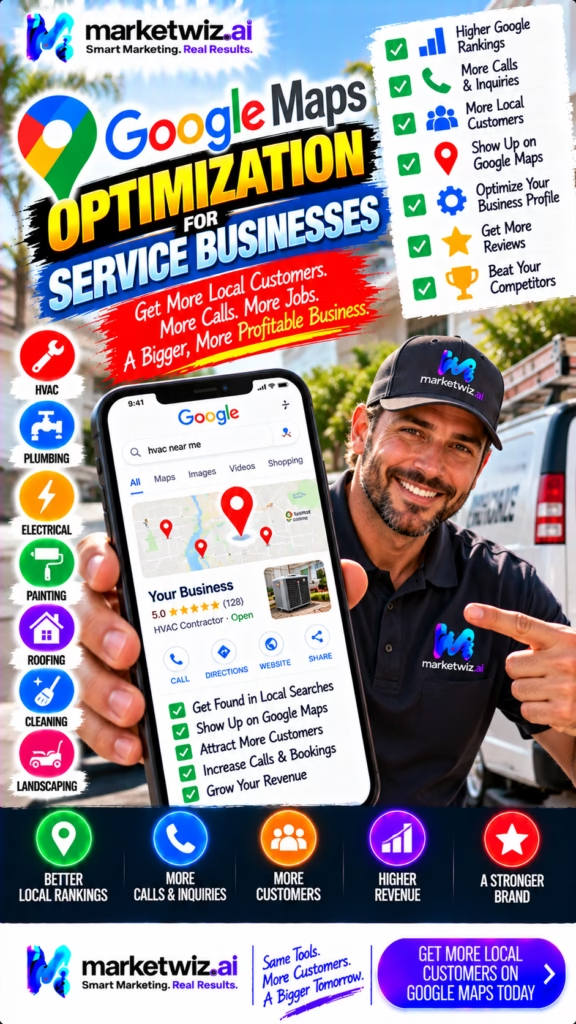
Google Maps Optimization for Service Businesses
Discover 30 practical strategies to strengthen your Google Business Profile, improve local search visibility, reach customers in your actual service area, build credibility through genuine reviews, and turn Google Maps discovery into more qualified calls, appointments, and customer opportunities.
Updated October 20261. Why Google Maps Optimization Matters for Service Businesses
Service businesses depend on being discovered by customers who need help in a specific location. A homeowner searching for an emergency plumber, an air conditioning technician, a roof repair company, or a cleaning provider usually wants a business that can handle the job within a reasonable distance and timeframe. Google Maps is one of the places where those customers can evaluate local options.
Unlike broad advertising that introduces a company to people who may not need its services, local search often begins with an existing customer need. Someone searching for a nearby electrician may already be comparing providers, checking business hours, reading reviews, and looking for a phone number. That makes accurate local visibility particularly valuable for companies whose revenue depends on appointments, estimates, and completed jobs.
Google Maps optimization for service businesses involves maintaining an eligible Google Business Profile, representing the company accurately, supporting its online reputation, and improving the usefulness of its local website presence. These efforts can help Google understand the business and help customers determine whether it meets their needs.
However, optimization is not a shortcut to guaranteed rankings. Google states that local results are primarily influenced by relevance, distance, and prominence. A company cannot purchase a higher organic Maps position, and even a well-managed profile may appear differently depending on where the customer searches.
Core principle: Effective Google Maps SEO connects accurate business information, genuine local credibility, useful website content, and dependable customer communication. The objective is not simply to appear in searches, but to become a relevant and trustworthy option for real customers.
For a service company, the most useful outcome is a qualified customer opportunity. More profile impressions may indicate visibility, but completed appointments and profitable jobs ultimately determine whether the marketing strategy supports business growth.
2. Understand Google's Three Primary Local Ranking Factors
Before optimizing a Google Business Profile, business owners should understand the basic principles behind local results. Google describes three primary factors: relevance, distance, and prominence. These factors help explain why two businesses in the same industry can appear in different positions for different customers.
Relevance
Relevance describes how closely a business matches the customer's search. Accurate categories, business details, and service information help represent what the company actually provides. A roofing contractor should not select unrelated categories simply because those terms seem popular.
Distance
Distance considers how far a business is from the location used in a search. A customer searching from one neighborhood may receive different results than someone searching across town. Service-area settings do not eliminate geographic considerations or guarantee visibility throughout every listed city.
Prominence
Prominence relates to how well-known a business is, including information Google can find across the web. Reviews, ratings, links, and other signals may contribute. Prominence should be developed through legitimate business activity rather than artificial links, fake reviews, or misleading directory listings.
Relevance
Make your real services, business category, and company information clear.
Distance
Represent your actual location and legitimate service coverage accurately.
Prominence
Build genuine customer feedback and a credible online business presence.
Customer Experience
Turn discovery into useful communication and dependable job fulfillment.
The fourth item above is a business-performance priority, not an additional ranking factor identified by Google. It matters because improved visibility has limited value if customers cannot reach the company or receive reliable service.
3. Set Up and Verify an Eligible Google Business Profile
Google Business Profile is the foundation of a company's presence in Google Maps and local business results. Eligible businesses can manage a profile without paying Google for the listing. The profile may display contact information, business categories, hours, reviews, photos, and other relevant details.
Service businesses should first determine whether they qualify. In general, eligible businesses must make in-person contact with customers during stated hours. A company that visits customers at their homes may qualify as a service-area business, even if it does not receive customers at its own address.
Verification helps Google confirm that the person managing the profile is authorized to represent the business. Available verification methods vary, and Google may require specific evidence or additional steps. Business owners should follow the options provided within their profile rather than assuming a particular method will always be available.
Initial setup checklist
- Use the real business name.
- Confirm the business meets eligibility requirements.
- Choose the most accurate primary category.
- Enter genuine contact information.
- Set appropriate address visibility.
- Specify legitimate service areas when applicable.
- Complete the verification process offered by Google.
- Review all visible information after verification.
A properly established profile provides a stable foundation for ongoing optimization. Creating multiple profiles or using invented locations to increase coverage can introduce compliance problems and should not be part of a legitimate local SEO strategy.
4. Optimize Google Maps for Service-Area Businesses
Many local companies travel to customers instead of operating a public storefront. Plumbers, HVAC technicians, roofers, landscapers, pest control providers, and residential cleaning companies often fit this business model. Google supports eligible service-area businesses, but their profiles must represent how they actually operate.
A company that does not serve customers at its business address should generally hide that address from public view and define supported service areas. A company that both receives customers at an eligible staffed location and travels to customers may qualify for a hybrid setup.
The service area should reflect real operational coverage. Listing distant cities that the company cannot reasonably serve creates poor customer expectations and does not guarantee stronger rankings in those places.
Service-Area Accuracy Matters
Use legitimate service coverage based on where your team can actually complete jobs. Do not create virtual offices, fabricated storefronts, or duplicate business profiles to manufacture a presence in additional cities.
For example, a plumbing company based in one community may serve several surrounding towns. Its website can explain that coverage clearly, while its Google Business Profile should use the service-area options supported by Google. Customers benefit when both sources communicate the same practical geographic reach.
5. Use Your Real Business Name Without Keyword Stuffing
A common Google Maps optimization mistake is adding promotional keywords to the business name field. A company officially operating as Smith Plumbing should not automatically change its profile name to include several nearby cities, emergency repair phrases, and unsupported claims about being the best provider.
Google's naming guidelines generally require the business name to reflect the name used consistently in the real world, including branding and customer-facing materials. Extra location names, phone numbers, and marketing slogans can violate those requirements when they are not part of the actual business name.
Accurate naming also supports consistency across the company's website, invoices, business signage, and relevant directories. Customers should be able to recognize that these references identify the same organization.
Business name best practices
- Use the established real-world business name.
- Keep branding consistent across major platforms.
- Do not insert unrelated search keywords.
- Avoid adding false geographic claims.
- Do not include unsupported ranking statements.
- Update the profile when a genuine business name change occurs.
The right place to explain services is through appropriate profile categories, service fields, and website content—not by artificially expanding the company name.
6. Choose the Most Accurate Primary and Secondary Categories
Google Business Profile categories help describe what a company does. For a service business, category selection is one of the most important decisions in profile setup because it affects how the business is represented in relevant searches.
The primary category should identify the company's main business activity as specifically as the available options allow. Secondary categories may be appropriate when the company genuinely offers additional qualifying services.
A plumbing contractor should not select categories associated with unrelated industries simply to appear in more searches. Similarly, a company that occasionally performs a minor task should not necessarily present that task as its principal business.
| Business Type | Category Selection Principle | Additional Consideration |
|---|---|---|
| Plumbing Contractor | Choose the most accurate plumbing category available. | Describe genuine repair and installation capabilities. |
| HVAC Company | Select the category that best represents its primary HVAC work. | Include relevant heating and cooling details. |
| Roofing Company | Use the most appropriate roofing category. | Explain actual roofing services and materials. |
| Cleaning Company | Choose the category matching its core cleaning business. | Distinguish residential and commercial offerings. |
| Landscaping Company | Represent its primary landscaping activity accurately. | Identify genuine maintenance or installation offerings. |
Available category names may change. Businesses should review the choices within Google Business Profile and select the most accurate current options rather than relying on outdated lists.
7. Complete Every Relevant Google Business Profile Field
An incomplete profile can leave customers uncertain about the company's availability, contact details, or capabilities. Service businesses should review each applicable field and provide accurate information wherever the feature is supported.
Important details may include phone number, website, business hours, services, business description, and relevant attributes. The specific fields available depend on the business category and Google's current product features.
Profile completeness should not be confused with adding as much text as possible. A clear description of the business is more useful than repeating the same search phrases dozens of times.
Profile information to review
- Business name and category
- Phone number
- Website address
- Business hours
- Holiday and special hours
- Service-area settings
- Available service details
- Business description
- Applicable attributes
- Photos and other supported media
Accuracy should be maintained after the initial setup. A phone number that no longer reaches the business or operating hours that are no longer correct can create customer frustration even when the profile receives substantial visibility.
8. Write a Google Business Profile Description That Explains Your Services
The business description gives customers a concise introduction to the company. For a local service provider, it should explain the core services, relevant experience, and general geographic market in clear language.
A good description is written for customers first. It should help someone understand whether the business is appropriate for their situation. Repeating city names or adding unsupported promotional claims does not improve the usefulness of the information.
Useful description elements
- The company's primary service category
- Its genuine specialties
- Residential or commercial focus
- Relevant experience or qualifications, when verified
- General service-area context
- Distinctive but supportable business characteristics
Example structure: A locally operated HVAC company provides residential air conditioning repair, heating maintenance, and equipment installation for customers in its established service area. The description should be adjusted to reflect the company's actual capabilities and verified qualifications.
Keep the description consistent with Google's current content requirements. Avoid promotional clutter, misleading claims, and information that belongs in other profile fields.
9. Add Accurate Service Details to Improve Customer Relevance
Service businesses frequently offer several distinct types of work. A plumber may handle drain cleaning, fixture replacement, leak repairs, and water heater installation. An HVAC contractor may provide system diagnostics, seasonal maintenance, and equipment replacement.
Where supported, Google Business Profile service fields can help explain these offerings. The information should match the work the company genuinely performs, including any meaningful limitations.
Customers may search using a specific problem rather than a broad industry name. Someone dealing with a leaking water heater has a more defined need than a person researching plumbing companies generally. Clear service information helps customers understand whether the company is a reasonable match.
Service information checklist
- Identify the actual service offered.
- Use straightforward customer language.
- Distinguish repair, installation, and maintenance where relevant.
- Disclose meaningful service limitations.
- Keep details aligned with the website.
- Remove discontinued offerings promptly.
Service fields should never be used to advertise capabilities the business does not possess. Accurate specialization can attract more suitable inquiries and reduce time spent explaining that a company cannot perform a requested job.
10. Maintain Accurate Hours, Emergency Availability, and Contact Information
For many service businesses, timing matters as much as price or reputation. Customers dealing with a broken air conditioner, plumbing leak, or electrical problem may need to know whether a company can respond soon.
Business hours should represent when the company is genuinely available for customer-facing operations. A business should not claim to operate 24 hours a day merely because it accepts voicemail or website submissions overnight.
If a company provides actual emergency availability, it should communicate that capability accurately. Holiday schedules and temporary changes should also be reflected when relevant.
Accurate Hours
Set hours that match genuine operating availability.
Reliable Phone
Use a number that reaches the business or its authorized response process.
Special Hours
Update holidays and exceptional schedule changes.
Emergency Claims
Advertise emergency response only when the company actually offers it.
Accurate contact information also supports lead conversion. Visibility cannot create meaningful customer opportunities if calls fail, messages go unanswered, or customers receive conflicting availability information.
11. Use Authentic Photos to Strengthen Your Google Maps Presence
Photographs help potential customers understand a service company before making contact. Depending on the business, useful images may show staff members, branded vehicles, tools, equipment, completed projects, and an eligible customer-facing location.
The strongest images are relevant and authentic. A roofing company can show real roofing projects with permission. A cleaning business can share genuine work examples without exposing customers' private belongings or addresses. An HVAC contractor can display its actual equipment and team.
Images should not be manipulated to imply that a company completed work it did not perform. Stock photography may be useful for some website designs, but it is not a substitute for authentic evidence of the business's operations.
Photo categories to consider
- Real team photographs
- Company vehicles
- Tools and equipment
- Completed projects
- Before-and-after examples with appropriate context
- Legitimate office or storefront images
- Customer-facing work environments
- Seasonal project examples
Businesses should obtain appropriate permissions and avoid exposing sensitive information. Regularly reviewing photos also helps ensure the profile reflects the company's current operations.
12. Build a Sustainable Google Review Strategy
Reviews are an important part of local business discovery. Google identifies review count and positive ratings among the factors that can help local ranking. Reviews also provide potential customers with information about other people's experiences.
Service businesses should focus on earning genuine feedback through real customer interactions. A practical process might involve asking customers to share their honest experience after a completed job, using an approved review link or other supported method.
Businesses must not offer incentives in exchange for reviews, selectively pressure customers to leave positive ratings, or arrange fabricated feedback. Review requests should not depend on whether the customer appears satisfied.
Ethical Review Growth Process
Complete the job professionally, provide the customer with appropriate documentation, invite an honest review without incentives or pressure, and monitor incoming feedback for issues that deserve attention.
A genuine review program is a long-term reputation practice, not a one-time campaign to manufacture ratings. It also provides useful operational feedback about scheduling, communication, workmanship, and customer expectations.
13. Respond Professionally to Positive and Negative Reviews
Review management does not end when a customer publishes feedback. Thoughtful responses can demonstrate that the company pays attention to customer experiences and takes concerns seriously.
Positive reviews can receive brief, genuine acknowledgments. Negative reviews deserve careful consideration, especially when the customer raises a specific operational issue. The response should remain professional and avoid sharing private account details, addresses, or sensitive job information.
A company should not pressure customers to change or remove legitimate negative reviews. If feedback appears to violate Google's policies, the business can use Google's available reporting process rather than attempting to manipulate the reviewer.
Professional response principles
- Thank customers for sharing feedback.
- Respond to the substance of the experience.
- Avoid scripted arguments.
- Protect personal information.
- Explain appropriate resolution steps.
- Do not offer rewards for review changes.
- Use recurring feedback to improve operations.
AI tools may assist with drafting response suggestions, but staff should verify the facts and tone before publishing. A personalized, accurate response is preferable to an automated message that misrepresents what happened.
14. Use Google Business Profile Updates to Share Relevant Information
Where available, Google Business Profile updates can help a company communicate timely information about its operations, offerings, and business activities. These updates should be relevant to customers and comply with Google's current content rules.
A landscaping company might share seasonal maintenance information. An HVAC business could explain the importance of preparing equipment for changing weather. A plumbing company may provide educational content about recognizing common household leaks.
The objective is to make the business profile more informative, not to publish repetitive keyword-heavy advertisements. Content should accurately describe the company and avoid unsupported promises.
Useful update topics
- Seasonal maintenance advice
- Newly available genuine services
- Relevant business announcements
- Team or equipment updates
- Educational customer information
- Actual schedule changes
- Community participation
- Verified project highlights
Google's supported posting features and moderation requirements can change. Businesses should check the available options within their profile and avoid assuming that frequent posting guarantees ranking improvements.
15. Connect Google Maps Optimization With a Strong Local Website
A Google Business Profile can help customers discover a company, while its website can provide deeper information about services, qualifications, geographic coverage, and the next steps for requesting help.
For service businesses, the website should make essential information easy to find. A customer should not have to navigate through multiple pages to identify the company's phone number, service categories, or general operating area.
A well-structured website can also support organic search visibility beyond the Maps interface. Useful service pages answer customer questions and explain what the company actually provides.
Important website elements
- Clear business identity
- Accurate contact information
- Dedicated pages for major services
- Truthful service-area details
- Mobile-friendly navigation
- Useful customer explanations
- Authentic project photographs
- Appropriate credentials and licensing information
- Accessible contact options
- Consistent branding
A website should be designed for real users rather than constructed solely around search phrases. Helpful content and a straightforward customer journey make it easier to convert interest into appropriate inquiries.
16. Create Dedicated SEO Pages for Your Most Important Services
Service-specific website pages can help explain the different types of work a company performs. A general homepage may introduce the business, but customers often need detailed information about a particular problem.
For example, an HVAC contractor may benefit from separate pages explaining air conditioning repair, heating installation, and preventive maintenance. A plumbing company may need distinct information about drain cleaning, water heater replacement, and leak detection.
Each page should offer genuinely useful content. Simply replacing one keyword in an otherwise identical page does not create meaningful value for customers.
Recommended service-page structure
- Clear service-specific heading
- Explanation of the customer problem
- Relevant capabilities
- Typical service process
- Appropriate limitations or qualifications
- Helpful customer questions
- Actual geographic availability
- Accurate contact information
Content should not promise outcomes that depend on inspection, property condition, parts availability, or other unknown factors. A useful page explains the company's approach without guaranteeing every job will be identical.
17. Build Helpful City and Service-Area Pages Without Doorway Content
Service businesses often operate across several neighboring communities. Their websites may benefit from explaining where they work, but geographic content must provide value beyond repeating a city name.
A legitimate location page can describe actual service availability, local scheduling considerations, and relevant customer information. It should not falsely claim a physical office or storefront in a city where the company has no such location.
Businesses should avoid creating dozens of nearly identical pages designed only to funnel visitors to the same destination. This type of low-value doorway content can undermine the usefulness of the website.
Local page principle: Publish a city page when it answers meaningful questions for customers in that area. Use accurate service coverage, useful details, and honest business information instead of fabricated addresses or repeated keyword blocks.
A roofing company serving several towns might explain regional weather considerations, appointment coverage, and the roofing systems it genuinely handles. A cleaning company could clarify scheduling availability and property types served in its real operating territory.
18. Improve Mobile Website Speed and Customer Experience
Local service searches frequently involve people who need information quickly. A homeowner looking for an urgent repair provider may be using a mobile device while dealing with an active problem.
A slow or difficult-to-use website can create friction after a customer clicks through from Google. Even when the business profile is accurate, poor mobile usability may discourage a visitor from contacting the company.
Service businesses should review their websites on real mobile devices and address problems that interfere with navigation, readability, or contact actions.
Mobile optimization priorities
- Readable text without excessive zooming
- Fast-loading, appropriately sized images
- Clear navigation menus
- Visible contact information
- Functional phone links
- Accessible forms
- Stable page layouts
- Limited intrusive popups
- Secure HTTPS connections
- Useful content above unnecessary visual effects
Website performance improvements should be tested carefully. Aggressive caching or script optimization can sometimes break menus, forms, and interactive elements. A faster page is not an improvement if customers can no longer use it correctly.
19. Maintain Consistent Local Citations and Business Information
Local citations are references to a company's identifying information on directories, industry websites, and other relevant online resources. These references can help customers find accurate business details and may contribute to a coherent online presence.
For a service business, citation management begins with consistency. The real business name, primary contact number, and publicly appropriate address information should not conflict unnecessarily across major platforms.
Service-area businesses that hide their address on Google should be thoughtful about how other websites display location details. They should not publish fabricated addresses to create the appearance of additional offices.
Citation quality checklist
- Use the genuine business name.
- Maintain a current contact number.
- Represent physical locations accurately.
- Choose relevant directory categories.
- Correct outdated business information.
- Remove or resolve unnecessary duplicates when possible.
- Prioritize reputable and relevant platforms.
- Avoid bulk submissions to questionable directories.
More citations are not automatically better. A smaller number of accurate, relevant business references is often more useful to customers than hundreds of low-quality listings.
20. Build Genuine Local Authority Through Community and Industry Relationships
A service company's online reputation develops through more than its Google Business Profile. Local organizations, industry associations, suppliers, community projects, and legitimate partnerships may create opportunities for useful mentions and relevant website links.
These relationships should exist for real business or community reasons. A contractor participating in a local trade association may have an appropriate member listing. A company sponsoring a genuine community event may receive recognition from the organizer.
The purpose is to establish an authentic online presence, not to purchase artificial authority or participate in manipulative link schemes.
Legitimate local authority opportunities
- Relevant industry associations
- Local chambers of commerce
- Authentic community partnerships
- Supplier relationships
- Professional certifications
- Useful local educational resources
- Genuine project coverage
- Relevant business directories
Service businesses should evaluate each opportunity based on credibility, relevance, and actual value. An unrelated backlink package is not a substitute for a trustworthy business reputation.
21. Use Appropriate Local Business Structured Data on Your Website
Structured data helps search engines interpret information presented on a website. Service businesses can use relevant Schema.org types to describe their organization, contact details, and other factual business information.
Structured data should reflect content that is accurate and appropriate for the website. A service-area business should not publish a fabricated storefront address in its markup. Likewise, businesses should not add misleading review ratings or claim qualifications they do not possess.
The correct structured data type depends on the company's actual business model. A broad LocalBusiness type or a more specific supported subtype may be appropriate.
Information commonly represented in structured data
- Real business name
- Official website
- Business telephone number
- Appropriate business type
- Genuine public address, when applicable
- Operating hours, where relevant
- Official logo
- Accurate service information
Structured data is not a guarantee of enhanced search presentation or higher rankings. It should be viewed as a technical method for representing accurate website information, not a replacement for helpful content and legitimate business operations.
22. Google Maps Optimization for Plumbing Contractors
Plumbing companies serve customers with a wide range of needs, from routine fixture replacement to urgent leak repairs. Google Maps optimization can help these businesses communicate what they offer and where they operate.
A plumbing company's profile should identify its real business category, contact information, operating hours, and supported services. The website can provide additional explanations about common problems and the company's actual repair or installation capabilities.
Plumbing SEO priorities
- Accurate plumbing business category
- Genuine emergency availability, if offered
- Leak repair information
- Drain cleaning details
- Water heater services
- Fixture repair and installation
- Authentic project photographs
- Genuine customer reviews
- Accurate geographic coverage
- Clear appointment or dispatch information
A plumbing contractor should avoid promising immediate response everywhere in its service area unless that level of availability is consistently supported. Clear expectations about scheduling and service capabilities can improve the quality of incoming inquiries.
23. Google Maps Optimization for HVAC Companies
Heating and cooling companies often experience seasonal changes in demand. Customers may search for air conditioning repair during hot weather, heating assistance during colder months, or routine maintenance before seasonal transitions.
An accurate Google Business Profile helps explain the company's HVAC capabilities. Supporting website content can answer questions about diagnostics, installation, maintenance, and equipment replacement.
The company should represent any emergency availability truthfully and avoid guaranteeing equipment outcomes without a proper evaluation.
HVAC local SEO priorities
- Accurate HVAC business category
- Air conditioning repair details
- Heating repair information
- Installation capabilities
- Maintenance offerings
- Supported equipment types
- Actual operating hours
- Real service-area coverage
- Genuine customer feedback
- Seasonally relevant educational content
For HVAC contractors, local SEO and operational readiness should work together. Visibility during peak demand is most valuable when the company can respond appropriately and communicate realistic appointment availability.
24. Google Maps SEO for Roofing, Cleaning, Painting, and Landscaping Companies
Different service industries share common local SEO principles, but their customers often evaluate different information. A roofing customer may prioritize experience with particular roofing materials, while a cleaning customer may focus on scheduling, property type, and scope of work.
Google Maps optimization should reflect those differences instead of applying identical content to every industry.
| Industry | Customer Information Needs | Useful Optimization Focus |
|---|---|---|
| Roofing | Repair scope, materials, qualifications | Project examples, service details, genuine reviews |
| Cleaning | Property types, scheduling, cleaning scope | Accurate categories, service descriptions, availability |
| Painting | Interior/exterior work, finishes, project quality | Authentic photos, service pages, customer feedback |
| Landscaping | Maintenance, design, installation, seasonality | Service-area accuracy, seasonal content, project images |
An effective profile should help a potential customer answer a straightforward question: Does this company provide the specific work I need, in my location, with a level of credibility that makes contacting it worthwhile?
The best optimization decisions are grounded in that customer question rather than attempts to manipulate search visibility.
25. Analyze Local Competitors Without Copying Their Mistakes
Competitive research can help a service business understand how nearby providers present their services, what customer questions appear in reviews, and which types of website information are common in the market.
However, a competitor's high visibility does not prove that every element of its profile is effective or compliant. Some businesses may use misleading names, questionable locations, or other tactics that should not be copied.
Useful competitive research questions
- Which legitimate categories describe competing businesses?
- How clearly do competitors explain their services?
- What concerns appear repeatedly in customer reviews?
- Do competing websites answer common customer questions?
- How easy is it to find their contact information?
- What authentic project information do they provide?
- Which customer needs remain poorly explained?
Compete Through Clarity and Credibility
Use competitor research to identify opportunities for better information, stronger customer communication, and more useful website content. Avoid duplicating misleading tactics or assuming that a competitor's profile structure guarantees rankings.
A local company can often improve its marketing by explaining its genuine strengths more clearly rather than imitating every visible feature of a competitor's online presence.
26. Use AI to Support Google Maps Optimization and Local Lead Management
AI-assisted marketing tools can help service businesses organize information, prepare content drafts, analyze customer questions, and manage certain administrative workflows. These capabilities may be useful for small teams that lack a dedicated marketing department.
For Google Maps optimization, AI can help staff review whether service descriptions are clear, summarize recurring customer concerns, or prepare drafts for business updates. Human review remains important because generated content may contain inaccurate claims or outdated platform guidance.
AI may also support authorized lead management after a customer contacts the company. For example, a workflow could help organize inquiry details, prepare internal summaries, or identify follow-up tasks.
Practical AI-assisted applications
- Drafting accurate service descriptions
- Preparing educational local content
- Organizing review-response suggestions
- Summarizing customer inquiry themes
- Reviewing aggregate lead performance
- Supporting internal appointment workflows
- Identifying missing website information
- Helping staff maintain content calendars
Responsible AI use: Never publish invented customer reviews, fabricated business locations, false service claims, or unverified performance statistics. AI-assisted processes should follow applicable privacy rules, Google policies, and authorized integration requirements.
The strongest role for AI is supporting accurate, efficient business operations. It cannot replace real-world eligibility, genuine reputation, or reliable service delivery.
27. Turn Google Maps Visibility Into Qualified Calls and Appointments
Google Maps optimization should support a complete customer journey. A potential customer may discover the company, review its information, visit the website, make a phone call, and schedule an appointment. Each step creates an opportunity for confusion or improvement.
A business that appears prominently but rarely answers calls may lose opportunities. A company with accurate contact information but unclear service details may receive inquiries it cannot fulfill. Marketing and customer operations therefore need to work together.
Lead conversion workflow
Local Discovery
A customer finds the business through a relevant Google search or Maps result.
Business Evaluation
The customer reviews service information, hours, photos, and genuine feedback.
Initial Contact
The customer calls or uses another available contact method to explain the need.
Qualification and Scheduling
Staff confirm relevant service details and explain realistic next steps.
Completed Job and Measurement
The company records the outcome and reviews appropriate marketing attribution.
This process highlights why local SEO cannot be evaluated entirely through search visibility. A business needs dependable response procedures, accurate scheduling information, and clear internal responsibilities to benefit from customer interest.
28. Track Google Maps Performance, Qualified Leads, and Marketing ROI
Google Business Profile provides performance information that can help businesses understand certain customer interactions. Available metrics and reporting interfaces may change, so owners should review the current information within their account.
Useful measures may include profile views, search interactions, calls initiated through supported profile features, website clicks, and direction requests where applicable. These indicators should be interpreted carefully because they do not always represent unique qualified leads or completed sales.
A service business should connect profile performance to its own operational records whenever feasible and appropriate.
| Metric | What It Helps Explain | Important Limitation |
|---|---|---|
| Profile Views | Business profile exposure | Not equivalent to customers or sales |
| Call Interactions | Contact activity through supported features | Not every call becomes a qualified lead |
| Website Clicks | Traffic sent toward the website | Clicks do not prove completed inquiries |
| Qualified Leads | Relevant potential customer opportunities | Requires consistent qualification |
| Booked Jobs | Appointments or projects secured | May involve several marketing touchpoints |
| Attributed Profit | Financial value linked to marketing | Depends on sound accounting and attribution |
Illustrative Lead Conversion Example
If a company records 80 qualified inquiries and 20 become booked jobs, its qualified-lead-to-booking conversion rate is 25%. This is a mathematical example, not an expected industry result. Actual performance depends on the market, pricing, scheduling, customer needs, and operational quality.
Businesses should distinguish between correlation and attribution. An increase in calls after profile optimization does not automatically prove that every additional call came from Google Maps. Consistent tracking supports more informed decisions.
29. Avoid Common Google Maps Optimization Mistakes
Some local SEO mistakes arise from outdated business information. Others come from attempts to force higher rankings through tactics that violate Google's rules. Both can create problems for service companies that rely on steady customer discovery.
An inaccurate phone number or incorrect hours can frustrate customers immediately. A fabricated location or keyword-stuffed business name may also create profile compliance risks.
Major mistakes to avoid
- Using a false or virtual office address that does not qualify
- Creating duplicate profiles for one business
- Adding marketing keywords to the real business name
- Selecting unrelated business categories
- Claiming service areas the company does not actually cover
- Advertising emergency availability that does not exist
- Buying or fabricating customer reviews
- Offering incentives for Google reviews
- Publishing misleading project photographs
- Creating low-value doorway city pages
- Buying manipulative backlinks
- Ignoring inaccurate contact details
- Neglecting customer questions and feedback
- Relying only on rankings instead of qualified leads
- Expecting guaranteed results from a single optimization tactic
The most sustainable alternative is straightforward: represent the business truthfully, keep information current, publish useful content, and provide customers with a reliable experience.
When a profile encounters verification or eligibility problems, owners should use Google's official support and appeal processes rather than creating replacement listings that reproduce the same underlying issue.
30. Follow a 90-Day Google Maps Optimization Plan for Service Businesses
A structured 90-day plan can help service businesses turn local SEO into a manageable operating process. The timeline below organizes important work into three phases. It does not guarantee ranking improvements or a particular number of leads within 90 days.
Days 1–30: Audit and Correct the Foundation
- Confirm Google Business Profile eligibility.
- Complete or review verification.
- Audit the real business name.
- Review primary and secondary categories.
- Correct phone numbers and website details.
- Check hours and special hours.
- Set appropriate address visibility.
- Confirm legitimate service areas.
- Review existing customer feedback.
- Audit the website's major service pages.
Days 31–60: Improve Content and Credibility
- Update accurate service descriptions.
- Add relevant authentic photographs.
- Improve useful service-specific website pages.
- Review mobile usability and contact functions.
- Correct important directory inconsistencies.
- Establish an ethical review request process.
- Respond to relevant existing reviews.
- Publish useful customer information.
- Document customer inquiry procedures.
- Begin consistent performance reporting.
Days 61–90: Refine Lead Generation and Measurement
- Review available profile performance metrics.
- Compare qualified inquiries with completed jobs.
- Identify frequently requested services.
- Improve unclear website content.
- Review actual geographic demand.
- Update outdated photographs and details.
- Refine call handling and scheduling workflows.
- Evaluate authorized AI-assisted administrative tools.
- Review customer feedback themes.
- Set ongoing monthly maintenance responsibilities.
The Long-Term Optimization Objective
Build a trustworthy local search presence that accurately represents the business, supports relevant customer discovery, and connects Google Maps interactions to qualified inquiries and measurable business outcomes.
After the initial 90 days, optimization should continue as a routine business process. Hours change, services evolve, new reviews arrive, and customer expectations shift. Periodic maintenance helps the profile remain useful and accurate.
Conclusion: Build Long-Term Growth With Google Maps Optimization for Service Businesses
Google Maps optimization for service businesses is most effective when it begins with an accurate understanding of the company and the customers it serves. A plumbing contractor, HVAC company, roofing provider, cleaning business, or landscaping company may have different operational priorities, but each needs reliable information that helps local customers make informed decisions.
An eligible and properly managed Google Business Profile provides the foundation. The real business name, relevant categories, contact information, operating hours, and service-area settings should accurately represent how the company operates. These details help customers understand whether the business is available and appropriate for their needs.
Service-area companies must pay particular attention to location accuracy. Hiding an address when customers are not received there, identifying genuine service coverage, and avoiding artificial locations support a more responsible local marketing strategy. Adding more cities to a profile is not a substitute for legitimate proximity or actual operational capacity.
Google's local ranking framework also helps set realistic expectations. Relevance, distance, and prominence influence local results, and no legitimate provider can guarantee a permanent top position for every customer or keyword. Optimization should therefore focus on improving the quality and accuracy of the business's presence rather than chasing unsupported ranking promises.
Customer reviews are another important component. A consistent process for inviting honest feedback can help a company develop a more informative reputation profile over time. Responding professionally to reviews also provides an opportunity to acknowledge customers and address legitimate concerns. Artificial reviews, selective incentives, and misleading testimonials should never be part of the strategy.
Authentic photographs, useful service descriptions, and relevant business updates can help potential customers evaluate the company. These assets should explain genuine capabilities and real-world experience. They should not exaggerate qualifications, invent completed projects, or create false impressions about the size or location of the business.
A strong website complements Google Maps visibility by providing deeper information about specific services, customer questions, and practical next steps. Dedicated service pages can explain different offerings clearly, while useful geographic content can communicate real coverage without resorting to duplicate doorway pages or fabricated offices.
Mobile usability deserves attention because many local customers need information quickly. Clear navigation, functioning phone links, accessible forms, and readable content help turn interest into communication. Technical optimization should improve the customer experience rather than introducing broken menus or unreliable contact features.
Local citations, legitimate industry relationships, and appropriate structured data can support a coherent online business presence. The emphasis should remain on accuracy and relevance. Artificial backlinks, unrelated directories, and misleading structured data do not provide a dependable foundation for long-term growth.
Service businesses can also benefit from AI-assisted marketing and lead management when these tools are used responsibly. AI may help organize customer inquiries, draft educational content, prepare review-response suggestions, and support internal workflows. Human oversight is necessary to prevent inaccurate claims and ensure that customer information is handled appropriately.
Ultimately, the business value of Google Maps optimization should be measured through qualified opportunities and completed work. Profile views, calls, and website clicks provide useful signals, but booked appointments, customer acquisition costs, and attributed profit offer a clearer picture of commercial performance.
Market Wiz AI helps local businesses develop organic-first marketing strategies that connect Google Maps SEO, website visibility, Facebook marketing, and AI-assisted lead management. A coordinated approach can help companies maintain accurate information across channels while improving how they respond to customer interest.
The most sustainable strategy is not built around one trick or temporary ranking movement. It combines accurate Google Business Profile management, genuine customer feedback, helpful local content, professional communication, and ongoing measurement. For service businesses seeking dependable local growth, those fundamentals provide a practical foundation for attracting relevant customers and turning discovery into real business opportunities.
Frequently Asked Questions About Google Maps Optimization for Service Businesses
1. What is Google Maps optimization for service businesses?
Google Maps optimization for service businesses is the process of improving an eligible business's Google Business Profile, local website information, reputation, and online presence to help relevant customers discover it through Google Maps and local search.
2. How does Google Maps ranking work for service businesses?
Google states that local results are primarily based on relevance, distance, and prominence. Rankings vary by search, location, and available business information.
3. Is Google Business Profile free for service businesses?
Yes. Eligible businesses can create and manage a Google Business Profile without paying Google for the listing. Marketing assistance and advertising are separate optional expenses.
4. Can service-area businesses appear on Google Maps without showing an address?
Yes. Eligible service-area businesses can hide their customer-facing address and define supported service areas when they travel to customers rather than receive them at a storefront.
5. How can a plumbing company improve Google Maps visibility?
A plumbing company can maintain an accurate eligible profile, choose relevant categories, describe genuine services, manage reviews, keep contact information current, and publish useful local website content.
6. Does Google Maps SEO work for HVAC companies?
Yes. HVAC companies can use Google Business Profile and local SEO to improve how accurately their services, location, and business information are represented in local search.
7. How long does Google Maps optimization take?
There is no guaranteed timeline. Changes may be reviewed or processed at different speeds, and visibility depends on competition, relevance, distance, prominence, and other factors.
8. Can I pay Google for a higher organic Maps ranking?
No. Google states that businesses cannot request or pay for a better local ranking. Paid advertising is separate from organic local results.
9. What Google Business Profile category should a service business choose?
Choose the most specific available primary category that accurately represents the business's main activity, then add relevant secondary categories where appropriate.
10. Do customer reviews help Google Maps optimization?
Google identifies review count and positive ratings as factors that can help local ranking. Reviews also provide information that potential customers may use when evaluating a business.
11. Can a service business offer incentives for Google reviews?
No. Businesses should not offer payment, discounts, or other incentives in exchange for Google reviews or changes to existing reviews.
12. How should service businesses respond to negative Google reviews?
Respond professionally, acknowledge relevant concerns, avoid exposing personal information, and explain an appropriate resolution process without pressuring the reviewer.
13. Are Google Business Profile photos important?
Authentic photos can help customers understand a company's team, equipment, work, and business environment. Photos should be relevant and accurately represent the business.
14. Should service businesses add every nearby city as a service area?
No. Service areas should reflect locations the business genuinely serves and comply with Google's supported service-area settings and eligibility rules.
15. Does adding keywords to a Google Business Profile name improve rankings?
Businesses should use their real-world business name, not add marketing keywords or locations that are not part of that name. Keyword stuffing can violate Google Business Profile guidelines.
16. Can home-based service businesses have a Google Business Profile?
Some legitimate home-based service-area businesses are eligible when they meet Google's requirements, including direct customer contact and accurate address visibility settings.
17. Do service businesses need a website for Google Maps optimization?
A website is not required for every eligible Google Business Profile, but a useful website can provide service details, location information, customer resources, and additional local search opportunities.
18. What are local citations for service businesses?
Local citations are online references to a business's identifying information, such as its name, address when publicly applicable, and phone number, on relevant directories and websites.
19. Does Google Maps optimization help generate phone calls?
An accurate, visible business profile can make it easier for potential customers to find contact details and call, although call volume and lead quality are not guaranteed.
20. How often should a service business update its Google Business Profile?
Review the profile whenever business information changes and conduct periodic checks for hours, services, contact details, photos, and customer feedback.
21. Can a business create multiple Google Maps listings for one location?
Businesses generally should not create duplicate profiles for the same eligible business location. Separate profiles require a legitimate basis under Google's applicable guidelines.
22. What is the difference between Google Maps SEO and Google Ads?
Google Maps SEO focuses on improving organic local business information and visibility, while Google Ads provides paid promotional placements through supported advertising products.
23. How can roofers improve their Google Maps presence?
Roofing companies can maintain accurate business categories, service information, real project photos, genuine reviews, appropriate service areas, and useful roofing content on their websites.
24. How can cleaning companies optimize Google Maps?
Cleaning companies can use accurate business information, appropriate categories, legitimate service areas, detailed service descriptions, genuine customer reviews, and helpful local website pages.
25. Does AI help with Google Maps optimization?
AI can assist with drafting business content, organizing review-response suggestions, analyzing performance data, and managing leads, provided information is accurate and workflows follow platform rules.
26. What is Google Maps lead generation?
Google Maps lead generation involves helping relevant local searchers discover a business and take actions such as calling, visiting its website, requesting directions, or contacting the company.
27. How can service businesses measure Google Maps SEO results?
Review available Google Business Profile performance metrics alongside qualified calls, website inquiries, booked appointments, completed jobs, and attributed revenue.
28. What are the biggest Google Maps optimization mistakes?
Common mistakes include inaccurate business information, keyword-stuffed names, fake locations, duplicate profiles, incentivized reviews, irrelevant categories, and neglected customer inquiries.
29. Can Google Maps optimization support multiple service locations?
Yes. Businesses with genuinely eligible separate locations can manage appropriate profiles, while service-area businesses should not create artificial locations solely to expand visibility.
30. What is the best Google Maps optimization strategy for service businesses?
Build a complete and accurate eligible Google Business Profile, choose relevant categories, represent genuine service areas, earn authentic reviews, maintain useful local website content, and track qualified customer outcomes.
30 Additional SEO Keywords for Google Maps Optimization for Service Businesses
These related search phrases support topical coverage around Google Business Profile optimization, service-area SEO, local search visibility, customer reviews, contractor marketing, AI-assisted lead management, and organic customer acquisition.
Turn Google Maps Visibility Into More Customer Opportunities
Market Wiz AI helps service businesses strengthen organic local visibility, optimize Google Business Profiles, improve website SEO, coordinate Facebook and Craigslist marketing where appropriate, and organize inquiries through AI-assisted lead management. Build a more consistent customer acquisition strategy around accurate business information, qualified leads, and measurable results.
Call MarketWiz.ai: (910) 601-2938