
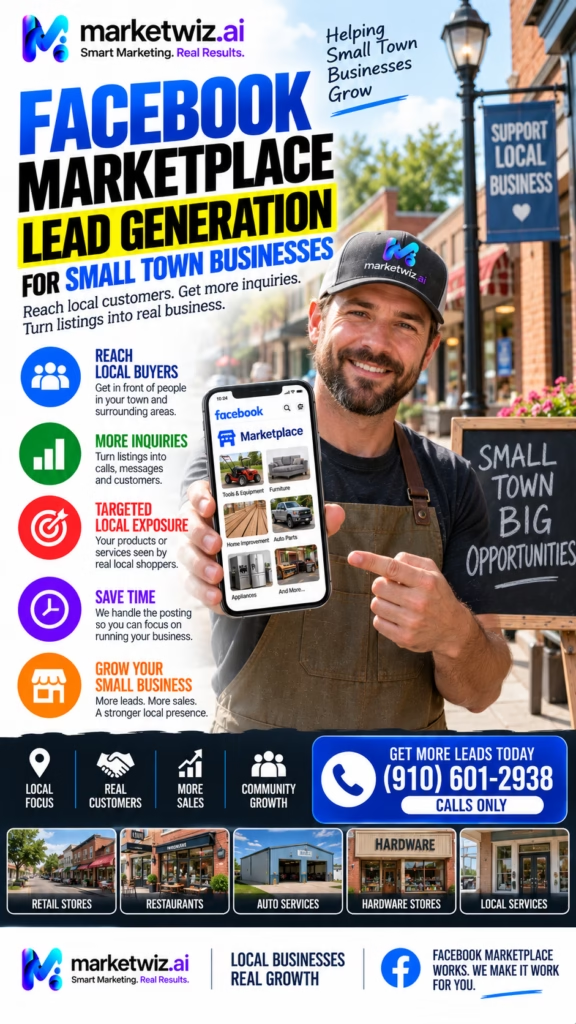
Facebook Marketplace Lead Generation for Small Town Businesses
Small town businesses can use Facebook Marketplace to create local product visibility, reach customers in surrounding communities, generate qualified buyer conversations, increase store and showroom traffic, and build a more measurable local customer-acquisition system when listings, lead response, follow-up, and tracking are handled strategically.
Small town businesses have a marketing advantage that is easy to underestimate: local proximity. Customers may already recognize the business name, know where the store is, have friends who purchased there, or pass the location during normal weekly travel. Facebook Marketplace can amplify that local visibility by placing real products in front of buyers who are already browsing nearby inventory.
For many small town businesses, the challenge is not necessarily reaching millions of people.
The challenge is reaching enough of the right local people consistently.
Those customers may live:
- in the same town,
- ten miles away,
- in a neighboring county,
- in several surrounding rural communities,
- in the nearest regional city.
A well-built Marketplace strategy can help a business turn that geography into an advantage.
A customer may discover:
- a sectional sofa,
- a mattress,
- a refrigerator,
- a flooring product,
- a utility trailer,
- a metal building,
- a piece of equipment
while browsing Marketplace.
They may then search the business on Google.
They may read reviews.
They may realize the store is only fifteen minutes away.
Then they may call, visit, or arrange pickup.
That creates a simple but powerful local funnel:
Marketplace listing → local inquiry → qualification → visit or purchase step → sale → review → repeat business.
1. Understand the Small Town Marketplace Advantage
Small towns do not always have the same customer volume as major cities.
But they can have advantages that larger markets lack.
Less Local Competition
In some rural or small-town markets, there may be only a few serious local sellers in a given category.
That can make a strong listing more visible.
Higher Local Familiarity
Customers may recognize:
- the store,
- the owner,
- the street,
- the shopping center,
- the town name.
Convenient Pickup
A buyer may prefer driving ten minutes to a local store instead of:
- waiting for shipping,
- driving an hour to a large city,
- buying from an unknown private seller.
2. Choose Products That Work Well on Marketplace
Not every product needs equal Marketplace attention.
Some items are naturally more suited to local visual discovery.
Furniture
Sofas, sectionals, dining sets, beds, mattresses, recliners, and other visually obvious products can perform well when pricing and dimensions are clear.
Appliances
Refrigerators, washers, dryers, ranges, freezers, and related products can attract buyers who value nearby inventory and quick pickup.
Building & Outdoor Products
Carports, sheds, metal buildings, fencing materials, trailers, and related products can benefit from strong visual presentation and local availability.
Flooring & Materials
Flooring, tile, lumber, countertops, and other physical building materials may create project-specific buyer inquiries.
Other categories may include:
- vehicles,
- RV inventory,
- farm equipment,
- lawn equipment,
- powersports,
- tools,
- home-improvement products.
Prioritize High-Opportunity Inventory
Focus on products with:
- clear demand,
- good margins,
- strong photos,
- easy-to-understand pricing,
- enough inventory to support promotion.
3. Define the Real Local Buying Radius
A small town business should think beyond the town limits.
Customers may regularly drive between:
- nearby towns,
- county seats,
- regional shopping areas,
- rural communities.
Map the Practical Market
Ask:
- How far will customers drive for this product?
- Can the business deliver?
- What nearby towns already produce customers?
- Which communities lack a competitor?
Different Products Have Different Radii
A customer may drive:
- five miles for a low-value item,
- twenty miles for a furniture deal,
- fifty miles for a specialty structure,
- much farther for high-value equipment.
Track Actual Distance
Your CRM can reveal where real buyers come from.
That data is more useful than guessing.
4. Build a Surrounding-Town Strategy
One of the strongest small-town strategies is to treat nearby towns as a local network.
Suppose the business is located in Town A.
Potential demand may also come from:
- Town B,
- Town C,
- Town D,
- rural ZIP codes between them.
Think in Drive Time
Instead of only focusing on municipal boundaries, think about:
- 15-minute radius,
- 30-minute radius,
- 45-minute radius.
Respect Real Inventory Location
The business should still accurately represent where the product is physically located.
Use Sales Data to Expand
If many buyers already drive from one neighboring town, that may justify more local marketing effort there.
5. Use a Primary Photo That Feels Real and Local
In a small-town market, overly polished advertising can sometimes feel less believable than a clean real product photo.
Show the Actual Product
Customers often want to know:
- Is this really in stock?
- Is this the actual item?
- Can I come see it?
Use Good Lighting
Natural daylight or clean indoor lighting can dramatically improve:
- furniture,
- vehicles,
- appliances,
- equipment.
Avoid Distracting Clutter
The local feel should come from authenticity, not visual mess.
Keep the product easy to identify.
6. Use Multiple Images to Pre-Qualify Local Buyers
Local buyers often want enough information to decide whether the drive is worthwhile.
That makes supporting images important.
Useful Images May Include
- full front view,
- second angle,
- side view,
- feature close-up,
- dimensions,
- condition,
- product label,
- installed or real-use context.
Help the Customer Decide Before Driving
A buyer twenty miles away may not want to visit just to discover:
- the item is too large,
- the color is wrong,
- the condition is different than expected.
Good photos reduce that friction.
7. Write Clear Titles for Small Town Buyers
Marketplace titles should communicate fast.
Useful Product Details
- product name,
- brand,
- model,
- size,
- color,
- material,
- condition.
Examples
- Gray Sectional Sofa With Chaise
- Queen Mattress Set – Medium Firm
- 12x20 Metal Carport
- Stainless Steel Refrigerator
- Luxury Vinyl Plank Flooring – 20 MIL
Avoid Empty Hype
A title like:
"BEST DEAL IN TOWN!!!"
does not explain the item.
Clear product information is more useful.
8. Use Local Language Naturally
Local context can make a listing easier to understand.
If appropriate, explain:
- where pickup is available,
- which general area the business is in,
- whether delivery is available nearby.
Do Not Stuff City Names
Avoid long strings such as:
Town A Town B Town C Town D Town E Town F
inside every listing.
Use Location to Help, Not Manipulate
The goal is to communicate convenience and real service coverage.
9. Use Accurate Pricing to Improve Small Town Lead Quality
Pricing is especially important in smaller communities because reputation spreads quickly.
Use Real Pricing Where Possible
A genuine price helps customers determine whether the product fits their budget before contacting.
Use Starting Prices Carefully
Starting prices can work when:
- multiple configurations exist,
- the starting item is actually available,
- the description explains what the price covers.
Avoid Fake $1 Pricing
Fake low prices may generate:
- more clicks,
- more unqualified messages,
- frustrated local buyers.
10. Write Descriptions That Save Local Buyers Time
A strong description should help a customer decide whether contacting or driving to the business makes sense.
Include
- product name,
- price,
- dimensions,
- condition,
- material,
- color,
- important features,
- pickup details,
- delivery details where available.
Keep It Scannable
Use:
- short paragraphs,
- bullet points,
- clear ordering.
Answer the Obvious Questions
If customers repeatedly ask:
- what size?
- what price?
- where are you?
- do you deliver?
those details probably belong in the listing.
11. Include Dimensions and Product Details
Small-town buyers may be driving farther than city buyers.
Accurate specifications reduce wasted trips.
Dimensions Matter for
- furniture,
- appliances,
- outdoor structures,
- equipment,
- flooring quantities.
Use Verified Data
Do not guess about:
- size,
- weight,
- capacity,
- features,
- materials.
Verify information before publishing.
12. Keep Small Town Marketplace Inventory Accurate
Outdated inventory can damage customer trust quickly.
A local shopper may:
- recognize the business,
- drive to the location,
- tell friends about the experience.
Create Inventory Statuses
Track:
- available,
- pending,
- sold,
- out of stock.
Update Prices
Do not leave outdated prices active.
Remove Sold Items
If the product is gone, update the listing rather than continuing to generate inquiries under false assumptions.
13. Turn Local Pickup Into a Competitive Advantage
Pickup convenience can be one of the strongest small-town selling points.
Customers may prefer:
- shorter drive,
- same-day pickup,
- seeing the product before buying,
- dealing with a local store.
Explain Pickup Clearly
Where appropriate, communicate:
- general pickup area,
- store or showroom pickup,
- business hours,
- loading considerations.
Make the Visit Easy
If customers frequently have trouble finding the business, improve:
- Google Maps listing,
- website directions,
- store signage.
14. Use Delivery to Expand the Small Town Market
Delivery can significantly increase reach.
A store in one small town may be able to serve:
- three nearby towns,
- several rural communities,
- the nearest city.
Products That May Benefit
- furniture,
- appliances,
- flooring,
- building materials,
- large outdoor products.
Protect Delivery Economics
Track:
- distance,
- labor,
- fuel,
- vehicle capacity,
- delivery fee.
Do Not Promise Unlimited Delivery
Communicate actual service areas and limitations.
15. Use Community Trust to Improve Marketplace Conversion
Small-town businesses often have something large online retailers do not:
local reputation.
Customers May Recognize
- the business name,
- the owner,
- the storefront,
- friends who have purchased there.
Make Verification Easy
Maintain:
- Google Business Profile,
- real reviews,
- accurate website,
- consistent phone number,
- business hours.
Trust Reduces Purchase Anxiety
A buyer may prefer a known local business over an unknown seller even when the price is not the absolute lowest.
16. Respond Fast Even in a Small Market
Small town does not mean slow customer behavior.
Buyers can still contact:
- multiple Marketplace sellers,
- stores in the next town,
- big-city competitors.
Build a Response Process
Decide:
- who monitors messages,
- how often messages are checked,
- who handles after-hours leads,
- who handles high-value inquiries.
Answer the Question First
If the buyer asks:
"Do you have this in stock?"
answer that accurately before sending a sales pitch.
17. Make the First Reply Feel Personal and Local
A strong reply does not need to be complicated.
A Useful First Response Can
- acknowledge the item,
- answer the buyer's question,
- confirm the local availability,
- ask one helpful next-step question.
Avoid Overly Generic Scripts
Responses such as:
"Thank you for your inquiry. How may we assist you?"
can feel disconnected when the customer asked a specific product question.
Use Real Context
Mention:
- the item,
- the location,
- pickup or delivery details.
18. Qualify Small Town Leads Without Creating Friction
Qualification helps determine whether the inquiry is realistic.
But keep it simple.
Furniture
- Do you need pickup or delivery?
- Do you need a specific size?
Flooring
- How many square feet do you need?
- What town is the project in?
Large Structures
- What size are you considering?
- What town is the property in?
- Do you need delivery or installation?
Ask Only What Helps
The goal is to move a good lead forward, not to make a local buyer fill out an application before receiving basic information.
19. Turn Marketplace Leads Into Store and Showroom Visits
For physical retailers, Marketplace can become a store-traffic channel.
Good Next Steps May Include
- visit the showroom,
- come see the item,
- schedule pickup,
- check multiple models,
- confirm stock before driving.
Reduce Visit Friction
Make sure the customer knows:
- where the business is,
- when it is open,
- whether an appointment is needed.
Track Store Visits
Ask customers how they found the business when appropriate.
This helps connect Marketplace to offline revenue.
20. Follow Up With Local Buyers Who Need More Time
Small-town buyers may delay purchases for many reasons.
They may need to:
- measure a room,
- borrow a truck,
- wait until payday,
- talk with family,
- compare another store.
Follow Up With Context
Reference:
- the product,
- their town,
- delivery or pickup question,
- their purchase timing.
Do Not Overdo It
Local reputation matters.
Professional follow-up is useful.
Aggressive repeated messaging is not.
21. Track Marketplace Leads by Town in a CRM
Small-town businesses can gain valuable geographic insight by tracking exactly where leads come from.
Useful Fields
- lead date,
- customer name,
- product,
- town,
- Marketplace listing,
- pickup or delivery,
- qualification,
- store visit,
- sale status,
- revenue.
Track Town-Level Performance
The business may discover:
- Town A produces lots of leads but few sales.
- Town B produces fewer leads but larger purchases.
- Town C uses delivery heavily.
Use Geography to Make Better Decisions
That data can guide:
- future inventory promotion,
- delivery expansion,
- Google Ads,
- local SEO.
22. Measure Lead Value, Not Just Message Count
A small town business may not receive hundreds of daily messages.
That does not mean Marketplace is underperforming.
Example
A business receives:
- 25 Marketplace inquiries,
- 12 qualified leads,
- 7 store visits,
- 4 sales,
- $8,500 in revenue.
That may be excellent performance for a small market.
Compare Revenue to Effort
Track:
- lead volume,
- staff time,
- delivery cost,
- sales,
- gross revenue.
23. Use Reviews to Reinforce Marketplace Trust
A Marketplace buyer may research the business before making a larger purchase.
They may search:
- business name,
- Google reviews,
- Facebook Page,
- website.
Reviews Can Address Common Buyer Concerns
Useful review themes may mention:
- customer service,
- product quality,
- delivery,
- pickup,
- communication.
Use Genuine Reviews
Do not create fake reviews.
Real customer experiences are far more valuable.
24. Use Google Maps to Support Marketplace Lead Conversion
Google Maps can become the trust layer behind Marketplace.
Maintain Accurate Information
Keep current:
- business name,
- address or service information,
- phone,
- hours,
- website.
Add Real Photos
Show:
- storefront,
- showroom,
- inventory,
- team where appropriate.
Local Verification Matters
The buyer may feel more comfortable driving to a store that clearly exists and has recent customer activity.
25. Coordinate Marketplace With Local Facebook Groups
Local buy/sell and community groups can sometimes complement Marketplace when the content fits group rules.
Useful Group Types May Include
- local buy/sell groups,
- community groups,
- county groups,
- special-interest groups.
Respect Group Rules
Some groups:
- do not allow businesses,
- limit promotional posts,
- have posting schedules.
Avoid Spam
Do not paste the same promotional content into every nearby group without regard for relevance.
26. Use Social Content to Support Marketplace Buyers
Customers may visit the business's social profiles after seeing a Marketplace listing.
Useful Content Includes
- new inventory videos,
- product walkarounds,
- before-and-after examples,
- customer pickups,
- showroom tours,
- staff introductions.
Local Content Can Build Familiarity
Small-town buyers may recognize:
- local roads,
- nearby landmarks,
- community events,
- the business location.
That familiarity can reinforce trust.
27. Use AI to Help Manage Small Town Marketplace Leads
AI can help small businesses compete even when they have limited staff.
Useful AI Applications
- drafting replies,
- classifying product interest,
- summarizing conversations,
- routing leads,
- updating CRM records,
- creating follow-up reminders,
- analyzing common questions.
AI Should Use Verified Data
It should not invent:
- prices,
- inventory,
- delivery areas,
- dimensions,
- warranties.
Small Teams Benefit From Organization
A small-town business may have one or two people handling:
- sales,
- phones,
- Marketplace,
- customer service.
AI can help reduce repetitive administrative work.
28. Test Marketplace Listings by Product and Town
Small markets still benefit from testing.
Test Primary Photos
Compare:
- clean product-only image,
- showroom context,
- real-use context.
Test Titles
Compare:
- brand first,
- product first,
- size first.
Test Markets
Track whether:
- local town buyers,
- neighboring town buyers,
- regional-city buyers
produce different sales values.
Judge by Sales
A listing variation should be evaluated based on:
- qualified leads,
- visits,
- sales,
- revenue.
29. Track Small Town Marketplace Metrics That Matter
| Metric | What It Measures | Business Question |
|---|---|---|
| Views | Visibility | Are local buyers seeing the listing? |
| Inquiries | Initial interest | Does the product create conversations? |
| Qualified Leads | Lead quality | Are realistic buyers responding? |
| Store / Showroom Visits | Offline movement | Is Marketplace creating foot traffic? |
| Sales | Conversion | Are leads becoming customers? |
| Revenue | Financial output | How much business does Marketplace create? |
| Town of Buyer | Geographic performance | Which surrounding markets perform best? |
| Response Time | Sales speed | Are local buyers receiving fast answers? |
Watch for Patterns
If one town produces many inquiries but few sales:
- review pricing,
- delivery cost,
- distance.
If another town produces high-value buyers:
- consider stronger targeting there.
30. Build a Complete Small Town Marketplace Lead Engine
Marketplace works best when all stages connect.
Select Strong Local Products
Choose items with local demand, enough margin, clear pricing, and strong visual appeal.
Create Authentic Listings
Use real photos, clear titles, accurate prices, verified specifications, and honest availability.
Target the Real Buying Radius
Think in practical drive time and actual service capability rather than town boundaries alone.
Respond Quickly
Answer local buyers while their interest is still active.
Qualify Naturally
Collect enough information to determine fit without making the process difficult.
Move Toward a Visit or Sale
Guide qualified buyers toward pickup, store visit, showroom appointment, delivery, or another appropriate purchase step.
Follow Up
Stay organized with buyers who need more time.
Measure Results
Track town, product, qualified lead rate, sales, and revenue.
A 90-Day Facebook Marketplace Plan for Small Town Businesses
Days 1–30: Build the Foundation
- Identify the strongest products.
- Define the real local buying radius.
- Map surrounding towns.
- Audit current Marketplace listings.
- Improve primary photos.
- Add useful supporting photos.
- Verify prices.
- Verify dimensions.
- Update inventory.
- Clarify pickup and delivery.
Days 31–60: Improve Lead Handling
- Create response-time standards.
- Improve first replies.
- Build product-specific qualification questions.
- Create store-visit and pickup workflows.
- Track buyer town in CRM.
- Create follow-up reminders.
- Review common questions weekly.
- Improve Google Maps information.
Days 61–90: Optimize for Revenue
- Track sales by town.
- Track revenue by product.
- Track qualified lead rate.
- Track store visits.
- Track delivery profitability.
- Test primary photos.
- Test titles.
- Test product selection.
- Identify the best surrounding markets.
- Scale the products and towns producing the strongest results.
Final Thoughts: Small Town Businesses Can Turn Local Reach Into a Competitive Advantage
Facebook Marketplace is not only a big-city marketing channel.
In many ways, it can fit small-town businesses extremely well because the platform is built around local discovery.
The opportunity is not to reach everyone.
The opportunity is to become highly visible to the people who can realistically buy.
Those customers may live:
- in town,
- ten miles away,
- in a neighboring community,
- in the nearest regional city.
A small business can create a strong local system by starting with real products.
Use:
- authentic inventory photos,
- clear titles,
- accurate pricing,
- verified specifications,
- honest condition details.
Then make location work in the business's favor.
Communicate:
- where the product is,
- whether pickup is available,
- whether delivery exists,
- which nearby communities can realistically be served.
Then improve response.
A local buyer who receives:
- a fast answer,
- accurate product information,
- simple directions
may be far more likely to visit.
The business should also use its local reputation.
Google reviews matter.
Google Maps matters.
A recognizable storefront matters.
Word of mouth matters.
Community reputation matters.
Marketplace can introduce the product.
The rest of the local presence can close the trust gap.
Finally, track performance.
Small-town businesses do not need enormous lead volume to succeed.
They need profitable local customers.
Track:
- which products produce inquiries,
- which towns produce qualified buyers,
- which listings create store visits,
- which leads become sales,
- which markets create the most revenue.
This turns Marketplace into a measurable system instead of random posting.
AI can support the process.
CRM tracking can organize it.
Follow-up can recover missed opportunities.
Google Maps can reinforce local trust.
Social media can build familiarity.
Together, these channels can help a small-town business compete far beyond what its population size might suggest.
Frequently Asked Questions About Facebook Marketplace Lead Generation for Small Town Businesses
1. Can small town businesses generate leads from Facebook Marketplace?
Yes. Small town businesses can potentially generate qualified local buyer inquiries by using eligible products, accurate listings, strong visuals, real pricing, fast response, and local follow-up.
2. Why can Marketplace work well in small towns?
Marketplace is local and visual, making it useful for customers who value nearby inventory, convenient pickup, local reputation, and businesses they can physically visit.
3. What types of small town businesses can use Marketplace?
Eligible product sellers may include furniture stores, appliance dealers, flooring retailers, equipment businesses, outdoor structure sellers, vehicle dealers, material suppliers, and other local retailers.
4. Should small town businesses list every product?
No. Prioritize products with local demand, attractive margins, strong visuals, clear pricing, and enough inventory to support promotion.
5. How important are Marketplace photos?
Very important. Strong authentic images help buyers understand the product and decide whether contacting or visiting the business is worthwhile.
6. Should businesses use real local inventory photos?
Yes, when possible. Real images can strengthen trust by showing buyers that the business actually has or accurately represents the item being advertised.
7. Should small town Marketplace listings include pricing?
Accurate pricing or genuine starting pricing can improve lead quality by helping customers understand the offer before messaging.
8. Should businesses use fake $1 prices?
No. Misleading prices can create more low-quality messages and reduce local customer trust.
9. How should Marketplace titles be written?
Use the real product name plus relevant verified details such as brand, size, model, material, style, color, or condition.
10. Should the town name appear in the listing?
Local context can be useful when it accurately helps buyers understand where the item is located or where pickup or delivery is available.
11. Can nearby towns be part of the strategy?
Yes. Surrounding towns can expand the local market when customers can realistically travel to the business or the business can serve them.
12. How far should a small town business target?
The practical radius depends on product value, customer willingness to travel, delivery capability, and the economics of serving nearby areas.
13. Can small town businesses compete with larger sellers?
Yes. Local convenience, real inventory, fast communication, strong reputation, easy pickup, and delivery where available can be meaningful advantages.
14. How quickly should Marketplace inquiries be answered?
As quickly and accurately as practical because local customers may still contact several sellers during the same shopping session.
15. Should small town Marketplace leads be qualified?
Yes. Qualification can help determine quantity, size, location, pickup, delivery, configuration, and purchase readiness.
16. Should Marketplace leads be tracked in a CRM?
Yes. CRM or structured tracking can show which products and towns generate qualified buyers, visits, sales, and revenue.
17. Can follow-up improve Marketplace conversion?
Yes. Buyers may need time to measure, arrange transportation, compare products, or wait until they are financially ready.
18. Can local reputation improve sales conversion?
Yes. Buyers may prefer a business they recognize or can verify through local reviews, Google Maps, a storefront, or a professional website.
19. Can Google Maps help Marketplace lead generation?
Yes. Buyers may search the seller on Google before visiting, so accurate information, genuine reviews, photos, and current hours can reinforce trust.
20. Should businesses use local Facebook Groups?
Relevant groups can complement Marketplace when business posts are permitted and content follows the group's rules.
21. Can AI help small businesses manage Marketplace leads?
Yes. AI can assist with reply drafting, lead classification, summaries, CRM updates, follow-up tasks, and reporting when it uses verified business information.
22. Can Marketplace posting be automated?
Businesses should use only tools and workflows that comply with Meta's current terms, technical restrictions, Marketplace rules, account requirements, and applicable laws.
23. What metrics should small town businesses track?
Track views, inquiries, qualified leads, store visits, sales, revenue, response time, conversion rate, buyer town, and product performance.
24. Can Marketplace increase store foot traffic?
Yes. Qualified local inquiries may turn into showroom visits, pickups, product inspections, and in-store purchases.
25. Should small town businesses offer delivery?
Delivery can expand the practical market when it is operationally feasible and profitable. Service areas and fees should be communicated accurately.
26. Does pickup convenience matter?
Yes. Nearby easy pickup can be a major advantage over distant sellers, especially for bulky products.
27. Should businesses test Marketplace listings?
Yes. Test legitimate variations in photos, titles, descriptions, product selection, and price presentation while keeping all information accurate.
28. How can a small town business expand beyond one town?
Evaluate surrounding communities based on buyer demand, travel distance, delivery economics, competition, and actual sales data.
29. What is the biggest Marketplace mistake small town businesses make?
A major mistake is focusing on posting volume while ignoring inventory accuracy, local trust, fast response, qualification, follow-up, and real sales tracking.
30. What is the best Facebook Marketplace strategy for small town businesses?
Use real eligible products, authentic photos, clear titles, accurate pricing, verified details, realistic local targeting, fast response, practical qualification, CRM tracking, professional follow-up, Google Maps trust, and sales-based performance measurement.
30 Additional SEO Keywords
These additional keyword ideas can support future Facebook Marketplace marketing pages, small-town business resources, local lead-generation articles, customer-acquisition guides, Google Maps content, and internal SEO linking.
Build a Stronger Local Lead Engine for Your Small Town Business
MarketWiz.ai combines AI-powered Facebook Marketplace marketing strategies, local lead generation, Google Maps visibility, CRM workflows, marketing automation, and customer acquisition technology designed to help local businesses improve listing performance, generate more qualified customer opportunities, strengthen response speed, improve follow-up, and build more scalable growth systems.
Call MarketWiz.ai: (910) 601-2938