

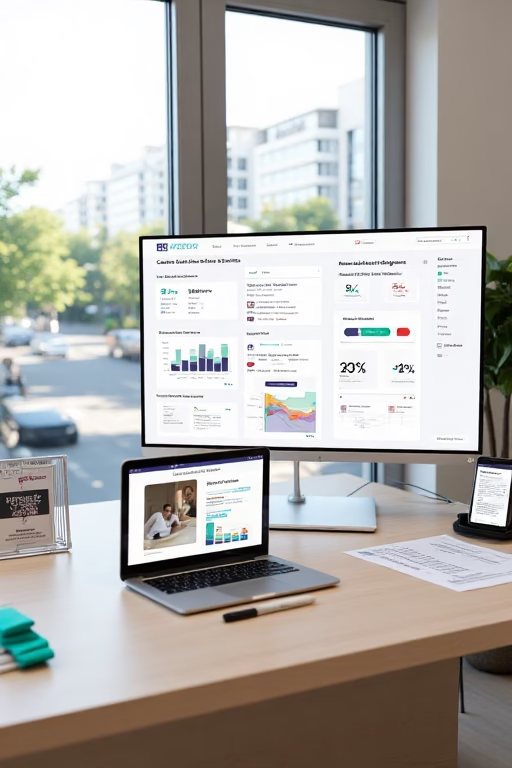
CRE Case Studies: How to Present Wins Without Disclosing Clients
Prove performance, protect relationships: a compliance-safe system for sharing outcomes, not identities.
Introduction
CRE Case Studies: How to Present Wins Without Disclosing Clients gives brokers, advisors, and operators a blueprint to tell credible success stories while honoring NDAs and internal policies. The core idea: highlight problems solved, methods used, and measurable results—and strip out any element that could realistically identify the client or property.
Compliance: This article is educational—not legal advice. Review brokerage policies, listing agreements, NDAs, lender covenants, and privacy rules before publication.
Expanded Table of Contents
- 1) Why “CRE Case Studies: How to Present Wins Without Disclosing Clients” Works
- 2) The REDACT Framework (Remove, Edit, De-Identify, Aggregate, Consent, Track)
- 3) What to Keep vs What to Cut
- 4) Case Study Structures (3 Editor-Ready Templates)
- 5) Metrics That Impress Without Overexposure
- 6) Visuals & Maps Without Doxxing
- 7) Quotes, Reviews & Surrogate Proof
- 8) Landing Page & PDF Design for CRE Case Studies
- 9) Workflow: From Deal Close → Publish in 10 Days
- 10) Distribution: Email, LI, Pitch Decks, RFPs
- 11) KPIs: What to Measure Post-Publication
- 12) Troubleshooting & Risk Mitigation
- 13) 25 Frequently Asked Questions
- 14) 25 Extra Keywords
1) Why “CRE Case Studies: How to Present Wins Without Disclosing Clients” Works
- Buyers of expertise need proof: anonymized outcomes still signal capability.
- Process de-risks selection: show your repeatable method, not your roster.
- Ethics builds trust: respecting confidentiality is a differentiator in CRE.
2) The REDACT Framework
- Remove direct identifiers (names, exact addresses, LLCs, loan #s).
- Edit near-identifiers (unique floor plates, one-of-a-kind art) that could pinpoint the asset.
- De-Identify locations to metro/region and use ranges for dates.
- Aggregate small samples (e.g., “3 suburban office assets”).
- Consent via a one-page release with checkboxes for data types.
- Track internal approvals (legal, client lead, lender/AM if needed).
Consent Snippet
“We consent to the publication of anonymized performance metrics and narrative descriptions
without naming our company, people, or specific property identifiers.” — Signature, Date
3) What to Keep vs What to Cut
Keep (high-signal)
- Problem → diagnosis → actions → results timeline
- Metrics as ranges or indexed values
- Market context (macro/micro trends)
- Process artifacts (checklists, playbooks)
Cut (risk/low value)
- Legal names, logos, staff headshots
- Parcel IDs, exact addresses, suite numbers
- Unique photos that reveal the site
- Bank/lender details, covenant language
4) Case Study Structures (3 Editor-Ready Templates)
A) 1-Page “Outcome Snapshot”
| Block | Guidance |
|---|---|
| Context | “Sunbelt industrial portfolio (3 assets), 250–400k SF” |
| Obstacle | Short-dated rollover; below-market rents |
| Actions | Stacked renewals, TI optimization, targeted tours |
| Result | NOI +18–24%; occupancy 92→97% in 180 days |
B) “Play-by-Play” (Process Focus)
1) Discovery → 2) Underwrite → 3) Strategy Sprint → 4) Execution
KPIs per phase; visuals: checklist + timeline with anonymized dates.
C) “Comparator” (Before/After + Market)
Show indexed performance vs. submarket average without revealing exact building.
5) Metrics That Impress Without Overexposure
- Indexed returns: “=100 at close; =132 at month 18”
- Ranges: “NOI +12–16%,” “Vacancy -3–5 pts”
- Percentiles: “Top quartile leasing velocity vs comp set”
- Relative deltas: “Achieved +210 bps vs market rent growth”
Avoid unique dollar amounts that triangulate the asset; prefer percentages, indices, and windows.
6) Visuals & Maps Without Doxxing
- Use blurred or illustrative floor plans; remove signage.
- Heat maps at county/MSA level (no parcel outlines).
- Charts: yoy deltas and indexed curves without raw rent lines.
7) Quotes, Reviews & Surrogate Proof
- Anonymous role-based quotes: “Asset Manager, West Coast REIT.”
- Third-party stats (brokerage reports) for context—paraphrase, don’t over-quote.
- Redact email signatures and scrub EXIF in images/PDFs.
8) Landing Page & PDF Design for CRE Case Studies
- Hero: “Proof without names” value prop + 3 bulleted outcomes.
- Tiles for each anonymized case; filter by asset type (Ind/Multifamily/Office/Retail).
- Lead form for deeper dives; link to NDA-bound versions under mutual confidentiality.
- Footer: confidentiality statement + contact.
9) Workflow: From Deal Close → Publish in 10 Days
- Day 1–2: Draft with REDACT; map what’s sensitive.
- Day 3–4: Legal/client review; apply edits.
- Day 5–6: Visuals (charts/maps) and accessibility checks.
- Day 7–8: Publish to web + PDF; add UTM links.
- Day 9–10: Distribute via email/LinkedIn; enable sales deck version.
10) Distribution: Email, LI, Pitch Decks, RFPs
- Email nurture: one case/week; “book a 15-min asset review.”
- LinkedIn carousel: 6 slides—Problem → Actions → Result → CTA.
- RFP annex: anonymized 1-pagers + methodology appendix.
11) KPIs: What to Measure Post-Publication
Time on Page
≥ 2:00
CTA Click Rate
≥ 3–6%
Meeting Requests
Weekly growth vs baseline
RFP Shortlists
Lift after launch
Zero Escalations
Compliance/Legal incidents
12) Troubleshooting & Risk Mitigation
- “This reveals too much.” Expand ranges, change timing windows, swap photos for illustrations.
- “Feels generic.” Add process specificity (checklists, sequencing) without naming names.
- “Prospects want proof.” Offer NDA-gated appendix after discovery call.
- “Legal delays.” Use a pre-approved case template and a consent checklist to cut cycles.
CRE Case Studies: How to Present Wins Without Disclosing Clients balances credibility and confidentiality—exactly what serious owners expect.
13) 25 Frequently Asked Questions
1) What is “CRE Case Studies: How to Present Wins Without Disclosing Clients”?
A system to publish persuasive, NDA-safe proof using anonymization and process storytelling.
2) Can I show photos?
Yes—use interior vignettes or illustrative renders; avoid signage and skyline giveaways.
3) How specific can metrics be?
Prefer percentages, indices, and ranges over precise dollars or dates.
4) Do I need written consent?
Best practice is yes. Use a one-page checkbox release for speed.
5) What if the client refuses?
Publish a composite case (aggregated, similar deals) or generic playbook instead.
6) Can lenders block case studies?
Loan docs can restrict disclosures—check covenants before sharing.
7) Is anonymization enough?
Combine de-identification with consent and internal review to reduce risk.
8) How do I avoid “humblebrag” tone?
Lead with client problem and decision logic, not just the outcome.
9) Should I mention submarket?
Metro or region is safest; submarket names can narrow identification—use cautiously.
10) How long should a case be?
1–3 pages web; 1 page PDF for decks; longer versions gated under NDA.
11) What visuals convert best?
Before/after indexed charts, timeline steps, and anonymized heat maps.
12) Can I quote the client anonymously?
Yes—title-only attribution (e.g., “CFO, National REIT”) with consent.
13) How to handle unique trophy assets?
Aggregate to “Class A CBD office, Tier-1 market” and widen time windows.
14) How do I show leasing wins?
Use velocity metrics (days-to-lease), rent delta %, TI per SF ranges.
15) What about development?
Show schedule adherence, cost variance %, pre-lease %, and safety stats—no parcel IDs.
16) For acquisitions?
Show underwriting thesis hits/misses, cap rate compression range, exit options.
17) For dispositions?
Emphasize buyer pool development, days-on-market vs comp set, bid depth (range).
18) For debt/equity placement?
Debt ratio bands, rate brackets (not exact), execution speed, approval path.
19) How often to publish?
Quarterly cadence keeps you current without overwhelming legal.
20) Can I use market reports as proof?
Yes—cite sources & paraphrase; avoid long quotes.
21) How to measure impact?
Track page time, CTA clicks, meetings set, RFP shortlists, and sourced pipeline.
22) Should I gate case studies?
Public summary + gated appendix after discovery call works well.
23) What if competitors copy?
Your process depth and proof cadence is the moat—not the client’s name.
24) How do I handle mistakes in published cases?
Issue a corrected version; keep a version log for compliance.
25) First step today?
Pick 3 deals, apply REDACT, draft 1-page snapshots, and route for consent.
14) 25 Extra Keywords
- CRE Case Studies: How to Present Wins Without Disclosing Clients
- anonymous real estate case study
- cre nda marketing
- deal teardown anonymized
- brokerage proof without clients
- asset management case study
- leasing velocity metrics
- industrial portfolio case
- multifamily turnaround story
- office repositioning proof
- retail remerchandising case
- development schedule variance
- capex value creation
- cap rate compression range
- noi growth indexed
- submarket anonymization
- cre compliance content
- gated appendix nda
- pitch deck case study
- rfp real estate proof
- investor relations narrative
- portfolio performance story
- tenant retention strategy
- leasing playbook anonymous
- 2025 cre marketing playbook













