
Market Wiz AI

Market Wiz

With ingenious automation fused with human dedication 24/7, Market Wiz puts the local marketing competition on notice – they’ve created a new standard operating system for dominating every digital front.All-Platform Compatibility: Facebook, Craigslist, Google, you name it. This system plays well with all the big players, ensuring your ads are everywhere they need to be.The Cherry on Top: There's a ton more under the hood, each feature adding more muscle to your marketing efforts.Bottom line: Market Wiz.ai isn’t just another tool; it’s your 24/7 digital marketing powerhouse. In the world of local advertising, it's the smartest move you’ll make.Market Wiz automates your online ads.|

Why Automation Is the Foundation of Modern Marketing
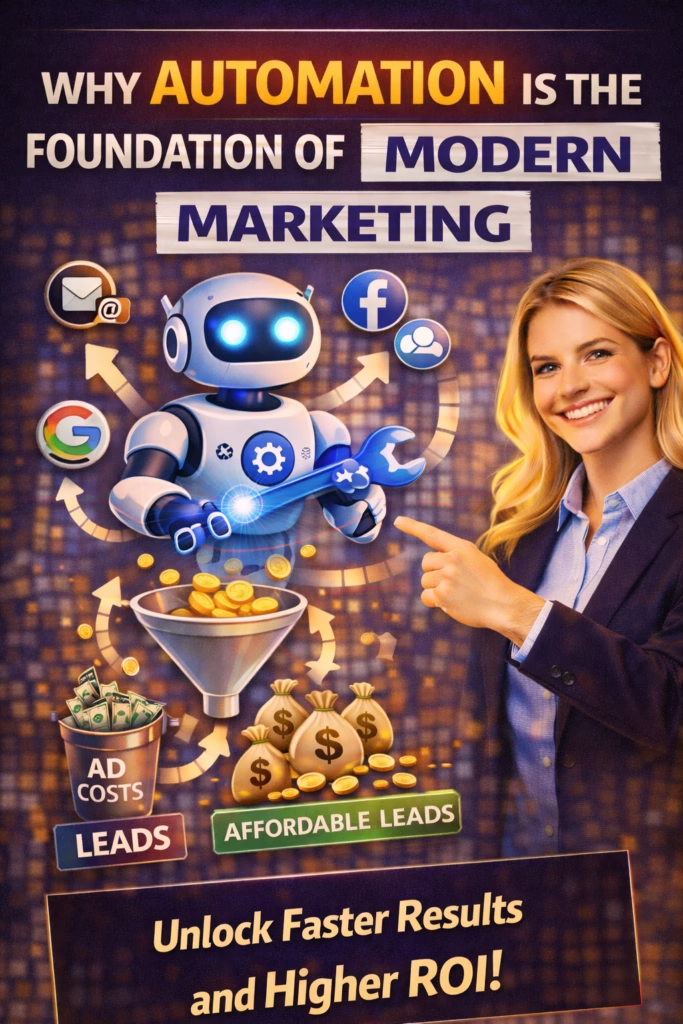
ChatGPT Image Feb 16 2026 02 59 06 PM
Why Automation Is the Foundation of Modern Marketing

Why Automation Is the Foundation of Modern Marketing

Why Automation Is the Foundation of Modern Marketing explains why the winners don’t just “market harder”—they build systems that respond instantly, follow up consistently, track every lead, and scale without chaos.

Modern Marketing Foundation: Capture Respond Qualify Follow-Up Book Report

Note: This is general guidance. Keep claims accurate, follow platform rules, and comply with privacy/consent requirements when messaging leads.

Introduction

Why Automation Is the Foundation of Modern Marketing comes down to one reality: marketing is no longer “a few campaigns.” It’s an always-on competition where buyers expect fast answers, clear options, and consistent follow-up.

In the old world, you could run ads, collect leads, and respond later. In the modern world, leads choose whoever responds first and feels most trustworthy.

Automation isn’t a luxury. It’s the operating system that prevents lead leakage and makes growth predictable.

Big idea: Automation doesn’t replace strategy. It enforces strategy—so results don’t depend on memory, mood, or bandwidth.

Expanded Table of Contents

1) What “marketing automation” actually means now

Modern marketing automation isn’t just email sequences. It’s the system that ensures every lead gets handled correctly—at the right time—every time.

Old definition

  • Email drips
  • Simple autoresponders
  • Scheduled posts

Modern definition

  • Instant response + qualification
  • Consistent follow-up SOP
  • Pipeline tracking and routing
  • Appointment booking automation
  • Attribution and reporting

Pro move: The goal isn’t “automate everything.” The goal is to automate consistency so your best practices run daily.

2) Why modern marketing requires automation

Automation became foundational because buyer behavior changed and competition increased.

Three forces driving automation

  1. Speed expectations: Buyers message multiple options and choose the fastest, clearest response.
  2. Channel complexity: Leads arrive from marketplaces, social DMs, forms, calls, and local search—at random times.
  3. Operational limits: Humans are inconsistent. Automation makes your best performance repeatable.

Rule: If leads arrive 24/7 but you respond 9–5, you are donating revenue to competitors.

3) Lead leakage: the real reason ROI collapses

Most businesses don’t have a “lead problem.” They have a lead leakage problem.

Where leads leak

  • Slow response times
  • No question asked → conversation stalls
  • No follow-up SOP → ghosts vanish permanently
  • Inbox chaos → leads get lost
  • No tracking → waste continues

Reality: Adding more spend to a leaky system scales losses, not profit.

4) The 6 layers of automation (capture → report)

Automation is foundational because it covers the entire lead lifecycle.

1) Capture

Forms, calls, DMs, marketplace messages, chat widgets—everything routes into a system.

2) Respond

Instant replies that confirm receipt and ask one forward-moving question.

3) Qualify

Collect city/zip, timeline, budget, and must-haves to reduce wasted conversations.

4) Nurture

Short sequences that keep you top-of-mind without being spammy.

5) Book

Automated scheduling, confirmations, reminders, and rescheduling flows.

6) Report

Source tracking, stage conversion, booked next steps, and revenue attribution.

Pro move: If you automate only one layer, you get partial results. If you automate capture → report, you get predictability.

5) Speed-to-lead automation: your highest ROI lever

Speed-to-lead is the easiest conversion lever to improve, and automation makes it consistent.

Instant reply template (universal)

Yes — got your message ✅

Quick question so I can point you to the best option:
What city/zip are you in, and is this for today or this week?

Why this works

  • Confirms you’re real
  • Moves the lead forward
  • Captures intent fast
  • Sets you up to offer options

Rule: Every automated reply should create momentum with one clear question.

6) Qualification automation: reduce wasted conversations

Modern marketing isn’t about “more conversations.” It’s about the right conversations.

Minimum qualification fields

  • City/zip (service area + logistics)
  • Timeline (today / this week / this month)
  • Budget range (fit)
  • Must-have (match)

Qualification message (copy/paste)

Perfect ✅
So I can match you to the best option:
1) What city/zip?
2) Are you looking for today or this week?
3) Any must-haves I should know?

Pro move: Qualification reduces back-and-forth and speeds up booking.

7) Follow-up automation: where “hidden revenue” lives

Most leads don’t say “no.” They disappear. Follow-up automation recovers them.

3-touch follow-up SOP (baseline)

TimingMessageGoal
20–40 minutesHelpful check-in + questionRe-engage
Same dayOptions + availabilityCreate action
Next dayAlternate fitSave the lead

Follow-up #1

Quick check-in ✅
Did you still want this?

Reply with your city + whether you want today or this week and I’ll confirm options.

Follow-up #2

Heads up ✅ We’ve had a few people asking today.
If you want it, reply with your city and I’ll confirm the fastest next step.

Follow-up #3

Still shopping? ✅
If this isn’t perfect, tell me your budget + must-haves and I’ll send the best match.

Important: Follow-ups must be helpful and respect opt-outs. Don’t spam. Don’t mislead.

8) Pipeline automation: stop losing leads in the cracks

When leads arrive from multiple channels, pipelines keep you sane.

Simple pipeline stages

  • New → inquiry received
  • Qualified → city + timeline captured
  • Options sent → offer shared
  • Booked → next step scheduled
  • Closed → completed
  • Lost → no response after SOP

Weekly checklist

[ ] inbound inquiries by source
[ ] median response time
[ ] qualified rate
[ ] booked next steps
[ ] close rate
[ ] top 5 scripts/angles that produced bookings

Rule: Automation without a pipeline still creates chaos—just faster.

9) Content and distribution automation: scale visibility

Automation isn’t only messaging. It can also scale visibility—by making consistent publishing easier.

What to automate in content

  • Content repurposing (one video → multiple platform cuts)
  • Posting cadence and scheduling
  • Template-based listing creation (varied angles)
  • Basic performance tagging (what worked and why)

Pro move: Automation should protect cadence. Cadence builds compounding attention.

10) Tracking and attribution automation: stop guessing

If you can’t measure what produces booked next steps, you can’t scale intelligently.

Minimum attribution model

  • Source tag on every lead
  • Stage timestamps (received, responded, booked, closed)
  • Outcome + lost reason

Rule: Optimize cost per booked next step, not cost per click.

11) KPIs that prove automation is working

KPIWhat it measuresTarget direction
Median response timeSpeed-to-leadDown
Follow-up completionLeakage preventionUp
Qualified rateLead clarityUp
Booked next stepsCommitmentUp
Close rateRevenue efficiencyUp

Pro move: If lead volume stays the same but bookings increase, automation is working.

12) 30–60–90 day rollout plan

Days 1–30 (Stop leakage fast)

  1. Implement instant replies everywhere leads arrive
  2. Deploy one-question qualification (city + timeline)
  3. Implement a 3-touch follow-up SOP
  4. Set up pipeline stages and required fields
  5. Track response time and booked next steps weekly

Days 31–60 (Increase conversion)

  1. Refine scripts based on objections and lost reasons
  2. Standardize offers and options
  3. Add booking prompts, confirmations, and reminders
  4. Improve proof content and clarity

Days 61–90 (Scale the system)

  1. Automate reporting: source → booked → closed
  2. Scale channels that produce best cost per booked next step
  3. Retire weak scripts and double down on winners
  4. Expand automation to nurture and referral loops

Outcome: Marketing stops being a heroic effort and becomes a reliable machine.

13) 25 Frequently Asked Questions

1) Why is automation the foundation of modern marketing?

Because it makes speed, consistency, follow-up, and tracking reliable—reducing lead leakage and increasing conversion.

2) What does automation solve first?

Slow replies, missed follow-ups, inconsistent messaging, and lost leads.

3) Is automation only for big companies?

No. Smaller teams benefit the most because automation fills staffing gaps.

4) What is lead leakage?

Revenue lost due to missed messages, slow response, and lack of follow-up.

5) What is speed-to-lead?

How fast you respond to an inquiry.

6) Why does speed matter?

Faster response increases conversion and lowers cost per close.

7) What should an instant reply include?

Confirmation and one question (city/zip + timeline).

8) How many follow-ups should I send?

Three is a strong baseline.

9) Will automation feel spammy?

Not if messages are short, helpful, and relevant.

10) What are the layers of automation?

Capture, respond, qualify, nurture, book, and report.

11) What KPI predicts revenue best?

Booked next steps.

12) Does automation replace humans?

No. It supports humans by enforcing speed and consistency.

13) What should I automate first?

Instant replies + 3-touch follow-up SOP + pipeline tracking.

14) What is pipeline automation?

Tagging and moving leads through stages so nothing is lost.

15) How does automation lower CAC?

By improving conversion and reducing missed leads.

16) What’s the risk of automating too early?

Scaling conversations without fixing offer clarity and qualification.

17) How do I keep automation compliant?

Follow platform policies, respect opt-outs, and avoid misleading claims.

18) Can automation help organic lead gen?

Yes—by converting inbound faster and more consistently.

19) What channels benefit most?

Any channel where leads arrive unpredictably: DMs, marketplaces, local SEO, calls.

20) What should be tracked?

Source, response time, stage conversion, booked next steps, closes, and lost reasons.

21) How do I know it’s working?

Faster replies, higher booking rate, fewer missed leads, higher closes.

22) What’s a system vs a campaign?

A system is repeatable and produces results consistently; a campaign is temporary.

23) Does automation help with ghosting?

Yes—follow-up sequences recover leads.

24) What’s the simplest qualification question?

“What city/zip are you in, and is this for today or this week?”

25) What’s the core takeaway?

Automation turns marketing from effort-based to system-based growth.

14) 25 Extra Keywords

  1. Why Automation Is the Foundation of Modern Marketing
  2. marketing automation foundation
  3. automation in modern marketing
  4. speed to lead automation
  5. instant reply scripts
  6. follow up automation SOP
  7. lead leakage prevention
  8. pipeline automation system
  9. booked appointment KPI
  10. marketing operations automation
  11. automated lead qualification
  12. automated appointment booking
  13. conversion rate optimization automation
  14. inbound lead automation
  15. local marketing automation
  16. marketplace lead automation
  17. Facebook Marketplace automation
  18. Craigslist automation leads
  19. OfferUp lead follow up
  20. attribution and reporting automation
  21. predictable lead generation system
  22. scalable marketing systems
  23. reduce CAC with automation
  24. automated customer acquisition
  25. modern marketing playbook 2026

© 2026 Your Brand. All Rights Reserved.
General information only—confirm compliance with platform policies, consent rules, and applicable privacy laws before automating outreach or messaging leads.

Why Automation Is the Foundation of Modern Marketing Read More »
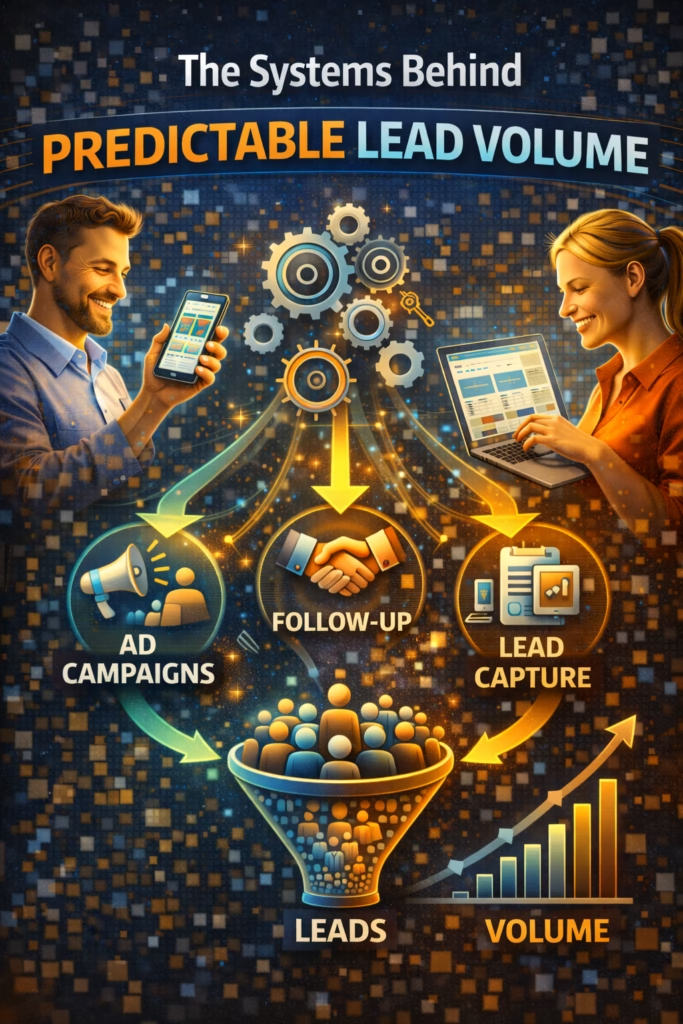
The Systems Behind Predictable Lead Volume

ChatGPT Image Feb 15 2026 03 15 44 PM
The Systems Behind Predictable Lead Volume

The Systems Behind Predictable Lead Volume

The Systems Behind Predictable Lead Volume is the framework for consistent inbound inquiries—built on cadence, proof, clear offers, fast response time, and follow-up systems that prevent lead leakage.

Predictable Lead Engine: Visibility Cadence Proof Speed-to-Lead Follow-Up Tracking

Note: This is general guidance. Keep claims accurate, avoid spam duplication, and follow platform policies when posting or automating messages.

Introduction

The Systems Behind Predictable Lead Volume are not secret hacks. They’re the boring fundamentals—executed consistently—until they compound into something that feels unfair.

Most businesses experience “random leads” because their systems are random:

  • They post when they remember
  • They reply when they have time
  • They follow up when they feel like it
  • They judge performance by emotion, not metrics

Predictable lead volume is created when the system becomes more consistent than the competition.

Big idea: Lead volume becomes predictable when visibility and conversion are both systemized.

Expanded Table of Contents

1) What “predictable lead volume” really means

Predictable lead volume doesn’t mean the exact same number of leads every day. It means your lead flow is stable enough that you can:

  • Forecast staff coverage
  • Plan inventory and scheduling
  • Set realistic revenue targets
  • Scale volume without chaos

Predictable means your system produces leads whether or not you “feel motivated” this week.

2) The predictable lead equation

Lead volume becomes predictable when you control two things:

Visibility
How often you appear in searches/feeds.
Conversion
How reliably you turn interest into booked next steps.

The equation

Predictable Leads = (Visibility Surface Area × Cadence) × (Proof × Offer Clarity × Speed-to-Lead × Follow-Up)

Important: Most businesses try to increase visibility while ignoring conversion. Fix conversion first—then scale visibility.

3) System #1: visibility surface area

Surface area is how many “doors” you have open for people to find you. On marketplaces, that’s listings. On social, that’s posts. On local SEO, that’s pages and rankings.

Surface area principles

  • More assets = more keywords covered
  • More angles = more buyer intent captured
  • More variety = less dependence on one listing

Surface-area map (example)

IntentAngleExample hook
BudgetBest value“Best deal this week”
UrgencyFast availability“Available today”
QualityPremium upgrade“Upgraded comfort”
PaymentMonthly options“Easy payments”
TrustProof-based“Real photos + details”

Rule: If lead volume is low, increase surface area with more varied assets—not duplicates.

4) System #2: cadence (the compounding rhythm)

Cadence is the schedule that keeps you visible. It turns “random bursts” into compounding reach.

Cadence model

  • Daily: publish or refresh a set number of assets
  • Weekly: refresh top performers (new first photo + title tweak)
  • Monthly: retire stale assets and launch new angles

Pro move: Decide your minimum viable cadence. Something you can do every week forever beats a 2-week sprint.

5) System #3: proof-based content (trust at scale)

Proof makes lead volume better, not just bigger. It reduces skepticism and increases serious inquiries.

Proof checklist

  1. Clean hero image
  2. Multiple angles
  3. Close-up detail shots
  4. Transparent details (what, where, when)
  5. Context signal (subtle brand legitimacy)

Rule: If you want higher-quality leads, improve proof before increasing volume.

6) System #4: offer clarity (why buyers message)

People message when the offer is easy to understand and easy to act on.

Offer clarity rules

  • One clear price (or truthful range)
  • One clear next step (appointment/pickup/delivery)
  • One clear trust line (proof + transparency)

Offer block (copy/paste)

✅ Price: $____
✅ Available: (today/this week)
✅ Next step: (pickup / delivery / appointment)
✅ Reply with your city for fastest options

Avoid: bait pricing, hidden conditions, or confusing terms.

7) System #5: speed-to-lead (conversion multiplier)

Speed-to-lead is the easiest conversion improvement most businesses can make. And it’s often the most profitable.

Instant reply (universal)

Yes — it’s available ✅
Are you looking to do this today or this week?

What city/zip are you in? I’ll confirm the fastest options.

Pro move: The goal of the first reply is not to “explain.” It’s to qualify and book the next step.

8) System #6: qualification workflows (protect your time)

Predictable lead volume can be a burden if every lead requires 20 minutes of manual work. Qualification protects capacity.

Qualification workflows

  • One-question qualifier (city + timeline)
  • Tags (budget, urgency, high-intent)
  • Options-based replies (“A or B?”)
  • Short intake forms for serious buyers (optional)

Rule: Qualification turns volume into usable volume.

9) System #7: follow-up SOP (hidden revenue)

Ghosting is normal. Follow-up is a system that turns “no response” into revenue.

3-touch follow-up SOP

TimingMessageGoal
20–40 minQuick check-in + next stepRe-engage
Same dayAvailability + optionsCreate action
Next dayAlternate optionSave lead
Quick check-in ✅
Did you still want this?

Tell me your city and whether you want today or this week, and I’ll confirm options.

Pro move: Follow-up works best when it offers a choice: “today or tomorrow,” “pickup or delivery,” “Option A or B.”

10) System #8: pipeline and ownership (no lead left behind)

Predictable lead volume requires predictable handling. A pipeline prevents lead leakage.

Pipeline stages

  • New
  • Qualified
  • Options Sent
  • Booked
  • Closed
  • Lost

Rule: Every lead must have an owner. “Everyone’s job” becomes no one’s job.

11) System #9: KPI tracking (truth > vibes)

KPIs turn lead volume from “feelings” into control.

KPIWhat it meansWhy it matters
Active assetsVisibility surface areaPredicts inbound volume
Messages/weekLead flowMeasures demand
Median response timeSpeed-to-leadPredicts conversion
Booked rateNext steps scheduledPredicts revenue
Close rateDeals wonMeasures performance

Rule: If response time improves and booked rate improves, revenue follows—even if traffic stays flat.

12) 30–60–90 day rollout plan

Days 1–30 (Stabilize conversion)

  1. Deploy instant replies and routing
  2. Implement 3-touch follow-up SOP
  3. Define pipeline stages and lead ownership
  4. Start weekly KPI tracking

Days 31–60 (Stabilize visibility)

  1. Build templates (titles, descriptions, offers)
  2. Standardize proof content system
  3. Implement consistent cadence
  4. Identify top-performing angles and replicate variants

Days 61–90 (Scale responsibly)

  1. Increase surface area while maintaining variation
  2. Optimize based on KPIs (response, booked, close)
  3. Retire weak assets and double down on winners
  4. Strengthen ops capacity (scheduling, SOPs, coverage)

13) 25 Frequently Asked Questions

1) What creates predictable lead volume?

Consistency: cadence, proof content, clear offers, fast response time, follow-up SOPs, and KPI tracking.

2) Why do most businesses have unpredictable leads?

Because their visibility and conversion are inconsistent and they don’t track performance.

3) What’s the fastest way to increase leads?

Improve speed-to-lead and follow-up first.

4) What’s “surface area” in marketing?

How many ways buyers can discover you: listings, posts, pages, and keyword coverage.

5) Is posting more always better?

No. Post more variety, not more duplicates.

6) What makes a lead “high intent”?

Clear timeline, clear need, and willingness to schedule a next step.

7) What should my first reply be?

Confirm availability, ask timeline, ask city, offer options.

8) How fast should I respond?

Under 5 minutes is good; under 1 minute is best.

9) How many follow-ups should I send?

Three touches is a strong baseline.

10) What’s “lead leakage”?

Leads lost due to slow replies, missed follow-up, or no clear owner.

11) What’s the best qualification question?

“What city are you in, and are you looking for today or this week?”

12) Do I need automation?

Not required, but it helps maintain consistency and speed.

13) Do I need a CRM?

You need pipeline stages and ownership. A CRM helps, but a simple tracker can work at first.

14) What KPI predicts revenue best?

Booked next steps.

15) What should I track weekly?

Active assets, messages/week, response time, booked rate, close rate.

16) Why do leads ghost?

They message multiple providers; slow response and no next step causes drop-off.

17) How do I reduce ghosting?

Fast replies, options-based scheduling, and follow-up SOPs.

18) Can predictable leads happen without ads?

Yes, if your visibility and conversion systems are consistent.

19) What makes visibility “compound”?

Cadence—consistent publishing and refreshing.

20) When should I scale volume?

When conversion and operations are stable.

21) What’s the biggest mistake?

Adding more traffic without fixing conversion bottlenecks.

22) How long until predictable volume?

Often 60–90 days for compounding stability.

23) Can this work across industries?

Yes. The systems apply broadly; the templates and offers change by niche.

24) What’s the best next step today?

Deploy instant replies and a follow-up SOP immediately.

25) What turns volume into revenue?

Booked next steps, strong follow-up, and operational execution.

14) 25 Extra Keywords

  1. The Systems Behind Predictable Lead Volume
  2. predictable lead volume
  3. lead generation systems
  4. systems for consistent leads
  5. predictable lead flow
  6. organic lead systems
  7. marketplace lead engine
  8. visibility surface area strategy
  9. posting cadence system
  10. proof based content marketing
  11. offer clarity framework
  12. speed to lead conversion
  13. instant reply scripts
  14. follow up SOP leads
  15. reduce lead leakage
  16. lead pipeline stages
  17. lead ownership system
  18. KPI tracking for leads
  19. booked appointment rate
  20. close rate optimization
  21. how to get predictable leads
  22. high intent inbound leads
  23. systems first marketing
  24. lead engine without ads
  25. 30 60 90 day lead plan

© 2026 Your Brand. All Rights Reserved.
General information only—confirm compliance with platform policies and applicable privacy rules before sending marketing messages.

The Systems Behind Predictable Lead Volume Read More »

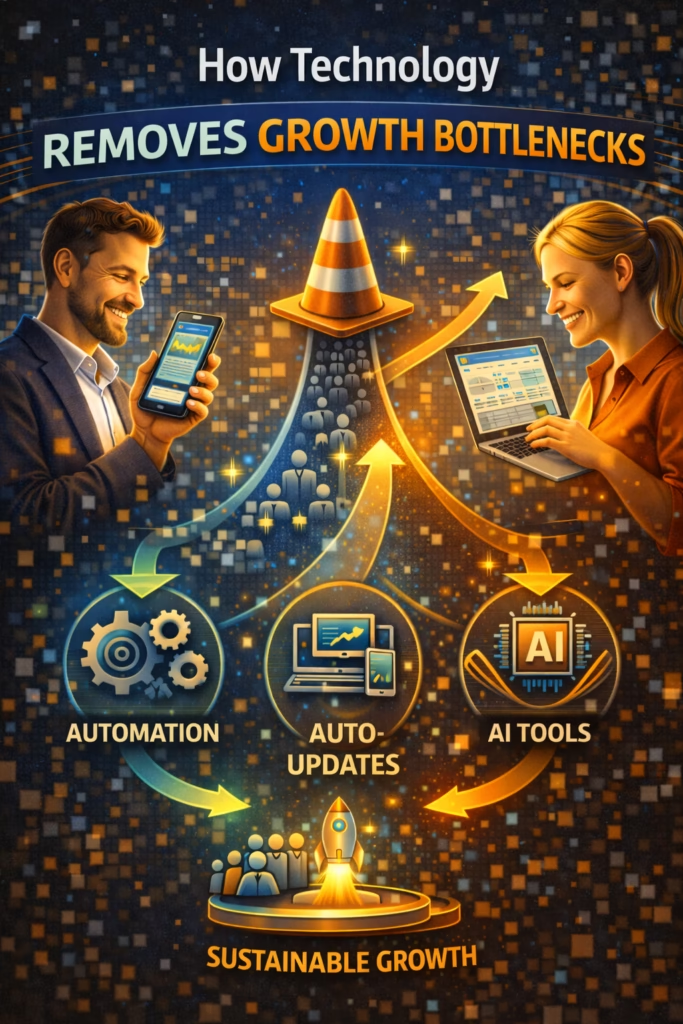
How Technology Removes Growth Bottlenecks

ChatGPT Image Feb 15 2026 03 15 46 PM
How Technology Removes Growth Bottlenecks

How Technology Removes Growth Bottlenecks

How Technology Removes Growth Bottlenecks is the modern playbook for scaling without chaos—by removing the constraints that slow leads, stall follow-up, break operations, and cap revenue.

Bottleneck Removal System: Speed-to-Lead Automation Consistency Follow-Up Tracking Ops

Note: This is general guidance. Keep claims accurate, follow platform policies, and implement automation responsibly to avoid spam or compliance issues.

Introduction

How Technology Removes Growth Bottlenecks isn’t about buying more tools. It’s about removing constraints—one by one—so your marketing, sales, and operations can scale without breaking.

Most businesses don’t stop growing because demand disappears. They stop growing because a single bottleneck becomes the ceiling:

  • Leads arrive… but response time is slow
  • Messages come in… but follow-up is inconsistent
  • Listings exist… but visibility is sporadic
  • Sales happen… but tracking is unclear
  • Operations get busy… and everything becomes reactive

Big idea: Growth is constrained by the tightest bottleneck—technology removes bottlenecks by making performance consistent.

Expanded Table of Contents

1) The 7 bottlenecks that cap growth

Most “growth problems” are actually bottleneck problems. These seven show up in almost every local business, service brand, or Marketplace-driven lead machine.

BottleneckSymptomsWhat fixes it
1) Slow response timeMissed leads, ghosting, low conversionInstant replies + routing
2) Inconsistent visibilityLead spikes then droughtsCadence + automation
3) Manual follow-upLeads fall through cracksSOPs + reminders
4) Poor qualificationWasted chats, wrong-fit buyersScripts + forms + tags
5) Weak handoffsNo one owns the leadPipeline + assignments
6) No trackingGuesswork decisionsDashboards + KPIs
7) Ops chaosCapacity caps growthScheduling + automation

Rule: Fix bottlenecks in order. Speed and visibility come first because they create the raw material: conversations.

2) Bottleneck #1: slow response time

Speed-to-lead is the easiest bottleneck to fix and often the highest ROI. If you respond late, someone else gets the buyer.

Technology fixes speed with

  • Instant reply templates
  • Auto-routing to the right team member
  • Notifications and escalation rules
  • After-hours coverage (handoff or assistant)

Instant reply (universal)

Yes — it’s available ✅
Are you looking to do this today or this week?

What city/zip are you in? I’ll confirm the fastest options.

Pro move: Don’t ask five questions. Ask one question that qualifies timeline + location, then move to scheduling.

3) Bottleneck #2: inconsistent visibility

Many businesses think they have a “lead problem.” They actually have a consistency problem.

What inconsistency looks like

  • Posting only when someone remembers
  • No templates, so everything takes too long
  • Stale listings that never get refreshed
  • No structured variation, so posting feels risky

Technology fixes visibility with

  • Templates for titles/descriptions/offers
  • Scheduled posting cadence
  • Queue-based publishing
  • Variation rules that avoid spam duplication

Rule: Visibility compounds when cadence is stable.

4) Bottleneck #3: manual follow-up and lead leakage

Lead leakage is silent. You don’t feel it—you just wonder why sales aren’t higher.

Technology fixes follow-up with

  • Reminder prompts when leads go quiet
  • Short follow-up sequences (3-touch SOP)
  • Reusable scripts by lead type
  • Calendar scheduling links and confirmations

3-touch follow-up SOP (copy/paste)

TimingMessageGoal
20–40 minQuick check-in + next stepRe-engage
Same dayAvailability + optionsCreate action
Next dayAlternate optionSave the lead
Quick check-in ✅
Did you still want this?

Tell me your city and whether you want today or this week, and I’ll confirm options.

Pro move: Follow-up is where “free money” lives—because it converts leads you already paid for (time or effort).

5) Bottleneck #4: poor qualification and wasted conversations

High lead volume can still fail if qualification is weak. You end up chatting with people who will never buy.

Technology fixes qualification with

  • One-question qualification scripts
  • Tags and pipeline stages
  • Simple intake forms for serious buyers
  • Automated “choose your option” prompts

Qualification question (universal)

“What city are you in, and are you looking for today or this week?”

Once you have those two, you can route the lead to the correct next step.

6) Bottleneck #5: weak handoffs between marketing and sales

When leads come from multiple places (Marketplace, social DMs, calls, forms), handoffs break unless ownership is clear.

Technology fixes handoffs with

  • Assigned ownership (who is responsible)
  • Central inbox or CRM routing
  • Pipeline stage definitions
  • Escalation rules (if no reply in X minutes)

Simple pipeline stages

  • New
  • Qualified
  • Options Sent
  • Booked
  • Closed
  • Lost

7) Bottleneck #6: no tracking, no truth

If you can’t measure it, you can’t improve it. Without tracking, your business runs on guesses.

Technology fixes tracking with

  • Message volume by listing/offer
  • Response time tracking
  • Booked rate and close rate
  • Lead source attribution (where it came from)

Pro move: Track “booked next steps” weekly. It’s the clearest signal of future revenue.

8) Bottleneck #7: operational chaos and capacity

When systems work, operations become the new ceiling. Tech removes pressure by standardizing what happens after the lead arrives.

Technology fixes ops with

  • Scheduling automation and reminders
  • Standard operating procedures (SOPs)
  • Task assignment and checklists
  • Templates for common customer questions

Rule: Don’t scale lead volume until your “booked → delivered/served” workflow is stable.

9) The bottleneck removal stack: what to implement in order

If you want predictable growth, implement this in order:

  1. Speed-to-lead: instant replies + routing
  2. Follow-up SOP: 3-touch sequence
  3. Cadence: consistent posting/refreshing
  4. Proof system: photos, transparency, trust signals
  5. Qualification: one-question filters + tags
  6. Pipeline: ownership, stages, handoffs
  7. Dashboards: KPIs and weekly optimization

Rule: Don’t add complexity until the basics are consistently executed.

10) KPIs that prove bottlenecks are gone

KPIWhat it measuresTarget
Median response timeSpeed-to-lead< 5 min good, < 1 min best
Qualified rateLead qualityImproves with scripts
Booked ratePipeline strengthImproves with options
Close rateRevenue conversionImproves with follow-up
Lead source mixChannel stabilityDiversify over time

Pro move: If response time improves and booked rate improves, revenue follows—even if lead volume stays the same.

11) 30–60–90 day rollout plan

Days 1–30 (Remove speed + follow-up bottlenecks)

  1. Deploy instant replies and routing
  2. Implement 3-touch follow-up SOP
  3. Define pipeline stages and ownership
  4. Start weekly tracking dashboard

Days 31–60 (Remove visibility + qualification bottlenecks)

  1. Build posting cadence and templates
  2. Standardize proof photo system
  3. Deploy one-question qualification filters
  4. Improve booked next steps workflow

Days 61–90 (Remove ops + tracking bottlenecks)

  1. Automate scheduling and reminders
  2. Standardize SOPs for team execution
  3. Optimize based on KPIs (response, booked, close)
  4. Scale volume responsibly once ops is stable

12) 25 Frequently Asked Questions

1) What are growth bottlenecks?

Constraints that prevent scaling—like slow response, inconsistent visibility, manual follow-up, weak tracking, or limited operational capacity.

2) How does technology remove growth bottlenecks?

By improving consistency: faster replies, automated follow-up, stable posting cadence, clear pipelines, and dashboards.

3) What’s the fastest bottleneck to fix?

Speed-to-lead. Instant replies can boost conversion immediately.

4) What’s the second fastest?

Follow-up. A short SOP recovers ghost leads and increases closes.

5) Why does slow response time hurt so much?

Because buyers message multiple providers. The fastest responder gets the appointment.

6) Do I need a CRM?

Not always, but you need a pipeline and a way to track ownership and stages.

7) How do I qualify leads quickly?

Ask one question that reveals timeline and location (or budget/intent).

8) How many follow-ups should I send?

Three touches is a strong baseline.

9) What KPIs matter most?

Response time, booked rate, and close rate.

10) Why is visibility a bottleneck?

Because inconsistent posting creates lead droughts.

11) How do I create consistent visibility?

Templates + cadence + responsible automation.

12) What is “lead leakage”?

Leads that stop responding because no follow-up system existed.

13) Can automation replace humans?

Automation supports humans by handling repetitive work and keeping systems consistent.

14) How do I prevent operational overload?

Standardize scheduling, SOPs, and handoffs before scaling lead volume.

15) What’s a pipeline stage?

A step that shows where a lead is in your process (New, Qualified, Booked, Closed).

16) How do I assign lead ownership?

Route leads to one person responsible for moving it to the next stage.

17) What’s the best “next step” in messaging?

Booking an appointment, pickup, or call—something scheduled.

18) Why do businesses stall at the same revenue level?

Because the same bottleneck remains unaddressed.

19) What does “systems-first growth” mean?

Fixing constraints before scaling volume so growth doesn’t break operations.

20) Does more traffic solve bottlenecks?

No—more traffic often makes bottlenecks worse.

21) How do I know which bottleneck is the main one?

Look for the tightest constraint: response time, follow-up, visibility cadence, or capacity.

22) What’s the best first step today?

Deploy instant replies and a follow-up SOP.

23) How long until results show?

Often within weeks for conversion improvements; 60–90 days for compounding systems.

24) Will this work in any niche?

The bottleneck framework applies broadly. The exact templates and offers vary by niche.

25) What’s the biggest mistake with technology?

Adding tools without fixing the workflow. Systems first, tools second.

13) 25 Extra Keywords

  1. How Technology Removes Growth Bottlenecks
  2. growth bottlenecks
  3. remove growth bottlenecks with technology
  4. business growth automation
  5. speed to lead improvement
  6. follow up SOP system
  7. lead leakage prevention
  8. pipeline stages for leads
  9. automated lead qualification
  10. operations automation
  11. workflow standardization
  12. posting cadence automation
  13. marketplace automation strategy
  14. organic lead engine system
  15. how to scale without ads
  16. KPI dashboard for sales
  17. response time KPI
  18. booked appointment rate
  19. close rate optimization
  20. lead routing system
  21. customer inquiry automation
  22. local marketing systems
  23. technology for scaling business
  24. remove operational bottlenecks
  25. systems-first growth framework

© 2026 Your Brand. All Rights Reserved.
General information only—confirm compliance with platform policies and applicable privacy rules before sending marketing messages.

How Technology Removes Growth Bottlenecks Read More »

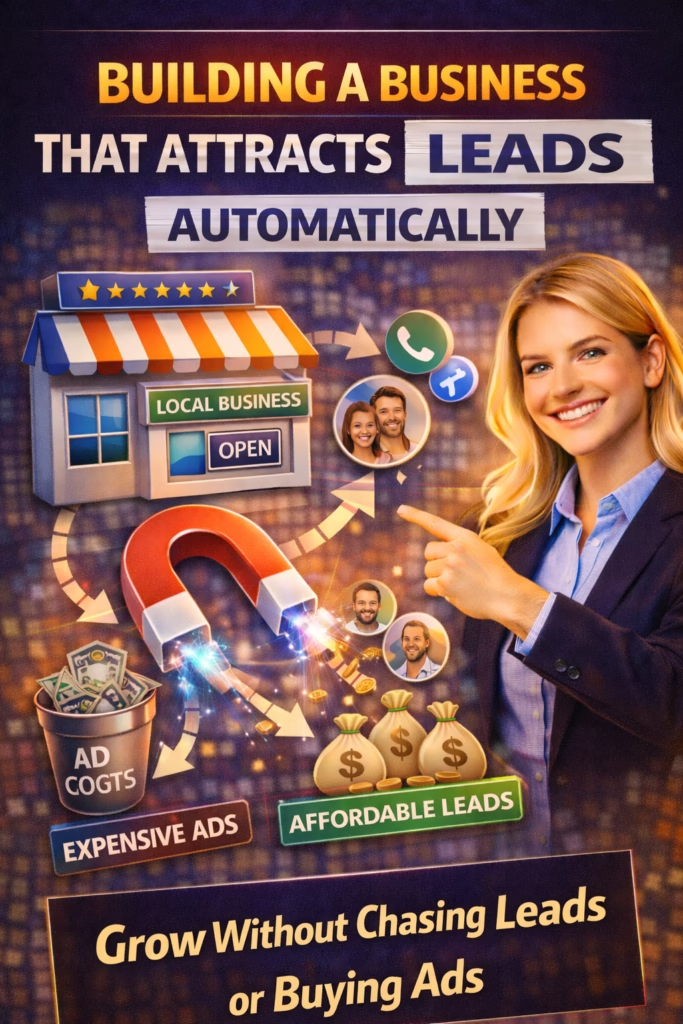
Building a Business That Attracts Leads Automatically

ChatGPT Image Feb 15 2026 03 15 42 PM
Building a Business That Attracts Leads Automatically

Building a Business That Attracts Leads Automatically

Building a Business That Attracts Leads Automatically is the blueprint for compounding inbound demand—built on visibility surface area, proof-based trust, clear offers, fast replies, follow-up systems, and tracking that prevents lead leakage.

Automatic Lead Attraction: Visibility Proof Offers Cadence Instant Replies Follow-Up

Note: This is general guidance. Keep all listings accurate, avoid misleading claims, and follow platform rules. Comply with privacy/consent requirements for messages.

Introduction

Building a Business That Attracts Leads Automatically sounds like magic, but it’s not. It’s what happens when inbound visibility and conversion systems work even when you’re busy, asleep, or focused on operations.

Most businesses “generate leads” by pushing: ads, cold outreach, promotions. That works—but it’s fragile. The moment you stop pushing, lead flow stops.

A business that attracts leads automatically is different. It pulls. It earns inbound messages because it’s consistently visible, trusted, and easy to say yes to.

Big idea: “Automatic” doesn’t mean zero work. It means your work builds assets and systems that keep producing leads tomorrow.

Expanded Table of Contents

1) What it means to attract leads automatically

Attracting leads automatically means your business produces inbound inquiries predictably because it is consistently discoverable, trusted, and structured to convert.

Manual lead generation

  • Leads spike when you post or spend
  • Activity stops → leads stop
  • Conversion depends on memory and effort
  • Inbox becomes chaotic

Automatic lead attraction

  • Leads arrive daily from compounding visibility
  • Systems respond fast
  • Follow-up recovers ghosts
  • Tracking prevents leakage

Pro move: A lead engine isn’t “more content.” It’s content + conversion systems + a cadence that compounds.

2) The 6 pillars of automatic lead attraction

To make leads feel automatic, you need six pillars working together.

1) Surface area

More quality assets across buyer intents and keywords.

2) Proof

Real photos, transparency, reviews, credibility signals.

3) Offer clarity

Clear price/terms, clear options, clear next step.

4) Cadence

Consistent publishing and refreshing that compounds visibility.

5) Speed-to-lead

Instant replies that keep you winning the first 5 minutes.

6) Follow-up + tracking

Simple SOP + pipeline so no lead gets lost.

Rule: If you fix only one pillar, you get random spikes. If you build all six, you get predictable inbound.

3) Visibility surface area: how inbound is earned

Automatic inbound starts with visibility surface area: the total number of places your business shows up when buyers search, browse, or compare.

Surface area includes

  • Marketplaces listings (multiple angles)
  • Local service pages and Google Business presence
  • Short-form video library (reusable, repurposable)
  • Evergreen blog posts and FAQs
  • Social posts that prove activity and trust

Surface area map (intent buckets)

IntentAsset typeWhat it catches
Price-focusedListing angle: value/budgetDeal hunters
UrgencyListing angle: available todayImmediate buyers
QualityContent: premium proofHigher-ticket buyers
TrustReviews, proof photos, FAQsSkeptical buyers
Local needLocal SEO / GBPHigh-intent searchers

Pro move: If you want more leads, don’t just post “more.” Post more variety that targets different intents.

4) Proof and trust: why people choose you

Visibility brings traffic. Proof converts it. In marketplaces and local services, trust is the currency.

Proof system checklist

  1. Clean, bright hero photo
  2. Multiple angles (complete coverage)
  3. Close-ups that prove condition/results
  4. Context proof (process photo, team, brand presence if allowed)
  5. Transparent details (what’s included, timelines, terms)

Trust lines (rotate in listings)

✅ Happy to answer questions — tell me your city and timeline.
✅ Real photos, clear details, and fast next steps.
✅ If this isn’t the perfect fit, tell me your budget and must-haves.

Rule: Don’t try to sound perfect. Try to sound real.

5) Offer clarity: the conversion shortcut

Leads arrive faster when buyers understand the offer instantly. Confusion creates drop-off.

Offer clarity rules

  • One clear price (or an honest range)
  • One clear option set (pickup/delivery/appointment)
  • One clear timeline (today/this week)
  • One clear next step (reply with city + timeline)

Offer block (copy/paste)

✅ Price: $____
✅ Available: (today / this week)
✅ Options: (pickup / delivery / appointment)
✅ Reply with your city + timeline for fastest next step

Avoid: bait pricing, vague terms, or forcing too many steps. Friction kills inbound.

6) Cadence: the rhythm that compounds

Automatic lead attraction is built with cadence. Cadence is the schedule that tells platforms you are active and tells buyers you are real.

Cadence model

  • Daily: publish or refresh a set number of assets (varied angles)
  • Weekly: refresh top performers (new first photo + title tweak)
  • Monthly: retire stale assets and replace with new angles

Rule: Predictable inbound comes from “boring consistency” executed relentlessly.

7) Speed-to-lead: the fastest way to increase closes

Speed-to-lead is the cheapest conversion lever you have. Buyers message multiple options. The fastest, clearest seller wins more often.

Instant reply (universal)

Yes — it’s available ✅

Quick question so I can give you the best option:
What city/zip are you in, and is this for today or this week?

Next-step message

Perfect ✅
Based on your city + timeline, do you want:
1) Fastest option
2) Best value option
3) Premium option?

Pro move: If you don’t ask a question, you don’t control the outcome.

8) Follow-up: where the “hidden revenue” lives

Most businesses don’t lose leads because of price. They lose leads because they stop the conversation too early.

3-touch follow-up sequence

TimingMessageGoal
20–40 minHelpful check-in + questionRe-engage
Same dayOptions + availabilityCreate action
Next dayAlternate matchSave the lead

Follow-up #1

Quick check-in ✅
Did you still want this?

Reply with your city + whether you want today or this week and I’ll confirm options.

Follow-up #2

Heads up ✅ We’ve had a few people asking about it today.
If you want it, reply with your city and I’ll confirm the fastest next step.

Follow-up #3

Still shopping? ✅
If this isn’t perfect, tell me your budget + must-haves and I’ll send the best match.

Rule: Follow-up is not spam when it’s helpful and focused on next steps.

9) Pipeline + tracking: prevent lead leakage

When inbound increases, chaos becomes your biggest competitor. A simple pipeline turns chaos into predictable conversion.

Pipeline stages

  • New → inquiry received
  • Qualified → city + timeline captured
  • Options sent → price/terms/choices shared
  • Booked → appointment/pickup/delivery scheduled
  • Closed → completed
  • Lost → no response after SOP

Weekly tracking checklist

[ ] # active assets (listings/pages/videos)
[ ] # inbound inquiries
[ ] median response time
[ ] qualified rate
[ ] booked next steps
[ ] close rate
[ ] top 5 asset angles by leads

Pro move: Measure “booked next steps” as your primary KPI. It predicts revenue better than lead volume.

10) Channels that produce automatic inbound

Automatic lead attraction is easier when you build multiple inbound sources with different cost structures.

ChannelWhy it worksBest use
MarketplacesBuilt-in buyer intent + tap-to-messageFast inbound, high intent
Local SEO / Google BusinessNeed-driven local searchHigh-trust inbound
Short-form videoScale trust and attention cheaplyAwareness + retargeting fuel
Evergreen blog + FAQsCompounds over timeAuthority + long-tail traffic
ReferralsTrust transferHighest quality leads

Important: Don’t add new channels until your conversion system is tight. Otherwise you scale chaos.

11) KPIs that prove your business is attracting leads automatically

KPIWhat it meansTarget direction
Active assetsVisibility surface areaUp
Inbound inquiries/weekLead flowUp
Median response timeConversion leverageDown
Booked next stepsCommitmentUp
Close rateRevenue efficiencyUp

Truth: When your response time and follow-up completion improve, your results often improve even without more traffic.

12) 30–60–90 day rollout plan

Days 1–30 (Build visibility + fix conversion)

  1. Create 5–7 angles and a listing/content template
  2. Build 30–50 assets (listings/pages/posts) with variation
  3. Deploy instant replies + one-question qualification
  4. Implement a 3-touch follow-up SOP
  5. Track response time + booked next steps weekly

Days 31–60 (Compound and standardize)

  1. Refresh top performers weekly (first photo + title tweak)
  2. Improve proof content and clarity based on questions asked
  3. Standardize pipeline stages and owner/operator SOPs
  4. Build evergreen assets (FAQs, blog, local pages)

Days 61–90 (Scale the engine)

  1. Increase surface area and cadence responsibly
  2. Retire weak angles and double down on winners
  3. Add automation for speed-to-lead and follow-up completion
  4. Measure booked next steps and optimize weekly

Outcome: Your business stops “chasing leads” and starts attracting them through compounding visibility and disciplined conversion systems.

13) 25 Frequently Asked Questions

1) What does it mean to attract leads automatically?

It means inbound inquiries come consistently from compounding visibility and conversion systems.

2) Can small businesses do this?

Yes. Systems matter more than size.

3) What are the pillars of automatic lead attraction?

Visibility, proof, offer clarity, cadence, speed-to-lead, and follow-up + tracking.

4) Is this the same as paid ads?

No. Ads rent attention. Automatic inbound compounds through assets and systems.

5) What channels work best?

Marketplaces, local SEO, content, referrals, and selective paid amplification after conversion is strong.

6) Why do marketplaces matter?

Built-in demand and low-friction messaging.

7) What is surface area?

The number of quality assets you have in front of buyers across intents.

8) What makes leads predictable instead of random?

Cadence and conversion discipline.

9) How important is proof?

Very. Proof reduces skepticism and boosts conversion.

10) What’s the best offer structure?

Clear price/terms, clear options, clear next step.

11) What is speed-to-lead?

How quickly you respond to inquiries.

12) What response time should I target?

Under 5 minutes is good; under 1 minute is best.

13) Why do leads ghost?

They compare options. Slow replies and weak next steps cause drop-off.

14) How many follow-ups should I send?

Three touches is a strong baseline.

15) What is a pipeline?

A stage system that prevents leads from getting lost.

16) What KPI predicts revenue best?

Booked next steps.

17) Do I need automation tools?

No, but automation improves speed and consistency.

18) How do I avoid getting flagged?

Rotate variations, avoid duplicates, keep details accurate, follow policies.

19) Should I use stock photos?

Real photos convert better.

20) How long does it take to see results?

Conversion improvements can be immediate; compounding visibility often shows over 30–90 days.

21) What’s the biggest mistake?

Automating volume before fixing conversion.

22) How do I improve lead quality?

Better proof, clearer offers, and tighter qualification questions.

23) Can this replace ads?

Often yes. Ads become optional amplification.

24) What’s the fastest action today?

Instant reply + 3-touch follow-up SOP.

25) What’s the core takeaway?

Automatic leads come from compounding visibility plus disciplined conversion systems.

14) 25 Extra Keywords

  1. Building a Business That Attracts Leads Automatically
  2. attract leads automatically
  3. automatic lead generation system
  4. inbound lead engine
  5. predictable lead flow strategy
  6. organic lead generation 2026
  7. marketplace lead generation
  8. Facebook Marketplace inbound leads
  9. Craigslist lead strategy
  10. OfferUp lead generation
  11. local SEO lead generation
  12. Google Business Profile leads
  13. proof-based content marketing
  14. offer positioning for leads
  15. speed to lead scripts
  16. instant reply templates
  17. follow up SOP leads
  18. pipeline tracking system
  19. booked appointment KPI
  20. lead leakage prevention
  21. compounding marketing assets
  22. content surface area strategy
  23. lead conversion system
  24. how to get leads without ads
  25. business growth inbound marketing

© 2026 Your Brand. All Rights Reserved.
General information only—confirm compliance with platform policies, consent rules, and applicable privacy laws before automating outreach or messaging leads.

Building a Business That Attracts Leads Automatically Read More »

The New Economics of Lead Generation

ChatGPT Image Feb 15 2026 03 15 40 PM
The New Economics of Lead Generation

The New Economics of Lead Generation

The New Economics of Lead Generation is the modern blueprint for acquisition—where attention costs more, conversion requires systems, and winners build diversified inbound plus compounding organic lead engines.

Modern Lead Gen Economics: CAC LTV Payback Conversion Math Speed-to-Lead Attribution

Note: This is general guidance. Keep all claims accurate, follow platform rules, and comply with privacy/consent requirements when messaging leads.

Introduction

The New Economics of Lead Generation is not about getting “more leads.” It’s about understanding why leads cost what they cost now—and how to build an acquisition system that survives volatility.

In 2026, attention is expensive. Buyers are cautious. And most businesses are competing in the same auction-based channels with the same creative and the same funnel shapes.

That’s why the winners aren’t the loudest. They’re the most disciplined.

Big idea: The new advantage is conversion discipline + compounding channels. If you fix leakage and diversify acquisition, your CAC stabilizes—even when the market doesn’t.

Expanded Table of Contents

1) What changed: the new economics in one sentence

The old model was: buy attention, send it to a funnel, hope conversion holds.

The new model is: diversify acquisition, compound organic visibility, and maximize conversion with speed + follow-up.

Old economics

  • Heavy reliance on paid ads
  • Tracking precision assumed
  • Conversion treated as secondary
  • Lead volume equals growth

New economics

  • Diversified channel mix
  • First-party data matters
  • Conversion is the advantage
  • Booked next steps equals growth

Pro move: Build systems that improve conversion even when traffic quality worsens. That’s how you stabilize CAC.

2) Why attention got expensive

Lead generation costs increased because the market matured. More advertisers competed. Auctions became tighter. Buyers became more skeptical.

The four drivers of higher costs

  1. Competition: more brands buying the same audiences.
  2. Measurement friction: less precise attribution increases waste.
  3. Trust deficit: buyers need more proof to convert.
  4. Operational lag: slow response times waste paid and organic attention.

Reality: If conversion is weak, higher ad spend doesn’t scale revenue—it scales leakage.

3) Unit economics: the only lens that matters

The new economics require thinking like an operator, not a marketer. Acquisition is a math problem with levers.

The core unit economics model

MetricDefinitionWhy it matters
CACTotal cost to acquire a customerDetermines scalability
LTVProfit over the customer lifecycleSets your acquisition ceiling
PaybackTime to recover CAC from profitControls cash flow risk
Gross marginProfit per sale before overheadFunds growth and ops
Conversion rateLeads → customersMost powerful CAC lever

Rule: If you don’t know CAC, payback, and conversion math, you’re guessing—not scaling.

4) Conversion math: where profits are created

Conversion math is the stage-by-stage model that shows where money is lost and where it can be gained.

The simplest funnel that predicts revenue

Inquiries → Qualified → Booked Next Steps → Closed Customers

Most teams obsess over inquiries. High-performing teams obsess over booked next steps.

Why booked next steps matter

  • They represent commitment, not curiosity.
  • They reduce “text-only” drift.
  • They predict revenue earlier than closes.

Pro move: Track conversion at each stage. Then fix the lowest stage first. That’s the fastest ROI path.

5) Lead leakage: the silent profit killer

Lead leakage is revenue that should have happened—based on demand—yet disappears because the system fails to respond, qualify, or follow up.

The 6 leakage points

  1. Slow replies (the lead chooses another seller)
  2. Unanswered calls/messages (no second chance)
  3. No question asked (conversation stalls)
  4. No follow-up (ghosting becomes permanent)
  5. No pipeline (leads get lost)
  6. No attribution (waste continues)

Truth: Fixing leakage often increases revenue without increasing lead volume or ad spend.

6) Speed-to-lead: the cheapest conversion lever

In modern lead gen economics, speed is not “customer service.” It’s a unit economics lever.

Instant reply (universal)

Yes — got your message ✅

Quick question so I can point you to the best option:
What city/zip are you in, and is this for today or this week?

Rule: Every reply ends with one forward-moving question.

Economics impact

Faster response increases conversion, which lowers CAC because the same inquiry volume produces more closed customers.

7) Channel strategy: paid vs organic vs marketplace demand capture

The “new economics” are about mixing channels with different cost structures.

ChannelCost structureStrengthRisk
Paid adsLinear (pay for every impression)Fast scaleCAC volatility
Organic content/SEOCompounding (assets keep working)Stable CAC over timeTime to ramp
Marketplaces/social discoveryLow direct cost; high effort/systemHigh intent, low frictionPolicy/duplicate sensitivity
ReferralsLow costHigh trustHarder to control volume

Pro move: Use paid for speed, marketplaces for intent capture, and organic for compounding stability.

8) Compounding acquisition: building assets that keep working

Compounding channels reduce dependence on auctions. When you build assets, you’re not renting attention—you’re owning surface area.

Examples of compounding assets

  • Local SEO pages and map presence
  • Evergreen blog posts and FAQs
  • Short-form video libraries
  • Marketplace listing templates and image sets
  • Email/SMS nurture sequences

Rule: Every week, build at least one asset that can still generate leads next month.

9) Attribution: what to measure and why

Attribution is not optional anymore. When attention costs more, you need to know what produces booked next steps—not just clicks.

Minimum attribution model

  • Source tag on each inquiry
  • Stage timestamps (received, responded, booked, closed)
  • Outcome + lost reason

What to optimize first

Optimize the bottleneck stage with the largest drop-off. That’s where CAC is being created (or destroyed).

10) The new playbook: how modern teams win

The winners in modern lead gen economics follow a simple playbook:

1) Fix conversion before scaling spend

  • Instant replies
  • One-question qualification
  • 3-touch follow-up
  • Clear next step (booking)

2) Diversify channels to reduce CAC volatility

  • Marketplaces + local discovery
  • Local SEO and content
  • Selective paid amplification
  • Referral systems

3) Measure what predicts revenue

  • Booked next steps
  • Time-to-book
  • Show rate
  • Close rate
  • Payback

Rule: More leads doesn’t fix a broken system. Better systems make every lead cheaper.

11) KPIs and targets you can actually use

KPIWhat it measuresTarget direction
Median response timeSpeed-to-leadDown
Qualified rateLead clarityUp
Booked next stepsCommitmentUp
Show rateFollow-throughUp
Close rateSales effectivenessUp
CACAcquisition costDown
PaybackCash efficiencyDown

Pro move: If you can improve response time and follow-up completion, you often improve every KPI downstream.

12) 30–60–90 day rollout plan

Days 1–30 (Fix leakage + establish measurement)

  1. Define pipeline stages and required fields
  2. Deploy instant replies and one-question qualification
  3. Implement a 3-touch follow-up SOP
  4. Tag lead sources and track booked next steps weekly
  5. Identify top leakage point and fix it first

Days 31–60 (Diversify acquisition + improve conversion)

  1. Add marketplace surface area and/or local SEO assets
  2. Create offer variants and improve proof/credibility
  3. Introduce booking prompts and confirmations
  4. Review lost reasons and rewrite templates

Days 61–90 (Scale what works + stabilize CAC)

  1. Scale channels with best cost per booked next step
  2. Standardize reporting: source → booked → closed → payback
  3. Retire weak offers/angles and double down on winners
  4. Continue building compounding assets weekly

Result: You don’t just get more leads—you create a system where leads cost less over time because conversion improves and organic assets compound.

13) 25 Frequently Asked Questions

1) What does “The New Economics of Lead Generation” mean?

It means acquisition costs, buyer behavior, and measurement changed, so winning now requires diversified channels and strong conversion systems.

2) Why has lead generation gotten more expensive?

Competition, measurement changes, and higher trust requirements increased CAC unless conversion improves.

3) What is CAC?

CAC is the total cost to acquire a customer, including spend, tools, and labor tied to acquisition.

4) What is LTV?

LTV is the total profit a customer generates over the lifecycle of the relationship.

5) What is payback period?

Payback is how long it takes to recover CAC from profit, impacting cash flow and scale.

6) What is lead leakage?

Lost revenue from missed inquiries, slow replies, missed follow-ups, and untracked leads.

7) What KPIs matter most today?

Response time, qualified rate, booked next steps, show rate, close rate, CAC, LTV, and payback.

8) Why does speed-to-lead matter economically?

It increases conversion, lowering CAC because more customers come from the same lead volume.

9) What’s the biggest mistake businesses make?

Chasing more leads instead of converting the leads they already have.

10) Is organic still viable?

Yes. Organic can compound over time and stabilize acquisition costs.

11) Why do marketplaces matter now?

They capture existing buyer intent with low friction, often lowering acquisition costs.

12) What is unit economics in lead gen?

It’s modeling costs and conversions at each stage to optimize CAC and profit.

13) What’s a “good” CAC-to-LTV ratio?

It depends on margins and retention, but LTV should comfortably exceed CAC with acceptable payback.

14) How do I reduce CAC without lowering lead volume?

Improve conversion: faster response, better follow-up, clearer offers, and better pipeline tracking.

15) What predicts revenue best?

Booked next steps, because they represent real commitment.

16) How do I diversify lead sources?

Build a mix: marketplaces, local SEO, content, referrals, and selective paid—then measure booked next steps by source.

17) Do privacy changes affect economics?

Yes. Less tracking can increase CAC. Strong first-party data and conversion discipline help offset it.

18) What role does automation play?

It reduces leakage and improves conversion without proportional labor growth.

19) Is more ad spend always the answer?

No. If conversion is weak, more spend often buys more leakage.

20) How do I calculate cost per booked next step?

Total acquisition cost divided by the number of booked next steps in the same period.

21) What is conversion math?

Tracking inquiries → qualified → booked → closed to find and fix drop-offs.

22) What’s the fastest improvement I can make?

Instant replies plus a 3-touch follow-up SOP.

23) How long until results show?

Speed improvements can impact immediately; compounding channels often show over 30–90 days.

24) How do I scale organic channels safely?

Rotate variations, avoid spammy duplication, keep listings accurate, throttle responsibly, and follow policies.

25) What’s the core takeaway?

Acquisition is a system. Diversify channels and obsess over conversion speed, follow-up, and unit economics.

14) 25 Extra Keywords

  1. The New Economics of Lead Generation
  2. lead generation economics 2026
  3. CAC and LTV framework
  4. marketing unit economics
  5. customer acquisition cost optimization
  6. payback period marketing
  7. cost per booked appointment
  8. lead leakage prevention
  9. speed to lead strategy
  10. follow up automation sequence
  11. conversion math lead generation
  12. reduce CAC without ads
  13. diversified acquisition channels
  14. organic compounding lead gen
  15. marketplace lead generation strategy
  16. Facebook Marketplace leads
  17. Craigslist lead generation
  18. OfferUp inbound inquiries
  19. local SEO lead generation
  20. attribution tracking system
  21. booked next steps KPI
  22. pipeline tracking for sales
  23. improve lead conversion rate
  24. marketing ROI framework
  25. predictable revenue system

© 2026 Your Brand. All Rights Reserved.
General information only—confirm compliance with platform policies, consent rules, and applicable privacy laws before automating outreach or messaging leads.

The New Economics of Lead Generation Read More »

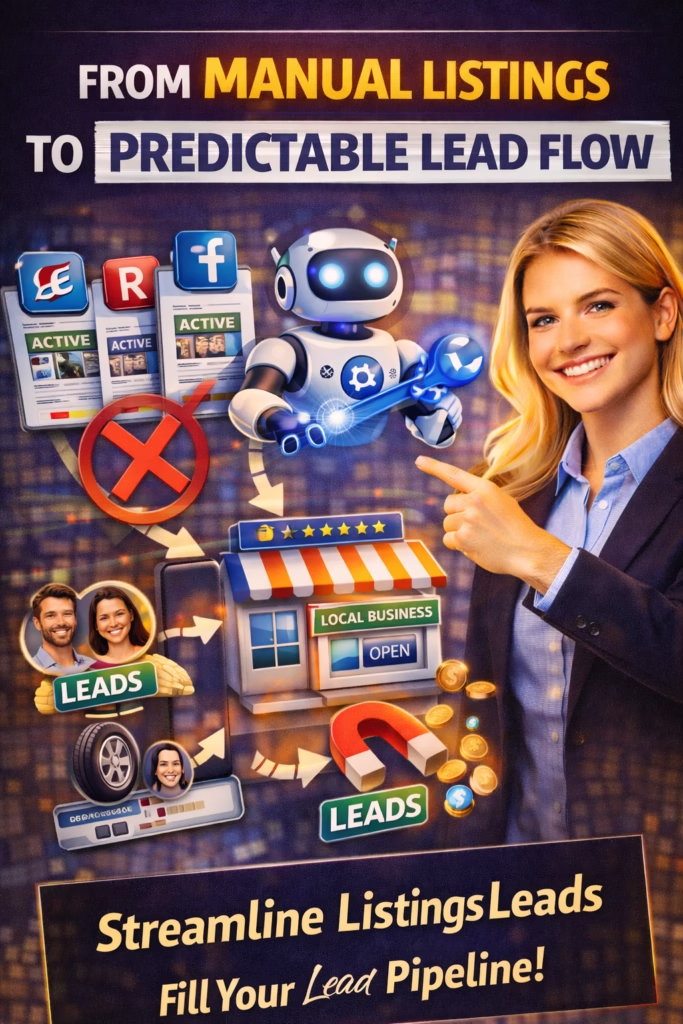
From Manual Listings to Predictable Lead Flow

ChatGPT Image Feb 14 2026 04 35 06 PM
From Manual Listings to Predictable Lead Flow

From Manual Listings to Predictable Lead Flow

From Manual Listings to Predictable Lead Flow is the blueprint for turning inconsistent, manual posting into a repeatable system—built on listing templates, proof photos, cadence, variation, instant replies, and follow-up.

Predictable Lead Flow: Templates Proof Photos Cadence Variation Instant Replies Follow-Up

Note: This is general guidance. Keep all listings accurate, avoid misleading claims, and follow platform rules. Rotate content responsibly and don’t spam duplicates.

Introduction

From Manual Listings to Predictable Lead Flow is the story of a simple upgrade: taking “posting when we have time” and turning it into a system that produces inbound inquiries every day.

Manual listings fail for one reason: they’re not a system. They depend on mood, time, and memory. Predictable lead flow depends on structure, cadence, and conversion discipline.

When this company started, leads were random. Some weeks were busy, some weeks were dead. The problem wasn’t demand—it was consistency.

Big idea: Predictability is built, not hoped for. A lead engine is a daily system that compounds.

Expanded Table of Contents

1) What predictable lead flow actually means

Predictable lead flow is when inbound inquiries arrive consistently enough that you can forecast workload and revenue. It doesn’t mean “no slow days.” It means your system creates a reliable baseline.

Unpredictable manual posting

  • Inconsistent posting
  • Repeated content
  • Slow response time
  • No follow-up
  • Leads leak

Predictable lead flow system

  • Template-driven posting
  • Varied angles and first photos
  • Instant replies + questions
  • Follow-up SOP
  • KPIs tracked weekly

Pro move: Measure “booked next steps,” not “messages.” Messages can be noise. Booked next steps predict revenue.

2) Why manual listings plateau and collapse

Manual listings can work for a while—especially if competition is low. But most sellers hit the same wall: they become busy, posting slows down, and lead flow collapses.

The 5 failure points of manual listing habits

  1. Cadence breaks: posting becomes “when we remember.”
  2. Content repeats: same photos and descriptions trigger fatigue.
  3. Response slows: leads go to the fastest competitor.
  4. No next step: conversations don’t move forward.
  5. No follow-up: ghosted leads never return.

Truth: Most “marketplace doesn’t work” stories are really “we stopped being consistent” stories.

3) The listing system: templates, angles, and proof

The company’s first upgrade was creating a repeatable listing template. Not “a perfect listing.” A template that could be launched fast and varied safely.

The listing template (structure)

BlockPurposeExample
TitleCapture intent“Available Today — Clean, Like-New Option”
First photoStop the scrollBright hero image, clear subject
Proof sectionBuild trustCondition details, transparent notes
Offer blockReduce confusionPrice/options/availability
Next step questionCreate motionCity + timeline question

Angles (intent buckets)

They built variants across buyer intent:

Budget Premium Fast availability Financing/payments Bundle/value Trust/condition proof

Rule: Predictable lead flow comes from variety, not one “best” listing.

4) Surface area: win with volume + variety

Surface area is the number of “hooks in the water.” The company didn’t post one listing and wait. They deployed many varied listings targeting different intents.

Surface area map

IntentHookWhat it attracts
Price-focused“Best value option”Deal hunters
Time-focused“Available today / fast delivery”Urgent buyers
Payment-focused“Easy payments / financing”Monthly shoppers
Quality-focused“Premium / upgraded”Higher-ticket buyers
Trust-focused“Proof photos / transparent details”Skeptical buyers

Pro move: Create 3–5 angles per product/service and rotate them weekly.

5) Proof photos: the trust layer that converts

Proof is the difference between “looks sketchy” and “this feels real.” Proof photos turn browsing into messaging.

Proof photo checklist

  1. Clean, bright hero image
  2. Full coverage angles
  3. Close-ups that prove condition
  4. Context photo (subtle business presence if allowed)
  5. Transparent notes (what’s included, timelines, terms)

Rule: Real photos beat perfect copy.

6) Offer positioning that triggers messages

Most listings fail because buyers don’t know what to do next. This company made offers painfully clear.

Offer clarity rules

  • Clear price (or honest range)
  • Clear availability (today/this week)
  • Clear options (pickup/delivery/appointment)
  • One next step (reply with city + timeline)

Offer block (copy/paste)

✅ Price: $____
✅ Available: (today / this week)
✅ Options: (pickup / delivery / appointment)
✅ Reply with your city + timeline for fastest next step

Avoid: Bait pricing or hidden conditions. That increases spam signals and reduces closes.

7) Cadence + refresh strategy: how momentum compounds

Consistency is what turns manual effort into predictable results. The company used a simple cadence and a refresh schedule.

Cadence model

  • Daily: publish or refresh a set number of listings (varied)
  • Weekly: refresh top performers (new first photo + title tweak)
  • Monthly: retire stale listings and replace with new angles

Rule: Don’t batch post and disappear. Predictability requires presence.

8) Anti-duplicate variation: scale without sameness

As volume increases, duplication becomes the enemy—both for performance and for platform friction. The company built safe variation rules so every listing stayed “new.”

Variation levers (use 3–5 per listing)

  • Title rewrite: change angle and intent keywords
  • First photo rotation: different hero image each time
  • Order of benefits: rotate which benefits appear first
  • Offer hook: swap (fastest/value/premium/financing)
  • Proof lines: change condition notes and included items
  • CTA question: alternate city/timeline vs budget/must-haves

Pro move: Build 10 “micro-blocks” you can rotate (trust lines, CTAs, benefit bullets). This creates hundreds of safe variants quickly.

9) Instant replies + qualification: turn messages into next steps

Predictable lead flow is pointless if you don’t convert. Speed-to-lead and qualification turned casual inquiries into booked next steps.

Instant reply (universal)

Yes — it’s available ✅

Quick question so I can give you the best option:
What city/zip are you in, and are you looking for today or this week?

Second question (only after they answer)

Perfect ✅
Do you want the fastest option, the best value option, or the premium option?

Rule: Always end with a question. Questions create momentum.

10) Follow-up SOP: where hidden revenue lives

The company discovered a surprising fact: most revenue wasn’t created by “more leads.” It was created by recovering leads that already existed.

3-touch follow-up sequence

TimingMessageGoal
20–40 minHelpful check-in + questionRe-engage
Same dayOptions + urgency noteCreate action
Next dayAlternate matchSave the lead

Follow-up #1

Quick check-in ✅
Did you still want this?

Reply with your city + whether you want today or this week and I’ll confirm options.

Follow-up #2

Heads up ✅ We’ve had a few people asking about it today.
If you want it, reply with your city and I’ll confirm the fastest next step.

Follow-up #3

Still shopping? ✅
If this isn’t perfect, tell me your budget + must-haves and I’ll send the best match.

11) Pipeline + tracking: prevent lead leakage

Once inbound becomes steady, the inbox becomes dangerous. The company implemented a simple pipeline so no lead vanished.

Pipeline stages

  • New → first message received
  • Qualified → city + timeline captured
  • Options sent → offer/choices shared
  • Booked → appointment/pickup/delivery scheduled
  • Closed → paid and completed
  • Lost → no response after SOP

Weekly tracking checklist

[ ] # active listings / content assets
[ ] # inbound messages
[ ] median response time
[ ] qualified rate
[ ] booked next steps
[ ] closes
[ ] top 5 angles by leads

Pro move: Don’t measure “leads.” Measure “booked next steps.”

12) KPIs that prove the system is working

KPIWhat it meansTarget
Active assetsVisibility surface areaConsistent growth
Inbound messages/weekLead flowSteady increase
Median response timeConversion leverage< 5 min good, < 1 min best
Qualified rateCity + timeline capturedImprove with scripts
Booked rateNext steps scheduledImprove with options

Truth: Predictable lead flow comes from boring consistency executed relentlessly.

13) 30–60–90 day rollout plan

Days 1–30 (Build the foundation)

  1. Create listing templates + 5–7 angles
  2. Build the first batch of 30–50 varied listings
  3. Implement instant replies + a 3-touch follow-up SOP
  4. Post/refresh consistently
  5. Track response time + booked next steps weekly

Days 31–60 (Convert more of the same leads)

  1. Identify top performers and replicate variants
  2. Improve titles + first photos for clarity
  3. Test 2–3 offer hooks (fastest/value/premium)
  4. Standardize pipeline for team use

Days 61–90 (Scale and compound)

  1. Increase surface area (more listings/assets)
  2. Increase speed-to-lead with automation where appropriate
  3. Double down on best angles and retire weak ones
  4. Measure booked next steps and optimize weekly

14) 25 Frequently Asked Questions

1) What does “predictable lead flow” mean?

It means inbound inquiries arrive consistently enough that you can forecast bookings and revenue, driven by a repeatable listing system.

2) Why do manual listings fail over time?

Because they rely on inconsistent effort, repeated content, slow replies, and missed follow-ups.

3) What platforms are best for predictable lead flow?

Marketplaces and local discovery channels like Facebook Marketplace, Craigslist, OfferUp, and local search.

4) How many listings should I start with?

Start with 30–50 varied listings, then refresh and expand.

5) What’s the most important part of a listing?

The first photo and title (for clicks) plus proof details (for trust).

6) What’s a listing angle?

A hook targeting a specific buyer intent like budget, premium, urgency, payments, or trust.

7) How often should I post?

Daily or several times per week. Consistency matters more than bursts.

8) What’s speed-to-lead?

How fast you respond after an inquiry. Faster replies usually convert better.

9) What response time should I target?

Under 5 minutes is good; under 1 minute is best.

10) Why do leads ghost?

They’re messaging multiple sellers. If you respond late or don’t create a next step, they move on.

11) What’s the best qualification question?

“What city/zip are you in, and are you looking for today or this week?”

12) What should my first message say?

Confirm availability, ask city + timeline, offer options.

13) Does follow-up really matter?

Yes. It often recovers the highest ROI leads.

14) How many follow-ups should I send?

Three touches is a strong baseline.

15) How do I avoid duplicates when scaling?

Rotate titles, first photos, benefit order, and CTAs to create meaningful variation.

16) Should I use stock photos?

Real photos convert better and build trust.

17) What’s a refresh strategy?

Updating top performers weekly and retiring stale listings monthly.

18) What KPI predicts revenue best?

Booked next steps (appointments/pickups/deliveries).

19) What should I track weekly?

Active assets, inbound messages, response time, booked next steps, closes, and top angles.

20) How do I improve lead quality?

Better proof, clearer offers, tighter qualification questions, and higher-intent angles.

21) Do I need automation tools?

Not required, but automation improves speed and consistency.

22) How long does it take to work?

Signals often appear in 2–4 weeks and compound over 60–90 days.

23) Can predictable lead flow replace ads?

In many cases, yes. Ads become optional amplification instead of the foundation.

24) What offer converts best?

The one that’s clear, credible, and easy to act on.

25) What’s the fastest improvement today?

Improve first photos/titles and deploy instant replies + a 3-touch follow-up SOP.

15) 25 Extra Keywords

  1. From Manual Listings to Predictable Lead Flow
  2. predictable lead flow system
  3. manual listings to automation
  4. marketplace lead generation strategy
  5. Facebook Marketplace posting cadence
  6. Craigslist posting system
  7. OfferUp lead strategy
  8. organic listing engine
  9. consistent inbound inquiries
  10. surface area marketing strategy
  11. listing angle framework
  12. proof photos conversion
  13. refresh strategy for listings
  14. anti duplicate listing variation
  15. instant reply scripts
  16. follow up SOP for leads
  17. speed to lead strategy
  18. lead leakage prevention
  19. pipeline tracking for sales
  20. booked appointments KPI
  21. organic lead generation 2026
  22. how to get leads without ads
  23. high intent inbound leads
  24. listing templates for scale
  25. predictable organic lead engine

© 2026 Your Brand. All Rights Reserved.
General information only—confirm compliance with platform policies and applicable privacy rules before sending marketing messages.

From Manual Listings to Predictable Lead Flow Read More »

How Automation Turned Inquiries Into Revenue at Scale

ChatGPT Image Feb 14 2026 04 35 08 PM
How Automation Turned Inquiries Into Revenue at Scale

How Automation Turned Inquiries Into Revenue at Scale

How Automation Turned Inquiries Into Revenue at Scale is the blueprint for turning inbound messages into booked next steps and predictable revenue—using speed-to-lead, routing, follow-up automation, and pipeline discipline.

Inquiry → Revenue Engine: Instant Replies Smart Routing Qualification Follow-Up Scheduling Tracking

Note: This is general guidance. Keep all outreach accurate, honor opt-outs, and follow platform rules and privacy requirements. Avoid spammy duplication and misleading claims.

Introduction

How Automation Turned Inquiries Into Revenue at Scale begins with a painful reality: most businesses don’t have a lead problem—they have a response problem.

They get inquiries… and then:

  • Messages sit unanswered for hours.
  • “I’ll reply later” becomes “they bought from someone else.”
  • Follow-ups are inconsistent (or never happen).
  • Hot leads get mixed with low-intent leads in one giant inbox.
  • No one knows what to do next, so conversations drift and die.

Automation solves this—not by sending more messages, but by building a system that moves every inquiry forward.

Big idea: Revenue at scale comes from booked next steps—and booked next steps come from speed, clarity, and consistent follow-up.

Expanded Table of Contents

1) What “inquiry → revenue automation” actually means

How Automation Turned Inquiries Into Revenue at Scale is about converting inbound attention into measurable outcomes.

Inquiry automation is a system that:

1) Responds instantly

Every lead gets an immediate, helpful reply that sets direction.

2) Captures key info

City/zip, timeline, and intent are collected with minimal friction.

3) Routes the lead

Hot leads are escalated; others get nurtured with follow-up.

4) Books a next step

Scheduling, pickup/delivery, consult call, or quote—locked in.

Important: Automation isn’t “set it and forget it.” It’s “set it, monitor it, improve it.”

2) The shift: from answering messages to running a conversion system

Most teams treat inquiries like “customer service.” A message arrives, and someone replies when they can.

But high-performing teams treat inquiries like a pipeline:

  • Every inquiry has a status.
  • Every status has a next action.
  • Every next action has a trigger (time-based or behavior-based).
  • Every trigger is tracked.

Rule: If you can’t see your next-step count, you can’t reliably predict revenue.

Campaign mindset vs system mindset

Campaign mindsetSystem mindset
“We got 200 inquiries.”“We booked 62 next steps and closed 19.”
“Our inbox is busy.”“Our response time is under 2 minutes.”
“We’ll follow up later.”“Follow-up runs automatically at 20–40 min / same day / next day.”
“Sales is inconsistent.”“The SOP is consistent, so outcomes are consistent.”

3) Where revenue leaks: the 7 most common breakdowns

Before building automation, the company mapped where money was leaking out of the funnel. They found seven predictable failures:

  1. Slow response: The lead buys from the first fast responder.
  2. No qualification: The team wastes time on low-intent leads.
  3. No clear next step: The conversation stays “informational.”
  4. No follow-up: Most “ghosts” are unrecaptured revenue.
  5. No routing: Hot leads get buried under everything else.
  6. No pipeline visibility: Leads vanish in DMs and text threads.
  7. No attribution: The team can’t see which sources create revenue.

Reality check: If you fix only slow response + follow-up, you can often increase revenue without generating a single new inquiry.

4) The automation architecture: components that create predictable revenue

How Automation Turned Inquiries Into Revenue at Scale is built on a simple architecture you can implement in layers. The company used a “stack” of behaviors, not a single tool.

Core components

Instant reply layer

Always-on acknowledgement + a one-question qualification prompt.

Routing layer

Rules that decide: nurture, escalate, or book.

Follow-up layer

Time-based sequences that recover leads consistently.

Scheduling layer

Low-friction booking with confirmations and reminders.

Pipeline layer

Status tracking so no lead disappears.

Measurement layer

KPIs and attribution: what happened, where, and why.

Pro move: Design automation around one goal: increase booked next steps. Everything else is secondary.

5) Speed-to-lead: instant replies that feel human

Speed is the multiplier. It’s also the easiest win because it doesn’t require more staff—only better systems.

What an instant reply must do

  • Confirm the message was received
  • Set direction (ask one forward-moving question)
  • Reduce friction (make it easy to answer)
  • Set expectations if after-hours

Universal instant reply (copy/paste)

Yes — got it ✅

Quick question so I can point you to the fastest option:
What city/zip are you in, and are you looking to do this today or this week?

After-hours variant

Got your message ✅

We’re currently away from the phone, but I can line everything up for you.
What city/zip are you in, and is this for today or this week?

I’ll reply first thing with the best next step.

Rule: Every automation ends with a question. Questions create momentum.

6) Smart routing: send the right lead to the right next step

The company realized that “one inbox” creates one outcome: chaos. Routing creates clarity.

Routing rules that work in almost any industry

SignalInterpretationRoute to
“Can I come today?”High urgencyImmediate human escalation + booking
Shares zip + timelineQualified baselineOptions + scheduling link
Asks only priceEarly-stage shopperClarify offer + qualify + nurture
Multiple questionsHigh intent but uncertainHuman handoff after short answers
No response after replyGhost riskFollow-up sequence

Pro move: Route by “next action,” not by “who’s available.” Availability changes; the system should not.

7) Qualification automation: capture city, timeline, and intent

Qualification isn’t interrogation. It’s simply collecting the minimum info required to recommend the correct next step.

The 3 fields that unlock conversion

  • Location: city/zip (routing + logistics)
  • Timeline: today/this week/this month (urgency)
  • Intent: info / compare / ready to book (actionability)

One-question branching (simple + powerful)

Perfect — what city/zip are you in, and are you looking for today or this week?

Second question (only after they answer)

Got it ✅
Do you want the fastest option, the best value option, or the premium option?

Rule: Ask fewer questions, not more. Every extra question lowers reply rate.

Why this works

Leads don’t want to be “sold.” They want to be guided. Qualification questions are guidance disguised as customer service.

8) Follow-up sequences: where the “hidden revenue” is recovered

Most teams stop after one reply. The company didn’t. They built a follow-up SOP that recovered leads automatically and politely.

Baseline 3-touch sequence (24 hours)

TimingMessage typeGoal
20–40 minutesHelpful check-inRestart the conversation
Same dayOptions + next stepPush to booking
Next dayAlternate optionSave the lead

Follow-up #1 (20–40 minutes)

Quick check-in ✅
Did you still want help with this?

Reply with your city/zip + whether you want today or this week and I’ll send the fastest next step.

Follow-up #2 (same day)

Heads up ✅ I can line this up for you if you want it.

What city/zip are you in, and is this for today or this week?
I’ll send the best option + next step.

Follow-up #3 (next day)

Still shopping? ✅
If this isn’t the perfect fit, tell me your budget + must-haves and I’ll point you to the best match.

Compliance: Always honor opt-outs. Avoid excessive follow-ups. Keep messages relevant and helpful.

Optional “Day 7 reactivation” (for longer buying cycles)

Quick update ✅
If you’re still considering this, I can send the best current option.

Want something budget-friendly, fastest, or premium?

9) Scheduling + confirmations: turn interest into a commitment

Inquiry is interest. Scheduling is commitment. The company made scheduling frictionless and used confirmations to reduce no-shows.

The scheduling rule

Don’t wait for the lead to ask to book. Offer booking after qualification—every time.

Scheduling prompt (copy/paste)

Perfect ✅
Fastest next step: grab a time that works for you.
Once you pick a slot, I’ll confirm everything and you’ll be set.

Confirmation message

Confirmed ✅ You’re all set.

If anything changes, reply “reschedule” and I’ll send options.

Reminder message (short + calm)

Reminder ✅
Looking forward to it. Reply “here” when you’re on the way (or “reschedule” if needed).

Rule: Reminders should reduce anxiety, not create pressure.

10) Pipeline + tracking: turn chaos into clarity

Automation fails without a pipeline. Why? Because you can’t automate what you can’t categorize.

Simple pipeline stages (works in any business)

  • New → inquiry received
  • Responded → first reply sent
  • Qualified → city + timeline captured
  • Options Sent → offer/choices provided
  • Booked → appointment / pickup / delivery / call scheduled
  • Completed → served / delivered / quote completed
  • Closed → paid / contract signed / sale won
  • Lost → unresponsive after SOP or opted out

What “pipeline discipline” looks like

Every lead has a status

No “floating” conversations. No invisible maybes.

Every status has a next action

Next action is a message, a call, or a booking link—always.

Every next action has a trigger

Time-based triggers ensure follow-up happens even when busy.

Every trigger is measured

KPIs show if the system is improving or slipping.

Weekly tracking checklist

[ ] inbound inquiries by source
[ ] median response time
[ ] % inquiries that became qualified
[ ] % qualified that became booked
[ ] show rate / completion rate
[ ] close rate
[ ] revenue per booked next step
[ ] top objections and best replies

11) KPIs and attribution: prove what’s working

How Automation Turned Inquiries Into Revenue at Scale works best when you track the right numbers. Not vanity metrics—conversion metrics.

KPIWhat it measuresWhy it matters
Inbound inquiriesDemand volumeTop-of-funnel capacity
Median response timeSpeed-to-leadPredicts booking rate
Qualified rateLead clarityReduces wasted effort
Booked next stepsCommitmentBest leading indicator of revenue
Show/completion rateFollow-throughImproves revenue without more leads
Close rateSales effectivenessFinal conversion health
Time-to-bookFunnel efficiencyShorter cycles scale better
Revenue per lead/sourceAttributionShows where to focus

Attribution that’s actually useful

Attribution doesn’t have to be complicated. Start with:

  • Source tag on each lead (marketplace, website, call, referral)
  • Status timestamps (inquiry received, responded, booked, closed)
  • Outcome (won/lost + reason)

Pro move: Track “lost reason” and fix the top one first. The fastest growth often comes from removing one bottleneck.

12) 30–60–90 day rollout plan

Days 1–30 (Stop the bleeding)

  1. Define pipeline stages and required fields (city, timeline, intent).
  2. Deploy instant replies across channels (within policy limits).
  3. Implement the baseline 3-touch follow-up sequence.
  4. Create 10–15 approved reply templates for common questions.
  5. Start tracking response time + booked next steps weekly.

Days 31–60 (Increase booking rate)

  1. Add routing rules (hot leads → human, others → nurture).
  2. Add scheduling prompts + confirmations + reminders.
  3. Refine qualification questions to reduce back-and-forth.
  4. Standardize a “handoff moment” for high-intent leads.
  5. Review conversations weekly and improve top 5 templates.

Days 61–90 (Scale and optimize)

  1. Expand automation coverage to all inquiry sources (calls, forms, DMs).
  2. Add attribution and improve reporting (source → booked → closed).
  3. Introduce a day-7 reactivation for longer buying cycles.
  4. Retire weak scripts and double down on high-performing ones.
  5. Set targets: response time, qualified rate, booked rate, close rate.

Truth: If you run this plan with discipline, your existing inquiry volume often produces significantly more revenue without generating a single new lead source.

13) 25 Frequently Asked Questions

1) What does it mean to turn inquiries into revenue with automation?

It means using instant replies, routing, follow-up sequences, scheduling, and pipeline tracking to convert inbound inquiries into booked next steps and closed sales consistently.

2) What is speed-to-lead?

Speed-to-lead is how fast you respond after someone reaches out. Faster response times typically produce higher booking and close rates because buyers choose the quickest competent option.

3) Do I need a CRM to automate follow-up?

A CRM helps, but the core requirement is a trackable workflow: statuses, triggers, and a consistent follow-up SOP that runs when people don’t respond.

4) What’s the first automation I should implement?

Instant replies plus a 3-touch follow-up sequence. This reduces lead leakage immediately.

5) How do I automate without sounding robotic?

Keep messages short, helpful, and question-based. Personalize with city/timeline, and hand off high-intent leads to a human quickly.

6) What is lead leakage?

Lead leakage is revenue loss from unanswered inquiries, slow responses, missed follow-ups, and untracked conversations that never reach a next step.

7) What counts as a “booked next step”?

An appointment, consult call, pickup/delivery slot, site visit, quote appointment, or any scheduled commitment that moves beyond messaging.

8) How many follow-ups should I send?

Three touches in the first 24 hours is a strong baseline. Add a day-7 reactivation for longer buying cycles if appropriate.

9) Which channels are easiest to automate?

SMS, email, missed-call text back, web chat, and internal task reminders. Some marketplaces restrict automation—follow policies carefully.

10) What should my first message say?

Confirm receipt/availability, ask city and timeline, and offer a clear next step such as options or scheduling.

11) How do I qualify leads automatically?

Use one question to capture city/zip and timeline, then one follow-up question for intent or preference (fastest/value/premium).

12) How do I route leads to the right person?

Create rules based on urgency, location, category, and business hours. Escalate hot leads; nurture the rest.

13) How do I handle after-hours inquiries?

Send an instant reply that sets expectations, captures city/timeline, and offers a scheduling link or next-step promise.

14) Can automation improve close rate?

Yes. It improves response speed, increases follow-up consistency, and boosts booked next steps—all of which increase closes.

15) What KPIs should I track?

Inbound inquiries, response time, qualified rate, booked rate, show rate, close rate, time-to-book, and revenue per lead/source.

16) How do I measure ROI from automation?

Compare booked next steps and closed revenue before vs after automation while monitoring response time and follow-up completion.

17) What response time should I aim for?

Under 5 minutes is strong. Under 1 minute is elite. Instant replies help you hit this consistently.

18) Should I use AI to reply to leads?

AI can draft responses and handle FAQs, but use guardrails, avoid unsupported claims, and hand off high-intent leads to a human quickly.

19) How do I prevent automations from getting flagged?

Follow platform policies, avoid spammy duplication, throttle follow-ups, keep messages helpful, and honor opt-outs.

20) What follow-up timing works best?

20–40 minutes, later same day, and next day is a proven baseline. Keep it helpful, not pushy.

21) How do I reduce no-shows?

Send confirmations and reminders with a simple reschedule option, and set expectations clearly.

22) What should be automated vs handled manually?

Automate speed-to-lead, qualification prompts, reminders, and follow-up. Handle negotiation, complex objections, and high-ticket closing manually or with supervised support.

23) Do I need integrations to start?

No. Start with templates and a basic pipeline. Integrations make it scalable, but SOP clarity matters most.

24) How long until results show up?

Response speed improves immediately. Booking improvements often appear within 2–4 weeks, and compounding gains show over 60–90 days.

25) What’s the biggest mistake businesses make with automation?

Automating messages without defining a pipeline and next-step rules. Automation must move leads toward booking—not just “reply.”

14) 25 Extra Keywords

  1. How Automation Turned Inquiries Into Revenue at Scale
  2. inquiry to revenue automation
  3. lead conversion automation system
  4. speed to lead automation
  5. instant reply automation
  6. follow up sequence for leads
  7. lead nurturing automation
  8. appointment setting automation
  9. booking rate optimization
  10. CRM workflow automation
  11. pipeline automation sales
  12. lead routing automation
  13. after hours lead response
  14. missed call text back automation
  15. sales follow up SOP
  16. reduce lead leakage
  17. convert inbound inquiries
  18. increase booked appointments
  19. time to book KPI
  20. lead response time KPI
  21. revenue attribution tracking
  22. automated qualification questions
  23. AI assisted sales replies
  24. scalable customer inquiry system
  25. predictable revenue system 2026

© 2026 Your Brand. All Rights Reserved.
General information only—confirm compliance with platform policies, consent rules, and applicable privacy laws before sending marketing messages or automating follow-ups.

How Automation Turned Inquiries Into Revenue at Scale Read More »

Scaling Visibility: A Marketplace Automation Story

ChatGPT Image Feb 14 2026 04 35 13 PM
Scaling Visibility: A Marketplace Automation Story

Scaling Visibility: A Marketplace Automation Story

Scaling Visibility: A Marketplace Automation Story is the modern playbook for compounding organic reach—using consistent listings, compliance-safe variation, proof photos, fast replies, and follow-up systems that convert messages into booked next steps.

Marketplace Visibility Engine: Automation Variation Proof Photos Cadence Instant Replies Follow-Up

Note: This is general guidance. Use a compliance-first approach: avoid spam duplication, rotate unique content, keep details accurate, and follow platform rules.

Introduction

Scaling Visibility: A Marketplace Automation Story begins with a simple truth: marketplaces reward consistent activity. Not “viral” activity. Not “perfect” activity. Consistent activity.

The company in this story didn’t win because they had the best ads. They won because they built a system that:

  • Put their inventory in front of buyers every day
  • Looked real and trustworthy in every listing
  • Responded instantly to convert high-intent messages
  • Followed up predictably to recover ghost leads

Big idea: Visibility is not a one-time push. It’s a daily compounding asset.

Expanded Table of Contents

1) The story arc: from inconsistent posting to compounding visibility

The company’s first attempt at Marketplace looked like most businesses:

  • Post a handful of listings
  • Get a few messages
  • Respond late
  • Lose momentum
  • Decide it “doesn’t work”

Then they made one operational change: they treated Marketplace like a daily channel, not a “whenever we remember” channel.

The turning point

They built a visibility engine with:

  • A consistent posting cadence
  • A repeatable content system (photos, titles, descriptions)
  • Fast response scripts
  • A follow-up SOP
  • Tracking to learn what produced the most leads

Result: Visibility stabilized. Messages increased. Conversion improved.

2) Visibility mechanics: how Marketplace distributes your listings

Marketplace visibility is a mix of search and feed discovery. Buyers find listings by:

  • Search keywords (what they type)
  • Location (nearby inventory)
  • Freshness (new/updated listings)
  • Engagement (messages, saves, clicks)

What this means operationally

You scale visibility by increasing two things:

Surface area
More quality listings across more keywords and intents.
Freshness
Consistent posting/refreshing so you stay “alive” in the system.

Pro move: Don’t chase “perfect listings.” Chase consistent freshness + proof.

3) What automation should do (and what it should never do)

Automation is not a license to spam. Automation is a tool to deliver consistency.

Automation should

  • Help you post and refresh consistently
  • Rotate approved templates
  • Queue listings so timing stays healthy
  • Trigger instant replies and reminders
  • Track message volume and response time

Automation should never

  • Blast identical duplicate listings at the same time
  • Misrepresent inventory, pricing, or condition
  • Use misleading claims or bait pricing
  • Ignore buyer questions (automation should assist, not deceive)

Rule: Compliance-first automation is what makes the engine sustainable.

4) Compliance-safe variation: scale without spam duplication

Scaling visibility requires variation. Not random variation—structured variation.

What to vary (safe + effective)

ElementVariation examplesWhy it helps
First photoAngle / lighting / hero shot orderRefreshes engagement + looks unique
TitleKeyword order + hookCaptures different searches
Description openingDifferent 2–3 line hooksImproves message rate
Offer angleBudget vs premium vs urgencyMatches buyer intent
CTA question“Pickup today?” vs “Delivery this week?”Moves conversation forward

Rule: Variation should still be truthful and consistent with real inventory.

5) Proof photo system: the trust layer that upgrades lead quality

When visibility scales, low-quality leads rise too—unless proof is built in.

The proof photo checklist

  1. Clean hero shot
  2. Multiple angles
  3. Close-up detail shots
  4. Condition proof
  5. Context proof (subtle brand/store presence)

Pro move: Add one “trust line” in every listing: “Happy to answer questions—tell me your city and timeline.”

6) Offer positioning that triggers “message now” behavior

Marketplace buyers message when the offer is instantly understandable and low friction.

Offer components that convert

  • Clarity: one clear price (or truthful range)
  • Friction removal: delivery/pickup/appointment options
  • Urgency: “available today/this week” only if real
  • Trust: proof photos + accurate details

Offer block (copy/paste)

✅ Price: $____
✅ Available: (today/this week)
✅ Options: (pickup / delivery / appointment)
✅ Reply with your city for fastest options

Avoid: confusing terms, hidden fees, or “too good to be true” claims.

7) Posting cadence: the daily rhythm that compounds reach

Cadence is what turns visibility into a steady stream instead of spikes.

Recommended cadence

  • Daily: publish/refresh a set number of listings (varied)
  • Weekly: refresh top performers with a new first photo + title tweak
  • Monthly: remove stale listings and replace with new angles

Rule: Engines require presence. Cadence is the presence.

8) Instant replies: converting speed into booked next steps

Visibility is useless if messages sit unanswered. Speed-to-lead is the multiplier.

Instant reply (universal)

Yes — it’s available ✅
Are you looking to do this today or this week?

What city/zip are you in? I’ll confirm the fastest options.

Two-option close (books more)

Perfect ✅ I can do:
• Today: __:__ / __:__
• Tomorrow: __:__ / __:__

Which works best? And what city are you in?

Rule: Always end with a simple question that moves the lead forward.

9) Follow-up SOP: recovering the leads competitors lose

Most sellers lose money in silence. A short follow-up SOP pulls leads back.

3-touch follow-up sequence

TimingMessageGoal
20–40 minQuick check-in + optionsRe-engage
Same dayAvailability + next stepCreate action
Next dayAlternate optionSave lead

Follow-up #1

Quick check-in ✅
Did you still want this?

Tell me your city and whether you want today or this week, and I’ll confirm options.

Follow-up #2

Heads up ✅ We’ve had a few people asking about it today.
If you want it, reply with your city and I’ll confirm the fastest next step.

Follow-up #3

Still shopping? ✅
If this isn’t perfect, tell me your budget + must-haves and I’ll send the best match.

10) Operations: pipelines, tags, and tracking

When automation scales visibility, operations must keep up—or leads leak.

Pipeline stages

  • New → message received
  • Qualified → city + timeline captured
  • Options sent → next step offered
  • Booked → appointment/pickup scheduled
  • Closed → completed
  • Lost → no response after SOP

Weekly dashboard checklist

[ ] Active listings
[ ] Messages per week
[ ] Median response time
[ ] Qualified leads
[ ] Booked next steps
[ ] Closed sales
[ ] Top 5 listing angles by messages

Pro move: Optimize for “booked next steps,” not just “more messages.”

11) KPIs that prove visibility is turning into revenue

KPIWhat it meansTarget
Median response timeConversion leverage< 5 min good, < 1 min best
Message rateListing effectivenessImprove with proof + offers
Qualified rateCity + timeline capturedImprove with scripts
Booked rateNext steps scheduledImprove with options
Close rateRevenue conversionImprove with follow-up

Truth: Visibility is only valuable when it creates booked next steps.

12) 30–60–90 day rollout plan

Days 1–30 (Stabilize visibility)

  1. Build templates (titles, descriptions, CTAs)
  2. Standardize proof photo checklist
  3. Deploy compliance-safe variation rules
  4. Implement instant replies + follow-up SOP
  5. Track response time and message volume weekly

Days 31–60 (Convert more)

  1. Identify top performers and replicate variants
  2. Improve first photo and first 2 lines of copy
  3. Test 2–3 offer angles (budget/premium/urgency)
  4. Standardize pipeline stages for team use

Days 61–90 (Scale responsibly)

  1. Increase listing volume while maintaining variation
  2. Increase speed-to-lead with smart automation
  3. Retire weak listings and double down on winners
  4. Measure booked next steps and optimize weekly

13) 25 Frequently Asked Questions

1) What does “scaling visibility” mean on Marketplace?

It means increasing consistent, high-quality listings so you appear in more searches and feeds, producing more inbound messages over time.

2) Does automation guarantee more leads?

No—automation guarantees consistency. Leads increase when consistency is paired with proof, offers, and fast replies.

3) Is Marketplace automation safe?

It can be when used responsibly: avoid spam duplication, rotate unique content, and follow platform rules.

4) What’s the #1 visibility lever?

Consistent cadence—posting and refreshing without disappearing.

5) What’s the #1 conversion lever?

Speed-to-lead (fast replies) and clear next steps.

6) Why do listings stop performing?

They go stale, competition increases, or the first photo/hook isn’t compelling.

7) How often should I refresh listings?

Weekly for top performers, monthly cleanup for stale listings.

8) What should I vary to stay compliant?

First photo, title wording, opening hook, offer angle, and CTA question.

9) Should I use stock photos?

Real proof photos convert better and build trust.

10) What’s a proof photo system?

A standardized set of photos that consistently proves inventory and condition.

11) How do I reduce low-quality leads?

Improve proof photos, increase clarity, and qualify with a simple question.

12) What’s the best first reply?

Confirm availability, ask timeline, ask city, and offer options.

13) How many follow-ups should I send?

Three touches is a strong baseline.

14) What’s the biggest mistake businesses make?

Posting inconsistently and responding slowly.

15) What KPI matters most?

Booked next steps (appointments/pickups), not just messages.

16) Does more volume always mean more leads?

Not if quality drops. Volume must be paired with proof and clarity.

17) How do I keep operations organized?

Use pipeline stages and track weekly metrics.

18) Can this work without a big team?

Yes—systems reduce workload and make consistency achievable.

19) How long until results show?

Often 2–4 weeks for traction, 60–90 days for compounding performance.

20) What makes Marketplace leads “high intent”?

Buyers are in a shopping mindset and can message instantly.

21) Do I need a website?

No, but it can increase trust and conversion.

22) How do I prevent getting flagged?

Avoid spam duplication, maintain variation, keep details accurate, and post responsibly.

23) What’s the best CTA question?

“What city are you in, and are you looking for today or this week?”

24) What’s the fastest improvement today?

Deploy instant replies and a follow-up SOP immediately.

25) What makes visibility “stick”?

Cadence + proof + conversion systems that keep engagement high.

14) 25 Extra Keywords

  1. Scaling Visibility: A Marketplace Automation Story
  2. marketplace automation story
  3. scaling visibility on Marketplace
  4. Marketplace lead generation automation
  5. organic leads with Marketplace
  6. Marketplace posting automation
  7. Marketplace visibility engine
  8. Marketplace lead engine system
  9. compliance safe listing variation
  10. proof photos for Marketplace
  11. Marketplace posting cadence
  12. how to scale Marketplace listings
  13. instant reply scripts Marketplace
  14. follow up SOP Marketplace leads
  15. reduce ghosting Marketplace
  16. Marketplace operations pipeline
  17. Marketplace lead tracking KPIs
  18. booked appointments from Marketplace
  19. organic visibility strategy 2026
  20. Marketplace marketing system
  21. how to get more Marketplace messages
  22. Marketplace offer positioning
  23. Marketplace trust signals
  24. Marketplace messaging conversion
  25. Marketplace automation best practices

© 2026 Your Brand. All Rights Reserved.
General information only—confirm compliance with platform policies and applicable privacy rules before sending marketing messages.

Scaling Visibility: A Marketplace Automation Story Read More »

How One Company Built a Lead Engine Without Ads

ChatGPT Image Feb 14 2026 04 35 17 PM
How One Company Built a Lead Engine Without Ads

How One Company Built a Lead Engine Without Ads

How One Company Built a Lead Engine Without Ads is the blueprint for organic lead generation at scale—built on a Marketplace-first listing system, proof-based content, daily cadence, instant replies, and relentless follow-up.

Organic Lead Engine: Listings Proof Photos Offers Cadence Instant Replies Follow-Up

Note: This is general guidance. Keep all listings accurate, avoid misleading claims, and follow platform rules. Rotate content responsibly and don’t spam duplicates.

Introduction

How One Company Built a Lead Engine Without Ads starts with the exact opposite of what most businesses do. Instead of spending money to “buy traffic,” they built a system that made traffic show up every day—organically—because their listings matched real buyer behavior.

Here’s the shift: paid campaigns rent attention. Organic lead engines own attention through consistency, surface area, and trust.

That doesn’t mean “never run ads.” It means ads stop being the foundation. They become optional fuel.

Big idea: A real lead engine is not a campaign. It’s a daily system that compounds.

Expanded Table of Contents

1) What a lead engine without ads actually is

A lead engine without ads is a system that produces inbound leads predictably without buying impressions. It relies on four pillars:

1) Visibility surface area

More quality listings/content assets across keywords and buyer intents.

2) Proof + trust

Real photos, transparency, credibility signals, consistent details.

3) Conversion speed

Instant replies, scripts, one-question qualification, clear next steps.

4) Follow-up

A short SOP that recovers “ghosts” and closes more of the same leads.

Pro move: Paid ads often hide broken conversion. Organic forces you to build a clean system because every message matters.

2) The mindset shift: campaigns vs systems

Most companies think in campaigns:

  • Launch something
  • Spend money
  • Measure leads
  • Stop when budget stops

The company in this story thought in systems:

  • Build repeatable listing templates
  • Create a daily cadence
  • Standardize proof photos
  • Deploy instant replies + follow-up
  • Track KPIs weekly

Rule: If the leads stop when you stop “doing a thing,” it wasn’t an engine—it was a push.

3) Why marketplaces and social feeds beat paid traffic

Marketplaces and social platforms are where demand already exists. People aren’t being interrupted—they’re searching and browsing on purpose.

SourceBuyer mindsetFrictionResult
Paid adsInterruptedHigh (landing pages, forms)Lower intent, slower
Marketplace/socialShoppingLow (tap-to-message)Higher intent, faster
Local searchNeed-drivenMedium (calls/website)High trust if optimized

Important: Social platforms reward consistency and responsiveness. If you disappear for 10 days, you lose momentum.

4) The surface area strategy: win with volume + variety

The company didn’t “post one listing and hope.” They created surface area across buyer intents.

Surface area means

  • Multiple listings for multiple keywords
  • Multiple offers for multiple budgets
  • Multiple angles for multiple objections

Example surface-area map

IntentListing angleWhat it catches
Price-focused“Best value / budget option”Deal hunters
Payment-focused“Easy payments / financing”Monthly shoppers
Urgency“Available today / fast delivery”Immediate buyers
Quality“Premium / upgraded”Higher-ticket buyers
Trust“Proof photos / transparent details”Skeptical buyers

Rule: If you want more leads, don’t just post “more.” Post more variety.

5) Proof-based content: the trust layer that converts

Proof is what separates organic engines from spam. The company built a “proof system” that made every listing feel real and credible.

Proof system checklist

  1. Clean, bright hero photo
  2. Multiple angles (complete coverage)
  3. Close-ups that prove condition
  4. Context photo (subtle brand/store presence)
  5. Transparent notes (condition, terms, timelines)

Pro move: Add one “trust line” in every listing: “Happy to answer questions—tell me your city and timeline.”

6) Offer positioning that triggers inbound messages

The engine worked because the offer was easy to understand. No confusion. No bait. No weird hoops.

Offer clarity rules

  • One clear price or a truthful range
  • One clear next step (pickup/delivery/appointment)
  • One credibility line (proof, availability, transparency)

Offer blocks (copy/paste)

✅ Price: $____
✅ Available: (today/this week)
✅ Options: (pickup / delivery / appointment)
✅ Reply with your city for fastest options

Avoid: “Too good to be true” pricing with hidden conditions. That increases spam flags and decreases closes.

7) Cadence: the daily rhythm that compounds

The company’s advantage wasn’t a viral post. It was daily consistency.

The simple cadence model

  • Daily: post or refresh a set number of listings (varied)
  • Weekly: refresh top performers with new first photo + title tweak
  • Monthly: retire stale listings and replace with fresh angles

Rule: Don’t “batch post and disappear.” Engines require presence.

8) Speed-to-lead: how instant replies double conversions

Speed is the multiplier. Organic leads are time-sensitive. If you respond late, they’ve already booked elsewhere.

Instant reply (universal)

Yes — it’s available ✅
Are you looking to do this today or this week?

What city/zip are you in? I’ll confirm the fastest options.

Qualification question (the engine’s secret)

Every reply ended with one question that moved the lead forward:

“What city are you in, and are you looking for today or this week?”

Rule: If you don’t ask a question, the conversation stalls.

9) Follow-up SOP: where the “hidden revenue” lives

The company didn’t just answer messages. They followed up with a short, consistent SOP that recovered leads competitors lost.

3-touch follow-up sequence

TimingMessageGoal
20–40 minQuick check-in + next stepRe-engage
Same dayAvailability + optionsCreate action
Next dayAlternate optionSave the lead

Follow-up #1

Quick check-in ✅
Did you still want this?

Tell me your city and whether you want today or this week, and I’ll confirm options.

Follow-up #2

Heads up ✅ We’ve had a few people asking about it today.
If you want it, reply with your city and I’ll confirm the fastest next step.

Follow-up #3

Still shopping? ✅
If this isn’t perfect, tell me your budget + must-haves and I’ll send the best match.

10) Pipeline + tracking: prevent lead leakage

Once inbound starts working, chaos kills performance. The company used a simple pipeline to keep every lead moving.

Pipeline stages

  • New → first message received
  • Qualified → city + timeline captured
  • Options sent → price/terms/next step offered
  • Booked → appointment/pickup/delivery scheduled
  • Closed → paid and completed
  • Lost → no response after SOP

Weekly tracking checklist

[ ] # of active listings/content assets
[ ] # of inbound messages
[ ] median response time
[ ] # booked next steps (appointments/pickups)
[ ] # closed sales
[ ] top 5 listing angles by leads

Pro move: Don’t measure “leads.” Measure “booked next steps.” That predicts revenue.

11) KPIs that prove the engine is working

KPIWhat it meansTarget
Active assetsVisibility surface areaConsistent growth
Inbound messages/weekLead flowSteady increase
Median response timeConversion leverage< 5 min good, < 1 min best
Qualified rateCity + timeline capturedImprove with scripts
Booked rateNext steps scheduledImprove with options

Truth: Most “organic doesn’t work” stories are actually “we stopped being consistent” stories.

12) 30–60–90 day rollout plan

Days 1–30 (Build the foundation)

  1. Create listing templates and proof photo checklist
  2. Build the first batch of 30–50 assets/listings (varied angles)
  3. Implement instant replies + follow-up SOP
  4. Post/refresh consistently
  5. Track response time and booked next steps weekly

Days 31–60 (Convert more of the same leads)

  1. Identify top performers and replicate variants
  2. Improve titles and first photos for clarity
  3. Test 2–3 offer hooks (financing, bundles, urgency)
  4. Standardize pipeline for team use

Days 61–90 (Scale and compound)

  1. Increase surface area (more listings/content assets)
  2. Increase speed-to-lead with automation where appropriate
  3. Double down on best angles and retire weak ones
  4. Measure booked next steps and optimize weekly

13) 25 Frequently Asked Questions

1) What does it mean to build a lead engine without ads?

It means building a repeatable organic system that generates inbound messages consistently through visibility, proof, cadence, fast replies, and follow-up.

2) Can a company really get leads without paid advertising?

Yes—especially through marketplaces, local search, and consistent organic posting systems.

3) What’s the biggest advantage of organic leads?

They compound over time and reduce dependence on ad spend.

4) What’s the biggest disadvantage?

They require consistency and systems, not one-time effort.

5) What channels work best for a no-ads lead engine?

Marketplaces, local SEO, social content, and direct messaging systems.

6) What matters most in the listings?

Proof photos, clear offers, and a simple next step.

7) How often should I post?

Consistently—daily or several times per week depending on capacity.

8) What’s speed-to-lead?

How fast you respond after a lead messages you.

9) What response time should I target?

Under 5 minutes is good; under 1 minute is best.

10) Why do leads ghost?

They’re messaging multiple sellers. If you don’t create a next step, they move on.

11) What’s the simplest qualification question?

“What city are you in, and are you looking for today or this week?”

12) What should my first message say?

Confirm availability, ask a timeline, ask city, offer options.

13) Does follow-up really matter?

Yes—follow-up often recovers the highest ROI leads.

14) How many follow-ups should I send?

Three touches is a strong baseline.

15) What’s the biggest mistake companies make?

Inconsistent posting and slow replies.

16) Do I need automation?

Not required, but automation can improve speed and consistency.

17) What should I track weekly?

Active assets, inbound messages, response time, booked next steps, and closes.

18) What KPI predicts revenue best?

Booked next steps (appointments/pickups/deliveries).

19) How do I scale without getting flagged?

Rotate content responsibly, avoid identical duplicates, keep details accurate.

20) Should I use stock photos?

Real photos convert better and build trust.

21) How long does it take to work?

Many systems produce signals in 2–4 weeks and compound over 60–90 days.

22) Can organic replace paid ads completely?

In some businesses, yes. In others, paid becomes an optional amplifier.

23) What offer converts best?

The one that’s clear, credible, and easy to act on.

24) How do I improve lead quality?

Better proof, clearer offers, and tighter qualification questions.

25) What’s the fastest improvement today?

Set instant replies and deploy a 3-touch follow-up SOP.

14) 25 Extra Keywords

  1. How One Company Built a Lead Engine Without Ads
  2. lead engine without ads
  3. organic lead generation system
  4. leads without paid campaigns
  5. Marketplace lead engine
  6. Facebook Marketplace lead generation
  7. organic lead funnel
  8. local marketing without ads
  9. free traffic lead system
  10. listing cadence strategy
  11. proof photos for leads
  12. offer positioning for inbound leads
  13. instant reply scripts
  14. follow up SOP leads
  15. reduce ghosting leads
  16. pipeline tracking for leads
  17. booked appointments lead engine
  18. organic marketing system 2026
  19. how to get leads organically
  20. lead conversion without ads
  21. speed to lead strategy
  22. marketplace driven marketing
  23. content surface area strategy
  24. compounding traffic strategy
  25. high intent inbound leads

© 2026 Your Brand. All Rights Reserved.
General information only—confirm compliance with platform policies and applicable privacy rules before sending marketing messages.

How One Company Built a Lead Engine Without Ads Read More »

Why Social Platforms Drive Better Auto Leads

ChatGPT Image Feb 13 2026 01 46 30 PM
Why Social Platforms Drive Better Auto Leads

Why Social Platforms Drive Better Auto Leads

Why Social Platforms Drive Better Auto Leads comes down to one thing: social platforms collapse the distance between discovery and conversation. Buyers see a vehicle, trust it faster through proof, and message immediately—if you respond fast, you win.

Social Auto Lead Advantage: Local Intent Instant Messaging Proof Photos Velocity Follow-Up Appointments

Note: This is general guidance. Keep listings accurate and compliant. Disclose title status, known issues, and real pricing. Avoid spam duplication.

Introduction

Why Social Platforms Drive Better Auto Leads can feel obvious once you see the mechanics: people already spend hours a day in social apps. When buying a vehicle, they don’t want to fill out a form and wait. They want to message, negotiate, and schedule immediately.

Traditional lead sources often add friction:

  • Long forms
  • Delayed responses
  • Low-quality lead reselling
  • Shoppers who are “price fishing” across 20 dealers

Social platforms shrink that timeline. And speed changes the entire economics of leads.

Big idea: Social doesn’t just generate leads—it generates conversations. Conversations close vehicles.

Expanded Table of Contents

1) The mechanics: why social creates higher-intent auto leads

Social platforms win because they compress the buyer journey:

Discovery is native

Buyers don’t “go to a website.” They scroll inventory where they already live.

Conversation is instant

Messaging is built-in. That removes steps and increases conversions.

Trust is visible

Profiles, reviews, posts, and mutual connections create credibility signals.

Velocity rewards speed

Fast responders win. Slow responders lose—regardless of price.

Supply meets demand locally

Proximity matters: buyers want to see it today, not “next week.”

Pro move: Treat social like a “conversation marketplace,” not an advertising channel.

2) Intent signals: how social platforms reveal buyer readiness

Social inquiries are often more revealing because the buyer’s behavior is immediate and conversational.

High-intent indicators

  • Asks about availability today or this week
  • Asks about payment type (cash vs financing) or down payment
  • Asks about title status, maintenance, or inspection
  • Responds quickly and confirms a time

Low-intent indicators

  • Only asks “lowest?” without any other details
  • Won’t confirm timeline
  • Ghosts after you answer basic questions

Rule: Social doesn’t eliminate low-intent leads—it makes it easier to filter them fast.

3) Trust stack: why proof matters more on social

On social, skepticism is higher because scams exist. So proof isn’t optional—it’s your conversion engine.

The trust stack (simple)

  • Proof photos (real, complete, honest)
  • Clarity (price, mileage, title, known issues)
  • Professionalism (fast replies, clean language, clear next step)
  • Consistency (matching info across listings)

Pro move: One “honesty photo” (a scratch, worn seat, tire tread) can increase trust and reduce wasted chats.

4) Listing velocity: why freshness beats “perfect ads”

Social inventory behaves like a feed. Fresh listings and active sellers get more visibility.

What “velocity” means

  • Consistent posting and refreshing
  • Rotating photos and titles (not duplicating identical spam)
  • Responding fast to keep conversion rates high

Simple weekly rhythm

DayActionGoal
MonPost fresh inventoryStart week strong
TueRefresh top performers (new hero photo)Boost impressions
WedPost payment/financing angle listingsExpand demand
ThuTrade-in hook + appointment CTAIncrease conversations
FriWeekend “test drive today” pushCapture peak intent
SatFollow-up + schedule confirmationsConvert chats
SunClean up stale listingsStay credible

Avoid: identical duplicate listings at the same time with the same photos and titles.

5) Marketplace-first behavior: buyers shop in-feed

Buyers don’t want to jump between websites. They want to shop in one place and message instantly.

Why this changes your funnel

  • Your listing is the landing page
  • Your chat is the sales call
  • Your appointment is the close

Rule: Build a “listing → message → appointment” system, not “ad → form → maybe.”

6) Proof photo framework that improves lead quality

Proof photos don’t just increase leads. They increase the quality of leads and reduce repetitive questions.

The 14-photo system (social-optimized)

  1. Front 3/4 hero shot
  2. Rear 3/4
  3. Both side profiles
  4. Odometer
  5. Dashboard (no warning lights)
  6. Infotainment + backup cam
  7. Front seats
  8. Rear seats
  9. Trunk/cargo
  10. Engine bay
  11. Tires/tread
  12. VIN plate (optional)
  13. Maintenance proof (if available)
  14. Issue photo (honesty)

Pro move: Add a final photo that says “Reply ‘TEST DRIVE’ + your city for times.” It boosts message clarity.

7) Offer positioning: price, financing, trade-ins, warranty

Social shoppers message when the offer is easy to understand and feels safe to pursue.

Offer blocks that convert

Cash buyer offer
Clear price, clean title, quick appointment options, inspection welcome.
Payment buyer offer
Financing available, down payment varies, quick pre-qualification steps.
Trade-in offer
Trades welcome, send photos/VIN/miles, get estimate before visit.

Financing hook (simple and compliant)

Financing options available ✅
Reply “FINANCE” + your city and I’ll confirm the next steps and test-drive times.

Note: Avoid misleading payment claims. Keep terms accurate and dependent on approval.

8) Messaging scripts that convert fast

Your first reply should be short, confident, and direction-setting.

Instant reply (universal)

Yes — it’s available ✅
Are you trying to come today or this week?

Also: cash, financing, or trade-in?

Appointment close

Great ✅ I can do a quick test drive:
• Today: __:__ / __:__
• Tomorrow: __:__ / __:__

Which time works? Cash/financing/trade-in?

Handle “lowest?” without losing control

I can help ✅
Are you optimizing for lowest cash price, or monthly payment?

If you tell me which + your timeline, I’ll confirm the best option and a test-drive time.

Rule: Every message ends with a question that qualifies timeline + payment type.

9) Follow-up SOP: how to stop lead leakage

Social leads die when the seller disappears. Follow-up turns “maybe” into “scheduled.”

3-touch follow-up sequence

TimingMessageGoal
20–40 minQuick check-in + timesRe-engage
Same dayAvailability + appointment slotsCreate action
Next dayAlternate optionSave lead

Follow-up #1

Quick check-in ✅
Did you still want to see it?

Tell me today/tomorrow + cash/financing/trade-in and I’ll lock a time.

Follow-up #2

Heads up ✅ We’re scheduling test drives today.
If you want a slot, reply with a time today/tomorrow + payment type.

Follow-up #3

Still shopping? ✅
If this isn’t the right fit, tell me your budget + must-haves (AWD/4x4/3rd row) and I’ll send the closest option.

10) Appointment funnel: from chat to test drive

Social platforms win because appointments are easy to create. Your job is to remove friction.

Appointment checklist

  • Offer two time options immediately
  • Confirm the address after time confirmation
  • Send a reminder 1–2 hours before
  • Confirm payment type and any trade-in details

Pro move: “Two time options” beats “When can you come?” every time.

11) KPIs that prove social leads are better

KPIWhat it tells youTarget
Median response timeConversion leverage< 5 min good, < 1 min best
Inquiry → appointment rateFunnel strengthImprove with scripts
Appointment show-up rateLead qualityImprove with reminders
Close rateSales performanceImprove with offer clarity
Cost per sold unitEconomicsLower via organic visibility

Truth: Social leads feel “better” when speed-to-lead and appointment setting are systemized.

12) 30–60–90 day rollout plan

Days 1–30 (Build the social funnel)

  1. Standardize photos (14-photo checklist)
  2. Deploy listing templates and title formulas
  3. Implement instant reply scripts + follow-up sequence
  4. Post/refresh consistently with variation (no spam duplication)
  5. Track response time and appointment rate weekly

Days 31–60 (Improve quality and conversion)

  1. Identify top-performing vehicles and replicate listing structure
  2. Test offer hooks: financing, trade-in, warranty
  3. Improve proof photos and include honesty notes
  4. Reduce no-shows with confirmations and reminders

Days 61–90 (Scale inventory and consistency)

  1. Expand active listings and rotate inventory weekly
  2. Increase appointment-setting speed
  3. Measure close rate and optimize offers by buyer type
  4. Build simple dashboards: inquiries, appointments, show-ups, sold

13) 25 Frequently Asked Questions

1) Why do social platforms drive better auto leads?

They reduce friction, create instant conversations, and reveal intent quickly—especially with Marketplace-style inventory browsing.

2) Is Facebook Marketplace good for auto leads?

Yes—buyers message fast, and visibility can be strong with consistent posting and proof photos.

3) Are social leads higher quality than form leads?

They can be, especially when you respond fast and qualify with timeline + payment type.

4) What’s the most important conversion factor?

Speed-to-lead (fast replies) and a clear appointment workflow.

5) How many photos should I include?

10–20. Use the 14-photo system for trust completeness.

6) What should my title include?

Year, make, model, a key feature/hook, and optionally mileage.

7) Should I mention financing?

If available, yes—social buyers often filter by payment options.

8) Should I accept trade-ins?

If you can, trade-ins increase lead volume and conversion.

9) How do I handle “lowest price?”

Ask whether they’re optimizing for cash price or monthly payment and move toward appointment.

10) What’s a good first reply?

Confirm availability, ask timeline, ask cash/finance/trade-in.

11) How do I reduce ghosting?

Use a short 3-touch follow-up sequence and keep next steps simple.

12) What’s the best next step after inquiry?

Schedule a test drive or inspection time.

13) How do I reduce no-shows?

Confirm time, send reminders, and ask for a simple confirmation reply.

14) Are duplicate listings bad?

Identical duplicates can look spammy. Vary photos/titles and timing.

15) What’s the best posting cadence?

Consistent, with variation—daily or several times per week.

16) Do reviews matter on social?

Yes—any credibility signals improve conversion.

17) Does Google Maps matter for auto leads?

For dealers, yes—Maps and reviews drive inbound calls and trust.

18) Can automation help social leads?

Yes—automation improves response time and follow-up consistency.

19) What KPI proves lead quality?

Inquiry-to-appointment rate and show-up rate.

20) What KPI proves funnel strength?

Median response time and appointment scheduling speed.

21) What’s the biggest mistake sellers make?

Slow replies and no follow-up system.

22) Should I disclose known issues?

Yes—honesty reduces wasted time and builds trust.

23) How do I improve trust fast?

Proof photos, odometer photo, dashboard photo, and clear title status.

24) What’s the fastest improvement I can make today?

Instant reply script + offer two test-drive times in every conversation.

25) Why do social leads “feel” better?

Because the buyer is already in a conversation mindset, not a form-filling mindset.

14) 25 Extra Keywords

  1. Why Social Platforms Drive Better Auto Leads
  2. social media auto leads
  3. Facebook Marketplace car leads
  4. better auto leads strategy
  5. vehicle leads from social platforms
  6. dealership social lead funnel
  7. Marketplace-first auto marketing
  8. car listing system that converts
  9. auto messaging scripts
  10. instant reply auto leads
  11. follow up sequence car inquiries
  12. appointment setting test drives
  13. reduce ghosting auto leads
  14. vehicle photo checklist
  15. car listing title formula
  16. financing leads on Facebook Marketplace
  17. trade in leads social media
  18. warranty offer car listing
  19. how to get more car leads organically
  20. vehicle inventory posting cadence
  21. auto sales KPIs response time
  22. inquiry to appointment conversion
  23. social platform vehicle marketing 2026
  24. high intent auto buyers social
  25. Marketplace vehicle lead generation system

© 2026 Your Brand. All Rights Reserved.
General information only—confirm compliance with platform policies and applicable advertising rules before contacting leads.

Why Social Platforms Drive Better Auto Leads Read More »

Scroll to Top