

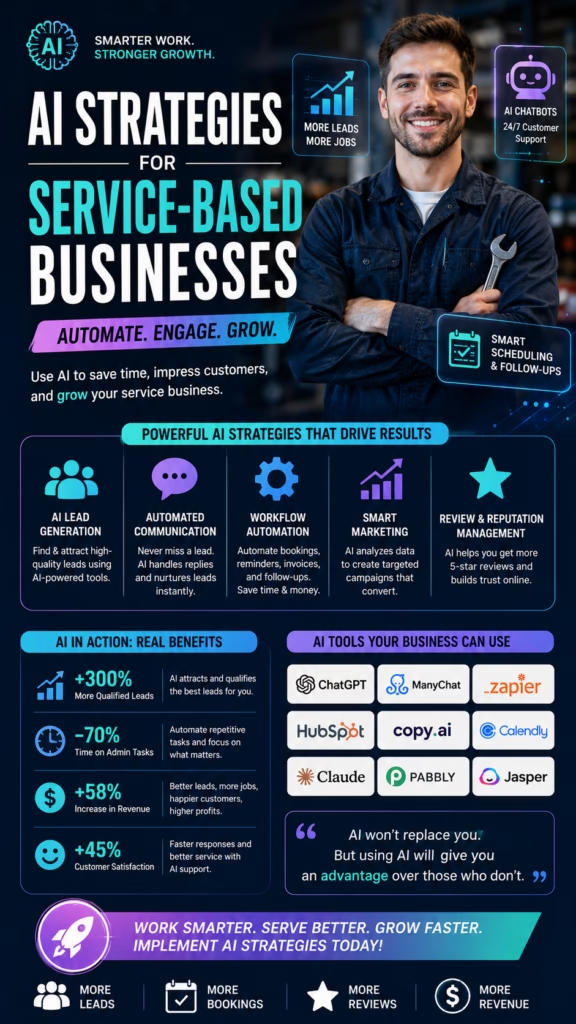
AI Strategies for Service-Based Businesses
AI strategies for service-based businesses can help companies improve lead generation, customer response, scheduling, sales follow-up, local marketing, customer service, and operational efficiency.
AI strategies for service-based businesses are most effective when they solve real customer and operational problems instead of simply adding more software.
Core strategy principle: Start with the customer journey, identify the biggest bottleneck, apply AI carefully, and measure the business result.
Introduction
Ai strategies for service-based businesses can help local and professional service companies improve lead generation, response speed, customer communication, scheduling, follow-up, marketing efficiency, and sales visibility.
Service businesses often depend on fast communication, local trust, accurate estimates, appointment availability, and consistent follow-up. Artificial intelligence can support each of these areas by reducing repetitive work and helping teams respond with more context.
This guide explains how service-based businesses can apply AI across marketing, lead management, customer service, local visibility, sales, CRM workflows, analytics, and retention while keeping accuracy, trust, and human oversight at the center.
What AI Strategy Means for Service Businesses
An AI strategy is a practical plan for using artificial intelligence to improve business outcomes rather than simply adding more software.
For service companies, the most valuable uses usually involve customer acquisition, lead qualification, appointment scheduling, customer communication, administrative automation, sales follow-up, and reporting.
The best strategy connects each AI workflow to a measurable goal such as more qualified leads, faster response time, higher booking rates, lower administrative workload, better customer retention, or increased revenue.
Why Service Businesses Are Adopting AI
Service businesses manage large amounts of repetitive communication. Prospects ask similar questions about pricing, availability, locations, scheduling, service areas, warranties, and next steps.
AI can help handle routine tasks quickly while allowing staff to focus on higher-value conversations, technical work, estimates, and customer relationships.
Companies can also use AI to analyze large volumes of marketing and sales data that would otherwise be difficult to review manually.
Set Clear AI Business Goals
Every AI project should begin with a specific business objective. Avoid vague goals such as 'use more AI' or 'automate marketing.'
Examples include reducing average lead-response time, increasing appointment bookings, improving estimate follow-up, recovering missed leads, increasing review volume, or reducing manual CRM work.
Clear goals make it easier to choose the right tools and determine whether the system is actually helping.
Map the Service Customer Journey
Service customers often move through several stages: discovery, inquiry, qualification, appointment, estimate, decision, service delivery, payment, review, and repeat business.
Map each stage and identify where customers wait too long, become confused, stop responding, or receive inconsistent information.
AI can then be applied to the areas with the highest friction instead of being inserted randomly into the process.
Use AI to Improve Lead Generation
AI can help businesses analyze which marketing channels, keywords, offers, locations, and customer types produce the strongest qualified leads.
Marketing teams can use these insights to create more relevant advertising, landing pages, social content, email campaigns, and local offers.
The goal is not simply more leads. The goal is more opportunities that match the company's service area, capacity, pricing, and ideal customer profile.
Strengthen Local Marketing With AI
Local service businesses depend heavily on geographic relevance. AI can help organize city-specific content, local FAQs, service-area pages, customer questions, and campaign ideas.
Each location should use accurate business information, hours, service areas, phone numbers, appointment availability, and local offers.
AI can increase content speed, but location-specific marketing still requires real knowledge of the market and customer.
Use AI to Support Local SEO
AI can assist with keyword clustering, page outlines, internal-link suggestions, title tags, meta descriptions, FAQs, and content-gap analysis.
Service businesses can use AI to organize content around specific services, customer problems, cities, neighborhoods, and buying intent.
Content should remain useful, original, and accurate. Publishing large volumes of thin or repetitive AI-generated pages can create a poor customer experience.
Improve Google Business Profile Workflows
AI can help teams organize post ideas, service descriptions, FAQ responses, review themes, and location-specific updates for Google Business Profile.
Businesses should verify all hours, service areas, categories, offers, and contact information before publishing.
AI can also summarize recurring questions from Google leads so companies can improve their website and sales process.
Use AI to Improve Paid Advertising
AI can help analyze advertising creative, audience segments, keyword themes, lead quality, landing-page performance, and campaign results.
Generate multiple legitimate creative variations and test them against real conversion outcomes.
Do not optimize only for the cheapest lead. Compare cost per qualified appointment, completed estimate, closed sale, gross profit, or lifetime value.
Optimize Service Landing Pages
AI can review landing pages for unclear messaging, weak calls to action, missing trust signals, unnecessary form fields, and common customer objections.
Strong service landing pages typically explain the problem, service, location, proof, process, pricing expectations, and next step clearly.
Use real conversion data to validate changes. AI should help identify opportunities, not replace testing.
Reduce Lead Form Friction
Service businesses often request more information than they need during the first interaction. Long forms can reduce conversion.
Collect the minimum details necessary to route the lead and schedule the next step. Additional information can be gathered during the conversation or appointment.
AI can help identify which form fields actually correlate with qualified opportunities and which fields simply add friction.
Improve Lead Response Speed
Fast response is especially important for local services because prospects often contact multiple companies.
AI can instantly acknowledge a new inquiry, classify it, route it to the correct person, create a CRM record, and trigger a follow-up task.
The first response should be short and useful. It should confirm the inquiry and help the customer move forward.
Use AI to Qualify Leads
AI can help determine whether a lead fits the service area, required service, budget, timeline, property type, business type, or other relevant criteria.
Qualification should remain simple for routine jobs and more detailed for complex or high-value services.
Automated qualification should not permanently reject potentially valuable customers without review because data can be incomplete or misunderstood.
Use AI for Appointment Scheduling
AI-assisted scheduling can help customers choose available appointment windows without waiting for manual back-and-forth.
Scheduling workflows should confirm the service requested, location, contact details, expected appointment length, and any preparation instructions.
High-value or unusual requests may still require human review before a final appointment is confirmed.
Use AI Chat for Common Questions
AI chat can help answer common questions about service areas, hours, appointment process, general pricing structure, warranties, and preparation.
The chatbot should use verified information and avoid inventing quotes, technical diagnoses, guarantees, or availability.
Customers should always have a clear path to human support when the situation is complicated or urgent.
Support Phone Workflows With AI
AI can assist with call summaries, routing, missed-call follow-up, appointment notes, and extraction of next actions.
This can reduce administrative workload for receptionists, dispatchers, sales representatives, and managers.
Service businesses should review privacy and consent requirements before recording, transcribing, or analyzing customer calls.
Improve Estimate Follow-Up
Many service leads disappear after an estimate is delivered. AI can help identify open estimates and trigger appropriate follow-up.
Follow-up can clarify questions, remind the customer of availability, explain financing, or help schedule the work.
Messages should remain relevant and respectful rather than repeatedly sending the same sales pitch.
Connect AI With the CRM
A CRM should show lead source, contact information, service requested, status, appointment, estimate, owner, next action, and outcome.
AI can summarize notes, categorize inquiries, flag overdue follow-up, and identify leads that may need immediate attention.
Automation should include safeguards against duplicate records, incorrect status changes, and accidental overwriting of customer data.
Support Sales Teams With AI
AI can prepare lead summaries, organize call notes, suggest discovery questions, and highlight unanswered objections.
Sales representatives can spend more time on actual customer conversations and less time reviewing scattered records.
Final pricing, promises, negotiations, technical recommendations, and contractual commitments should remain under human control.
Improve Customer Service With AI
AI can help route support requests, summarize customer history, prepare responses, and identify repeat issues.
Customers should receive consistent information regardless of which employee handles the conversation.
Complex complaints, billing disputes, safety issues, and sensitive situations should move to an experienced human quickly.
Use AI to Analyze Customer Reviews
Reviews reveal what customers value, dislike, misunderstand, and remember about the service experience.
AI can summarize themes across reviews and identify patterns in punctuality, communication, workmanship, pricing, cleanup, and follow-up.
These insights can improve marketing copy, training, operations, FAQs, and customer experience.
Use AI to Improve Customer Retention
Service businesses can use AI to identify when customers may need maintenance, inspections, renewals, replacement, or additional services.
Permission-based reminders can help create repeat business without relying entirely on new lead generation.
Retention workflows should be timed around genuine customer needs rather than sending constant promotional messages.
Identify Relevant Cross-Sell Opportunities
AI can analyze purchase and service history to identify additional services that may be useful to existing customers.
Cross-selling should be based on relevance. A customer should receive recommendations that make sense for the property, system, service history, or business need.
Unrelated recommendations can reduce trust and make automation feel intrusive.
Automate Repetitive Administrative Work
AI can help summarize forms, organize documents, categorize inquiries, prepare internal notes, and draft routine customer communications.
Administrative automation can reduce delays between marketing, sales, dispatch, service delivery, and billing.
Businesses should prioritize workflows that save meaningful staff time or reduce customer friction.
Use AI to Analyze Service Business Data
AI can help managers interpret performance across channels, locations, services, sales representatives, and time periods.
Useful questions include which services close at the highest rate, where leads are lost, which locations respond slowly, and which campaigns create the highest average job value.
Important conclusions should be validated against the underlying data before major decisions are made.
Build an AI-Assisted Testing Program
AI can generate test ideas for headlines, offers, ads, landing pages, follow-up messages, and scheduling workflows.
Test one meaningful variable at a time when possible and define the success metric before launching.
Document results so the company builds a conversion knowledge base and avoids repeating failed experiments.
Maintain Customer Trust With AI
Customers expect accurate information, respectful communication, and clear accountability.
Businesses should avoid deceptive personalization, fabricated reviews, invented pricing, fake availability, unsupported claims, and automated promises that cannot be fulfilled.
Human oversight is especially important when AI touches technical recommendations, billing, safety, warranties, contracts, or customer disputes.
Common AI Strategy Mistakes
Common mistakes include buying tools before defining the workflow, automating inaccurate processes, measuring activity instead of revenue, and using poor-quality data.
Another mistake is trying to automate every customer interaction. Some conversations are too complex or valuable to hand entirely to software.
The best AI strategy uses automation selectively where it improves speed, consistency, relevance, and operational visibility.
A 30-Day AI Strategy Plan
During the first week, map the customer journey, identify the highest-friction areas, review current response times, and define the most important conversion goals.
During the second week, implement one or two focused workflows such as lead routing, appointment reminders, estimate follow-up, CRM summarization, or FAQ support.
During the third week, review results and refine the workflow. During the fourth week, compare bookings, response time, staff workload, close rate, and revenue, then expand only the systems that create measurable value.
Conclusion
Ai strategies for service-based businesses work best when they are tied to real customer and operational problems.
Service businesses can use AI to improve marketing, response speed, qualification, scheduling, sales, customer service, retention, and analytics without sacrificing the human relationships that drive trust.
Start with one important bottleneck, use verified business data, measure the outcome, and expand carefully. That creates a sustainable AI strategy instead of a collection of disconnected tools.
Frequently Asked Questions
What are AI strategies for service-based businesses?
They are practical ways to use artificial intelligence to improve marketing, lead management, scheduling, customer communication, sales, operations, analytics, and retention.
How can service businesses use AI?
Service businesses can use AI for lead routing, qualification, appointment scheduling, follow-up, CRM updates, content creation, customer support, reporting, and workflow automation.
What is the best AI strategy to start with?
Start with the biggest operational or conversion bottleneck, such as slow lead response, missed follow-up, repetitive questions, or manual CRM work.
Can AI help local service businesses get more leads?
Yes. AI can support local SEO, paid advertising, social content, landing-page optimization, lead response, and campaign analysis.
Can AI improve lead response time?
Yes. AI can acknowledge new leads, classify them, route them, create CRM records, and trigger next actions quickly.
Can AI qualify service leads?
Yes. AI can help classify leads by location, service need, budget, timeline, property type, or other relevant criteria.
Can AI schedule appointments?
AI-assisted scheduling can help customers choose available times and reduce manual back-and-forth.
Can AI answer customer questions?
Yes. AI can answer routine questions using verified business information and escalate more complex situations to staff.
Can AI help with missed calls?
AI can support missed-call alerts, summaries, follow-up tasks, and routing so opportunities are less likely to be lost.
Can AI improve estimates and proposals?
AI can help organize notes, summarize requirements, prepare drafts, and trigger follow-up, while final pricing and commitments should be reviewed by a human.
Can AI improve local SEO?
AI can help with keyword research, page outlines, FAQs, internal links, title tags, and local content organization.
Can AI improve Google Business Profile marketing?
AI can help generate post ideas, summarize reviews, organize FAQs, and create location-specific content for human review.
Can AI improve paid ads?
AI can help analyze creative, audiences, keywords, landing pages, and lead quality so campaigns can be optimized toward better business outcomes.
Can AI help with social media?
Yes. AI can help create educational, promotional, seasonal, trust-building, and FAQ content for social channels.
Can AI reduce administrative work?
Yes. AI can help summarize forms, classify inquiries, prepare notes, organize tasks, and draft routine communications.
Can AI update a CRM?
AI can support CRM categorization, summaries, reminders, and workflow triggers when proper safeguards are used.
Can AI help sales teams?
Yes. AI can summarize leads, organize notes, suggest questions, and identify follow-up priorities.
Can AI improve customer service?
AI can route requests, summarize history, prepare responses, and identify common issues while escalating complicated cases.
Can AI analyze customer reviews?
Yes. AI can summarize recurring themes in reviews to identify strengths, complaints, objections, and customer expectations.
Can AI improve customer retention?
AI can help identify maintenance cycles, renewal opportunities, service reminders, and relevant follow-up for existing customers.
Can AI increase repeat business?
Potentially. Better timing, personalized reminders, and relevant follow-up can help existing customers return.
Can AI help service businesses cross-sell?
Yes. AI can identify relevant additional services based on customer history when recommendations are appropriate and accurate.
What metrics should service businesses track?
Track qualified leads, response time, booking rate, estimate rate, close rate, average job value, customer acquisition cost, repeat business, and revenue.
Should AI replace customer service staff?
Usually no. AI works best as support for repetitive tasks while humans handle judgment, complex issues, and relationships.
Should AI replace salespeople?
Usually no. AI can support research, summaries, routing, and follow-up, while salespeople remain responsible for judgment and relationship building.
What is the biggest AI mistake for service businesses?
A major mistake is buying tools without first defining the business problem or workflow they are supposed to improve.
How can businesses keep AI accurate?
Use verified source information, human review, clear escalation rules, good CRM data, and regular audits of automated workflows.
How quickly can AI improve a service business?
Operational improvements such as faster routing can happen quickly, while reliable conversion gains require testing and enough data to measure performance.
Is AI useful for small service businesses?
Yes. Small businesses can benefit from focused automation in lead response, scheduling, follow-up, content, and administrative work.
What is the main goal of an AI strategy for service businesses?
The main goal is to improve customer experience, operational efficiency, conversion, and revenue while keeping the business accurate, trustworthy, and easy to work with.
30 Additional SEO Keywords
Use these related phrases naturally in supporting articles, service pages, internal links, image alt text, and future content.
Build a Smarter AI Strategy for Your Service Business
MarketWiz.ai helps service businesses connect AI marketing, lead response, automation, local visibility, CRM workflows, and customer follow-up into a more measurable growth system.
Request a MarketWiz.ai Strategy ReviewResults vary by industry, offer, market, staffing, data quality, sales process, and implementation. AI-generated content and automated workflows should be reviewed for accuracy before use.














Build Better Social Media Workflows
AI can help service businesses create content for education, trust, proof, seasonal demand, common questions, and local offers.
Instead of posting generic promotional content, create a mix of before-and-after stories, customer education, frequently asked questions, team highlights, service explanations, and local updates.
Track whether social activity creates messages, calls, website visits, booked appointments, and revenue rather than focusing only on likes.