
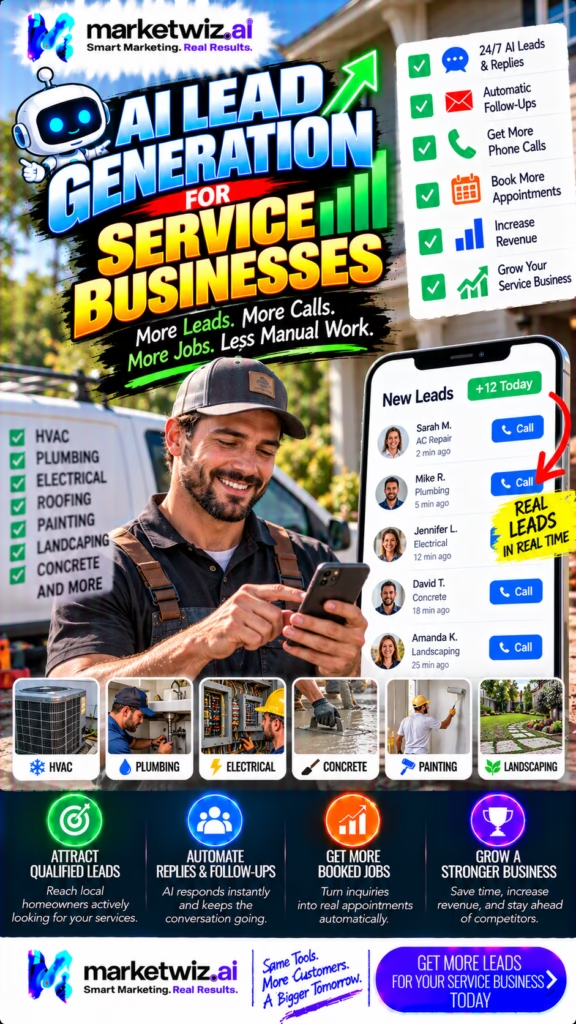
AI Lead Generation for Service Businesses
Discover how service companies can use artificial intelligence, organic marketing, local SEO, Google Maps optimization, automated customer communication, and smarter lead qualification to attract relevant inquiries and create a more efficient customer acquisition process.
1. AI Lead Generation for Service Businesses: The New Approach to Customer Acquisition
Service businesses depend on a steady flow of customer inquiries. Whether a company provides HVAC repair, plumbing, electrical work, landscaping, cleaning, painting, roofing, or home improvement, growth often depends on reaching the right people at the right time.
Traditional lead generation may involve paid advertising, referrals, direct outreach, search engine optimization, local directories, and social media. Each method can create opportunities, but managing several channels requires time and consistent follow-up.
Artificial intelligence introduces tools that can help businesses organize these activities more efficiently. AI can assist with content planning, inquiry classification, customer communication, appointment intake, and marketing analysis.
The most useful application of AI is not simply producing more messages. It is helping a service company identify relevant customer needs, communicate accurately, and move qualified inquiries toward a productive next step.
Core principle: AI lead generation works best when it supports a legitimate service offering, a clear marketing strategy, reliable customer communication, and meaningful human oversight.
A landscaping business may use AI to organize requests for lawn maintenance and landscape installation. An HVAC contractor may use it to categorize heating and cooling inquiries. A cleaning company may use automated intake to distinguish residential requests from commercial projects.
These workflows can save administrative effort, but no technology guarantees that customers will purchase a service. Business reputation, competitive positioning, availability, and customer experience remain essential.
2. What Is AI Lead Generation for Service Businesses?
AI lead generation is the use of artificial intelligence to assist with the process of attracting, identifying, organizing, qualifying, and communicating with potential customers.
For service companies, the process usually begins when someone discovers the business through a website, local search result, social platform, directory, referral, or other legitimate marketing channel.
The potential customer may ask about availability, service coverage, pricing, or the next step for requesting an estimate.
An AI-supported workflow can help collect appropriate details, draft a relevant response, and route the inquiry to the correct employee or department.
Five essential components
Customer Discovery
Help relevant customers encounter the business through appropriate marketing channels.
Inquiry Capture
Provide clear ways for customers to submit questions or request service.
Lead Qualification
Organize inquiries according to genuine service requirements.
Customer Follow-Up
Support timely, accurate communication using authorized workflows.
The fifth component is performance measurement. Businesses need to understand whether the system produces qualified conversations, booked appointments, completed work, and satisfied customers.
Without measurement, a company may mistake automated activity for business growth.
3. Why Service Businesses Are Well Suited for AI Lead Generation
Service businesses often receive repetitive questions that can be organized into predictable categories.
Customers may want to know whether a company serves their neighborhood, offers a particular type of work, provides estimates, or has appointments available.
These common questions create opportunities for structured intake and carefully configured automated assistance.
Common operational challenges
- Inquiries arrive through several marketing channels.
- Employees are busy completing customer jobs.
- Messages may arrive outside normal business hours.
- Customers often ask similar preliminary questions.
- Unqualified inquiries consume staff time.
- Follow-up tasks can become disorganized.
- Marketing results may be difficult to attribute.
AI tools can assist with several of these challenges, but implementation should reflect the business's actual operating capacity.
For example, an automated system should never promise a same-day appointment unless the business has verified availability.
Operational opportunity: A well-designed system helps service teams spend less time sorting routine inquiries and more time evaluating legitimate customer needs.
4. AI Lead Generation vs. Traditional Lead Generation
Traditional lead generation focuses on attracting potential customers through marketing and outreach. AI lead generation adds software-assisted processes that can organize and support those interactions.
The distinction is important because AI does not replace the need for an effective marketing channel. A chatbot on a website with no visitors cannot independently create a reliable stream of customers.
| Activity | Traditional Approach | AI-Assisted Approach |
|---|---|---|
| Content Planning | Manual research and drafting | AI-supported topic research and outlines |
| Inquiry Intake | Staff reads every incoming request | Automated collection and organization |
| Lead Qualification | Manual preliminary questioning | Structured AI-assisted intake with review |
| Follow-Up | Individual reminders and messages | Authorized automated reminders and drafts |
| Reporting | Manual spreadsheets and summaries | AI-assisted analysis of verified data |
| Customer Decisions | Human judgment | Human judgment supported by organized information |
The strongest approach combines automation with human expertise rather than treating the two as competing alternatives.
5. Build an AI-Powered Lead Generation Funnel for Local Services
A lead generation funnel describes how potential customers move from discovering a company to requesting and purchasing a service.
AI can support multiple stages, but each stage should have a clear purpose and a measurable outcome.
Attract Relevant Visitors
Use accurate local SEO, helpful content, organic social marketing, and other legitimate channels to reach people interested in the company's services.
Explain the Service Clearly
Help potential customers understand the offering, coverage area, and next steps before they submit an inquiry.
Capture the Inquiry
Collect the information necessary to respond through a working form, phone process, or authorized messaging channel.
Qualify the Request
Determine whether the inquiry matches the company's actual services, geographic coverage, and operating requirements.
Route and Follow Up
Send the inquiry to the appropriate team and communicate the next step accurately.
Measure the Outcome
Review whether the inquiry resulted in an appointment, estimate, completed project, or another meaningful business outcome.
A funnel should be designed around real customer needs. Excessive questions, unnecessary forms, and confusing automated messages can create friction rather than improving conversion.
6. Generate Organic Service Leads Without Relying Entirely on Paid Ads
Paid advertising can be useful, but it is not the only way to reach potential customers.
Organic marketing includes search engine optimization, Google Maps visibility, helpful website content, permitted social media activity, and relevant community discovery channels.
AI can assist with organizing these efforts by helping teams research topics, prepare drafts, review business information, and maintain content schedules.
Organic lead generation channels
- Google Business Profile and Google Maps
- Local service pages on the company website
- Educational blog content
- Organic Facebook and Instagram posts
- Relevant business directories
- Community engagement where permitted
- Customer referrals and repeat business
- Other platforms that permit the business's specific type of listing
Businesses must follow the rules of each platform. A service company should not misrepresent a service as a physical product to bypass marketplace listing restrictions.
Organic lead generation also requires patience. Publishing content does not guarantee search visibility, customer inquiries, or immediate revenue.
7. Combine AI Lead Generation With Google Maps SEO
Google Maps is an important discovery channel for many local service businesses. Customers may use it to compare nearby providers, examine reviews, and locate contact information.
Google identifies relevance, distance, and prominence as the main factors influencing local rankings.
AI can assist with profile audits, keyword organization, and content planning, but it cannot guarantee a particular Google Maps ranking.
Google Maps optimization priorities
- Maintain an eligible Google Business Profile.
- Use the real-world business name.
- Select accurate business categories.
- Keep hours and contact details current.
- Describe genuine services.
- Use authentic photographs.
- Encourage honest customer reviews.
- Maintain a helpful business website.
Important distinction: AI can help manage local marketing workflows, but Google's ranking systems determine organic placement. No legitimate provider can purchase guaranteed organic Google Maps positions.
8. Use AI-Assisted Local SEO to Reach High-Intent Customers
Local SEO helps businesses create useful information for people searching for nearby services.
A potential customer may search for a general service category or a specific problem. Understanding these differences helps companies produce more relevant content.
Examples of service-related search intent
- Air conditioner repair in a specific city
- Residential plumbing near a neighborhood
- Commercial cleaning for office buildings
- Interior painting estimates
- Landscape design for residential properties
- Roof replacement contractors
- Electrical panel installation
- Bathroom remodeling services
AI can group these topics and suggest article structures. However, staff should verify that the business actually provides the advertised services.
Search content should answer meaningful customer questions instead of repeating keywords for the sake of ranking.
9. Turn Service Business Websites Into Better Lead Generation Assets
A website often serves as the point where a potential customer decides whether to contact a service company.
An attractive design is helpful, but visitors also need accurate information and a straightforward path to requesting assistance.
High-value website elements
Clear Services
Explain the work the company actually performs and any relevant limitations.
Trustworthy Examples
Show real project photographs, credentials, or other substantiated business information.
Simple Contact Options
Make it easy to request an estimate or ask a relevant question.
Mobile Usability
Ensure customers can navigate the website and submit inquiries on smaller screens.
AI-assisted chat may help answer routine questions, but it should not invent prices, licenses, warranties, appointment availability, or project capabilities.
If a question requires human judgment, the system should provide a clear path to a qualified employee.
10. AI Chatbots for Service Business Lead Generation
AI chatbots can assist with initial customer communication on supported websites and messaging platforms.
A useful chatbot should help visitors understand available services, collect appropriate inquiry details, and identify when a human response is required.
Common chatbot tasks
- Explain published business hours.
- Identify the service being requested.
- Collect a customer's preferred contact method.
- Ask about general project location.
- Provide verified service information.
- Route inquiries to staff.
- Clarify when the business will respond.
Chatbots should clearly communicate their role when appropriate and avoid presenting themselves as licensed professionals.
They should also avoid collecting unnecessary sensitive information.
11. AI Phone Assistants and Automated Call Intake
Phone calls remain important for many service businesses. Customers may prefer speaking rather than completing a web form.
AI phone systems can assist with basic call intake, routing, and information collection when properly configured.
Potential applications
- Collecting the reason for a call
- Identifying the requested service
- Recording an authorized callback request
- Providing verified business hours
- Routing calls to available employees
- Supporting appointment intake through approved integrations
Businesses should consider applicable call recording, privacy, consent, and automated communication requirements before deployment.
For safety-sensitive situations, the system should avoid unsupported technical advice and provide appropriate escalation instructions.
Best practice: Treat AI phone intake as a customer communication tool, not a substitute for trained professionals handling complex estimates, emergencies, or regulated advice.
12. AI Lead Qualification: Identify Better Service Opportunities
Not every inquiry is a good match for every service business.
A company may receive requests outside its geographic coverage, for services it does not offer, or for projects that require different qualifications.
Lead qualification helps organize these requests before they consume extensive staff time.
Useful qualification criteria
- Requested service category
- General project location
- Type of property or project
- Customer's preferred timing
- Relevant project requirements
- Availability of the required service
- Preferred contact method
The goal is to identify practical fit, not to make unsupported assumptions about customers.
Automated qualification rules should be reviewed regularly to ensure legitimate opportunities are not incorrectly rejected.
13. Use AI Lead Scoring to Prioritize Relevant Inquiries
Lead scoring assigns priorities to incoming inquiries using defined criteria or predictive methods.
For a service business, useful criteria might include whether the requested work is offered, whether the project is within the service area, and whether sufficient information is available for follow-up.
Lead scoring should not be treated as a perfect prediction of customer value.
| Lead Signal | Potential Meaning | Recommended Action |
|---|---|---|
| Service Match | Customer requests a genuine offering | Continue qualification |
| Location Match | Project is within normal coverage | Route to appropriate team |
| Incomplete Details | More information is required | Ask a relevant clarifying question |
| Scheduling Request | Customer wants an appointment | Check actual availability |
| Outside Service Scope | Business may not provide the requested work | Respond accurately and avoid false promises |
Human review remains important, especially when an inquiry is complex or the automated classification is uncertain.
14. Automate Lead Follow-Up Without Losing the Human Touch
Follow-up is an important part of service business customer acquisition. Customers may submit an inquiry and then wait for confirmation or additional information.
Automated workflows can help acknowledge requests, notify staff, and remind employees about outstanding tasks.
Appropriate follow-up sequence
Acknowledge the Inquiry
Confirm receipt when the communication channel and customer permissions allow it.
Clarify Missing Information
Ask only for details needed to determine the next step.
Notify the Right Employee
Route the request to the person or team responsible for the service.
Provide a Verified Next Step
Communicate realistic timing, scheduling options, or estimate procedures.
Respect Customer Preferences
Honor opt-outs and avoid repeated unwanted messages.
The objective is helpful communication, not an aggressive sequence of automated messages.
15. Connect AI Lead Generation With Customer Relationship Management
A customer relationship management system, commonly called a CRM, helps businesses organize contacts, inquiries, appointments, and follow-up tasks.
AI integrations can support these processes by categorizing messages, drafting summaries, and identifying incomplete records.
Useful CRM fields
- Customer contact details
- Inquiry source
- Requested service
- Project location
- Inquiry date
- Assigned employee
- Follow-up status
- Appointment or estimate status
- Final business outcome
Access to customer records should be limited to authorized personnel and systems. Businesses should establish appropriate data retention and security practices.
A clean CRM can make marketing reports more meaningful by distinguishing initial inquiries from qualified opportunities and completed jobs.
16. AI Lead Generation for HVAC Companies
HVAC businesses often manage seasonal demand, maintenance inquiries, installation requests, and repair questions.
AI can assist with organizing these inquiries while helping marketing teams develop accurate educational content about heating and cooling services.
Potential HVAC workflows
- Classify heating and cooling inquiries.
- Identify the customer's general service location.
- Collect preliminary equipment information when appropriate.
- Provide verified business contact details.
- Route installation inquiries to the correct team.
- Organize seasonal maintenance marketing.
- Track qualified appointment requests.
An AI assistant should not diagnose dangerous equipment problems or promise emergency availability without confirmation.
Technical evaluations and safety decisions should remain with qualified professionals.
17. AI Lead Generation for Plumbing Businesses
Plumbing companies receive a wide variety of requests, including leaks, fixture repairs, drain problems, water heater work, and installation projects.
AI-assisted intake can help categorize requests and provide staff with relevant preliminary information.
Practical plumbing applications
- Organize drain and fixture inquiries.
- Identify water heater service requests.
- Collect general project details.
- Confirm actual service coverage.
- Route requests for professional assessment.
- Support follow-up for estimates.
Automated systems should not provide unsafe instructions for serious leaks, gas-related issues, or other potentially hazardous conditions.
A clear escalation process is especially important when customers describe urgent property or safety concerns.
18. AI Marketing and Lead Generation for Electrical Contractors
Electrical contractors may provide panel upgrades, wiring work, lighting installations, inspections, and other specialized services.
Customers often need help determining whether a company handles a particular project before requesting an estimate.
AI can support this process through accurate service descriptions, organized intake, and appropriate staff routing.
Recommended electrical lead workflows
- Identify the general project category.
- Confirm the company's service coverage.
- Collect appropriate project context.
- Provide verified business information.
- Direct technical questions to qualified staff.
- Track estimate and appointment requests.
AI should never imply that it has performed an electrical inspection or determined that a hazardous condition is safe.
19. AI Lead Generation for Landscaping and Lawn Care Businesses
Landscaping companies often manage multiple service categories and seasonal changes in customer demand.
A business might provide lawn maintenance, landscape installation, hardscaping, seasonal cleanup, or other outdoor property work.
AI can help organize these offerings into clear marketing topics and classify inquiries by project type.
Landscaping lead generation opportunities
Lawn Maintenance
Organize recurring maintenance inquiries and relevant scheduling information.
Landscape Design
Collect preliminary project goals before a professional consultation.
Hardscaping
Separate patio, walkway, and retaining wall inquiries when those services are offered.
Seasonal Work
Coordinate accurate marketing content around services available during the current season.
Real project photos, clearly described services, and timely customer communication can complement AI-assisted marketing.
20. AI Lead Generation for Painting Contractors
Painting businesses may serve residential and commercial customers with interior painting, exterior painting, cabinet refinishing, and related work.
Customers often want examples of completed projects before requesting an estimate.
AI can help prepare service-specific content, organize inquiry details, and support customer follow-up.
Useful painting lead information
- Interior or exterior project type
- General property location
- Residential or commercial setting
- Approximate project scope
- Preferred consultation timing
- Available project photographs when voluntarily provided
The business should verify estimates and timelines rather than allowing AI to invent project prices or completion dates.
21. AI Lead Generation for Roofing and Remodeling Companies
Roofing and remodeling projects can involve significant planning, multiple decisions, and detailed estimates.
AI can assist with early-stage communication by collecting basic project information and routing requests to experienced staff.
Potential workflows
- Organize roof repair and replacement inquiries.
- Classify kitchen and bathroom remodeling requests.
- Collect general property and project details.
- Explain verified consultation procedures.
- Track estimate requests and follow-up tasks.
- Prepare educational content about project planning.
AI-generated cost ranges should not be presented as binding estimates unless the company has an authorized, validated pricing process.
For complex projects, professional assessment remains necessary.
22. AI Lead Generation for Residential and Commercial Cleaning
Cleaning companies often need to distinguish between residential work, commercial contracts, recurring maintenance, and specialized cleaning requests.
AI-assisted intake can help organize these categories and identify the correct follow-up process.
Cleaning business intake questions
- Is the request residential or commercial?
- What type of cleaning is needed?
- What is the general service location?
- Is the request one-time or recurring?
- Are there special requirements?
- What is the customer's preferred contact method?
Only necessary information should be collected, and customers should not be promised services that the company cannot provide.
24. Measure AI Lead Generation Performance With the Right Metrics
A successful lead generation system should be evaluated by business outcomes rather than automation volume.
For example, a system that sends many replies but generates few qualified appointments may need better targeting or more accurate qualification rules.
Important performance indicators
| Metric | What It Measures | Why It Matters |
|---|---|---|
| Incoming Inquiries | Total initial customer contacts | Shows overall inquiry activity |
| Qualified Leads | Requests matching business criteria | Indicates relevance |
| Response Time | Time to an appropriate response | Helps evaluate communication |
| Appointments | Scheduled customer interactions | Shows progression through the funnel |
| Completed Jobs | Work resulting from inquiries | Connects marketing to operations |
| Acquisition Cost | Marketing cost relative to acquired customers | Supports financial decisions |
| Customer Feedback | Reported experience with the process | Identifies quality improvements |
Attribution can be imperfect because customers may interact with multiple channels before contacting a business.
Reports should acknowledge those limitations rather than claiming precision that the available data does not support.
25. Common AI Lead Generation Mistakes Service Businesses Should Avoid
AI automation can create problems when businesses prioritize volume over accuracy and customer experience.
Frequent mistakes
- Publishing AI-generated claims without verification.
- Sending unwanted automated messages.
- Failing to obtain required communication consent.
- Promising appointments without checking availability.
- Using misleading service or pricing information.
- Collecting unnecessary personal data.
- Allowing bots to provide unsafe technical advice.
- Ignoring customer requests for human assistance.
- Failing to monitor automation errors.
- Measuring success only through message volume.
- Creating low-quality mass-produced SEO content.
- Violating platform rules through unauthorized posting.
- Overlooking data security and access controls.
- Using inaccurate or unfair lead scoring assumptions.
Quality standard: Every automated interaction should help the customer understand the business, obtain accurate information, or move toward an appropriate next step.
26. A 90-Day AI Lead Generation Implementation Plan
Service businesses can use a phased approach to reduce implementation risk and evaluate results.
The following roadmap is an operational planning framework rather than a guarantee of growth within 90 days.
Days 1–15: Audit Existing Lead Sources
Identify where inquiries originate, how they are handled, and which operational problems require attention.
Days 16–30: Improve Core Marketing Information
Review the website, Google Business Profile, service descriptions, contact information, and relevant organic channels.
Days 31–45: Organize Lead Intake
Create clear inquiry categories, routing rules, notifications, and staff responsibilities.
Days 46–60: Introduce Supervised AI Assistance
Test approved response drafts, basic qualification, and customer communication workflows.
Days 61–75: Connect Follow-Up and Reporting
Integrate authorized tools where appropriate and monitor communication quality, qualified leads, and appointments.
Days 76–90: Evaluate and Improve
Review actual customer outcomes, identify errors, and refine the system based on verified business data.
Businesses should expand automation only when existing processes are reliable.
27. Advanced AI Lead Generation Strategies for Growing Service Companies
Once a company has accurate marketing information and reliable intake workflows, it can consider more sophisticated automation.
Service-specific inquiry routing
Direct different categories of requests to employees with the appropriate expertise. For example, installation estimates and routine maintenance questions may require different workflows.
Customer communication summaries
Generate concise summaries of authorized customer interactions so staff can review relevant details without rereading lengthy conversations.
Follow-up task prioritization
Use verified business criteria to identify outstanding requests requiring attention.
Content performance analysis
Evaluate which service pages and educational topics attract relevant inquiries, then improve content based on real customer needs.
Seasonal marketing organization
Coordinate legitimate seasonal offerings, such as heating maintenance, exterior painting, landscaping, or other services available during particular periods.
Quality assurance monitoring
Review automated conversations for factual errors, inappropriate promises, privacy issues, and missed escalation opportunities.
Advanced automation should increase operational clarity rather than introduce unnecessary complexity.
28. Privacy, Consent, and Responsible AI Marketing
Service businesses must treat customer information carefully. Lead generation systems may process names, phone numbers, project details, and other personal information.
AI workflows should be designed with appropriate access controls, data retention practices, and vendor oversight.
Responsible implementation principles
- Collect only information needed for a legitimate business purpose.
- Provide appropriate privacy disclosures.
- Follow applicable consent requirements.
- Honor customer communication preferences.
- Use secure, authorized integrations.
- Restrict access to customer information.
- Monitor AI-generated responses for accuracy.
- Provide human escalation when needed.
- Review applicable telemarketing and messaging requirements.
Requirements vary by jurisdiction, communication method, and business activity. Companies should obtain qualified legal guidance when necessary.
Trustworthy customer communication is an essential part of sustainable lead generation.
29. The Future of AI Lead Generation for Local Service Businesses
AI capabilities are evolving across marketing, customer communication, search, and business operations.
Future tools may make it easier to connect customer inquiries with scheduling systems, service records, marketing analytics, and other authorized business processes.
However, technology changes do not eliminate the importance of reliable service delivery.
Long-term priorities
- Maintain accurate business information.
- Develop helpful organic marketing content.
- Keep customer communication transparent.
- Use AI to support rather than replace expertise.
- Protect customer information.
- Monitor automation performance.
- Improve the quality of qualified inquiries.
- Evaluate completed jobs and customer satisfaction.
Businesses that build reliable systems can adapt more effectively as software and customer expectations change.
30. How Market Wiz AI Supports Lead Generation for Service Businesses
Market Wiz AI helps businesses coordinate organic marketing activities and AI-supported customer communication.
For service companies, a broader marketing approach can include local SEO, Google Maps optimization, useful website content, organic social media, and permitted marketplace or community channels.
AI-assisted workflows can support inquiry organization, response preparation, and consistent follow-up when properly configured.
Marketing and operational priorities
- Strengthening local business visibility
- Developing SEO-oriented service content
- Coordinating organic marketing activity
- Maintaining accurate business information
- Supporting customer communication workflows
- Organizing qualified inquiries
- Improving marketing consistency
- Tracking meaningful business outcomes
The goal is to help service businesses build a more organized digital marketing presence and reduce unnecessary manual work.
AI should be implemented responsibly, with accurate service descriptions, authorized customer communication, and compliance with relevant platform rules.
Lead volume, rankings, appointments, and revenue depend on business circumstances and cannot be guaranteed.
30 Frequently Asked Questions About AI Lead Generation for Service Businesses
1. What is AI lead generation for service businesses?
AI lead generation for service businesses uses artificial intelligence to assist with attracting, organizing, qualifying, and following up with potential customers who need services.
2. How does AI lead generation work?
AI tools can help process inquiries, organize customer information, draft responses, identify service needs, and route qualified opportunities to the appropriate team.
3. Can AI generate leads for small service businesses?
Yes. Small service businesses can use AI to support marketing and customer communication, although lead volume and quality depend on demand, targeting, and execution.
4. Which service industries can use AI lead generation?
Industries such as HVAC, plumbing, electrical, landscaping, painting, cleaning, roofing, remodeling, and other eligible local service businesses can use AI-supported lead generation workflows.
5. Can AI replace a human sales team?
AI can assist with repetitive communication and administrative tasks, but human oversight remains important for complex decisions, estimates, sensitive situations, and customer relationships.
6. Does AI lead generation require paid advertising?
No. AI tools can support organic SEO, Google Maps optimization, website inquiries, and permitted social media marketing without requiring paid advertising.
7. What is AI lead qualification?
AI lead qualification involves using software to organize customer information and identify whether an inquiry appears relevant to the business's services, location, and availability.
8. Can AI respond to customers automatically?
AI systems can provide automated responses through supported channels when properly configured, authorized, and monitored.
9. How can AI help HVAC companies generate leads?
AI can support HVAC companies through service content planning, inquiry organization, appointment intake, and follow-up for legitimate heating and cooling requests.
10. Can plumbers use AI for lead generation?
Yes. Plumbing companies can use AI to help organize inquiries, explain available services, and collect preliminary details before staff review.
11. How does AI help landscaping businesses?
AI can help landscaping businesses organize seasonal marketing, draft service descriptions, categorize inquiries, and manage follow-up for prospective customers.
12. Can AI improve Google Maps lead generation?
AI can assist with local keyword research, profile audits, and content planning, but Google Maps rankings depend on Google's systems and cannot be guaranteed.
13. What is automated lead follow-up?
Automated lead follow-up uses configured workflows to send appropriate messages or reminders after a customer inquiry, subject to consent and applicable communication rules.
14. How fast should service businesses respond to leads?
Businesses should respond promptly during appropriate hours and according to customer expectations. Automated replies should be accurate and should not promise unavailable services.
15. Can AI schedule service appointments?
AI can assist with appointment requests and scheduling when integrated with an authorized calendar or booking system and configured to verify availability.
16. What is organic AI lead generation?
Organic AI lead generation combines unpaid marketing channels with AI-assisted content, inquiry management, and follow-up workflows.
17. Can AI help improve local SEO?
AI can support keyword research, content organization, and audits, but published information should be verified and designed for real customer needs.
18. How do service businesses qualify leads?
Businesses can assess service type, location, timing, project requirements, and other relevant details while collecting only information necessary for the inquiry.
19. Can AI handle customer questions after business hours?
Properly configured AI systems can provide general information and collect inquiries after hours, while clearly communicating when human assistance is unavailable.
20. Is AI lead generation expensive?
Costs vary by software, integrations, communication volume, management needs, and the complexity of the workflow.
21. How do I measure AI lead generation performance?
Track qualified inquiries, response times, appointments, completed jobs, acquisition costs, and customer satisfaction rather than relying only on message counts.
22. Can AI reduce missed service inquiries?
AI-assisted intake and notification systems may reduce missed inquiries when properly configured, monitored, and connected to reliable business workflows.
23. What are the risks of AI lead generation?
Risks include inaccurate responses, privacy issues, unwanted messages, poor qualification, system failures, and noncompliance with platform or communication rules.
24. Can AI integrate with a CRM?
Many AI systems can integrate with supported customer relationship management platforms to organize inquiries and follow-up tasks.
25. How does AI lead scoring work?
AI lead scoring uses defined criteria or predictive models to prioritize inquiries, but scoring should be reviewed for accuracy and unfair or irrelevant assumptions.
26. Can AI help roofing and remodeling companies?
Yes. AI can assist with content planning, project inquiry intake, customer communication, and follow-up for roofing and remodeling businesses.
27. Does AI guarantee more service leads?
No. AI cannot guarantee lead volume, conversion rates, search rankings, or revenue. Results depend on market conditions and implementation.
28. How can AI improve customer experience?
AI can improve access to basic information, organize inquiries, and support timely communication when it is accurate, transparent, and appropriately supervised.
29. What should businesses automate first?
A useful starting point is organizing incoming inquiries, creating reliable notifications, and drafting accurate responses before introducing more complex automation.
30. What is the best long-term AI lead generation strategy?
Combine useful organic marketing, accurate business information, responsible AI automation, human oversight, and measurement of actual customer outcomes.
30 Additional SEO Keywords for AI Lead Generation for Service Businesses
These keyword ideas can support relevant articles, service pages, and marketing research. Use them naturally when they match actual services and customer intent.
Final Thoughts: Build a Smarter AI Lead Generation Strategy for Your Service Business
AI lead generation can help service businesses organize marketing, improve inquiry handling, and support more consistent customer communication.
The greatest opportunities often come from combining useful organic marketing with accurate business information and reliable operational processes.
Google Maps optimization, local SEO, service-specific website content, and appropriate social media activity can help customers discover a company.
AI-assisted intake, qualification, and follow-up can then help the business respond more efficiently.
However, automation should never replace accuracy, customer consent, professional judgment, or responsible data handling.
A service company should begin with clear goals, test manageable workflows, and measure outcomes that matter: qualified inquiries, appointments, completed projects, and customer satisfaction.
The strongest AI lead generation strategy combines relevant customer discovery, trustworthy information, responsible automation, and dependable human service.
Grow Your Service Business With Smarter AI Marketing
Build a more consistent organic marketing presence with SEO-focused content, local visibility strategies, coordinated multi-platform marketing, and AI-supported customer communication. Discover how Market Wiz AI helps service businesses organize marketing activity and create opportunities for qualified customer inquiries.
Explore MarketWiz.ai© 2026 Market Wiz AI. This article provides general educational information about AI marketing, service business lead generation, and customer communication. Platform policies and applicable laws may change. Lead volume, search rankings, conversions, and revenue are not guaranteed.










23. Combine AI Lead Generation With Organic Social Media Marketing
Organic social media can help businesses communicate with local audiences and demonstrate the kinds of work they perform.
AI can assist with content calendars, draft captions, topic organization, and response preparation.
However, businesses should avoid automated spam, misleading engagement tactics, and posting content that violates platform rules.
Useful organic social content
Social media content should represent the business truthfully and respect customer privacy.
Where a platform restricts service-only listings, businesses should use an appropriate permitted channel rather than disguising the offering.