
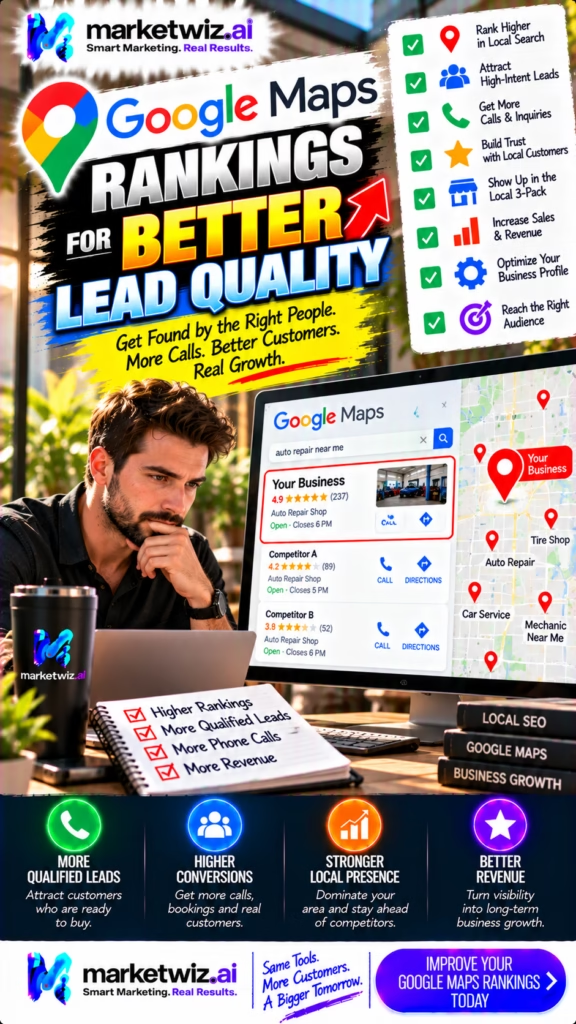
Google Maps Rankings for Better Lead Quality
Learn how strategic Google Maps optimization can attract more relevant local customers, strengthen search visibility, improve customer trust, and transform business discovery into higher-quality inquiries and revenue opportunities.
For local businesses, appearing on Google Maps is about much more than achieving a prominent position in search results. The real opportunity is connecting with people who are actively looking for a specific product, professional, contractor, or solution in their area.
A business can generate hundreds of impressions without producing meaningful revenue. Another business might receive fewer impressions but attract customers who are ready to request estimates, schedule appointments, or make purchasing decisions.
That difference illustrates why Google Maps rankings for better lead quality should be approached as a customer acquisition strategy rather than a visibility contest.
Effective local SEO connects the right business with the right customer at the right moment. It combines Google Business Profile optimization, local search relevance, trust-building content, geographic targeting, conversion-focused website experiences, and meaningful performance measurement.
Core principle: The most valuable Google Maps ranking is not necessarily the one producing the highest number of views. It is the ranking that helps attract customers whose needs, locations, expectations, and buying intentions match what your business actually provides.
1. Understanding Google Maps Rankings
Google Maps rankings describe the order in which eligible local businesses appear when users search for relevant businesses, products, or services. These results can appear directly in Google Maps or in the local results displayed within Google Search.
When someone searches for phrases such as "roof repair near me," "emergency plumber," "commercial cleaning company," or "best kitchen remodeling contractor," Google attempts to identify businesses relevant to the searcher's needs and geographic context.
Google Maps as a Local Discovery Platform
Unlike broad informational searches, many Google Maps searches involve immediate or near-term commercial interest. Users may be comparing providers, researching business reputations, checking availability, or preparing to contact a company.
This makes local search visibility valuable for businesses that depend on customers within specific cities, neighborhoods, or service areas.
The Difference Between Visibility and Opportunity
Visibility indicates that a business can be discovered. Opportunity depends on whether that discovery occurs among potential customers who are genuinely interested in the company's offerings.
For example, a residential painting contractor may receive significant traffic from general painting searches. However, appearing for searches involving exterior house painting estimates or kitchen cabinet painting in its actual service area may produce more relevant conversations.
A productive Google Maps strategy therefore evaluates which searches attract the business's ideal customers, not simply how often its profile appears.
2. Why Lead Quality Matters More Than Lead Volume
Lead generation is often measured by the number of phone calls, contact forms, messages, and appointment requests a business receives. Although these measurements are useful, they do not reveal whether the inquiries represent realistic sales opportunities.
A qualified lead generally matches several important criteria:
- The customer is located within the business's actual service area.
- The requested product or service matches the company's offerings.
- The customer has a realistic budget or purchasing expectation.
- The customer has a reasonable timeline for making a decision.
- The inquiry comes from someone who can influence or authorize the purchase.
Why More Leads Can Sometimes Create More Work
Unqualified inquiries consume employee time, scheduling capacity, and sales resources. A company may appear successful based on call volume while experiencing weak appointment rates and disappointing revenue.
For instance, a premium remodeling company might receive many inquiries from customers seeking inexpensive handyman work. Those calls increase activity but do little to support the company's business model.
When search visibility accurately represents your offerings, pricing position, geographic reach, and capabilities, customers can make more informed decisions before contacting your business.
Quality-Based Performance Indicators
Instead of evaluating only profile impressions and calls, businesses should also measure qualified inquiry rate, appointment booking rate, estimate acceptance rate, customer acquisition cost, and revenue from locally sourced customers.
These metrics help connect local search activity with actual business performance.
3. Google's Three Core Local Ranking Factors
Google identifies three primary considerations for local rankings: relevance, distance, and prominence. Understanding these concepts is essential for building a realistic optimization strategy.
Relevance
Relevance describes how closely a business matches what someone is searching for. Google uses available information about a business to determine whether it may satisfy a particular query.
Accurate business categories, descriptions, services, and other relevant details help communicate what a company offers.
Distance
Distance reflects how far a potential result is from the location used in a search. That location may be the searcher's current position or a location explicitly included in the query.
A business cannot simply optimize its way around every geographic limitation. Even a strong profile may have difficulty appearing prominently for searches far outside its actual location.
Prominence
Prominence concerns how well-known or established a business appears to be. Google considers information such as links, articles, directory references, and review-related signals.
Strong local recognition and a credible online presence can support visibility over time.
Google does not offer a way to request or pay for a better organic local ranking. Advertising placements and organic Maps rankings are separate mechanisms.
What Businesses Can Control
Although companies cannot control Google's algorithms or a customer's location, they can improve the accuracy, usefulness, credibility, and completeness of their public business information.
That is where sustainable local SEO work should begin.
4. Optimizing Google Business Profile for Qualified Leads
A Google Business Profile is one of the most important customer-facing assets in local search. It allows eligible businesses to communicate their identity, location or service area, operating hours, offerings, photos, and other useful information.
Complete Every Relevant Profile Field
Businesses should review their profiles for missing or outdated information. Incomplete details can create confusion and make it harder for customers to determine whether a business meets their needs.
Prioritize accurate contact information, website links, business hours, relevant categories, and descriptions that reflect actual operations.
Write a Clear Business Description
An effective description explains what the company does, who it helps, and what makes its offerings relevant to prospective customers.
Avoid exaggerated promises, repetitive keywords, or promotional language that distracts from the business's actual capabilities.
Maintain Accurate Business Hours
Incorrect hours can produce frustrated customers and missed opportunities. Update regular hours, holiday hours, and temporary changes whenever necessary.
Use Appropriate Contact Paths
Customers should have a straightforward way to call, visit the website, request information, or otherwise contact the company using available profile features.
For better lead quality, the linked website should clearly explain the business's services and geographic coverage before visitors submit inquiries.
5. Targeting High-Intent Local Search Keywords
Not all search phrases communicate the same level of customer intent. Some searches are educational, while others suggest that the user is preparing to hire a professional or purchase a product.
Informational Keywords
Examples include "how to repaint kitchen cabinets" or "why is my air conditioner leaking." These searches can support awareness and future demand, but they do not always indicate immediate purchasing intent.
Commercial Investigation Keywords
Examples include "best roofing contractors near me," "local HVAC company reviews," and "interior painters in Dallas."
These users may be comparing providers and evaluating their options.
High-Intent Transactional Keywords
Examples include "schedule AC repair," "emergency drain cleaning near me," and "request exterior painting estimate."
Such phrases can indicate stronger near-term interest, although actual lead quality still depends on customer circumstances.
| Keyword Type | Example | Potential Customer Intent |
|---|---|---|
| Informational | How much does roof repair cost? | Researching options |
| Comparison | Best roofers near me | Evaluating providers |
| Local commercial | Roofing contractor in Tampa | Finding nearby businesses |
| Transactional | Schedule emergency roof repair | Seeking prompt assistance |
| Specialized | Commercial flat roof replacement contractor | Looking for a specific capability |
Match Keywords to Actual Offerings
A company specializing in commercial work should not aggressively target residential inquiries merely because those searches are popular.
The most useful keywords are those that align with the business's capabilities, profitable offerings, and customer expectations.
6. Business Categories and Search Relevance
Google Business Profile categories help describe the nature of a company. Selecting accurate categories is an important part of communicating relevance.
Choose the Most Accurate Primary Category
The primary category should represent the business's core activity rather than a loosely related offering.
For example, a company primarily operating as a plumbing contractor should choose the most accurate available category for that business, rather than selecting an unrelated category simply to pursue additional traffic.
Use Additional Categories Carefully
Additional categories can represent legitimate aspects of a business, but they should not be used to describe every possible keyword or service variation.
Businesses should review Google's current category options and select only those that accurately describe their operations.
Explain Specialized Offerings
Where relevant profile features are available, add accurate services and descriptions. These details help customers understand whether the company can address their specific needs.
A clearly described specialty may produce fewer irrelevant inquiries and more conversations with suitable customers.
7. Geographic Targeting and Local Lead Quality
Geographic relevance is essential for businesses that operate within defined service territories. A lead outside the service area may have little value even when the customer is otherwise ready to purchase.
Define Your Real Service Territory
Businesses should identify the cities, communities, and neighborhoods they genuinely serve.
This helps marketing teams develop accurate website content and communicate coverage clearly to customers.
Understand Service-Area Settings
Eligible service-area businesses can configure their profiles according to Google's guidelines. However, listing a city as a service area does not guarantee prominent rankings throughout that city.
Distance and other local ranking considerations still apply.
Create Useful Location-Specific Content
Businesses operating across several communities may benefit from website pages that explain their work in each location.
These pages should contain genuinely useful information, such as local project examples, relevant service details, and accurate coverage descriptions.
Avoid producing large numbers of nearly identical city pages that offer no distinct value.
Evaluate Geographic Profitability
Not every nearby area produces the same business outcomes. Travel time, job size, operating expenses, and customer demand can influence whether a location is profitable.
Use completed-job data to determine which areas produce strong opportunities rather than targeting every possible city indiscriminately.
8. Building Customer Trust Through Authentic Reviews
Customer reviews play an important role in local business evaluation. Prospective buyers frequently examine ratings, review content, and business responses before deciding whom to contact.
Google also states that review count and positive ratings can contribute to local ranking.
Encourage Genuine Customer Feedback
Businesses can invite customers to share honest reviews about their experiences.
Review requests should not require positive ratings, offer prohibited incentives, or selectively discourage dissatisfied customers from providing feedback.
Why Detailed Reviews Can Be Valuable
A review describing a completed project, communication quality, timeliness, and customer experience can help prospective buyers evaluate the business.
For example, a customer discussing a successful kitchen cabinet refinishing project may help future customers understand the company's specialty.
Respond Professionally
Thoughtful responses demonstrate that the company pays attention to customer experiences.
Responses should be respectful, accurate, and mindful of customer privacy.
Avoid Manipulated Reviews
Fake reviews, purchased reviews, and review-gating practices can undermine credibility and violate platform policies.
Long-term trust is more valuable than artificially increasing a review count.
9. Connecting Google Maps Visibility With Website Conversion
A Google Maps listing often serves as the first step in a customer's research process. The website then provides an opportunity to explain the company's offerings in greater detail.
A strong landing page should answer the visitor's most important questions quickly.
Clearly Explain the Service
Visitors should immediately understand what the company provides and whether their specific needs are covered.
Communicate Service Areas
Display accurate geographic coverage so visitors can determine whether they are eligible customers before contacting the business.
Build Credibility
Use authentic project examples, relevant qualifications, useful FAQs, and accurate customer testimonials.
Reduce Unnecessary Friction
Mobile-friendly navigation, readable text, fast-loading pages, and straightforward contact options can make it easier for prospective customers to take the next step.
Qualify Without Creating Obstacles
Contact forms can ask useful questions about project type, location, timeline, and approximate scope.
However, requiring too much information can discourage legitimate prospects. The objective is to collect enough detail to route inquiries efficiently without making contact unnecessarily difficult.
A high-ranking Google Business Profile and a confusing website can work against each other. Strong local marketing requires consistency between what customers see in search results and what they experience after clicking.
10. Turning Google Maps Visibility Into Qualified Customer Inquiries
Google Maps visibility becomes commercially valuable when it leads to relevant customer actions.
A successful conversion strategy focuses on clarity, credibility, accessibility, and expectation-setting.
Make Your Offerings Easy to Understand
Potential customers should not have to guess whether your company provides the solution they need.
Use straightforward language to describe services, specialties, and relevant project types.
Set Appropriate Expectations
If your business has minimum project requirements, specialized capabilities, or geographic limitations, explain them where appropriate.
Clear expectations can reduce inquiries that are unlikely to become customers.
Improve Response Processes
Even a highly qualified inquiry can lose value when a business responds too slowly.
Establish consistent procedures for answering calls, reviewing forms, assigning leads, and scheduling follow-ups.
Measure Appointments and Sales
Track whether inquiries become appointments, estimates, proposals, and paying customers.
These downstream outcomes provide a more complete picture of marketing effectiveness than profile interactions alone.
11. Using Photos and Profile Content to Attract the Right Customers
Photos allow potential customers to evaluate a business before making direct contact.
For many local industries, visual proof of actual work can be more informative than generic promotional imagery.
Show Authentic Projects
Contractors can display completed projects. Restaurants can show food and dining spaces. Retailers can showcase their stores and merchandise.
Images should accurately represent the business and comply with Google's content policies.
Highlight Relevant Specialties
If a company wants to attract customers seeking premium exterior painting, displaying real exterior projects can help communicate that capability.
Similarly, a commercial contractor should feature appropriate commercial examples rather than relying entirely on residential photographs.
Keep Information Current
Update outdated photos, operating information, and relevant profile content when business circumstances change.
Fresh information can help customers evaluate what the company currently offers, but adding content does not guarantee higher rankings.
12. Local Citations and Consistent Business Information
Local citations are references to a business on websites such as directories, industry platforms, and community resources.
These references may include the company's name, address, phone number, website, and other identifying details.
Maintain Accurate Information
Inconsistent contact information can confuse potential customers and create operational problems.
Review important listings when a business changes its phone number, location, name, or operating structure.
Prioritize Relevant Sources
Industry associations, reputable directories, professional organizations, and appropriate local resources can provide useful opportunities for business discovery.
The objective should be accurate representation and customer usefulness, not simply accumulating as many directory entries as possible.
Avoid Low-Quality Directory Campaigns
Mass submissions to irrelevant or questionable websites may provide little customer value.
A smaller collection of accurate, trustworthy references is generally more useful than a large collection of misleading or outdated listings.
13. Tracking Google Maps Leads and Measuring Their Quality
Accurate measurement helps businesses understand whether local search visibility is producing meaningful commercial results.
Review Business Profile Performance
Google Business Profile performance reporting can provide information about customer interactions and discovery activity, subject to the metrics currently available.
These measurements are useful starting points but should not be treated as complete revenue attribution.
Use Tagged Website Links
Where appropriate, UTM parameters can help analytics platforms distinguish visits originating from Business Profile links.
For example, a tagged website URL can identify traffic associated with a Google Business Profile without changing the underlying destination.
Track Inquiries in a CRM
Record important lead details such as requested service, location, contact date, estimated project value, and sales outcome.
Classify Lead Quality
A simple classification system can separate qualified opportunities from inquiries outside the service area, requests for unavailable services, and other unsuitable contacts.
| Metric | What It Measures | Why It Matters |
|---|---|---|
| Profile interactions | Customer activity on the profile | Shows engagement |
| Website visits | Traffic from tracked profile links | Shows website interest |
| Qualified inquiries | Leads matching business requirements | Measures relevance |
| Booked appointments | Inquiries progressing to meetings | Measures sales progression |
| Closed customers | Completed sales from attributed leads | Measures business outcomes |
| Revenue per lead | Attributed revenue divided by leads | Measures economic value |
Useful Lead Quality Formulas
Qualified lead rate: Qualified leads ÷ Total leads × 100.
Lead-to-customer conversion rate: New customers ÷ Total leads × 100.
Revenue per qualified lead: Attributed revenue ÷ Qualified leads.
These measurements can reveal whether changes in Google Maps visibility are attracting customers who are genuinely valuable to the business.
14. Common Google Maps SEO Mistakes That Reduce Lead Quality
Chasing Rankings Without Understanding Intent
Ranking for a broad search term may create visibility without attracting customers who need the company's actual offerings.
Using Inaccurate Business Categories
Selecting irrelevant categories can misrepresent a business and create a poor customer experience.
Keyword-Stuffing Business Names
Adding marketing phrases or location keywords that are not part of the real-world business name can violate Google guidelines.
Targeting Unsupported Locations
Claiming service coverage where the company does not operate can generate unqualified leads and customer dissatisfaction.
Ignoring Customer Reviews
Failing to engage professionally with feedback can miss opportunities to demonstrate customer care.
Sending Traffic to Generic Pages
A landing page that fails to explain the searched-for service can cause otherwise interested visitors to leave.
Failing to Track Sales Outcomes
Without lead qualification and revenue tracking, businesses may invest in keywords or locations that generate activity but little profit.
Expecting Guaranteed Rankings
No ethical provider can guarantee a particular organic Google Maps position for every user, location, and query.
15. Google Maps Lead Quality Strategies by Industry
The ideal local SEO strategy depends on how customers research, compare, and purchase within a particular industry.
HVAC Companies
HVAC businesses can distinguish emergency repairs, maintenance, installations, and system replacements through accurate service information and relevant website content.
A customer needing immediate AC repair has different expectations from someone researching a future equipment upgrade.
Plumbing Contractors
Plumbing companies can clarify whether they handle emergency repairs, drain cleaning, water heaters, sewer work, or commercial plumbing.
Accurate specialization reduces the likelihood of receiving inquiries for work the company does not perform.
Painting Contractors
Painting companies can use authentic project photographs and descriptive service pages to distinguish interior painting, exterior painting, cabinet refinishing, and commercial projects.
This can help attract customers seeking the specific type of work the business wants to perform.
Roofing Companies
Roofers may benefit from clearly separating inspection, repair, replacement, and commercial roofing information.
Customers comparing a minor repair with a complete replacement often have very different budgets and timelines.
Medical and Dental Practices
Healthcare organizations should accurately describe specialties, appointment procedures, accepted insurance where applicable, and relevant location details.
Clear information can help prospective patients determine whether a practice is appropriate for their needs.
Professional Services
Attorneys, accountants, consultants, and other professionals can communicate their actual practice areas and client requirements.
The goal is to attract inquiries aligned with their expertise rather than broad, unrelated requests.
16. A Practical 90-Day Google Maps Optimization Roadmap
A structured optimization plan helps businesses prioritize accurate information, customer relevance, and measurable outcomes.
Days 1–15: Audit and Establish a Baseline
- Verify profile ownership and business eligibility.
- Review categories, contact details, hours, and website links.
- Identify priority services and profitable geographic areas.
- Document existing visibility and inquiry metrics.
- Review website pages and contact processes.
Days 16–30: Improve Profile Accuracy
- Correct outdated or incomplete profile details.
- Refine business descriptions and relevant services.
- Add authentic, representative business photographs.
- Check important third-party listings for accuracy.
- Ensure contact information is consistent.
Days 31–45: Improve Website Relevance
- Strengthen important service pages.
- Clarify geographic coverage.
- Add useful customer questions and answers.
- Improve mobile usability and navigation.
- Make contact and appointment paths straightforward.
Days 46–60: Strengthen Customer Trust
- Implement a compliant review request process.
- Respond professionally to customer feedback.
- Publish authentic examples of completed work.
- Improve relevant local content where necessary.
- Review common customer objections and questions.
Days 61–75: Improve Lead Measurement
- Configure appropriate website attribution.
- Organize lead-source tracking.
- Define qualified and unqualified lead criteria.
- Review appointment and estimate conversion rates.
- Identify patterns in profitable customer inquiries.
Days 76–90: Evaluate and Refine
- Compare results with the original baseline.
- Review visibility across important local searches.
- Identify which offerings produce valuable inquiries.
- Address weak landing-page experiences.
- Plan the next optimization cycle.
Build a more accurate, useful, measurable local search presence. Ranking improvements may take longer and are not guaranteed, but stronger customer alignment and clearer lead tracking can create a foundation for better decisions.
17. Advanced Strategies for Improving Local Lead Quality
Segment Leads by Service Type
A business offering several services should track which categories generate the most qualified opportunities.
For example, installation inquiries may have different revenue potential, scheduling requirements, and closing rates from maintenance inquiries.
Evaluate Search Performance by Location
Local rankings can vary significantly across neighborhoods and cities. Evaluate geographic performance using appropriate tools and representative search locations rather than assuming one ranking position applies everywhere.
Analyze Customer Questions
Review questions received during calls, consultations, and estimates.
Use those insights to improve website content, service explanations, and qualification processes.
Build Content Around Customer Decisions
Useful topics may include service comparisons, project preparation, realistic pricing considerations, timelines, and explanations of what is included in an offering.
This content helps customers determine whether they are a good fit before contacting the company.
Improve Internal Lead Routing
Businesses with multiple departments or service categories can route inquiries based on location, project type, and urgency.
Appropriate routing can reduce response delays and improve the customer experience.
Connect Marketing With Sales Feedback
Marketing teams should regularly review sales outcomes rather than relying exclusively on traffic reports.
Feedback from employees who speak directly with customers can reveal recurring qualification problems and overlooked opportunities.
18. Measuring Long-Term Google Maps SEO Success
Google Maps optimization is an ongoing process rather than a one-time configuration task.
Customer expectations change, competitors evolve, business offerings expand, and local search results can fluctuate.
Monitor Meaningful Trends
Compare performance over appropriate time periods while accounting for seasonality, market conditions, and operational changes.
Avoid drawing conclusions from a single day's ranking movement or a small number of inquiries.
Measure Revenue Contribution
Whenever attribution is reasonably reliable, connect qualified leads to completed sales and revenue.
This helps determine whether local SEO investments support the company's commercial objectives.
Focus on Sustainable Practices
Accurate business information, authentic customer experiences, useful content, and ethical optimization provide a stronger long-term foundation than attempts to manipulate ranking systems.
Define Success Based on Business Goals
A growing contractor may prioritize larger projects. A medical practice may focus on appropriate new-patient appointments. A local retailer may value store visits and product purchases.
Google Maps performance should be evaluated against the outcomes that matter to the specific business.
Better Google Maps rankings can support better lead quality when visibility is connected to genuine search relevance, accurate business information, customer trust, effective conversion experiences, and measurable sales outcomes. The goal is not merely to be found more often. It is to be found by the customers your business is best equipped to help.
Frequently Asked Questions About Google Maps Rankings and Lead Quality
1. What are Google Maps rankings?
Google Maps rankings describe where eligible businesses appear in Google Maps and local search results for relevant searches.
2. How do Google Maps rankings improve lead quality?
Relevant Maps visibility can connect a business with nearby customers actively searching for its offerings, improving the opportunity to attract qualified inquiries.
3. What factors influence Google Maps rankings?
Google identifies relevance, distance, and prominence as primary local ranking considerations.
4. Does Google Business Profile optimization help rankings?
Accurate categories, complete business information, and useful profile content help Google understand a business and help customers evaluate it.
5. How long does Google Maps SEO take?
Timelines vary by competition, location, business history, and the work required. There is no guaranteed ranking timeframe.
6. Can reviews improve Google Maps visibility?
Google states that review count and positive ratings can contribute to local ranking, while authentic review content also helps customers make decisions.
7. Are Google Maps leads better than social media leads?
Maps inquiries may show stronger immediate purchase intent because customers often search for a specific nearby solution, although quality depends on the business and search.
8. What is the Google local pack?
The local pack is a group of local business listings displayed for certain location-related Google searches.
9. Do keywords in a business name improve rankings?
Business names should reflect real-world branding. Adding unnecessary keywords can violate Google Business Profile guidelines.
10. How important is the primary business category?
The primary category helps describe the business and is an important relevance signal for appropriate local searches.
11. Should businesses add secondary categories?
Businesses should add accurate additional categories that represent their actual operations without selecting irrelevant categories.
12. Do Google Business Profile photos matter?
Useful authentic photos help potential customers understand the business and evaluate its offerings.
13. Can Google Maps generate phone calls?
Eligible profiles can display calling options that allow customers to contact businesses directly.
14. What is local search intent?
Local search intent is the purpose behind a search for a business, product, or solution connected to a particular geographic area.
15. How can I track Google Maps leads?
Use Business Profile performance data, tagged website links, call tracking where appropriate, and CRM lead-source records.
16. Do website landing pages help local SEO?
Helpful service and location pages can support local organic visibility and improve the experience of visitors arriving from a Business Profile.
17. Is Google Maps SEO free?
Creating and managing an eligible Google Business Profile is free, although optimization work and professional assistance can involve costs.
18. Can service-area businesses rank on Google Maps?
Eligible service-area businesses can use Google Business Profiles while following Google's location and address-display rules.
19. Does distance affect Google Maps rankings?
Yes. Distance is one of Google's main local ranking factors, based on the location of the searcher or the location specified in the search.
20. What is Google Maps conversion optimization?
It is the process of improving the profile, website, and contact experience so relevant visitors are more likely to become qualified inquiries.
21. How often should a Google Business Profile be updated?
Review important information whenever it changes and regularly check hours, categories, photos, reviews, and customer-facing details.
22. Are citations important for local SEO?
Consistent business information on trustworthy websites can support local discovery and reduce confusion, although citations do not guarantee rankings.
23. Can Google Maps SEO reduce wasted leads?
Accurate services, service areas, descriptions, and landing pages can help discourage inquiries from customers who are not a good fit.
24. What is a qualified local lead?
A qualified local lead is an inquiry from a customer whose location, needs, budget, and purchasing timeline reasonably match the business.
25. Can businesses rank in multiple cities?
A business may appear for relevant searches across multiple locations, but results depend on relevance, distance, prominence, and actual eligibility.
26. Do Google Business Profile posts guarantee better rankings?
No. Posts can communicate timely information, but they do not guarantee a ranking improvement.
27. Why do Google Maps rankings fluctuate?
Results can vary with searcher location, query wording, competitors, business information, and changes in Google's systems.
28. What is the difference between ranking and conversion?
Ranking measures search visibility, while conversion measures whether exposure produces meaningful customer actions.
29. What is the best Google Maps SEO strategy?
A sustainable strategy combines accurate profile information, relevant categories, authentic reviews, helpful website content, and lead-quality measurement.
30. How can MarketWiz.ai help with local lead generation?
MarketWiz.ai can help businesses explore local marketing strategies focused on visibility, relevant customer inquiries, and measurable conversion opportunities.
30 Additional SEO Keywords for Google Maps Lead Generation
The following related search phrases provide additional topical coverage for businesses researching Google Maps optimization, local customer acquisition, and qualified lead generation.
These keywords should be used naturally where they accurately describe the content. Repeating keywords excessively or inserting unrelated phrases does not create a stronger user experience or guarantee improved search rankings.
Turn Google Maps Visibility Into Better Business Opportunities
At MarketWiz.ai, we focus on marketing strategies that connect local visibility with meaningful customer acquisition. Discover how a stronger local search presence, clearer business positioning, and smarter lead generation can support your growth goals.
Explore MarketWiz.ai