
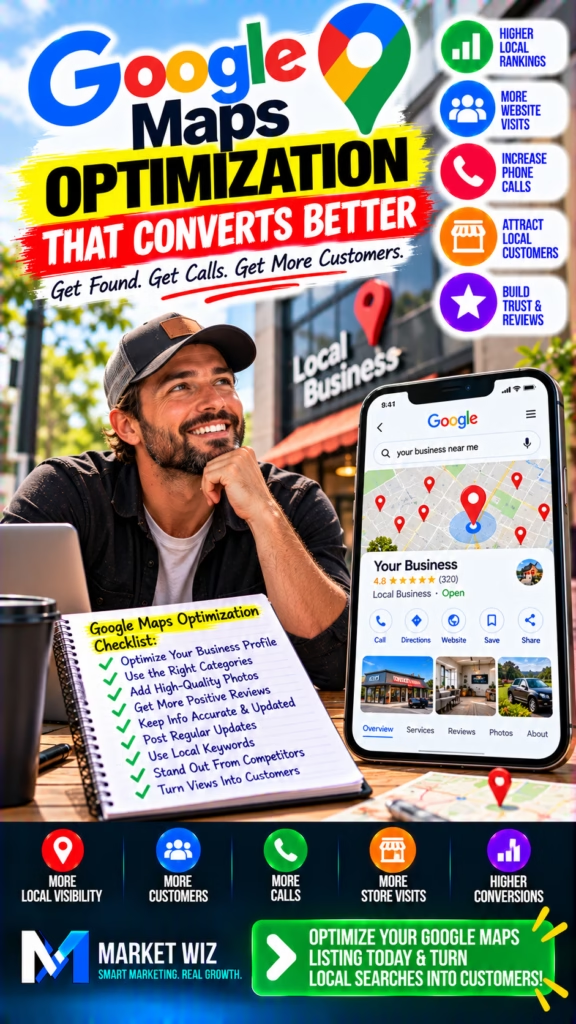
Google Maps Optimization That Converts Better
Discover how strategic Google Maps optimization transforms local visibility into qualified phone calls, website visits, customer inquiries, and measurable business growth.
Google Maps has become one of the most valuable customer acquisition channels for local businesses. Whether someone needs an HVAC contractor, plumber, painting company, roofing specialist, landscaping professional, or nearby retail location, Google Maps frequently influences which business receives the first phone call.
However, ranking prominently on Google Maps is only part of the equation. A business can receive hundreds of profile views without generating meaningful revenue if its listing fails to communicate trust, relevance, convenience, and clear reasons to make contact.
Effective Google Maps optimization combines local search visibility with conversion strategy. The objective is not simply to appear higher in search results. It is to attract relevant prospects, demonstrate credibility, and make the next step easy for potential customers.
The strongest Google Maps marketing programs focus on three connected outcomes: visibility among relevant local searchers, credibility when those searchers evaluate the business, and conversion when they decide whom to contact.
01 What Is Google Maps Optimization?
Google Maps optimization is the process of improving how a business appears, performs, and communicates with potential customers across Google Maps and its associated Google Business Profile.
This process includes accurate business information, appropriate categories, relevant services, quality photography, customer reviews, local website optimization, and ongoing performance analysis.
Google's local ranking systems consider relevance, distance, and prominence. Businesses can improve many aspects of relevance and prominence, but they cannot guarantee a particular ranking for every searcher or location.
A conversion-focused approach goes further by considering what visitors do after discovering the listing. Does the profile answer their questions? Does it establish credibility? Is the business an appropriate match for their needs? Can they contact the company quickly?
02 Why Better Rankings Do Not Always Produce Better Leads
A higher ranking can increase exposure, but exposure alone does not guarantee quality inquiries. A business may appear for searches outside its preferred service area, attract customers seeking services it does not offer, or receive calls from people who are not ready to purchase.
For example, a premium residential painting contractor may receive substantial visibility for broad painting-related searches. Yet those impressions may include people looking for inexpensive supplies, employment opportunities, or do-it-yourself advice.
The goal should be to attract homeowners actively comparing qualified painting companies rather than maximizing every possible impression.
- Target searches that indicate a genuine service need.
- Communicate the company's specialties accurately.
- Show real examples of completed work.
- Explain the geographic areas the business serves.
- Measure qualified leads rather than impressions alone.
03 Understand Local Search Intent Before Optimizing
Search intent describes what someone wants to accomplish when entering a query into Google. Understanding intent helps businesses develop listings that attract visitors who are more likely to become customers.
Immediate-Need Searches
Examples include emergency plumbing repair, same-day AC repair, and urgent electrical troubleshooting. These searches often indicate a need for quick contact.
Comparison Searches
Examples include best local roofers, top-rated painters, and nearby HVAC companies. Searchers may evaluate several providers before contacting one.
Specific-Service Searches
Examples include kitchen cabinet painting, drain cleaning, and commercial roof replacement. These indicate interest in a defined service.
Research Searches
Examples include painting costs or AC replacement options. These visitors may be earlier in the buying process.
Each search category deserves a different conversion strategy. Urgent searches benefit from accessible contact information and accurate business hours. Comparison searches benefit from reviews, project photography, and detailed service descriptions.
04 Build a Complete Google Business Profile
A complete Google Business Profile helps potential customers understand what a business does, where it operates, and how to contact it.
Important profile elements include the business name, primary category, additional categories, address or service area, phone number, website, operating hours, business description, services, and relevant photographs.
Every detail should reflect the actual business. Adding unsupported services, misleading locations, or unnecessary keywords to the business name may violate Google's guidelines and undermine customer trust.
A well-maintained profile also reduces uncertainty. Customers should not have to guess whether a company serves their neighborhood, provides a specific service, or accepts appointments.
05 Choose the Most Accurate Primary Business Category
The primary category is one of the most important relevance signals a business can control within its Google Business Profile.
A company specializing in residential painting should generally choose the most accurate painting-related category available rather than a broad category that does not represent its main business activity.
Additional categories can describe legitimate secondary operations. However, categories should not be added simply to pursue unrelated search traffic.
When evaluating categories, consider the services that generate the greatest value, the company's actual operating model, and the terminology customers use to find those services.
06 Write a Business Description That Builds Trust
A compelling business description explains the company's specialties, ideal customers, operating area, and distinguishing qualities in natural language.
Instead of repeating a city name dozens of times, describe the business in a way that helps someone understand whether it is the right provider.
Our residential painting team helps homeowners refresh interiors, exteriors, cabinets, and outdoor living spaces. We focus on careful preparation, clean finishes, clear communication, and dependable project planning throughout our local service area.
Descriptions should remain accurate, avoid unsupported claims, and follow Google's content policies. Their primary purpose is to inform customers, not to manipulate rankings.
07 Optimize Services for High-Intent Searches
The services section should accurately represent the work a company performs. Specific service entries can help customers identify relevant offerings without navigating away from the profile.
For an HVAC company, services might include air conditioner repair, furnace installation, heat pump maintenance, and ductwork inspection. A painting company might include interior painting, exterior painting, cabinet refinishing, and fence staining.
Each service should have a clear description when the platform supports one. Avoid copying the same generic language into every service field.
Specificity improves the customer experience because people can quickly determine whether the company addresses their particular problem.
08 Improve Local Relevance With Accurate Service Areas
Local businesses often operate across multiple cities, suburbs, or neighborhoods. Their Google Business Profile should accurately reflect their actual service territory.
For service-area businesses, Google provides settings for specifying areas served. These settings should be used according to Google's eligibility and address-display rules.
A company should not create fictitious offices or duplicate listings merely to appear in additional cities. Such practices can create suspension risks and confuse customers.
Geographic expansion is better supported through legitimate operations, strong local reputation, useful location-specific website content, and consistent business information.
09 Use Professional Photos to Increase Customer Confidence
Photography can strongly influence how potential customers perceive a local business. Clear images help visitors evaluate workmanship, facilities, equipment, and professionalism.
For home improvement companies, genuine before-and-after photographs can be especially useful because they demonstrate tangible outcomes.
- Upload clear, current photographs representing the business.
- Show completed projects from different service categories.
- Include authentic exterior or interior business imagery when appropriate.
- Use properly exposed images without misleading alterations.
- Keep the visual presentation consistent and professional.
Real images generally provide stronger evidence of actual business activity than generic stock photography. Image quality should support customer confidence rather than serve as a substitute for legitimate work.
10 Develop a Consistent Customer Review Strategy
Customer reviews influence both business credibility and how prospects compare local providers. A thoughtful review strategy makes it easier for real customers to share their experiences.
Businesses can request reviews after completed transactions, provide convenient review links, and train staff to explain the process clearly.
Review requests must not involve payment, discounts, gifts, selective solicitation of positive feedback, or pressure to leave a particular rating. Google's policies prohibit incentivized and manipulated reviews.
The strongest approach is to request honest feedback consistently from genuine customers, regardless of whether their experience was positive or negative.
11 Respond to Reviews With Professionalism
Review responses provide an opportunity to demonstrate customer care to future prospects. A thoughtful response acknowledges the customer's experience without turning the conversation into an advertisement.
Positive reviews can receive a brief, specific expression of appreciation. Negative reviews should be addressed calmly, with attention to legitimate concerns and an appropriate path for further communication.
Avoid publishing private customer information or arguing publicly about disputed details.
A professional review history communicates that the company takes its reputation seriously and remains engaged with customers after completing the work.
12 Create a Website Landing Page That Converts
Google Maps visibility frequently leads to website visits. If the destination page is slow, confusing, or irrelevant, valuable prospects may leave before contacting the business.
A conversion-focused landing page should clearly identify the service, explain the company's qualifications, provide credible evidence, and make contact straightforward.
- Use a clear headline describing the core offering.
- Explain the customer problems the business solves.
- Include authentic testimonials and project examples.
- Provide accurate contact information.
- Make mobile navigation and contact options easy to use.
- Answer common questions about the service.
The website should reinforce the information visitors saw on Google Maps. Consistency between the listing and the landing page reduces confusion and helps establish trust.
13 Make Mobile Conversion a Priority
Many local searches happen on smartphones, especially when customers need immediate assistance or are traveling. A mobile-friendly experience is therefore essential.
Contact details should be easy to find, forms should request only necessary information, and pages should remain readable without excessive zooming or horizontal scrolling.
Businesses should also test their website on real mobile devices. A page that appears attractive on a desktop computer may contain navigation problems, oversized graphics, or inconvenient forms on smaller screens.
Mobile optimization should reduce the effort required to contact the company while preserving enough information for visitors to make informed decisions.
14 Improve Website Speed and User Experience
A slow website can interrupt the journey between discovering a business and submitting an inquiry.
Performance improvements may include compressing images, removing unnecessary scripts, using efficient hosting, reducing layout shifts, and prioritizing important page content.
Google's Core Web Vitals provide useful measures of loading performance, responsiveness, and visual stability.
While website speed alone cannot guarantee better Google Maps rankings, it can improve the experience of visitors arriving from local search results.
15 Align Local SEO Keywords With Real Customer Needs
Effective local keyword research begins with the language customers actually use. Search terms should reflect services, problems, locations, and buying intent.
A business should distinguish between broad informational keywords and specific searches that indicate a need for professional assistance.
| Keyword Type | Example | Potential Intent |
|---|---|---|
| General | House painting | Broad research |
| Local | House painters near me | Provider discovery |
| Service-specific | Kitchen cabinet painters | Defined project |
| Urgent | Emergency AC repair | Immediate assistance |
| Comparison | Best local roofing company | Provider evaluation |
Keyword research should inform helpful website content and accurate profile descriptions. Repetitive keyword stuffing makes content less useful and may conflict with search platform policies.
16 Build Strong Local Service Pages
A service page should provide meaningful information about a particular offering. Businesses with multiple specialties may benefit from dedicated pages explaining each major service.
For example, an exterior painting page can discuss surface preparation, siding types, paint selection, weather considerations, and project expectations.
A cabinet painting page should address cabinet preparation, coating options, durability, and the typical project process.
These pages can support organic search visibility while giving Google Maps visitors detailed information that helps them decide whether to contact the business.
17 Use Location Pages Without Creating Thin Content
Businesses serving several cities may create location-specific website pages when those pages offer genuine value.
A useful local page might include actual project examples, relevant service considerations, customer experiences, and accurate geographic coverage.
Creating dozens of nearly identical pages that simply replace one city name with another provides limited value and can create doorway-page concerns.
Location content should help customers understand the company's real relationship with an area, not imply the existence of offices that do not exist.
18 Maintain Consistent Business Information Online
Business information should remain accurate across the company's website, Google Business Profile, and relevant third-party directories.
Important details include the official business name, phone number, address when publicly applicable, website URL, and operating hours.
Inconsistent information can frustrate customers and complicate their ability to contact the business.
Directory listings should be maintained for accuracy and relevance. Creating large quantities of low-quality listings is not a substitute for a trustworthy local business presence.
19 Build Local Authority Through Legitimate Relationships
Local visibility benefits from a strong reputation and genuine community presence. Businesses can build authority through partnerships, professional associations, local sponsorships, and relevant editorial coverage.
For example, a home improvement company might participate in a legitimate community project or collaborate with complementary local businesses.
These relationships can generate referrals, increase brand recognition, and sometimes lead to useful website mentions or links.
The objective is to build authentic visibility rather than purchase manipulative links or manufacture artificial endorsements.
20 Publish Helpful Google Business Profile Updates
Google Business Profile updates can help businesses communicate relevant news, completed projects, seasonal offerings, and useful information when posting features are available.
Examples include announcing adjusted holiday hours, highlighting a recently completed renovation, or explaining a seasonal maintenance consideration.
Updates should be accurate, timely, and customer-focused. Posting frequency by itself does not guarantee improved local rankings.
A consistent content process can nevertheless keep the business's online presence informative and reinforce the company's expertise.
21 Reduce Friction Between Discovery and Contact
Every unnecessary step between discovering a business and contacting it creates an opportunity for a prospective customer to leave.
Review the entire customer journey from the Google Maps result to the phone call, website form, or appointment request.
Ask whether the visitor can immediately understand what the company offers, whether it serves their location, and how to request assistance.
Clear contact details, relevant landing pages, readable content, and simple forms can improve the experience without relying on aggressive sales tactics.
22 Qualify Leads Before They Reach the Sales Team
More leads are not always better leads. A company may waste considerable time responding to inquiries that fall outside its services, operating area, or project requirements.
Clear website information can help prospects determine whether the business is a suitable match before making contact.
A company specializing in premium exterior renovations, for example, may benefit from explaining the types of projects it accepts and the geographic areas it serves.
Contact forms can also ask concise qualifying questions about project type, location, and desired timeline.
The goal is not to create barriers for customers. It is to improve clarity so both parties can make efficient decisions.
23 Measure Calls, Website Visits, and Qualified Inquiries
Successful Google Maps optimization requires more than checking keyword rankings. Businesses should monitor how local visibility contributes to actual customer activity.
Useful measures include Google Business Profile interactions, website visits, completed contact forms, qualified phone inquiries, booked appointments, and acquired customers.
Where available, analytics platforms and customer relationship management systems can help connect marketing activity to business outcomes.
Because privacy settings, attribution limitations, and cross-device behavior can affect tracking, no single report should be treated as a complete record of every customer journey.
24 Understand Conversion Rate and Lead Quality
Conversion rate measures the percentage of visitors or interactions that produce a defined outcome.
For example, if 200 tracked website visits produce 20 inquiry submissions, the inquiry conversion rate is 10%.
However, inquiry volume should be evaluated alongside lead quality. If only a small percentage of those inquiries become qualified opportunities, the business may need to improve targeting or messaging.
Campaign A generates 50 inquiries, of which 10 become qualified opportunities. Campaign B generates 30 inquiries, of which 18 become qualified opportunities. Although Campaign A produces more inquiries, Campaign B produces more qualified opportunities.
This distinction helps businesses prioritize revenue potential over vanity metrics.
25 Optimize for Customer Lifetime Value
The value of a Google Maps lead depends partly on the services purchased and the customer's long-term relationship with the company.
A one-time transaction and a recurring maintenance customer may have very different economic value.
Businesses should consider acquisition costs, gross margins, repeat purchases, referrals, and customer retention when evaluating local marketing performance.
For example, an HVAC customer who schedules recurring maintenance and later purchases equipment may create more long-term value than a single low-cost repair inquiry.
This perspective encourages businesses to attract suitable customers rather than pursuing every available search impression.
26 Avoid Common Google Maps Optimization Mistakes
Several practices can reduce trust, waste resources, or create compliance problems.
- Adding unnecessary keywords to the official business name.
- Creating listings for locations that are not eligible.
- Purchasing fake reviews or offering rewards for ratings.
- Publishing misleading service information.
- Ignoring outdated business hours or contact details.
- Using irrelevant categories to attract unrelated searches.
- Building thin location pages solely for search engines.
- Focusing exclusively on rankings without measuring customer outcomes.
Sustainable optimization depends on accurate information, useful content, real customer experiences, and continuous improvement.
27 Build a Practical 90-Day Optimization Roadmap
A structured roadmap helps businesses prioritize foundational improvements before expanding their marketing activities.
Days 1–30: Audit and Correct
- Review Google Business Profile eligibility and completeness.
- Verify business categories and contact information.
- Audit website performance and mobile usability.
- Identify important local search themes.
- Establish baseline lead and conversion measurements.
Days 31–60: Improve Content and Credibility
- Expand accurate service information.
- Add authentic project photography.
- Improve major service landing pages.
- Implement a compliant customer review request process.
- Address website conversion obstacles.
Days 61–90: Measure and Refine
- Compare lead quality across service categories.
- Review customer inquiries and conversion rates.
- Improve underperforming landing pages.
- Expand useful local content where appropriate.
- Document ongoing optimization priorities.
Actual results depend on market competition, existing visibility, business reputation, and the quality of implementation. A 90-day plan provides operational structure rather than a guarantee of rankings or revenue.
28 Connect Google Maps With Your Broader Marketing Strategy
Google Maps should not operate independently from the rest of a business's marketing.
Website content, customer reviews, organic search visibility, paid advertising, social media, and offline referrals can all influence how customers discover and evaluate a company.
Consistent branding and accurate service information across these channels help prospects recognize the business and develop confidence.
For example, a homeowner may first see a company's social media project photos, later search for the company on Google Maps, read customer reviews, and finally submit an inquiry through its website.
Understanding this connected journey helps businesses avoid judging each channel in isolation.
29 Create a Continuous Optimization Process
Local search conditions change as competitors update their profiles, customer expectations evolve, and businesses expand their offerings.
Google Maps optimization should therefore be treated as an ongoing process rather than a one-time setup task.
A practical monthly review may include checking business information, responding to reviews, reviewing profile interactions, assessing website conversions, and identifying new content needs.
Quarterly reviews can examine larger trends such as lead quality, customer acquisition cost, service demand, and geographic performance.
The purpose of continuous improvement is to make better decisions using actual customer behavior rather than relying on assumptions.
30 Turn Google Maps Visibility Into Sustainable Business Growth
The most effective Google Maps strategy aligns visibility, credibility, and conversion.
A business needs to appear for relevant searches, demonstrate why it deserves consideration, and provide a straightforward way for customers to take action.
High-quality photos, accurate services, honest reviews, useful website content, and clear contact information all contribute to this process.
Businesses should also monitor whether their marketing attracts the right customers. More traffic has limited value if the inquiries are unrelated, unqualified, or unlikely to become profitable projects.
By combining local SEO fundamentals with conversion-focused marketing, companies can build a stronger foundation for long-term customer acquisition.
Google Maps optimization that converts better is not about chasing rankings alone. It is about helping the right local customers find, trust, and contact your business when they need what you offer.
Frequently Asked Questions About Google Maps Optimization
1. What is Google Maps optimization?
Google Maps optimization improves a business's local search presence through accurate profile information, relevant categories, customer reviews, photography, website content, and ongoing maintenance.
2. Why is Google Maps important for local businesses?
Google Maps helps nearby customers discover businesses, compare options, find contact information, and make purchasing decisions.
3. Does ranking higher on Google Maps guarantee more customers?
No. Higher visibility may create more opportunities, but customer trust, relevance, competition, and conversion experience also influence results.
4. How does Google determine local rankings?
Google identifies relevance, distance, and prominence as major local ranking factors.
5. Can a business improve its Google Maps ranking?
Businesses can improve profile accuracy, relevance, reputation, and website quality, although specific ranking positions cannot be guaranteed.
6. How long does Google Maps optimization take?
Results vary according to competition, existing visibility, business history, and the improvements being implemented.
7. Are Google reviews important for local SEO?
Yes. Reviews contribute to business credibility and can influence local prominence and customer decisions.
8. Can businesses pay for Google reviews?
No. Incentivized, purchased, or manipulated reviews violate Google's review policies.
9. How often should a Google Business Profile be updated?
Businesses should correct important changes promptly and review their profile regularly for accuracy and usefulness.
10. Do photos help Google Maps conversions?
Authentic photographs can help customers assess workmanship, facilities, and business credibility before contacting a company.
11. What is a Google Business Profile?
Google Business Profile is a tool that allows eligible businesses to manage how they appear on Google Search and Maps.
12. Is Google Business Profile free?
Yes. Eligible businesses can create and manage a Google Business Profile without paying a listing fee.
13. What is the best primary business category?
The best category is the available option that most accurately describes the business's main activity.
14. Can service-area businesses appear on Google Maps?
Yes. Eligible service-area businesses can maintain profiles while following Google's address and service-area requirements.
15. Do businesses need a website for Google Maps?
A website is not universally required for an eligible listing, but a useful website can provide detailed information and support lead conversion.
16. What are high-intent local keywords?
They are search phrases indicating that a person may be ready to find, compare, or contact a provider for a specific service.
17. Should businesses create pages for every nearby city?
Only when the pages provide meaningful, distinct information for customers in those locations.
18. Does mobile website speed matter?
Yes. Faster, more usable mobile pages can reduce friction for visitors who arrive from Google Maps.
19. How can a business generate better-quality leads?
By targeting relevant services, accurately describing its offerings, clearly defining its service area, and simplifying customer inquiries.
20. What is a Google Maps conversion?
A conversion is a defined customer action, such as a qualified phone inquiry, appointment request, or completed contact form.
21. How should businesses measure Google Maps performance?
They should evaluate profile interactions alongside website inquiries, qualified leads, appointments, and customer acquisition outcomes.
22. Are Google Business Profile posts a ranking factor?
Posting frequently does not guarantee better rankings. Posts are primarily useful for communicating relevant information to customers.
23. Can duplicate Google Business Profiles cause problems?
Yes. Ineligible duplicate listings may confuse customers and create compliance or profile management issues.
24. Should business names contain extra keywords?
No. Business names should reflect the real-world business name and comply with Google's naming guidelines.
25. What is local SEO?
Local SEO involves improving a business's visibility and usefulness for geographically relevant searches.
26. What is lead qualification?
Lead qualification determines whether a potential customer is a suitable match based on needs, location, timing, and other relevant criteria.
27. Can customer reviews improve conversions?
Authentic reviews can provide social proof and help prospective customers feel more confident about contacting a business.
28. What should a local landing page include?
It should explain the service, establish credibility, answer customer questions, and provide an easy way to contact the business.
29. What is the biggest Google Maps optimization mistake?
One major mistake is pursuing visibility without considering whether the resulting inquiries are relevant and commercially valuable.
30. How can businesses turn Google Maps traffic into customers?
They can combine accurate listings, strong reputation signals, relevant landing pages, clear contact options, and consistent lead follow-up.
30 Additional SEO Keywords
The following keyword themes support content planning around Google Maps optimization, local SEO, and conversion-focused lead generation. Use them naturally where relevant rather than repeating them mechanically.
Conclusion: Better Google Maps Optimization Starts With Better Customer Experience
Google Maps is an important discovery channel for local businesses, but sustainable results require more than visibility alone.
A complete, accurate Google Business Profile helps customers find the right company. Authentic reviews and photographs build confidence. Relevant website pages answer questions and make it easier to request assistance.
When these elements work together, businesses can move beyond measuring rankings and begin evaluating the outcomes that matter: qualified inquiries, booked appointments, satisfied customers, and long-term growth.
At MarketWiz.ai, the emphasis is on practical digital marketing strategies that connect local search visibility with meaningful business opportunities.
Ready to Turn Google Maps Visibility Into Better Leads?
Discover how a conversion-focused local SEO strategy can help your business attract more relevant searches, build customer trust, and create stronger opportunities for growth.
Improve Your Google Maps Strategy →